|
시장보고서
상품코드
2122186
스마트 헬스케어 제품 : 시장 점유율 분석, 업계 동향과 통계, 성장 예측(2026-2031년)Smart Healthcare Products - Market Share Analysis, Industry Trends & Statistics, Growth Forecasts (2026 - 2031) |
||||||
 Mordor Intelligence
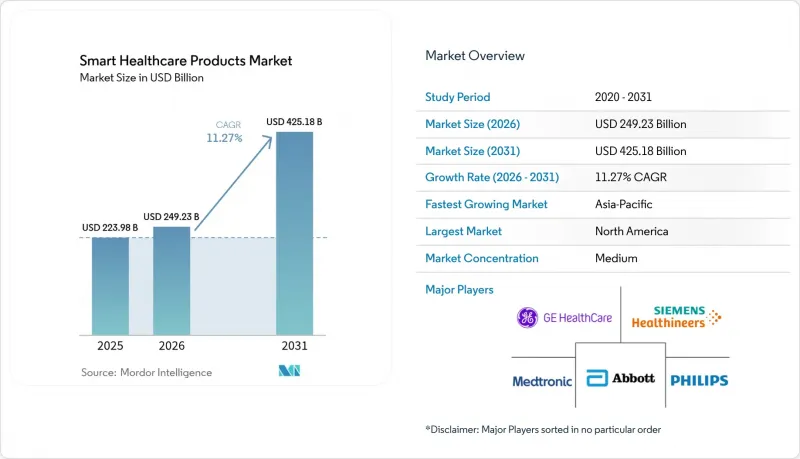
Mordor Intelligence에 따르면 스마트 헬스케어 제품 시장 규모는 2025년에 2,239억 8,000만 달러로 평가되며, 2026년 2,492억 3,000만 달러에서 2031년까지 4,251억 8,000만 달러에 달할 것으로 예측되고 있으며, 예측 기간(2026-2031년)에 CAGR은 11.27%에 달할 전망입니다.
이 보고서는 제품 유형(원격의료, 전자건강기록, m-헬스 솔루션, 스마트 알약, 스마트 주사기, 스마트 RFID 캐비닛 등), 용도(보관·재고 관리, 원격 모니터링 등), 최종사용자(병원, 재택 간호 시설 등) 및 지역(북미, 유럽 등)별로 분류되어 있습니다. 시장 전망은 금액(달러) 기준으로 제시되어 있습니다.
글로벌 스마트 헬스케어 제품 시장의 동향 및 인사이트
IoT 지원 의료기기의 보급 확대
연결형 기기의 보급으로 환자 데이터를 실시간으로 수집하고, 진료 현장에서 실용적인 인사이트를 제공함으로써 임상 현장의 양상이 크게 변화하고 있습니다. 5G 네트워크를 통해 전송 지연이 110밀리초로 단축되고 패킷 손실률이 0.07%로 감소함에 따라 2025년까지 미국의 원격 환자 모니터링 이용자는 7,100만 명을 넘어설 것으로 예상됩니다. 의료 제공자의 엣지 컴퓨팅에 대한 지출은 2025년에 103억 달러에 달할 것으로 예측되며, 이는 조기 개입을 위한 예측 분석을 지원할 것으로 보입니다. 아시아태평양의 공급업체들은 부정맥이나 혈당 이상을 감지하는 AI 탑재 웨어러블 기기를 잇달아 출시하고 있으며, 이는 새로운 수입원을 창출하는 동시에 상호 운용성 요건을 높이고 있습니다. 기기 제조업체들은 전력 소비를 30% 절감하는 보안 칩셋을 탑재하여 장기 모니터링을 위한 배터리 수명을 연장하고 있습니다. 이러한 요인들이 결합되어 임상 성과가 향상되고, 스마트 헬스케어 제품 시장 전체의 출하량 증가를 견인하고 있습니다.
만성질환 부담 증가와 고령화
2024년, 전 세계 사망 원인의 74%를 만성질환이 차지하고 있으며, 그 부담이 가장 큰 지역은 아시아태평양 경제권입니다. 지속적인 모니터링 솔루션을 통해 재입원율이 85% 감소하여 보험사에게 실질적인 비용 절감을 가져다주는 동시에, 환자 만족도를 97%까지 향상시키고 있습니다. 고령화가 진행되는 사회에서는 장기 요양이 필요해지며, 스마트 침대, 낙상 감지 센서, AI를 활용한 영상 진단에 대한 수요가 높아지고 있습니다. 경제적 이점도 커서, AI 도입을 통해 진단 오류와 행정적 부담을 줄임으로써 연간 최대 3,600억 달러의 비용 절감이 예상됩니다. 국민건강보험 제도를 도입한 국가들에서는 스마트 헬스케어 제품을 만성질환 대책 프로그램에 임베디드하여 도입 규모 확대를 가속화하는 한편, 데이터 교환 프로토콜의 표준화를 추진하고 있습니다.
스마트 헬스케어 생태계의 높은 초기 투자 비용
IoT 플랫폼, 엣지 서버, 사이버 보안 계층의 도입에는 막대한 초기 투자가 필요하며, 소규모 의료 제공자들은 자금 조달에 어려움을 겪고 있습니다. 제안된 HIPAA(의료보험 이동성 및 책임에 관한 법률) 개정안에 따라 규제 대상 기관은 첫 해에만 93억 달러의 비용을 부담하게 되며, 여기에는 암호화, 다중 요소 인증 및 교육 의무화가 포함됩니다. 입법자들은 ‘의료 인프라 보안 및 책임법(Health Infrastructure Security and Accountability Act)’을 발의했습니다. 이 법안에는 기준 준수를 위해 13억 달러의 예산이 편성되어 있지만, 그럼에도 업그레이드 비용의 대부분은 병원 측이 부담하게 됩니다. 자본 집약적인 특성으로 인해 진료 보수가 여전히 종량제이며, 이익률이 낮은 신흥 시장에서는 도입 속도가 둔화되고 있습니다. 각 벤더들은 비용을 여러 해에 걸쳐 분산시키는 ‘Device-as-a-Service(기기 서비스형)’ 계약에 대응하고 있습니다. 그러나 도입 일정은 여전히 자금 조달 여부에 좌우되므로 스마트 헬스케어 제품 시장의 단기 출하 대수에 큰 부담을 주고 있습니다.
부문 분석
2025년에는 전자건강기록(EHR)이 총매출의 28.11%를 차지하며, 임상 워크플로우의 데이터베이스으로서의 입지를 확고히 했습니다. 베트남에서 3,200만 건의 환자 파일을 병원 전체적으로 디지털화하는 국가 차원의 프로그램은 정부의 지원을 재확인하는 것이며, 플랫폼 공급업체에 지속적인 라이선스 수익을 보장하고 있습니다. 또한 오라클이 재향군인부를 위한 도입 계획으로 35억 달러의 예산을 신청한 것은 기업 규모의 도입에 대한 기관 측의 확고한 의지를 다시 한번 보여줍니다. 지속적인 사용자 경험 개선과 HL7 FHIR 준수를 통해 전환 비용이 고정화되고 있습니다. 선진국의 1차 진료 현장에서 보급률이 정체되고 있는 반면, EHR 스마트 헬스케어 제품 시장 규모는 한 자릿수 성장률임에도 불구하고 꾸준히 확대될 것으로 예측됩니다.
연평균 성장률(CAGR) 18.87%를 기록할 것으로 예상되는 스마트 웨어러블 기기는 외래 모니터링 분야에서 충족되지 않은 수요를 포착하고 있습니다. 커프리스 혈압계나 손목 착용형 맥박 감지 장치 등 FDA 승인을 받은 혁신적인 제품들은 임상 현장에서의 수용성을 넓혀가고 있습니다. 스타트업 기업은 클라우드 연결과 AI 알고리즘을 활용하여 구독형 분석 서비스를 제공함으로써, 하드웨어 이익률에 대한 의존도를 낮추고 있습니다. 기기 제조사들은 소프트웨어를 최신 상태로 유지하는 무선 업데이트(OTA) 파이프라인을 구축하여 제품의 수명과 서비스 수익을 연장하고 있습니다. 따라서 웨어러블 기기를 활용한 스마트 헬스케어 제품 시장 규모는 다른 기기 카테고리에 비해 현저한 성장이 예상됩니다.
이와 병행하는 부문들도 긍정적인 역할을 하고 있습니다. 원격의료 플랫폼은 웨어러블 기기를 온라인 진료에 통합하고 있는 반면, 스마트 알약은 혈액 검출과 관련하여 FDA의 데 노보(De Novo) 승인을 받아 소화기 계통 진단 분야에서 보급이 확대되고 있습니다. 스마트 RFID 캐비닛은 고가의 소모품을 보호하고 재고 손실을 최대 15%까지 줄이는 동시에, 보관 이력 관리(체인 오브 커스토디) 요건 준수를 향상시킵니다. 지멘스가 칸톤스스피탈 바덴에 7,000개의 IoT 센서를 도입한 사례 등, 스마트 병원 인프라에 대한 투자는 스마트 헬스케어 제품 시장 전반에서 종단 간 통합이 진행되고 있음을 보여줍니다.
지역별 분석
북미는 정교한 보험 시스템, 첨단인 인프라, 그리고 막대한 벤처 캐피탈 유입에 힘입어 2025년에도 매출 점유율 37.47%를 유지했습니다. 디지털 헬스 연구에 1억 달러 이상을 투자한 ‘ARPA-H Women’s Health Sprint’와 같은 연방 정부 주도의 구상이 혁신 파이프라인을 강화하고 있습니다. 메디케어가 2025년까지 원격의료의 유연성을 연장함에 따라 원격 모니터링의 활용이 더욱 정착되어 공급업체에 대한 수요가 안정적으로 유지되고 있습니다. 캐나다는 표준 기반의 상호 운용성을 촉진하기 위해 ‘인포웨이 임상 혁신 센터’를 설립하여 해당 지역의 활력을 더욱 높이고 있습니다. 양국의 강력한 사이버 보안 감독 체계 덕분에 정보 유출 소식이 보도되는 상황에서도 지속적인 투자가 보장되고 있습니다.
아시아태평양은 각국의 협력적인 전략, 확대되는 중산층, 그리고 농촌 지역의 미충족 임상 수요로 인해 16.96%라는 가장 높은 연평균 성장률(CAGR)을 기록하고 있습니다. 싱가포르는 5년간 1억 5,000만 달러를 투자하는 GenAI 계획을 통해 공립 병원 전체에서 영상 진단 AI 및 진료 기록 자동 전사를 가속화하고 있습니다. 한국은 AI를 활용한 응급 시스템에 8억 3,000만 달러를 배정하여 실시간 환자 이송 관리 분야의 벤치마크를 확립하고 있습니다. 동남아시아 디지털 헬스 분야의 매출은 2024년에 61억 달러에 달할 전망이며, 투자자들은 높은 스마트폰 보급률과 수급 격차에 주목하고 있습니다. 호주의 ‘Health Connect’ 플랫폼은 원활한 데이터 공유를 촉진하여 의료 제공자의 시장 진입을 가속화하고 있습니다.
유럽에서는 2025년 3월에 시행되는 ‘유럽 건강 데이터 공간 규정’의 혜택을 받고 있으며, 디지털 헬스 서비스의 단일 시장이 확립되어 Xt-EHR 및 EUVAC 등의 프로젝트가 지원되고 있습니다. 통일된 규정을 통해 벤더 간의 단절이 해소되고, 국경을 초월한 원격의료가 촉진될 것입니다. 독일과 프랑스의 국민건강보험 제도에서는 전자처방전 의무화가 도입되어 디지털화 노력이 강조되고 있습니다. 중동 및 아프리카에서는 남아프리카공화국이 국가 차원의 e-헬스 전략을 시범적으로 도입하고 있는 반면, 걸프협력회의(GCC) 회원국들은 스마트 병원 건설에 투자하고 있습니다. 남미에서는 성장세가 두드러지며, 특히 브라질에서는 도시화와 민간 보험의 보급이 수요를 견인하고 있지만, 거시경제의 변동으로 인해 성장세는 완만해지고 있습니다. 전반적으로 지역적 분산이 사업 확장의 위험을 상쇄하며, 스마트 헬스케어 제품 시장 전체의 지속가능한 성장을 지원하고 있습니다.
기타 혜택:
- 엑셀 형식의 시장 예측(ME) 시트
- 3개월간의 애널리스트 지원
자주 묻는 질문
목차
제1장 서론
제2장 조사 방법
제3장 개요
제4장 시장 구도
제5장 시장 규모와 성장 예측
제6장 경쟁 구도
제7장 시장 기회와 향후 전망
KSA 26.09.04According to Mordor Intelligence, the smart healthcare products market size was valued at USD 223.98 billion in 2025 and estimated to grow from USD 249.23 billion in 2026 to reach USD 425.18 billion by 2031, at a CAGR of 11.27% during the forecast period (2026-2031).
This report is Segmented by Product Type (Telemedicine, Electronic Health Records, Mhealth Solutions, Smart Pills, Smart Syringes, Smart RFID Cabinets, and More), Application (Storage and Inventory Management, Remote Monitoring, and More), End User (Hospitals, Home Care Settings, and More), and Geography (North America, Europe, and More). The Market Forecasts are Provided in Terms of Value (USD).
Global Smart Healthcare Products Market Trends and Insights
Rising Adoption of IoT-Enabled Medical Devices
The proliferation of connected devices is reshaping clinical practice by capturing patient data in real time and delivering actionable insights at the point of care. Remote patient monitoring users in the United States are expected to surpass 71 million by 2025 as 5G networks lower transmission latency to 110 milliseconds, reducing packet loss to 0.07%. Healthcare provider spending on edge computing is forecast to reach USD 10.3 billion in 2025, supporting predictive analytics for early-stage intervention. Asia-Pacific suppliers are rolling out AI-driven wearables that detect arrhythmia and glucose anomalies, creating new revenue pools and raising interoperability requirements. Device makers are embedding secure chipsets that consume 30% less power, extending battery life for long-term monitoring. Collectively, these factors improve clinical outcomes and drive volume growth across the smart healthcare products market.
Escalating Chronic-Disease Burden & Ageing Demographics
Chronic diseases accounted for 74% of global deaths in 2024, with the highest burden in Asia-Pacific economies. Continuous monitoring solutions reduce hospital readmissions by 85%, generating tangible savings for payers while enhancing patient satisfaction scores to 97%. An ageing population requires long-term care, triggering demand for smart beds, fall-detection sensors, and AI-enabled imaging. The economic upside is considerable, with AI projected to save up to USD 360 billion annually by trimming diagnostic errors and administrative overhead. Countries with universal healthcare systems are integrating smart healthcare products into chronic-disease programmes, accelerating volume deployment and standardising data exchange protocols.
High Capital Cost of Smart Healthcare Ecosystems
Deploying IoT platforms, edge servers, and cybersecurity layers requires sizable upfront outlays that smaller providers struggle to finance. Proposed HIPAA revisions could cost regulated entities USD 9.3 billion in the first year, covering encryption, multifactor authentication, and training mandates. Legislators introduced the Health Infrastructure Security and Accountability Act, which budgets USD 1.3 billion for standards compliance but still leaves hospitals funding the bulk of upgrades. Capital intensity slows rollouts in emerging markets where reimbursement remains fee-for-service and margins are thinner. Vendors are responding with device-as-a-service contracts that spread costs over multi-year terms. Yet adoption timelines remain contingent on financing availability, weighing on near-term units shipped in the smart healthcare products market.
Other drivers and restraints analyzed in the detailed report include:
- Government Incentives for Digital-Health Infrastructure
- Broader Reimbursement for Telemedicine Services
- Cyber-Security & Data-Privacy Concerns
For complete list of drivers and restraints, kindly check the Table Of Contents.
Segment Analysis
Electronic Health Records contributed 28.11% to overall revenue in 2025, underlining their position as the data backbone of clinical workflows. National programmes such as Vietnam's hospital-wide digitisation of 32 million patient files reaffirm government support, ensuring sustained licensing income for platform vendors. Oracle's USD 3.5 billion budget application for the Veterans Affairs rollout further demonstrates institutional commitment to enterprise-scale implementations. Continuous user-experience upgrades and HL7 FHIR compliance solidify switching costs. The smart healthcare products market size for EHRs is projected to expand steadily, albeit at a single-digit rate, as penetration in primary care settings plateaus in developed economies.
Smart Wearable Devices, forecast to record a 18.87% CAGR, are capturing unmet needs in ambulatory monitoring. FDA-cleared innovations such as cuffless blood-pressure monitors and wrist-based pulse detection broaden clinical acceptability. Start-ups leverage cloud connectivity and AI algorithms to offer subscription-based analytics, reducing reliance on hardware margins. Device makers embed over-the-air update pipelines that keep software current, extending product life and service revenue. The smart healthcare products market size for wearables is therefore positioned for outsized expansion relative to other device classes.
Parallel segments play supporting roles. Telemedicine Platforms integrate wearables into virtual-care visits, while Smart Pills gain traction in gastrointestinal diagnostics following FDA De Novo clearance for blood detection. Smart RFID Cabinets protect high-value consumables, cutting inventory shrinkage by up to 15% and improving compliance with chain-of-custody mandates. Investments in smart hospital infrastructure, such as Siemens' deployment of 7,000 IoT sensors at Kantonsspital Baden, illustrate growing end-to-end integration across the smart healthcare products market.
Complete Report Scope:
- By Product Type
- Telemedicine
- Electronic Health Records
- mHealth Solutions
- Smart Pills
- Smart Syringes
- Smart RFID Cabinets
- Smart Wearable Devices
- Smart Hospital Infrastructure
- By Application
- Storage & Inventory Management
- Remote Monitoring
- Diagnostics
- Treatment & Drug-Delivery
- Wellness & Preventive Care
- By End User
- Hospitals
- Home-Care Settings
- Specialty Clinics
- Ambulatory Surgical Centers
- Long-Term Care Facilities
- Geography
- North America
- United States
- Canada
- Mexico
- Europe
- Germany
- United Kingdom
- France
- Italy
- Spain
- Rest of Europe
- Asia-Pacific
- China
- Japan
- India
- South Korea
- Australia
- Rest of Asia-Pacific
- Middle East and Africa
- GCC
- South Africa
- Rest of Middle East and Africa
- South America
- Brazil
- Argentina
- Rest of South America
- North America
Geography Analysis
North America retained 37.47% revenue share in 2025, buoyed by sophisticated payer systems, advanced infrastructure, and sizeable venture capital flows. Federal initiatives such as the ARPA-H Women's Health Sprint, which committed more than USD 100 million to digital health research, strengthen the innovation pipeline. Medicare's extension of telehealth flexibilities through 2025 further entrenches remote monitoring usage and stabilises supplier demand. Canada complements the region's dynamism by launching the Infoway Centre for Clinical Innovation to foster standards-based interoperability. Strong cybersecurity oversight in both countries ensures continued investment despite breach headlines.
Asia-Pacific delivers the fastest CAGR at 16.96% thanks to coordinated national strategies, expanding middle-class populations, and unmet clinical demand in rural areas. Singapore's five-year USD 150 million GenAI plan fast-tracks imaging AI and automated record transcription across public hospitals. South Korea allocates USD 830 million for AI-enabled emergency systems, setting benchmarks for real-time patient transfer management. Southeast Asia's digital health revenue is poised to reach USD 6.1 billion in 2024, with investors attracted to high smartphone penetration and supply-demand gaps. Australia's Health Connect platform promotes seamless data sharing, accelerating provider onboarding.
Europe benefits from the European Health Data Space Regulation, effective March 2025, setting a single market for digital health services and supporting projects such as Xt-EHR and EUVAC. Unified rules reduce vendor fragmentation and encourage cross-border telemedicine. National health systems in Germany and France have rolled out e-prescription mandates, underlining commitment to digitalisation. In the Middle East and Africa, South Africa pilots national e-health strategies, while Gulf Cooperation Council states invest in smart hospital builds. South America shows momentum, particularly in Brazil where urbanisation and private insurance uptake fuel demand, although macroeconomic volatility moderates growth. Overall, geographic diversification balances expansion risks and underpins sustained growth across the smart healthcare products market.
- Abbott Laboratories
- Medtronic
- GE Healthcare
- Siemens Healthineers
- Koninklijke Philips
- Samsung Medison Co. Ltd.
- Mckesson
- Oracle
- NextGen Healthcare
- Olympus
- Capsule Technologies
- Omron Healthcare Co. Ltd.
- Teladoc Health
- Dexcom
- Apple
- Allscripts
- IBM Corporation (Watson Health)
- Cisco Systems
- Boston Scientific
- iRhythm Technologies
Additional Benefits:
- The market estimate (ME) sheet in Excel format
- 3 months of analyst support
TABLE OF CONTENTS
1 Introduction
- 1.1 Study Assumptions & Market Definition
- 1.2 Scope of the Study
2 Research Methodology
3 Executive Summary
4 Market Landscape
- 4.1 Market Overview
- 4.2 Market Drivers
- 4.2.1 Rising Adoption Of Iot-Enabled Medical Devices
- 4.2.2 Escalating Chronic-Disease Burden & Ageing Demographics
- 4.2.3 Government Incentives For Digital-Health Infrastructure
- 4.2.4 Broader Reimbursement For Telemedicine Services
- 4.2.5 Wearable Ultrasound & Smart Textiles For Continuous Care
- 4.2.6 Energy-Efficient Lightweight Cryptography Unlocking Ultra-Low-Power Sensors
- 4.3 Market Restraints
- 4.3.1 High Capital Cost Of Smart Healthcare Ecosystems
- 4.3.2 Cyber-Security & Data-Privacy Concerns
- 4.3.3 BLE Protocol Vulnerabilities Triggering Compliance Delays
- 4.3.4 Supply-Chain Fragility For Advanced Mini-Sensors
- 4.4 Technological Outlook
- 4.5 Porter's Five Forces
- 4.5.1 Threat of New Entrants
- 4.5.2 Bargaining Power of Buyers / Consumers
- 4.5.3 Bargaining Power of Suppliers
- 4.5.4 Threat of Substitute Products
- 4.5.5 Intensity of Competitive Rivalry
5 Market Size & Growth Forecasts (Value, USD)
- 5.1 By Product Type
- 5.1.1 Telemedicine
- 5.1.2 Electronic Health Records
- 5.1.3 mHealth Solutions
- 5.1.4 Smart Pills
- 5.1.5 Smart Syringes
- 5.1.6 Smart RFID Cabinets
- 5.1.7 Smart Wearable Devices
- 5.1.8 Smart Hospital Infrastructure
- 5.2 By Application
- 5.2.1 Storage & Inventory Management
- 5.2.2 Remote Monitoring
- 5.2.3 Diagnostics
- 5.2.4 Treatment & Drug-Delivery
- 5.2.5 Wellness & Preventive Care
- 5.3 By End User
- 5.3.1 Hospitals
- 5.3.2 Home-Care Settings
- 5.3.3 Specialty Clinics
- 5.3.4 Ambulatory Surgical Centers
- 5.3.5 Long-Term Care Facilities
- 5.4 Geography
- 5.4.1 North America
- 5.4.1.1 United States
- 5.4.1.2 Canada
- 5.4.1.3 Mexico
- 5.4.2 Europe
- 5.4.2.1 Germany
- 5.4.2.2 United Kingdom
- 5.4.2.3 France
- 5.4.2.4 Italy
- 5.4.2.5 Spain
- 5.4.2.6 Rest of Europe
- 5.4.3 Asia-Pacific
- 5.4.3.1 China
- 5.4.3.2 Japan
- 5.4.3.3 India
- 5.4.3.4 South Korea
- 5.4.3.5 Australia
- 5.4.3.6 Rest of Asia-Pacific
- 5.4.4 Middle East and Africa
- 5.4.4.1 GCC
- 5.4.4.2 South Africa
- 5.4.4.3 Rest of Middle East and Africa
- 5.4.5 South America
- 5.4.5.1 Brazil
- 5.4.5.2 Argentina
- 5.4.5.3 Rest of South America
- 5.4.1 North America
6 Competitive Landscape
- 6.1 Market Concentration
- 6.2 Market Share Analysis
- 6.3 Company Profiles (includes Global level Overview, Market level overview, Core Segments, Financials as available, Strategic Information, Market Rank/Share for key companies, Products & Services, and Recent Developments)
- 6.3.1 Abbott Laboratories
- 6.3.2 Medtronic plc
- 6.3.3 GE Healthcare
- 6.3.4 Siemens Healthineers AG
- 6.3.5 Koninklijke Philips N.V.
- 6.3.6 Samsung Medison Co. Ltd.
- 6.3.7 McKesson Corporation
- 6.3.8 Oracle Corporation (Cerner)
- 6.3.9 NextGen Healthcare Inc.
- 6.3.10 Olympus Corporation
- 6.3.11 Capsule Technologies Inc.
- 6.3.12 Omron Healthcare Co. Ltd.
- 6.3.13 Teladoc Health Inc.
- 6.3.14 DexCom Inc.
- 6.3.15 Apple Inc.
- 6.3.16 Allscripts Healthcare Solutions Inc.
- 6.3.17 IBM Corporation (Watson Health)
- 6.3.18 Cisco Systems Inc.
- 6.3.19 Boston Scientific Corporation
- 6.3.20 iRhythm Technologies Inc.
7 Market Opportunities & Future Outlook
- 7.1 White-space & Unmet-Need Assessment