|
시장보고서
상품코드
2122200
환자 참여 솔루션 : 시장 점유율 분석, 업계 동향 및 통계, 성장 예측(2026-2031년)Patient Engagement Solution - Market Share Analysis, Industry Trends & Statistics, Growth Forecasts (2026 - 2031) |
||||||
 Mordor Intelligence
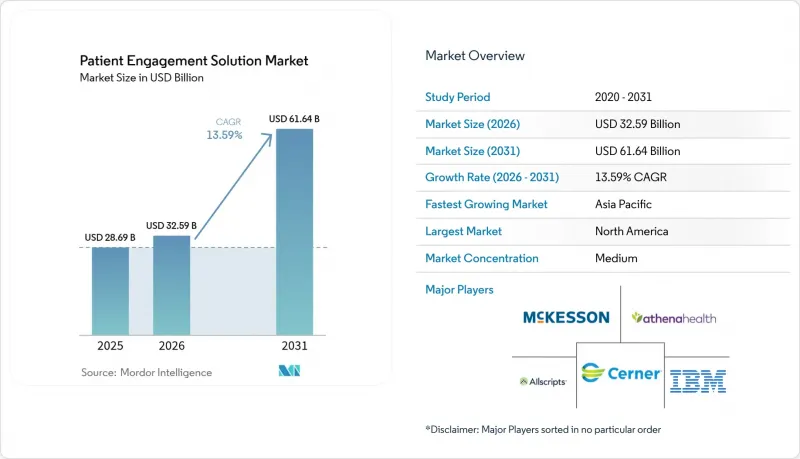
Mordor Intelligence에 의하면, 환자 참여 솔루션 시장 규모는 2025년 286억 9,000만 달러로 평가되었습니다. 2026년에는 325억 9,000만 달러로 확대되어 2026년부터 2031년에 걸쳐 CAGR 13.59%로 성장을 지속하여, 2031년에는 616억 4,000만 달러에 이를 것으로 예측됩니다.
본 보고서에서는 업계를 구성 요소(하드웨어, 소프트웨어, 서비스), 제공 형태(웹 기반 및 클라우드 기반, On-Premise), 용도(사회·행동 관리 등), 최종 사용자(의료 제공업체, 보험사 등), 지역(북미, 유럽, 아시아태평양, 중동 및 아프리카, 남미)별로 분류하고 있습니다. 시장 예측은 금액(달러) 기준으로 제시되어 있습니다.
세계의 환자 참여 솔루션 시장 동향 및 인사이트
병원 내 AI 기반 참여 플랫폼의 급속한 도입
병원에서는 대화형 AI, 예측 분석 및 자동화된 트라이아지를 프론트오피스 및 임상 워크플로우에 통합하고 있습니다. 조사 대상 의료 시스템의 82%가 2년 이내에 AI 기반 참여 도구를 도입할 계획입니다. 조기 도입 기관들로부터는 대기 시간 단축, 치료 과정의 원활한 전환, 의료진 만족도 향상 등의 보고가 접수되고 있습니다. 이는 주로 가상 비서가 진료 기록에 미리 정보를 입력하거나 일상적인 문의에 대응하기 때문입니다. Philips의 조사에 따르면, 경영진의 85%가 현재 생성형 AI를 활용한 환자 참여 프로젝트에 특정 예산을 배정하고 있습니다. 알고리즘이 성숙해짐에 따라 병원에서는 예약 준수율 향상과 무단 결석 감소가 나타나고 있으며, 이는 측정 가능한 수익 증가를 가져오는 동시에 환자 충성도도 강화하고 있습니다.
모바일 헬스 용도 동향
스마트폰을 중심으로 한 케어 패스를 통해 환자는 자신의 의료 데이터, 챗봇, 행동 유도에 실시간으로 접근할 수 있게 되었으며, 이로 인해 대규모 의료 시스템 전반에서 포털 로그인률이 향상되고 있습니다. 모바일 헬스 앱 다운로드 수에서는 아시아태평양이 1위를 차지하고 있지만, 사용자 1인당 세션 시간은 북미의 의료 제공업체가 가장 길습니다. 의료 기관은 화상 진료, 보안 메시징, 원격 생체 신호 측정 기능을 단일 앱에 통합하여 소비자용 기술 경험을 반영한 옴니채널 환경을 구축하고 있습니다. 이러한 접근 방식 덕분에 콜센터로 들어오는 문의 건수가 감소하고, 후속 진료 예약이 신속하게 처리되어 비용 절감과 치료의 연속성 향상으로 이어지고 있습니다.
환자 정보 보호
데이터 보안에 대한 우려는 시장 성장에 큰 제약 요인으로 작용하고 있습니다. 의료 기관은 환자와의 참여를 강화하는 것과 엄격한 데이터 보호 요건 사이에서 균형을 맞추어야 하기 때문입니다. 2009년부터 2022년까지 5,000건 이상의 의료 데이터 유출이 보고되었으며, 업계는 사용자 친화적인 참여 솔루션을 유지하면서 강력한 보안 프레임워크를 도입해야 한다는 점점 더 커지는 압박에 직면해 있습니다. 미국의 HIPAA나 유럽의 GDPR(EU 개인정보보호규정)과 같은 규제의 도입은 규정 준수상의 과제를 야기하며, 특히 IT 자원이 제한적인 소규모 의료 제공업체의 경우 도입 지연으로 이어질 가능성이 있습니다. 의료 기관은 이러한 과제를 해결하기 위해 HITRUST 공통 보안 프레임워크(CSF)와 같은 체계에 대한 의존도를 높이고 있지만, 이를 도입하려면 기술과 전문 지식 양면에서 막대한 투자가 필요합니다. 사용자 경험을 저해하지 않는 안전한 인증 메커니즘의 필요성은 특히 큰 과제가 되고 있습니다. 복잡한 보안 대책은 환자의 참여율을 저하시키고, 본래는 가치 있는 솔루션의 효과를 제한할 가능성이 있기 때문입니다.
부문별 분석
2025년, 소프트웨어는 환자 참여 솔루션 시장에서 55.74%라는 최대 점유율을 차지했으며, 의료 기관 전체의 디지털 전환(DX) 이니셔티브의 초석이 되고 있습니다. 이러한 우위는 소프트웨어가 기존 의료 IT 인프라와 원활하게 통합될 수 있을 뿐만 아니라, 환자와의 의미 있는 상호작용에 필요한 기능을 제공할 수 있다는 점에 기인합니다. 환자 포털, 모바일 애플리케이션, 원격의료 플랫폼은 가장 널리 채택된 소프트웨어 솔루션이며, 그 기능은 예약 일정 설정부터 보안 메시징, 의료 기록 접근에 이르기까지 다양합니다. 서비스 부문은 현재 규모는 작지만, 2026년부터 2031년에 걸쳐 연평균 성장률(CAGR) 15.88%라는 가장 빠른 성장세를 보이고 있습니다. 이는 의료 기관들이 기술 투자의 효과를 극대화하기 위해 도입 지원, 교육 및 지속적인 유지보수의 중요성을 점점 더 인식하고 있기 때문입니다. 키오스크, 태블릿, 웨어러블 기기 등의 하드웨어 구성 요소는 전체 생태계에서 보조적이지만 필수적인 역할을 수행하며, 특히 환자와의 직접적인 상호작용이 필요한 임상 현장에서 중요합니다.
소프트웨어 동향은 급속히 진화하고 있으며, AI 통합이 결정적인 트렌드로 부상하고 있습니다. 의료 업계 리더의 85%가 임상의의 생산성과 환자 참여도를 높이기 위해 생성형 AI에 투자하고 있기 때문입니다. 상호 운용성은 중요한 중점 분야로 부상하고 있으며, 의료 기관들은 서로 다른 시스템 간에 원활하게 데이터를 교환하고 통합된 환자 경험을 창출할 수 있는 솔루션을 우선시하고 있습니다. 확장성, 접근성 및 IT 관리 비용 절감과 같은 이점에 힘입어 클라우드 기반 소프트웨어 제공 모델로의 전환이 가속화되고 있습니다. 서비스 제공업체들은 단순한 도입을 넘어 전략적 컨설팅, 워크플로우 최적화, 지속적인 개선 프로그램 등으로 서비스 범위를 확대하고 있으며, 이를 통해 의료 기관이 환자 참여에 대한 투자 가치를 극대화할 수 있도록 지원하고 있습니다. 컴포넌트 생태계는 변화하는 의료 제공 모델에 대응하여 계속 진화하고 있으며, 기존의 임상 현장 이외에서 케어를 제공하는 것을 지원하는 솔루션이 점점 더 중요시되고 있습니다.
2025년에는 웹 및 클라우드 기반 솔루션이 합쳐서 시장 점유율의 69.62%를 차지했으며, 이는 의료 분야가 기존의 On-Premise형 시스템에서 결정적으로 전환되고 있음을 반영합니다. 특히 클라우드 기반 솔루션은 의료 기관들이 확장성, 접근성, IT 부담 경감 등의 이점을 인식함에 따라 2026년부터 2031년에 걸쳐 연평균 성장률(CAGR) 18.45%라는 폭발적인 성장을 이루고 있습니다. 클라우드 도입의 경제적 이점은 매우 설득력 있는데, 클라우드 도입 비용은 On-Premise 시스템에 비해 77% 저렴하며 유지 관리 비용도 대폭 절감할 수 있습니다. On-Premise형 솔루션은 주로 특정 보안 요구 사항이나 연결성 제약이 있는 환경에서 여전히 중요성을 유지하고 있지만, 클라우드 보안 기능이 성숙해지고 연결 인프라가 개선됨에 따라 그 시장 점유율은 계속 하락하고 있습니다.
클라우드 기반 제공 모델로의 전환을 통해 실시간 데이터 분석, 원활한 멀티 디바이스 경험, 진화하는 의료 수요에 대응한 신속한 기능 업데이트 등, 기존에는 실현하기 어려웠던 새로운 기능들이 가능해졌습니다. 의료 기관에서는 보안, 규정 준수,접근성 요건의 균형을 맞추기 위해, 클라우드와 On-Premise 요소를 결합한 하이브리드 접근 방식을 채택하는 사례가 늘고 있습니다. 클라우드 솔루션의 비용 구조는 일반적으로 ‘사용자 1인당 월정액’ 모델을 채택하고 있어, 막대한 초기 투자를 감당할 자금력이 부족한 소규모 의료 기관에게 특히 매력적입니다. 한때 클라우드 도입을 제한했던 보안상의 우려는 고도의 암호화, 다단계 인증 및 규정 준수 인증을 통해 해소되고 있으며, 현재 많은 클라우드 제공업체가 기존의 On-Premise형 도입의 보안 기능을 능가하는 수준에 도달했습니다. 클라우드 기반 솔루션의 유연성은 의료 현장에서 혼란이 발생했을 때 특히 그 가치를 발휘하며, 변화하는 환자의 요구와 의료 제공 모델에 대응하여 새로운 참여 기능을 신속하게 도입할 수 있게 해줍니다.
지역별 분석
북미는 선진적인 의료 인프라, 유리한 환급 정책, 그리고 디지털 헬스 기술의 조기 도입에 힘입어 2025년에는 41.62%의 점유율을 차지하며 환자 참여 솔루션 시장에서 계속해서 지배적인 위치를 유지했습니다. 이 지역의 주도적 입지는 환자 참여 이니셔티브에 대한 강력한 규제적 지원에 의해 더욱 강화되고 있으며, 여기에는 ‘Meaningful Use’ 요건과 의료 제공업체가 참여 기술에 투자하도록 장려하는 가치 기반 의료 프로그램 등이 포함됩니다. 헬스케어 정보 관리 시스템 협회(HIMSS)의 종합적인 조사에 따르면, 미국 의료 기관의 61%가 전략 계획에서 환자 경험 및 참여 이니셔티브를 우선순위로 삼고 있으며, 72%는 2026년까지 디지털 환자 참여 기술에 대한 투자를 확대할 계획입니다. 이 지역에서는 AI를 활용한 참여 솔루션의 통합이 특히 활발히 진행되고 있으며, 그 용도는 자동화된 예약 일정 관리부터 개인 맞춤형 건강 권고 사항, 가상 건강 비서에 이르기까지 다양합니다. 캐나다와 멕시코도 유사한 도입 추세를 보이고 있지만, 의료 제도 구조와 자금 조달 메커니즘의 차이로 인해 그 속도는 다소 완만합니다.
아시아태평양은 급속히 확장되는 의료 인프라, 스마트폰 보급률 상승, 그리고 의료에 대한 기대치가 높은 중산층 증가에 힘입어 2026년부터 2031년까지 연평균 성장률(CAGR) 17.52%를 나타낼 것으로 예측되는 가장 빠르게 성장하는 지역 시장이 되고 있습니다. 중국은 디지털 헬스 인프라와 환자 중심 치료에 대한 대규모 투자를 통해 지역 성장을 주도하고 있습니다. 한편, 인도에서는 정부 주도의 디지털 헬스 프로그램과 급성장하는 원격의료 부문의 뒷받침을 받아 도입이 가속화되고 있습니다. 일본에서는 고령화에 따라 환자 참여 측면에서 특유의 과제와 기회가 발생하고 있으며, 고령 환자를 위한 원격 모니터링 및 만성 질환 관리에 초점을 맞춘 솔루션이 점점 더 중요해지고 있습니다. 호주와 한국은 AI 및 IoT와 같은 첨단 기술을 환자 참여 플랫폼에 통합하는 최전선에 서서, 더욱 개인화되고 선제적인 의료 경험을 창출하고 있습니다. 이 지역의 성장은 의료비 증가와 도시 및 농촌 지역의 의료 접근성 향상에 대한 강력한 집중에 힘입어 더욱 가속화되고 있습니다.
유럽은 큰 시장 점유율을 차지하고 있으며, 독일, 영국, 프랑스 등의 국가들이 환자 참여 솔루션 도입을 주도하고 있습니다. 이 지역의 엄격한 데이터 보호 규정, 특히 GDPR(EU 개인정보보호규정)은 강화된 개인정보 보호 기능과 투명한 데이터 거버넌스가 실천되는 참여 플랫폼의 개발을 이끌어 왔습니다. 중동 및 아프리카는 현재 시장 점유율이 작지만, 특히 걸프협력회의(GCC) 국가들에서 도입이 진행되고 있으며, 의료 현대화를 위한 노력이 환자 참여 기술에 대한 투자를 뒷받침하고 있습니다. 남미는 유망한 성장 잠재력을 보이고 있으며, 의료 제공업체들이 디지털 참여 솔루션을 통해 의료 접근성 관련 과제를 해결하고자 함에 따라 브라질이 이 지역 내 도입을 주도하고 있습니다. 환자 참여 시장의 세계 특성은 점점 더 두드러지고 있으며, 지리적 경계를 초월하는 핵심 기능을 유지하면서도 지역별 고유한 의료 과제에 대응할 수 있도록 솔루션이 조정되고 있습니다.
기타 혜택 :
- 엑셀 형식 시장 예측(ME) 시트
- 3개월간의 애널리스트 지원
자주 묻는 질문
목차
제1장 서론
제2장 조사 방법
제3장 주요 요약
제4장 시장 구도
제5장 시장 규모 및 성장 예측
제6장 경쟁 구도
제7장 시장 기회 및 향후 전망
KTH 26.09.04According to Mordor Intelligence, the patient engagement solution market size is expected to grow from USD 28.69 billion in 2025 to USD 32.59 billion in 2026 and is forecast to reach USD 61.64 billion by 2031 at 13.59% CAGR over 2026-2031.
This report Segments the Industry Into by Component (Hardware, Software, Services), Delivery Mode (Web-Based and Cloud-Based, On-Premise), Application (Social and Behavioral Management, and More), End User (Providers, Payers, and More), and Geography (North America, Europe, Asia-Pacific, Middle East and Africa, and South America). The Market Forecasts are Provided in Terms of Value (USD).
Global Patient Engagement Solution Market Trends and Insights
Rapid Adoption of AI-Driven Engagement Platforms in Hospitals
Hospitals are embedding conversational AI, predictive analytics, and automated triage into front-office and clinical workflows. Eighty-two percent of health systems surveyed plan to implement AI-enabled engagement tools within two years. Early adopters report shorter wait times, smoother care transitions, and higher clinician satisfaction, largely because virtual assistants pre-populate charts and handle routine queries. Philips found that 85% of executives now allocate specific budgets for generative-AI engagement projects.As algorithms mature, hospitals see improved appointment adherence and a decline in no-shows, producing measurable revenue uplift while strengthening patient loyalty.
Rising Trend of Mobile Health Applications
Smartphone-centric care pathways give patients real-time access to their medical data, chatbots, and behavioral nudges, which has helped lift portal log-in rates across large health systems. Asia-Pacific leads mobile-health downloads, yet North American providers record the highest per-user session length. Health organizations are layering video visits, secure messaging, and remote vitals capture into single apps, building an omni-channel presence that mirrors consumer-tech experiences. The approach reduces inbound call-center volume and accelerates follow-up scheduling, delivering cost savings and better care continuity.
Protection of Patient Information
Data security concerns represent a significant restraint on market growth, as healthcare organizations must balance enhanced patient engagement with stringent data protection requirements. With over 5,000 reported healthcare data breaches from 2009 to 2022, the industry faces mounting pressure to implement robust security frameworks while maintaining user-friendly engagement solutions. The implementation of regulations like HIPAA in the US and GDPR in Europe creates compliance challenges that can slow adoption, particularly for smaller healthcare providers with limited IT resources. Healthcare organizations are increasingly turning to frameworks like the HITRUST Common Security Framework (CSF) to address these challenges, but implementation requires significant investment in both technology and expertise. The need for secure authentication mechanisms that don't compromise user experience presents a particular challenge, as cumbersome security measures can reduce patient engagement rates and limit the effectiveness of otherwise valuable solutions.
Other drivers and restraints analyzed in the detailed report include:
- Growing Popularity Among the Aging Population
- Rising Investments and Technological Advancements
- Lack of Skilled IT Professionals in the Healthcare Industry
For complete list of drivers and restraints, kindly check the Table Of Contents.
Segment Analysis
Software commands the largest share of the Patient Engagement Solution Market at 55.74% in 2025, serving as the cornerstone of digital transformation initiatives across healthcare organizations. This dominance stems from software's ability to integrate seamlessly with existing healthcare IT infrastructure while providing the functionality necessary for meaningful patient interactions. Patient portals, mobile applications, and telehealth platforms represent the most widely adopted software solutions, with features ranging from appointment scheduling to secure messaging and access to medical records. The services segment, while currently smaller, is experiencing the fastest growth at a CAGR of 15.88% for 2026-2031, as healthcare organizations increasingly recognize the importance of implementation support, training, and ongoing maintenance to maximize their technology investments. Hardware components, including kiosks, tablets, and wearable devices, play a supporting but essential role in the overall ecosystem, particularly in clinical settings where direct patient interaction is required.
The software landscape is evolving rapidly with AI integration emerging as a defining trend, as 85% of healthcare leaders invest in generative AI to enhance clinician productivity and patient engagement. Interoperability has become a critical focus area, with healthcare organizations prioritizing solutions that can exchange data seamlessly across disparate systems to create a unified patient experience. The shift toward cloud-based software delivery models is accelerating, driven by advantages in scalability, accessibility, and reduced IT overhead. Services providers are expanding their offerings beyond basic implementation to include strategic consulting, workflow optimization, and continuous improvement programs that help healthcare organizations maximize the value of their patient engagement investments. The component ecosystem continues to evolve in response to changing healthcare delivery models, with an increasing emphasis on solutions that support care delivery outside traditional clinical settings.
Web and cloud-based solutions collectively dominate the market with a 69.62% share in 2025, reflecting healthcare's decisive shift away from legacy on-premise systems. Cloud-based solutions specifically are experiencing explosive growth at a CAGR of 18.45% for 2026-2031, as healthcare organizations recognize the advantages in scalability, accessibility, and reduced IT burden. The economic case for cloud adoption is compelling, with cloud deployments being 77% cheaper than on-premises systems and offering significant reductions in maintenance costs. On-premise solutions retain relevance primarily in settings with specific security requirements or connectivity limitations, but their market share continues to decline as cloud security capabilities mature and connectivity infrastructure improves.
The transition to cloud-based delivery models is enabling new capabilities that were previously impractical, including real-time data analytics, seamless multi-device experiences, and rapid feature updates that keep pace with evolving healthcare needs. Healthcare organizations are increasingly adopting hybrid approaches that combine cloud and on-premise elements to balance security, compliance, and accessibility requirements. The cost structure of cloud solutions, typically following a 'per user per month' model, is proving particularly attractive for smaller healthcare organizations that lack the capital for large upfront investments. Security concerns that previously limited cloud adoption are being addressed through advanced encryption, multi-factor authentication, and compliance certifications, with many cloud providers now exceeding the security capabilities of traditional on-premise deployments. The flexibility of cloud-based solutions is proving especially valuable during healthcare disruptions, enabling rapid deployment of new engagement capabilities in response to changing patient needs and care delivery models.
Complete Report Scope:
- By Component
- Hardware
- Software
- Services
- By Delivery Mode
- Web-Based and Cloud-Based
- On-Premise
- By Application
- Social and Behavioral Management
- Fitness and Health Management
- Home Healthcare Management
- Financial Management
- Population Health Management
- By End User
- Providers (Hospitals, Clinics, ACOs)
- Payers (Public and Private Insurers)
- Patients & Caregivers
- Pharmaceutical Companies
- Pharmacies and Retail Health Chains
- By Geography
- North America
- United States
- Canada
- Mexico
- Europe
- Germany
- United Kingdom
- France
- Italy
- Spain
- Rest of Europe
- Asia-Pacific
- China
- Japan
- India
- Australia
- South Korea
- Rest of Asia-Pacific
- Middle East & Africa
- GCC
- South Africa
- Rest of Middle East & Africa
- South America
- Brazil
- Argentina
- Rest of South America
- North America
Geography Analysis
North America maintains its dominant position in the Patient Engagement Solution Market with a 41.62% share in 2025, driven by advanced healthcare infrastructure, favorable reimbursement policies, and early adoption of digital health technologies. The region's leadership is reinforced by strong regulatory support for patient engagement initiatives, including Meaningful Use requirements and value-based care programs that incentivize provider investments in engagement technologies. A comprehensive survey by the Healthcare Information and Management Systems Society (HIMSS) indicates that 61% of U.S. healthcare organizations have prioritized patient experience and engagement initiatives in their strategic plans, with 72% planning to increase investments in digital patient engagement technologies by 2026. The integration of AI-powered engagement solutions is particularly advanced in this region, with applications ranging from automated appointment scheduling to personalized health recommendations and virtual health assistants. Canada and Mexico are following similar adoption trajectories, though at a somewhat slower pace due to differences in healthcare system structures and funding mechanisms.
Asia-Pacific represents the fastest-growing regional market with a projected CAGR of 17.52% for 2026-2031, fueled by rapidly expanding healthcare infrastructure, increasing smartphone penetration, and growing middle-class populations with higher healthcare expectations. China leads regional growth with substantial investments in digital health infrastructure and patient-centered care initiatives, while India is experiencing accelerated adoption driven by government digital health programs and a burgeoning telehealth sector. Japan's aging population is creating unique engagement challenges and opportunities, with solutions increasingly focused on remote monitoring and chronic disease management for elderly patients. Australia and South Korea are at the forefront of integrating advanced technologies like AI and IoT into patient engagement platforms, creating more personalized and proactive care experiences. The region's growth is further supported by increasing healthcare expenditure and a strong focus on improving healthcare accessibility in both urban and rural areas.
Europe holds a significant market share, with countries like Germany, the United Kingdom, and France leading adoption of patient engagement solutions. The region's strict data protection regulations, particularly GDPR, have shaped the development of engagement platforms with enhanced privacy features and transparent data governance practices. The Middle East and Africa region, while currently representing a smaller market share, is experiencing growing adoption particularly in Gulf Cooperation Council (GCC) countries where healthcare modernization initiatives are driving investments in patient engagement technologies. South America shows promising growth potential, with Brazil leading regional adoption as healthcare providers seek to address access challenges through digital engagement solutions. The global nature of the patient engagement market is increasingly evident, with solutions being adapted to address region-specific healthcare challenges while maintaining core functionality that transcends geographic boundaries.
- Oracle Cerner Corporation
- Epic Systems
- Allscripts
- Athenahealth
- Mckesson
- IBM
- GetWellNetwork
- Lincor Solutions
- Medecision
- Medhost
- Orion Health Ltd.
- WelVU
- YourCareUniverse Inc.
- AdvancedMD
- Kareo
- Meditech
- CureMD Healthcare
- NextGen Healthcare
- Tebra Technologies
- TeleVox (Odeza)
Additional Benefits:
- The market estimate (ME) sheet in Excel format
- 3 months of analyst support
TABLE OF CONTENTS
1 Introduction
- 1.1 Study Assumptions & Market Definition
- 1.2 Scope of the Study
2 Research Methodology
3 Executive Summary
4 Market Landscape
- 4.1 Market Overview
- 4.2 Market Drivers
- 4.2.1 Rapid Adoption of AI-Driven Engagement Platforms in Hospitals
- 4.2.2 Rising Trend of Mobile Health Applications
- 4.2.3 Growing Popularity of Patient Engagement Solutions Among the Aging Population
- 4.2.4 Rising Investments and Technological Advancements
- 4.2.5 Shift from Fee-for-Service to Risk-Sharing Contracts Fuelling Payer Demand
- 4.2.6 Integration of Remote Patient Monitoring with Value-Based Care Reimbursement
- 4.3 Market Restraints
- 4.3.1 Protection of Patient Information
- 4.3.2 Lack of Skilled IT Professionals in the Healthcare Industry
- 4.3.3 Persistent Interoperability Gaps Between EHR and Third-Party Engagement Apps
- 4.3.4 Sub-Optimal Reimbursement Codes for Home-Health Engagement
- 4.4 Porter's Five Forces Analysis
- 4.4.1 Threat of New Entrants
- 4.4.2 Bargaining Power of Buyers/Consumers
- 4.4.3 Bargaining Power of Suppliers
- 4.4.4 Threat of Substitute Products
- 4.4.5 Intensity of Competitive Rivalry
5 Market Size & Growth Forecasts (Value in USD)
- 5.1 By Component
- 5.1.1 Hardware
- 5.1.2 Software
- 5.1.3 Services
- 5.2 By Delivery Mode
- 5.2.1 Web-Based and Cloud-Based
- 5.2.2 On-Premise
- 5.3 By Application
- 5.3.1 Social and Behavioral Management
- 5.3.2 Fitness and Health Management
- 5.3.3 Home Healthcare Management
- 5.3.4 Financial Management
- 5.3.5 Population Health Management
- 5.4 By End User
- 5.4.1 Providers (Hospitals, Clinics, ACOs)
- 5.4.2 Payers (Public and Private Insurers)
- 5.4.3 Patients & Caregivers
- 5.4.4 Pharmaceutical Companies
- 5.4.5 Pharmacies and Retail Health Chains
- 5.5 By Geography
- 5.5.1 North America
- 5.5.1.1 United States
- 5.5.1.2 Canada
- 5.5.1.3 Mexico
- 5.5.2 Europe
- 5.5.2.1 Germany
- 5.5.2.2 United Kingdom
- 5.5.2.3 France
- 5.5.2.4 Italy
- 5.5.2.5 Spain
- 5.5.2.6 Rest of Europe
- 5.5.3 Asia-Pacific
- 5.5.3.1 China
- 5.5.3.2 Japan
- 5.5.3.3 India
- 5.5.3.4 Australia
- 5.5.3.5 South Korea
- 5.5.3.6 Rest of Asia-Pacific
- 5.5.4 Middle East & Africa
- 5.5.4.1 GCC
- 5.5.4.2 South Africa
- 5.5.4.3 Rest of Middle East & Africa
- 5.5.5 South America
- 5.5.5.1 Brazil
- 5.5.5.2 Argentina
- 5.5.5.3 Rest of South America
- 5.5.1 North America
6 Competitive Landscape
- 6.1 Market Concentration
- 6.2 Market Share Analysis
- 6.3 Company Profiles (includes Global level Overview, Market level overview, Core Segments, Financials as available, Strategic Information, Market Rank/Share for key companies, Products & Services, and Recent Developments)
- 6.3.1 Oracle Cerner Corporation
- 6.3.2 Epic Systems Corporation
- 6.3.3 Allscripts Healthcare Solutions Inc.
- 6.3.4 Athenahealth Inc.
- 6.3.5 McKesson Corporation
- 6.3.6 IBM Corporation
- 6.3.7 GetWellNetwork Inc.
- 6.3.8 Lincor Solutions
- 6.3.9 Medecision Inc.
- 6.3.10 MEDHOST
- 6.3.11 Orion Health Ltd.
- 6.3.12 WelVU
- 6.3.13 YourCareUniverse Inc.
- 6.3.14 AdvancedMD
- 6.3.15 Kareo
- 6.3.16 MEDITECH
- 6.3.17 CureMD Healthcare
- 6.3.18 NextGen Healthcare
- 6.3.19 Tebra Technologies
- 6.3.20 TeleVox (Odeza)
7 Market Opportunities & Future Outlook
- 7.1 White-Space & Unmet-Need Assessment