|
시장보고서
상품코드
2122217
관절경 기기 : 시장 점유율 분석, 업계 동향과 통계, 성장 예측(2026-2031년)Arthroscopy Devices - Market Share Analysis, Industry Trends & Statistics, Growth Forecasts (2026 - 2031) |
||||||
 Mordor Intelligence
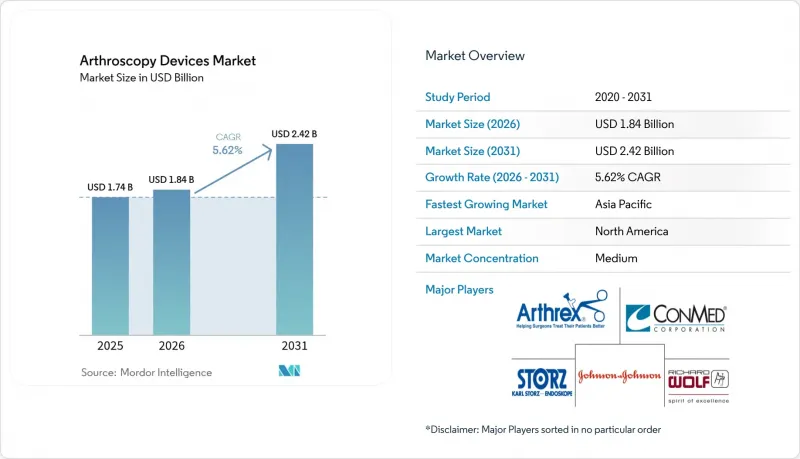
Mordor Intelligence에 따르면 관절경 기기 시장 규모는 2025년 17억 4,000만 달러에서 2026년에는 18억 4,000만 달러로 확대하며, 2026-2031년에 CAGR 5.62%로 추이하며, 2031년까지 24억 2,000만 달러에 달할 것으로 예측됩니다.
이 보고서는 용도별(무릎, 어깨·팔꿈치, 고관절, 기타), 제품별(관절경, 관절경용 임플란트, 기타), 최종사용자별(병원, ASC, 정형외과·스포츠 의학 클리닉), 지역별(북미, 유럽, 아시아태평양, 중동 및 아프리카, 남미)로 분류되어 있습니다. 시장 전망은 금액(달러) 기준으로 제시되어 있습니다.
전 세계 관절경용 의료기기 시장의 동향 및 인사이트
근골격계 질환의 부담 증가
2021년 전 세계 퇴행성 관절염 환자 수는 6억 650만 명에 달했으며, 여성과 고령층의 유병률은 가속화되고 있습니다. 근골격계 질환은 현재 장애를 안고 사는 기간(YLD)의 두 번째 주요 원인으로 꼽히고 있으며, 이로 인해 보험사들은 비용 대비 효과가 높은 관절경 수술 솔루션을 모색하고 있습니다. 예측에 따르면 2045년까지 폐경 후 여성의 50% 가까이가 퇴행성 관절염을 앓을 가능성이 있다고 합니다. 따라서 수요 증가는 선진국과 신흥 지역 모두에서 인구 고령화와 평균 수명 연장과 직접적으로 연동되어 있습니다.
저침습 정형외과수술로의 전환
관절경 수술이 개복 수술을 대체함에 따라 평균 입원 일수가 2-3일 단축되며, 이는 의료 보험사에게 명확한 비용 절감으로 이어지고 환자 만족도 향상에도 기여합니다. 또한 4K 영상 기술, 무선 카메라, 로봇 보조 기술의 도입으로 인해 과거에는 단일 절개 접근법으로는 너무 복잡하다고 여겨졌던 적응증이 확대되면서 보급이 더욱 가속화되고 있습니다. 젊은 환자층은 개복 수술에 비해 재활 기간이 짧고 흉터도 작다는 점을 선호합니다.
높은 설비 투자 및 수술 비용
설비가 완비된 관절경 수술실에는 50만 달러가 넘는 초기 투자가 필요하며, 여기에 1건당 2,000-5,000달러의 소모품 비용이 추가되므로 수술 건수가 그리 많지 않은 의료기관에는 부담이 되고 있습니다. 여러 관절을 치료하는 경우 재고 수요가 더욱 증가하며, 일회용 제품에 드는 추가 비용은 보험 환급액만으로는 충당하기 어려운 경우가 많습니다.
부문별 분석
2025년 매출 중 무릎 수술이 44.78%를 차지하고 있으며, 이는 이 관절의 높은 부상률과 관절경 하 전방십자인대(ACL) 및 반월상 연골 복원 프로토콜의 성숙도를 지원합니다. 안정적인 보험 환급과 외과 의사의 풍부한 경험이 수술 건수 면에서 주도적인 위치를 공고히 하고 있습니다. 고관절 관절경 수술은 현재 규모는 작지만, 젊은 운동선수들 사이에서 대퇴골-비구 충돌 증후군 및 관절순 파열에 대한 인식이 확산됨에 따라 연평균 성장률(CAGR) 7.45%로 성장하고 있습니다. 접근 정밀도가 향상된 캐뉼라와 유연한 바 덕분에 기술 습득의 어려움이 줄어들어, 더 많은 지역 병원이 이 분야에 진출할 수 있게 되었습니다. 어깨 및 팔꿈치 관절경 수술에서는 재파열률을 낮추는 생체 유도성 패치 임플란트가 기여하고 있는 반면, 기업이 플랫폼을 추간판 감압술로 확대함에 따라 내시경 척추 수술용 포털도 점차 주류로 자리 잡고 있습니다. 전반적으로 수술 구성은 진단 목적의 세척에서 재건 수술로 전환되고 있으며, 이러한 변화가 관절경 의료기기 시장 전체의 평균 판매 가격을 끌어올리고 있습니다.
무릎 관절 수술용 관절경 의료기기 시장 규모는 스포츠 관련 인대 복원 및 퇴행성 반월상 연골 치료에 힘입어 2031년까지 꾸준히 확대될 것으로 예측됩니다. 대조적으로, 고관절 수술은 현재 시장 점유율이 10%대 중반에 머물러 있지만, 임플란트, 펌프 및 시각화 시스템이 심부 관절의 인체공학적 특성에 적응함에 따라 관절경용 의료기기 시장에서 실질적으로 큰 점유율을 차지하게 될 것으로 예측됩니다. 관절별 도입률에 편차가 있으므로 각 제조사는 관절 전용 셰이버 바, 봉합사 삽입기, 고정 앵커에 대한 투자를 지속하고 있으며, 이로 인해 제품 카탈로그와 서비스 모델의 세분화가 더욱 진행되고 있습니다.
지역별 분석
북미는 높은 수준의 교육 체계, 폭넓은 보험 적용, 그리고 고령이 되어도 신체 활동을 지속하는 인구에 힘입어 2025년 매출의 42.05%를 차지했습니다. 수요의 대부분은 미국이 주도하고 있으며, 메디케어 외래 진료 보수율 3.8%의 개정은 병원의 이익률을 유지하는 동시에 외래 수술 센터(ASC)로의 전환을 촉진하고 있습니다. 캐나다의 단일 지불자 모델은 연간 수술 건수를 안정적으로 유지하고 있으며, 멕시코에서는 확대되는 의료 관광 시장이 저렴한 관절경 하 수복술을 원하는 환자들을 끌어모으고 있습니다.
유럽은 매출 기준 2위를 차지하고 있으며, 엄격한 규제와 숙련된 외과 의사의 풍부한 인력 기반이 균형을 이루고 있습니다. EU의 친환경 의료기기 추진은 재사용 가능한 셰이버 핸드피스 및 재활용 가능한 튜브의 조기 도입을 지원하고 있습니다. 고령화로 인해 고관절 및 어깨 관절 수술 건수가 증가하고 있으며, 또한 각국의 스포츠 프로그램으로 인해 젊은 세대 사이에서도 무릎 관절경 수술이 보편화되고 있습니다. 임상 결과에 대한 증거 요건으로 인해 공급업체와 전향적 등록 연구를 수행하는 학술기관 간의 긴밀한 협력이 촉진되어, 관절경용 의료기기 시장의 데이터베이스이 강화되고 있습니다.
아시아태평양은 연평균 성장률(CAGR) 6.39%로 가장 빠르게 성장하고 있는 지역입니다. 중국의 중앙집권적인 조달 체제로 인해 임플란트 가격이 인하되어 병원내 보급이 촉진되고 있습니다. 국내 OEM 제조사들도 부상하고 있지만, 4K 영상 기술 및 내비게이션 기술 분야에서는 국제 브랜드가 여전히 기술적 우위를 유지하고 있습니다. 일본의 로봇 기술 리더십은 AI 가이드식 포털의 도입을 지원하고 있으며, 초고령화 사회가 수술 건수의 꾸준한 증가를 보장하고 있습니다. 인도에서는 민관 파트너십을 통해 새로운 관절경 수술실에 자금이 지원되고 있으며, 정부의 ‘메이크 인 인디아(Make in India)’ 정책이 현지 조립을 촉진하여 수입 관세 인하로 이어지고 있습니다. 동남아시아 국가들에서는 민간 보험의 적용 범위가 확대되고 있으며, 급성장하는 중산층 사이에서 선택적 무릎 관절경 수술에 대한 수요가 촉발되고 있습니다. 전반적으로 가처분 소득의 증가와 병원의 수용 능력 향상으로 인해 관절경용 의료기기 시장 전체에서 수술 건수의 지속적인 증가가 예상됩니다.
기타 혜택:
- 엑셀 형식의 시장 예측(ME) 시트
- 3개월간의 애널리스트 지원
자주 묻는 질문
목차
제1장 서론
제2장 조사 방법
제3장 개요
제4장 시장 구도
제5장 시장 규모와 성장 예측
제6장 경쟁 구도
제7장 시장 기회와 향후 전망
KSAAccording to Mordor Intelligence, the arthroscopy devices market size is expected to grow from USD 1.74 billion in 2025 to USD 1.84 billion in 2026 and is forecast to reach USD 2.42 billion by 2031 at 5.62% CAGR over 2026-2031.
This report is Segmented by Application (Knee, Shoulder & Elbow, Hip, and More), Product (Arthroscopes, Arthroscopic Implants, and More), End User (Hospitals, Ascs, Orthopedic & Sports Medicine Clinics), and Geography (North America, Europe, Asia-Pacific, Middle East & Africa, South America). The Market Forecasts are Provided in Terms of Value (USD).
Global Arthroscopy Devices Market Trends and Insights
Rising Burden of Musculoskeletal Disorders
Global osteoarthritis cases reached 606.5 million in 2021, with prevalence accelerating among women and the elderly. Musculoskeletal disease now ranks as the second-largest cause of years lived with disability, pushing payors toward cost-effective arthroscopic solutions. Projections suggest that nearly 50% of post-menopausal women could have osteoarthritis by 2045. Demand growth therefore aligns directly with demographic aging and rising life expectancy in both developed and emerging regions.
Shift Toward Minimally Invasive Orthopedic Procedures
Average hospital stay falls by 2-3 days when arthroscopy replaces open surgery, translating to measurable payor savings and improved patient satisfaction. Uptake is further propelled by 4K visualization, wireless cameras, and robotic assistance that expand indications once considered too complex for a portal approach. Younger patients favor the faster rehabilitation and smaller scars relative to open repair.
High Capital and Procedural Costs
A fully equipped arthroscopy suite requires upfront investment above USD 500,000, while consumables add USD 2,000-5,000 per case, pressuring facilities with modest volumes. Inventory demands escalate when covering multiple joints, and reimbursement often fails to offset the premium of single-use disposables.
Other drivers and restraints analyzed in the detailed report include:
- Continuous Technological Innovation in Arthroscopic Equipment
- Growing Participation in Sports and Physical Fitness Activities
- Stringent Regulatory and Reimbursement Hurdles
For complete list of drivers and restraints, kindly check the Table Of Contents.
Segment Analysis
Knee procedures accounted for 44.78% of 2025 revenues, underscoring the joint's high injury incidence and the maturity of arthroscopic ACL and meniscus repair protocols. Stable reimbursement and extensive surgeon familiarity cement volume leadership. Hip arthroscopy, although smaller today, is growing at a 7.45% CAGR on wider recognition of femoroacetabular impingement and labral tears in younger athletes. Access-refining cannulas and flexible burrs mitigate the steep learning curve, opening the segment to more community hospitals. Shoulder and elbow scopes benefit from bio-inductive patch implants that cut re-tear rates, while endoscopic spine portals inch into mainstream as companies extend platforms to disc decompression. Collectively, procedure mix is tilting from diagnostic lavage to reconstructive repair, a shift that lifts average selling price across the arthroscopy devices market.
The arthroscopy devices market size for knee interventions is projected to advance steadily through 2031, supported by sports-related ligament repair and degenerative meniscus management. In contrast, hip procedures hold only a mid-teens share today but are forecast to command a materially larger slice of the arthroscopy devices market share as implants, pumps, and visualization systems adapt to deep-joint ergonomics. Varied joint adoption rates keep manufacturers investing in joint-specific shaver burrs, suture passers, and fixation anchors, reinforcing segmentation in their catalogs and service models.
Complete Report Scope:
- By Application
- Knee Arthroscopy
- Shoulder & Elbow Arthroscopy
- Hip Arthroscopy
- Spine Arthroscopy
- Foot & Ankle Arthroscopy
- Hand & Wrist Arthroscopy
- Other Applications
- By Product
- Arthroscopes (Reusable & Single-Use)
- Arthroscopic Implants
- Visualization Systems
- Fluid Management Systems
- RF Ablation Systems
- Motorized Shavers & Resection Systems
- Hand Instruments
- Other Products
- By End User
- Hospitals
- Ambulatory Surgical Centers (ASCs)
- Orthopedic & Sports Medicine Clinics
- Geography
- North America
- United States
- Canada
- Mexico
- Europe
- Germany
- United Kingdom
- France
- Italy
- Spain
- Rest of Europe
- Asia-Pacific
- China
- Japan
- India
- Australia
- South Korea
- Rest of Asia-Pacific
- Middle East & Africa
- GCC
- South Africa
- Rest of Middle East & Africa
- South America
- Brazil
- Argentina
- Rest of South America
- North America
Geography Analysis
North America generated 42.05% of 2025 sales, underpinned by high training capacity, strong insurer coverage, and a population that remains physically active into older age. The United States drives most demand; Medicare's 3.8% outpatient rate update sustains hospital margins while validating ASC migration. Canada's single-payer model steadies annual procedure counts, and Mexico's growing medical tourism market draws patients seeking lower-priced arthroscopic repair.
Europe ranks second in revenue, balancing strict regulation with a large base of skilled surgeons. The EU's push for greener devices encourages early adoption of reusable shaver handpieces and recyclable tubing. Aging demographics feed hip and shoulder volumes, and national sports programs keep knee scopes common among younger cohorts. Clinical-outcome evidence requirements foster tight links between suppliers and academic centers that run prospective registries, strengthening the data core of the arthroscopy devices market.
Asia-Pacific is the fastest-growing region at a 6.39% CAGR. China's centralized procurement lowers implant pricing, allowing wider hospital penetration. Domestic OEMs emerge, but international brands retain a technology edge in 4K visualization and navigation. Japan's robotics leadership supports the rollout of AI-guided portals, and its super-aging society guarantees steady case growth. India's public-private partnerships fund new arthroscopy labs, and government Make-in-India policies spur local assembly to lower import duties. Southeast Asian countries expand private insurance coverage, unlocking elective knee arthroscopy demand among a burgeoning middle class. Collectively, rising disposable income and improved hospital capacity translate into sustained volume gains across the arthroscopy devices market.
- Arthrex
- Smiths Group
- Stryker
- Johnson & Johnson
- Conmed
- Zimmer Biomet
- Medtronic
- Karl Storz
- Olympus
- Richard Wolf
- Cannuflow Inc.
- Ceterix Orthopaedics
- Wright Medical Group
- Bioventus Inc.
- Parcus Medical
- JRF Ortho
- Fujifilm Holdings Corp.
- Aesculap (B. Braun)
- G2 Orthopedics
Additional Benefits:
- The market estimate (ME) sheet in Excel format
- 3 months of analyst support
TABLE OF CONTENTS
1 Introduction
- 1.1 Study Assumptions & Market Definition
- 1.2 Scope of the Study
2 Research Methodology
3 Executive Summary
4 Market Landscape
- 4.1 Market Overview
- 4.2 Market Drivers
- 4.2.1 Rising Burden of Musculoskeletal Disorders
- 4.2.2 Shift Toward Minimally Invasive Orthopedic Procedures
- 4.2.3 Continuous Technological Innovation in Arthroscopic Equipment
- 4.2.4 Growing Participation in Sports and Physical Fitness Activities
- 4.2.5 Expansion of Ambulatory Surgical Centers and Outpatient Settings
- 4.2.6 Increasing Healthcare Expenditure in Emerging Economies
- 4.3 Market Restraints
- 4.3.1 High Capital and Procedural Costs
- 4.3.2 Stringent Regulatory and Reimbursement Hurdles
- 4.3.3 Limited Availability of Skilled Arthroscopic Surgeons
- 4.3.4 Sustainability Concerns Regarding Single-Use Devices
- 4.4 Regulatory Landscape
- 4.5 Porter's Five Forces Analysis
- 4.5.1 Threat Of New Entrants
- 4.5.2 Bargaining Power Of Buyers
- 4.5.3 Bargaining Power Of Suppliers
- 4.5.4 Threat Of Substitutes
- 4.5.5 Competitive Rivalry
5 Market Size & Growth Forecasts (Value, USD)
- 5.1 By Application
- 5.1.1 Knee Arthroscopy
- 5.1.2 Shoulder & Elbow Arthroscopy
- 5.1.3 Hip Arthroscopy
- 5.1.4 Spine Arthroscopy
- 5.1.5 Foot & Ankle Arthroscopy
- 5.1.6 Hand & Wrist Arthroscopy
- 5.1.7 Other Applications
- 5.2 By Product
- 5.2.1 Arthroscopes (Reusable & Single-Use)
- 5.2.2 Arthroscopic Implants
- 5.2.3 Visualization Systems
- 5.2.4 Fluid Management Systems
- 5.2.5 RF Ablation Systems
- 5.2.6 Motorized Shavers & Resection Systems
- 5.2.7 Hand Instruments
- 5.2.8 Other Products
- 5.3 By End User
- 5.3.1 Hospitals
- 5.3.2 Ambulatory Surgical Centers (ASCs)
- 5.3.3 Orthopedic & Sports Medicine Clinics
- 5.4 Geography
- 5.4.1 North America
- 5.4.1.1 United States
- 5.4.1.2 Canada
- 5.4.1.3 Mexico
- 5.4.2 Europe
- 5.4.2.1 Germany
- 5.4.2.2 United Kingdom
- 5.4.2.3 France
- 5.4.2.4 Italy
- 5.4.2.5 Spain
- 5.4.2.6 Rest of Europe
- 5.4.3 Asia-Pacific
- 5.4.3.1 China
- 5.4.3.2 Japan
- 5.4.3.3 India
- 5.4.3.4 Australia
- 5.4.3.5 South Korea
- 5.4.3.6 Rest of Asia-Pacific
- 5.4.4 Middle East & Africa
- 5.4.4.1 GCC
- 5.4.4.2 South Africa
- 5.4.4.3 Rest of Middle East & Africa
- 5.4.5 South America
- 5.4.5.1 Brazil
- 5.4.5.2 Argentina
- 5.4.5.3 Rest of South America
- 5.4.1 North America
6 Competitive Landscape
- 6.1 Market Concentration
- 6.2 Market Share Analysis
- 6.3 Company Profiles (includes Global level Overview, Market level overview, Core Business Segments, Financials, Headcount, Key Information, Market Rank, Market Share, Products and Services, and analysis of Recent Developments)
- 6.3.1 Arthrex Inc.
- 6.3.2 Smith & Nephew PLC
- 6.3.3 Stryker Corporation
- 6.3.4 Johnson & Johnson (DePuy Synthes)
- 6.3.5 Conmed Corporation
- 6.3.6 Zimmer Biomet Holdings Inc.
- 6.3.7 Medtronic PLC
- 6.3.8 Karl Storz SE & Co. KG
- 6.3.9 Olympus Corporation
- 6.3.10 Richard Wolf GmbH
- 6.3.11 Cannuflow Inc.
- 6.3.12 Ceterix Orthopaedics
- 6.3.13 Wright Medical Group N.V.
- 6.3.14 Bioventus Inc.
- 6.3.15 Parcus Medical
- 6.3.16 JRF Ortho
- 6.3.17 Fujifilm Holdings Corp.
- 6.3.18 Aesculap (B. Braun)
- 6.3.19 G2 Orthopedics
7 Market Opportunities & Future Outlook
- 7.1 White-Space & Unmet-Need Assessment