

|
시장보고서
상품코드
2122235
과산화수소 : 시장 점유율 분석, 업계 동향과 통계, 성장 예측(2026-2031년)Hydrogen Peroxide - Market Share Analysis, Industry Trends & Statistics, Growth Forecasts (2026 - 2031) |
||||||
 Mordor Intelligence
Mordor Intelligence에 따르면 과산화수소 시장 규모는 2025년 611만 톤에서 2026년에는 635만 톤으로 확대하며, 2031년까지 771만 톤에 달할 것으로 예상되고 있으며, 2026-2031년에 CAGR 3.96%로 성장할 것으로 전망되고 있습니다.
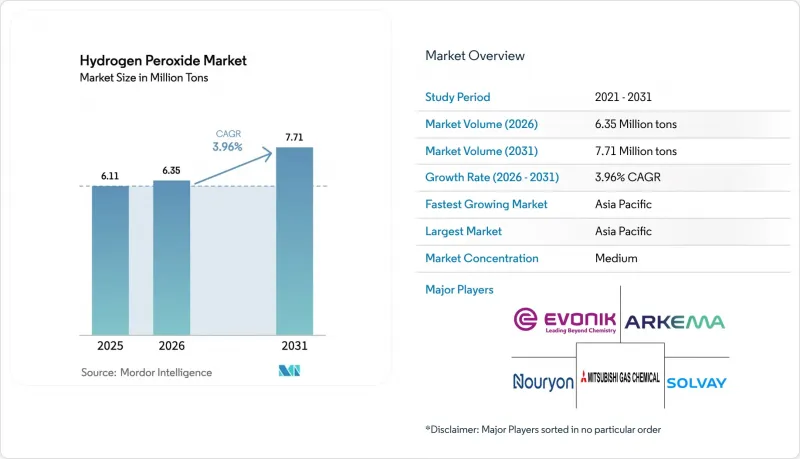
이 보고서는 제품의 기능(소독제 등), 등급(표준 등급 등), 농도·형태(수용액 등), 최종사용자 산업(펄프·제지, 화학 합성, 폐수 처리, 광업 등) 및 지역(아시아태평양, 북미, 유럽, 남미, 중동 및 아프리카)별로 분류되어 있습니다. 시장 전망은 판매량(톤) 기준으로 제시되어 있습니다.
전 세계 과산화수소 시장의 동향 및 인사이트
5nm 미만 반도체 팹에서의 초고순도 H₂O₂ 수요 급증
주요 반도체 제조업체들은 웨이퍼 세정시 허용되는 금속 함량 기준을 10조 분의 1 미만으로 엄격히 적용하고 있으며, 이는 7nm 노드에 비해 10분의 1 수준입니다. 솔베이(Solvay)는 이 기준을 충족하기 위해 2025년에 진장(Zhenjiang) 공장에서 전자 등급 제품의 생산량을 두 배로 늘렸으며, 한편 미쓰비시 가스 화학(Mitsubishi Gas Chemical)은 애리조나주와 텍사스주의 신규 생산 라인을 지원하기 위해 일본 국내 생산을 확대했습니다. 현물 가격은 1kg당 2.50달러를 넘어 표백용 등급의 3배 수준에 달하고 있으며, 이 틈새 시장의 점유율이 3% 미만인 점을 충분히 상쇄하고 있습니다. 에보닉의 락산 합작 사업은 2026년에 가동을 시작하여 30킬로톤의 특수 제품 생산 능력을 추가하는 한편, 노하우 관리를 위해 에보닉이 지분의 과반수를 보유하게 됩니다. 극자외선(EUV) 장비에 대한 수출 규제로 인해 동북아시아 이외 지역의 반도체 제조 공장 건설이 정체될 우려가 있으며, 수요가 지역적으로 집중되어 공급망 리스크가 높아질 가능성이 있으므로 무역 마찰의 위험은 여전히 남아 있습니다. ISO 14644 클래스 1 클린룸 기준을 충족하는 공급업체는 전환 비용에 따른 보호를 받고 있으며, 이는 후발 진입자를 억제하는 요인이 되고 있습니다.
분산형 폐수 처리에서 현장 전기 산화 처리의 급증
처리 시설 내에서 공기와 물로부터 과산화수소를 생성하는 컨테이너형 유닛은 운송 위험을 줄이고 공급망을 단축합니다. BASF는 2025년 루트비히스하펜에서 54MW 규모의 양성자 교환막형 전해 장치를 가동하며, 독일 산업 단지를 대상으로 녹색 수소를 이용한 첨단 산화 반응 장치의 시범 사업을 시작했습니다. 인도에서는 2025년 공해 규제 당국이 미량 오염 물질의 기준치를 설정함에 따라 섬유 산업 클러스터가 이 기술을 채택했습니다. 수송 거리가 500km를 초과하면 납품 비용은 20%-30% 감소하지만, 100m3/h 용량의 스키드형 장치에 드는 약 150만 달러의 초기 투자 비용으로 인해 도입은 인구 5만 명 이상의 도시로 제한되고 있습니다. 전기 산화는 기존의 생물학적 처리로는 분해할 수 없는 의약품, PFAS, 염료 분자를 분해하므로 사업자는 대규모 토목 공사를 동반하지 않고도 더 엄격한 배출 기준을 충족할 수 있는 수단을 확보할 수 있습니다.
EU의 폭발물 전구체 규제 강화로 인해 중량 백분율 35%를 초과하는 등급의 유통 비용이 상승
규정 2019/1148에서는 중량 백분율 35%를 초과하는 과산화수소에 대해 최종사용자 심사, 안전한 보관 및 거래 보고가 의무화되어 있으며, 이로 인해 물류 비용이 1kg당 0.11-0.17유로 상승했습니다. 알케마(Arkema)는 자리(Jary) 공장의 규정 준수를 위한 설비 갱신에 320만 유로를 투자했으나, 이 지출로 인해 2024년 장부 가치는 18% 감소했습니다. 많은 소규모 섬유 및 화장품 구매업체들이 행정 절차를 피하기 위해 중량 기준 35% 이하의 등급으로 전환함에 따라 높은 수익률을 기록하던 드럼통 판매가 감소하고 있습니다. 또한 세관 검사로 인해 앤트워프와 로테르담을 경유하는 재수출이 지연되면서, 2024년 이후 북아프리카 및 걸프 국가로 향하는 35중량%를 초과하는 과산화수소의 유럽 출하량이 12% 감소했습니다. 이 규제의 적용을 받지 않는 아시아 생산자들은 이러한 시장에서 점유율을 확대하고 있습니다.
부문별 분석
2025년 출하량의 61.76%는 여전히 표백 용도가 차지하고 있으며, 이는 공기 건조 톤당 8-12kg을 소비하는 펄프 공장에 의해 지원되고 있지만, 재생 섬유 및 효소에 의한 전처리가 사용량을 억제하고 있으며, 그 성장률은 둔화되고 있습니다. 대조적으로, 소독제로서의 사용량은 연평균 성장률(CAGR) 4.44%로 증가하고 있는데, 이는 식품 가공업체, 음료 충전업체 및 지자체 정수장이 염소계 부산물을 피하기 위해 과산화수소를 선호하기 때문입니다. 산화제는 특히 HPPO(과산화수소-프로필렌옥사이드)를 이용한 프로필렌옥사이드 합성에서 중요한 역할을 하고 있으며, 이는 단열재 및 자동차 시트 용도의 폴리우레탄 수요와 연동되어 있습니다. 또한 반도체 및 제약 업계의 클린룸용 세정제에 사용되는 산화제는 순도 요건과 가격 동향의 영향을 받고 있습니다. 과산화수소 시장은 수자원이 부족한 지역이 과산화수소를 이용한 소독을 선택하고 있다는 점에서 혜택을 보고 있으며, 이 방법은 염류 공급이 필요하지 않고 클로레이트 기준 위반의 위험도 없습니다.
소독제 시장의 성장이 가장 두드러지는 곳은 남아시아와 중동이며, 이 지역에서는 탈염수 시스템에 염소를 포함하지 않는 병원체 차단 장치가 필요합니다. 동남아시아에서는 2024-2025년에 12개의 신규 재생 섬유 펄프 공장이 가동을 시작함에 따라 표백제 수요는 계속해서 견고한 모습을 보이고 있습니다. 섬유 공장에서는 과산화수소 사용량을 줄이는 효소계 표백조로의 전환이 진행되고 있으며, 이로 인해 원단 마감 분야에서의 과산화수소 시장 점유율이 축소되고 있습니다. HPPO(과산화수소) 수요는 휴스턴에 위치한 라이오넬 바셀의 470킬로톤 규모 공장에 의해 구조적인 지원을 받아 188킬로톤의 계약 판매량이 확보되었습니다. 전자기기 세정 분야에서는 수량은 적지만 부가가치가 높아, 5nm 공정의 팹 하나만으로도 많은 펄프 생산 라인에 상응하는 과산화수소 매출을 창출할 수 있습니다.
산업용 등급(35-50%)은 2025년에 42.27%의 점유율을 차지하며, 펄프, 섬유, 폐수 처리 분야에 공급되고 있습니다. 반도체 팹, 의약품 합성, 항공우주용 단일 추진제는 50 중량%를 초과하는 고순도 등급의 성장을 지원하고 있습니다. 35 중량% 미만의 표준 등급은 금속 함량에 대한 허용 범위가 넓고, 킬로그램당 비용이 저렴하여 풀 및 가정용 수요를 충족시키고 있습니다. 솔베이의 진장 공장 확장으로 인해 인 및 붕소 함량이 0.1 ppb 미만인 태양광발전용 등급 제품이 25킬로톤 추가되었습니다. 이는 오염 물질 기준이 태양전지의 효율 목표와 일치할 경우 얻을 수 있는 높은 이익률을 지원하는 것입니다.
에보닉의 락산 프로젝트에서는 2026년에 전자 등급 과산화수소를 30킬로톤 증산할 예정이며, 이는 고순도 부문에서 과산화수소 시장 규모 확대의 가능성을 지원하고 있습니다. 펄프 공장에서 산소 탈리그닌 공정이 도입됨에 따라 톤당 사용량이 감소하고 있으며, 산업용 등급의 시장 점유율은 점차 축소되고 있습니다. 표준 등급의 성장률은 성숙한 경제권에서는 정체되어 있지만, 팬데믹 이후에도 가정내 소독이 정착된 인도와 아세안 국가에서는 6%의 성장률을 보이고 있습니다. 고순도 분야로의 진입에는 높은 비용 장벽이 존재합니다. 불소 수지로 내부가 코팅된 ISO 컨테이너와 실시간 ICP-MS 모니터링으로 인해 물류 비용이 kg당 0.10달러 증가할 뿐만 아니라, 클린룸내 충전 라인은 1기당 800만-1,200만 달러의 비용이 듭니다.
지역별 분석
아시아태평양은 2025년 생산량의 52.28%를 차지하며, 2031년까지 연평균 성장률(CAGR) 4.33%를 기록할 것으로 예측됩니다. 중국은 여전히 주요 생산국이지만, 2025년 초 이후 안트라센 비용 상승과 콜타르 규제로 인해 생산 비용이 크게 상승하고 있습니다. 인도에서는 의약품 중간체 및 섬유 표백에 대한 수요 증가와 새로운 지방 자치 단체 기준 준수를 배경으로 꾸준한 성장이 나타나고 있습니다. 일본과 한국에서는 새로운 반도체 제조 시설 설립을 통해 고순도 제품에 대한 수요를 지원하고 있으며, 현지 화학 제품 공급업체들은 이미 엄격한 금속 함량 제한 인증 요건을 충족하고 있습니다. 한편, 인도네시아, 베트남, 태국에서는 최근 재생 섬유 펄프 생산 라인이 도입되면서 표백 용도에 대한 지역적 수요가 강화되고 있습니다.
북미에서는 리오넬 바셀의 휴스턴 HPPO 공장과 다우의 프리포트 공장이 합쳐서 250-280킬로톤의 자사 수취량을 확보하고 있으며, 시장 가격을 안정시키고 있습니다. 현재 솔베이의 디어파크 거점과 애리조나주의 반도체 제조 공장은 전용 ISO 탱크를 통해 초순도 공급망으로 연결되어 있습니다. 유럽에서는 저탄소 등급으로의 전환이 진행되고 있으며, BASF의 루트비히스하펜에 위치한 54 MW 전해 설비에서 재생 수소가 과산화수소 루프로 공급되고 있습니다. EU 규정 2019/1148에 따라 35 중량%를 초과하는 농도의 제품에 대한 물류 비용이 인상됨에 따라 일부 고객은 농도를 낮추거나 아시아에서 수입으로 전환하고 있습니다.
남미에서는 브라질의 유칼립투스 펄프 생산 확대와 시안화물을 사용하지 않는 과산화수소 침출법을 시험적으로 도입하고 있는 아르헨티나의 광산 프로젝트에 힘입어 연간 성장이 예상됩니다. 중동 및 아프리카에서는 180킬로톤 미만의 소규모 기반이지만 성장을 기록하고 있습니다. 사우디아라비아의 폐수 처리 시설 개보수와 남아프리카공화국의 금광이 수요 증가를 주도하고 있습니다. 전반적으로 과산화수소 시장에서는 아시아가 판매량을 주도하는 반면, 유럽과 북미에서는 전자 분야나 저탄소 공급 분야와 같은 고수익성 틈새 시장이 존재합니다.
기타 혜택:
- 엑셀 형식의 시장 예측(ME) 시트
- 3개월간의 애널리스트 지원
자주 묻는 질문
목차
제1장 서론
제2장 조사 방법
제3장 개요
제4장 시장 구도
제5장 시장 규모와 성장 예측
제6장 경쟁 구도
제7장 시장 기회와 향후 전망
KSA 26.09.04According to Mordor Intelligence, the hydrogen peroxide market size is expected to increase from 6.11 Million tons in 2025 to 6.35 Million tons in 2026 and reach 7.71 Million tons by 2031, growing at a CAGR of 3.96% over 2026-2031.
This report is Segmented by Product Function (Disinfectant, and More), Grade (Standard Grade, and More), Concentration/Form (Aqueous Solution and More), End-User Industry (Pulp and Paper, Chemical Synthesis, Wastewater, Mining, and More), and Geography (Asia-Pacific, North America, Europe, South America, and the Middle East and Africa). Market Forecasts are Provided in Terms of Volume (tons).
Global Hydrogen Peroxide Market Trends and Insights
Surging Ultra-High-Purity H2O2 Demand In Sub-5 nm Semiconductor Fabs
Leading chipmakers have tightened metal limits to below 10 parts-per-trillion for wafer cleaning, a ten-fold reduction from 7 nm nodes. Solvay doubled electronic-grade output at Zhenjiang in 2025 to meet this bar, while Mitsubishi Gas Chemical expanded in Japan to serve new lines in Arizona and Texas. Spot prices above USD 2.50 per kilogram, three times bleaching-grade levels, more than offset the niche's sub-3% volume share. Evonik's Leshan joint venture will come on stream in 2026, adding 30 kilotons of specialty capacity and securing the firm majority ownership for know-how control. Trade-tension risks linger because extreme-ultraviolet tool export restrictions could stall fabs outside Northeast Asia, concentrating demand geographically and raising supply-chain exposure. Suppliers that meet ISO 14644 Class 1 clean-room protocols enjoy switching-cost protection that discourages late entrants.
Sharp Rise In On-Site Electro-Oxidation For Decentralized Wastewater Treatment
Containerized units that make hydrogen peroxide from air and water at the treatment plant reduce transport risk and shorten supply chains. BASF put a 54 MW proton-exchange-membrane electrolyzer online in 2025 at Ludwigshafen, using green hydrogen for pilot advanced-oxidation reactors serving German industrial parks. In India, textile clusters adopted the technology after the pollution regulator set micropollutant limits in 2025. Delivered cost falls 20%-30% when haulage exceeds 500 km, yet the capital of about USD 1.5 million for a 100 m3 h-1 skid limits uptake to cities above 50,000 people. Electro-oxidation degrades pharmaceuticals, PFAS, and dye molecules that conventional biology cannot, giving operators a route to meet tighter discharge standards without major civil works.
EU Explosives-Precursor Tightening Lifts Distribution Costs For >35 wt% Grades
Regulation 2019/1148 requires end-user vetting, secure storage, and transaction reports for hydrogen peroxide above 35 wt%, lifting logistics cost by EUR 0.11-0.17 kg-1. Arkema spent EUR 3.2 million on compliance upgrades at its Jarrie site, an outlay that trimmed book value by 18% in 2024. Many small textile and cosmetics buyers have downshifted to 35 wt% grades to avoid paperwork, eroding high-margin drum sales. Customs checks now delay re-exports via Antwerp and Rotterdam, prompting a 12% drop in European shipments of >35 wt% peroxide to North Africa and the Gulf since 2024. Asian producers exempt from the rule have gained share in these destinations.
Other drivers and restraints analyzed in the detailed report include:
- Healthcare Infection-Control Mandates Boosting VHP Sterilization
- Low-Carbon H2O2 Routes Attracting ESG Premiums
- Anthraquinone Feedstock Volatility Tied To Coal-Tar Disruptions
For complete list of drivers and restraints, kindly check the Table Of Contents.
Segment Analysis
Bleaching still supplied 61.76% of 2025 volume, anchored in pulp mills that consume 8-12 kg per air-dried ton, yet growth trails as recycled fiber and enzyme pretreatments curb dosage. Disinfectant usage, by contrast, rises at a 4.44% CAGR because food processors, beverage fillers, and municipal water plants favor peroxide to avoid chlorinated by-products. Oxidants play a key role, particularly in HPPO propylene oxide synthesis, which aligns with polyurethane demand in insulation and automotive seating applications. Additionally, the use of oxidants in cleaning agents for semiconductor and pharmaceutical cleanrooms is influenced by purity requirements and pricing dynamics. The hydrogen peroxide market benefits from water-scarce regions opting for peroxide disinfection, which neither salts supply nor risks chlorate violation.
Disinfectant growth is most pronounced in South Asia and the Middle East, where desalinated water systems need a chlorine-free pathogen barrier. Bleaching remains robust in Southeast Asia, where 12 new recycled-fiber pulp mills started between 2024 and 2025. Textile mills pivot to enzymatic bleach bath setups that reduce peroxide input, trimming the hydrogen peroxide market share of fabric finishing. HPPO demand received a structural lift from LyondellBasell's 470 kiloton plant in Houston, locking in 188 kilotons of contract offtake. Electronics cleaning gains modest volume but high value, as a single 5 nm fab can generate peroxide revenue equivalent to many pulp lines.
Industrial Grade (35-50%) held a 42.27% share in 2025, serving pulp, textile, and wastewater. Chip fabs, pharma synthesis, and aerospace monopropellants support high-purity grades above 50 wt%'s growth. Standard grades below 35 wt% fill swimming-pool and household needs where metal tolerance is lenient, and the cost per kilogram is low. Solvay's Zhenjiang expansion added 25 kilotons of photovoltaic-grade product with phosphorus and boron below 0.1 ppb, underscoring the margin available when contamination specs align with solar-cell efficiency targets.
Evonik's Leshan project will add 30 kilotons of electronic-grade peroxide in 2026, confirming the hydrogen peroxide market size upside in the high-purity tier. Industrial-grade share erodes slowly as pulp mills install oxygen delignification, cutting usage per ton. Standard-grade growth is flat in mature economies but 6% in India and ASEAN, where household disinfection remains a growth habit post-pandemic. The cost barrier to enter the high-purity arena is steep: fluoropolymer-lined ISO containers and real-time ICP-MS monitoring add USD 0.10 kg-1 to logistics, while clean-room bottling lines cost USD 8-12 million each.
Complete Report Scope:
- By Product Function
- Disinfectant
- Bleaching
- Oxidant
- Other Product Function (Cleaning Agent, etc.)
- By Grade
- Standard Grade (less than 35% w/w)
- Industrial Grade (35-50%)
- High-Purity Grade (more than 50%)
- By Concentration / Form
- Aqueous Solution (less than or equal to 70%)
- Anhydrous (more than 90%)
- Powder/Granular Adducts (Perborate and Percarbonate)
- By End-user Industry
- Pulp and Paper
- Chemical Synthesis
- Wastewater Treatment
- Mining
- Food and Beverage
- Cosmetics and Healthcare
- Textiles
- Other End-user Industries (Electronics and Semiconductors, Transportation, Aseptic Packaging, and Rocketry)
- By Geography
- Asia-Pacific
- China
- India
- Japan
- South Korea
- Malaysia
- Thailand
- Indonesia
- Vietnam
- Rest of Asia-Pacific
- North America
- United States
- Canada
- Mexico
- Europe
- Germany
- United Kingdom
- France
- Italy
- Spain
- NORDIC Countries
- Turkey
- Russia
- Rest of Europe
- South America
- Brazil
- Argentina
- Colombia
- Rest of South America
- Middle East and Africa
- Saudi Arabia
- Qatar
- United Arab Emirates
- South Africa
- Egypt
- Nigeria
- Rest of Middle East and Africa
- Asia-Pacific
Geography Analysis
Asia-Pacific controlled 52.28% of the 2025 volume and is forecast to post a 4.33% CAGR to 2031. China remains a leading producer, but increasing anthracene costs and coal-tar restrictions have significantly raised production expenses since early 2025. India is witnessing steady growth, driven by rising demand for pharmaceutical intermediates, textile bleaching, and compliance with new municipal standards. Japan and South Korea are supporting high-purity demand through the establishment of new semiconductor fabrication facilities, with local chemical suppliers already meeting stringent metal limit certifications. Meanwhile, Indonesia, Vietnam, and Thailand have introduced recycled-fiber pulp lines in recent years, reinforcing regional demand for bleaching applications.
In North America, LyondellBasell's Houston HPPO unit and Dow's Freeport plant together commit 250-280 kilotons of captive offtake, stabilizing merchant pricing. Ultra-pure supply chains now link Solvay's Deer Park site with Arizona fabs by dedicated ISO tanks. Europe is shifting to low-carbon grades; BASF's 54 MW electrolyzer at Ludwigshafen feeds renewable hydrogen into peroxide loops. EU Regulation 2019/1148 lifts logistics cost for >35 wt% strengths, prompting some customers to downgrade concentration or import from Asia.
South America sees annual growth, tied to Brazil's eucalyptus-pulp expansions and Argentina's mining projects that test cyanide-free peroxide leaching. The Middle East and Africa post growth albeit from a small base under 180 kilotons. Saudi wastewater upgrades and South African gold mines drive incremental demand. Overall, the hydrogen peroxide market sees Asia dominating volume, while Europe and North America host margin-rich niches in electronics and low-carbon supply.
- Arkema
- BASF
- Chang Chun Group
- Dow
- Engro Corporation Limited.
- Evonik Industries AG
- FMC Corporation
- Guangdong Zhongcheng Chemicals Inc.
- Gujarat Alkalies & Chemicals Limited
- Hodogaya Chemical Co. Ltd.
- Indian Peroxide Ltd.
- Kemira
- Kingboard Chemical Holdings Ltd.
- Luxi Chemical Group
- Mitsubishi Gas Chemical Company Inc.
- National Peroxide Ltd.
- Nippon Paper Chemicals Co. Ltd.
- Nouryon
- OCI Peroxygens LLC
- PQ Corporation
- Qingdao LaSheng Co. Ltd.
- Sichuan Hebang Biotechnology Co. Ltd.
- Solvay
- Thai Peroxide Company Ltd.
Additional Benefits:
- The market estimate (ME) sheet in Excel format
- 3 months of analyst support
TABLE OF CONTENTS
1 Introduction
- 1.1 Study Assumptions & Market Definition
- 1.2 Scope of the Study
2 Research Methodology
3 Executive Summary
4 Market Landscape
- 4.1 Market Overview
- 4.2 Market Drivers
- 4.2.1 Surging ultra-high-purity H2O2 demand in sub-5 nm semiconductor fabs
- 4.2.2 Sharp rise in onsite electro-oxidation systems for decentralised wastewater treatment
- 4.2.3 Capacity expansion of recycled-fibre pulp mills in SE-Asia
- 4.2.4 Growth of HPPO (hydrogen-peroxide-to-propylene-oxide) plants in Europe and China
- 4.2.5 Healthcare infection-control mandates boosting VHP sterilisation equipment sales
- 4.2.6 Low-carbon H2O2 routes (renewable H2 and PEM electrolysis) gaining ESG premiums
- 4.3 Market Restraints
- 4.3.1 EU "explosives-precursor" tightening lifts distribution costs for more than 35% grades
- 4.3.2 Anthraquinone feedstock volatility linked to coal-tar supply disruptions
- 4.3.3 High-purity logistics (ppb metal limits) require costly single-use canisters
- 4.3.4 Process safety upgrades (LOPA/SIL) raising CAPEX for new more than and equal to 70% plants
- 4.4 Value Chain Analysis
- 4.5 Porter's Five Forces
- 4.5.1 Bargaining Power of Suppliers
- 4.5.2 Bargaining Power of Buyers
- 4.5.3 Threat of New Entrants
- 4.5.4 Threat of Substitutes
- 4.5.5 Degree of Competition
- 4.6 Pricing Analysis
- 4.7 Trade Scenario
- 4.8 Supply Scenario
5 Market Size & Growth Forecasts (Volume)
- 5.1 By Product Function
- 5.1.1 Disinfectant
- 5.1.2 Bleaching
- 5.1.3 Oxidant
- 5.1.4 Other Product Function (Cleaning Agent, etc.)
- 5.2 By Grade
- 5.2.1 Standard Grade (less than 35% w/w)
- 5.2.2 Industrial Grade (35-50%)
- 5.2.3 High-Purity Grade (more than 50%)
- 5.3 By Concentration / Form
- 5.3.1 Aqueous Solution (less than or equal to 70%)
- 5.3.2 Anhydrous (more than 90%)
- 5.3.3 Powder/Granular Adducts (Perborate and Percarbonate)
- 5.4 By End-user Industry
- 5.4.1 Pulp and Paper
- 5.4.2 Chemical Synthesis
- 5.4.3 Wastewater Treatment
- 5.4.4 Mining
- 5.4.5 Food and Beverage
- 5.4.6 Cosmetics and Healthcare
- 5.4.7 Textiles
- 5.4.8 Other End-user Industries (Electronics and Semiconductors, Transportation, Aseptic Packaging, and Rocketry)
- 5.5 By Geography
- 5.5.1 Asia-Pacific
- 5.5.1.1 China
- 5.5.1.2 India
- 5.5.1.3 Japan
- 5.5.1.4 South Korea
- 5.5.1.5 Malaysia
- 5.5.1.6 Thailand
- 5.5.1.7 Indonesia
- 5.5.1.8 Vietnam
- 5.5.1.9 Rest of Asia-Pacific
- 5.5.2 North America
- 5.5.2.1 United States
- 5.5.2.2 Canada
- 5.5.2.3 Mexico
- 5.5.3 Europe
- 5.5.3.1 Germany
- 5.5.3.2 United Kingdom
- 5.5.3.3 France
- 5.5.3.4 Italy
- 5.5.3.5 Spain
- 5.5.3.6 NORDIC Countries
- 5.5.3.7 Turkey
- 5.5.3.8 Russia
- 5.5.3.9 Rest of Europe
- 5.5.4 South America
- 5.5.4.1 Brazil
- 5.5.4.2 Argentina
- 5.5.4.3 Colombia
- 5.5.4.4 Rest of South America
- 5.5.5 Middle East and Africa
- 5.5.5.1 Saudi Arabia
- 5.5.5.2 Qatar
- 5.5.5.3 United Arab Emirates
- 5.5.5.4 South Africa
- 5.5.5.5 Egypt
- 5.5.5.6 Nigeria
- 5.5.5.7 Rest of Middle East and Africa
- 5.5.1 Asia-Pacific
6 Competitive Landscape
- 6.1 Market Concentration
- 6.2 Strategic Moves
- 6.3 Market Share(%)/Ranking Analysis
- 6.4 Company Profiles {(includes Global level Overview, Market level overview, Core Segments, Financials as available, Strategic Information, Products & Services, Recent Developments)}
- 6.4.1 Arkema
- 6.4.2 BASF
- 6.4.3 Chang Chun Group
- 6.4.4 Dow
- 6.4.5 Engro Corporation Limited.
- 6.4.6 Evonik Industries AG
- 6.4.7 FMC Corporation
- 6.4.8 Guangdong Zhongcheng Chemicals Inc.
- 6.4.9 Gujarat Alkalies & Chemicals Limited
- 6.4.10 Hodogaya Chemical Co. Ltd.
- 6.4.11 Indian Peroxide Ltd.
- 6.4.12 Kemira
- 6.4.13 Kingboard Chemical Holdings Ltd.
- 6.4.14 Luxi Chemical Group
- 6.4.15 Mitsubishi Gas Chemical Company Inc.
- 6.4.16 National Peroxide Ltd.
- 6.4.17 Nippon Paper Chemicals Co. Ltd.
- 6.4.18 Nouryon
- 6.4.19 OCI Peroxygens LLC
- 6.4.20 PQ Corporation
- 6.4.21 Qingdao LaSheng Co. Ltd.
- 6.4.22 Sichuan Hebang Biotechnology Co. Ltd.
- 6.4.23 Solvay
- 6.4.24 Thai Peroxide Company Ltd.
7 Market Opportunities & Future Outlook
- 7.1 White-space and Unmet-Need Assessment
- 7.2 Emerging Opportunities in Advanced Oxidation and Semiconductor Cleaning


