
|
시장보고서
상품코드
2122247
손목관절 전치환술 시장 : 시장 점유율 분석, 업계 동향 및 통계, 성장 예측(2026-2031년)Total Wrist Replacement - Market Share Analysis, Industry Trends & Statistics, Growth Forecasts (2026 - 2031) |
||||||
 Mordor Intelligence
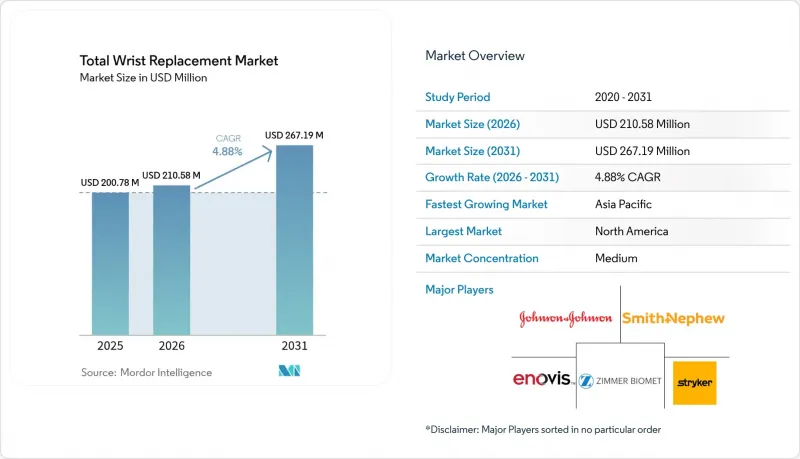
Mordor Intelligence에 의하면, 2026년 손목관절 전치환술 시장 총규모는 2억 1,058만 달러로 추정되고, 2025년 2억 78만 달러에서 확대해, 2031년에는 2억 6,719만 달러에 이를 것으로 예측됩니다.
2026-2031년 연평균 성장률(CAGR) 4.88%로 성장할 것으로 전망됩니다.
본 보고서는 기술별(손목 전체 치환술, 손목 전체 고정술), 소재별(코발트·크롬 합금, 티타늄 합금, 스테인리스 스틸 등), 최종 사용자별(병원, 외래수술센터(ASC), 전문 정형외과 클리닉), 지역별(북미, 유럽,아시아태평양, 중동 및 아프리카, 남미)로 분류되어 있습니다. 시장 전망은 금액(달러) 기준으로 제시되어 있습니다.
세계의 손목관절 전치환술 시장 동향 및 인사이트
류마티스 관절염 및 퇴행성 관절염 유병률 증가
미국에서는 250만 명이 류마티스 관절염을 앓고 있으며, 일반 인구의 13.6%가 손목 관절염을 앓고 있어 인공 관절 치환술의 대상이 되는 환자층이 확대되고 있습니다. 인구 통계학적 변화와 앉아서 하는 업무 습관으로 인해 질환의 조기 발병이 유발되어, 젊은 층의 경제적으로 활동적인 환자들 사이에서 치료 수요가 증가하고 있습니다. 비교 연구에 따르면, 합병증 양상에는 약간의 차이가 있지만, 관절 리메디시스와 비교했을 때 관절 성형술이 류마티스 관절염 환자 집단에서 더 우수한 기능적 결과를 가져온다는 것이 확인되어, 이 수술의 가치 제안이 더욱 강화되고 있습니다. 질환 수정 항류마티스제(DMARD)를 통해 관절의 건전성이 유지되게 되었지만, 생존 기간이 연장됨에 따라 가동성을 유지하기 위한 중재 조치에 대한 평생에 걸친 수요가 증가하고 있습니다. 실제 임상 현장에서 ‘유니버설 토탈 리스트’ 인공관절은 DASH(팔·어깨·손 기능 장애) 점수를 29% 개선하는 동시에 통증 점수를 66.3에서 6.7로 낮췄습니다. 이 결과는 환자들이 중요하게 여기는 우선순위와 부합합니다.
4세대 모듈형 임플란트의 발전
4세대 시스템은 90% 이상의 4년 생존율을 달성하여, 1세대 기기에서 나타난 42%라는 중기 성과를 훨씬 뛰어넘고 있습니다. 모듈식 트레이를 통해 외과의사는 수술 중 구성 요소의 크기를 조정할 수 있으므로, 정렬 불량 위험을 최소화하고 단계적인 재수술도 용이해집니다. 예를 들어, ‘Freedom’ 인공관절은 환자 만족도 점수에서 8.7/10을 기록하고 있지만, 이식 사례의 3분의 1에서 X선 상의 투과상이 관찰되므로 연 1회의 경과 관찰이 필요함이 밝혀졌습니다. 반강제형 타원체 관절을 통한 운동학적 개선으로, 수근골과 수근관절의 접합부 전체에 하중이 보다 고르게 분산됩니다. CoCrMo 및 Ti6Al4V 합금에 적용된 티타늄 질화물 코팅을 통해 감지 가능한 이온 방출이 사실상 배제되어, 장기적인 생체 적합성에 대한 우려를 해소하고 있습니다.
높은 수술 및 기기 비용/제한된 보험 급여
미국의 보험사들은 아직 손목 전체 치환술에 대한 전국적인 보험 적용 결정을 발표하지 않았으며, 외과의사는 사례별로 사전 승인을 받아야 합니다. 일부 민간 보험사는 류마티스 관절염 이외의 적응증에 대해서는 이 수술을 ‘실험적’으로 간주하여, 환자 수용 수를 제한하는 엄격한 기준을 적용하고 있습니다. 손목은 고관절이나 무릎에 비해 수술 건수가 적어 규모의 경제가 작용하기 어렵고, 규제상의 장벽도 상용화 비용을 상승시키고 있어 임플란트 가격은 여전히 높은 수준을 유지하고 있습니다. 포괄 지급 계약에 따라, 우수한 치료 성과로 인해 고품질 부품의 사용이 정당화되지 않는 한, 의료 기관은 임플란트 비용을 절감해야 하는 압박을 받고 있습니다. 많은 신흥 시장에서는 공적 보험자가 틈새 시장인 손목 수술보다 수술 건수가 많은 정형외과적 시술을 우선시하고 있어, 보험 적용이 지연되고 있습니다.
부문 분석
2025년에는 손목 전체 관절 고정술이 매출의 64.58%를 차지했으며, 신뢰할 수 있는 통증 관리와 예측 가능한 골유합에 대한 외과의사의 신뢰를 보여주었습니다. 대조적으로, 관절 성형술은 연평균 성장률(CAGR) 7.21%로 성장하고 있습니다. 이는 4세대 기기가 류마티스 관절염 환자군을 넘어 퇴행성 관절염 및 외상 후 적응증에서도 내구성을 입증하며 대상 환자층을 확대하고 있기 때문입니다. 3D 프린팅된 미세다공성 티타늄 인공관절(3DMT-Wrist)은 통증을 66.3에서 6.7로 경감시키는 동시에, 악력을 3배로 높이고 가동성을 보존하는 플랫폼에 대한 기대를 더욱 높이고 있습니다.
임상 메타분석에 따르면, 관절 치환술의 합병증 발생률은 19%로, 류마티스 관절염 사례에서 고정술의 발생률 17%와 거의 동일한 수준이며, 기존에 ‘실패 위험이 높다’고 여겨지던 인식을 뒤집고 있습니다. Re-motion 시스템이 달성한 97%라는 7년 생존율은 이러한 진전을 뒷받침하고 있지만, 수술을 받은 환자의 3분의 1은 여전히 2차적 개입이 필요합니다. 인공지능(AI) 기반 가이던스를 통해 나사의 궤적 및 구성 요소의 정렬에서 mm 단위의 정밀도가 실현되어 재현성이 향상되고 있습니다. 증거가 확고해짐에 따라, 손목 관절 전치환술 시장 규모는 2031년까지 다른 어떤 기술 분야보다 빠르게 확대될 전망입니다.
지역별 분석
북미는 2025년에 매출의 39.35%를 차지했으며, 계속해서 주도적인 위치를 유지하고 있습니다. 이는 CJR(Comprehensive Joint Replacement)과 같은 메디케어(Medicare)의 노력으로 평균 치료 당 비용이 절감되고, 복잡한 손목 임플란트에 대한 안정적인 보험 급여가 확보되고 있는 것이 배경입니다. 통합된 ‘센터 오브 엑설런스(Center of Excellence)’가 전국에서 환자를 유치하고 있는 한편, FDA 510(k) 기준이 명확해짐에 따라 임플란트의 단계적 업그레이드에 대한 장벽이 낮아지고 있습니다. 지불 기관의 압박에 힘입어 ASC(외래수술센터(ASC))가 확대됨에 따라, 환자 안전 지표를 저해하지 않으면서 수술 장소의 전환이 가속화되고 있습니다.
아시아태평양은 2031년까지 연평균 성장률(CAGR) 9.20%로 가장 높은 성장세를 기록하고 있습니다. 중국에서는 수술 건수의 다수와 현지 제조 능력이 결합되어, 현재 국산 임플란트가 수입품을 능가하는 입지를 확립했으며, 가격 대비 성능비가 획기적으로 향상되고 있습니다. 아시아태평양 손목 수술 협회를 통한 지식 공유와 다국적 펠로우십 교류를 통해 외과 수술의 모범 사례가 신속하게 확산되고 있습니다. 일본과 인도에서는 국민건강보험의 확대와 민간 병원 네트워크 구축으로 인해 지역 전체의 수치를 더욱 끌어올리고 있습니다.
유럽에서는 완만하지만 꾸준한 성장이 예상됩니다. 이 시장에서는 생존율 및 합병증 지표를 벤치마크로 삼는 엄격한 레지스트리를 통한 피드백 루프를 거쳐 체계적인 도입이 진행되고 있습니다. 2024년 에노비스(Enovis)가 리마 코퍼레이트(Rima Corporate)를 8억 유로에 인수함에 따라, 유럽의 제품 포트폴리오에 3D 프린팅 기술에 대한 전문 지식이 더욱 강화되어 해면골용 티타늄 임플란트의 보급이 촉진되고 있습니다. 국경을 초월한 연구 컨소시엄과 EU 전역에 적용되는 의료기기 지침이 결합되어, 환자 안전 확보 의무를 준수하면서도 첨단 임플란트로의 통합적인 길을 제시하고 있습니다.
기타 혜택 :
- 엑셀 형식 시장 예측(ME) 시트
- 3개월간의 애널리스트 지원
자주 묻는 질문
목차
제1장 서론
제2장 조사 방법
제3장 주요 요약
제4장 시장 구도
제5장 시장 규모 및 성장 예측
제6장 경쟁 구도
제7장 시장 기회 및 향후 전망
AJY 26.09.07According to Mordor Intelligence, total wrist replacement market size in 2026 is estimated at USD 210.58 million, growing from 2025 value of USD 200.78 million with 2031 projections showing USD 267.19 million, growing at 4.88% CAGR over 2026-2031.
This report is Segmented by Technology (Total Wrist Replacement, Total Wrist Fusion), Material (Cobalt-Chromium Alloys, Titanium Alloys, Stainless Steel, and More), End User (Hospitals, Ambulatory Surgical Centers, Specialty Orthopedic Clinics), and Geography (North America, Europe, Asia-Pacific, Middle East and Africa, South America). The Market Forecasts are Provided in Terms of Value (USD).
Global Total Wrist Replacement Market Trends and Insights
Rising Prevalence of Rheumatoid & Osteoarthritis
Rheumatoid arthritis affects 2.5 million individuals in the United States, and wrist arthritis is present in 13.6% of the general population, expanding the clinical pool eligible for arthroplasty. Shifting demographics and sedentary work habits bring the earlier onset of pathology that pushes treatment demand among younger, economically active patients. Comparative studies confirm that arthroplasty delivers better functional results than arthrodesis in rheumatoid cohorts despite slightly different complication profiles, strengthening the procedure's value proposition. Disease-modifying antirheumatic therapies now prolong joint integrity, yet prolonged survival raises the lifetime need for motion-preserving interventions. In practice, the Universal Total Wrist prosthesis improved Disabilities of the Arm, Shoulder and Hand (DASH) scores by 29% while cutting pain scores from 66.3 to 6.7, an outcome that resonates with patient-reported priorities.
Advancements in 4th-Generation Modular Implants
Fourth-generation systems provide four-year survival rates above 90%, dwarfing the 42% mid-term results seen in first-generation devices. Modular trays let surgeons tailor component sizes intraoperatively, minimizing malalignment risk and enabling easier staged revisions. The Freedom prosthesis, for instance, receives patient satisfaction scores of 8.7/10, but radiographic lucency in one-third of implants underlines the need for annual surveillance. Enhanced kinematics via semi-constrained ellipsoidal joints distribute load more evenly across the radiocarpal interface. Titanium-nitride coatings on CoCrMo and Ti6Al4V alloys virtually eliminate detectable ion release, responding to long-term biocompatibility concerns
High Procedure & Device Cost / Limited Reimbursement
U.S. payers have yet to publish national coverage determinations for total wrist arthroplasty, obliging surgeons to secure prior authorization case by case. Several private insurers label the operation experimental outside rheumatoid indications, enforcing restrictive criteria that limit patient throughput. Device prices remain elevated relative to hip and knee counterparts because smaller volumes offer fewer economies of scale, while regulatory hurdles raise commercialization costs. Bundled payment contracts push providers toward lower implant expenditures unless superior outcomes justify premium components. In many emerging markets, state payers favor high-volume orthopedic interventions over niche wrist procedures, delaying reimbursement inclusion.
Other drivers and restraints analyzed in the detailed report include:
- Preference for Motion-Preserving Procedures
- Expansion of Outpatient/ASC Arthroplasty
- High Revision & Complication Rates
For complete list of drivers and restraints, kindly check the Table Of Contents.
Segment Analysis
Total Wrist Fusion represented 64.58% revenue in 2025, illustrating surgeon trust in reliable pain control and predictable union. In contrast, arthroplasty rises at a 7.21% CAGR as fourth-generation devices prove durable beyond the rheumatoid cohort and into osteoarthritis as well as post-traumatic indications, enlarging the candidate base. The 3D-printed microporous titanium prosthesis (3DMT-Wrist) lowered pain from 66.3 to 6.7 while tripling grip strength, reinforcing momentum behind motion-preserving platforms.
Clinical meta-analyses place arthroplasty complications at 19%, nearly matching the 17% rate seen in fusion among rheumatoid cases, eroding historical perceptions of high failure risk. Seven-year survival of 97% achieved by the Re-motion system underscores progress, though one-third of recipients still face secondary interventions. Artificial-intelligence guidance now offers millimeter-level accuracy on screw trajectory and component alignment, enhancing reproducibility. As evidence solidifies, the total wrist replacement market size for arthroplasty is set to expand faster than any other technology segment through 2031.
Complete Report Scope:
- By Technology
- Total Wrist Replacement (TWR)
- Total Wrist Fusion (TWF)
- By Material
- Cobalt-Chromium Alloys
- Titanium Alloys
- Stainless Steel
- Ceramic-based Components
- Polymer Components
- By End User
- Hospitals
- Ambulatory Surgical Centers
- Specialty Orthopedic Clinics
- By Geography
- North America
- United States
- Canada
- Mexico
- Europe
- Germany
- United Kingdom
- France
- Italy
- Spain
- Rest of Europe
- Asia-Pacific
- China
- Japan
- India
- Australia
- South Korea
- Rest of Asia-Pacific
- Middle East & Africa
- GCC
- South Africa
- Rest of Middle East & Africa
- South America
- Brazil
- Argentina
- Rest of South America
- North America
Geography Analysis
North America maintains leadership with 39.35% revenue in 2025, supported by Medicare initiatives such as CJR that reduce average episode costs and create stable reimbursement for complex wrist implants. Consolidated centers of excellence draw volume nationally, while FDA 510(k) clarity lowers the hurdle for incremental implant upgrades. ASC expansion, driven by payer pressure, accelerates site-of-service conversions without diminishing patient safety metrics.
Asia-Pacific records the fastest 9.20% CAGR through 2031. China's high procedure volume, together with local manufacturing capability, now positions domestic implants ahead of imported counterparts, dramatically tightening price-performance ratios. Knowledge-sharing through the Asia Pacific Wrist Association plus multinational fellowship exchanges quickly diffuse surgical best practices. Japan and India further elevate regional numbers thanks to national insurance expansion and private-sector hospital networks.
Europe posts moderate, steady growth. The market benefits from methodical adoption following rigorous registry feedback loops that benchmark survivorship and complication metrics. The completion of Enovis's EUR 800 million purchase of LimaCorporate in 2024 brought additional 3D-printed expertise into continental portfolios, supporting take-up of trabecular titanium designs. Cross-border research consortia, combined with pan-EU medical-device directives, provide an integrated pathway for advanced implants while preserving patient safety obligations.
- Acumed
- Small Bone Innovations Inc.
- Zimmer Biomet
- Integra LifeSciences Holdings Corp.
- Johnson & Johnson
- Stryker
- Enovis
- Medartis
- Skeletal Dynamics LLC
- Anika Therapeutics
- Conmed
- Extremity Medical LLC
- Wright Medical Group
- Smiths Group
- Orthofix
- KeriMedical SA
- Avanta Orthopaedics
- MatOrtho Limited
- Signature Orthopaedics
- Stanmore Implants
- Biotechni SAS
- LimaCorporate S.p.A.
Additional Benefits:
- The market estimate (ME) sheet in Excel format
- 3 months of analyst support
TABLE OF CONTENTS
1 Introduction
- 1.1 Study Assumptions & Market Definition
- 1.2 Scope of the Study
2 Research Methodology
3 Executive Summary
4 Market Landscape
- 4.1 Market Overview
- 4.2 Market Drivers
- 4.2.1 Rising Prevalence of Rheumatoid & Osteoarthritis
- 4.2.2 Advancements in 4th-Generation Modular Implants
- 4.2.3 Preference for Motion-Preserving Procedures
- 4.2.4 Expansion of Outpatient/ASC Arthroplasty
- 4.2.5 Emergence of 3-D-Printed Patient-Specific Devices
- 4.2.6 Bundled-Payment Models Rewarding Outcomes
- 4.3 Market Restraints
- 4.3.1 High Procedure & Device Cost / Limited Reimbursement
- 4.3.2 High Revision & Complication Rates
- 4.3.3 Regulatory Caution After Device Withdrawals
- 4.3.4 Sparse Long-Term Evidence for Novel Biomaterials
- 4.4 Technological Outlook
- 4.5 Porter's Five Forces Analysis
- 4.5.1 Threat of New Entrants
- 4.5.2 Bargaining Power of Buyers
- 4.5.3 Bargaining Power of Suppliers
- 4.5.4 Threat of Substitutes
- 4.5.5 Intensity of Competitive Rivalry
5 Market Size & Growth Forecasts (Value in USD)
- 5.1 By Technology
- 5.1.1 Total Wrist Replacement (TWR)
- 5.1.2 Total Wrist Fusion (TWF)
- 5.2 By Material
- 5.2.1 Cobalt-Chromium Alloys
- 5.2.2 Titanium Alloys
- 5.2.3 Stainless Steel
- 5.2.4 Ceramic-based Components
- 5.2.5 Polymer Components
- 5.3 By End User
- 5.3.1 Hospitals
- 5.3.2 Ambulatory Surgical Centers
- 5.3.3 Specialty Orthopedic Clinics
- 5.4 By Geography
- 5.4.1 North America
- 5.4.1.1 United States
- 5.4.1.2 Canada
- 5.4.1.3 Mexico
- 5.4.2 Europe
- 5.4.2.1 Germany
- 5.4.2.2 United Kingdom
- 5.4.2.3 France
- 5.4.2.4 Italy
- 5.4.2.5 Spain
- 5.4.2.6 Rest of Europe
- 5.4.3 Asia-Pacific
- 5.4.3.1 China
- 5.4.3.2 Japan
- 5.4.3.3 India
- 5.4.3.4 Australia
- 5.4.3.5 South Korea
- 5.4.3.6 Rest of Asia-Pacific
- 5.4.4 Middle East & Africa
- 5.4.4.1 GCC
- 5.4.4.2 South Africa
- 5.4.4.3 Rest of Middle East & Africa
- 5.4.5 South America
- 5.4.5.1 Brazil
- 5.4.5.2 Argentina
- 5.4.5.3 Rest of South America
- 5.4.1 North America
6 Competitive Landscape
- 6.1 Market Concentration
- 6.2 Market Share Analysis
- 6.3 Company Profiles (includes Global level Overview, Market level overview, Core Segments, Financials as available, Strategic Information, Market Rank/Share for key companies, Products & Services, and Recent Developments)
- 6.3.1 Acumed LLC
- 6.3.2 Small Bone Innovations Inc.
- 6.3.3 Zimmer Biomet Holdings Inc.
- 6.3.4 Integra LifeSciences Holdings Corp.
- 6.3.5 DePuy Synthes (Johnson & Johnson)
- 6.3.6 Stryker Corporation
- 6.3.7 Enovis (DJO Global)
- 6.3.8 Medartis AG
- 6.3.9 Skeletal Dynamics LLC
- 6.3.10 Anika Therapeutics Inc.
- 6.3.11 CONMED Corporation
- 6.3.12 Extremity Medical LLC
- 6.3.13 Wright Medical Group NV
- 6.3.14 Smith & Nephew plc
- 6.3.15 Orthofix Medical Inc.
- 6.3.16 KeriMedical SA
- 6.3.17 Avanta Orthopaedics
- 6.3.18 MatOrtho Limited
- 6.3.19 Signature Orthopaedics
- 6.3.20 Stanmore Implants
- 6.3.21 Biotechni SAS
- 6.3.22 LimaCorporate S.p.A.
7 Market Opportunities & Future Outlook
- 7.1 White-space & Unmet-need Assessment