
|
시장보고서
상품코드
2122963
관절 치환술 시장 : 시장 점유율 분석, 업계 동향 및 통계, 성장 예측(2026-2031년)Joint Replacement - Market Share Analysis, Industry Trends & Statistics, Growth Forecasts (2026 - 2031) |
||||||
 Mordor Intelligence
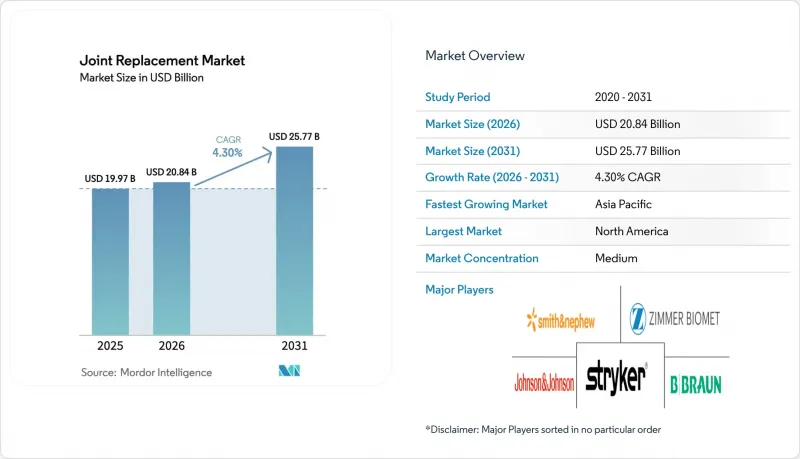
Mordor Intelligence에 의하면, 관절 치환술 시장 규모는 2025년 199억 7,000만 달러로 평가되었고, 2026년에는 208억 4,000만 달러로 추정되고, 2026-2031년 CAGR 4.30%로 성장을 지속할 전망이며, 2031년에는 257억 7,000만 달러에 이를 것으로 예측됩니다.
본 보고서는 수술 부위별(고관절, 무릎관절, 어깨관절, 발목관절, 팔꿈치관절, 기타), 제품별(임플란트, 골이식재·골대용재, 고정구·수술 기구, 기타), 기술별(기존 방식, 로봇 보조 방식, 내비게이션/AR 가이드 방식), 최종 사용자별(병원, 전문 정형외과 센터 등), 지역별(북미, 유럽, 아시아태평양 등)로 분류되어 있습니다. 시장 예측은 금액(달러)으로 제시되어 있습니다.
세계의 관절 치환술 시장 동향 및 인사이트
높은 퇴행성 관절염 유병률
‘세계 질병 부담(Global Burden of Disease)’ 조사에 따르면, 2021년 퇴행성 관절염 환자 수는 6억 700만 명으로 추산되며, 사람들의 수명이 연장되고 체질량 지수(BMI)가 상승함에 따라 2050년까지 무릎 관절 질환이 75% 증가할 것으로 예측됩니다. 또한, 퇴행성 관절염 유병률은 노화와 함께 증가합니다. 일본에서는 이미 65세 이상 인구가 전체 인구의 29%를 차지하고 있으며, 한국은 2025년에 ‘초고령 사회’에 진입할 전망이므로 관절 치환술 시장에 대한 수요는 견조하게 유지될 것입니다. 비만은 체중이 많은 환자에게 강화형 임플란트가 필요하게 하고 재수술 위험도 높이기 때문에 치료의 복잡화와 비용 증가를 초래합니다. 중국에서는 70세 이상 인구가 2050년까지 4억 200만 명에 달할 것으로 예상되지만, 수술 건수는 여전히 미국의 5분의 1 수준에 그치고 있어, 보험 제도 개혁이 성숙해지면 인공관절 치환술 시장에는 잠재적인 성장 여지가 생길 것입니다. 고령화, 비만, 그리고 보험 적용 범위 확대가 맞물려 장기적인 수술 건수 증가를 뒷받침하고 있지만, 일부 신흥국에서는 외과 의사 부족이나 멸균 처리 능력의 제약으로 인해 보급 속도가 둔화될 가능성이 있습니다.
최소 침습 및 로봇 보조 관절 치환술술에 대한 관심 증가
로봇 보조 인공 슬관절 치환술술은 플랫폼 비용의 하락과 수술 시간 단축으로 인해, 2020년에는 연간 100건 이상이 필요했던 반면, 2024년에는 연간 불과 24-50건으로 경제적인 손익분기점에 도달했습니다. 현재 지역 병원이나 외래수술센터(ASC)에서도 로봇이 도입되고 있으며, 각 벤더사는 임플란트와 소프트웨어를 세트로 판매함으로써 재구매 수요를 확보하고 있습니다. 임상 데이터에서는 정렬 개선과 탈구율 감소가 확인되었으며, 이에 따라 입원 기간 단축 및 90일 이내 재입원율 감소로 이어지는 로봇 수술에 대해 보험사의 보상 지급이 확대되고 있습니다. 2025년 NICE(영국 국립의료기술평가기구)의 지침에서는 로봇 정형외과 수술이 권장되었으며, NHS(영국 국민보건서비스)의 조달 계획이 촉진되었습니다. 증거가 축적됨에 따라 로봇 수술 체계를 갖추지 않은 병원은 환자 유입을 잃을 위험에 직면하고 있으며, 이로 인해 인공관절 치환술 시장은 기술 업그레이드 주기를 유지하게 될 것입니다.
부문 분석
어깨 수술은 과거 비수술적 치료가 이루어지던 골절 및 재수술에 대응하는 리버스 디자인 덕분에 2031년까지 연평균 성장률(CAGR) 5.1%로 확대되고 있습니다. 스트라이커(Stryker)사의 ‘Aequalis Perform+’ 및 지머(Zimmer)사의 관절와 재건 솔루션이 FDA 승인을 받음에 따라 적응증이 확대되었습니다. 10년 생존율은 95%에 달하며, 70세 이상 환자에 대한 해부학적 모델에서의 전환이 진행되고 있습니다. 무릎 관절 치환술술은 메디케어에 의한 안정적인 지급이 지속됨에 따라 2025년에도 여전히 관절 치환술 시장 점유율의 40.1%를 차지했지만, 미국 내 보급률이 북유럽 국가들의 포화 수준에 가까워짐에 따라 그 성장은 둔화되고 있습니다. 고관절 치환술술은 탈구를 40% 감소시키는 로봇 수술의 도입으로 혜택을 보고 있지만, 발목 관절 및 팔꿈치 관절은 여전히 틈새 시장으로 남아 있습니다. 다만, 3D 프린팅 임플란트가 복잡한 해부학적 구조에 대응할 수 있게 됨에 따라 이러한 분야도 확대될 가능성이 있습니다.
기존 임플란트의 수명이 다함에 따라, 합성 및 동종 이식편을 이용한 대체 재료 시장은 연평균 성장률(CAGR) 4.9%로 성장하고 있습니다. 탈회 매트릭스와 인산칼슘 세라믹에 대한 FDA 승인은 외과의사들의 신뢰를 높이고 있습니다. 기증자 선별 과정의 개선으로 감염 위험은 낮아졌으나, 공급이 부족하기 때문에 조직 은행에 가격 결정권이 부여되고 있습니다. 2025년에는 임플란트가 관절 치환술 시장 규모의 61%를 차지했으나, 1건당 이식편 사용량이 증가함에 따라 그 점유율은 감소할 가능성이 있습니다. 고분자 폴리에틸렌 및 세라믹 헤드(head)는 마모를 절반으로 줄여주며, 한편 일회용 기구 키트는 외래수술센터(ASC)의 멸균 비용을 절감합니다.
지역별 분석
2025년, 북미는 전 세계 매출의 45.6%를 차지했습니다. 이는 미국에서 인구 1,000명당 7.2건에 달하는 높은 인공 슬관절 전치환술 시행률과, 대당 100만 달러를 초과하는 로봇 콘솔 판매에 힘입은 결과입니다. 2024년 1월, 메디케어·메디케이드 서비스 센터(CMS)가 인공 고관절 전치환술을 입원 환자 전용 목록에서 제외한 이후, 더 많은 수술이 외래 환경으로 전환되면서 병원의 이익률이 압박을 받았고, 유통업체의 통합이 진행되었습니다. 캐나다의 공적 의료 제도에서는 2024년에 인공 고관절 치환술술의 대기 기간이 12개월(중앙값)에 달하자, 환자들이 국경 근처의 미국 외래수술센터(ASC)로 몰려들었습니다. 멕시코 티후아나와 몬테레이에 위치한 의료 관광 거점에서는 2024년에 4만 5,000명의 관절 치환술술 환자를 수용했으며, ISO 13485 인증을 획득한 임플란트를 미국 가격의 절반에 제공했습니다. 2024년 FDA가 에틸렌옥사이드 잔류량 과다를 이유로 23건의 경고장을 발부함에 따라 신제품 출시가 최대 9개월 지연되면서, 이 지역의 성장은 공급 부족에 직면해 있습니다.
아시아태평양은 연평균 성장률(CAGR) 4.5%로 성장하며, 모든 지역 중 가장 높은 성장세를 보이고 있습니다. 2024년 65세 이상 인구가 29%를 차지하는 일본의 초고령화 사회가 뒷받침되어, 같은 해 인공 슬관절 치환술술 총 건수는 18만 건에 달했습니다. 이는 시멘트리스 다공성 임플란트에 대한 보험 환급 제도 변경이 호재로 작용하여 2020년 대비 12% 증가한 결과입니다. 중국에서는 2025년까지 도시 지역 주민의 95%가 인공관절 치환술술 보험 적용 대상이 되도록 확대되어 추가적인 호재가 되었습니다. 인도에서는 JCI 인증 병원의 존재와 서유럽 수준보다 60% 저렴한 임플란트 가격 덕분에 2024년에 첸나이와 뭄바이에 12만 명의 해외 환자가 방문했습니다. 한국에서는 2025년부터 보험사가 역어깨 관절 치환술술 비용을 지급하기 시작하여, 회전근개 손상 환자에 대한 치료 접근성이 가능해졌습니다. 한편, 호주에서는 2024년에 로봇 시스템 승인 기간을 9개월로 단축하여, 기업들이 미국이나 EU에서의 승인과 같은 분기에 현지 판매를 시작할 수 있게 되었습니다.
유럽에서는 의료기기 규정(MDR) 준수에 드는 비용이 제품군당 평균 200만 유로에 달하고, CE 마크 취득까지의 기간이 약 2년으로 길어지면서 성장이 둔화되고 있습니다. 독일과 프랑스에서는 여전히 많은 고관절 재치환술이 시행되고 있습니다. 독일의 등록 자료에 따르면, 2024년 수술 건수는 2만 8,000건이었으며, 그 중 40%는 구형 금속 대 금속 임플란트로 인한 코발트·크롬 파편과 관련이 있었습니다. 영국 국민보건서비스(NHS)가 2025년 무릎 관절 임플란트 가격을 15% 인하하도록 협상함에 따라, 각 제조업체는 이익률을 유지하기 위해 민간 보험을 통한 판매량에 의존할 수밖에 없는 상황입니다. 중동 및 아프리카에서는 정부의 지출이 호재로 작용하고 있습니다. 사우디아라비아의 ‘비전 2030’은 정형외과 센터 건설에 100억 달러를 투자하여 2028년까지 연간 5만 건의 관절 치환술술을 시행하는 것을 목표로 하고 있습니다. 남미에서는 브라질이 중심이 되고 있으며, 2024년에는 국민 중 27%가 민간 보험에 가입해 있었습니다. 공립 병원에서는 18개월이 넘는 대기 시간이 발생하고 있어, 민간 시설이 프리미엄 임플란트에 대한 수요를 흡수하고 있습니다.
기타 혜택 :
- 엑셀 형식 시장 예측(ME) 시트
- 3개월간의 애널리스트 지원
자주 묻는 질문
목차
제1장 서론
제2장 조사 방법
제3장 주요 요약
제4장 시장 구도
제5장 시장 규모 및 성장 예측
제6장 경쟁 구도
제7장 시장 기회 및 향후 전망
AJY 26.09.07According to Mordor Intelligence, the joint replacement market size is expected to grow from USD 19.97 billion in 2025 to USD 20.84 billion in 2026 and is forecast to reach USD 25.77 billion by 2031 at 4.30% CAGR over 2026-2031.
This report is Segmented by Procedure (Hip, Knee, Shoulder, Ankle, Elbow, Others), Product (Implants, Bone Grafts & Substitutes, Fixation & Instrumentation, Others), Technology (Conventional, Robotic-Assisted, Navigation/AR-Guided), End User (Hospitals, Specialty Orthopedic Centers, and More), and Geography (North America, Europe, Asia-Pacific, and More). Market Forecasts are Provided in Value (USD).
Global Joint Replacement Market Trends and Insights
High Osteoarthritis Prevalence
The Global Burden of Disease study counted 607 million osteoarthritis cases in 2021, and forecasts a 75% increase in knee disease by 2050 as people live longer and body-mass-index levels rise. Furthermore, the prevalence of osteoarthritis increases with age. Japan already has 29% of its citizens aged 65 plus, while South Korea will be super-aged in 2025, producing steady joint replacement market demand. Obesity adds complexity and cost, because heavier patients need reinforced implants and face higher revision risk. China's over-70 cohort is set to reach 402 million by 2050, yet procedure rates remain one-fifth of U.S. levels, creating latent joint replacement market upside once insurance reforms mature. The combined effects of aging, obesity, and broader coverage underpin long-run volume growth, although surgeon shortages and sterile processing capacity could slow uptake in some emerging economies.
Growing Preference for Minimally Invasive and Robotic-Assisted TJA
Robotic total knee arthroplasty reached economic break-even at only 24-50 cases annually in 2024, versus 100-plus in 2020, as platform costs fell and OR times shortened. Community hospitals and ASCs now adopt robots, while vendors bundle implants and software to lock in repeat business. Clinical data show better alignment and lower dislocation rates, pushing payers to reimburse robotic procedures that shorten stays and reduce 90-day readmissions. NICE guidance in 2025 endorsed robotic orthopedics, prompting NHS procurement plans . As evidence accumulates, hospitals without robotic capacity risk losing referrals, keeping the joint replacement market on a technology-upgrade cycle.
Other drivers and restraints analyzed in the detailed report include:
- Accelerated Post-Op Rehab Protocols Boosting Outpatient TJA Volumes
- 3D-Printed Patient-Specific Implants Cutting Revision Risk
- High Procedure & Implant Cost
- Revision-Surgery Burden from Metal Hypersensitivity Claims
For complete list of drivers and restraints, kindly check the Table Of Contents.
Segment Analysis
Shoulder procedures are growing at a 5.1% CAGR to 2031 as reverse designs address fractures and revisions once treated non-operatively. FDA clearance of Stryker's Aequalis Perform+ and Zimmer's glenoid reconstruction solutions widened indications. Ten-year survivorship reaches 95%, shifting surgeons from anatomic models for patients over 70. Knee replacement still held 40.1% joint replacement market share in 2025 due to consistent Medicare payment, yet its growth slows as U.S. penetration nears northern European saturation levels. Hip arthroplasty benefits from robotic adoption that cuts dislocations by 40%, while ankle and elbow remain niche but may expand as 3D-printed devices solve complex anatomies.
Synthetic and allograft substitutes are advancing at 4.9% CAGR as older implants reach end-of-life. FDA clearances for demineralized matrices and calcium phosphate ceramics bolster surgeon confidence . Improved donor screening lowered infection risk, but tight supply gives tissue banks pricing power. Implants captured 61% of the joint replacement market size in 2025, though share may slip as graft content per case rises. Highly cross-linked polyethylene and ceramic heads halve wear, while single-use instrument kits cut ASC sterilization costs.
Complete Report Scope:
- By Procedure
- Hip Replacement
- Knee Replacement
- Shoulder Replacement
- Ankle Replacement
- Elbow Replacement
- Others
- By Product
- Implants
- Metallic
- Ceramic
- Polymeric & Hybrid Biomaterials
- Bone Grafts & Substitutes
- Autograft
- Allograft
- Synthetic
- Fixation & Instrumentation
- Others
- Implants
- By Technology
- Conventional
- Robotic-Assisted
- Navigation / AR-Guided
- By End User
- Hospitals
- Specialty Orthopaedic Centres
- Ambulatory Surgery Centres
- By Geography
- North America
- United States
- Canada
- Mexico
- Europe
- Germany
- United Kingdom
- France
- Italy
- Spain
- Rest of Europe
- Asia-Pacific
- China
- Japan
- India
- Australia
- South Korea
- Rest of Asia-Pacific
- Middle East & Africa
- GCC
- South Africa
- Rest of Middle East & Africa
- South America
- Brazil
- Argentina
- Rest of South America
- North America
Geography Analysis
North America held 45.6% of global revenue in 2025, supported by the United States' high procedure rate of 7.2 total knee arthroplasties per 1,000 people and the sale of robotic consoles priced above USD 1 million each. After the Centers for Medicare & Medicaid Services removed total hip arthroplasty from the inpatient-only list in January 2024, more surgeries shifted to outpatient settings, tightening hospital margins and prompting distributor consolidation. Canada's publicly funded system posted a 12-month median wait for hip replacement in 2024, steering patients to U.S. ambulatory surgery centers near the border. Mexico's medical-tourism hubs in Tijuana and Monterrey treated 45,000 joint-replacement patients in 2024, offering ISO 13485-certified implants at half of U.S. prices. Regional growth faces a supply pinch because the FDA issued 23 warning letters for excess ethylene oxide residue in 2024, delaying new product launches by up to nine months.
Asia-Pacific is growing at a 4.5% CAGR, the fastest among all regions. Japan's super-aged profile, with 29% of residents at least 65 in 2024, helped lift total knee procedures to 180,000 that year, a 12% rise since 2020, after reimbursement changes rewarded cementless porous implants. China expanded insurance to cover 95% of urban residents for joint replacement by 2025, adding further momentum. India drew 120,000 overseas patients to Chennai and Mumbai in 2024, thanks to JCI-accredited hospitals and implant prices 60% below Western levels. South Korea's insurer began paying for reverse shoulder arthroplasty in 2025, opening access for rotator-cuff cases, while Australia cut approval times for robotic systems to nine months in 2024, letting firms launch locally in the same quarter as U.S. and EU clearances.
In Europe, Medical Device Regulation compliance now averages EUR 2 million per product family and extends CE-mark timelines to about two years, slowing growth. Germany and France still perform many hip revisions: the German registry logged 28,000 in 2024, 40% tied to cobalt-chromium debris from older metal-on-metal implants. The United Kingdom's National Health Service negotiated a 15% price cut on knee implants for 2025, pushing manufacturers to rely on private-pay volumes to protect margins. The Middle East and Africa gain from government spending. Saudi Arabia's Vision 2030 commits USD 10 billion to build orthopedic centers, aiming for 50,000 annual joint replacements by 2028. South America centers on Brazil, where private insurance covered 27% of citizens in 2024. Public hospitals face wait times longer than 18 months, so private facilities capture demand for premium implants.
- Arthrex
- B. Braun
- Bioimpianti Srl
- Conformis
- Corin Group
- DePuy Synthes
- Enovis
- Exactech
- Globus Medical
- Kyocera Medical
- LimaCorporate
- Medacta Group
- MicroPort
- Smiths Group
- Stryker
- United Orthopedic Corp.
- Uteshiya Medicare
- Waldemar Link
- Zimmer Biomet
Additional Benefits:
- The market estimate (ME) sheet in Excel format
- 3 months of analyst support
TABLE OF CONTENTS
1 Introduction
- 1.1 Study Assumptions & Market Definition
- 1.2 Scope of the Study
2 Research Methodology
3 Executive Summary
4 Market Landscape
- 4.1 Market Overview
- 4.2 Market Drivers
- 4.2.1 High Osteoarthritis Prevalence
- 4.2.2 Rising Geriatric Population
- 4.2.3 Growing Preference for Minimally-Invasive and Robotic-Assisted TJA
- 4.2.4 Accelerated Post-Op Rehab Protocols Boosting Outpatient TJA Volumes
- 4.2.5 3D-Printed Patient-Specific Implants Cutting Revision Risk
- 4.2.6 Strategic Reshoring of Titanium and Cobalt Alloy Supply Chains
- 4.3 Market Restraints
- 4.3.1 High Procedure & Implant Cost
- 4.3.2 Availability of Pharmacological and Arthroscopic Alternatives
- 4.3.3 Revision-Surgery Burden from Metal Hypersensitivity Claims
- 4.3.4 Capacity Bottlenecks in Sterilization and Clean-Room Machining
- 4.4 Supply Chain Analysis
- 4.5 Regulatory Landscape
- 4.6 Technological Outlook
- 4.7 Porter's Five Forces Analysis
- 4.7.1 Bargaining Power of Buyers
- 4.7.2 Bargaining Power of Suppliers
- 4.7.3 Threat of New Entrants
- 4.7.4 Threat of Substitutes
- 4.7.5 Competitive Rivalry
5 Market Size & Growth Forecasts (Value, USD)
- 5.1 By Procedure
- 5.1.1 Hip Replacement
- 5.1.2 Knee Replacement
- 5.1.3 Shoulder Replacement
- 5.1.4 Ankle Replacement
- 5.1.5 Elbow Replacement
- 5.1.6 Others
- 5.2 By Product
- 5.2.1 Implants
- 5.2.1.1 Metallic
- 5.2.1.2 Ceramic
- 5.2.1.3 Polymeric & Hybrid Biomaterials
- 5.2.2 Bone Grafts & Substitutes
- 5.2.2.1 Autograft
- 5.2.2.2 Allograft
- 5.2.2.3 Synthetic
- 5.2.3 Fixation & Instrumentation
- 5.2.4 Others
- 5.2.1 Implants
- 5.3 By Technology
- 5.3.1 Conventional
- 5.3.2 Robotic-Assisted
- 5.3.3 Navigation / AR-Guided
- 5.4 By End User
- 5.4.1 Hospitals
- 5.4.2 Specialty Orthopaedic Centres
- 5.4.3 Ambulatory Surgery Centres
- 5.5 By Geography
- 5.5.1 North America
- 5.5.1.1 United States
- 5.5.1.2 Canada
- 5.5.1.3 Mexico
- 5.5.2 Europe
- 5.5.2.1 Germany
- 5.5.2.2 United Kingdom
- 5.5.2.3 France
- 5.5.2.4 Italy
- 5.5.2.5 Spain
- 5.5.2.6 Rest of Europe
- 5.5.3 Asia-Pacific
- 5.5.3.1 China
- 5.5.3.2 Japan
- 5.5.3.3 India
- 5.5.3.4 Australia
- 5.5.3.5 South Korea
- 5.5.3.6 Rest of Asia-Pacific
- 5.5.4 Middle East & Africa
- 5.5.4.1 GCC
- 5.5.4.2 South Africa
- 5.5.4.3 Rest of Middle East & Africa
- 5.5.5 South America
- 5.5.5.1 Brazil
- 5.5.5.2 Argentina
- 5.5.5.3 Rest of South America
- 5.5.1 North America
6 Competitive Landscape
- 6.1 Market Concentration
- 6.2 Market Share Analysis
- 6.3 Company Profiles (includes Global level Overview, Market level overview, Core Segments, Financials as available, Strategic Information, Market Rank/Share for key companies, Products & Services, and Recent Developments)
- 6.3.1 Arthrex
- 6.3.2 B. Braun
- 6.3.3 Bioimpianti Srl
- 6.3.4 Conformis
- 6.3.5 Corin Group
- 6.3.6 DePuy Synthes
- 6.3.7 Enovis
- 6.3.8 Exactech
- 6.3.9 Globus Medical
- 6.3.10 Kyocera Medical
- 6.3.11 LimaCorporate
- 6.3.12 Medacta Group
- 6.3.13 MicroPort Scientific
- 6.3.14 Smith & Nephew
- 6.3.15 Stryker
- 6.3.16 United Orthopedic Corp.
- 6.3.17 Uteshiya Medicare
- 6.3.18 Waldemar Link
- 6.3.19 Zimmer Biomet
7 Market Opportunities & Future Outlook
- 7.1 White-space & Unmet-need Assessment