

|
시장보고서
상품코드
2122251
어깨 인공관절 치환술 시장 : 시장 점유율 분석, 업계 동향 및 통계, 성장 예측(2026-2031년)Shoulder Replacement - Market Share Analysis, Industry Trends & Statistics, Growth Forecasts (2026 - 2031) |
||||||
 Mordor Intelligence
Mordor Intelligence에 의하면, 2026년 어깨 인공관절 치환술 시장 규모는 23억 9,000만 달러로 추정되고, 2025년 22억 4,000만 달러에서 확대해, 2031년에는 32억 9,000만 달러에 이를 것으로 예측됩니다.
2026-2031년 연평균 성장률(CAGR) 6.6%로 성장할 것으로 전망됩니다.
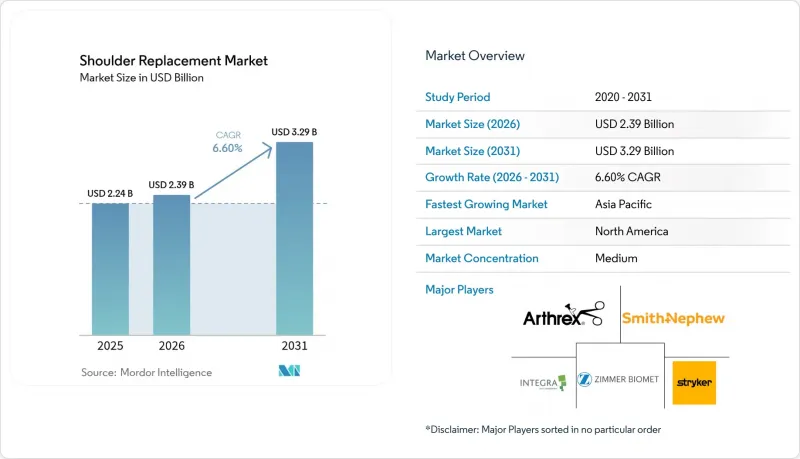
본 보고서는 제품 유형별(해부학적 인공관절, 리버스 인공관절 등), 수술법별(표면 치환형 반관절 치환술, 스템이 있는 반관절 치환술 등), 고정법별(시멘트 고정 등), 최종 사용자별(병원, 정형외과 센터 등), 지역별(북미, 유럽,아시아태평양, 중동 및 아프리카, 남미)로 분류되어 있습니다. 시장 예측은 금액(달러) 기준으로 제시되어 있습니다.
세계의 어깨 인공관절 치환술 시장 동향 및 인사이트
관절염 유병률 증가
관절염은 미국에서만 5,400만 명의 성인에게 영향을 미치고 있으며, 현재 어깨 관절 퇴행성 관절염은 해부학적 인공관절 치환술로 의뢰되는 사례의 비율을 증가시키고 있습니다. 회전근개 병변이 있는 환자의 연골 퇴행 가속화는 종종 복잡한 리버스 수술로 이어져, 대상 환자층을 확대시키고 있습니다. 고해상도 영상 진단을 통한 조기 발견으로 인해 더 젊은 연령층에서 수술 적응증이 증가하는 한편, 메디케어 적용 범위 확대로 인해 적격 사례에 대한 경제적 장벽이 제거되고 있습니다. 관리되지 않은 관절염 통증에 수반되는 경제적 부담-생산성 저하, 장기적인 치료, 오피오이드 사용-은 근치적 관절 치환술의 가치를 더욱 높이고 있습니다. 이러한 요인들이 복합적으로 작용하여 의료 접근성이 확보된 지역 전반에 걸쳐 수술 건수의 꾸준한 증가를 뒷받침하고 있습니다.
인공관절 설계의 기술적 진보
2024년에 FDA 승인을 받은 Smith+Nephew사와 Zimmer Biomet사의 스템리스 시스템은 골량을 보존하고 인공관절 주변 골절의 위험을 줄여줍니다. 리버스 설계에는 현재 삼각근의 역학적 기능을 회복시키는 외측화 및 원위화 원리가 통합되어 있으며, 파이로는카본 재질의 상완골두는 피질골의 탄성 계수에 근접하기 때문에 코발트-크롬 재질의 제품에 비해 관절와 침식을 줄여줍니다. 외과의들은 관절와에 정확하게 고정되도록 보장하기 위해, 수술 전 3D 계획과 수술 중 트래커를 연동하는 내비게이션 플랫폼을 점점 더 많이 활용하고 있습니다. 이러한 기술의 융합을 통해 임플란트의 수명이 연장되고, 첨단 연구 개발에 적극적으로 투자하는 공급업체와의 차별화가 이루어지고 있습니다.
수술 후 합병증 및 임플란트 이완
노르웨이의 장기 데이터에 따르면, 역형 인공관절 치환술의 합병증 발생률은 14.3%이며, 그 주요 원인으로 불안정성과 감염에 따른 재수술이 꼽히고 있습니다. 해부학적 설계 사례에서는 2년 이내에 최대 48%에서 관절와 이완이 관찰되어, 고정 전략에 대한 우려가 커지고 있습니다. 금속 백킹 컴포넌트와 폴리에틸렌 인서트의 조합은 재치환 위험이 높기 때문에 모노블록 폴리에틸렌이나 하이브리드 설계로의 전환이 진행되고 있습니다. 메디케어 수급자를 대상으로 한 인공관절 치환술 후 5년 사망률은 16.6%에 달하며, 이는 동반 질환이 치료 결과에 큰 영향을 미칩니다는 사실을 다시 한번 보여줍니다. 설계의 지속적인 개선과 엄격한 감염 관리 프로토콜의 철저한 이행이 여전히 최우선 과제입니다.
부문 분석
2025년 매출액 중 해부학적 인공관절이 65.78%를 차지했으나, 리버스 시스템은 연평균 성장률(CAGR) 6.95%로 그 격차를 좁히고 있습니다. 외과의사들은 회전근개가 건강한 환자에게 해부학적 임플란트를 선호합니다. 이는 이러한 기기가 정상적인 운동학을 재현하고 상완골을 보존하기 때문입니다. 스템리스형은 골수강 준비를 생략하고 향후 재치환 수술을 단순화함으로써 수술 시간을 단축합니다. 리버스 임플란트는 회전근개 결손 사례, 불안정 골절 및 재치환 수술에서 주류를 이루고 있으며, 10년 생존율은 88%를 초과합니다.
설계 발전은 회전 중심을 외측으로 이동시키고 관절와를 원위부로 이동시키는 데 중점을 두고 있으며, 이를 통해 삼각근의 장력이 증가하고 가동 범위가 확대됩니다. 인레이형 리버스 시스템은 관절강 노출을 단순화하는 반면, 온레이형 플랫폼은 골 결손이 있는 사례에서 더 큰 안정성을 제공합니다. 모듈형 플랫폼은 현재 해부학적 구성과 리버스 구성 모두를 지원하며, 추가 재고 없이도 수술 중 선택 변경이 가능합니다. 이러한 발전으로 적응증이 확대되었으며, 전체 어깨 인공관절 치환술 시장에서 구성 가능한 솔루션을 제공하는 기업의 경쟁력이 강화되고 있습니다.
2025년에도 전체 어깨 인공관절 치환술술은 수십 년에 걸친 치료 성과 데이터와 외과 의사들 사이에서 폭넓은 인지도를 바탕으로 매출의 43.92%를 계속 차지했습니다. 한편, 리버스형 인공 어깨 인공관절 치환술은 복잡한 힘줄 파열성 관절증, 골절, 재재치환술과 같은 사례를 통해 연평균 성장률(CAGR) 7.95%로 수술 건수 증가를 주도하고 있습니다. 표면 치환형 반관절 치환술은 인공관절 전치환술을 미룰 가능성이 있는 젊은 운동선수의 국소성 연골 병변에 여전히 유용하지만, 리버스형 치환술이 통증 완화 및 기능 회복 면에서 더 우수하다는 것이 입증됨에 따라 스템이 포함된 반관절 치환술은 감소 추세를 보이고 있습니다.
리버스 전 어깨 인공관절 치환술술로의 전환 경향은 힘줄의 복합 이식을 통해 32°의 외회전 가동 범위를 회복할 수 있어 일상생활 동작이 향상된다는 근거를 반영하고 있습니다. 로봇 보조 플랫폼은 해부학적 접근법과 리버스 접근법 모두의 워크플로우를 지원하며, 기구를 통일함으로써 학습 곡선을 단축시키고 있습니다. 외래 수술로의 전환은 더 이상 첫 수술 시의 해부학적 증례에만 국한되지 않습니다. 신중하게 선택된 리버스 수술은 동등한 안전성을 확보한 상태에서 현재는 당일 퇴원이 가능해졌습니다. 이러한 수술법의 다양성은 성장을 다양한 임상 적응증으로 분산시킴으로써 어깨 인공관절 치환술 시장에 탄력성을 부여하고 있습니다.
지역별 분석
북미는 성숙한 보험 지급 제도와 미국에서만 연간 약 5만 3,000건의 관절 치환술이 시행되고 있다는 점을 배경으로, 2025년에도 39.35%의 매출 점유율을 유지하며 선두 자리를 지키고 있습니다. CMS(미국 의료보험센터)가 어깨 인공관절 치환술을 ASC(외래수술센터(ASC))의 보험 적용 목록에 추가함에 따라 수술의 전환이 가속화되고 있으며, 전국적인 관절 레지스트리가 근거에 기반한 임플란트 선정을 지원하고 있습니다. 캐나다에서는 수술실 수용 능력을 확대하여 선택적 수술 대기 건수를 해소하기 위해 노력하고 있는 반면, 멕시코에서는 비용 차이를 활용하여 해외 환자를 유치하고 있습니다.
아시아태평양은 병원 인프라 확충, 중산층 소득 증가, 그리고 합리적인 가격의 정형외과 솔루션을 추구하는 정부 정책에 힘입어 2031년까지 8.12%라는 가장 높은 연평균 성장률(CAGR)을 보일 것으로 전망됩니다. 중국의 수량 기준 조달 제도로 인해 입원 비용이 절반으로 줄어들어, 품질을 희생하지 않고도 임플란트에 대한 접근성이 확대되고 있습니다. 일본에서는 초고령화 사회가 진행되는 한편 엄격한 규제 감독이 이루어지고 있지만, 그럼에도 불구하고 수술 수요는 증가하고 있습니다. 인도의 민간 병원 체인은 의료 관광에 주력하고 있으며, ‘메이크 인 인디아(Make in India)’ 정책의 틀 아래 고급 임플란트를 수입하는 동시에 국내 생산을 추진하고 있습니다. 호주는 인구 규모에 비해 임상시험 분야에서 계속해서 높은 존재감을 보이고 있으며, 신기술의 조기 도입 기회를 제공합니다. 유럽에서는 공공·민간 시스템을 불문하고 꾸준한 보급이 이루어지고 있습니다. 독일의 제조거점은 국내 높은 보급률을 뒷받침하고 있는 반면, 영국은 브렉시트에 따른 규제 재편에도 불구하고 관절 치환술에 대한 조사를 지속하고 있습니다. 프랑스와 이탈리아에서는 재입원율을 증가시키지 않으면서 입원 일수를 단축하는 ‘조기 회복 프로토콜’의 개선이 진행되고 있습니다. 북유럽의 등록 데이터는 수술 기법과 치료 결과의 상관관계를 밝혀주는 상세한 데이터를 제공하며, 전 세계 진료 패턴의 지침이 되고 있습니다. 유럽 의료기기 규정(MDR)으로 인해 승인까지의 기간은 연장되었지만, 안전성을 중시하는 이 규정의 입장은 차세대 임플란트에 대한 지역적 신뢰를 높일 가능성이 있습니다. 이러한 지역별 동향이 결합되어, 개별 정책 변동으로 인한 충격으로부터 어깨 인공관절 치환술 시장을 보호하는 다양한 수익원이 확보되고 있습니다.
기타 혜택 :
- 엑셀 형식 시장 예측(ME) 시트
- 3개월간의 애널리스트 지원
자주 묻는 질문
목차
제1장 서론
제2장 조사 방법
제3장 주요 요약
제4장 시장 구도
제5장 시장 규모 및 성장 예측
제6장 경쟁 구도
제7장 시장 기회 및 향후 전망
AJY 26.09.07According to Mordor Intelligence, shoulder replacement market size in 2026 is estimated at USD 2.39 billion, growing from 2025 value of USD 2.24 billion with 2031 projections showing USD 3.29 billion, growing at 6.6% CAGR over 2026-2031.
This report is Segmented by Product Type (Anatomical Prosthesis, Reverse Prosthesis, and More), Procedure (Resurfacing Hemiarthroplasty, Stemmed Hemiarthroplasty, and More), Fixation (Cemented, and More), End User (Hospitals, Orthopedic Centers, and More), and Geography (North America, Europe, Asia-Pacific, Middle East and Africa, South America). The Market Forecasts are Provided in Terms of Value (USD).
Global Shoulder Replacement Market Trends and Insights
Growing Prevalence of Arthritis
Arthritis afflicts 54 million adults in the United States alone, and glenohumeral osteoarthritis now triggers a rising share of anatomic arthroplasty referrals. Accelerated cartilage degeneration in patients with rotator-cuff pathology often progresses to complex reverse procedures, broadening the addressable base. Earlier detection through high-resolution imaging increases surgical candidacy at younger ages, while Medicare coverage expansion removes financial barriers for qualified cases. The economic burden of unmanaged arthritic pain-lost productivity, prolonged therapy, and opioid use-reinforces the value proposition of definitive joint replacement. Collectively, these factors anchor steady procedural volume growth across regions with established healthcare access.
Technological Advances in Prosthesis Design
Stemless systems from Smith + Nephew and Zimmer Biomet, cleared by the FDA in 2024, conserve bone stock and lower periprosthetic fracture risk. Reverse designs now incorporate lateralization and distalization principles that restore deltoid mechanics, and pyrocarbon humeral heads approximate cortical bone modulus, reducing glenoid erosion relative to cobalt-chromium alternatives. Surgeons increasingly rely on navigation platforms that marry 3D preoperative plans with intraoperative trackers to ensure precise glenoid seating. These converging technologies deliver longer implant survival and differentiate suppliers prepared to invest in advanced R&D.
Post-Operative Complications & Implant Loosening
Long-term data from Norway cite 14.3% complication rates for reverse arthroplasty, with instability and infection driving revisions. Glenoid loosening manifests in up to 48% of anatomic cases within two years, raising concerns about fixation strategies. Metal-backed components paired with polyethylene inserts exhibit elevated revision risk, prompting shifts toward monoblock polyethylene or hybrid designs. Five-year mortality after arthroplasty reaches 16.6% among Medicare beneficiaries, a reminder that comorbidities significantly influence outcomes. Continuous design refinement and rigorous infection-control protocols remain paramount.
Other drivers and restraints analyzed in the detailed report include:
- Expanding Geriatric Population & Life Expectancy
- Growth of Outpatient Arthroplasty Programs
- High Procedure & Implant Costs
For complete list of drivers and restraints, kindly check the Table Of Contents.
Segment Analysis
Anatomical prostheses supplied 65.78% of 2025 revenue, yet reverse systems are closing the gap at a 6.95% CAGR. Surgeons favor anatomical implants for patients with intact rotator cuffs because these devices imitate normal kinematics and preserve humeral bone. Stemless variants shorten operative time by sidestepping canal preparation and simplifying future revision. Reverse implants dominate cuff-deficient cases, unstable fractures, and revisions, boasting 10-year survival above 88%.
Design evolution centers on lateralized centers of rotation and distalized glenospheres, which boost deltoid tension and extend range of motion. Inlay reverse systems simplify glenoid exposure, whereas onlay platforms provide incremental stability in cases with bone loss. Modular platforms now accommodate both anatomical and reverse configurations, permitting intraoperative decision shifts without additional inventory. These advancements broaden indications and reinforce the competitive posture of companies delivering configurable solutions across the shoulder replacement market.
Total shoulder replacement maintained 43.92% revenue in 2025, supported by decades of outcome data and widespread surgeon familiarity. Reverse total shoulder replacement, however, propels volume expansion at 7.95% CAGR through complex tear arthropathy, fractures, and re-revision pathways. Resurfacing hemiarthroplasty remains relevant for focal chondral lesions in young athletes who may postpone total replacement, while stemmed hemiarthroplasty has receded as reverse alternatives demonstrate higher pain relief and function.
The trajectory toward reverse total procedures reflects evidence that combined tendon transfers can regain 32° of external rotation, enhancing daily living activities. Robotic platforms support both anatomical and reverse workflows, unifying instrumentation and reducing learning curves. Outpatient migration is no longer limited to primary anatomical cases; carefully selected reverse procedures are now discharged the same day with equivalent safety profiles. This procedural diversity injects resilience into the shoulder replacement market by dispersing growth across varied clinical indications.
Complete Report Scope:
- By Product Type
- Anatomical Prosthesis
- Stemmed Anatomical
- Stemless Anatomical
- Reverse Prosthesis
- Inlay Reverse
- Onlay Reverse
- Stemless Reverse
- Hybrid/Biological Prosthesis
- Anatomical Prosthesis
- By Procedure
- Resurfacing Hemiarthroplasty
- Stemmed Hemiarthroplasty
- Total Shoulder Replacement
- Reverse Total Shoulder Replacement
- Partial Shoulder Replacement
- By Fixation
- Cemented
- Cementless
- Hybrid
- By End User
- Hospitals
- Orthopedic Centers
- Ambulatory Surgical Centers
- Specialty Clinics
- By Geography
- North America
- United States
- Canada
- Mexico
- Europe
- Germany
- United Kingdom
- France
- Italy
- Spain
- Rest of Europe
- Asia-Pacific
- China
- Japan
- India
- Australia
- South Korea
- Rest of Asia-Pacific
- Middle East & Africa
- GCC
- South Africa
- Rest of Middle East & Africa
- South America
- Brazil
- Argentina
- Rest of South America
- North America
Geography Analysis
North America retains primacy with a 39.35% revenue share in 2025, underpinned by mature reimbursement structures and roughly 53,000 annual arthroplasty procedures in the United States alone. CMS inclusion of total shoulder replacement in the ASC covered list amplifies procedural migration, while national joint registries support evidence-based device selection. Canada confronts elective surgery backlogs by increasing theater capacity, whereas Mexico leverages cost differentials to attract international patients.
Asia-Pacific posts the fastest CAGR at 8.12% to 2031, fueled by hospital infrastructure expansion, rising middle-class income, and government policies that seek affordable orthopedic solutions. China's volume-based procurement has reduced inpatient costs by half, enabling broader access to implants without sacrificing quality. Japan's super-aged society magnifies procedure demand even as it exercises strict regulatory oversight. India's private hospital chains pursue medical tourism, importing high-end implants while promoting indigenous manufacturing under the "Make in India" framework. Australia continues to punch above its population weight in clinical trials, offering early adoption opportunities for new technologies. Europe records steady uptake across public and private systems. Germany's manufacturing base underwrites high domestic adoption, while the United Kingdom persists in joint replacement research despite Brexit regulatory realignment. France and Italy refine enhanced recovery protocols that trim length of stay without increasing readmissions. Nordic registries provide granular data that illuminate technique-outcome correlations, guiding global practice patterns. Although the European Medical Device Regulation has extended approval timelines, its emphasis on safety may elevate regional confidence in next-generation implants. Collectively, these regional patterns assure diversified revenue streams that insulate the shoulder replacement market from isolated policy shocks.
- Arthrex
- Zimmer Biomet
- Integra LifeSciences
- Johnson & Johnson
- Smiths Group
- Wright Medical Group
- Stryker
- Enovis Corporation (DJO Global)
- Acumed
- Exactech
- LimaCorporate S.p.A
- Conmed
- B. Braun
- Medacta International
- Stryker
- Apex Biomedical
- Globus Medical
- FH Orthopedics
- Biotechni SAS
- Ascension Orthopedics
Additional Benefits:
- The market estimate (ME) sheet in Excel format
- 3 months of analyst support
TABLE OF CONTENTS
1 Introduction
- 1.1 Study Assumptions & Market Definition
- 1.2 Scope of the Study
2 Research Methodology
3 Executive Summary
4 Market Landscape
- 4.1 Market Overview
- 4.2 Market Drivers
- 4.2.1 Growing Prevalence of Arthritis
- 4.2.2 Technological Advances in Prosthesis Design
- 4.2.3 Expanding Geriatric Population & Life Expectancy
- 4.2.4 Growth of Outpatient Arthroplasty Programs
- 4.2.5 AI-Driven Patient-Specific Instrumentation
- 4.2.6 Rising Sports-Injury Cases Driving Young Demand
- 4.3 Market Restraints
- 4.3.1 Post-Operative Complications & Implant Loosening
- 4.3.2 High Procedure & Implant Costs
- 4.3.3 Volatile Supply of Medical-Grade Metals & UHMWPE
- 4.3.4 Stricter Approval Cycles for Reverse Prostheses
- 4.4 Technological Outlook
- 4.5 Porter's Five Forces Analysis
- 4.5.1 Threat of New Entrants
- 4.5.2 Bargaining Power of Buyers
- 4.5.3 Bargaining Power of Suppliers
- 4.5.4 Threat of Substitute Products
- 4.5.5 Intensity of Competitive Rivalry
5 Market Size & Growth Forecasts (Value in USD)
- 5.1 By Product Type
- 5.1.1 Anatomical Prosthesis
- 5.1.1.1 Stemmed Anatomical
- 5.1.1.2 Stemless Anatomical
- 5.1.2 Reverse Prosthesis
- 5.1.2.1 Inlay Reverse
- 5.1.2.2 Onlay Reverse
- 5.1.2.3 Stemless Reverse
- 5.1.3 Hybrid/Biological Prosthesis
- 5.1.1 Anatomical Prosthesis
- 5.2 By Procedure
- 5.2.1 Resurfacing Hemiarthroplasty
- 5.2.2 Stemmed Hemiarthroplasty
- 5.2.3 Total Shoulder Replacement
- 5.2.4 Reverse Total Shoulder Replacement
- 5.2.5 Partial Shoulder Replacement
- 5.3 By Fixation
- 5.3.1 Cemented
- 5.3.2 Cementless
- 5.3.3 Hybrid
- 5.4 By End User
- 5.4.1 Hospitals
- 5.4.2 Orthopedic Centers
- 5.4.3 Ambulatory Surgical Centers
- 5.4.4 Specialty Clinics
- 5.5 By Geography
- 5.5.1 North America
- 5.5.1.1 United States
- 5.5.1.2 Canada
- 5.5.1.3 Mexico
- 5.5.2 Europe
- 5.5.2.1 Germany
- 5.5.2.2 United Kingdom
- 5.5.2.3 France
- 5.5.2.4 Italy
- 5.5.2.5 Spain
- 5.5.2.6 Rest of Europe
- 5.5.3 Asia-Pacific
- 5.5.3.1 China
- 5.5.3.2 Japan
- 5.5.3.3 India
- 5.5.3.4 Australia
- 5.5.3.5 South Korea
- 5.5.3.6 Rest of Asia-Pacific
- 5.5.4 Middle East & Africa
- 5.5.4.1 GCC
- 5.5.4.2 South Africa
- 5.5.4.3 Rest of Middle East & Africa
- 5.5.5 South America
- 5.5.5.1 Brazil
- 5.5.5.2 Argentina
- 5.5.5.3 Rest of South America
- 5.5.1 North America
6 Competitive Landscape
- 6.1 Market Concentration
- 6.2 Market Share Analysis
- 6.3 Company Profiles (includes Global level Overview, Market level overview, Core Segments, Financials as available, Strategic Information, Market Rank/Share for key companies, Products & Services, and Recent Developments)
- 6.3.1 Arthrex Inc.
- 6.3.2 Zimmer Biomet Holdings Inc.
- 6.3.3 Integra LifeSciences Holdings Corporation
- 6.3.4 Johnson & Johnson (DePuy Synthes)
- 6.3.5 Smith & Nephew plc
- 6.3.6 Wright Medical Group N.V.
- 6.3.7 Stryker Corporation
- 6.3.8 Enovis Corporation (DJO Global)
- 6.3.9 Acumed LLC
- 6.3.10 Exactech Inc.
- 6.3.11 LimaCorporate S.p.A
- 6.3.12 Conmed Corporation
- 6.3.13 B. Braun Melsungen AG
- 6.3.14 Medacta International
- 6.3.15 Stryker Corporation
- 6.3.16 Apex Biomedical
- 6.3.17 Globus Medical Inc.
- 6.3.18 FH Orthopedics
- 6.3.19 Biotechni SAS
- 6.3.20 Ascension Orthopedics
7 Market Opportunities & Future Outlook
- 7.1 White-space & Unmet-Need Assessment


