

|
시장보고서
상품코드
2122264
GaN RF 반도체 소자 : 시장 점유율 분석, 업계 동향과 통계, 성장 예측(2026-2031년)GaN RF Semiconductor Devices - Market Share Analysis, Industry Trends & Statistics, Growth Forecasts (2026 - 2031) |
||||||
 Mordor Intelligence
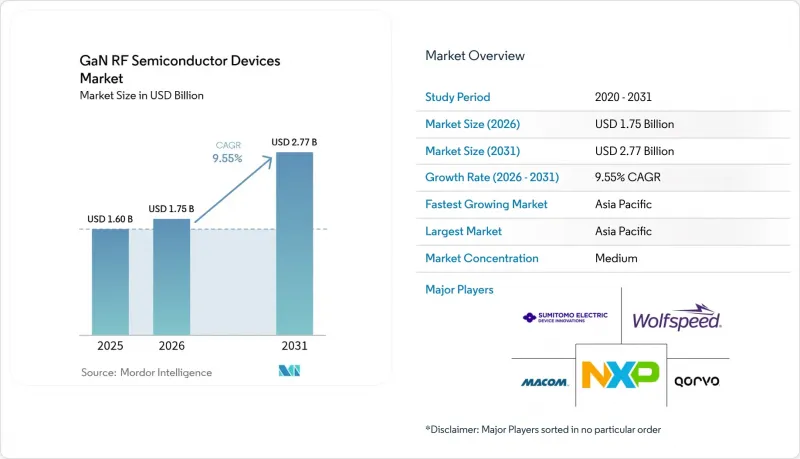
Mordor Intelligence에 의하면, 2026년 GaN RF 반도체 소자 시장 규모는 17억 5,000만 달러로 추정되며, 2025년 16억 달러에서 성장하여 2031년에는 27억 7,000만 달러에 달할 것으로 예측됩니다.
또한, 2026-2031년 연평균 성장률(CAGR) 9.55%를 기록할 전망입니다.
본 보고서는 용도별(방위 및 항공우주, 통신 인프라, 기타), 소자 유형별(디스크리트 RF 파워 트랜지스터, MMIC/모노리식 전력 증폭기, 기타), 기판 기술별(GaN-on-SiC, GaN-on-Si, 기타),주파수 대역별(VHF/UHF(1GHz 미만), L/S 밴드(1-4GHz), 기타), 지역별(북미, 남미, 유럽, 아시아태평양, 중동 및 아프리카)로 분류되어 있습니다.
전 세계 GaN RF 반도체 소자 시장 동향 및 인사이트
아시아태평양의 5G 매크로셀 및 스몰셀 구축
중국, 한국, 일본 전역에 도입된 Massive-MIMO 기지국 아키텍처는 최대 64채널의 전력 증폭기에 의존하고 있으며, 여기서 갈륨 질화물은 LDMOS에 비해 15-20%의 에너지 효율 향상을 실현하여 사이트 수준의 운영 비용을 절감했습니다. Open-RAN의 표준화로 인해 무선 하드웨어와 벤더 간의 유대 관계가 더욱 약화되면서, 전문 GaN 공급업체들이 원격 무선 헤드(RRH) 업그레이드 시장에서 점유율을 확보할 수 있게 되었습니다. 차이나모바일의 사상 최대 규모의 도입을 통해 실제 환경에서의 신뢰성이 입증되었으며, Qorvo의 0.013%라는 고장률은 통신 사업자들의 신뢰를 더욱 공고히 했습니다. 200mm 웨이퍼로의 전환에 따른 USD/W 출력의 점진적인 감소로, GaN RF 반도체 디바이스 시장은 지방 및 실내 깊숙한 곳에 위치한 스몰 셀 계층으로의 추가적인 침투를 위한 기반을 마련했습니다. 통신 사업자의 에너지 절약 목표는 GaN의 낮은 발열 특성과 부합하며, 부품 가격보다 효율 지표를 중시하는 조달 체계 구축을 촉진했습니다.
미국/EU의 AESA 레이더 현대화를 위한 자금 조달
미국 국방부는 GaN을 ‘제조 준비 수준 10’으로 상향 조정하고, 2024-2025년에 걸쳐 차세대 레이더 프로그램에 30억 달러 이상을 배정했습니다. 이로 인해 고출력 모노리식 마이크로파 집적 회로(MMIC)의 다년간에 걸친 생산 확대가 촉발되었습니다. 유럽의 각 부처도 장거리 모니터링 및 전자전 시스템의 갱신 주기를 통해 이러한 추세를 따랐습니다. 이 과정에서 GaN의 뛰어난 전력 밀도 덕분에 감지 범위와 전파 방해 효과가 향상되었습니다. 허니웰(Honeywell)이 해군의 저대역 송신기를 GaN으로 개조하는 2,990만 달러 규모의 계약을 수주한 것은 노후화 완화와 주파수 대역의 유연성을 우선시하는 태도를 여실히 보여줍니다. 200W/mm의 열유속을 견디는 패키징 기술의 획기적인 발전은 하류 상용 통신 무선기로 파급되어, GaN RF 반도체 소자 시장을 국방 부문의 범위를 넘어 확장시켰습니다.
6GHz 이하 대역 기지국에서 LDMOS 대비 비용 프리미엄
2024년, 6GHz 이하 무선기용 GaN 파워 앰프는 LDMOS에 비해 40%의 가격 차이가 있었으며, 운용 개시 후 18개월 이내에 에너지 절약 효과로 그 차이가 메워질 것임에도 불구하고 신흥 시장에서의 전환은 지연되었습니다. Texas Instruments의 8인치 GaN-on-Si 제조로의 전환으로 다이 비용은 10% 이상 절감되었지만, 거시경제적 압박이 여전히 통신 사업자의 설비 투자를 억제하고 있었으며, 특히 인도와 동남아시아 일부 지역에서 이러한 경향이 두드러졌습니다. 그 결과, 통신 장비 OEM 업체들은 듀얼 소싱 전략을 유지하며 LDMOS 공급량을 유지하는 한편, GaN RF 반도체 소자 시장의 단기적인 성장 여지를 제한하게 되었습니다.
부문 분석
통신 인프라는 2025년 매출의 42.65%를 차지하며 GaN RF 반도체 소자 시장의 기반을 형성했습니다. 기지국 벤더들은 설치 면적을 축소하고 매크로 무선 유닛에서 55.2%의 드레인 효율이라는 벤치마크를 달성하기 위해 GaN을 채택했습니다. 이를 통해 냉각 부하를 줄이고 타워 상단의 무게를 경감할 수 있었으며, 이는 고밀도 5G 구축에 있어 매우 중요한 요소가 되었습니다. Open-RAN에 따른 디어그리게이션으로 인해 독립형 파워 앰프 전문 기업들이 설계 수주를 확보하는 움직임이 나타난 반면, 소이텍의 특수 기판은 삽입 손실을 줄이고 사이트당 커버리지를 향상시켰습니다. 통신 사업자가 GaN 프런트엔드를 전제로 한 6G 서브-THz 파일럿 테스트를 실시함에 따라, GaN RF 반도체 디바이스 시장은 2025년 내내 성장세를 유지했습니다. 자동차용 레이더는 2024년 기준에서 시장 점유율이 소폭에 그쳤으나, 2031년까지 연평균 성장률(CAGR) 17.95%로 확대될 것으로 예측됩니다. 중국의 첨단 운전자 지원 시스템 의무화와 한국의 커넥티드카 생태계가 79GHz 이미징 레이더 수요를 뒷받침했습니다. 이 부문에서 GaN은 신뢰성을 저해하지 않으면서 mm파 대역의 전력 밀도를 충족시켰습니다. GaN PA-LNA 모듈을 탑재한 V2X 통신 시범 프로젝트는 향후 생산량 확대를 예고하고 있습니다. 200mm GaN-on-Si 웨이퍼와 연계된 비용 절감 로드맵은 주류 자동차 전자 기기와의 호환성을 보장하며, 보다 광범위한 GaN RF 반도체 디바이스 시장에 규모를 가져왔습니다. 방위 및 항공우주 부문에서는 레이더, 전자전, 위성 통신 페이로드 분야에서 GaN의 내방사선성과 출력 전력이 활용되었습니다. 가전 분야에서는 Wi-Fi 7 라우터 및 휴대전화 프런트엔드에 GaN PA가 채택되어, 소신호 부문에서의 가능성이 입증되었습니다. 산업용 로봇 부문에서는 GaN HEMT를 전원원으로 사용하는 6.78MHz 무선 충전 송신기가 채택되어, 수익원을 다각화하는 부문 간 확산이 강조되었습니다.
디스크리트 파워 트랜지스터는 2025년에 45.75%의 점유율을 차지하며, 레이더, 방송, 매크로셀 무선 기기에서 확립된 설계 도입 주기를 반영했습니다. MACOM의 제품 포트폴리오는 2W에서 7kW에 이르기까지 GaN RF 반도체 디바이스 시장을 뒷받침하는 확장성을 보여주었습니다. 방열 성능이 강화된 볼트다운형 패키징은 80% 이상의 드레인 효율을 실현하여, 가혹한 작동 사이클 하에서도 디바이스의 수명을 연장했습니다. 모노리식 마이크로파 집적 회로(MMIC) 파워 앰프는 가장 빠른 성장세를 보였으며, 2031년 연평균 성장률(CAGR)은 18.65%로 예측됩니다. 위상 배열 모듈, 공간 제약이 있는 위성 통신 단말기, 밀리파 백홀 무선기에서는 이득 단과 바이어스 네트워크를 소형 다이에 집약한 MMIC가 선호되었습니다. Qorvo의 광대역 QPA2210D는 이러한 추세를 상징하는 제품으로, 이산 소자에 비해 6dB 더 높은 전력 부가 효율을 실현했습니다. RF 스위치 및 프런트엔드 모듈에서는 핫 스위칭 부하에 대응하기 위해 강화 모드 GaN 트랜지스터가 채택된 반면, C-밴드 위성 링크에서는 저잡음 증폭기가 GaAs를 대체하기 시작하면서 GaN RF 반도체 산업 시장 전망을 넓히고 있습니다.
지역별 분석
아시아태평양은 2025년 매출의 33.80%를 차지하며 1위를 차지할 것으로 보이며, 2031년까지 연평균 성장률(CAGR) 17.80%를 나타낼 것으로 예측됩니다. 중국의 5G 기지국 급증, 현지 GaN 파운드리 확충, ‘제3의 반도체 붐’에 따른 정책 지원이 이 지역의 자급자족화를 촉진했습니다. 한국은 AI 센터와 자동차용 레이더에 주력한 반면, 일본은 가전 부문에서의 실적과 SiC 기판공급 역량을 활용했습니다. 대만의 고도화된 백엔드 서비스는 GaN-on-Si의 비용 최적화를 가속화하여 GaN RF 반도체 소자 시장의 성장 주기를 강화했습니다.
북미는 미국의 국방 예산과 위성 인터넷 메가 콘스텔레이션에 힘입어 2위를 차지했습니다. Polar Semiconductor의 미네소타주 GaN-on-Si 프로젝트 등 국내 팹에 대한 정부 자금은 공급망의 회복력을 뒷받침했습니다. 캐나다의 통신 인프라 현대화와 멕시코의 자동차 전자기기 클러스터는 대륙 차원 수요 다각화를 이끌어내며, 지역 GaN RF 반도체 소자 시장을 단일 부문의 변동으로부터 보호했습니다.
유럽에서는 자동차용 레이더 부문의 리더십과 에너지 효율이 뛰어난 산업용 드라이브가 결합되어 성장을 이뤘습니다. 독일은 79GHz 대역 차량용 센서 도입을 주도했고, 프랑스는 항공우주 부문의 페이로드를 중시했으며, 영국은 주파수 대역을 주축으로 한 전자전 능력 강화를 우선시했습니다. EU의 전략적 자립에 관한 지원책에 따라 IQE-X-FAB의 650V GaN 플랫폼 등 합작 사업에 보조금이 투입되어, EU 역내 GaN RF 반도체 소자 시장 규모 확대를 뒷받침하는 지역 밀착형 밸류체인이 육성되었습니다.
브라질에서의 도입 확대, 걸프협력회의(GCC) 회원국에서의 스마트시티 구축, 호주의 저지구궤도 백홀 검사는 이 기술의 세계적 보급 궤적을 보여주었습니다.
기타 혜택
- 엑셀 형식 시장 예측(ME) 시트
- 3개월간의 애널리스트 지원
자주 묻는 질문
목차
제1장 서론
제2장 조사 방법
제3장 주요 요약
제4장 시장 구도
제5장 시장 규모와 성장 예측
제6장 경쟁 구도
제7장 시장 기회와 향후 전망
LSH 26.09.04According to Mordor Intelligence, the GaN RF semiconductor devices market size in 2026 is estimated at USD 1.75 billion, growing from 2025 value of USD 1.60 billion with 2031 projections showing USD 2.77 billion, growing at 9.55% CAGR over 2026-2031.
This report is Segmented by Application (Defense and Aerospace, Telecom Infrastructure, and More), Device Type (Discrete RF Power Transistors, MMIC / Monolithic Power Amplifiers, and More), Substrate Technology (GaN-On-SiC, GaN-On-Si, and More), Frequency Band (VHF / UHF (<1 GHz), L / S-Band (1-4 GHz), and More), and Geography (North America, South America, Europe, Asia-Pacific, and Middle East and Africa).
Global GaN RF Semiconductor Devices Market Trends and Insights
5G macro- and small-cell roll-outs accelerate GaN adoption
Massive-MIMO base-station architectures installed across China, Korea, and Japan relied on up to 64 power-amplifier channels, where gallium nitride delivered a 15-20% energy-efficiency uplift versus LDMOS, cutting site-level operating costs. Open-RAN standardization further decoupled radio hardware from system vendors, enabling specialist GaN suppliers to win sockets for remote-radio-head upgrades. Record deployments by China Mobile validated field reliability, while Qorvo's 0.013% failure rate reinforced operator confidence. Progressive reductions in USD/W output through 200 mm wafer migration positioned the GaN RF semiconductor devices market for broader penetration of rural and deep-indoor small-cell layers. Telecom carriers' energy-saving targets aligned with GaN's lower heat dissipation, catalyzing procurement frameworks that rewarded efficiency metrics over component price.
U.S./EU AESA radar modernization drives high-power demand
The U.S. Department of Defense elevated GaN to Manufacturing Readiness Level 10 and allocated more than USD 3 billion for next-generation radar programs between 2024-2025, triggering multi-year production ramps for high-power monolithic microwave integrated circuits (MMICs). European ministries mirrored this trajectory through long-range surveillance and electronic-warfare refresh cycles, where GaN's superior power density increased detection range and jamming effectiveness. Honeywell's USD 29.9 million contract to retrofit Navy low-band transmitters with GaN exemplified obsolescence mitigation and spectrum agility priorities. Packaging breakthroughs that survived 200 W/mm heat flux migrated downstream to commercial telecom radios, expanding the GaN RF semiconductor devices market beyond defense silos.
Cost premium tempers penetration in price-sensitive deployments
In 2024, GaN power amplifiers carried a 40% price delta over LDMOS for sub-6 GHz radios, delaying transitions in emerging markets, even though energy savings absorbed the gap within 18 months of operation. Texas Instruments' move to 8-inch GaN-on-Si fabrication lowered die cost by more than 10%, but macroeconomic pressures still constrained carrier capex, especially in India and parts of Southeast Asia. Telecom OEMs, therefore, maintained dual-sourcing strategies, sustaining LDMOS volume and limiting near-term upside for the GaN RF semiconductor devices market.
Other drivers and restraints analyzed in the detailed report include:
- LEO/MEO sat-com constellation payload demand
- mmWave automotive imaging radar adoption in China and South Korea
- Epi-wafer and substrate shortages create production chokepoints
For complete list of drivers and restraints, kindly check the Table Of Contents.
Segment Analysis
Telecom infrastructure accounted for 42.65% of 2025 revenue, anchoring the GaN RF semiconductor devices market. Base-station vendors adopted GaN to unlock smaller footprints and a 55.2% drain efficiency benchmark in macro radio units. This translates to reduced cooling loads and lower tower-top weight, critical for dense 5G rollouts. Open-RAN disaggregation encouraged independent power-amplifier specialists to capture design wins, while Soitec's engineered substrates reduced insertion losses, boosting coverage per site. The GaN RF semiconductor devices market retained momentum through 2025 as operators trialed 6 G sub-THz pilots that presupposed GaN front ends.Automotive radar remained a modest slice in 2024 but is forecast to expand at an 17.95% CAGR to 2031. China's mandatory advanced-driver-assistance mandates and South Korea's connected-car ecosystem spurred demand for 79 GHz imaging radar, where GaN handled millimeter-wave power density without compromising reliability. V2X communication pilots incorporating GaN PA-LNA modules amplify volume prospects. Cost-down roadmaps tied to 200 mm GaN-on-Si wafers promised alignment with mainstream vehicle electronics, creating scale for the wider GaN RF semiconductor devices market.Across defense and aerospace, radar, electronic warfare, and sat-com payloads drew on GaN's radiation tolerance and output power. Consumer electronics adopted GaN PAs for Wi-Fi 7 routers and handset front ends, validating smaller-signal opportunities. Industrial robotics embraced 6.78 MHz wireless-charging transmitters powered by GaN HEMTs, underscoring cross-sector breadth that diversified revenue streams.
Discrete power transistors captured 45.75% share in 2025, reflecting entrenched design-in cycles across radar, broadcast, and macro-cell radios. MACOM's portfolio spanned 2 W to 7 kW, illustrating scalability that underpinned the GaN RF semiconductor devices market. Thermal-enhanced bolt-down packages supported >80% drain efficiency, extending device lifetimes in harsh duty cycles.Monolithic microwave integrated-circuit power amplifiers delivered the fastest growth, projected at 18.65% CAGR through 2031. Phased-array modules, space-constrained sat-com terminals, and mmWave backhaul radios favored MMICs that collapsed gain stages and bias networks into compact dies. Qorvo's wideband QPA2210D exemplified this trend, offering 6 dB higher power-added efficiency versus discrete alternatives. RF switches and front-end modules employed enhancement-mode GaN transistors to handle hot-switching stresses, while low-noise amplifiers began displacing GaAs in C-Band satellite links, broadening the GaN RF semiconductor devices industry landscape.
Complete Report Scope:
- By Application
- Defense and Aerospace
- Telecom Infrastructure
- Consumer Electronics
- Automotive (ADAS, V2X)
- Industrial and Energy
- Data Centers and High-Efficiency Power Links
- By Device Type
- Discrete RF Power Transistors
- MMIC / Monolithic Power Amplifiers
- RF Switches and Front-End Modules
- Low-Noise and Driver Amplifiers
- By Substrate Technology
- GaN-on-SiC
- GaN-on-Si
- GaN-on-Diamond and Advanced Composites
- By Frequency Band
- VHF / UHF (<1 GHz)
- L / S-Band (1-4 GHz)
- C / X-Band (4-12 GHz)
- Ku / Ka-Band (12-40 GHz)
- mmWave (>40 GHz, incl. 5G FR2)
- By Geography
- North America
- United States
- Canada
- Mexico
- South America
- Brazil
- Argentina
- Rest of South America
- Europe
- Germany
- United Kingdom
- France
- Italy
- Spain
- Rest of Europe
- Asia-Pacific
- China
- Japan
- South Korea
- India
- Taiwan
- Rest of Asia-Pacific
- Middle East and Africa
- Middle East
- Saudi Arabia
- United Arab Emirates
- Turkey
- Rest of Middle East
- Africa
- South Africa
- Rest of Africa
- Middle East
- North America
Geography Analysis
Asia-Pacific led with 33.80% of 2025 revenue and is projected to advance at an 17.80% CAGR through 2031. China's 5 G base-station surge, local GaN foundry build-outs, and policy support under the "third semiconductor wave" catalyzed regional self-reliance. Korea focused on AI-centers and automotive radar, while Japan leveraged consumer-electronics legacy and SiC substrate supply. Taiwan's advanced backend services accelerated GaN-on-Si cost optimization, reinforcing the GaN RF semiconductor devices market growth loop.
North America ranked second, buoyed by the U.S. defense budget and satellite-internet mega constellations. Government funding for domestic fabs, such as Polar Semiconductor's Minnesota GaN-on-Si project, supported supply-chain resiliency. Canada's telecom revamps and Mexico's automotive-electronics clusters created continental demand diversity that insulated the regional GaN RF semiconductor devices market from single-sector volatility.
Europe combined automotive radar leadership with energy-efficient industrial drives. Germany spearheaded 79 GHz vehicle sensor roll-outs, France emphasized aerospace payloads, and the United Kingdom prioritized spectrum-dominated electronic-warfare upgrades. EU strategic autonomy packages channelled grants to joint ventures such as IQE-X-FAB's 650 V GaN platform, nurturing a localized value chain that underpinned the GaN RF semiconductor devices market size expansion in the bloc.
Emerging adoption across Brazil, Gulf Cooperation Council smart-city rollouts, and Australia's low-Earth-orbit backhaul trials showcased the technology's global diffusion trajectory.
- Wolfspeed, Inc.
- Qorvo, Inc.
- Sumitomo Electric Device Innovations
- NXP Semiconductors N.V.
- MACOM Technology Solutions - GaN-on-SiC
- Broadcom Inc.
- Infineon Technologies AG
- RFHIC Corp.
- Ampleon Netherlands B.V.
- Mitsubishi Electric Corporation
- Fujitsu Ltd. (GaN RF)
- Northrop Grumman Microelectronics
- Integra Technologies, Inc.
- Analog Devices Inc.
- WIN Semiconductors Corp.
- Finwave Semiconductor Inc.
- Tagore Technology Inc.
- Guerrilla RF
- SEDI - Silent-Solutions Engineering (EU)
- Teledyne e2v HiRel
Additional Benefits:
- The market estimate (ME) sheet in Excel format
- 3 months of analyst support
TABLE OF CONTENTS
1 INTRODUCTION
- 1.1 Study Assumptions and Market Definition
- 1.2 Scope of the Study
2 RESEARCH METHODOLOGY
3 EXECUTIVE SUMMARY
4 MARKET LANDSCAPE
- 4.1 Market Overview
- 4.2 Market Drivers
- 4.2.1 5G Macro- and Small-Cell Roll-outs across Asia-Pacific
- 4.2.2 U.S./EU AESA Radar Modernization Funding
- 4.2.3 LEO / MEO Sat-Com Constellation Payload Demand
- 4.2.4 mmWave Automotive Imaging Radar Adoption in China and South Korea
- 4.2.5 High-Power Wireless Charging for Industrie 4.0 Robotics
- 4.2.6 Rapid Proliferation of Open-RAN Remote Radio Heads
- 4.3 Market Restraints
- 4.3.1 Cost Premium vs. LDMOS in Sub-6 GHz Base-Stations
- 4.3.2 SiC Encroachment in >3 kW Tactical Radar Blocks
- 4.3.3 Epi-wafer and Sub-strate Supply Bottlenecks (150 and 200 mm)
- 4.3.4 Thermal Management and Reliability at >200 W/mm
- 4.4 Value Chain Analysis
- 4.5 Technological Outlook
- 4.5.1 GaN-on-Si Mass-Production and 200 mm Transition
- 4.6 Regulatory Outlook
- 4.6.1 ITU and FCC Spectrum Releases for 5G/6G and Radar
- 4.7 Porter's Five Forces Analysis
- 4.7.1 Bargaining Power of Buyers
- 4.7.2 Bargaining Power of Suppliers
- 4.7.3 Threat of New Entrants
- 4.7.4 Threat of Substitutes
- 4.7.5 Intensity of Competitive Rivalry
- 4.8 RF-GaN Patent Landscape
- 4.9 Imapct of Macroeconomic Factors on the Market
5 MARKET SIZE AND GROWTH FORECASTS (VALUE)
- 5.1 By Application
- 5.1.1 Defense and Aerospace
- 5.1.2 Telecom Infrastructure
- 5.1.3 Consumer Electronics
- 5.1.4 Automotive (ADAS, V2X)
- 5.1.5 Industrial and Energy
- 5.1.6 Data Centers and High-Efficiency Power Links
- 5.2 By Device Type
- 5.2.1 Discrete RF Power Transistors
- 5.2.2 MMIC / Monolithic Power Amplifiers
- 5.2.3 RF Switches and Front-End Modules
- 5.2.4 Low-Noise and Driver Amplifiers
- 5.3 By Substrate Technology
- 5.3.1 GaN-on-SiC
- 5.3.2 GaN-on-Si
- 5.3.3 GaN-on-Diamond and Advanced Composites
- 5.4 By Frequency Band
- 5.4.1 VHF / UHF (<1 GHz)
- 5.4.2 L / S-Band (1-4 GHz)
- 5.4.3 C / X-Band (4-12 GHz)
- 5.4.4 Ku / Ka-Band (12-40 GHz)
- 5.4.5 mmWave (>40 GHz, incl. 5G FR2)
- 5.5 By Geography
- 5.5.1 North America
- 5.5.1.1 United States
- 5.5.1.2 Canada
- 5.5.1.3 Mexico
- 5.5.2 South America
- 5.5.2.1 Brazil
- 5.5.2.2 Argentina
- 5.5.2.3 Rest of South America
- 5.5.3 Europe
- 5.5.3.1 Germany
- 5.5.3.2 United Kingdom
- 5.5.3.3 France
- 5.5.3.4 Italy
- 5.5.3.5 Spain
- 5.5.3.6 Rest of Europe
- 5.5.4 Asia-Pacific
- 5.5.4.1 China
- 5.5.4.2 Japan
- 5.5.4.3 South Korea
- 5.5.4.4 India
- 5.5.4.5 Taiwan
- 5.5.4.6 Rest of Asia-Pacific
- 5.5.5 Middle East and Africa
- 5.5.5.1 Middle East
- 5.5.5.1.1 Saudi Arabia
- 5.5.5.1.2 United Arab Emirates
- 5.5.5.1.3 Turkey
- 5.5.5.1.4 Rest of Middle East
- 5.5.5.2 Africa
- 5.5.5.2.1 South Africa
- 5.5.5.2.2 Rest of Africa
- 5.5.5.1 Middle East
- 5.5.1 North America
6 COMPETITIVE LANDSCAPE
- 6.1 Market Concentration
- 6.2 Strategic Moves
- 6.3 Market Share Analysis
- 6.4 Company Profiles (includes Global level Overview, Market level overview, Core Segments, Financials as available, Strategic Information, Market Rank/Share for key companies, Products and Services, and Recent Developments)
- 6.4.1 Wolfspeed, Inc.
- 6.4.2 Qorvo, Inc.
- 6.4.3 Sumitomo Electric Device Innovations
- 6.4.4 NXP Semiconductors N.V.
- 6.4.5 MACOM Technology Solutions - GaN-on-SiC
- 6.4.6 Broadcom Inc.
- 6.4.7 Infineon Technologies AG
- 6.4.8 RFHIC Corp.
- 6.4.9 Ampleon Netherlands B.V.
- 6.4.10 Mitsubishi Electric Corporation
- 6.4.11 Fujitsu Ltd. (GaN RF)
- 6.4.12 Northrop Grumman Microelectronics
- 6.4.13 Integra Technologies, Inc.
- 6.4.14 Analog Devices Inc.
- 6.4.15 WIN Semiconductors Corp.
- 6.4.16 Finwave Semiconductor Inc.
- 6.4.17 Tagore Technology Inc.
- 6.4.18 Guerrilla RF
- 6.4.19 SEDI - Silent-Solutions Engineering (EU)
- 6.4.20 Teledyne e2v HiRel
7 MARKET OPPORTUNITIES AND FUTURE OUTLOOK
- 7.1 White-Space and Unmet-Need Assessment


