

|
시장보고서
상품코드
2122662
RF GaN : 시장 점유율 분석, 업계 동향 및 통계, 성장 예측(2026-2031년)RF GaN - Market Share Analysis, Industry Trends & Statistics, Growth Forecasts (2026 - 2031) |
||||||
 Mordor Intelligence
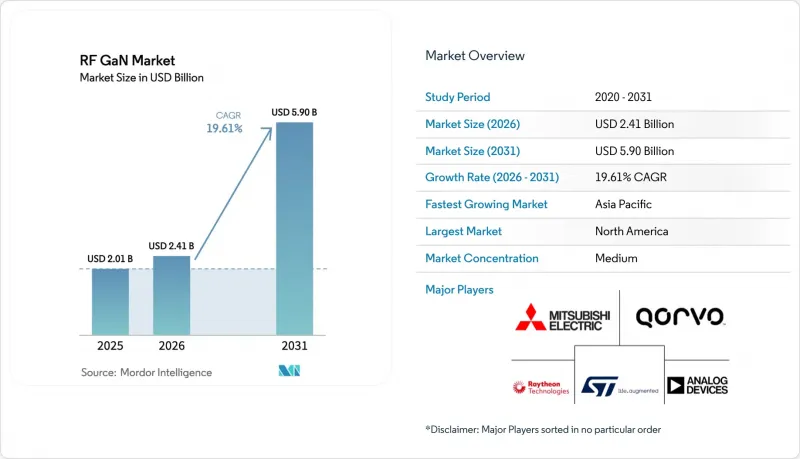
Mordor Intelligence에 의하면, RF GaN 시장 규모는 2025년에 20억 1,000만 달러로 평가되었습니다. 2026년 24억 1,000만 달러에서 2031년까지 59억 달러에 이를 것으로 예상되며, 예측 기간(2026-2031년) CAGR은 19.61%를 나타낼 전망입니다.

본 보고서는 용도(군사, 통신 인프라, 위성 통신, 유선 광대역, 기타), 소재 유형(GaN-on-Si, GaN-on-SiC, 기타 소재 유형), 디바이스 유형(디스크리트 트랜지스터, MMIC, 파워 앰프 모듈, 기타),주파수 대역(3GHz 이하, 3-6GHz, 6-18GHz, 18GHz 이상), 지역별로 분류되어 있습니다. 시장 예측은 금액(달러)으로 제시되어 있습니다.
세계의 RF GaN 시장 동향 및 인사이트
Sub-6GHz 대역 5G mMIMO 기지국 도입 급증
2025년, 이동통신 사업자들은 120만 곳의 새로운 5G 기지국을 설치했으며, 그중 68%에는 각각 최소 64개의 GaN 파워 앰프를 내장한 64개의 트랜시버가 탑재된 매시브 MIMO 무선 장치가 포함되어 있었습니다. 미쓰비시 전기는 2025년 6월, 200와트 C-밴드 모듈을 출하했습니다. 이 모듈은 6dB 백오프에서 50%의 드레인 효율을 달성하여, 이전 세대에 비해 12% 포인트 개선되었습니다. 중국의 통신 사업자들은 2025년에 5G 무선 장비에 870억 위안(人民元)을 투자하고, ‘중국 제조 2025’ 목표에 따라 GaN의 국산화율을 40%로 규정했습니다. 인도 규제 당국은 2026년 1월부터 매크로셀용 트리플 밴드 캐리어 어그리게이션을 의무화했으며, 이로 인해 사이트당 증폭기 수가 사실상 2배로 늘어났습니다. 이러한 규제로 인해 단기적인 수요는 3.3-3.8GHz 대역에 집중되고 있으며, RF GaN 시장은 계속해서 Sub-6GHz 대역의 출하량에 의해 견고하게 뒷받침되고 있습니다.
전체 방위 플랫폼 전반에 걸친 AESA 레이더 업그레이드 가속화
2025년, 14개국 국방부는 AESA 레이더 현대화 프로그램에 83억 달러를 투자하여 갈륨 비소(GaAs)에서 GaN 송수신 모듈로의 전환을 추진했습니다. 이를 통해 감지 범위가 2배로 확대되는 동시에 함대의 전력 소비도 감소합니다. 레이시온(Raytheon)은 2025년 9월, F-15EX 및 F-16V 전투기용 X-밴드 APG-82(V)X의 납품을 시작했습니다. 각 어레이에는 1,200개의 GaN MMIC가 탑재되어 있습니다. 일본 방위성은 2025년 3월, 차세대 전투기용 국산 화기관제 레이더를 개발하기 위해 미쓰비시 전기에 3억 1,000만 달러를 발주했습니다. 노스롭 그루먼사는 자사의 AN/APG-83 레이더 내 GaN 함유율이 2023년 22%에서 2025년에는 61%로 상승했다고 밝혔습니다. ‘국제무기거래규정(ITAR)’에 따른 수출 규제로 인해 판매는 동맹국으로 제한되고 있으며, 이로 인해 지속적인 공정 연구 개발을 뒷받침할 수 있는 높은 수준의 평균 판매 가격이 유지되고 있습니다.
에피택셜 웨이퍼의 높은 결함 밀도가 수율에 영향을 미침
2025년 시점의 상용 GaN-on-SiC 에피택시에서는 스레딩 전위 밀도가 5×10-cm-²에 육박하여, 성숙한 GaAs 제품 라인의 약 10배에 달했으며, 이로 인해 고출력 부품의 수율이 최대 25% 하락했습니다. Wolfspeed는 더럼 공장에서 리워크가 웨이퍼 투입량의 8%를 차지하여 2025 회계연도의 매출 총이익률을 220 베이시스 포인트 하락시켰다고 밝혔습니다. AIXTRON과 Veeco는 1대당 120만 달러의 가격으로 인시투(in-situ) 광학 반사율 측정 기능 애드온을 출시했습니다. 이를 통해 엔지니어들은 결함이 있는 제조 공정을 조기에 중단할 수 있게 되었지만, 2025년에는 리액터의 3분의 1 이하만이 이 기능으로 업그레이드되었습니다. 2024년 10월에 도입된 첨단 MOCVD 장비에 대한 미국의 수출 규제로 인해 중국 팹의 이러한 업그레이드 도입 능력이 더욱 제한되었고, 유럽 및 미국 공급업체와의 수율 격차가 확대되었습니다. 밀도가 1×10-cm² 미만으로 떨어질 때까지는 RF GaN 시장의 비용 측면에서의 이점은 제한적일 것으로 보입니다.
부문별 분석
2025년에는 전 세계 통신 사업자들이 520만 개의 5G 기지국을 운영함에 따라, 통신 인프라가 매출의 46.62%를 차지했습니다. 그러나 위성 통신은 연평균 성장률(CAGR) 20.44%를 기록할 전망이며, 저지구 궤도(LEO) 위성 군집의 발사 증가에 힘입어 2031년까지 그 격차를 좁힐 것으로 보입니다. AESA 레이더 개조 등의 군사 프로그램 덕분에 방위 부문은 2위 자리를 유지했습니다. 한편, DOCSIS 4.0 업그레이드에 따른 유선 광대역 노드는 꾸준하지만 낮은 성장세의 수주를 기록했습니다. Honeywell이 GaN을 채택하여 안테나 크기를 40% 축소함에 따라, 상용 레이더 및 항공 전자 장비는 규모는 작지만 수익성이 높은 틈새 시장을 형성했습니다.
더 높은 처리량을 추구하는 통신 사업자들은 현재 Ka 대역 페이로드를 표준으로 간주하고 있으며, 이로 인해 위성 1기당 증폭기 수가 높은 수준을 유지되어 공급업체에게는 향후 수년에 걸친 수요 전망이 확보되었습니다. 대조적으로, RF 에너지 용도는 여전히 실험 단계에 머물러 있지만, 미쓰비시 전기는 2025년 6월, 산업용 오븐용 효율 70%의 915MHz 모듈을 발표했습니다. 미국 FCC의 C-밴드 재할당 등 규제 변경으로 인해 주파수 대역이 5G로 재분배되면서, 간접적으로 3.7-3.98GHz 대역에서 GaN 수요를 끌어올리고 있습니다. 전반적으로 현재 소비는 통신 부문이 주도하고 있지만, 예측 기간 동안 위성 통신이 RF GaN 시장의 성장을 견인할 것으로 전망됩니다.
2025년에는 GaN-on-SiC 기판이 매출의 72.73%를 차지했으며, 이는 SiC의 열전도도 490W/m·K가 200°C를 초과하는 접합 온도에서도 고장 없이 작동함을 입증합니다. GaN-on-Si는 더 낮은 절연 파괴 전압이 허용되는 3GHz 이하 대역에서는 여전히 유용하지만, 많은 통신 사업자들은 전력 부하 효율을 극대화하기 위해 SiC로 전환하고 있습니다. 고주파 대역에서는 RF GaN 시장에서 GaN-on-SiC의 점유율 우위가 더욱 확대될 전망이며, 이 부문은 2031년까지 연평균 성장률(CAGR) 21.12%를 나타낼 것으로 예측됩니다.
Wolfspeed가 200mm SiC 웨이퍼 가격을 2024년 850달러에서 2025년 610달러로 인하함에 따라 비용 압박이 완화되고 있으며, 실리콘과의 가격 차이가 좁혀지면서 더 광범위한 채택이 촉진되고 있습니다. GaN-on-Diamond와 같은 다른 대안의 경우, 접합 온도가 40-50°C 낮아졌지만, 4인치 웨이퍼당 2,400달러라는 가격 때문에 여전히 고급 방위용도로만 제한되고 있습니다. 파운드리가 더 큰 직경으로 확대됨에 따라, SiC의 성능적 우위와 기판 비용 하락이 맞물려 RF GaN 시장 전체에서 고전력 밀도 설계의 기본 선택지로 계속 자리매김할 것으로 보입니다.
지역별 분석
북미는 2025년 8,860억 달러의 국방 지출과 Wolfspeed, Skyworks, BAE Systems의 생산 능력 확장을 지원하는 9억 달러가 넘는 ‘CHIPS 법’ 인센티브에 힘입어 39.74%의 점유율을 유지했습니다. 캐나다는 내방사선 GaN 연구에 8,800만 달러를 추가로 투입했으며, 멕시코는 미국 설계 거점과의 근접성을 활용하여 조립 부문에서 소규모이지만 투자를 유치했습니다.
아시아태평양은 2031년까지 연평균 성장률(CAGR) 20.67%가 예상됩니다. 중국은 2025년에 90만 기의 5G 기지국을 건설하고, 에피택셜 웨이퍼 연구 개발에 500억 위안(人民元)을 투자했습니다. 일본 경제산업성은 와이드 밴드갭 반도체 팹에 대한 보조금을 책정한 반면, 인도의 생산 연계형 인센티브 제도는 자본 비용의 최대 50%를 지원하여 타타 그룹의 관심을 끌고 있습니다. 아세안, 특히 베트남과 태국은 낮은 인건비와 수출 우대 조치를 결합한 조립 거점으로서의 입지를 확립해 가고 있습니다.
유럽의 점유율은 10%대 중반이었습니다. ‘유럽 칩 법’에 따라 파일럿 라인용으로 12억 유로가 지원되었고, 인피니언 테크놀로지스(Infineon Technologies)는 GaN Systems를 8억 3,000만 달러에 인수했지만, 초점은 여전히 주로 1GHz 이하 부문에 머물러 있습니다. STMicroelectronics의 카타니아 공장은 RF 생산량에서 차지하는 비중이 10% 이하이지만, 해당 지역의 생산 능력을 강화하고 있습니다. 중동 및 아프리카에서는 아랍에미리트와 사우디아라비아의 위성 게이트웨이에서 수요가 나타났으나, 라틴아메리카는 엠브라에르(Embraer)의 GaN 탑재 항공기용 무선기 등 개별적인 방위 프로그램에 그쳐 여전히 초기 단계에 머물러 있습니다.
기타 혜택
- 엑셀 형식 시장 예측(ME) 시트
- 3개월간의 애널리스트 지원
자주 묻는 질문
목차
제1장 서론
제2장 조사 방법
제3장 주요 요약
제4장 시장 구도
제5장 시장 규모 및 성장 예측
제6장 경쟁 구도
제7장 시장 기회 및 향후 전망
KTH 26.09.08According to Mordor Intelligence, the RF GaN market size was valued at USD 2.01 billion in 2025 and is estimated to grow from USD 2.41 billion in 2026 to reach USD 5.90 billion by 2031, at a CAGR of 19.61% during the forecast period (2026-2031).
This report is Segmented by Application (Military, Telecom Infrastructure, Satellite Communication, Wired Broadband, and More), Material Type (GaN-On-Si, GaN-On-SiC, and Other Material Types), Device Type (Discrete Transistors, MMIC, Power-Amplifier Modules, and More), Frequency Band (Below 3 GHz, 3-6 GHz, 6-18 GHz, and Above 18 GHz), and Geography. The Market Forecasts are Provided in Terms of Value (USD).
Global RF GaN Market Trends and Insights
Surge in Sub-6 GHz 5G mMIMO Base-Station Deployments
Mobile operators installed 1.2 million new 5G sites in 2025, of which 68% included 64-transceiver massive MIMO radios that each embed at least 64 GaN power amplifiers. Mitsubishi Electric shipped a 200-watt C-band module in June 2025, which achieved 50% drain efficiency at a 6 dB back-off, representing a 12 percentage-point improvement over the prior generation. China's operators spent CNY 87 billion on 5G radios in 2025, specifying 40% indigenous GaN content in line with Made in China 2025 targets. India's regulator mandated triple-band carrier aggregation for macro cells from January 2026, implicitly doubling the amplifier count per site. Together these mandates concentrate near-term demand in the 3.3-3.8 GHz window, keeping the RF GaN market firmly anchored in sub-6 GHz shipments.
Accelerating AESA Radar Upgrades Across Defense Platforms
Fourteen defense ministries committed USD 8.3 billion to AESA radar refresh programs during 2025, moving from gallium arsenide to GaN transmit-receive modules that double detection range while lowering fleet power draw. Raytheon began X-band APG-82(V)X deliveries for F-15EX and F-16V jets in September 2025, each array integrating 1,200 GaN MMICs. Japan's Ministry of Defense awarded Mitsubishi Electric USD 310 million in March 2025 to develop an indigenous fire-control radar for its next-generation fighter. Northrop Grumman disclosed that GaN content inside its AN/APG-83 radar rose from 22% in 2023 to 61% in 2025. Export rules under the International Traffic in Arms Regulations channel sales to allied nations, sustaining premium average selling prices that finance ongoing process R&D.
High Epitaxial-Wafer Defect Density Affecting Yield
Commercial GaN-on-SiC epitaxy posted threading dislocation densities near 5 X 108 cm-2 in 2025, about ten times higher than mature GaAs lines, depressing yields by up to 25% on high-power parts. Wolfspeed disclosed that rework consumed 8% of wafer starts at its Durham site and compressed gross margin by 220 basis points in fiscal 2025. AIXTRON and Veeco launched in-situ optical reflectometry add-ons priced at USD 1.2 million per reactor that let engineers abort defective runs early, yet fewer than one-third of reactors were retrofitted in 2025. United States export controls on advanced MOCVD tools introduced in October 2024 further limited Chinese fabs' ability to adopt these upgrades, widening the yield gap with Western suppliers. Until densities fall below 1 X 108 cm-2 the RF GaN market gains in cost will be tempered.
Other drivers and restraints analyzed in the detailed report include:
- Transition to 6-Inch and 8-Inch GaN-on-SiC Wafers Lowering USD per Watt
- GaN Front-End Adoption in LEO and GEO Satellite Payloads
- Thermal-Management Limits Above 10 W/mm in Dense Arrays
For complete list of drivers and restraints, kindly check the Table Of Contents.
Segment Analysis
Telecom infrastructure accounted for 46.62% of revenue in 2025 as operators supported 5.2 million 5G base stations worldwide. Satellite communication, however, is on track to register a 20.44% CAGR and will narrow the gap by 2031, powered by rising LEO constellation launches. Military programs such as AESA radar retrofits kept defense in the second position, while wired broadband nodes within DOCSIS 4.0 upgrades delivered steady but low-growth orders. Commercial radar and avionics created a small yet profitable niche, as Honeywell adopted GaN to shrink antenna size by 40%.
Operators chasing higher throughput now view Ka-band payloads as standard, which keeps amplifier counts per satellite high and secures multi-year visibility for suppliers. In contrast, RF energy applications stayed experimental although Mitsubishi Electric showcased a 70% efficient 915 MHz module for industrial ovens in June 2025. Regulatory shifts such as the United States FCC C-band repack also redirect spectrum toward 5G, indirectly boosting GaN demand in the 3.7-3.98 GHz slice. Overall, telecom dominates present consumption, yet satellite communication is likely to carry the growth banner for the RF GaN market through the forecast horizon.
GaN-on-SiC substrates held 72.73% revenue in 2025, underscoring SiC's thermal conductivity of 490 W/m K that allows junction temperatures above 200 °C without failure. GaN-on-Si remains relevant below 3 GHz where lower breakdown voltage is acceptable, but many operators are shifting to SiC to maximize power-added efficiency. The RF GaN market size advantage for GaN-on-SiC widens further at high frequencies, and the category is set for a 21.12% CAGR to 2031.
Cost pressure is easing as Wolfspeed lowered the 200-millimeter SiC wafer price from USD 850 in 2024 to USD 610 in 2025, narrowing the gap with silicon and encouraging broader adoption. Other options, such as GaN-on-diamond, showed a 40-50 °C junction reduction but, at USD 2,400 per 4-inch wafer, remain confined to premium defense applications. As foundries scale to larger diameters, SiC's performance lead, combined with falling substrate costs, will keep it the default choice for high power density designs across the RF GaN market.
Complete Report Scope:
- By Application
- Military
- Telecom Infrastructure (Backhaul, RRH, Massive MIMO, Small Cells)
- Satellite Communication
- Wired Broadband
- Commercial Radar and Avionics
- RF Energy
- By Material Type
- GaN-on-Si
- GaN-on-SiC
- Other Material Types (GaN-on-GaN, GaN-on-Diamond)
- By Device Type
- Discrete Transistors (HEMT)
- Monolithic Microwave ICs (MMIC)
- Power-Amplifier Modules
- Driver Amplifiers
- By Frequency Band
- Below 3 GHz (L, S Bands)
- 3 - 6 GHz (C Band, 5G Sub-6)
- 6 - 18 GHz (X, Ku)
- Above 18 GHz (Ka, mmWave)
- By Geography
- North America
- United States
- Canada
- Mexico
- South America
- Brazil
- Argentina
- Rest of South America
- Europe
- Germany
- United Kingdom
- France
- Italy
- Spain
- Rest of Europe
- Asia-Pacific
- China
- Japan
- South Korea
- India
- ASEAN
- Oceania
- Rest of Asia-Pacific
- Middle East and Africa
- Middle East
- Saudi Arabia
- UAE
- Turkey
- Rest of Middle East
- Africa
- South Africa
- North Africa
- Rest of Africa
- Middle East
- North America
Geography Analysis
North America retained 39.74% share in 2025 due to defense outlays of USD 886 billion and CHIPS Act incentives exceeding USD 900 million that underwrite capacity expansion at Wolfspeed, Skyworks, and BAE Systems. Canada added USD 88 million for radiation-hardened GaN research, and Mexico drew modest assembly investment, leveraging proximity to United States design hubs.
Asia Pacific is set for a 20.67% CAGR through 2031. China erected 900,000 5G base stations in 2025 and committed CNY 50 billion to epitaxial wafer R&D. Japan's economic ministry earmarked subsidies for wide-bandgap fabs, while India's production-linked incentive scheme covers up to 50% of capital cost, drawing interest from Tata Group. ASEAN nations, especially Vietnam and Thailand, position themselves as assembly hubs to mix lower labor cost with export privileges.
Europe held a mid-teens stake. The European Chips Act unlocked EUR 1.2 billion for pilot lines, and Infineon Technologies closed its USD 830 million GaN Systems acquisition, though focus remains mainly below 1 GHz. STMicroelectronics' Catania line accounts for sub-10% RF output yet strengthens regional capability. Middle East and Africa saw demand from satellite gateways in the United Arab Emirates and Saudi Arabia, while Latin America stays early stage with isolated defense programs such as Embraer's GaN-enabled aircraft radios.
- Aethercomm Inc.
- Ampleon Netherlands B.V.
- Analog Devices Inc.
- Broadcom Inc.
- Efficient Power Conversion Corp.
- Guerrilla RF Inc.
- HRL Laboratories LLC
- Infineon Technologies AG
- Integra Technologies Inc.
- MACOM Technology Solutions Holdings Inc.
- Mercury Systems Inc.
- Mitsubishi Electric Corp.
- NXP Semiconductors N.V.
- Northrop Grumman Corp.
- Qorvo Inc.
- Raytheon Technologies Corp.
- RFHIC Corp.
- Skyworks Solutions Inc.
- STMicroelectronics N.V.
- Sumitomo Electric Device Innovations Inc.
- Tagore Technology Inc.
- Teledyne Technologies Inc.
- Toshiba Corp.
- WIN Semiconductors Corp.
- Wolfspeed Inc.
Additional Benefits:
- The market estimate (ME) sheet in Excel format
- 3 months of analyst support
TABLE OF CONTENTS
1 INTRODUCTION
- 1.1 Study Assumptions and Market Definition
- 1.2 Scope of the Study
2 RESEARCH METHODOLOGY
3 EXECUTIVE SUMMARY
4 MARKET LANDSCAPE
- 4.1 Market Overview
- 4.2 Market Drivers
- 4.2.1 Surge in sub-6 GHz 5G mMIMO base-station deployments
- 4.2.2 Accelerating AESA radar upgrades across defense platforms
- 4.2.3 Transition to 6-inch and 8-inch GaN-on-SiC wafers lowering $/W
- 4.2.4 GaN front-end adoption in LEO and GEO satellite payloads
- 4.2.5 Demand for ultra-wide-bandwidth PAs in mmWave backhaul
- 4.2.6 Government funding for domestic compound-semiconductor supply chains
- 4.3 Market Restraints
- 4.3.1 High epitaxial-wafer defect density affecting yield
- 4.3.2 Thermal-management limits above 10 W/mm in dense arrays
- 4.3.3 Export-control regulations on GaN devices and MOCVD tools
- 4.3.4 Competition from advanced LDMOS below 3 GHz
- 4.4 Value Chain Analysis
- 4.5 Regulatory Landscape
- 4.6 Technological Outlook
- 4.7 Porter's Five Forces Analysis
- 4.7.1 Threat of New Entrants
- 4.7.2 Bargaining Power of Buyers
- 4.7.3 Bargaining Power of Suppliers
- 4.7.4 Threat of Substitute Products
- 4.7.5 Intensity of Competitive Rivalry
- 4.8 Investment Analysis
- 4.9 Impact of Macroeconomic Factors on the Market
5 MARKET SIZE AND GROWTH FORECASTS (VALUE)
- 5.1 By Application
- 5.1.1 Military
- 5.1.2 Telecom Infrastructure (Backhaul, RRH, Massive MIMO, Small Cells)
- 5.1.3 Satellite Communication
- 5.1.4 Wired Broadband
- 5.1.5 Commercial Radar and Avionics
- 5.1.6 RF Energy
- 5.2 By Material Type
- 5.2.1 GaN-on-Si
- 5.2.2 GaN-on-SiC
- 5.2.3 Other Material Types (GaN-on-GaN, GaN-on-Diamond)
- 5.3 By Device Type
- 5.3.1 Discrete Transistors (HEMT)
- 5.3.2 Monolithic Microwave ICs (MMIC)
- 5.3.3 Power-Amplifier Modules
- 5.3.4 Driver Amplifiers
- 5.4 By Frequency Band
- 5.4.1 Below 3 GHz (L, S Bands)
- 5.4.2 3 - 6 GHz (C Band, 5G Sub-6)
- 5.4.3 6 - 18 GHz (X, Ku)
- 5.4.4 Above 18 GHz (Ka, mmWave)
- 5.5 By Geography
- 5.5.1 North America
- 5.5.1.1 United States
- 5.5.1.2 Canada
- 5.5.1.3 Mexico
- 5.5.2 South America
- 5.5.2.1 Brazil
- 5.5.2.2 Argentina
- 5.5.2.3 Rest of South America
- 5.5.3 Europe
- 5.5.3.1 Germany
- 5.5.3.2 United Kingdom
- 5.5.3.3 France
- 5.5.3.4 Italy
- 5.5.3.5 Spain
- 5.5.3.6 Rest of Europe
- 5.5.4 Asia-Pacific
- 5.5.4.1 China
- 5.5.4.2 Japan
- 5.5.4.3 South Korea
- 5.5.4.4 India
- 5.5.4.5 ASEAN
- 5.5.4.6 Oceania
- 5.5.4.7 Rest of Asia-Pacific
- 5.5.5 Middle East and Africa
- 5.5.5.1 Middle East
- 5.5.5.1.1 Saudi Arabia
- 5.5.5.1.2 UAE
- 5.5.5.1.3 Turkey
- 5.5.5.1.4 Rest of Middle East
- 5.5.5.2 Africa
- 5.5.5.2.1 South Africa
- 5.5.5.2.2 North Africa
- 5.5.5.2.3 Rest of Africa
- 5.5.5.1 Middle East
- 5.5.1 North America
6 COMPETITIVE LANDSCAPE
- 6.1 Market Concentration
- 6.2 Strategic Moves
- 6.3 Market Share Analysis
- 6.4 Company Profiles (includes Global level Overview, Market level overview, Core Segments, Financials as available, Strategic Information, Market Rank/Share for key companies, Products and Services, and Recent Developments)
- 6.4.1 Aethercomm Inc.
- 6.4.2 Ampleon Netherlands B.V.
- 6.4.3 Analog Devices Inc.
- 6.4.4 Broadcom Inc.
- 6.4.5 Efficient Power Conversion Corp.
- 6.4.6 Guerrilla RF Inc.
- 6.4.7 HRL Laboratories LLC
- 6.4.8 Infineon Technologies AG
- 6.4.9 Integra Technologies Inc.
- 6.4.10 MACOM Technology Solutions Holdings Inc.
- 6.4.11 Mercury Systems Inc.
- 6.4.12 Mitsubishi Electric Corp.
- 6.4.13 NXP Semiconductors N.V.
- 6.4.14 Northrop Grumman Corp.
- 6.4.15 Qorvo Inc.
- 6.4.16 Raytheon Technologies Corp.
- 6.4.17 RFHIC Corp.
- 6.4.18 Skyworks Solutions Inc.
- 6.4.19 STMicroelectronics N.V.
- 6.4.20 Sumitomo Electric Device Innovations Inc.
- 6.4.21 Tagore Technology Inc.
- 6.4.22 Teledyne Technologies Inc.
- 6.4.23 Toshiba Corp.
- 6.4.24 WIN Semiconductors Corp.
- 6.4.25 Wolfspeed Inc.
7 MARKET OPPORTUNITIES AND FUTURE OUTLOOK
- 7.1 White-space and Unmet-Need Assessment


