

|
시장보고서
상품코드
2122268
의약품용 플라스틱병 : 시장 점유율 분석, 업계 동향과 통계, 성장 예측(2026-2031년)Pharmaceutical Plastic Bottles - Market Share Analysis, Industry Trends & Statistics, Growth Forecasts (2026 - 2031) |
||||||
 Mordor Intelligence
Mordor Intelligence에 의하면, 2026년 의약품용 플라스틱병 시장 규모는 99억 8,000만 달러로 추정되며, 2025년 96억 달러에서 2031년에는 120억 8,000만 달러에 달할 것으로 예측됩니다.
또한, 2026-2031년 연평균 성장률(CAGR) 3.92%를 기록할 전망입니다.
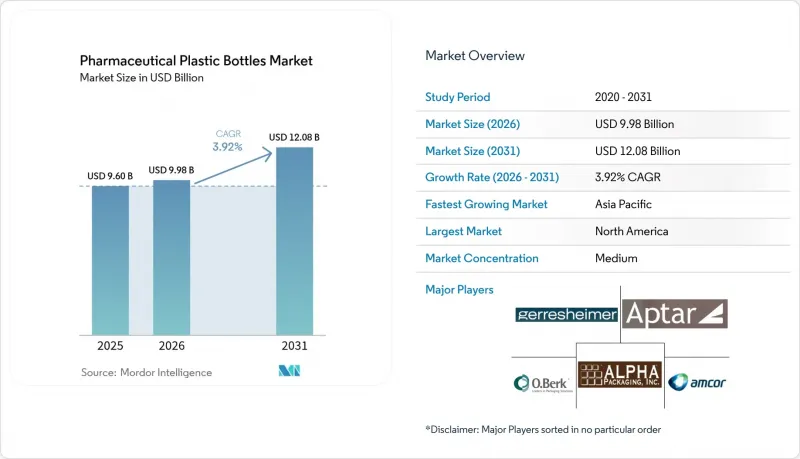
본 보고서는 원료(폴리에틸렌 테레프탈레이트, 고밀도 폴리에틸렌, 기타), 병 유형(고형 경구 제제용 용기, 드롭퍼 병, 기타),용량(30mL 이하, 31-100mL, 101-250mL, 기타), 최종 사용자(제네릭 의약품 제조업체, CDMO, 기타), 지역(북미, 남미, 기타)별로 분류되어 있습니다. 시장 전망은 금액(달러) 기준으로 제시되어 있습니다.
전 세계 의약품용 플라스틱 병 시장 동향 및 인사이트
유아 및 고령자를 배려한 개폐 구조로의 전환 확대
평균 수명의 연장과 규제의 정교화로 인해 캡 설계의 우선순위가 재검토되고 있습니다. FDA는 현재 유아용 안전 기능과 고령자용 사용 편의성을 모두 검사하고 있으며, 공급업체에 대해 토크 밸런스機構 및 혁신적인 그립 형태의 채택을 추진하고 있습니다. AptarGroup의 2단계 푸시-턴 캡은 인체공학에 기반한 안전성으로의 전환을 상징하며, 2050년까지 전 세계 65세 이상 인구가 2배로 증가할 것으로 예상되는 가운데 그 채택이 가속화되고 있습니다. 이러한 이중 기능 시스템에 투자하는 제조업체들은 의약품용 플라스틱 병 시장에서 우위를 점하고 있습니다. 이는 미국과 유럽연합(EU)의 주요 제약 기업들에서 규정 준수가 조달의 필수 조건이 되었기 때문입니다.
액상 바이오의약품 및 전문의약품의 급속한 확대
액상 바이오의약품에는 높은 차단성과 추출물이 적은 포장이 요구됩니다. 산소 제거제로 코팅된 PET 병이나 클래스 VI를 준수하는 HDPE 용기는 현재 민감한 제제를 보호하고 있으며, 특정 단일클론 항체의 경우 상온 보관을 가능하게 하고 있습니다. ISO 14644-1을 준수하는 클린룸에서의 병 제조는 이제 필수 조건이 되었으며, 게레스하이머(Geresheimer)와 스테바나트 그룹(Stevannart Group)이 발표한 생산 능력 확대는 이 부문의 상업적 기회를 뒷받침하고 있습니다. 바이오시밀러의 등장으로 치료비가 낮아짐에 따라, 더 많은 치료법이 바이알에서 경구 및 비강용 제제로 전환되고 있으며, 의약품용 플라스틱 병 시장의 잠재적 고객 기반이 확대되고 있습니다.
유럽의 일회용 플라스틱에 대한 엄격한 과세
독일에서는 현재 일회용 플라스틱 포장에 대해 1kg당 0.80유로의 세금이 부과되고 있으며, 이탈리아와 스페인에서도 유사한 제도가 적용되고 있습니다. 이로 인해 병 단가에 약 3-5%의 비용이 추가되어, 1팩당 몇 페니 차이로 경쟁하고 있는 제네릭 의약품 포장 업체들의 이익률이 압박받고 있습니다. 경쟁력을 유지하기 위해 각 컨버터 기업들은 병 두께를 줄이고, 바이오 PE로 대체하며, 재활용 업체와의 폐쇄형 공급 계약 인증을 추진하고 있습니다. 그러나 화학적 재활용이 본격화되기 전까지는 가격 측면의 역풍이 유럽 전역의 의약품용 플라스틱 병 시장을 억제할 것으로 보입니다.
부문 분석
2025년, HDPE는 고형 경구용 의약품에 대한 뛰어난 방습성과 저비용을 강점으로 삼아 의약품용 플라스틱 병 시장 매출의 38.02%를 차지했습니다. 같은 해 HDPE 포장용 의약품 플라스틱 병 시장 규모는 약 36억 5,000만 달러였습니다. 각 제조업체는 기존의 고속 압출 블로우 성형 라인을 활용하고 있으며, 이를 통해 제네릭 의약품 제조업체는 100mL 병당 0.05달러 미만의 가격 책정을 실현하고 있습니다. 그러나 2031년까지 PET의 연평균 성장률(CAGR)이 5.28%라는 점은 시장 점유율이 서서히 이동하고 있음을 시사합니다. 화학적 재활용을 통해 거의 신소재와 동등한 투명도를 얻을 수 있어, 생물학적 제제나 소아용 제제를 검사하는 규제 당국의 우려를 불식시키고 있습니다. 또한, PET는 산소 흡수제 코팅과 호환성이 좋아 보존 기간을 연장합니다. 주요 컨버터 기업들은 고부가가치 액상 제제 시장에서 의약품용 플라스틱 병의 점유율을 확보하기 위해 셔틀 라인을 2단계 ISBM(인라인 블로우 성형) 방식으로 전환하고 있습니다. PET의 추가적인 성장은 각 재활용 원료 스트림에 대해 FDA의 ‘이의 없음 통지서(LON)’를 취득할 수 있는지 여부에 달려 있지만, 이 과정은 중견 공급업체들 사이에서는 여전히 번거로운 것으로 간주되고 있습니다.
예측 기간 동안 PP는 화학적 및 증기 멸균에 대한 내성이 요구되는 캡 시스템의 틈새 시장을 계속 지켜나갈 것으로 보이며, LDPE는 수량 증가세가 둔화되고 있지만 스퀴즈 팁 방식의 안과용 브랜드에서 여전히 중요한 위치를 유지할 것으로 예측됩니다. 업계가 USP(665) 플라스틱 시스템으로 전환됨에 따라 추출물 검사 범위가 확대되고, 수지 제조업체들은 첨가제 포장을 개선해야 할 압박을 받고 있습니다. 이러한 변화로 인해 HDPE의 지배력은 약화되겠지만, 비용뿐만 아니라 용도 적합성이 우선시되는 다중 소재의 균형이 강화되어 의약품용 플라스틱 병 시장에서 균형 잡힌 경쟁 환경이 유지될 것으로 보입니다.
고형 경구제용 용기는 2025년 매출의 41.88%를 차지하며, 만성 질환 치료에서 정제 및 캡슐이 여전히 주류를 이루고 있음을 반영합니다. 이러한 용기와 관련된 의약품용 플라스틱 병 시장 규모는 40억 2,000만 달러에 달했습니다. 표준화된 40드럼 및 100드럼 규격의 용기는 고속 충전 라인에서 효율적으로 처리할 수 있으며, 영상 검사 시스템과의 통합도 용이합니다. 한편, 연평균 성장률(CAGR) 5.44%의 상승이 예상되는 비강 스프레이 병은 성장 전망을 재정의하고 있습니다. 아프터(Aptar)사의 FDA 승인을 받은 에피네프린 스프레이 ‘네피(Nefi)’는 자동 주사기에서 비강 투여로 광범위한 전환을 시사하고 있습니다. 이러한 기기에는 엄격한 치수 공차와 APF의 ‘Futurity’와 같은 무금속 펌프가 요구되며, 이로 인해 평균 판매 가격(ASP)은 경구용 병에 비해 4배나 치솟았습니다. 액상 시럽이나 구강 관리용 구강 세정제 병은 기침·감기 및 치과 위생 부문에 힘입어 완만한 성장을 유지하고 있지만, 당분 저감 추세의 영향을 받기 쉬운 상황에 놓여 있습니다.
비강용 액추에이터의 클린룸 내 조립 기술을 습득한 제조업체들은 밸류체인 내 점유율을 확대하고 이익률을 안정화하고 있습니다. 이러한 전문화는 진입 장벽을 높이며, 결과적으로 최저 비용 공급보다 임상 성능과 기기의 정밀도가 중시되는 이 부문에서 가격 규율을 뒷받침하고 있습니다. 이는 의약품용 플라스틱 병 시장 전체의 수익성에 영향을 미치고 있습니다.
지역별 분석
북미는 확립된 제조거점, 엄격한 규제, 국내 생산을 촉진하는 연방 정부의 우대 조치 덕분에 2025년에 39.55%의 점유율로 의약품용 플라스틱 병 시장을 주도했습니다. 미국 FDA의 엄격한 승인 절차는 저품질 수입품을 효과적으로 배제하고, 국내 cGMP 시설을 우대하고 있습니다. 캐나다의 특수 충전 업체와 멕시코의 비용 효율이 뛰어난 성형 공장은 USMCA 회랑의 물류망을 활용하여 신속한 유통을 실현하며, 서로를 보완하는 역할을 하고 있습니다.
연평균 성장률(CAGR) 7.05%가 예상되는 아시아태평양은 의약품용 플라스틱 병 시장의 성장을 이끄는 원동력이 되고 있습니다. 중국의 ‘국가 필수 의약품 목록’ 확대로 액상 항생제 생산이 급증하고 있는 한편, 인도가 제네릭 의약품 강국으로서의 위상을 공고히 하면서 HDPE 병 사용이 증가하고 있습니다. 아세안(ASEAN)은 ‘의약품 실무그룹’을 통해 GMP 기준의 조화를 추진하고 있으며, 역내 위탁 포장을 촉진하고 있습니다. 일본과 한국은 생산량은 적지만 고정밀 비강용 기기 및 스마트 캡 부문을 주도하고 있으며, 이들이 전 세계의 ‘개념 증명(PoC)’ 수요를 뒷받침하고 있습니다.
유럽은 여전히 중요한 시장이지만, 비용 측면에서 과제를 안고 있습니다. 독일, 이탈리아, 스페인에서 부과되는 플라스틱세로 인한 추가 부담은 이익률을 압박하고 있지만, 한편으로는 화학적 재활용 PET의 조기 도입을 촉진하는 요인이기도 합니다. 브렉시트 이후 영국의 이중 규제 체제 현실로 인해, 병행하여 규제 당국에 신고해야 하므로 관리상의 부담이 증가하고 있습니다. 동유럽의 컨버터, 특히 폴란드와 헝가리의 기업들은 낮은 인건비와 EU 전역에서 통용되는 품질 인증을 무기로 서유럽의 CDMO 기업을 유치하고 있으며, 이로 인해 EU 내 의약품용 플라스틱 병 시장에서의 경쟁이 유지되고 있습니다.
남미 시장의 성장 동력은 브라질 ANVISA가 의무화한 일련번호 부여(시리얼라이제이션)에 있으며, 이것이 충전 및 포장 라인 전반에 걸친 설비 투자를 주도하고 있습니다. 중동 및 아프리카에서는 아직 초기 단계이긴 하지만 수요가 점차 증가하고 있습니다. 사우디아라비아의 ‘비전 2030’에 따른 현지화 조치의 일환으로 무균 포장 단지에 대한 지원이 이루어지고 있어, 수입 의존도를 낮출 것으로 기대되고 있습니다. 전반적으로 이러한 신흥 지역은 성숙 시장의 포화에 직면한 세계 벤더들에게 사업 다각화를 통한 리스크 헤지 역할을 수행하고 있습니다.
기타 혜택
- 엑셀 형식 시장 예측(ME) 시트
- 3개월간의 애널리스트 지원
자주 묻는 질문
목차
제1장 서론
제2장 조사 방법
제3장 주요 요약
제4장 시장 구도
제5장 시장 규모와 성장 예측
제6장 경쟁 구도
제7장 시장 기회와 향후 전망
LSH 26.09.04According to Mordor Intelligence, the pharmaceutical plastic bottles market size in 2026 is estimated at USD 9.98 billion, growing from 2025 value of USD 9.60 billion with 2031 projections showing USD 12.08 billion, growing at 3.92% CAGR over 2026-2031.
This report is Segmented by Raw Material (Polyethylene Terephthalate, High-Density Polyethylene, and More), Bottle Type (Solid Oral Containers, Dropper Bottles, and More), Capacity (<=30 Ml, 31-100 Ml, 101-250 Ml, and More), End User (Generic Drug Manufacturers, Cdmos, and More), and Geography (North America, South America, and More). The Market Forecasts are Provided in Terms of Value (USD).
Global Pharmaceutical Plastic Bottles Market Trends and Insights
Increasing Shift Toward Child-Resistant, Senior-Friendly Closures
Rising life expectancy and regulatory refinements have recast closure design priorities. The FDA now tests both child resistance and senior accessibility, pushing suppliers toward torque-balancing mechanisms and novel grip geometries. AptarGroup's two-step push-turn caps exemplify the pivot to ergonomic safety, and adoption is accelerating as the global population aged 65+ doubles by 2050. Producers investing in these dual-function systems gain an edge in the pharmaceutical plastic bottles market because compliance has become a procurement prerequisite for large drug makers in the United States and the European Union.
Rapid Scale-Up of Biologics and Specialty Drugs in Liquid Form
Liquid biologics need high-barrier, low-extractable packaging. PET bottles coated with oxygen scavengers and Class VI-compliant HDPE containers now shield sensitive formulations, enabling room-temperature storage for select monoclonal antibodies. Clean-room bottle manufacturing that meets ISO 14644-1 has become table stakes, and capacity expansions announced by Gerresheimer and Stevanato Group underline the commercial opportunity. As biosimilar entrants lower treatment costs, more therapies shift from vials to oral and nasal formats, enlarging the addressable base for the pharmaceutical plastic bottles market.
Stringent Single-Use Plastic Taxation in Europe
Germany now levies EUR 0.80 per kg on single-use plastic packaging, and Italy and Spain apply similar schemes. This adds roughly 3-5% to bottle unit costs, narrowing margins for generic drug packagers that compete on pennies per pack. To stay competitive, converters are trimming wall thickness, substituting bio-based PE, and certifying closed-loop supply agreements with recyclers. Until chemical recycling scales, however, price headwinds will restrain the pharmaceutical plastic bottles market across Europe.
Other drivers and restraints analyzed in the detailed report include:
- Rise of Personalized Home-Care Medication Regimens
- Re-shoring of Pharma Manufacturing in the United States
- Volatility in Crude-Derived Polymer Feedstock Prices
For complete list of drivers and restraints, kindly check the Table Of Contents.
Segment Analysis
HDPE generated 38.02% of the pharmaceutical plastic bottles market revenue in 2025, anchored by moisture-barrier strength and low cost for solid oral drugs. The pharmaceutical plastic bottles market size for HDPE packaging was roughly USD 3.65 billion that year. Producers leverage existing high-speed extrusion blow-molding lines, enabling generic manufacturers to hit price points below USD 0.05 per 100-ml bottle. However, PET's 5.28% CAGR through 2031 signals a gradual hand-off. Chemical recycling delivers near-virgin clarity that reassures regulators inspecting biologic and pediatric formulations, and PET's compatibility with oxygen scavenger coatings extends shelf life. Leading converters have converted shuttle lines to two-stage ISBM to capture the pharmaceutical plastic bottles market share in high-value liquids. Further PET growth depends on securing FDA Letters of No Objection for each recycled feedstock stream, a process still viewed as cumbersome by mid-tier suppliers.
Over the forecast horizon, PP will protect its niche in closure systems needing chemical and steam-sterilization resilience, while LDPE maintains relevance in squeeze-tip ophthalmic brands despite slower volume growth. The industry's pivot toward USP (665) plastic systems widens test scope for extractables, obliging resin makers to refine additive packages. This evolution should moderate HDPE's dominance yet reinforce a multi-material equilibrium where application fit trumps cost alone, sustaining a balanced competitive field within the pharmaceutical plastic bottles market.
Solid oral containers captured 41.88% of 2025 revenue, reflecting continued tablet and capsule prevalence in chronic disease therapies. The pharmaceutical plastic bottles market size, linked to these containers, reached USD 4.02 billion. Standardized 40- and 100-dram formats run efficiently on high-speed filling lines and integrate readily with vision-based inspection. Conversely, nasal spray bottles-projected to climb 5.44% CAGR-are redefining growth prospects. Aptar's FDA-cleared neffy epinephrine spray signals a broader transition from autoinjectors to intranasal delivery. Devices demand tight dimensional tolerances and metal-free pumps like APF's Futurity, lifting ASPs fourfold versus oral bottles. Liquid syrup and oral-care rinse bottles sustain moderate growth, buoyed by cough-cold and dental hygiene segments but exposed to sugar-reduction trends.
Manufacturers that master clean-room assembly of nasal actuators extend their value chain share and insulate margins. This specialization raises entry barriers and, by extension, supports price discipline in a segment where clinical performance and device precision outweigh lowest-cost supply, influencing the overall profitability of the pharmaceutical plastic bottles market.
Complete Report Scope:
- By Raw Material
- Polyethylene Terephthalate (PET)
- High-Density Polyethylene (HDPE)
- Low-Density Polyethylene (LDPE)
- Polypropylene (PP)
- Other Raw Materials
- By Bottle Type
- Solid Oral Containers
- Dropper Bottles
- Nasal Spray Bottles
- Liquid Syrup Bottles
- Oral-Care Rinse Bottles
- By Capacity
- <=30 ml
- 31 - 100 ml
- 101 - 250 ml
- 251 - 500 ml
- >500 ml
- By End User
- Branded Pharmaceutical Manufacturers
- Generic Drug Manufacturers
- Contract Development and Manufacturing Organizations (CDMOs)
- Over-the-Counter (OTC) Product Companies
- By Geography
- North America
- United States
- Canada
- Mexico
- South America
- Brazil
- Argentina
- Rest of South America
- Europe
- United Kingdom
- Germany
- France
- Spain
- Italy
- Rest of Europe
- Asia-Pacific
- China
- India
- Japan
- Australia
- South Korea
- Rest of Asia-Pacific
- Middle East and Africa
- Middle East
- Saudi Arabia
- United Arab Emirates
- Turkey
- Rest of Middle East
- Africa
- South Africa
- Kenya
- Rest of Africa
- Middle East
- North America
Geography Analysis
North America led the pharmaceutical plastic bottles market with 39.55% share in 2025, thanks to entrenched manufacturing, regulatory rigor, and federal incentives that encourage onshoring. The U.S. FDA's exacting approval pathway effectively filters out low-spec imports and rewards domestic cGMP facilities. Canada's specialty fillers and Mexico's cost-efficient molding plants play complementary roles, leveraging USMCA corridor logistics for quick-turn distribution.
Asia-Pacific, forecast to post a 7.05% CAGR, is the acceleration engine of the pharmaceutical plastic bottles market. China's extended National Essential Drugs List is swelling liquid antibiotic production, while India's generics powerhouse status fuels HDPE bottle usage. ASEAN states are harmonizing GMP standards under the Pharmaceutical Product Working Group, facilitating intra-regional contract packaging. Japan and South Korea, though smaller in volume, lead in high-precision nasal devices and smart closures that feed global evidence of concept demand.
Europe remains a pivotal but cost-challenged arena. Plastic tax surcharges levied in Germany, Italy, and Spain dampen margins, yet they also propel early adoption of chemically recycled PET. The United Kingdom's dual-regime reality after Brexit necessitates parallel regulatory filings, increasing administrative overhead. Eastern European converters, especially in Poland and Hungary, are courting Western CDMOs with lower labor rates and EU-wide quality certifications, keeping the pharmaceutical plastic bottles market competitive within the bloc.
South America's momentum centers on Brazil's ANVISA-mandated serialization, which is driving capex across filling and packaging lines. The Middle East & Africa show nascent but rising demand; Saudi Arabia's Vision 2030 localization agenda is subsidizing sterile packaging parks, hoping to curb import reliance. Collectively, these emerging regions represent diversification hedges for global vendors confronting mature-market saturation.
- Amcor plc
- Gerresheimer AG
- AptarGroup, Inc. (Aptar Pharma)
- O.Berk Company LLC
- Alpha Packaging, Inc.
- Pro-Pac Packaging Ltd
- COMAR LLC
- Gil Plastic Products Ltd
- Drug Plastics & Glass Company, Inc.
- Frapak Packaging B.V.
- Plastipak Holdings, Inc.
- Pretium Packaging, LLC
- Origin Pharma Packaging Ltd
- Zhejiang B.I. Industrial Co., Ltd
- Sanner GmbH
- Weener Plastics Group BV
- Ningbo Zhengli Pharmaceutical Packaging, Co. Ltd
- Montebello Packaging, Inc.
- TricorBraun, Inc.
Additional Benefits:
- The market estimate (ME) sheet in Excel format
- 3 months of analyst support
TABLE OF CONTENTS
1 INTRODUCTION
- 1.1 Study Assumptions and Market Definition
- 1.2 Scope of the Study
2 RESEARCH METHODOLOGY
3 EXECUTIVE SUMMARY
4 MARKET LANDSCAPE
- 4.1 Market Overview
- 4.2 Market Drivers
- 4.2.1 Increasing shift toward child-resistant, senior-friendly closures
- 4.2.2 Rapid scale-up of biologics and specialty drugs in liquid form
- 4.2.3 Rise of personalized home-care medication regimens
- 4.2.4 Re-shoring of pharma manufacturing in the United States
- 4.2.5 Mandatory track-and-trace serialization in emerging markets
- 4.2.6 Commercial adoption of chemical-recycling grade PET
- 4.3 Market Restraints
- 4.3.1 Stringent single-use plastic taxation in Europe
- 4.3.2 Accelerated glass-to-polymer shift reversal for injectables
- 4.3.3 Volatility in crude-derived polymer feedstock prices
- 4.3.4 Limited recyclate grade availability for pharma compliance
- 4.4 Industry Value Chain Analysis
- 4.5 Regulatory Landscape
- 4.6 Technological Outlook
- 4.7 Impact of Macroeconomic Factors on the Market
- 4.8 Porter's Five Forces Analysis
- 4.8.1 Threat of New Entrants
- 4.8.2 Bargaining Power of Buyer
- 4.8.3 Bargaining Power of Suppliers
- 4.8.4 Threat of Substitute Products
- 4.8.5 Intensity of Competitive Rivalry
5 MARKET SIZE AND GROWTH FORECASTS (VALUE)
- 5.1 By Raw Material
- 5.1.1 Polyethylene Terephthalate (PET)
- 5.1.2 High-Density Polyethylene (HDPE)
- 5.1.3 Low-Density Polyethylene (LDPE)
- 5.1.4 Polypropylene (PP)
- 5.1.5 Other Raw Materials
- 5.2 By Bottle Type
- 5.2.1 Solid Oral Containers
- 5.2.2 Dropper Bottles
- 5.2.3 Nasal Spray Bottles
- 5.2.4 Liquid Syrup Bottles
- 5.2.5 Oral-Care Rinse Bottles
- 5.3 By Capacity
- 5.3.1 <=30 ml
- 5.3.2 31 - 100 ml
- 5.3.3 101 - 250 ml
- 5.3.4 251 - 500 ml
- 5.3.5 >500 ml
- 5.4 By End User
- 5.4.1 Branded Pharmaceutical Manufacturers
- 5.4.2 Generic Drug Manufacturers
- 5.4.3 Contract Development and Manufacturing Organizations (CDMOs)
- 5.4.4 Over-the-Counter (OTC) Product Companies
- 5.5 By Geography
- 5.5.1 North America
- 5.5.1.1 United States
- 5.5.1.2 Canada
- 5.5.1.3 Mexico
- 5.5.2 South America
- 5.5.2.1 Brazil
- 5.5.2.2 Argentina
- 5.5.2.3 Rest of South America
- 5.5.3 Europe
- 5.5.3.1 United Kingdom
- 5.5.3.2 Germany
- 5.5.3.3 France
- 5.5.3.4 Spain
- 5.5.3.5 Italy
- 5.5.3.6 Rest of Europe
- 5.5.4 Asia-Pacific
- 5.5.4.1 China
- 5.5.4.2 India
- 5.5.4.3 Japan
- 5.5.4.4 Australia
- 5.5.4.5 South Korea
- 5.5.4.6 Rest of Asia-Pacific
- 5.5.5 Middle East and Africa
- 5.5.5.1 Middle East
- 5.5.5.1.1 Saudi Arabia
- 5.5.5.1.2 United Arab Emirates
- 5.5.5.1.3 Turkey
- 5.5.5.1.4 Rest of Middle East
- 5.5.5.2 Africa
- 5.5.5.2.1 South Africa
- 5.5.5.2.2 Kenya
- 5.5.5.2.3 Rest of Africa
- 5.5.5.1 Middle East
- 5.5.1 North America
6 COMPETITIVE LANDSCAPE
- 6.1 Market Concentration
- 6.2 Strategic Moves
- 6.3 Market Share Analysis
- 6.4 Company Profiles (includes Global level Overview, Market level overview, Core Segments, Financials as available, Strategic Information, Market Rank/Share for key companies, Products and Services, and Recent Developments)
- 6.4.1 Amcor plc
- 6.4.2 Gerresheimer AG
- 6.4.3 AptarGroup, Inc. (Aptar Pharma)
- 6.4.4 O.Berk Company LLC
- 6.4.5 Alpha Packaging, Inc.
- 6.4.6 Pro-Pac Packaging Ltd
- 6.4.7 COMAR LLC
- 6.4.8 Gil Plastic Products Ltd
- 6.4.9 Drug Plastics & Glass Company, Inc.
- 6.4.10 Frapak Packaging B.V.
- 6.4.11 Plastipak Holdings, Inc.
- 6.4.12 Pretium Packaging, LLC
- 6.4.13 Origin Pharma Packaging Ltd
- 6.4.14 Zhejiang B.I. Industrial Co., Ltd
- 6.4.15 Sanner GmbH
- 6.4.16 Weener Plastics Group BV
- 6.4.17 Ningbo Zhengli Pharmaceutical Packaging, Co. Ltd
- 6.4.18 Montebello Packaging, Inc.
- 6.4.19 TricorBraun, Inc.
7 MARKET OPPORTUNITIES AND FUTURE OUTLOOK
- 7.1 White-space and Unmet-need Assessment


