
|
시장보고서
상품코드
2122277
기업용 라우터 시장 : 시장 점유율 분석, 업계 동향 및 통계, 성장 예측(2026-2031년)Enterprise Routers - Market Share Analysis, Industry Trends & Statistics, Growth Forecasts (2026 - 2031) |
||||||
 Mordor Intelligence
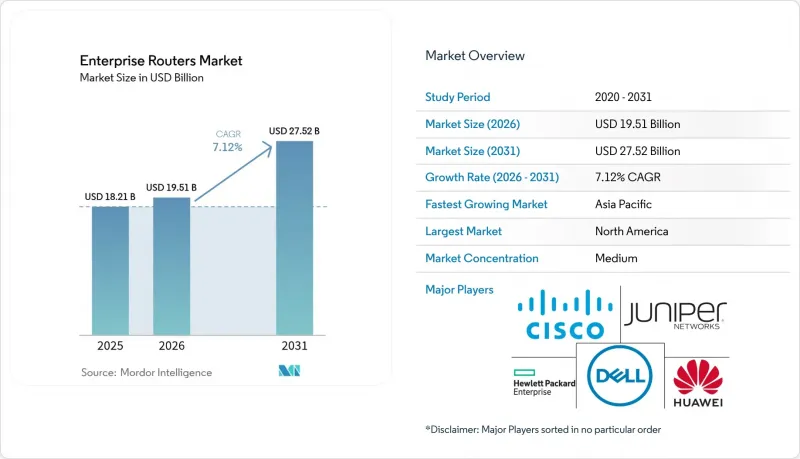
Mordor Intelligence에 의하면, 기업용 라우터 시장 규모는 2025년에 182억 1,000만 달러로 평가되었고, 2026년 195억 1,000만 달러에서 2031년까지 275억 2,000만 달러에 이를 것으로 예측되며, 예측 기간(2026-2031년) CAGR은 7.12%를 나타낼 전망입니다.
본 보고서는 연결 방식별(유선, 무선, 하이브리드), 포트 밀도별(8포트 이하, 9-24포트, 24포트 초과), 라우터 유형별(코어, 엣지/어그리게이션,액세스, SD-WAN 어플라이언스), 최종 사용자 산업별(은행, 금융서비스 및 보험(BFSI), IT 및 통신, 의료, 소매 및 전자상거래, 제조, 기타), 지역별로 분류되어 있습니다. 시장 예측은 금액(달러) 기준으로 제시되어 있습니다.
세계의 엔터프라이즈 라우터 시장 동향 및 인사이트
SD-WAN 도입 확대
소프트웨어 정의 WAN(SD-WAN)은 MPLS 비용을 최소화하고 정책 제어를 간소화함으로써 광역 연결의 경제성을 획기적으로 변화시켰습니다. 시스코는 2025년 2분기 SD-WAN 제품 수주가 전년 동기 대비 15% 증가했으며, Catalyst SD-WAN의 고객 기반은 50,000개 이상의 기업으로 확대되었습니다. 한때 엔터프라이즈급 WAN을 도입할 여력이 없다고 생각했던 중견 기업들도 현재는 동적 경로 선택을 통해 용도 응답성을 향상시키면서 네트워크 운영 비용을 30-50% 절감할 수 있게 되었습니다. 제로 트러스트 원칙이 조달을 주도하는 가운데, 보안은 여전히 필수적이며, 통합형 방화벽 및 세분화은 라우터 벤더에게 필수 요건이 되었습니다. SD-WAN의 교체 주기는 평균 3-5년이기 때문에 예측 기간 내에 재구매 수요가 발생하며, 이러한 추세는 중기적인 시장 확장을 지속적으로 뒷받침할 것으로 보입니다.
기업의 클라우드 전환 급증
온프레미스 데이터센터를 40% 통합하면서 클라우드 워크로드 밀도를 높이고 있는 기업들은 직접 인터넷 액세스 및 멀티 클라우드 연결을 중심으로 네트워크 재구축을 추진하고 있습니다. 라우터에는 동적인 대역폭 관리, 세밀한 QoS, 그리고 데이터 주권 규칙을 준수하는 자동화된 경로 정책 관리가 요구됩니다. 실시간 분석 등 지연 시간에 민감한 용도의 경우, 패킷을 중앙 집중식 게이트웨이로 백홀하는 대신 밀리초 단위로 트래픽 흐름을 결정하는 엣지 라우터의 도입이 확대되고 있습니다. 따라서 벤더의 로드맵에서는 경로 결정을 컴퓨팅 위치나 규정 준수 태그와 연계하는 클라우드 게이트웨이 및 API 수준의 오케스트레이션이 중시되고 있습니다.
공급망 내 칩 부족의 장기화
하이엔드 라우팅 플랫폼을 뒷받침하는 전용 ASIC은 여전히 공급이 부족하여 리드타임이 20-26주로 늘어났고, 부품 비용이 상승하고 있습니다. 기업들은 이에 대응하기 위해 멀티벤더 프레임워크를 도입하고 더 장기적인 조달 계약을 체결하고 있지만, 미션 크리티컬한 프로젝트에서는 여전히 연기를 피할 수 없는 상황입니다. 기본적인 액세스 라우터는 보다 일반적인 상용 실리콘으로 대체할 수 있어 영향은 적지만, 데이터센터의 코어 부분에서는 최첨단 공정 노드에 대한 의존도가 높아 심각한 부족 사태를 겪고 있습니다.
부문 분석
유선 링크는 2025년 매출의 63.04%를 차지했으며, 확정적인 처리량과 강력한 전자기 차폐가 필요한 워크로드를 지원합니다. 한편, 기업들이 유연한 평면 배치, IoT 센서 그리드, 캠퍼스 내 이동성을 추구함에 따라 무선 구축은 연평균 성장률(CAGR) 8.53%로 확대되고 있습니다. 파이버 백본과 Wi-Fi 6E 액세스를 융합한 하이브리드 설계는 유선 회선의 신뢰성과 무선 기술의 민첩성을 모두 확보하여 도입 기간을 최대 60% 단축합니다. 프라이빗 5G 네트워크는 과거 구리선 회선에서만 가능했던 1밀리초 미만의 지연 시간을 실현하여, 공장 전체에서 산업용 로봇 및 무인 운반 차량의 활용을 촉진하고 있습니다.
또한, 기업은 이더넷과 무선 엔드포인트 중 어느 것을 채택할지 결정할 때 주파수 대역 관리, 간섭, 배터리 수명도 고려하고 있습니다. Wi-Fi 6E의 6GHz 대역 채널은 1.2GHz의 새로운 주파수 대역을 제공하여 경쟁을 완화하는 동시에 유선 연결에 필적하는 성능을 실현하는 160 MHz 폭의 채널을 가능하게 합니다. 재해 복구 시에는 LTE 및 5G 라우터가 지상 회선이 단절되었을 때 즉시 연결성을 확보합니다. 이는 POS 시스템의 가동 중단 시간을 허용할 수 없는 소매 체인에서 높이 평가되는 기능입니다. 엔터프라이즈 라우터 시장은 양극화가 진행되고 있습니다. 미션 크리티컬 부문은 계속해서 광섬유를 채택하는 반면, 엣지 및 지사 환경에서는 무선이 우선적으로 채택되고 있어, 예측 기간 동안 병행된 수요 추이가 예상됩니다.
2025년에는 9-24포트 라우터가 엔터프라이즈 라우터 시장에서 48.10%의 점유율을 차지한 것으로 평가되었으며, 이는 중규모 서버룸에서 주력 집약 노드로서의 역할을 반영한 것입니다. 반면, 24포트 이상의 플랫폼은 데이터센터 사업자가 랙을 통합하고 배선 및 지연을 최소화하는 2계층 리프-스파인 토폴로지를 추구함에 따라 연평균 성장률(CAGR) 8.01%로 확대되고 있습니다. 고밀도 섀시는 포트당 비용을 최대 35% 절감하고 귀중한 바닥 면적을 확보해 주므로, 사업자는 고비용의 시설 확장을 미룰 수 있게 됩니다.
가상화와 컨테이너화로 인해 이스트-웨스트 트래픽이 증가함에 따라, 다수의 가상 연결을 배포할 수 있는 라우터에 400GbE 인터페이스의 채택이 촉진되고 있습니다. 한편, 엣지 마이크로 데이터센터에서는 카메라 및 센서에 최적화된 PoE 프로파일을 갖춘 소형 8포트 설계가 권장됩니다. 의료 및 금융 분야의 네트워크 세분화 관련 규제 요건에서는 포트 수준의 정책 제어가 요구되고 있어, 관리자가 트러스트 존별로 물리적 인터페이스를 할당할 수 있는 모듈형 라인 카드의 도입이 촉진되고 있습니다. 따라서 엔터프라이즈 라우터 시장에서는 워크로드 배치 전략에 따라 고밀도 코어와 소형 엣지에 대한 수요가 동시에 존재하고 있습니다.
지역별 분석
북미는 확립된 광섬유 백본, SD-WAN의 조기 도입, 그리고 엄격한 연방 사이버 보안 지침을 배경으로 2025년 엔터프라이즈 라우터 시장에서 38.40%의 점유율을 차지했습니다. 정부 기관이 제로 트러스트 아키텍처로의 전환을 추진하고, 기업들이 에너지 효율 향상을 위해 장비를 갱신하고 있어 수요는 지속되고 있지만, 신흥 지역에 비해 대수 기준 성장세는 둔화되고 있습니다. 캐나다의 석유, 가스, 광업 분야 기업에서는 온도 변동과 공기 중의 미세 입자를 견딜 수 있는 내환경형 라우터가 채택되고 있습니다.
아시아태평양은 5G 인프라 구축과 정부 주도의 제조업 디지털화에 힘입어 2031년까지 연평균 성장률(CAGR) 7.61%로 가장 빠르게 성장하는 지역입니다. 중국의 국산 기술 우선 정책은 국내 라우터 OEM 제조업체를 육성하는 동시에, 다국적 기업들에게 생산 현지화 및 펌웨어 감사를 요구하고 있습니다. 인도의 ‘디지털 인디아(Digital India)’ 프로그램은 농촌 지역 및 데이터센터 회랑에 대한 광대역 보급을 촉진하여, 핀테크, 헬스케어,BPO(비즈니스 프로세스 아웃소싱) 등 각 산업 분야에서 엣지 라우터의 도입을 뒷받침하고 있습니다. 일본의 ‘사회 5.0’ 로드맵은 자동화 및 스마트 인프라에 대한 투자를 촉진하여, 결정론적이고 저지연 라우팅 장비에 대한 프리미엄 수요를 지탱하고 있습니다.
유럽에서는 지속가능성에 관한 규제와 GDPR(EU 개인정보보호규정)에 기반한 데이터 주권 규칙에 힘입어 꾸준한 수익 증가가 나타나고 있으며, 친환경 설계와 규정 준수를 동시에 보장하는 온프레미스형 라우터의 도입이 진행되고 있습니다. 순환형 경제에 대한 인센티브로 인해 회수 프로그램 및 재생 하드웨어의 활용이 촉진되고 있습니다. 라틴아메리카에서는 통신 사업자의 백본 및 광산 시설의 업그레이드가 진행 중이며, 고온 내성 하드웨어가 선호되고 있습니다. UAE와 사우디아라비아를 비롯한 중동의 스마트 시티 계획에서는 영상 분석 및 IoT 텔레메트리 제어를 위한 AI 탑재 라우터가 요구되고 있는 반면, 아프리카 국가들에서는 5G 고정 무선 접속으로의 비약적인 전환이 시작되어 기업 지점에서의 통합형 셀룰러 라우터에 대한 수요를 촉진하고 있습니다.
기타 혜택 :
- 엑셀 형식 시장 예측(ME) 시트
- 3개월간의 애널리스트 지원
자주 묻는 질문
목차
제1장 서론
제2장 조사 방법
제3장 주요 요약
제4장 시장 구도
제5장 시장 규모 및 성장 예측
제6장 경쟁 구도
제7장 시장 기회 및 향후 전망
AJY 26.09.07According to Mordor Intelligence, the enterprise routers market size was valued at USD 18.21 billion in 2025 and estimated to grow from USD 19.51 billion in 2026 to reach USD 27.52 billion by 2031, at a CAGR of 7.12% during the forecast period (2026-2031).
This report is Segmented by Connectivity (Wired, Wireless, and Hybrid), Port Density (less Than or Equal To 8 Ports, 9-24 Ports, and Above 24 Ports), Router Type (Core, Edge/Aggregation, Access, and SD-WAN Appliance), End-User Industry (BFSI, IT and Telecom, Healthcare, Retail and E-Commerce, Manufacturing, and More), and Geography. The Market Forecasts are Provided in Terms of Value (USD).
Global Enterprise Routers Market Trends and Insights
Growing SD-WAN Adoption
Software-defined WAN has altered the economics of wide-area connectivity by minimizing MPLS spend and simplifying policy control. Cisco processed a 15% year-over-year increase in SD-WAN product orders during Q2 2025, bringing its Catalyst SD-WAN customer base above 50,000 enterprises. Mid-market organizations that once deemed enterprise-grade WAN unaffordable can now trim network operating expenses by 30-50% while improving application response through dynamic path selection. Security remains integral as zero-trust principles steer procurement, making integrated firewalls and segmentation table-stakes for router vendors. The momentum is likely to sustain medium-term market expansion because SD-WAN refresh cycles average three to five years, creating repeat demand within the forecast horizon.
Surge in Enterprise Cloud Migration
Enterprises consolidating on-premises data centers by 40% while elevating cloud workload density are re-architecting networks around direct internet access and multi-cloud links. Routers must manage dynamic bandwidth, granular QoS, and automated route policies that honor data-sovereignty rules. Latency-sensitive apps such as real-time analytics are encouraging edge routers that decide traffic flows in milliseconds rather than backhauling packets to centralized gateways. Vendor roadmaps therefore emphasize cloud gateways and API-level orchestration that align route decisions with compute location and compliance tags.
Persistent Supply-Chain Chip Shortages
Specialized ASICs powering high-end routing platforms remain in tight supply, stretching lead times to 20-26 weeks and inflating component costs. Enterprises respond by adopting multi-vendor frameworks and committing to longer procurement contracts, yet mission-critical projects still face deferrals. Basic access routers see smaller impact because they can swap in more common merchant silicon, but data-center cores experience acute shortages due to cutting-edge process node dependence.
Other drivers and restraints analyzed in the detailed report include:
- Edge-Compute Traffic Explosion
- Sustainability-Driven Router Refresh
- Rising SASE Cannibalization
For complete list of drivers and restraints, kindly check the Table Of Contents.
Segment Analysis
Wired links captured 63.04% of 2025 revenue, underpinning workloads that demand deterministic throughput and strong electromagnetic shielding. Simultaneously, wireless deployments are gaining an 8.53% CAGR as companies pursue flexible floorplans, IoT sensor grids, and campus mobility. Hybrid designs that marry fiber backbones with Wi-Fi 6E access deliver the reliability of cable and the agility of radio, shrinking deployment timelines by up to 60%. Private 5G networks now achieve sub-millisecond latency once reserved for copper links, unleashing industrial robots and autonomous guided vehicles across factory floors.
Enterprises also weigh spectrum governance, interference, and battery life in deciding between Ethernet and wireless endpoints. Wi-Fi 6E's 6 GHz channels supply 1.2 GHz of fresh spectrum, reducing contention and enabling 160 MHz-wide channels that approximate cabled performance. For disaster recovery, LTE and 5G routers furnish immediate connectivity when terrestrial lines fail, a feature prized by retail chains that cannot tolerate point-of-sale downtime. The enterprise routers market continues to bifurcate: mission-critical segments stay on fiber while edge and branch environments adopt radio first, sustaining parallel demand paths across the forecast horizon.
Routers with 9-24 ports held a 48.10% enterprise routers market share in 2025, reflecting their role as workhorse aggregation nodes in medium server closets. Yet platforms exceeding 24 ports are expanding at 8.01% CAGR as data-center operators consolidate racks and strive for two-tier leaf-spine topologies that minimize cabling and latency. High-density chassis reduce per-port costs by up to 35% and free valuable floor space, allowing operators to defer expensive building expansions.
Virtualization and containerization have magnified east-west traffic, driving 400GbE interface adoption on routers that can fan out numerous virtual connections. Conversely, edge micro-data centers advocate compact eight-port designs with PoE profiles tailored for cameras and sensors. Regulatory demands for network segmentation in healthcare and finance require port-level policy control, encouraging modular line-cards that let administrators allocate physical interfaces by trust zone. The enterprise routers market therefore supports simultaneous demand for dense cores and compact edges, depending on workload placement strategies.
Complete Report Scope:
- By Connectivity
- Wired
- Wireless
- Hybrid
- By Port Density
- less than or equal to 8 Ports
- 9 - 24 Ports
- above 24 Ports
- By Router Type
- Core
- Edge / Aggregation
- Access
- SD-WAN Appliance
- By End-user Industry
- BFSI
- IT and Telecom
- Healthcare
- Retail and E-commerce
- Manufacturing
- Government and Defense
- Education
- By Geography
- North America
- United States
- Canada
- Europe
- Germany
- United Kingdom
- France
- Russia
- Rest of Europe
- Asia Pacific
- China
- India
- Japan
- South-East Asia
- Rest of Asia Pacific
- South America
- Brazil
- Argentina
- Rest of South America
- Middle East and Africa
- Middle East
- Saudi Arabia
- United Arab Emirates
- Rest of Middle East
- Africa
- South Africa
- Nigeria
- Rest of Africa
- Middle East
- North America
Geography Analysis
North America commanded a 38.40% enterprise routers market share in 2025 on the back of established fiber backbones, early SD-WAN adoption, and stringent federal cybersecurity directives. Demand persists as agencies migrate toward zero-trust architectures and enterprises refresh for energy efficiency, though unit growth slows relative to emerging regions. Canadian enterprises in oil, gas, and mining adopt ruggedized routers rated for temperature swings and airborne particulates.
Asia Pacific is the fastest-growing territory at a 7.61% CAGR through 2031, buoyed by 5G buildouts and state-sponsored manufacturing digitization. China's policy of indigenous technology preference nurtures domestic router OEMs while compelling multinationals to localize production and firmware audits. India's Digital India program fosters broadband to rural districts and data-center corridors, catalyzing edge-router installations across fintech, healthcare, and BPO verticals. Japan's Society 5.0 roadmap spurs investments in automation and smart infrastructure, sustaining premium demand for deterministic and low-latency routing gear.
Europe exhibits steady revenue progression anchored in sustainability regulations and GDPR-driven data-sovereignty rules, prompting on-premises router deployments that pair green design with compliance guarantees. Circular-economy incentives encourage take-back schemes and refurbished hardware. Latin America upgrades telco backbones and mining operations, favoring high-temperature tolerant hardware. Middle Eastern smart-city programs in the UAE and Saudi Arabia require AI-enabled routers to direct video analytics and IoT telemetry, while African nations begin leapfrogging to 5G fixed-wireless access, sparking demand for integrated cellular routers in enterprise branches.
- Cisco Systems Inc.
- Juniper Networks Inc.
- Huawei Technologies Co. Ltd.
- Hewlett Packard Enterprise Co.
- Dell Technologies Inc.
- Nokia Corp.
- Arista Networks Inc.
- Extreme Networks Inc.
- Ubiquiti Inc.
- Fortinet Inc.
- Netgear Inc.
- Check Point Software Technologies Ltd.
- Palo Alto Networks Inc.
- Edgecore Networks Corp.
- ZTE Corp.
- TP-Link Technologies Co. Ltd.
- MikroTik LS
- Riverbed Technology LLC
- Ciena Corp.
- Adtran Inc.
- Versalink International Ltd.
Additional Benefits:
- The market estimate (ME) sheet in Excel format
- 3 months of analyst support
TABLE OF CONTENTS
1 INTRODUCTION
- 1.1 Study Assumptions and Market Definition
- 1.2 Scope of the Study
2 RESEARCH METHODOLOGY
3 EXECUTIVE SUMMARY
4 MARKET LANDSCAPE
- 4.1 Market Overview
- 4.2 Market Drivers
- 4.2.1 Growing SD-WAN adoption
- 4.2.2 Surge in enterprise cloud migration
- 4.2.3 Edge-compute traffic explosion
- 4.2.4 Sustainability-driven router refresh
- 4.2.5 AI-driven intent-based networking
- 4.2.6 Government secure-routing mandates
- 4.3 Market Restraints
- 4.3.1 Persistent supply-chain chip shortages
- 4.3.2 Skill-gap in programmable networking
- 4.3.3 Rising SASE cannibalisation
- 4.3.4 Open-source white-box disruption
- 4.4 Industry Value Chain Analysis
- 4.5 Regulatory Landscape
- 4.6 Technological Outlook
- 4.7 Porter's Five Forces Analysis
- 4.7.1 Threat of New Entrants
- 4.7.2 Bargaining Power of Buyers
- 4.7.3 Bargaining Power of Suppliers
- 4.7.4 Threat of Substitutes
- 4.7.5 Competitive Rivalry
- 4.8 Impact of Macroeconomic Factors
5 MARKET SIZE AND GROWTH FORECASTS (VALUE)
- 5.1 By Connectivity
- 5.1.1 Wired
- 5.1.2 Wireless
- 5.1.3 Hybrid
- 5.2 By Port Density
- 5.2.1 less than or equal to 8 Ports
- 5.2.2 9 - 24 Ports
- 5.2.3 above 24 Ports
- 5.3 By Router Type
- 5.3.1 Core
- 5.3.2 Edge / Aggregation
- 5.3.3 Access
- 5.3.4 SD-WAN Appliance
- 5.4 By End-user Industry
- 5.4.1 BFSI
- 5.4.2 IT and Telecom
- 5.4.3 Healthcare
- 5.4.4 Retail and E-commerce
- 5.4.5 Manufacturing
- 5.4.6 Government and Defense
- 5.4.7 Education
- 5.5 By Geography
- 5.5.1 North America
- 5.5.1.1 United States
- 5.5.1.2 Canada
- 5.5.2 Europe
- 5.5.2.1 Germany
- 5.5.2.2 United Kingdom
- 5.5.2.3 France
- 5.5.2.4 Russia
- 5.5.2.5 Rest of Europe
- 5.5.3 Asia Pacific
- 5.5.3.1 China
- 5.5.3.2 India
- 5.5.3.3 Japan
- 5.5.3.4 South-East Asia
- 5.5.3.5 Rest of Asia Pacific
- 5.5.4 South America
- 5.5.4.1 Brazil
- 5.5.4.2 Argentina
- 5.5.4.3 Rest of South America
- 5.5.5 Middle East and Africa
- 5.5.5.1 Middle East
- 5.5.5.1.1 Saudi Arabia
- 5.5.5.1.2 United Arab Emirates
- 5.5.5.1.3 Rest of Middle East
- 5.5.5.2 Africa
- 5.5.5.2.1 South Africa
- 5.5.5.2.2 Nigeria
- 5.5.5.2.3 Rest of Africa
- 5.5.5.1 Middle East
- 5.5.1 North America
6 COMPETITIVE LANDSCAPE
- 6.1 Market Concentration
- 6.2 Strategic Moves
- 6.3 Market Share Analysis
- 6.4 Company Profiles (includes Global Overview, Market Overview, Core Segments, Financials, Strategic Info, Market Rank/Share, Products and Services, Recent Developments)
- 6.4.1 Cisco Systems Inc.
- 6.4.2 Juniper Networks Inc.
- 6.4.3 Huawei Technologies Co. Ltd.
- 6.4.4 Hewlett Packard Enterprise Co.
- 6.4.5 Dell Technologies Inc.
- 6.4.6 Nokia Corp.
- 6.4.7 Arista Networks Inc.
- 6.4.8 Extreme Networks Inc.
- 6.4.9 Ubiquiti Inc.
- 6.4.10 Fortinet Inc.
- 6.4.11 Netgear Inc.
- 6.4.12 Check Point Software Technologies Ltd.
- 6.4.13 Palo Alto Networks Inc.
- 6.4.14 Edgecore Networks Corp.
- 6.4.15 ZTE Corp.
- 6.4.16 TP-Link Technologies Co. Ltd.
- 6.4.17 MikroTik LS
- 6.4.18 Riverbed Technology LLC
- 6.4.19 Ciena Corp.
- 6.4.20 Adtran Inc.
- 6.4.21 Versalink International Ltd.
7 MARKET OPPORTUNITIES AND FUTURE OUTLOOK
- 7.1 White-space and Unmet-need Assessment