

|
시장보고서
상품코드
2122298
해양 석유 및 가스 통신 시장 : 시장 점유율 분석, 업계 동향 및 통계, 성장 예측(2026-2031년)Offshore Oil And Gas Communications - Market Share Analysis, Industry Trends & Statistics, Growth Forecasts (2026 - 2031) |
||||||
 Mordor Intelligence
Mordor Intelligence에 의하면, 해양 석유 및 가스 통신 시장 규모는 2026년에 82억 9,000만 달러로 추정되고, 2031년까지 111억 6,000만 달러로 확대될 것으로 예측되며, 이것은 CAGR 6.13%에 상당합니다.
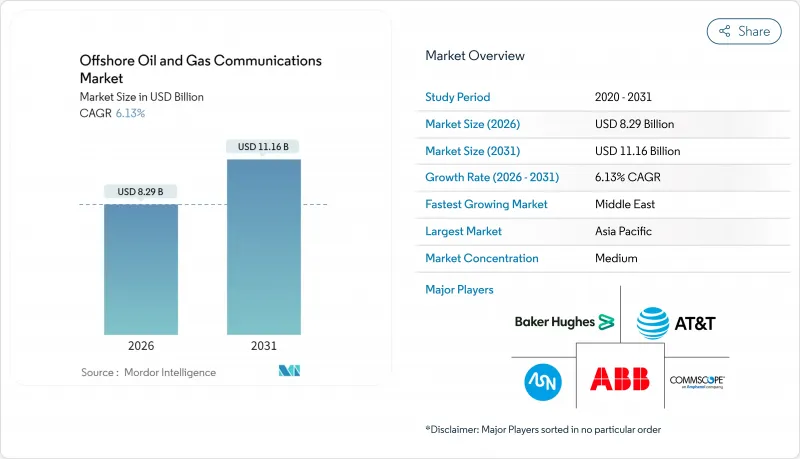
본 보고서는 솔루션별(업스트림 통신 시스템 등), 통신 네트워크 기술별(VSAT 통신 네트워크, 5G/프라이빗 LTE 등), 구성 요소별(하드웨어, 소프트웨어, 서비스), 서비스 유형별(전문 서비스 등), 해양 설비 유형별(시추 리그 등) 및 지역별로 분류되어 있습니다. 시장 예측은 금액(달러)으로 표시되어 있습니다.
세계의 해양 석유 및 가스 통신 시장 동향 및 인사이트
실시간 시추 장비 감시를 위한 대역폭 수요 증가
현재 시추 유닛은 하루에 수 테라바이트의 데이터 세트를 생성하고 있으며, 이는 2 Mbit/s VSAT 회선의 용량을 훨씬 초과합니다. Maersk Integrator와 같은 자산에 프라이빗 5G 셀이 도입됨에 따라 2025년에는 50 Mbps의 업링크가 실현되어 4K 비디오 및 유정 내 원격 측정 데이터를 몇 초 만에 육상 센터로 전송할 수 있게 되었습니다. 실시간 가시화를 통해 심해 유정의 비생산 시간이 최대 20% 감소했으며, 피크 시간대를 제외한 시간대의 복리후생용 대역폭이 2배로 늘어 승무원 이직률도 개선되었습니다. 현재 각 통신사는 운영 트래픽을 우선시하는 단계별 대역폭 요금제를 묶어 제공함으로써 비용과 이용률을 적절히 조율하고 있습니다.
수심 2,500미터를 초과하는 심해 프로젝트의 확대
초심해 유전에서는 해저 분출 방지 장치(BOP) 제어 및 동적 위치 측정 시스템을 위해 50밀리초 미만의 지연 시간이 요구됩니다. 페트로브라스의 ‘메로(Mero)’ FPSO 프로그램에서는 저지연을 보장하는 관리형 광섬유 링이 채택된 반면, 쉘(Shell)의 ‘웨일(Whale)’ 플랫폼에서는 하루 10만 배럴의 생산량을 보호하기 위해 2025년에 3중 중복화된 링크가 추가되었습니다. 이처럼 심해 광구의 확장에 따라, 육상에 위치한 고성능 클러스터와 동기화되는 하이브리드형(위성·광섬유 병용) 토폴로지 및 엣지 서버의 수주가 가속화되고 있습니다.
Ka 대역 회선에서 악천후 시 발생하는 신호 저하
Ka 대역은 처리량을 10배 향상시키지만, 격렬한 폭풍 시에는 레인페이드의 영향을 받아 가동률이 95% 미만으로 떨어집니다. 북해의 플랫폼에서는 과거 Ku 대역의 연간 다운타임이 30시간인 반면, Ka 대역에서는 120시간이 기록된 바 있습니다. 현재 사업자들은 서비스 연속성을 유지하기 위해 사이트 다이버시티 게이트웨이와 멀티오빗 단말기를 도입하고 있지만, 여전히 남아 있는 위험 요인으로 인해 지연 시간에 극도로 민감한 워크로드의 Ku 대역에서 Ka 대역으로의 전환이 저해되고 있습니다.
부문 분석
2025년, 해양 석유 및 가스 통신 시장의 업스트림 부문은 시장 규모의 47.34%를 차지했습니다. 이는 실시간 데이터가 시추 효율을 직접 향상시키는 탐사 및 생산 자산에 대한 막대한 자본 배분이 반영된 결과입니다. 현재 신규 심해 유정의 60%에 통합된 지능형 유정 완공 기술을 통한 엣지 텔레메트리가 지속적인 고대역폭 링크에 대한 수요를 뒷받침하고 있습니다.
하류 부문 시설은 현재 규모가 작지만, 정유시설가 배기가스 및 누출 감시를 위해 1만 개의 센서를 갖춘 무선 네트워크를 도입함에 따라 2031년까지 연평균 성장률(CAGR) 6.77%를 나타낼 것으로 예측되며, 그 통신 부하는 업스트림 부문 시설에 근접할 것으로 전망됩니다. 또한, 중류 부문 사업자들은 파이프라인 침입 사건을 실시간으로 감지하는 광섬유 센싱 케이블 도입을 추진하고 있으며, 이에 따라 해양 석유 및 가스 통신 시장은 파이프라인 건전성 모니터링이라는 틈새 분야로 확대되고 있습니다.
VSAT는 1.2m 파라볼라 안테나를 며칠 만에 설치할 수 있어 신규 시추 설비의 신속한 가동을 가능하게 함에 따라, 2025년에도 매출액 기준 39.77%의 선두를 유지했습니다. 따라서 이 기술은 미탐사 유정의 원격 시운전 일정의 기반이 되어, 해양 석유 및 가스 통신 시장에서의 우위를 공고히 하고 있습니다.
그러나 안전 루프 및 산업용 IoT를 위해 예측 가능한 지연을 실현하는 면허 대역 할당으로 인해 5G 및 프라이빗 LTE 네트워크가 연평균 성장률(CAGR) 6.96%로 확대되고 있어, VSAT의 지배력은 점차 약화되고 있습니다. 한편, 경제성이 허용하는 한 광섬유는 여전히 대역폭의 한계를 나타내고 있습니다. 그 대표적인 예로, VSAT 회선을 완전히 대체한 에퀴놀(Equinor)사의 120km에 달하는 요한 스베르도르프(Johan Sverdrup) 케이블이 있습니다.
지역별 분석
아시아태평양은 2025년 매출의 28.82%를 차지했습니다. 이는 페트로나스(Petronas), ONGC, CNOOC가 노후화된 잭업식 시추선 함대를 쿠알라룸푸르,뭄바이, 선전에 위치한 원격 운영 센터에 연결하는 ‘Fiber-to-the-Rig’ 링크나 프라이빗 LTE를 통해 개조하고 있는 것이 원동력이 되고 있습니다. 말레이시아에서는 정부의 주파수 대역 승인 절차가 대체로 간소화되어 있어, 시험 운영을 6개월 이내에 실험실에서 현장으로 전환할 수 있습니다. 북미는 계속해서 기술 실증의 장으로서의 위상을 유지하고 있습니다. 멕시코만에 위치한 셰브론의 ‘앵커’ 플랫폼에서는 저궤도 위성과 5G 메쉬 네트워크를 결합하여, 우선순위가 높은 안전 관련 통신은 셀룰러 회선을 통해 라우팅하는 한편, 중요도가 낮은 데이터는 VSAT 회선으로 분배하고 있습니다. 허리케인에 대한 내성은 여전히 주요 촉진요인이며, 가동률을 99.9% 가까이 유지하기 위한 듀얼 궤도 안테나 설치가 진행되고 있습니다.
유럽에서는 해저 광섬유 개량에 대한 투자가 계속되고 있습니다. 2024년 말 완공된 에퀴노르(Equinor)사의 요한 스베르드루프(Johan Sverdrup)용 120km 케이블 덕분에, 이 회사는 정지 궤도 링크를 폐지하고 연간 대역폭 비용을 60% 절감할 수 있었습니다. 2024년에 발효되는 NIS2 지침에 따라 사업자들은 운영 기술(OT) 트래픽을 모니터링하여 이상 징후를 감지하는 관리형 보안 서비스 도입을 더욱 추진하게 될 것입니다. 중동은 연평균 성장률(CAGR) 7.11%가 예상되는 가장 빠르게 성장하는 지역 시장입니다. 사우디 아람코가 2025년에 15개의 가스 플랫폼을 대상으로 1억 8,000만 달러 규모의 민간 5G 계약을 발주한 것은 지속적인 기가비트급 통신 회선에 의존하는 무인 플랫폼 구상에 대한 지역 내 수요가 증가하고 있음을 보여줍니다. ADNOC도 자쿰 및 하일 프로젝트에서 이에 발맞추어 IEC 62443을 준수하기 위해 사이버 보안 게이트웨이를 통합하고 있습니다.
남미는 브라질의 프리솔트층 개발 붐에 힘입고 있습니다. 페트로브라스와 스피드캐스트가 체결한 7년, 1억 2,000만 달러 규모의 계약은 12기의 FPSO를 대상으로 하며, 이들 FPSO는 저류층 데이터를 육상의 분석 허브로 실시간으로 전송함으로써 장기적인 서비스 수익을 확보하고 있습니다. 가이아나와 수리남의 소규모 사업자들은 고정형 VSAT 계약에 따른 설비 투자(CAPEX)를 피하기 위해 Starlink Maritime을 이용하고 있습니다. 아프리카의 상황은 여전히 편차가 있습니다. 앙골라의 사업자들은 해안 지역의 광섬유 육상 기지국이 드물기 때문에 여전히 기존의 Ku-밴드 VSAT에 의존하고 있는 반면, 나이지리아의 독립 사업자들은 갑판상의 설치 면적을 줄이기 위해 Kymeta사의 평면 패널 안테나를 시범 운영 중입니다. 해양 주파수 대역에 관한 규제 명확화는 여전히 병목 현상으로 작용하고 있으며, 나이지리아와 앙골라에서는 도입 일정에 최대 12개월의 지연이 발생할 가능성이 있습니다.
기타 혜택 :
- 엑셀 형식 시장 예측(ME) 시트
- 3개월간의 애널리스트 지원
자주 묻는 질문
목차
제1장 서론
제2장 조사 방법
제3장 주요 요약
제4장 시장 구도
제5장 시장 규모 및 성장 예측
제6장 경쟁 구도
제7장 시장 기회 및 향후 전망
AJY 26.09.07According to Mordor Intelligence, the offshore oil and gas communications market size reached USD 8.29 billion in 2026 and is projected to rise to USD 11.16 billion by 2031, reflecting a 6.13% CAGR.
This report is Segmented by Solution (Upstream Communication Systems, and More), Communication Network Technology (VSAT Communication Network, 5G/Private LTE, and More), Component (Hardware, Software, and Services), Service Type (Professional Services, and More), Offshore Installation Type (Drilling Rigs, and More), and Geography. The Market Forecasts are Provided in Terms of Value (USD).
Global Offshore Oil And Gas Communications Market Trends and Insights
Rising Bandwidth Needs for Real-Time Rig Monitoring
Drilling units now generate multi-terabyte datasets each day, far exceeding the capacity of 2 Mbit/s VSAT links. The adoption of private 5G cells on assets such as the Maersk Integrator delivered 50 Mbps uplinks in 2025, enabling 4K video and downhole telemetry to reach onshore centers in seconds. Real-time visibility reduced non-productive time on deepwater wells by up to 20% and improved crew retention by doubling welfare bandwidth during off-peak periods. Providers now bundle tiered bandwidth that prioritizes operational traffic, aligning cost with utilization.
Expansion of Deepwater Projects Beyond 2,500 m
Ultra-deep fields require sub-50-ms latency for subsea blowout preventer controls and dynamic positioning systems. Petrobras's Mero FPSO program relies on managed fiber rings that guarantee low latency, while Shell's Whale platform added triple-redundant links in 2025 to protect 100,000 barrels-per-day output. The scaling of deepwater acreage is therefore accelerating orders for hybrid satellite-fiber topologies and edge servers that synchronize with onshore high-performance clusters.
Harsh-Weather Signal Degradation on Ka-Band Links
Ka-band delivers ten-fold throughput improvements but experiences rain fade that drops uptime below 95% during severe storms. North Sea platforms historically logged 120 hours of Ka-band outages each year versus 30 hours on Ku-band. Operators now deploy site-diversity gateways and multi-orbit terminals to maintain continuity, yet residual risks deter fully latency-sensitive workloads from migrating off Ku-band.
Other drivers and restraints analyzed in the detailed report include:
- 5G-Enabled Private LTE Roll-Outs on Floating Assets
- Growing Use of Edge-Based AI for Predictive Maintenance
- High CAPEX of Subsea Fiber Backbones
For complete list of drivers and restraints, kindly check the Table Of Contents.
Segment Analysis
The upstream portion of the offshore oil and gas communications market accounted for 47.34% of the market size in 2025, reflecting heavy capital allocation to exploration and production assets, where real-time data directly improves drilling efficiency. Edge telemetry from intelligent well completions, now embedded in 60% of new deepwater wells, anchors demand for continuous high-bandwidth links.
Downstream installations, although smaller today, are forecast to grow at a 6.77% CAGR through 2031 as refineries add 10,000-sensor wireless networks for emissions and leak monitoring, creating communication loads approaching those of upstream installations. Midstream operators are also commissioning fiber-optic sensing cables that detect pipe intrusion events in real time, extending the offshore oil and gas communications market into pipeline integrity-monitoring niches.
VSAT maintained a 39.77% revenue lead in 2025 because a 1.2 m dish can be installed in a few days, enabling rapid commissioning of new rigs. The technology, therefore, anchors remote start-up schedules for wildcat wells, cementing its dominance in the offshore oil and gas communications market.
That grip is loosening as 5G and private LTE networks expand at a 6.96% CAGR, enabled by licensed-spectrum allocations that provide predictable latency for safety loops and industrial IoT. Meanwhile, fiber remains the bandwidth ceiling where economics allow, as exemplified by Equinor's 120 km Johan Sverdrup cable, which replaced VSAT links altogether.
Complete Report Scope:
- By Solution
- Upstream Communication Systems
- Midstream Communication Systems
- Downstream Communication Systems
- By Communication Network Technology
- Cellular Communication Network
- VSAT Communication Network
- Fiber Optic-based Communication Network
- Microwave Communication Network
- 5G/Private LTE
- By Component
- Hardware
- Software
- Services
- By Service Type
- Managed Services
- Professional Services
- Maintenance and Support Services
- Integration Services
- By Offshore Installation Type
- Drilling Rigs
- Floating Production Storage and Offloading (FPSO)
- Fixed Production Platforms
- Support Vessels and Supply Ships
- Subsea Production Systems
- By Geography
- North America
- United States
- Canada
- Mexico
- Europe
- Germany
- United Kingdom
- France
- Russia
- Rest of Europe
- Asia-Pacific
- China
- Japan
- India
- South Korea
- Australia
- Rest of Asia-Pacific
- Middle East and Africa
- Middle East
- Saudi Arabia
- United Arab Emirates
- Rest of Middle East
- Africa
- South Africa
- Egypt
- Rest of Africa
- Middle East
- South America
- Brazil
- Argentina
- Rest of South America
- North America
Geography Analysis
Asia-Pacific generated 28.82% of 2025 revenue, driven by Petronas, ONGC, and CNOOC, which are retrofitting aging jack-up fleets with fiber-to-the-rig links and private LTE that feed remote operations centers in Kuala Lumpur, Mumbai, and Shenzhen. Government spectrum approvals are generally streamlined in Malaysia, allowing trials to move from the lab to the field in under 6 months. North America retains its status as a technology testbed. Chevron's Anchor platform in the Gulf of Mexico combines low-Earth-orbit satellites with 5G meshing that routes high-priority safety traffic across cellular links while relegating non-critical data to VSAT circuits. Hurricane resilience remains a central driver, leading to dual-orbit antenna installations that keep uptime near 99.9%.
Europe continues to invest in subsea fiber retrofits. Equinor's 120 km cable to Johan Sverdrup, completed in late 2024, enabled the operator to decommission geostationary links and cut annual bandwidth costs by 60%. The NIS2 Directive, effective in 2024, further pushes operators to adopt managed security services that monitor operational technology traffic for anomalies. The Middle East is the fastest-growing regional market with a 7.11% CAGR outlook. Saudi Aramco's 2025 award of USD 180 million in private 5G contracts for 15 gas platforms signals regional appetite for unmanned platform concepts that rely on continuous gigabit-class links. ADNOC is following suit on the Zakum and Hail projects, embedding cybersecurity gateways to comply with IEC 62443.
South America rides on Brazil's pre-salt boom. Petrobras's seven-year, USD 120 million deal with Speedcast covers 12 FPSOs that stream real-time reservoir data to onshore analytics hubs, locking in long-duration service revenues. Smaller operators in Guyana and Suriname use Starlink Maritime to avoid the CAPEX of fixed VSAT contracts. Africa remains fragmented. Angolan operators still rely on traditional Ku-band VSAT because near-shore fiber landing stations are sparse, while Nigerian independents are testing flat-panel antennas from Kymeta to reduce deck footprint. Regulatory clarity on offshore spectrum remains a bottleneck that can add up to 12 months to deployment timelines in Nigeria and Angola.
- ABB Ltd
- Alcatel-Lucent Submarine Networks
- AT&T Inc.
- Baker Hughes Co.
- CommScope Holding Co. Inc.
- Redline Communications Group Inc.
- Harris CapRock Communications Inc.
- Hughes Network Systems LLC
- Huawei Technologies Co. Ltd.
- Siemens AG
- Inmarsat Group Holdings Ltd.
- Speedcast International Ltd.
- Oceaneering International Inc.
- Subsea 7 SA
- NEC Corp.
- RigNet Inc.
- Kongsberg Gruppen ASA
- Fortinet Inc.
- Ericsson AB
- L3Harris Technologies Inc.
Additional Benefits:
- The market estimate (ME) sheet in Excel format
- 3 months of analyst support
TABLE OF CONTENTS
1 INTRODUCTION
- 1.1 Study Assumptions and Market Definition
- 1.2 Scope of the Study
2 RESEARCH METHODOLOGY
3 EXECUTIVE SUMMARY
4 MARKET LANDSCAPE
- 4.1 Market Overview
- 4.2 Market Drivers
- 4.2.1 Rising Bandwidth Needs for Real-time Rig Monitoring
- 4.2.2 Expansion of Deep-water Projects Beyond 2,500 m
- 4.2.3 5G-Enabled Private LTE Roll-outs on Floating Assets
- 4.2.4 Growing Use of Edge-Based AI for Predictive Maintenance
- 4.2.5 Energy-Industry Cybersecurity Regulations Tightening
- 4.2.6 Under-reported: Satellite Mega-Constellations Providing Low-Latency Links
- 4.3 Market Restraints
- 4.3.1 Harsh-weather Signal Degradation on Ka-band Links
- 4.3.2 High CAPEX of Subsea Fiber Backbones
- 4.3.3 Limited Spectrum Allocation in Offshore Blocks
- 4.3.4 Under-reported: Shortage of RF Technicians Willing to Work Offshore
- 4.4 Industry Value Chain Analysis
- 4.5 Impact of Macroeconomic Factors on the Market
- 4.6 Regulatory Landscape
- 4.7 Technological Outlook
- 4.8 Porter's Five Forces Analysis
- 4.8.1 Threat of New Entrants
- 4.8.2 Bargaining Power of Buyers
- 4.8.3 Bargaining Power of Suppliers
- 4.8.4 Threat of Substitute Products
- 4.8.5 Intensity of Competitive Rivalry
5 MARKET SIZE AND GROWTH FORECASTS (VALUE)
- 5.1 By Solution
- 5.1.1 Upstream Communication Systems
- 5.1.2 Midstream Communication Systems
- 5.1.3 Downstream Communication Systems
- 5.2 By Communication Network Technology
- 5.2.1 Cellular Communication Network
- 5.2.2 VSAT Communication Network
- 5.2.3 Fiber Optic-based Communication Network
- 5.2.4 Microwave Communication Network
- 5.2.5 5G/Private LTE
- 5.3 By Component
- 5.3.1 Hardware
- 5.3.2 Software
- 5.3.3 Services
- 5.4 By Service Type
- 5.4.1 Managed Services
- 5.4.2 Professional Services
- 5.4.3 Maintenance and Support Services
- 5.4.4 Integration Services
- 5.5 By Offshore Installation Type
- 5.5.1 Drilling Rigs
- 5.5.2 Floating Production Storage and Offloading (FPSO)
- 5.5.3 Fixed Production Platforms
- 5.5.4 Support Vessels and Supply Ships
- 5.5.5 Subsea Production Systems
- 5.6 By Geography
- 5.6.1 North America
- 5.6.1.1 United States
- 5.6.1.2 Canada
- 5.6.1.3 Mexico
- 5.6.2 Europe
- 5.6.2.1 Germany
- 5.6.2.2 United Kingdom
- 5.6.2.3 France
- 5.6.2.4 Russia
- 5.6.2.5 Rest of Europe
- 5.6.3 Asia-Pacific
- 5.6.3.1 China
- 5.6.3.2 Japan
- 5.6.3.3 India
- 5.6.3.4 South Korea
- 5.6.3.5 Australia
- 5.6.3.6 Rest of Asia-Pacific
- 5.6.4 Middle East and Africa
- 5.6.4.1 Middle East
- 5.6.4.1.1 Saudi Arabia
- 5.6.4.1.2 United Arab Emirates
- 5.6.4.1.3 Rest of Middle East
- 5.6.4.2 Africa
- 5.6.4.2.1 South Africa
- 5.6.4.2.2 Egypt
- 5.6.4.2.3 Rest of Africa
- 5.6.4.1 Middle East
- 5.6.5 South America
- 5.6.5.1 Brazil
- 5.6.5.2 Argentina
- 5.6.5.3 Rest of South America
- 5.6.1 North America
6 COMPETITIVE LANDSCAPE
- 6.1 Market Concentration
- 6.2 Strategic Moves
- 6.3 Market Share Analysis
- 6.4 Company Profiles (includes Global Level Overview, Market Level Overview, Core Segments, Financials as Available, Strategic Information, Market Rank/Share for Key Companies, Products and Services, and Recent Developments)
- 6.4.1 ABB Ltd
- 6.4.2 Alcatel-Lucent Submarine Networks
- 6.4.3 AT&T Inc.
- 6.4.4 Baker Hughes Co.
- 6.4.5 CommScope Holding Co. Inc.
- 6.4.6 Redline Communications Group Inc.
- 6.4.7 Harris CapRock Communications Inc.
- 6.4.8 Hughes Network Systems LLC
- 6.4.9 Huawei Technologies Co. Ltd.
- 6.4.10 Siemens AG
- 6.4.11 Inmarsat Group Holdings Ltd.
- 6.4.12 Speedcast International Ltd.
- 6.4.13 Oceaneering International Inc.
- 6.4.14 Subsea 7 SA
- 6.4.15 NEC Corp.
- 6.4.16 RigNet Inc.
- 6.4.17 Kongsberg Gruppen ASA
- 6.4.18 Fortinet Inc.
- 6.4.19 Ericsson AB
- 6.4.20 L3Harris Technologies Inc.
7 MARKET OPPORTUNITIES AND FUTURE OUTLOOK
- 7.1 White-space and Unmet-Need Assessment


