

|
시장보고서
상품코드
2122316
가죽용 화학제품 : 시장 점유율 분석, 업계 동향과 통계, 성장 예측(2026-2031년)Leather Chemicals - Market Share Analysis, Industry Trends & Statistics, Growth Forecasts (2026 - 2031) |
||||||
 Mordor Intelligence
Mordor Intelligence에 의하면, 가죽용 화학제품 시장 규모는 2025년에 110억 2,000만 달러로 평가되었고, 2026년 126억 2,000만 달러에서 2031년까지 170억 3,000만 달러에 이를 것으로 예측되며, 예측 기간(2026-2031년) CAGR은 6.18%를 기록할 전망입니다.

본 보고서는 제품 유형별(무두질·염색용 화학제품, 빔하우스용 화학제품, 기타), 화학제품 기능별(크롬계, 기타),최종 사용자 산업별(신발, 가구, 자동차, 섬유·패션, 기타 최종 사용자 산업), 지역별(아시아태평양, 북미, 유럽, 남미, 중동 및 아프리카)로 세분화되어 있습니다. 시장 예측은 금액(달러) 기준으로 제시되어 있습니다.
세계 가죽용 화학제품 시장 동향 및 인사이트
크롬 프리·메탈 프리 무두질 기술의 급증
고급 브랜드와 OEM 업체들은 EU의 REACH 부속서 XVII 및 각국의 규제를 준수하기 위해 Cr-VI 농도를 3ppm 이하로 억제해야 하며, 이에 따라 글루탈알데히드, 티타늄 염, 합성 재무두 폴리머를 조합한 웨트 화이트 시스템으로의 급속한 전환이 진행되고 있습니다. CLARIANT Leva 및 Stahl EasyWhite Tan-E와 같은 솔루션은 크롬 슬러지를 제거하고, 유해 폐기물 처리 비용을 40% 절감하며, 가공 주기를 15% 단축합니다. 중국에서는 GB 30585-2014 규격의 시행에 따라 저장성과 광둥성의 거점에서 설비 업그레이드가 진행되었습니다. 한편, 인도와 방글라데시의 중소기업들은 원자재 비용 상승과 pH 관리 강화에 직면하여 투입 비용이 12-18% 증가했습니다.
신발·섬유 산업의 급속한 성장
2024년, 아시아에서는 54억 켤레의 신발이 생산되었으며, 2025년에는 인도의 신발 생산량이 9.2% 증가하여 비용 효율이 높은 합성 무두질제 및 유화제에 대한 기초적인 수요가 유지되었습니다. 중국 연안 지역의 임금 상승에 따라 베트남과 인도네시아는 생산 능력을 확대하고 있으며, 양국의 가죽 공장에서는 다국적 기업공급업체 기준을 충족하기 위해 크롬 프리 생산 라인을 도입하고 있습니다. 패션 브랜드가 식물성 타닌 무두질이나 재활용 가죽을 지정하는 사례가 증가하고 있어, 경제적인 무금속 무두질제와 프리미엄 바이오 신탄에 대한 이중 수요가 높아지고 있습니다.
엄격한 6가 크롬(Cr-VI) 배출 및 폐수 규제
EU와 중국의 기준에 따르면 6가 크롬(Cr-VI)의 상한선을 3-10mg/kg으로 정하고 있어, 크롬계 무두질 공장은 고가의 재활용 루프를 도입하거나 3가 크롬 염으로 전환해야 하는 상황에 직면해 있습니다. 2025년에 개정될 인도의 배수 규제에서는 TDS(총 용존 고형물)와 BOD(생화학적 산소 요구량)의 기준치가 하향 조정되며, 중규모 공장의 경우 150만-300만 달러에 달하는 비용이 소요되는 막 생물 반응 장치의 도입이 의무화됩니다. 2024년 다카의 23개 가죽 무두질 공장이 폐쇄된 것과 같은 규제 집행 사례는 분산된 클러스터에서 발생하는 규정 준수 위험을 여실히 드러내고 있습니다.
부문 분석
2025년 시점에서 무두질제와 염색제가 가죽용 화학제품 시장 점유율의 45.22%를 계속 차지하고 있었지만, 마감용 화학제품이 연평균 성장률(CAGR) 6.98%로 가장 높은 성장률을 기록했습니다. 유럽에서는 50g/m2라는 VOC 상한 기준을 충족하는 수성 아크릴 및 폴리우레탄계 탑코트가 현재 매출의 62%를 차지하고 있습니다. 디지털 잉크젯 지원으로 인해 실리콘 개질 탑코트에 대한 수요가 더욱 높아지고 있으며, 스크린 교체에 따른 가동 중단 시간 없이 주문형 그래픽 인쇄가 가능해졌습니다. 빔 하우스용 효소는 매출의 18%를 차지하고 있으며, 이는 물 사용량을 30%, 석회 사용량을 40% 절감하는 프로테아제 혼합에 힘입은 것으로, 가뭄이 자주 발생하는 클러스터에 필수적입니다.
알데히드계 신탄 제제가 비슷한 비용으로 80°C 이상의 수축 온도에 대응할 수 있게 되면서, 크롬계 시스템의 기세는 꺾이고 있습니다. 중국 저장성에서는 2025년 관세 인상으로 인해 도시 상수도 요금이 18% 상승함에 따라 효소 도입이 가속화되고 있으며, 비용 대비 효과의 균형이 생화학적 공정 쪽으로 기울고 있습니다.
지역별 분석
아시아태평양은 2025년에 매출의 48.79%를 차지할 것으로 보이며, 2031년까지 연평균 6.87%의 성장률을 보일 전망입니다. 중국의 GB 30585-2014 규격 시행과 인도의 보조금 제도에 따라 웨트 화이트 가공의 채택이 촉진되는 한편, 베트남의 15억 5,000만 켤레에 달하는 수출 기반이 크롬 프리 기술에 대한 투자를 유치하고 있습니다. 인도네시아는 낮은 인건비를 활용해 중견 브랜드를 유치하고 있으며, 일본의 크롬 프리 러닝화 정책은 특수 분야에서 수요를 더욱 심화시키고 있습니다.
유럽과 북미에서는 독일 바이에른주에 위치한 자동차 산업 클러스터가 크롬 프리 내장재를 조달하고 있으며, 수성 마감의 보급률은 78%에 달할 전망입니다. 토스카나 지역의 식물성 무두질이라는 틈새 시장은 확립된 밤 추출물 공급망을 활용하여 40%의 가격 프리미엄을 확보하고 있습니다. 미국은 2024년에 12억 ft²의 마감 가죽을 수입하고 있으며, 이는 멕시코 및 라틴아메리카로의 니어쇼어링 추세를 반영하고 있습니다.
남미, 중동 및 아프리카에서는 브라질이 연간 4,400만 장의 가죽을 생산하여 이탈리아와 미국의 고객에게 공급하고 있습니다. 아르헨티나는 자동차 및 가구용 가죽을 위해 저비용 소가죽 공급을 활용하고 있습니다. 사우디아라비아는 고급 자동차 및 항공 산업을 대상으로 제다에 크롬 프리 가공 단지를 건설하기 위해 1억 5,000만 달러를 투자하고 있습니다. 남아프리카공화국은 국내 수질 기준을 준수하기 위해 효소를 병용하는 가공 공정으로의 전환을 추진하고 있습니다.
기타 혜택
- 엑셀 형식 시장 예측(ME) 시트
- 3개월간의 애널리스트 지원
자주 묻는 질문
목차
제1장 서론
제2장 조사 방법
제3장 주요 요약
제4장 시장 구도
제5장 시장 규모와 성장 예측
제6장 경쟁 구도
제7장 시장 기회와 향후 전망
LSH 26.09.04According to Mordor Intelligence, the leather chemicals market size was valued at USD 11.02 billion in 2025 and is estimated to grow from USD 12.62 billion in 2026 to reach USD 17.03 billion by 2031, at a CAGR of 6.18% during the forecast period (2026-2031).
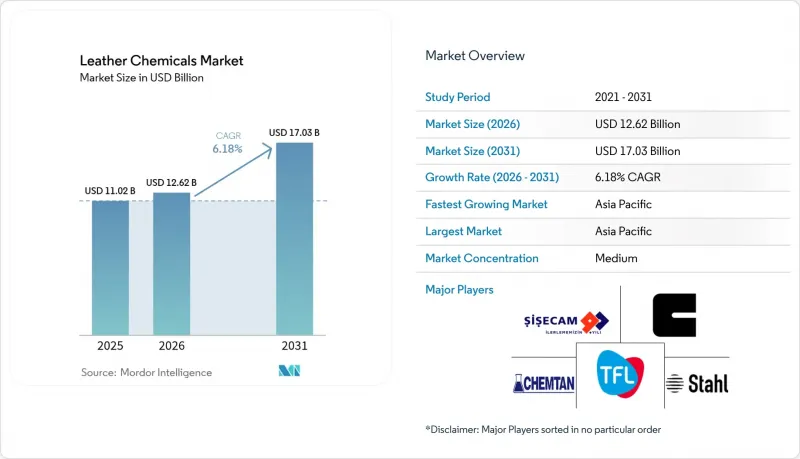
This report is Segmented by Product Type (Tanning and Dyeing Chemicals, Beam-House Chemicals, and More), Chemical Function (Chrome-Based, and More), End-User Industry (Footwear, Furniture, Automotive, Textile and Fashion, and Other End-User Industries), and Geography (Asia-Pacific, North America, Europe, South America, and Middle East and Africa). The Market Forecasts are Provided in Terms of Value (USD).
Global Leather Chemicals Market Trends and Insights
Surge in Chrome-Free & Metal-Free Tanning Technologies
Luxury brands and OEMs require Cr-VI below 3 ppm to comply with EU REACH Annex XVII and state regulations, prompting rapid migration to wet-white systems that combine glutaraldehyde, titanium salts, and synthetic retanning polymers. Solutions such as CLARIANT Leva and Stahl EasyWhite Tan-E eliminate chromium sludge, cut hazardous disposal costs by 40%, and shorten processing cycles by 15%. In China, the GB 30585-2014 standard spurred upgrades across Zhejiang and Guangdong hubs, while Indian and Bangladeshi SMEs face higher raw-material costs and tighter pH controls that add 12-18% to inputs.
Rapid Growth of Footwear & Textile Industries
Asia produced 5.4 billion pairs of shoes in 2024, and India's footwear output rose 9.2% in 2025, sustaining baseline demand for cost-efficient syntans and fatliquors. Vietnam and Indonesia expand capacity as China's coastal wages climb, and their tanneries adopt chrome-free lines to meet multinational supplier codes. Fashion labels increasingly specify vegetable-tanned or recycled hides, reinforcing dual demand for economical metal-free agents and premium bio-syntans.
Strict Cr-VI Emission & Wastewater Norms
EU and Chinese standards cap Cr-VI at 3-10 mg/kg, forcing chrome-based tanneries to install expensive recycling loops or pivot toward trivalent salts. India's revised effluent rules in 2025 cut TDS and BOD limits, requiring membrane bioreactors that can cost USD 1.5-3 million for mid-sized plants. Enforcement closures, such as 23 Dhaka tanneries in 2024, highlight compliance risk for fragmented clusters.
Other drivers and restraints analyzed in the detailed report include:
- Increasing Demand for Automotive & Aviation Upholstery
- Rising Preference for Bio-Based Fatliquors & Syntans
- High Energy & Effluent-Treatment Costs
For complete list of drivers and restraints, kindly check the Table Of Contents.
Segment Analysis
Finishing chemicals delivered the fastest growth at 6.98% CAGR, even as tanning and dyeing agents retained 45.22% of the leather chemicals market share in 2025. Water-based acrylic and polyurethane topcoats now hold 62% of sales in Europe, meeting VOC caps of 50 g/m2. Digital inkjet compatibility drives incremental demand for silicone-modified top layers, enabling on-demand graphics without screen change downtime. Beam-house enzymes account for 18% of revenues, supported by protease blends that lower water use by 30% and lime 40%, vital for drought-prone clusters.
Chrome-based systems lose momentum as aldehyde-syntan packages now match shrinkage temperatures above 80°C at similar cost. Enzyme adoption accelerates in China's Zhejiang province, where a 2025 tariff hike raised municipal water charges 18%, tipping the cost-benefit scale toward biochemical processes.
Complete Report Scope:
- By Product Type
- Tanning and Dyeing Chemicals
- Beam-house Chemicals
- Finishing Chemicals
- By Chemical Function
- Chrome-based
- Chrome-free Mineral
- Synthetic Organic
- By End-user Industry
- Footwear
- Furniture
- Automotive
- Textile and Fashion
- Other End-user Industries (Heavy Leather and Saddlery, etc.)
- By Geography
- Asia-Pacific
- China
- Japan
- India
- South Korea
- ASEAN Countries
- Rest of Asia-Pacific
- North America
- United States
- Canada
- Mexico
- Europe
- Germany
- United Kingdom
- France
- Italy
- Spain
- Russia
- NORDIC Countries
- Rest of Europe
- South America
- Brazil
- Argentina
- Rest of South America
- Middle East and Africa
- Saudi Arabia
- South Africa
- Rest of Middle East and Africa
- Asia-Pacific
Geography Analysis
Asia-Pacific dominated with 48.79% revenue in 2025 and will expand at 6.87% through 2031. China's GB 30585-2014 enforcement and India's subsidy scheme boost wet-white adoption, while Vietnam's 1.55 billion-pair export base draws chrome-free investments. Indonesia leverages lower wages to attract mid-tier brands, and Japan's chrome-free running-shoe policy deepens specialty demand.
In Europe and North America, Germany's Bavarian automotive cluster sources chrome-free interiors, lifting water-based finishing penetration to 78%. Tuscany's vegetable-tanning niche commands 40% price premiums, benefitting from established chestnut-extract supply chains. The United States imported 1.2 billion ft2 of finished leather in 2024, reflecting near-shoring trends to Mexico and Latin America.
In South America and the Middle East, and Africa, Brazil's 44 million hides per year feed Italian and US customers. Argentina capitalizes on low-cost bovine supply for automotive and furniture leather. Saudi Arabia invests USD 150 million to build a chrome-free cluster in Jeddah, targeting luxury autos and aviation. South Africa shifts toward enzyme-assisted processes to align with national water standards.
- AMIT
- Balmer Lawrie & Co. Ltd.
- Buckman
- Chemtan Company, Inc.
- CLARIANT
- Dyna Glycols
- DyStar Singapore Pte Ltd
- Fashion Chemicals GmbH & Co. KG
- Indofil Industries Limited.
- SCHILL+SEILACHER GMBH
- Sisecam
- Stahl Holdings B.V.
- Syn-Bios S.p.A.
- TEXAPEL S.A.
- TFL
- YILDIRIM Group Of Companies
- Zschimmer & Schwarz Chemie GmbH
Additional Benefits:
- The market estimate (ME) sheet in Excel format
- 3 months of analyst support
TABLE OF CONTENTS
1 Introduction
- 1.1 Study Assumptions & Market Definition
- 1.2 Scope of the Study
2 Research Methodology
3 Executive Summary
4 Market Landscape
- 4.1 Market Overview
- 4.2 Market Drivers
- 4.2.1 Surge in chrome-free & metal-free tanning tech
- 4.2.2 Rapid growth of footwear & textile industries
- 4.2.3 Increasing demand for automotive & aviation upholstery
- 4.2.4 Rising preference for bio-based fatliquors & syntans
- 4.2.5 Enzyme-driven beam-house processes cut water 30%
- 4.3 Market Restraints
- 4.3.1 Strict Cr-VI emission & wastewater norms
- 4.3.2 High energy & effluent-treatment costs
- 4.3.3 Shift to mycelium/lab-grown leathers cuts chemical demand
- 4.4 Value Chain Analysis
- 4.5 Porter's Five Forces
- 4.5.1 Bargaining Power of Suppliers
- 4.5.2 Bargaining Power of Buyers
- 4.5.3 Threat of New Entrants
- 4.5.4 Threat of Substitutes
- 4.5.5 Degree of Competition
5 Market Size and Growth Forecasts (Value)
- 5.1 By Product Type
- 5.1.1 Tanning and Dyeing Chemicals
- 5.1.2 Beam-house Chemicals
- 5.1.3 Finishing Chemicals
- 5.2 By Chemical Function
- 5.2.1 Chrome-based
- 5.2.2 Chrome-free Mineral
- 5.2.3 Synthetic Organic
- 5.3 By End-user Industry
- 5.3.1 Footwear
- 5.3.2 Furniture
- 5.3.3 Automotive
- 5.3.4 Textile and Fashion
- 5.3.5 Other End-user Industries (Heavy Leather and Saddlery, etc.)
- 5.4 By Geography
- 5.4.1 Asia-Pacific
- 5.4.1.1 China
- 5.4.1.2 Japan
- 5.4.1.3 India
- 5.4.1.4 South Korea
- 5.4.1.5 ASEAN Countries
- 5.4.1.6 Rest of Asia-Pacific
- 5.4.2 North America
- 5.4.2.1 United States
- 5.4.2.2 Canada
- 5.4.2.3 Mexico
- 5.4.3 Europe
- 5.4.3.1 Germany
- 5.4.3.2 United Kingdom
- 5.4.3.3 France
- 5.4.3.4 Italy
- 5.4.3.5 Spain
- 5.4.3.6 Russia
- 5.4.3.7 NORDIC Countries
- 5.4.3.8 Rest of Europe
- 5.4.4 South America
- 5.4.4.1 Brazil
- 5.4.4.2 Argentina
- 5.4.4.3 Rest of South America
- 5.4.5 Middle East and Africa
- 5.4.5.1 Saudi Arabia
- 5.4.5.2 South Africa
- 5.4.5.3 Rest of Middle East and Africa
- 5.4.1 Asia-Pacific
6 Competitive Landscape
- 6.1 Market Concentration
- 6.2 Strategic Moves
- 6.3 Market Share(%)/Ranking Analysis
- 6.4 Company Profiles (includes Global level Overview, Market level overview, Core Segments, Financials as available, Strategic Information, Products and Services, and Recent Developments)
- 6.4.1 AMIT
- 6.4.2 Balmer Lawrie & Co. Ltd.
- 6.4.3 Buckman
- 6.4.4 Chemtan Company, Inc.
- 6.4.5 CLARIANT
- 6.4.6 Dyna Glycols
- 6.4.7 DyStar Singapore Pte Ltd
- 6.4.8 Fashion Chemicals GmbH & Co. KG
- 6.4.9 Indofil Industries Limited.
- 6.4.10 SCHILL+SEILACHER GMBH
- 6.4.11 Sisecam
- 6.4.12 Stahl Holdings B.V.
- 6.4.13 Syn-Bios S.p.A.
- 6.4.14 TEXAPEL S.A.
- 6.4.15 TFL
- 6.4.16 YILDIRIM Group Of Companies
- 6.4.17 Zschimmer & Schwarz Chemie GmbH
7 Market Opportunities and Future Outlook
- 7.1 White-space and Unmet-need Assessment
- 7.2 Digital leather-printing chemicals for mass-custom


