|
시장보고서
상품코드
2122351
요도 카테터 : 시장 점유율 분석, 업계 동향과 통계, 성장 예측(2026-2031년)Global Urinary Catheters - Market Share Analysis, Industry Trends & Statistics, Growth Forecasts (2026 - 2031) |
||||||
 Mordor Intelligence
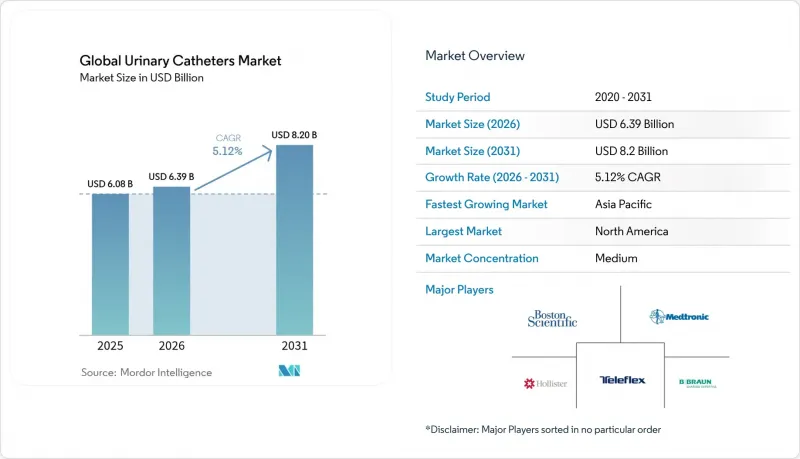
Mordor Intelligence에 의하면, 요도 카테터 시장 규모는 2025년 60억 8,000만 달러에서 2026년에는 63억 9,000만 달러에 이르고, 2026-2031년 CAGR 5.12%로 성장을 지속하여 2031년에는 82억 달러에 달할 것으로 예측됩니다.
본 보고서에서는 산업을 제품 유형별(체내 삽입형(폴리) 카테터, 간헐적 카테터, 기타), 용도별(양성 전립선 비대증(BPH), 요실금, 기타), 최종 사용자별(병원, 재택 간호, 기타),성별(남성, 여성), 지역별로 분류하고 있습니다. 본 보고서에서는 상기 각 부문별 시장 규모를 금액(달러) 기준으로 제시하고 있습니다.
전 세계 요도 카테터 시장 동향 및 인사이트
요실금 유병률 증가
요양 시설 내 요실금 유병률은 76.5%로 보고되고 있으며, 이는 상주형, 간헐형, 체외형 기기에 대한 수요가 지속되고 있음을 여실히 보여줍니다. 기능성 요실금은 현재 전체 사례의 45.5%를 차지하고 있으며, 대상층이 고령자에 국한되지 않고 있습니다. 피부염이나 낙상 등의 관련 합병증으로 인해 요양 비용이 상승하고 있어, 카테터는 일회용 소모품이 아닌 필수적인 치료 도구로서의 입지가 강화되고 있습니다. 요양 시설에서의 요실금 관련 연간 지출은 50억 달러에 육박하고 있으며, 이에 따라 보험사들은 2차 합병증을 줄여주는 제품을 지원하기 시작했습니다. 재택 간호와 비교했을 때 전문 요양 시설에서의 진단율이 높은 점은 견고하고 감염 예방에 뛰어난 설계의 중요성을 부각시키고 있습니다. 지역사회에 거주하는 고령자의 유병률 증가에 따라, 각 제조업체들은 디지털 교육을 접목한 자가 요도 삽입 키트 공급에서 뚜렷한 성장세를 보이고 있습니다.
고령 인구 증가
양성 전립선 비대증(BPH)의 사례 수는 1990년부터 2022년에 걸쳐 2배 이상 증가하여 1억 1,250만 건에 달하며, 70세 이상 남성의 80%가 이 질환을 앓고 있습니다. 척수 손상 발생률은 100만 명당 23.77건이며, 이로 인해 수십 년에 걸친 카테터 의존이 발생하지만, 사례 수 증가의 95% 가까이는 인구 증가에 기인합니다. 이러한 동반 질환이 중첩되면서 복잡한 다중 적응증 시나리오가 발생하고 있으며, 동일한 환자에서 신경성 방광, 수술 후 요폐, 만성 기능 장애에 대응할 수 있는 의료기기 포트폴리오가 요구되고 있습니다. 의료 시스템이 고령화에 따른 다중 질환 병존으로 어려움을 겪는 가운데, 조달 우선순위는 재고 관리를 효율화하면서도 다양한 임상적 요구를 충족시키는 범용성이 높은 플랫폼으로 전환되고 있습니다.
CAUTI에 따른 높은 위험과 비용 부담
중환자실의 CAUTI 발생률은 평균 8.83%이며, 입원 기간을 연장시키기 때문에 가치 기반 구매(VBP) 제도 하에서 금전적 페널티의 대상이 됩니다. 병원에서는 간호사 주도의 카테터 제거 알고리즘을 도입하여, 이로 인해 고관절 골절 환자의 카테터 삽입률이 30%에서 6.7%로 감소했습니다. 이는 예방 조치가 시술 건수를 줄일 수 있음을 보여줍니다. 고소득 국가와 저소득 국가 간에 큰 격차가 존재하기 때문에 항균 카테터의 보급 곡선은 여전히 불균일한 상태입니다. 지불 기관은 확실한 감염 데이터를 갖춘 의료기기를 선호하는 반면, 지출 상한선으로 인해 의료 제공업체는 카테터 삽입 기간을 단축할 수밖에 없어, 프리미엄 가격(ASP)이 유지되고 있음에도 불구하고 판매량은 둔화되고 있습니다.
부문 분석
2025년에는 삽입형 폴리 카테터가 매출의 51.62%를 차지하며, 급성기 입원 의료의 기반을 계속 유지할 것으로 보입니다. 반면, 간헐적 카테터는 감염 발생률이 낮고 환자의 쾌적성이 향상된다는 증거에 힘입어 연평균 5.73%의 성장이 예상됩니다. 외부 카테터는 틈새 시장을 차지하고 있지만, 높은 사용자 만족도와 미국 내 명확한 환급 코드의 혜택을 받고 있습니다.
현재 설계 측면에서의 경쟁은 친수성 코팅, 일체형 윤활제 팩, 항균 합금에 초점이 맞추어져 있습니다. ConvaTec의 보고서에 따르면, 친수성 모델은 이미 요실금 관리 사업 매출의 60%를 차지하고 있으며, 2026년에 시행될 새로운 HCPCS 환급 코드에 따라 프리미엄 제품의 채택이 더욱 촉진될 것으로 예측됩니다. 미세 기공 배액 채널과 같은 기술적 진보로 인해 잔뇨량은 6mL 이하로 감소했으며, 이 기준은 병원과 재택 환경 모두에서 환자의 안전을 뒷받침하고 있습니다.
50세 이상 여성의 요실금 유병률이 61%인 점을 고려할 때, 2025년 수요의 65.10%는 여성 사용자가 차지할 것으로 보입니다. 전립선 비대증(BPH)이나 전립선 전적출술 후 관리에 간헐적 또는 일시적인 기기가 필요하기 때문에 남성 수요는 2031년까지 연평균 성장률(CAGR) 6.05%로 확대될 것으로 예측됩니다.
혁신의 방향은 해부학적 구조에 따라 다릅니다. 콤바텍(Combatec)사는 여성 전용 간헐적 카테터 제품 라인을 출시하여 의료 전문가들로부터 높은 지지를 얻으며 유럽 전역으로 보급을 확대되고 있습니다. 남성 환자의 경우, 전립선 비대증(BPH) 수술 후의 클린 간헐적 자가 카테터법은 도관형 카테터에 비해 합병증 발생률이 낮습니다. 라텍스 프리 시스를 채택한 남성용 외부 카테터 시스템은 삽입 시 외상을 완전히 배제함으로써 예방적 역할을 수행하고 있으며, 이로 인해 요도 카테터 시장은 성별에 따라 서로 다른 성장 궤적을 그려가고 있습니다.
지역별 분석
북미는 2025년 매출의 40.05%를 차지할 것으로 예상되며, 이는 프리미엄 외부 시스템에 대한 메디케어 환급과 비뇨기 질환에 대한 추정 110억 달러 규모의 국내 지출에 힘입은 것입니다. 간소화된 510(k) 승인 절차가 혁신을 촉진하고 있으며, 최근 승인 사례에는 진단용 카테터가 필요 없는 무선 요역동학 플랫폼이 포함되어 있어, 이는 치료용 기기의 추가적인 보급을 뒷받침하고 있습니다.
유럽은 엄격한 규제의 영향을 받고 있습니다. 현지 제조업체의 절반은 MDR 인증 비용을 이유로 제품 라인을 축소하고 있으며, 자본력이 있는 다국적 기업이 시장 점유율을 독점하는 상황이 되었습니다. 2030년 7월에 발효될 DEHP 규제로 인해 원자재 비용이 20-40% 상승할 전망임에도 불구하고, 바이오플라스틱 기판으로의 전환이 가속화되고 있습니다. 초기 단계부터 친환경 제품 포트폴리오를 구축해 온 의료기기 제조업체는 조달 체계에 포함된 지속가능성 지표를 중시하는 병원의 입찰을 수주할 가능성이 높을 것으로 보입니다.
아시아태평양은 수술 건수 증가, 보험 적용 범위 확대, 2030년까지 2,250억 달러를 넘어설 것으로 예상되는 국내 의료 기술 부문의 성장에 힘입어 연평균 성장률(CAGR) 7.12%의 궤도에 올라 있습니다. 중국의 척수 손상 환자 수는 1990년 이후 63% 증가했으며, 이는 간헐적 카테터에 대한 지속적인 수요로 이어지고 있습니다. 대만 등 신흥 시장에서는 카테터 수입이 두 자릿수 성장세를 보이고 있으며, 해외 생산과 현지 규제에 대한 노하우를 결합한 기업들이 그 혜택을 누리고 있습니다. 그러나 환급 규정이 다양하기 때문에 가격 책정의 불일치를 피하려면 시장 진출 전략을 개별적으로 조정해야 합니다.
기타 혜택
- 엑셀 형식 시장 예측(ME) 시트
- 3개월간의 애널리스트 지원
자주 묻는 질문
목차
제1장 서론
제2장 조사 방법
제3장 주요 요약
제4장 시장 구도
제5장 시장 규모와 성장 예측
제6장 경쟁 구도
제7장 시장 기회와 향후 전망
LSH 26.09.04According to Mordor Intelligence, the urinary catheters market size is expected to grow from USD 6.08 billion in 2025 to USD 6.39 billion in 2026 and is forecast to reach USD 8.2 billion by 2031 at 5.12% CAGR over 2026-2031.
This report Segments the Industry Into by Product Type (Indwelling (Foley) Catheters, Intermittent Catheters, and More), Application (Benign Prostate Hyperplasia (BPH), Urinary Incontinence, and More), End User (Hospitals, Home-Care Settings, and More), Gender (Male and Female) and Geography. The Report Offers the Value (in USD) for the Above Segments.
Global Urinary Catheters Market Trends and Insights
Rising Prevalence of Urinary Incontinence
Nursing homes report 76.5% incontinence prevalence, underscoring sustained demand for indwelling, intermittent and external devices . Functional incontinence now comprises 45.5% of cases, widening the addressable pool beyond older adults. Associated complications such as dermatitis and falls elevate care costs, positioning catheters as essential therapeutic tools rather than disposable commodities. Annual nursing-home expenditures tied to incontinence approach USD 5 billion, prompting insurers to back products that lower secondary morbidities. Higher diagnosis rates in skilled-nursing facilities versus home-care settings accentuate the importance of robust infection-resistant designs. As prevalence rises among community-dwelling seniors, manufacturers see clear momentum in supplying self-catheterization kits bundled with digital education.
Growing Geriatric Population
Benign prostatic hyperplasia (BPH) cases more than doubled from 1990 to 2022, reaching 112.5 million and affecting 80% of men older than 70. Spinal cord injury incidence of 23.77 per million adds decades-long catheter dependence, while population growth contributes nearly 95% of the uplift in case volumes. These overlapping morbidities create complex multi-indication scenarios that demand device portfolios tuned to neurogenic bladder, post-operative retention and chronic dysfunction in the same patient. As health systems grapple with multimorbidity in ageing cohorts, procurement priorities tilt toward versatile platforms that streamline inventory while satisfying diverging clinical needs.
High Risk & Cost Burden of CAUTI
Intensive-care CAUTI rates average 8.83% and extend hospital stays, attracting financial penalties under value-based purchasing. Hospitals are rolling out nurse-led removal algorithms that trimmed retention from 30% to 6.7% in hip-fracture patients, demonstrating that prevention can erode procedure volume. Wide disparity between high- and low-income countries means adoption curves for antimicrobial catheters remain uneven. Payors favor devices with robust infection data, yet spending caps push providers to shorten catheter duration, dampening unit sales even as premium ASPs hold.
Other drivers and restraints analyzed in the detailed report include:
- Technological Advances in Coatings & Biomaterials
- Increasing Surgical Procedure Volumes
- Availability of Non-Catheter Therapies for Incontinence
For complete list of drivers and restraints, kindly check the Table Of Contents.
Segment Analysis
Indwelling Foley devices retained 51.62% revenue in 2025 and remain the cornerstone of acute in-patient care. Intermittent catheters, however, are forecast to grow 5.73% annually, propelled by evidence of lower infection incidence and higher patient comfort. External catheters occupy a niche yet benefit from high user-satisfaction scores and clear reimbursement coding in the United States.
Design competition now hinges on hydrophilic coatings, integrated lubrication packets and antimicrobial alloys. ConvaTec reports that hydrophilic models already contribute 60% of Continence Care turnover, and new HCPCS reimbursement codes effective 2026 are expected to boost premium adoption. Engineering advances such as micro-hole drainage channels lower residual volumes to under 6 mL, a benchmark that supports patient safety in both hospital and home settings.
Female users generated 65.10% of 2025 demand due to a 61% prevalence of urinary incontinence in women older than 50. Male demand is projected to advance 6.05% CAGR through 2031 as BPH and post-prostatectomy care require intermittent or temporary devices.
Innovation pathways diverge by anatomy. ConvaTec launched a women-specific intermittent line that is scaling across Europe following strong clinician acceptance. For male patients, clean intermittent self-catheterization yields fewer complications after BPH surgery versus indwelling alternatives. External male systems designed around latex-free sheaths are carving a preventive role by eliminating insertion trauma altogether, positioning the urinary catheters market for differential growth across gender lines.
Complete Report Scope:
- By Product Type
- Indwelling (Foley) Catheters
- Intermittent Catheters
- External/Condom Catheters
- By Gender
- Male
- Female
- By Application
- Urinary Incontinence
- Benign Prostate Hyperplasia
- Spinal Cord Injury
- Post-operative Urinary Retention
- Others
- By End User
- Hospitals
- Long-term Care Facilities
- Home-care Settings
- By Geography
- North America
- United States
- Canada
- Mexico
- Europe
- Germany
- United Kingdom
- France
- Italy
- Spain
- Rest of Europe
- Asia-Pacific
- China
- Japan
- India
- Australia
- South Korea
- Rest of Asia-Pacific
- Middle East & Africa
- GCC
- South Africa
- Rest of Middle East & Africa
- South America
- Brazil
- Argentina
- Rest of South America
- North America
Geography Analysis
North America contributed 40.05% of 2025 sales, underpinned by Medicare reimbursement for premium external systems and an estimated USD 11 billion national spend on urologic disorders. Streamlined 510(k) pathways facilitate innovation: recent clearances include wireless urodynamic platforms that eliminate diagnostic catheters, yet still spur follow-on treatment device uptake.
Europe is shaped by stringent regulation. Half of local manufacturers trimmed product lines due to MDR certification costs, concentrating share with well-capitalized multinationals. The DEHP restriction effective July 2030 accelerates the shift to bioplastic substrates despite 20-40% higher input costs . Device makers with early-stage green portfolios are likely to capture hospital tenders that favor sustainability metrics embedded in purchasing frameworks.
Asia-Pacific is on track for a 7.12% CAGR, propelled by rising procedure volumes, expanding insurance coverage and a domestic medtech sector expected to top USD 225 billion by 2030. China's spinal cord injury caseload grew 63% since 1990, translating into sustained intermittent-catheter demand. Emerging hubs such as Taiwan show double-digit gains in catheter imports, benefiting firms that pair off-shore manufacturing with localized regulatory know-how. Diverse reimbursement rules, however, require tailored go-to-market playbooks to avoid pricing misalignment.
- Coloplast
- Becton Dickinson & Company (incl. C. R. Bard)
- B. Braun
- Teleflex
- Hollister
- Boston Scientific
- Convatec
- Amsino International
- CompactCath Inc.
- Cure Medical
- Cardinal Health
- Bactiguard AB
- Pennine Healthcare
- Go Medical Industries
- Medical Device Innovations Group
- Medtronic
- UroDev Medical
- WellSpect Healthcare
Additional Benefits:
- The market estimate (ME) sheet in Excel format
- 3 months of analyst support
TABLE OF CONTENTS
1 Introduction
- 1.1 Study Assumptions & Market Definition
- 1.2 Scope of the Study
2 Research Methodology
3 Executive Summary
4 Market Landscape
- 4.1 Market Overview
- 4.2 Market Drivers
- 4.2.1 Rising prevalence of urinary incontinence
- 4.2.2 Growing geriatric population
- 4.2.3 Technological advances in coatings & biomaterials
- 4.2.4 Increasing surgical procedure volumes
- 4.2.5 E-commerce-enabled rise in self-catheterisation
- 4.2.6 Introduction of female external urine-management devices
- 4.3 Market Restraints
- 4.3.1 High risk & cost burden of CAUTI
- 4.3.2 Availability of non-catheter therapies for incontinence
- 4.3.3 Emerging single-use plastics regulation
- 4.3.4 Limited reimbursement for premium smart/antimicrobial catheters
- 4.4 Value / Supply-Chain Analysis
- 4.5 Regulatory Landscape
- 4.6 Technological Outlook
- 4.7 Porter's Five Forces Analysis
- 4.7.1 Bargaining Power of Buyers/Consumers
- 4.7.2 Bargaining Power of Suppliers
- 4.7.3 Threat of New Entrants
- 4.7.4 Threat of Substitute Products
- 4.7.5 Intensity of Competitive Rivalry
5 Market Size & Growth Forecasts
- 5.1 By Product Type
- 5.1.1 Indwelling (Foley) Catheters
- 5.1.2 Intermittent Catheters
- 5.1.3 External/Condom Catheters
- 5.2 By Gender
- 5.2.1 Male
- 5.2.2 Female
- 5.3 By Application
- 5.3.1 Urinary Incontinence
- 5.3.2 Benign Prostate Hyperplasia
- 5.3.3 Spinal Cord Injury
- 5.3.4 Post-operative Urinary Retention
- 5.3.5 Others
- 5.4 By End User
- 5.4.1 Hospitals
- 5.4.2 Long-term Care Facilities
- 5.4.3 Home-care Settings
- 5.5 By Geography
- 5.5.1 North America
- 5.5.1.1 United States
- 5.5.1.2 Canada
- 5.5.1.3 Mexico
- 5.5.2 Europe
- 5.5.2.1 Germany
- 5.5.2.2 United Kingdom
- 5.5.2.3 France
- 5.5.2.4 Italy
- 5.5.2.5 Spain
- 5.5.2.6 Rest of Europe
- 5.5.3 Asia-Pacific
- 5.5.3.1 China
- 5.5.3.2 Japan
- 5.5.3.3 India
- 5.5.3.4 Australia
- 5.5.3.5 South Korea
- 5.5.3.6 Rest of Asia-Pacific
- 5.5.4 Middle East & Africa
- 5.5.4.1 GCC
- 5.5.4.2 South Africa
- 5.5.4.3 Rest of Middle East & Africa
- 5.5.5 South America
- 5.5.5.1 Brazil
- 5.5.5.2 Argentina
- 5.5.5.3 Rest of South America
- 5.5.1 North America
6 Competitive Landscape
- 6.1 Market Concentration
- 6.2 Market Share Analysis
- 6.3 Company Profiles (includes Global level Overview, Market level overview, Core Segments, Financials as available, Strategic Information, Market Rank/Share for key companies, Products & Services, and Recent Developments)
- 6.3.1 Coloplast A/S
- 6.3.2 Becton Dickinson & Company (incl. C. R. Bard)
- 6.3.3 B. Braun Melsungen AG
- 6.3.4 Teleflex Inc.
- 6.3.5 Hollister Inc.
- 6.3.6 Boston Scientific Corp.
- 6.3.7 ConvaTec Group PLC
- 6.3.8 Amsino International
- 6.3.9 CompactCath Inc.
- 6.3.10 Cure Medical LLC
- 6.3.11 Cardinal Health
- 6.3.12 Bactiguard AB
- 6.3.13 Pennine Healthcare
- 6.3.14 Go Medical Industries
- 6.3.15 Medical Device Innovations Group
- 6.3.16 Medtronic plc
- 6.3.17 UroDev Medical
- 6.3.18 WellSpect Healthcare
7 Market Opportunities & Future Outlook
- 7.1 White-space & Unmet-need Assessment