

|
시장보고서
상품코드
2122352
자동차 촉매 컨버터 시장 : 시장 점유율 분석, 업계 동향 및 통계, 성장 예측(2026-2031년)Automotive Catalytic Converter - Market Share Analysis, Industry Trends & Statistics, Growth Forecasts (2026 - 2031) |
||||||
 Mordor Intelligence
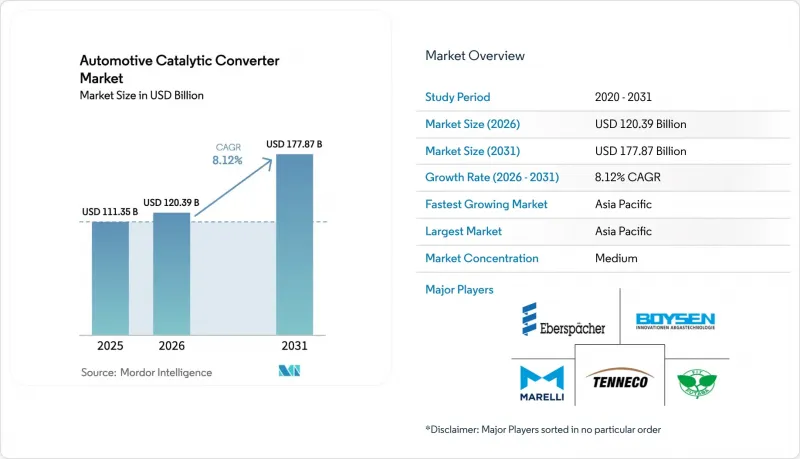
Mordor Intelligence에 의하면, 자동차 촉매 컨버터 시장 규모는 2025년 1,113억 5,000만 달러로 평가되었고, 2026년에는 1,203억 9,000만 달러로 추정되고, 2026-2031년 CAGR 8.12%로 성장을 지속할 전망이며, 2031년에는 1,778억 7,000만 달러에 이를 것으로 예측됩니다.
본 보고서는 촉매 변환기 유형별(이원 촉매 변환기, 삼원 촉매 변환기 등), 차종별(승용차, 소형 상용차 등), 연료 유형별(가솔린, 디젤,하이브리드), 지지체 재료별(백금, 팔라듐 등), 지역별(북미 등)로 분류되어 있습니다. 시장 예측은 금액(달러) 기준으로 제시되어 있습니다.
세계의 자동차 촉매 컨버터 시장 동향 및 인사이트
2025년 이후의 엄격한 배기가스 규제가 기술 업그레이드를 촉진
유로 7은 2025년 7월부터 단계적으로 도입되며, 적합 내구 기간이 8년/160,000km로 연장됨에 따라 자동차 제조업체들은 더 두꺼운 귀금속층과 첨단 가솔린 미립자 필터를 채택할 수밖에 없습니다. 중국 7은 유로 7을 반영하고 있으며, 몇 가지 측면에서 이를 상회하고 있어, 입자 수 제한 및 모든 플랫폼에 걸친 실제 주행 배기가스 시험이 의무화되어 있습니다. 미국에서는 오프로드 차량 및 경차에 대한 규제가 강화되어 기존의 규제 공백이 해소되었습니다. 전 세계적으로 통일된 기준치로 인해 OEM 각사가 과거에 활용하던 유예 기간의 여유가 사라지게 되어, 첨단 3웨이 및 4웨이 시스템의 설계 주기가 가속화될 것입니다.
코로나19 사태 이후 전 세계 내연기관(ICE) 및 하이브리드 차량 생산 대수의 회복
세계 소형 상용차 생산 대수는 가솔린차, 디젤차, 하이브리드차 각 라인에서 회복세를 보였습니다. 상용 트럭은 물류 수요를 배경으로 생산 대수가 증가했으며, 아시아태평양의 인프라 부양책에 힘입어 대형 트럭 조립 라인도 가동을 이어갔습니다. 하이브리드차는 생산 대수의 약 10%를 차지하고 있으며, 잦은 정지 및 재출발 주기에서 콜드 스타트 시의 배기가스를 억제하기 위해 더 많은 촉매가 필요합니다. 중국자동차공업협회는 열효율 향상과 첨단 배기가스 제어 시스템을 통해 2035년까지 이산화탄소 배출량을 20% 감축한다는 목표를 세운 3단계 개발 전략을 시행하고 있습니다. 장기적인 전동화 압력에도 불구하고, 공장 가동률이 정상화됨에 따라 촉매 변환기 시장의 단기 출하 대수는 증가하고 있습니다.
백금족 금속 가격의 극심한 변동
팔라듐 가격이 2022년 온스당 3,000달러 이상에서 2025년 초에는 1,000달러 미만으로 하락했고, 백금 가격도 온스당 900-1,100달러 사이에서 급등락하고 있어 조달 예산 수립이 복잡해지고 있으며, 대체 재료로의 전환이 진행되고 있습니다. 공급업체들은 헤지 조치를 취하고 있지만, 소규모 사업자들은 가격 변동을 상쇄하는 데 어려움을 겪고 있으며, 비용 충격이 발생할 경우 단기적인 이익 전망이 불투명해져 발주가 지연되는 사태가 발생하고 있습니다. 남아프리카공화국 광산의 설비 투자 축소 계획으로 인해 2020년대 후반에는 공급이 부족해질 우려가 있습니다.
부문별 분석
2025년에도 삼원 촉매는 촉매 변환기 시장에서 66.20%의 점유율을 유지했으며, 이는 화학량론적 가솔린 엔진에 대한 범용성을 반영한 것입니다. 입자 수 및 내구성에 관한 규제가 강화됨에 따라, 이 형태는 규제 준수의 핵심적인 역할을 계속하고 있지만, 금속 부하량 및 워시코트의 배합은 계속 진화하고 있습니다. 삼원 촉매 변환기 시장 규모는 콜드 스타트 빈도를 높이는 하이브리드화의 흐름에 힘입어, 2031년까지 전체 자동차 생산 대수와 연동하여 확대될 것으로 예측됩니다.
제4종 촉매 변환기, 린 NOx 트랩, 선택적 촉매 환원(SCR) 복합 시스템과 같은 새로운 흐름이 ‘기타 유형’ 범주에 집계되어 있으며, 해당 범주는 연평균 성장률(CAGR) 11.59%를 나타낼 것으로 예측됩니다. 워싱턴 주립대학교의 실험에 따르면, 배기 가스의 고열에 의해 유발되는 나노 규모의 세리아 클러스터는 귀금속 사용량을 줄이면서 활성을 10배 높이는 것으로 나타났으며, 이 발견은 비용 곡선을 재구성할 가능성이 있습니다. 이와 병행하여 진행되고 있는 자가 재생형 페로브스카이트 촉매에 대한 연구는 PGM 함량을 최대 90%까지 줄이는 것을 목표로 하고 있으며, 생산 규모와 내구성 기준이 충족된다면 보다 광범위한 채택을 위한 길이 열릴 것입니다.
2025년 시장 규모에서 승용차는 촉매 변환기 시장 점유율의 63.05%를 차지했으며, 절대적인 생산 규모에 힘입어 주도적인 위치를 차지했습니다. 전동화의 진전에 따라 그 비율은 소폭 하락하겠지만, 승용차용 촉매는 차량 수명이 길고, 수명 주기 후반에 하이브리드 차량이 출시되며, 신흥 디젤 엔진에서 가솔린 엔진으로의 다운사이징 전략에 힘입어 여전히 주력 제품으로서의 지위를 유지하고 있습니다.
중형 및 대형 상용차는 연평균 성장률(CAGR) 8.95%로 가장 높은 성장률을 보이고 있습니다. 물류 확대, 인프라 투자, 그리고 대형차 대상 NOx 배출 상한선 강화로 인해 차량 관리자들은 대용량 촉매 블록과 장기 보증을 요구하고 있습니다. 각 개발사는 이미 장거리 트럭 운송용 수소·내연기관(ICE) 시스템의 검증을 진행 중이며, 이는 높은 배기 온도에서 100% 수소 유량을 견디면서 NOx를 억제해야 하는 삼원 촉매에게 새로운 길을 열어주는 것입니다. 오프로드 기계는 틈새 시장이지만, 맞춤형 파이프 하우징을 갖춘 스테이지 V 대응 개조 패키지를 활용함으로써 성장을 지속하고 있습니다.
지역별 분석
아시아태평양은 2025년 촉매 변환기 시장 매출의 49.30%를 차지했으며, 2031년까지 연평균 성장률(CAGR) 7.72%로 확대될 것으로 예측됩니다. 중국은 유럽 기준을 상회하는 입자 수 및 실제 주행 시험 프로토콜을 포함하는 ‘중국 7’ 기준을 바탕으로 지역 성장을 주도하고 있습니다. 인도에서는 국내 모빌리티 수요와 수출 주문 모두를 충족하기 위해 자동차 생산이 확대되면서 시장 규모가 커지고 있습니다. 이 지역의 대형 차량 생산은 트럭 및 오프로드 장비 판매를 촉진하는 인프라 구축 계획의 혜택을 받고 있습니다. 광저우의 신규 거래소에 상장된 백금 및 팔라듐 선물 계약으로 인해 금속 조달 과정이 더욱 전문화되어 현지 제조업체의 가격 변동 위험이 완화되고 있습니다.
북미는 연평균 성장률(CAGR) 5.02%를 나타낼 것으로 예측됩니다. 개정된 연방 규정에 따르면 2032년까지 NMOG 및 NOx를 50% 감축해야 하며, 가솔린 차량에 미립자 필터 장착이 의무화되었습니다. 텍사스주, 미시간주, 온타리오주는 계속해서 경차용 촉매변환기의 주요 생산 거점이며, 한편 캘리포니아주의 Tier 5 비도로용 차량 규제안은 건설 기계를 위한 첨단 SCR 시스템의 도입을 촉진하고 있습니다. 수소 및 내연기관(ICE) 시험 시설에 대한 투자는 NOx 감축을 위해 여전히 후처리 기술에 의존하고 있음에도 불구하고, 이 지역이 대체 추진 기술에 주력하고 있음을 보여줍니다.
유럽의 연평균 성장률(CAGR) 4.72%는 2035년 이후 제로 배출 판매 의무화라는 압박에 직면한 성숙한 차량 기반을 반영합니다. 유로 7 규격에서는 8년간의 내구성과 온도 적합 범위의 확대가 도입됨에 따라 단기적인 촉매 수요가 증가하고 있습니다. 주요 공급업체들은 엄격한 유로 7 규제 기준을 충족하기 위해 고밀도 워시 코트, 전기 가열식 벽돌, 그리고 NOx 및 입자상 물질의 복합 재생 알고리즘에 주력하고 있습니다. 신차 수요가 정체된 이후에도 비도로용 차량 플릿에 대한 사후 개조가 애프터마켓 수요를 뒷받침하고 있습니다.
기타 혜택 :
- 엑셀 형식 시장 예측(ME) 시트
- 3개월간의 애널리스트 지원
자주 묻는 질문
목차
제1장 서론
제2장 조사 방법
제3장 주요 요약
제4장 시장 구도
제5장 시장 규모 및 성장 예측
제6장 경쟁 구도
제7장 시장 기회 및 향후 전망
AJY 26.09.07According to Mordor Intelligence, the catalytic converters market size is expected to grow from USD 111.35 billion in 2025 to USD 120.39 billion in 2026 and is forecast to reach USD 177.87 billion by 2031 at 8.12% CAGR over 2026-2031.
This report is Segmented by Converter Type (Two-Way Catalytic Converters, Three-Way Catalytic Converters, and More), Vehicle Type (Passenger Cars, Light Commercial Vehicles, and More), Fuel Type (Gasoline, Diesel, and Hybrid), Substrate Material (Platinum, Palladium, and More), and Geography (North America and More). The Market Forecasts are Provided in Terms of Value (USD).
Global Automotive Catalytic Converter Market Trends and Insights
Stringent Post-2025 Emission Legislation Drives Technology Upgrades
Euro 7 begins phasing in from July 2025 and extends compliance durability to eight years/160,000 km, forcing automakers to specify thicker precious-metal layers and sophisticated gasoline particulate filters. China 7 mirrors and, in several respects, exceeds Euro 7, requiring particulate-number limits and real-driving emissions testing across platforms. In the United States, tougher off-road and light-vehicle rules close historical regulatory gaps. Unified global thresholds remove the lag-time cushion OEMs once used, accelerating design cycles for advanced three- and four-way systems.
Rebound in Global ICE and Hybrid Production Volume Post-COVID
Worldwide light-vehicle output witnessed volume restoration across gasoline, diesel, and hybrid lines. Commercial trucks added volume on the back of logistics demand, while infrastructure stimulus in Asia-Pacific kept heavy-duty assembly lines active. Hybrids represented approximately 10% of production and need larger catalyst volumes to control cold-start emissions during frequent stop-start cycling. the China Association of Automobile Manufacturers is implementing a three-step development strategy targeting 20% carbon emissions reduction by 2035 through enhanced thermal efficiency and advanced emission control systems. Normalized factory utilization raises near-term unit shipments for the catalytic converters market despite longer-term electrification pressure.
Extreme Platinum-Group-Metal Price Volatility
Palladium's fall from more than USD 3,000/oz in 2022 to under USD 1,000/oz in early 2025, and platinum's swings between USD 900-1,100/oz, complicate sourcing budgets and encourage substitution. Suppliers hedge, but small participants struggle to offset price moves, reducing short-term margin visibility and delaying orders when cost shocks hit. Planned reductions in South African mine capex threaten to tighten supply later in the decade..
Other drivers and restraints analyzed in the detailed report include:
- Higher Precious-Metal Loadings in GDI and Mild Hybrid Engines
- OEM Retrofit Demand from Non-Road/Mobile Machinery ESG Pressure
- Accelerated BEV Penetration Reducing Long-Term Unit Demand
For complete list of drivers and restraints, kindly check the Table Of Contents.
Segment Analysis
Three-way converters retained a 66.20% share of the catalytic converters market in 2025, reflecting their universal fit for stoichiometric gasoline engines. Tightening particulate-number and durability rules keep this format central to compliance, though metal loading and wash-coat formulations continue to evolve. The catalytic converters market size for three-way units is forecast to rise in line with overall vehicle production through 2031, underpinned by hybridization that magnifies cold-start events.
A new wave of four-way converters, lean-NOx traps, and combined selective catalytic-reduction systems clusters in the "other types" category, which is projected to grow at 11.59% CAGR. Laboratory work at Washington State University shows that nano-scale ceria clustering induced by high exhaust heat boosts activity tenfold while using less precious metal, a discovery that may reshape cost curves. Parallel research into self-regenerating perovskite catalysts aims to cut PGM content by up to 90%, setting the stage for broader adoption once production scale and durability benchmarks are met.
Passenger cars dominated the 2025 volume with 63.05% catalytic converters market share, driven by their absolute production scale. Despite the portion declining modestly as electrification grows, passenger-car catalysts remain a staple due to long fleet lives, late-cycle hybrid launches, and emerging diesel-downsize gasoline strategies.
Medium and heavy commercial vehicles provide the fastest 8.95% CAGR. Logistics expansion, infrastructure spending, and stricter heavy-duty NOx ceilings push fleet managers toward higher-capacity catalyst bricks and longer warranties. Developers are already validating hydrogen-ICE systems for long-haul trucking, opening a fresh avenue for three-way catalysts that must tolerate 100% hydrogen streams at high exhaust temperatures while still curbing NOx. Off-road machinery, though niche, prolongs growth by tapping Stage V retrofit packages with bespoke pipe-fabricated housings.
Complete Report Scope:
- By Converter Type
- Two-Way Catalytic Converters
- Three-Way Catalytic Converters
- Other Types
- By Vehicle Type
- Passenger Cars
- Light Commercial Vehicles
- Medium and Heavy Commercial Vehicles
- Off-Road and Non-Road Equipment
- Motorcycles and Powersports
- By Fuel Type
- Gasoline
- Diesel
- Hybrid (MHEV, HEV, and PHEV)
- By Substrate Material
- Platinum
- Palladium
- Rhodium
- Others (Cerium, Vanadium, and Perovskites)
- By Geography
- North America
- United States
- Canada
- Rest of North America
- South America
- Brazil
- Argentina
- Rest of South America
- Europe
- Germany
- United Kingdom
- France
- Italy
- Spain
- Russia
- Rest of Europe
- Asia-Pacific
- China
- India
- Japan
- South Korea
- Australia and New Zealand
- Rest of Asia-Pacific
- Middle East and Africa
- Saudi Arabia
- United Arab Emirates
- Turkey
- South Africa
- Nigeria
- Rest of Middle East and Africa
- North America
Geography Analysis
Asia-Pacific controlled 49.30% of the catalytic converters market revenue in 2025 and is expected to expand at a 7.72% CAGR through 2031. China anchors regional growth on the back of China 7 standards that embed particulate-number and real-driving protocols exceeding European thresholds. India adds volume as automotive production ramps up to meet both domestic mobility demand and export orders. Regional heavy-duty output benefits from infrastructure pipelines that stimulate truck and off-road equipment sales. Futures contracts for platinum and palladium listed on a new Guangzhou exchange further professionalize metal procurement, lessening price-shock exposure for local manufacturers.
North America is forecast to grow at 5.02% CAGR. Updated federal rules demand 50% NMOG + NOx cuts by 2032 and force gasoline particulate-filter adoption. Texas, Michigan, and Ontario remain key production clusters for light-vehicle converters, while Tier 5 off-road proposals in California pull through advanced SCR systems for construction machinery. Investments in hydrogen-ICE testing labs illustrate the region's commitment to alternative propulsion while still relying on after-treatment for NOx abatement.
Europe's 4.72% CAGR reflects a mature vehicle base under pressure from mandated zero-emission sales after 2035. Near-term catalyst demand rises as Euro 7 introduces eight-year durability and extended temperature compliance windows. Leading suppliers focus on higher density wash-coats, electrically heated bricks, and combined NOx/particulate regeneration algorithms to meet the stringent Euro 7 limits. Retrofit activity in non-road fleets sustains aftermarket volumes once new-car demand flattens.
- Marelli Holdings Co., Ltd.
- Tenneco Inc. (Walker Emissions Control)
- HELLA GmbH and Co. KGaA
- Eberspacher Group
- Yutaka Giken Company Limited
- Futaba Industrial Co. Ltd.
- Boysen Group
- BOSAL International
- Katcon S.A. de C.V.
- Sejong Industrial Co., Ltd.
- Hanwoo Industrial Co. Ltd.
- Sango Co. Ltd.
- Benteler International AG
Additional Benefits:
- The market estimate (ME) sheet in Excel format
- 3 months of analyst support
TABLE OF CONTENTS
1 Introduction
- 1.1 Study Assumptions and Market Definition
- 1.2 Scope of the Study
2 Research Methodology
3 Executive Summary
4 Market Landscape
- 4.1 Market Overview
- 4.2 Market Drivers
- 4.2.1 Stringent Post-2025 Emission Legislation Drives Technology Upgrades
- 4.2.2 Rebound in global ICE and hybrid production volumes post-COVID
- 4.2.3 Higher precious-metal loadings in GDI and mild-hybrid engines
- 4.2.4 OEM retrofit demand from non-road/mobile machinery ESG pressure
- 4.2.5 Supply-chain gaps caused by converter-theft recycling boom
- 4.2.6 Growing incentives for hydrogen-ICE vehicles needing three-way converters
- 4.3 Market Restraints
- 4.3.1 Extreme platinum-group metal (PGM) price volatility
- 4.3.2 Accelerated BEV penetration reducing long-term unit demand
- 4.3.3 Crack-down on illicit PGM sourcing raising compliance cost
- 4.3.4 Early-stage commercialisation of single-material catalysts (vanadium, perovskite)
- 4.4 Value / Supply-Chain Analysis
- 4.5 Regulatory Landscape
- 4.6 Technological Outlook
- 4.7 Porter's Five Forces Analysis
- 4.7.1 Threat of New Entrants
- 4.7.2 Bargaining Power of Buyers/Consumers
- 4.7.3 Bargaining Power of Suppliers
- 4.7.4 Threat of Substitute Products
- 4.7.5 Intensity of Competitive Rivalry
5 Market Size and Growth Forecasts (Value in USD)
- 5.1 By Converter Type
- 5.1.1 Two-Way Catalytic Converters
- 5.1.2 Three-Way Catalytic Converters
- 5.1.3 Other Types
- 5.2 By Vehicle Type
- 5.2.1 Passenger Cars
- 5.2.2 Light Commercial Vehicles
- 5.2.3 Medium and Heavy Commercial Vehicles
- 5.2.4 Off-Road and Non-Road Equipment
- 5.2.5 Motorcycles and Powersports
- 5.3 By Fuel Type
- 5.3.1 Gasoline
- 5.3.2 Diesel
- 5.3.3 Hybrid (MHEV, HEV, and PHEV)
- 5.4 By Substrate Material
- 5.4.1 Platinum
- 5.4.2 Palladium
- 5.4.3 Rhodium
- 5.4.4 Others (Cerium, Vanadium, and Perovskites)
- 5.5 By Geography
- 5.5.1 North America
- 5.5.1.1 United States
- 5.5.1.2 Canada
- 5.5.1.3 Rest of North America
- 5.5.2 South America
- 5.5.2.1 Brazil
- 5.5.2.2 Argentina
- 5.5.2.3 Rest of South America
- 5.5.3 Europe
- 5.5.3.1 Germany
- 5.5.3.2 United Kingdom
- 5.5.3.3 France
- 5.5.3.4 Italy
- 5.5.3.5 Spain
- 5.5.3.6 Russia
- 5.5.3.7 Rest of Europe
- 5.5.4 Asia-Pacific
- 5.5.4.1 China
- 5.5.4.2 India
- 5.5.4.3 Japan
- 5.5.4.4 South Korea
- 5.5.4.5 Australia and New Zealand
- 5.5.4.6 Rest of Asia-Pacific
- 5.5.5 Middle East and Africa
- 5.5.5.1 Saudi Arabia
- 5.5.5.2 United Arab Emirates
- 5.5.5.3 Turkey
- 5.5.5.4 South Africa
- 5.5.5.5 Nigeria
- 5.5.5.6 Rest of Middle East and Africa
- 5.5.1 North America
6 Competitive Landscape
- 6.1 Market Concentration
- 6.2 Strategic Moves (MandA, JV, capacity, and recycling initiatives)
- 6.3 Market Share Analysis
- 6.4 Company Profiles (Includes Global Level Overview, Market Level Overview, Core Segments, Financials as Available, Strategic Information, Market Rank/Share for Key Companies, Products and Services, SWOT Analysis, and Recent Developments)
- 6.4.1 Marelli Holdings Co., Ltd.
- 6.4.2 Tenneco Inc. (Walker Emissions Control)
- 6.4.3 HELLA GmbH and Co. KGaA
- 6.4.4 Eberspacher Group
- 6.4.5 Yutaka Giken Company Limited
- 6.4.6 Futaba Industrial Co. Ltd.
- 6.4.7 Boysen Group
- 6.4.8 BOSAL International
- 6.4.9 Katcon S.A. de C.V.
- 6.4.10 Sejong Industrial Co., Ltd.
- 6.4.11 Hanwoo Industrial Co. Ltd.
- 6.4.12 Sango Co. Ltd.
- 6.4.13 Benteler International AG
7 Market Opportunities and Future Outlook
- 7.1 White-space and Unmet-Need Assessment


