

|
시장보고서
상품코드
2122383
고온 단열재 : 시장 점유율 분석, 산업 동향·통계 데이터, 성장 예측(2026-2031년)High-temperature Insulation Materials - Market Share Analysis, Industry Trends & Statistics, Growth Forecasts (2026 - 2031) |
||||||
 Mordor Intelligence
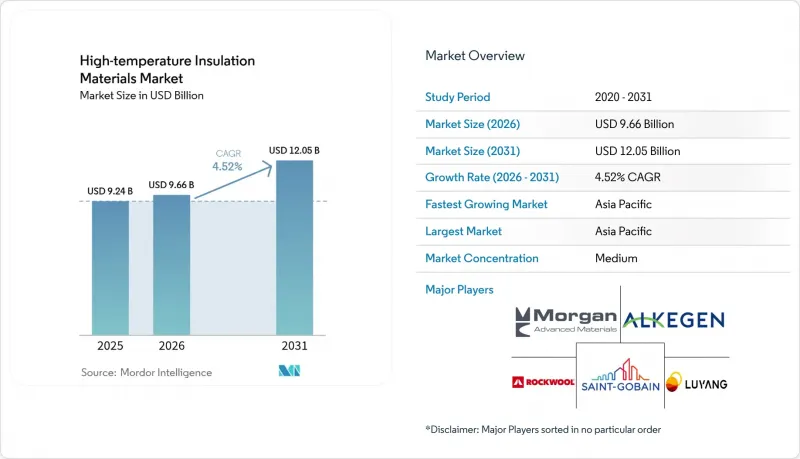
Mordor Intelligence에 따르면 고온 단열재 시장 규모는 2025년 92억 4,000만 달러에서 2026년에는 96억 6,000만 달러로 확대하며, 2026-2031년에 CAGR 4.52%로 추이하며, 2031년에는 120억 5,000만 달러에 달할 것으로 예측됩니다.
이 보고서에서는 업계를 재료 유형(유리섬유, 세라믹 섬유, 미네랄울, 폴리우레탄 폼 등), 용도(단열재, 산업 기계, 기타 용도), 최종사용자 산업(석유화학, 건설, 운송 등) 및 지역(아시아태평양, 북미 등)별로 분류하고 있습니다. 시장 예측은 금액(달러) 기준으로 제시되어 있습니다.
글로벌 내열 단열재 시장의 동향 및 인사이트
에너지 효율이 높은 산업용 용광로에 대한 수요 급증
산업용 용광로 제조업체들은 허용 열손실을 낮추고 공기 누출률을 엄격하게 규정한 ‘2024년 국제 에너지 절약 코드’에 따라 더욱 엄격한 에너지 성능 기준에 직면해 있습니다. 사업자들은 연료 효율을 저해하지 않으면서 1,000°C의 사용 환경을 견딜 수 있는 세라믹 섬유 블랭킷이나 미세 다공성 패널을 지정하고 있습니다. 기존 라이닝에 비해 에너지 절감률은 보통 30%에 달하며, 초기 투자 비용은 높지만 투자 회수 기간은 단축되고 있습니다. 스마트 열 관리 시스템과 첨단 단열재를 통합함으로써 예측 유지보수와 에너지 소비 최적화가 가능해졌으며, 고온 단열재는 ‘인더스트리 4.0’의 변혁 전략에서 중요한 요소로서의 입지를 확립하고 있습니다.
고온 단열재가 필요한 건축·에너지 기준의 강화
2024년 ‘국제 에너지 절약 기준(IECC)’ 개정에 따라 상업용 건물의 외피에 관한 요건도 엄격해졌으며, 연속 단열 및 열교 저감에 대한 관심이 높아지고 있습니다. 유럽연합(EU)의 ‘Fit-for-55’ 지침에서는 산업 시설에 내열성과 내화성을 겸비한 솔루션이 요구되고 있으며, 열 성능과 방화 안전성을 모두 갖춘 재료가 점점 더 중요시되고 있습니다. 이에 따라 미네랄울이나 세라믹 섬유 시스템 등 불연성 소재에 대한 수요가 확대되고 있습니다. 건물 소유주는 에너지 비용 급등과 탄소 가격 책정 메커니즘에 직면해 있으며, 건물의 전체 수명 주기 동안 고성능 단열재가 경제적으로 매력적인 선택지가 되고 있습니다. 에너지 효율 관련 규제와 방화 요건이 결합됨에 따라 두 가지 규제 요건을 동시에 충족할 수 있는 고온용 단열재에 있으며, 절호의 기회가 열리고 있습니다.
합성 유리섬유의 직업적 노출 한계치
전 세계 규제 당국은 합성 유리섬유의 직업적 노출 한계치를 더욱 엄격하게 적용하고 있으며, OSHA(미국 직업안전보건청)는 내화 세라믹 섬유에 대해 1세제곱센티미터당 0.2가닥의 허용 노출 한계치를 유지하고 있습니다. 영국 보건안전집행청(HSE)은 내화 세라믹 섬유를 2등급 발암 물질로 분류하고 있으며, COSHH 규정에 따른 엄격한 관리 조치가 요구됩니다. 이로 인해 취급 비용이 증가하고 용도의 유연성이 제한되고 있습니다. 유럽의 법규에서는 체내 잔류성이 낮은 대체 소재가 점점 더 중요시되고 있으며, 비용이 높고 내열성이 다소 낮음에도 불구하고 알칼리 토금속 규산염 섬유의 시장 점유율 확대를 지원하고 있습니다. 생체 용해성 섬유를 권장하는 추세는 혁신적인 제조업체에 기회를 제공하는 한편, 기존 세라믹 섬유의 용도를 제한하고 있습니다. 규정 준수 비용 및 법적 책임에 대한 우려로 인해 성능 면에서 어느 정도 타협이 필요한 경우에도 산업 사용자들은 대체 소재로의 전환을 강요받고 있습니다. 장기적인 동향을 살펴보면, 규제 압력은 앞으로도 지속될 것이며, 생분해성이 높은 섬유 포트폴리오를 강화하고 있는 기업에게 유리한 방향으로 경쟁 구도가 재편될 것으로 예상됩니다.
부문 분석
세라믹 섬유는 1,260°C라는 사용 한계 온도, 낮은 밀도, 그리고 블랭킷, 모듈, 보드에 대한 적응성 덕분에 2025년 매출의 55.63%를 차지했습니다. 이러한 주도적 지위는 철강, 비철금속, 석유화학 등 자산 집약적 산업에 의해 지원되고 있으며, 이러한 산업에서는 가동 중단으로 인한 비용이 재료 가격을 훨씬 상회합니다. 아시아태평양의 신규 생산 능력 가동에 따라 세라믹 섬유 고온 단열재 시장 규모는 안정적인 한 자릿수 성장을 보일 것으로 예상됩니다.
에어로겔 복합재 및 미세 다공성 패널과 같은 다른 재료 유형은 연평균 성장률(CAGR) 6.01%를 기록하며 가장 빠르게 성장하는 그룹입니다. 무게에 민감한 최종 용도 분야에서는 에어로겔의 0.020 W/m*K(와트/미터·켈빈) 미만의 열전도율과 취급 강도를 높이는 섬유 보강재의 조합이 높이 평가되고 있습니다. 규제를 배경으로 생체 잔류성이 낮은 화학 물질로의 전환에 따라 특히 유럽에서 알칼리 토금속 규산염 울의 채택이 가속화되고 있습니다. 다결정 울은 1,500°C를 초과하는 특수한 용도에 대응하고 있으며, 한편 진공 성형품은 현장에서 비용이 많이 드는 건 분사 및 다짐 작업이 필요한 복잡한 형상에 대응하고 있습니다. 고온 단열재 업계에서는 샷 함량, 강도, 열충격 내성의 균형을 맞추기 위해 소결 첨가제 및 섬유 직경에 대한 개선이 계속되고 있습니다.
지역별 분석
아시아태평양은 2025년에 47.08%의 시장 점유율을 차지하며, 연평균 성장률(CAGR) 5.44%로 확대될 것으로 예측됩니다. 중국의 철강, 알루미늄, 화학 분야의 지속적인 생산 능력 증대가 수요를 지원하는 한편, 인도의 국가 인프라 계획과 확대되는 수소 계획이 장기적인 성장을 촉진하고 있습니다. 동남아시아 국가들에서는 마찬가지로 내화 라이닝이 필요한 석유화학 및 재생 가능 에너지 관련 자산이 증가하고 있습니다. 정책 입안자들은 에너지 효율 기준의 시행을 강화하고 있으며, 구매 동향은 낮은 열전도율을 가진 섬유 모듈 및 에어로겔로 이동하고 있습니다.
북미는 시장 규모에서 2위를 차지하고 있습니다. 연방 정부의 청정 에너지 세액 공제 및 주 차원의 탄소 배출 상한제로 인해 정유소, 액화천연가스(LNG) 터미널, 펄프 공장의 단열재 개보수가 경제적으로 매력적인 선택지가 되고 있습니다. 이 지역의 반도체 및 배터리 제조의 국내 복귀(리쇼어링)로 인해 초저공해 단열 보드와 섬유 강화 에어로겔의 소비가 증가하고 있습니다. 또한 산업 안전 규제의 엄격한 시행도 알칼리 토금속 규산염 울의 채택을 가속화하고 있습니다.
유럽은 계속해서 기술 중심의 자세를 유지하고 있으며, 엄격한 환경 규제와 탄소 국경 조정 조치를 활용하여 생분해성이 낮은 재료의 보급을 추진하고 있습니다. 유럽연합(EU)의 ‘그린 딜’에 따른 투자는 단열 및 방화 기능을 겸비한 다층 라이닝을 이용한 기존 산업 자산의 개조를 촉진하고 있습니다. 집광형 태양열발전 및 열 에너지 저장 분야의 혁신적인 시범 프로젝트에서는 첨단 세라믹이 채택되고 있으며, 그 응용 범위가 확대되고 있습니다.
기타 혜택:
- Excel 형식의 시장 예측(ME) 시트
- 3개월간의 애널리스트 지원
자주 묻는 질문
목차
제1장 서론
제2장 분석 방법
제3장 개요
제4장 시장 구도
제5장 시장 규모·성장률 예측
제6장 경쟁 구도
제7장 시장 기회와 향후 전망
KSA 26.09.07According to Mordor Intelligence, the high-temperature insulation materials market size is expected to grow from USD 9.24 billion in 2025 to USD 9.66 billion in 2026 and is forecast to reach USD 12.05 billion by 2031 at 4.52% CAGR over 2026-2031.
This report Segments the Industry Into Material Type (Fiberglass, Ceramic Fibre, Mineral Wool, Polyurethane Foam, and More), Application (Insulation, Industrial Eqipment, and Other Applications), End-User Industry (Petrochemicals, Construction, Transportation, and More), and Geography (Asia-Pacific, North America, and More). The Market Forecasts are Provided in Terms of Value (USD).
Global High-temperature Insulation Materials Market Trends and Insights
Surging Demand for Energy-Efficient Industrial Furnaces
Industrial furnace builders face stricter energy-performance rules under the 2024 International Energy Conservation Code, which lowered allowable heat loss and tightened air-leakage rates. Operators specify ceramic fibre blankets and microporous panels that endure 1,000°C service without compromising fuel economy. Typical energy savings approach 30% over legacy linings, improving payback despite higher capital cost. Integrating smart thermal management systems with advanced insulation materials enables predictive maintenance and optimized energy consumption, positioning high-temperature insulation as a critical component in Industry 4.0 transformation strategies. .
Tightening Building-Energy Codes Requiring High-Temperature Insulation
The same 2024 International Energy Conservation Code (IECC) revision also sharpened commercial building shell requirements, magnifying interest in continuous insulation and thermal-bridge mitigation. European Union Fit-for-55 directives demand complementary heat- and fire-resistant solutions in industrial facilities, increasingly favoring materials that combine thermal performance with fire safety, driving demand for non-combustible options like mineral wool and ceramic fiber systems. Building owners face escalating energy costs and carbon pricing mechanisms that make high-performance insulation economically attractive over building lifecycles. The convergence of energy efficiency mandates and fire safety requirements creates a sweet spot for high-temperature insulation materials that can address both regulatory imperatives simultaneously.
Occupational Exposure Limits on Synthetic Vitreous Fibres
Regulatory authorities worldwide are tightening occupational exposure limits for synthetic vitreous fibers, with OSHA maintaining permissible exposure limits of 0.2 fibers per cubic centimeter for refractory ceramic fibers . The Health and Safety Executive in the UK has classified refractory ceramic fiber as a category 2 carcinogen, necessitating stringent control measures under COSHH regulations that increase handling costs and limit application flexibility. European legislation increasingly favors low-biopersistent alternatives, driving market share gains for alkaline earth silicate fibers despite their higher costs and slightly reduced temperature capabilities. The regulatory trend toward biosoluble fibers creates opportunities for innovative manufacturers while constraining traditional ceramic fiber applications. Compliance costs and liability concerns are pushing industrial users toward alternative materials, even when performance trade-offs exist. The long-term trajectory suggests continued regulatory pressure that will reshape the competitive landscape in favor of companies with strong low-biopersistent fiber portfolios.
Other drivers and restraints analyzed in the detailed report include:
- Rapid Capacity Build-Out in Asian Petro-Chem and Metal Sectors
- Green-Hydrogen Electrolyser Adoption Needs High-Temperature Lining
- Volatile Alumina and Silica Prices Squeeze Converter Margins
For complete list of drivers and restraints, kindly check the Table Of Contents.
Segment Analysis
Ceramic fibre held 55.63% of 2025 revenue owing to its 1,260°C service limit, low density, and adaptability into blankets, modules, and boards. This leadership is anchored in asset-heavy industries, such as steel, non-ferrous metals, and petrochemicals, where downtime costs dwarf material prices. The high-temperature insulation materials market size for ceramic fibre is expected to post steady single-digit growth as new capacities in Asia-Pacific come on stream.
Other material types, such as aerogel composites and microporous panels, are the fastest-growing group at 6.01% CAGR. Weight-sensitive end uses value aerogels' sub-0.020 W/m*K (Watt per metre Kelvin) conductivity combined with fiber reinforcement that boosts handling strength. Regulatory-driven migration to low-biopersistent chemistries accelerates alkaline earth silicate wool uptake, especially in Europe. Polycrystalline wool supports specialized duties above 1,500°C, while vacuum-formed shapes address complex geometries that would require costly on-site gunning or ramming. The high-temperature insulation materials industry continues to refine sintering additives and fiber diameters to balance shot content, strength, and thermal shock resistance.
Complete Report Scope:
- By Material Type
- Fiberglass
- Ceramic Fibre
- Mineral Wool
- Alkaline Earth Silicate (AES)
- Aluminum Silicate Wool (ASW) or Refractory Ceramic Fibre (RCF)
- Polycrystalline Wool or Fibre (PCW)
- Long Fibre
- Vacuum-Formed Insulating Products
- Polyurethane Foam
- Polystyrene
- Insulating Fire-Bricks (IFB)
- Other Material Types (Aerogel Blankets, Microporous Panels, etc.)
- By Application
- Insulation
- Industrial Eqipment
- Other Applications (Building and Fire-Protection, etc.)
- By End-use Industry
- Petrochemicals
- Industrial
- Power Generation
- Transportation
- Electrical and Electronics
- Construction
- Other End-use Industries (Metal Processing, etc.)
- By Geography
- Asia-Pacific
- China
- Japan
- India
- South Korea
- ASEAN Countries
- Rest of Asia-Pacific
- North America
- United States
- Canada
- Mexico
- Europe
- Germany
- United Kingdom
- France
- Italy
- Spain
- Russia
- NORDIC Countries
- Rest of Europe
- South America
- Brazil
- Argentina
- Rest of South America
- Middle East and Africa
- Saudi Arabia
- South Africa
- Rest of Middle East and Africa
- Asia-Pacific
Geography Analysis
Asia-Pacific had a 47.08% market share in 2025 and is projected to advance at a 5.44% CAGR. China's ongoing capacity additions in steel, aluminum, and chemicals sustain bulk demand, while India's National Infrastructure Pipeline and expanding hydrogen plans reinforce long-term growth. Southeast Asian nations add petrochemical and renewables assets that likewise require refractory linings. Policymakers increasingly enforce energy-efficiency norms, shifting purchasing toward low-conductivity fibre modules and aerogels.
North America ranks second by value. Federal clean energy credits and state-level carbon caps make retrofit insulation economically attractive in refineries, liquidated natural gas (LNG) terminals, and pulp mills. The region's reshoring of semiconductor and battery manufacturing raises consumption of ultra-clean insulation boards and fiber-reinforced aerogels. Robust industrial safety enforcement also accelerates adoption of alkaline earth silicate wool.
Europe remains technology-focused, leveraging its stringent environmental rules and carbon-border adjustments to champion low-biopersistent materials. European Union (EU) Green Deal investments spur renovation of existing industrial assets with multilayer linings that marry insulation and fire-containment. Innovative pilot projects in concentrated solar power and thermal energy storage adopt advanced ceramics, broadening application footprints.
- 3M
- Alkegen
- Almatis
- Aspen Aerogels, Inc.
- BNZ Materials,Inc.
- Cabot Corporation
- Carlisle Companies Inc.
- Dyson Technical Ceramics
- Etex Group
- ISOLITE
- Knauf Insulation
- Luyang Energy-saving Materials Co., Ltd.
- M.E. Schupp Industriekeramik Gmbh
- Morgan Advanced Materials
- NUTEC Incorporated
- Pacor Inc.
- Pyrotek
- Rath-Group
- ROCKWOOL A/S
- Saint-Gobain
Additional Benefits:
- The market estimate (ME) sheet in Excel format
- 3 months of analyst support
TABLE OF CONTENTS
1 Introduction
- 1.1 Study Assumptions and Market Definition
- 1.2 Scope of the Study
2 Research Methodology
3 Executive Summary
4 Market Landscape
- 4.1 Market Overview
- 4.2 Market Drivers
- 4.2.1 Surging Demand for Energy-Efficient Industrial Furnaces
- 4.2.2 Tightening Building-Energy Codes Requiring High-Temperature Insulation
- 4.2.3 Rapid Capacity Build-Out in Asian Petro-Chem and Metal Sectors
- 4.2.4 Green-Hydrogen Electrolyser Adoption needs High Temperature Lining
- 4.2.5 Growing Lightweight, Durable Insulation Material Demand
- 4.3 Market Restraints
- 4.3.1 Occupational Exposure Limits on Synthetic Vitreous Fibres
- 4.3.2 Volatile Alumina and Silica Prices Squeeze Converter Margins
- 4.3.3 Supply-Chain Risk for High-Purity Zirconia Precursors
- 4.4 Value Chain Analysis
- 4.5 Porter's Five Forces
- 4.5.1 Threat of New Entrants
- 4.5.2 Bargaining Power of Suppliers
- 4.5.3 Bargaining Power of Buyers
- 4.5.4 Threat of Substitutes
- 4.5.5 Industry Rivalry
5 Market Size and Growth Forecasts (Value)
- 5.1 By Material Type
- 5.1.1 Fiberglass
- 5.1.2 Ceramic Fibre
- 5.1.3 Mineral Wool
- 5.1.3.1 Alkaline Earth Silicate (AES)
- 5.1.3.2 Aluminum Silicate Wool (ASW) or Refractory Ceramic Fibre (RCF)
- 5.1.3.3 Polycrystalline Wool or Fibre (PCW)
- 5.1.3.4 Long Fibre
- 5.1.4 Vacuum-Formed Insulating Products
- 5.1.5 Polyurethane Foam
- 5.1.6 Polystyrene
- 5.1.7 Insulating Fire-Bricks (IFB)
- 5.1.8 Other Material Types (Aerogel Blankets, Microporous Panels, etc.)
- 5.2 By Application
- 5.2.1 Insulation
- 5.2.2 Industrial Eqipment
- 5.2.3 Other Applications (Building and Fire-Protection, etc.)
- 5.3 By End-use Industry
- 5.3.1 Petrochemicals
- 5.3.2 Industrial
- 5.3.3 Power Generation
- 5.3.4 Transportation
- 5.3.5 Electrical and Electronics
- 5.3.6 Construction
- 5.3.7 Other End-use Industries (Metal Processing, etc.)
- 5.4 By Geography
- 5.4.1 Asia-Pacific
- 5.4.1.1 China
- 5.4.1.2 Japan
- 5.4.1.3 India
- 5.4.1.4 South Korea
- 5.4.1.5 ASEAN Countries
- 5.4.1.6 Rest of Asia-Pacific
- 5.4.2 North America
- 5.4.2.1 United States
- 5.4.2.2 Canada
- 5.4.2.3 Mexico
- 5.4.3 Europe
- 5.4.3.1 Germany
- 5.4.3.2 United Kingdom
- 5.4.3.3 France
- 5.4.3.4 Italy
- 5.4.3.5 Spain
- 5.4.3.6 Russia
- 5.4.3.7 NORDIC Countries
- 5.4.3.8 Rest of Europe
- 5.4.4 South America
- 5.4.4.1 Brazil
- 5.4.4.2 Argentina
- 5.4.4.3 Rest of South America
- 5.4.5 Middle East and Africa
- 5.4.5.1 Saudi Arabia
- 5.4.5.2 South Africa
- 5.4.5.3 Rest of Middle East and Africa
- 5.4.1 Asia-Pacific
6 Competitive Landscape
- 6.1 Market Concentration
- 6.2 Strategic Moves
- 6.3 Market Share (%)/Ranking Analysis
- 6.4 Company Profiles (includes Global level Overview, Market level overview, Core Segments, Financials as available, Strategic Information, Market Rank/Share for key companies, Products and Services, and Recent Developments)
- 6.4.1 3M
- 6.4.2 Alkegen
- 6.4.3 Almatis
- 6.4.4 Aspen Aerogels, Inc.
- 6.4.5 BNZ Materials,Inc.
- 6.4.6 Cabot Corporation
- 6.4.7 Carlisle Companies Inc.
- 6.4.8 Dyson Technical Ceramics
- 6.4.9 Etex Group
- 6.4.10 ISOLITE
- 6.4.11 Knauf Insulation
- 6.4.12 Luyang Energy-saving Materials Co., Ltd.
- 6.4.13 M.E. Schupp Industriekeramik Gmbh
- 6.4.14 Morgan Advanced Materials
- 6.4.15 NUTEC Incorporated
- 6.4.16 Pacor Inc.
- 6.4.17 Pyrotek
- 6.4.18 Rath-Group
- 6.4.19 ROCKWOOL A/S
- 6.4.20 Saint-Gobain
7 Market Opportunities and Future Outlook
- 7.1 White-space and Unmet-need Assessment
- 7.2 Lightweight Refractory Cements for Concentrated-Solar Receivers


