

|
시장보고서
상품코드
2122387
공기압축기 : 시장 점유율 분석, 산업 동향·통계 데이터, 성장 예측(2026-2031년)Air Compressor - Market Share Analysis, Industry Trends & Statistics, Growth Forecasts (2026 - 2031) |
||||||
 Mordor Intelligence
Mordor Intelligence에 따르면 공기압축기(공기압축기) 시장 규모는 2025년에 334억 5,000만 달러, 2026년에 352억 1,000만 달러에 달하며, 2031년까지 441억 1,000만 달러에 달할 것으로 예측되고 있으며, 2026-2031년에 CAGR 4.61%로 성장할 것으로 전망되고 있습니다.
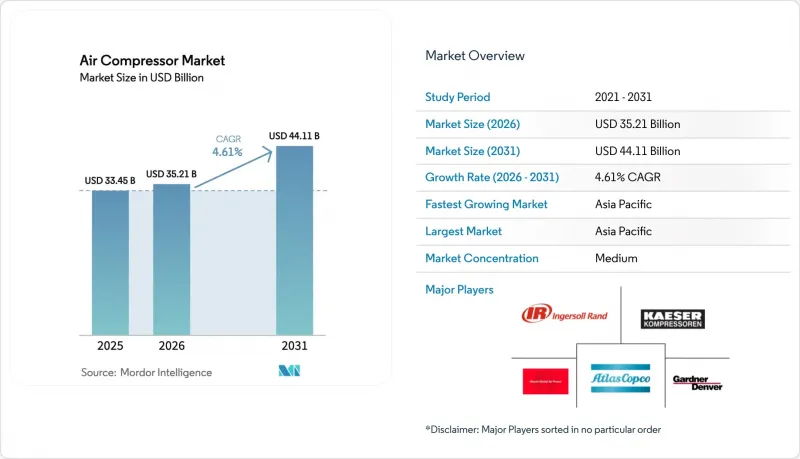
이 보고서는 작동 원리(용적식, 동적식), 기술(유입식, 오일프리), 이동성(고정형, 이동형), 냉각 방식(공랭식, 수랭식),정격 출력(101-300kW, 500kW 이상, 기타), 최종사용자 산업(제조, 석유 및 가스, 발전, 의료, 기타) 및 지역(북미, 유럽, 아시아태평양, 기타)별로 분류되어 있습니다.
전 세계 공기 압축기 시장의 동향 및 인사이트
전기화로 인한 오일프리 압축기 수요
제약, 반도체, 식품 포장 업계에서 ISO 8573-1 순도 기준이 강화됨에 따라 사양이 유윤활식에서 오일프리 설계로 전환되고 있으며, 이를 통해 윤활유 폐기 비용을 절감하고 수명 주기 전반에 걸친 탄소 배출 감축 약속에도 부합하게 되었습니다. 비용 중심의 개조에서는 여과 성능 향상이 중시되고 있으며, 도입 속도에 양극화가 나타나고 있습니다. 배터리식 전기자동차 및 수소차 생산 라인에서는 클래스 제로 공기가 필수로 요구되고 있으며, 이에 따라 오일프리 시장의 성장률은 시장 전체의 연평균 성장률(CAGR) 4.61%를 상회하는 추세를 보이고 있습니다. 각 OEM 업체들은 오일프리 하드웨어와 에너지 관리 소프트웨어를 세트로 판매함으로써 서비스 측면에서 고객 충성도를 강화하고 있습니다.
LNG 및 수소 인프라 분야의 설비 투자(CAPEX) 급증
2030년까지 전 세계에서 230GW를 초과하는 전해조 설비 용량이 발표되었으며, 1기가와트당 저장, 파이프라인 및 암모니아 합성을 위해 대규모 수소 압축이 필요합니다. LNG 수출 터미널 역시 마찬가지로 수 메가와트급 원심식 압축기 시스템을 발주하고 있습니다. 하네웰(Honeywell)이 에어 프로덕츠(Air Products)의 LNG 설비 사업을 18억 1,000만 달러에 인수한 것은 압축과 액화를 통합한 사업 전략을 강화하는 조치입니다. 고압 수소용 특수 소재는 프로젝트가 본격화되기까지 시간이 걸리지만, 수익성이 높은 틈새 시장을 형성하고 있습니다.
가변 속도·오일 프리 시스템의 높은 초기 비용
가변 속도 및 오일프리 압축기는 설비 투자 비용이 25-50% 더 높기 때문에 인도, 동남아시아, 라틴아메리카의 중소기업이 구매하는 데 걸림돌이 되고 있습니다. 대규모 사용자의 경우 수명 주기 비용 절감을 통해 초기 비용이 상쇄되지만, 자금 조달의 어려움과 미비한 리스 환경이 보급을 늦추고 있습니다. 부품 가격은 규모 확대에 따라 하락 추세를 보이고 있으나, 대중 시장으로의 전환은 예측 기간 내에는 실현되지 않을 전망입니다.
부문 분석
LNG, 수소, CCUS 프로젝트에서는 높은 처리 능력과 오일 프리라는 특징이 중요시되므로, 다이내믹 압축기는 공기 압축기 시장에서 점유율을 더욱 확대할 전망입니다. 2025년 시점에 공기 압축기 시장 규모는 여전히 용적식 설계가 주류를 이루었지만, 원심식 및 축류식 유닛은 2031년까지 연평균 성장률(CAGR) 5.3%를 기록했습니다. 300 bar를 초과하는 압력, 특히 수소 충전 분야에서는 왕복식 기계가 여전히 필수적입니다. 로터리 스크류와 원심식 단계를 결합한 하이브리드 구조는 진행 중인 기술 융합을 여실히 보여줍니다.
이러한 변화는 지역별로도 뚜렷하게 나타납니다. 걸프 지역의 LNG 수출 터미널에서는 다단 원심식 트레인이 발주되는 반면, 중국의 수소 통합 사업자에서는 중압 전해조의 BOP(Balance of Plant)용으로 오일프리 스크류 방식이 선호되고 있습니다. 왕복동식 압축기에 대한 수요는 북미의 CNG 충전소와 유럽의 산업용 가스 분야에서 여전히 견고하게 이어지고 있습니다. 각 OEM 업체들은 공통 부품 재고를 활용하여 5 bar에서 350 bar까지 규모를 확장할 수 있는 모듈식 플랫폼을 확대하고 있으며, 이를 통해 수명 주기 비용 절감을 도모하고 있습니다.
연평균 성장률(CAGR) 5.2%로 성장하고 있는 오일프리 유닛은 규제 및 배상 책임에 대한 압박이 커지는 가운데, 제약, 식품 및 음료, 반도체 분야로 진출하고 있습니다. 한편, 오일 플러드식 장비는 초기 투자 비용이 낮고 유지보수가 용이하므로 일반 산업 분야에서 여전히 공기의 대부분을 공급하고 있습니다.
수분사식 스크류 압축기 및 자기 베어링 등의 기술 발전으로 인해 수명 주기 동안의 마찰이 감소했으며, 용량은 500kW를 넘어 확대되고 있습니다. 대만과 한국의 반도체 클린룸에서는 현재 에어 베어링을 장착한 오일프리 원심식 압축기가 지정되어 있는 반면, 유럽의 음료 병입 업체에서는 하류 측 여과 공정을 제거하기 위해 수봉식 스크류 압축기로의 개조가 진행되고 있습니다. 광업 및 건설 업계에서는 포스트 필터를 사용하여 오일 미스트를 계속 허용하고 있으므로 두 기술의 공존은 앞으로도 지속될 전망입니다.
지역별 분석
아시아태평양은 2025년에 공기 압축기 시장의 43.7%를 차지하며, 중국의 수소 인프라 구축과 인도의 인프라 확충이 급속히 확대됨에 따라 2031년까지 연평균 성장률(CAGR) 5.0%를 기록할 것으로 예측됩니다. 중국은 전해조의 생산 능력을 연간 165GW로 확대하고 있으며, 이에 따라 원심식 및 스크류식 압축기에 대한 막대한 수요가 발생하고 있습니다. 한편, 인도에서는 고속도로 및 지하철 건설이 휴대용 압축기 임대 수요를 견인하고 있습니다. 일본과 한국에서는 반도체 및 연료전지차용 초저공해 오일프리 압축기가 중시되고 있으며, 자기 베어링 및 실리콘 카바이드(SiC) 제 VSD 구동 장치에 높은 비용을 지불하고 있습니다.
북미에서는 리쇼어링, 멕시코만 연안의 LNG 터미널, 하이퍼스케일 데이터센터의 확대로 인해 고정형 설비의 설치가 급증하고 있으며, 이는 2025년 매출의 약 4분의 1을 차지할 전망입니다. 섹션 45Q 세액 공제로 인해 미국 중서부 지역의 CCUS 프로젝트가 촉진되면서 다단식 CO₂ 압축기 수주가 증가하고 있습니다. 캐나다에서는 수소 전략 자금을 활용하여 앨버타주의 오일샌드 사업을 저탄소 수소로 전환하고 있으며, 이를 위해서는 고압 왕복식 압축기가 필요합니다. 멕시코로의 니어쇼어링에 따른 수요 유입으로, 신속한 플랜트 건설을 위한 중형 고정식 압축기 및 디젤식 휴대용 압축기 구매가 촉진되고 있습니다.
유럽은 약 20%의 점유율을 차지하고 있으며, 독일, 프랑스, 북유럽 국가들이 주도하여 그린 수소 및 CCUS 시범 사업을 추진하고 있습니다. EU의 ISO 50001 조달 규정에 따라 가변속 드라이브(VSD) 도입이 가속화되고 있습니다. 동유럽에서는 전기자동차용 배터리 생산이 집중되어 있으며, 기가팩토리 설계에 오일프리 사양이 반영되어 있습니다. 또한 이 지역에서는 지역 난방 루프로 연결된 수랭식 압축기의 도입을 선도하고 있으며, 프로젝트의 ROI를 향상시키고 있습니다.
남미 및 중동 및 아프리카는 2025년 지출의 약 10%를 차지했습니다. 브라질의 프레솔트층과 아르헨티나의 리튬 광산이 대형 이동식 압축기 수요를 지원하고 있는 반면, 카타르와 UAE의 LNG 수출 확대에 따라 대형 원심식 압축기 트레인이 지정되고 있습니다. 아프리카에서는 전력망의 신뢰성이 낮아 광업 및 건설 현장에서 디젤식 이동식 압축기가 계속해서 사용되고 있습니다. IIoT의 보급이 미흡하여, 이 지역에서는 AI를 활용한 유지보수 도입이 지연되고 있습니다.
기타 혜택:
- Excel 형식의 시장 예측(ME) 시트
- 3개월간의 애널리스트 지원
자주 묻는 질문
목차
제1장 서론
제2장 분석 방법
제3장 개요
제4장 시장 구도
제5장 시장 규모·성장률 예측
제6장 경쟁 구도
제7장 시장 기회와 향후 전망
KSA 26.09.07According to Mordor Intelligence, the air compressor market size is projected to be USD 33.45 billion in 2025, USD 35.21 billion in 2026, and reach USD 44.11 billion by 2031, growing at a CAGR of 4.61% from 2026 to 2031.
This report is Segmented by Operating Principle (Positive Displacement and Dynamic), Technology (Oil-Flooded and Oil-Free), Portability (Stationary and Portable), Cooling Method (Air-Cooled and Water-Cooled), Power Rating (101-300 KW, Above 500 KW, and More), End-User Industry (Manufacturing, Oil and Gas, Power Generation, Healthcare, and More), and Geography (North America, Europe, Asia-Pacific, and More).
Global Air Compressor Market Trends and Insights
Electrification-driven demand for oil-free compressors
Tightening ISO 8573-1 purity rules in pharmaceuticals, semiconductors, and food packaging shift specifications from oil-flooded to oil-free designs, curbing lubricant disposal costs and aligning with lifecycle-carbon pledges. Cost-sensitive retrofits rely on upgraded filtration, creating a dual-speed adoption path. Battery-electric and hydrogen vehicle lines mandate Class Zero air, propelling oil-free growth above the overall 4.61% market CAGR. OEMs bundle oil-free hardware with energy-management software, strengthening service lock-in.
Surging CAPEX in LNG & hydrogen infrastructure
Global announcements exceed 230 GW of committed electrolyzer capacity by 2030, each gigawatt requiring sizable hydrogen compression for storage, pipeline, and ammonia synthesis. LNG export terminals likewise order multi-megawatt centrifugal trains. Honeywell's USD 1.81 billion purchase of Air Products' LNG equipment business reinforces an integrated compression-plus-liquefaction play. Specialized materials for high-pressure hydrogen create a profitable niche despite longer project gestation.
High Initial Cost of Variable-Speed & Oil-Free Systems
Variable-speed and oil-free compressors carry capital premiums of 25-50%, discouraging SME buyers in India, Southeast Asia, and Latin America. Although lifecycle savings offset cost for large users, financing gaps and weak leasing ecosystems slow diffusion. Component prices are easing with scale, yet mass-market transition remains beyond the forecast horizon.
Other drivers and restraints analyzed in the detailed report include:
- Post-COVID Re-Shoring of Manufacturing in North America & Europe
- Mandatory Energy-Efficiency Regulations for Industrial Equipment
- Volatility in Raw-Material Prices (Steel, Rare-Earth Magnets)
For complete list of drivers and restraints, kindly check the Table Of Contents.
Segment Analysis
Dynamic compressors are set to capture greater air compressor market share as LNG, hydrogen, and CCUS projects prefer their high throughput and oil-free profiles. Positive-displacement designs still dominated the air compressor market size in 2025, but centrifugal and axial units posted a 5.3% CAGR through 2031. Reciprocating machines remain vital for pressures above 300 bar, especially in hydrogen refueling. Hybrid architectures blending rotary screw and centrifugal stages illustrate the ongoing convergence.
The shift manifests geographically: Gulf LNG export terminals order multi-stage centrifugal trains, while Chinese hydrogen integrators favor oil-free screws for mid-pressure electrolyzer balance-of-plant. Reciprocating demand endures in North American CNG stations and European industrial gases. OEMs expand modular platforms that let customers scale from 5 bar to 350 bar with shared parts inventories, lowering lifecycle cost.
Oil-free units, growing at a 5.2% CAGR, make inroads into pharmaceuticals, food and beverage, and semiconductors as regulatory and liability pressures tighten. Oil-flooded equipment still delivers the bulk of air across the general industry thanks to favorable capex and easy maintenance.
Advances such as water-injected screws and magnetic bearings cut lifecycle friction and expand capacity beyond 500 kW. Semiconductor cleanrooms in Taiwan and Korea now specify oil-free centrifugal machines with air bearings, while European beverage bottlers retrofit with water-sealed screws to eliminate downstream filtration. The coexistence of both technologies will persist as mining and construction continue accepting oil mist with post-filters.
Complete Report Scope:
- By Operating Principle
- Positive Displacement
- Reciprocating
- Rotary Screw
- Rotary Vane
- Dynamic
- Centrifugal
- Axial
- Positive Displacement
- By Technology
- Oil-Flooded
- Oil-Free
- By Portability
- Stationary
- Portable
- By Cooling Method
- Air-Cooled
- Water-Cooled
- By Power Rating
- Up to 100 kW
- 101 to 300 kW
- 301 to 500 kW
- Above 500 kW
- By End-User Industry
- Manufacturing
- Oil and Gas
- Power Generation
- Chemicals and Petrochemicals
- Mining and Construction
- Food and Beverage
- Healthcare
- Others
- By Geography
- North America
- United States
- Canada
- Mexico
- Europe
- Germany
- United Kingdom
- France
- Italy
- NORDIC Countries
- Russia
- Rest of Europe
- Asia Pacific
- China
- India
- Japan
- South Korea
- ASEAN Countries
- Rest of Asia Pacific
- South America
- Brazil
- Argentina
- Rest of South America
- Middle East and Africa
- Saudi Arabia
- United Arab Emirates
- South Africa
- Egypt
- Rest of Middle East and Africa
- North America
Geography Analysis
Asia-Pacific anchored 43.7% of the air compressor market in 2025 and is forecast to log a 5.0% CAGR through 2031 on China's hydrogen build-out and India's infrastructure blitz. China scales electrolyzer output toward 165 GW per year, embedding vast centrifugal and screw demand, while India's highways and metro rail drive portable rentals. Japan and South Korea emphasize ultra-clean oil-free compressors for chips and fuel-cell vehicles, paying a premium for magnetic bearings and silicon-carbide VSD drives.
North America controlled about one-quarter of 2025 revenue as re-shoring, LNG terminals on the Gulf Coast, and hyperscale data centers multiply stationary installations. Section 45Q tax credits stimulate CCUS projects in the U.S. Midwest, pulling orders for multi-stage CO2 compression. Canada leverages hydrogen strategy funding to retrofit Alberta oil-sands operations with low-carbon hydrogen, requiring high-pressure reciprocating units. Mexico's nearshoring inflows spur mid-size stationary purchases and diesel portables for rapid plant construction.
Europe held a roughly 20% share, led by Germany, France, and the Nordics, pushing green-hydrogen and CCUS pilots. EU ISO 50001 procurement rules accelerate VSD adoption. Eastern Europe attracts EV battery production, embedding oil-free specifications into gigafactory designs. The region also pioneers water-cooled compressors linked to district-heating loops, improving project ROI.
South America, plus the Middle East and Africa, made up about 10% of the 2025 spend. Brazil's pre-salt fields and Argentina's lithium mines underpin heavy-duty portable demand, while Qatar and UAE LNG export expansions specify large centrifugal trains. Africa's grid unreliability sustains diesel portables for mining and construction. Weak IIoT coverage delays AI-based maintenance adoption in these regions.
- Atlas Copco AB
- Ingersoll Rand Inc.
- Hitachi Global Air Power (Sullair)
- Gardner Denver Industries
- Siemens Energy Compressor Business
- Kaeser Kompressoren SE
- Elgi Equipments Ltd
- Kobe Steel (Kobelco Compressors)
- Mitsubishi Heavy Industries Compressor Corp.
- Doosan Portable Power
- Kaishan Compressor Co. Ltd
- BOGE Kompressoren
- Aerzen Maschinenfabrik GmbH
- Quincy Compressor
- Chicago Pneumatic
- Bauer Kompressoren GmbH
- Hanwha Power Systems
- Danfoss Turbocor Compressors
- Sulzer Ltd
- General Electric (GE Aero-Derivatives)
Additional Benefits:
- The market estimate (ME) sheet in Excel format
- 3 months of analyst support
TABLE OF CONTENTS
1 Introduction
- 1.1 Study Assumptions & Market Definition
- 1.2 Scope of the Study
2 Research Methodology
3 Executive Summary
4 Market Landscape
- 4.1 Market Overview
- 4.2 Market Drivers
- 4.2.1 Electrification-driven demand for oil-free compressors
- 4.2.2 Surging CAPEX in LNG & hydrogen infrastructure
- 4.2.3 Post-COVID re-shoring of manufacturing in North America & Europe
- 4.2.4 Mandatory energy-efficiency regulations for industrial equipment
- 4.2.5 Rapid adoption of AI-enabled predictive maintenance modules
- 4.2.6 Emerging carbon-capture compression skids
- 4.3 Market Restraints
- 4.3.1 High initial cost of variable-speed & oil-free systems
- 4.3.2 Volatility in raw-material prices (steel, rare-earth magnets)
- 4.3.3 Grid-power unreliability in emerging economies boosting diesel rentals
- 4.3.4 OEM talent crunch for advanced rotor-profile design
- 4.4 Supply-Chain Analysis
- 4.5 Regulatory Landscape
- 4.6 Technological Outlook
- 4.7 Porter's Five Forces
- 4.7.1 Bargaining Power of Suppliers
- 4.7.2 Bargaining Power of Consumers
- 4.7.3 Threat of New Entrants
- 4.7.4 Threat of Substitutes
- 4.7.5 Intensity of Competitive Rivalry
5 Market Size & Growth Forecasts
- 5.1 By Operating Principle
- 5.1.1 Positive Displacement
- 5.1.1.1 Reciprocating
- 5.1.1.2 Rotary Screw
- 5.1.1.3 Rotary Vane
- 5.1.2 Dynamic
- 5.1.2.1 Centrifugal
- 5.1.2.2 Axial
- 5.1.1 Positive Displacement
- 5.2 By Technology
- 5.2.1 Oil-Flooded
- 5.2.2 Oil-Free
- 5.3 By Portability
- 5.3.1 Stationary
- 5.3.2 Portable
- 5.4 By Cooling Method
- 5.4.1 Air-Cooled
- 5.4.2 Water-Cooled
- 5.5 By Power Rating
- 5.5.1 Up to 100 kW
- 5.5.2 101 to 300 kW
- 5.5.3 301 to 500 kW
- 5.5.4 Above 500 kW
- 5.6 By End-User Industry
- 5.6.1 Manufacturing
- 5.6.2 Oil and Gas
- 5.6.3 Power Generation
- 5.6.4 Chemicals and Petrochemicals
- 5.6.5 Mining and Construction
- 5.6.6 Food and Beverage
- 5.6.7 Healthcare
- 5.6.8 Others
- 5.7 By Geography
- 5.7.1 North America
- 5.7.1.1 United States
- 5.7.1.2 Canada
- 5.7.1.3 Mexico
- 5.7.2 Europe
- 5.7.2.1 Germany
- 5.7.2.2 United Kingdom
- 5.7.2.3 France
- 5.7.2.4 Italy
- 5.7.2.5 NORDIC Countries
- 5.7.2.6 Russia
- 5.7.2.7 Rest of Europe
- 5.7.3 Asia Pacific
- 5.7.3.1 China
- 5.7.3.2 India
- 5.7.3.3 Japan
- 5.7.3.4 South Korea
- 5.7.3.5 ASEAN Countries
- 5.7.3.6 Rest of Asia Pacific
- 5.7.4 South America
- 5.7.4.1 Brazil
- 5.7.4.2 Argentina
- 5.7.4.3 Rest of South America
- 5.7.5 Middle East and Africa
- 5.7.5.1 Saudi Arabia
- 5.7.5.2 United Arab Emirates
- 5.7.5.3 South Africa
- 5.7.5.4 Egypt
- 5.7.5.5 Rest of Middle East and Africa
- 5.7.1 North America
6 Competitive Landscape
- 6.1 Market Concentration
- 6.2 Strategic Moves (M&A, Partnerships, PPAs)
- 6.3 Market Share Analysis (Market Rank/Share for key companies)
- 6.4 Company Profiles (includes Global level Overview, Market level overview, Core Segments, Financials as available, Strategic Information, Products & Services, and Recent Developments)
- 6.4.1 Atlas Copco AB
- 6.4.2 Ingersoll Rand Inc.
- 6.4.3 Hitachi Global Air Power (Sullair)
- 6.4.4 Gardner Denver Industries
- 6.4.5 Siemens Energy Compressor Business
- 6.4.6 Kaeser Kompressoren SE
- 6.4.7 Elgi Equipments Ltd
- 6.4.8 Kobe Steel (Kobelco Compressors)
- 6.4.9 Mitsubishi Heavy Industries Compressor Corp.
- 6.4.10 Doosan Portable Power
- 6.4.11 Kaishan Compressor Co. Ltd
- 6.4.12 BOGE Kompressoren
- 6.4.13 Aerzen Maschinenfabrik GmbH
- 6.4.14 Quincy Compressor
- 6.4.15 Chicago Pneumatic
- 6.4.16 Bauer Kompressoren GmbH
- 6.4.17 Hanwha Power Systems
- 6.4.18 Danfoss Turbocor Compressors
- 6.4.19 Sulzer Ltd
- 6.4.20 General Electric (GE Aero-Derivatives)
7 Market Opportunities & Future Outlook
- 7.1 White-space & Unmet-Need Assessment


