

|
시장보고서
상품코드
2122397
카메라 렌즈 시장 : 시장 점유율 분석, 산업 동향 및 통계 데이터, 성장 예측(2026-2031년)Camera Lens - Market Share Analysis, Industry Trends & Statistics, Growth Forecasts (2026 - 2031) |
||||||
 Mordor Intelligence
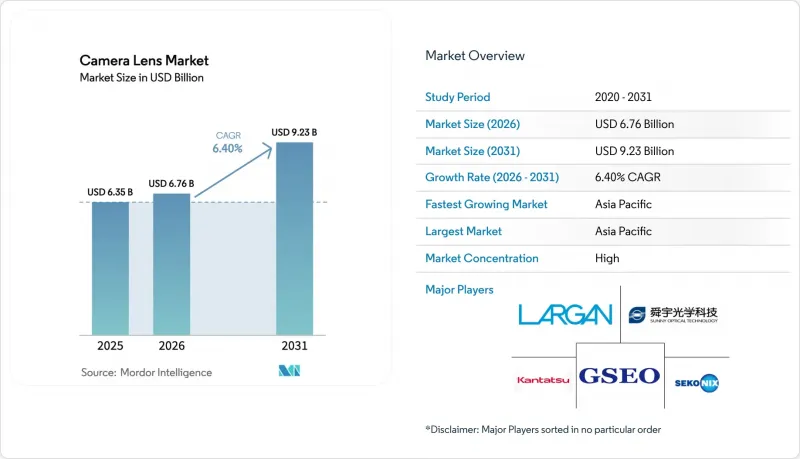
Mordor Intelligence에 의하면, 카메라 렌즈 시장 규모는 2025년에 63억 5,000만 달러로 평가되었고, 2026년에 67억 6,000만 달러로 추정되고, 2031년까지 92억 3,000만 달러에 이를 것으로 예측되며, 2026-2031년 CAGR 6.40%로 성장할 전망입니다.
본 보고서는 용도별(소비자용 전자기기(모바일, AR/VR/MR, 기타 소비자용 전자기기), 자동차, 기타), 렌즈 유형별(내장 렌즈, 교환 렌즈, 기타), 마운트 및 호환성별(DSLR 마운트, 기타), 최종 사용자별(전문가, 기타), 초점 거리별(초광각(16mm 미만), 광각(16-35mm), 기타), 지역별로 분류되어 있습니다. 시장 예측은 금액(달러) 기준으로 제시되어 있습니다.
세계의 카메라 렌즈 시장 동향 및 인사이트
고해상도 멀티 카메라 탑재 스마트폰의 보급
2025년 플래그십 모델에는 2억 화소 센서가 채택되었으며, 이에 따라 광학 설계에 대한 요구가 높아지면서 렌즈 스택에서 더 엄격한 공차와 코팅 기술의 고도화가 요구되었습니다. 소니는 1/1.12인치·2억 화소의 모바일 센서 ‘Lytia LYT-901’로 이 분야에 진출했습니다. 이 센서는 AI 학습에 기반한 리모자이크 회로를 통합하고 있어, 고해상도 줌 및 초당 30프레임의 4K 동영상 촬영을 유지함으로써 단말기 측의 처리 부하를 경감하고, 센서 면에서의 해상도를 향상시키는 광학 모듈의 채택을 촉진하고 있습니다. 또한, 각 스마트폰 제조업체들은 더욱 얇은 플래그십 모델에서 프리미엄 줌 기능을 구현하기 위해 망원 모듈의 소형화를 추진하고 있습니다. 이는 광학적 도달 거리를 저해하지 않으면서 망원 모듈의 점유 면적을 50% 축소하는 것을 목표로 하는 삼성일렉트로메카닉스의 ‘All Lenses on Prism’ 콘셉트와도 일치합니다. 이러한 변화로 인해 페리스코프 어셈블리의 사양은 더욱 엄격해지고 있으며, 잔광을 억제하고 콘트라스트를 유지하기 위해서는 프리즘, 미러 및 다중 렌즈 스택의 정밀한 위치 조정이 요구됩니다. 각 가격대를 불문하고 기기당 카메라 탑재 수는 여전히 높은 수준을 유지하고 있어, 카메라 렌즈 시장은 안정적인 판매량과 망원 모듈의 평균 판매 가격(ASP) 상승이라는 혜택을 누리고 있습니다. 초점 거리를 연장하고 손떨림 보정 기능을 향상시키는 액세서리 생태계는 광학 시스템이 센서에 선명한 디테일을 전달할 때 가장 큰 효과를 발휘합니다. 이를 통해 연산 처리 기술이 발전하더라도 고급 렌즈의 차별성은 유지됩니다.
ADAS 및 자율주행차의 보급 확대
자동차용 이미징은 단순한 옵션 기능에서 엄격한 성능과 신뢰성이 요구되는 통합형 지각 시스템으로 전환되고 있습니다. 소니의 자동차용 이미지 센서 ‘IMX828’은 MIPI A-PHY 인터페이스를 내장하고 있어, 외부 직렬화 칩이 필요 없으므로 부품표(BOM)의 복잡성을 줄이는 동시에 150데시벨의 다이나믹 레인지를 실현하여, 교통 상황에서 흔히 볼 수 있는 급격한 조명 변화에도 대응합니다. Mobileye의 레퍼런스 플랫폼에서는 ADAS 레벨에 따라 대당 1대에서 6대 이상의 카메라를 조합한 구성이 채택되고 있으며, 이에 따라 광시야각 렌즈, 장거리 전면 카메라, 그리고 광학계에서 뛰어난 내열성 및 내진동에 대한 수요가 높아지고 있습니다. 니콘과 미쓰비시 후소(Mitsubishi Fuso)는 하나의 광로 내에서 망원 촬영과 광각 촬영을 통합하고 시차를 방지하는 단일 렌즈 방식을 선보였습니다. 이를 통해 카메라 대수 감소, 시스템 비용 절감, 그리고 보정 절차의 간소화를 실현합니다. 설계 채택이 모듈당 성능을 더욱 높인 솔루션으로 전환됨에 따라, 카메라 렌즈 시장은 다이내믹 레인지, 왜곡 최소화, 그리고 자동차용 온도 범위 전반에 걸친 신뢰성 높은 작동을 중시하는 사양의 혜택을 받고 있습니다. 규제적 압력과 안전 목표에 따라 차종이나 지역을 불문하고 채택이 지속적으로 확대되고 있어, 자동차 등급의 품질 목표를 충족하는 렌즈 공급업체의 전망은 밝아지고 있습니다.
광학 소재 및 희토류 분야공급망 변동
지정학적 제약, 수출 규제, 그리고 게르마늄, 황화아연, 셀레늄화아연과 같은 주요 광학 소재에 대한 관세가 적외선 렌즈 및 특수 렌즈의 생산 계획에 위험 요인으로 작용하고 있습니다. 2025년 한 해 동안 업계 포럼에서는 이러한 취약성이 강조되었으며, 회의 토론에서는 열화상 및 기타 첨단 광학 기술을 뒷받침하는 핵심 소재공급 제약과 리드타임 장기화가 지적되었습니다. 정밀 광학 기기 제조업체들은 또한 특수 유리 기판 및 희토류 도핑 재료의 리드타임 장기화에 대해 경종을 울리고 있으며, 이로 인해 조달 주기가 수주에서 수개월에 이를 가능성이 있습니다. 대기업은 다중 공급처 조달 및 재고 전략을 통해 변동성에 대한 내성을 확보할 수 있지만, 중소규모의 모듈 조립 제조업체는 가격 및 공급 상황의 변동에 더 크게 영향을 받기 쉬운 상황에 놓여 있습니다. 광학 설계가 유리와 플라스틱의 하이브리드 구조나 메타렌즈와 같은 새로운 형태로 변화함에 따라, 틈새 소재에 대한 의존도가 높아져 위험에 노출될 가능성이 커질 것입니다. 따라서 카메라 렌즈 시장에서는 공급망의 회복탄력성을 제품 계획 및 조달 결정에 반영하고 있는 공급업체가 높이 평가받고 있습니다.
부문 분석
2025년, 카메라 렌즈 시장 규모의 58%를 소비자 가전 부문이 차지했습니다. 이는 스마트폰에 여러 대의 카메라를 탑재하는 설계로 인해 단위당 수요가 견조하게 유지되고 있는 것이 배경입니다. 슬림형 기기에서 광학 줌에 대한 견조한 수요가 페리스코프 모듈의 채택을 촉진하고 있으며, 이로 인해 프리미엄 스마트폰 시장에서 평균 판매 가격(ASP)이 높은 렌즈의 점유율이 증가하고 있습니다. 고정 렌즈식 컴팩트 카메라는 간편한 조작성과 색 재현 기술을 중시하는 크리에이터들 사이에서 다시 주목받고 있으며, 이는 스마트폰 이외의 분야에서 렌즈 사용자층 확대에 기여하고 있습니다. 카메라 렌즈 시장은 소비자 부문이 규모를 주도하고, 한편 기업 및 공공 부문에서의 활용이 안정성을 더함으로써 균형 잡힌 구성을 유지하고 있습니다. 구매자들이 기기 간 성능을 비교하는 가운데, 센서에서 더 세밀한 해상도를 구현하는 광학 시스템은 시스템 전체의 성능에 있어 계속해서 중요한 역할을 하고 있습니다.
산업용 및 머신 비전 분야는 공장 내 디지털 전환의 핵심 요소로 자리 잡고 있어, 2031년까지 연평균 10.3%의 성장이 예상되며 가장 빠르게 성장하는 응용 분야입니다. 현재 스마트 카메라에는 복잡한 검사 및 가이드 작업을 수행하기 위한 AI 추론 기능이 내장되어 있어, 프레임 전체에 걸쳐 그리고 불균일한 조명 조건에서도 선명도를 유지할 수 있는 렌즈에 대한 요구 수준이 높아지고 있습니다. 자동차 분야에서의 활용은 ADAS(첨단 운전자 보조 시스템) 수준이 향상되고, 카메라 기반 기능이 더 많은 차종과 지역에 보급됨에 따라 계속 확대되고 있으며, 이는 광각, 장거리, 서라운드 뷰와 같은 렌즈 형식에 대한 수요를 뒷받침하고 있습니다. 의료용 이미징 분야에서는 왜곡을 엄격하게 제어하거나 수술실 조명에 대응할 수 있는 코팅이 요구되고 있으며, 이는 프리미엄 가격 유지로 이어지고 있습니다. 모든 용도에서 카메라 렌즈 시장은 소비자용 기기의 대량 판매와, 이미징이 안전성 및 품질을 좌우하는 분야의 높은 이익률이라는 두 가지 요소 모두로부터 혜택을 받고 있습니다.
2025년에는 표준 렌즈와 단초점 렌즈가 시장 점유율의 49%를 차지했으며, 교환식 렌즈 시스템 및 스마트폰 메인 카메라의 주력 제품으로서의 역할을 입증하고 있습니다. 각 브랜드의 로드맵에서는 컴팩트한 바디와 손떨림 보정 기능과 결합된 범용성이 높은 줌 범위가 계속해서 중시되고 있으며, 이는 사진과 동영상을 모두 촬영하는 크리에이터에게 유익합니다. 스마트폰 분야에서는 페리스코프 모듈이 얇은 기기에 대한 촬영 범위와 선명도에 대한 기대를 새롭게 하고 있으며, 개발자들은 내부 반사를 억제하면서 광로를 단축하고 있습니다. 삼성의 ‘All Lenses on Prism’ 접근 방식은 광학 패키징 혁신을 통해 망원 모듈의 크기를 50% 축소할 수 있는 좋은 예이며, 이를 통해 동일한 기기 부피 내에서 더 큰 센서나 배터리를 탑재할 여지가 생깁니다. 설계 채택의 성패는 부피를 늘리지 않으면서도 프리미엄 스마트폰에 긴 초점 거리 기능을 통합할 수 있느냐에 달려 있기 때문에 이러한 변화는 카메라 렌즈 시장을 뒷받침하고 있습니다.
페리스코프 렌즈 시장은 2031년까지 연평균 11.3%의 성장이 예상되며, 이는 포켓 사이즈 단말기에서 5배-10배 광학 줌을 통한 선명한 화질을 원하는 사용자 수요를 반영한 것입니다. 주류 카메라 구성이 포화 상태에 이른 가운데, 기기 제조업체들은 장거리 망원 기능이나 줌 시 저조도 촬영 성능의 향상을 통해 차별화를 꾀하고 있습니다. 이와 동시에 광각 렌즈는 자동차 서라운드 뷰나 화면 가장자리부터 가장자리까지 선명함과 왜곡 제어가 필수적인 창의적인 용도에서 계속해서 수요가 증가하고 있습니다. 카메라 렌즈 업계는 렌즈 유형에 관계없이 크기, 무게, 성능의 균형을 맞추기 위해 다중 요소 설계, 코팅, 그리고 더욱 엄격한 조립 공차 최적화를 통해 적응해 나가고 있습니다. 이러한 조정은 사용자가 시각적·측정적으로 체감할 수 있는 새로운 기능을 구현하는 첨단 광학 모듈을 통해 얻어지는 부가가치를 높임으로써, 카메라 렌즈 시장을 더욱 강화할 것입니다.
지역별 분석
아시아태평양은 2025년에 62%의 점유율로 카메라 렌즈 시장을 주도할 것이며, 제조 클러스터의 집중과 스마트폰 및 자동차 분야의 최종 시장 수요 증가에 힘입어 2031년까지 연평균 18%의 성장이 예상됩니다. 중국, 한국, 일본, 동남아시아에 걸쳐 있는 생산 네트워크는 광학 시스템, 센서, 모듈을 대규모로 연계하고 있으며, 이를 통해 개발 주기가 단축되고 비용 경쟁력이 향상되고 있습니다. 삼성의 ‘All Lenses on Prism’ 망원 렌즈 패키징 콘셉트는 더 얇은 기기에 더 뛰어난 광학 성능을 집약하겠다는 이 지역의 핵심 전략을 반영하고 있으며, 프리미엄 스마트폰 분야의 경쟁 벤치마킹을 새롭게 바꿀 가능성이 있습니다. 캐논의 RF 및 EF 렌즈 누적 생산량 1억 7,000만 개라는 이정표는 크리에이터와 전문가를 위한 하이엔드 광학 생태계에서 일본의 강점을 부각시키고 있습니다. AR 및 자동화 용도가 확대됨에 따라, 아시아태평양의 카메라 렌즈 시장 규모는 수량 측면과 다양한 용도의 성장 모두에서 혜택을 받고 있습니다.
2025년에는 북미와 유럽의 합산 점유율이 28%를 차지했으며, 자동차 안전 시스템, 산업용 자동화 및 프리미엄 이미징이 성장을 뒷받침했습니다. 자동차용 렌즈 수요는 센서의 발전과 연동되어 있습니다. 예를 들어, 소니의 IMX828은 A-PHY 인터페이스를 칩에 내장함으로써 복잡성을 줄이고, 열악한 조명 조건에서 다이내믹 레인지를 향상시켰습니다. 이러한 기능 덕분에 ADAS(첨단 운전자 보조 시스템) 이용 사례에서 시스템 전체의 신뢰성이 향상됩니다. 멀티 카메라 어레이를 채택한 Mobileye 플랫폼의 설계는 지각 스택이 근거리 및 원거리 장면을 모두 포괄하는 렌즈에 의존하고 있음을 보여주며, 이로 인해 트림(사양)에 관계없이 다양한 광학 구성에 대한 수요가 증가하고 있습니다. 미국과 유럽의 공장에서는 임베디드 AI가 탑재된 스마트 카메라가 시범 프로젝트의 범위를 넘어 보급되고 있으며, 엣지에서의 모델 추론 시 선명도를 유지하는 광학 시스템이 중요시되고 있습니다. 이러한 지역적 동향이 카메라 렌즈 시장에서 B2B 및 프로슈머 수요의 안정적인 균형을 뒷받침하고 있습니다.
세계 기타 지역이 나머지 점유율을 차지하고 있으며, 물류, 인프라, 농업과 관련된 선택적인 성장이 예상됩니다. 중동 및 아프리카에서는 건설 및 물류 프로젝트에서 안전성과 처리 능력을 향상시키기 위해 비전 시스템이 도입되고 있으며, 이를 위해서는 먼지나 극한 온도를 견딜 수 있는 견고한 광학 시스템이 필수적입니다. 남미에서는 농업 모니터링 및 검사 분야에서 작물 분석 및 매핑용 전용 렌즈를 탑재한 드론이 활용되고 있어, 짐벌과 원활하게 통합될 수 있는 경량 고명암비 광학 시스템에 대한 수요가 발생하고 있습니다. 특수 소재공급망 리스크가 지속되는 가운데, 광학 유리 및 코팅을 여러 지역에서 조달할 수 있는 기업은 경쟁 우위를 확보하게 되며, 이는 공급이 제한되는 시장에서 특히 중요합니다. 각 지역에서 카메라 렌즈 시장은 신뢰성을 중시하는 안정적인 B2B 이용 사례 외에도, 더 많은 기기에 첨단 광학 기술을 도입하는 소비자용 업그레이드의 혜택을 받고 있습니다.
기타 혜택 :
- Excel 형식 시장 예측(ME) 시트
- 3개월간의 애널리스트 지원
자주 묻는 질문
목차
제1장 서론
제2장 분석 방법
제3장 주요 요약
제4장 시장 구도
제5장 시장 규모 및 성장률 예측
제6장 경쟁 구도
제7장 시장 기회 및 향후 전망
AJY 26.09.09According to Mordor Intelligence, the camera lens market size is projected to be USD 6.35 billion in 2025, USD 6.76 billion in 2026, and reach USD 9.23 billion by 2031, growing at a CAGR of 6.40% from 2026 to 2031.
This report is Segmented by Application (Consumer Electronics [Mobile, AR/VR/MR, Other Consumer Electronics], Automotive, and More), Lens Type (Built-In Lens, Interchangeable Lens, and More), Mount/Compatibility (DSLR Mount, and More), End-User (Professional, and More), Focal Length (Ultra-Wide [<16 Mm], Wide [16-35 Mm], and More), and Geography. The Market Forecasts are Provided in Terms of Value (USD).
Global Camera Lens Market Trends and Insights
Proliferation of High-Resolution Multi-Camera Smartphones
Flagship phones in 2025 adopted 200-megapixel sensors, which increased optical design demands and drove lens stacks toward tighter tolerances and enhanced coatings. Sony entered this tier with the Lytia LYT-901, a 1/1.12-inch, 200-megapixel mobile sensor that integrates an AI learning-based remosaicing circuit to sustain high-resolution zoom and 4K video at 30 frames per second, thereby reducing the on-device processing load and favoring optical modules that resolve more detail at the sensor plane. Smartphone makers are also compressing telephoto modules for premium zoom in slimmer flagships, which aligns with Samsung Electro-Mechanics' All Lenses on Prism concept that aims to shrink the telephoto footprint by 50% without compromising optical reach. These shifts tighten specifications for periscope assemblies, which require precise alignment of prisms, mirrors, and multi-element lens stacks to control stray light and maintain contrast. As camera counts per device remain high across tiers, the camera lenses market benefits from consistent unit pull-through and higher ASPs on telephoto modules. Accessory ecosystems that extend focal length and improve stabilization work best when optics deliver clean detail to the sensor, which sustains differentiation for advanced lenses even as computational processing improves.
Rising Adoption of ADAS and Autonomous Vehicles
Automotive imaging is moving from optional add-ons to integrated perception systems with stringent performance and reliability needs. Sony's IMX828 automotive image sensor integrates a built-in MIPI A-PHY interface, which reduces bill-of-materials complexity by eliminating an external serializer chip and delivers 150-decibel dynamic range to handle harsh lighting transitions that are common in traffic scenes. Mobileye reference platforms use multiple camera configurations, from one to six or more cameras per vehicle depending on the ADAS level, which raises demand for wide field-of-view lenses, long-range front cameras, and robust thermal and vibration performance in the optical stack. Nikon and Mitsubishi Fuso showcased a single-lens approach that merges telephoto and wide-angle capture within one optical path to prevent parallax, which reduces camera count, lowers system cost, and simplifies calibration. As design-wins shift to solutions that pack more performance per module, the camera lenses market benefits from specifications that value dynamic range, minimal distortion, and reliable operation across automotive temperature ranges. Regulatory pressure and safety objectives continue to advance adoption across trims and regions, improving visibility for lens suppliers that meet automotive-grade quality targets.
Supply-Chain Volatility in Optical Materials and Rare Earths
Geopolitical constraints, export controls, and tariffs on key optical materials such as germanium, zinc sulfide, and zinc selenide are adding risk to production planning for infrared and specialty lenses. Industry forums highlighted these vulnerabilities during 2025, with conference discussions pointing to constrained supply and longer lead times for critical materials that underpin thermal imaging and other advanced optics. Precision optics manufacturers also flagged extended lead times for specialty glass substrates and rare-earth doped materials, which can stretch procurement cycles from weeks to months. Larger companies can buffer volatility with multi-sourcing and inventory strategies, but smaller module assemblers face sharper price and availability swings. As optical designs trend toward hybrid glass-plastic constructions and new formats like metalenses, the dependence on niche materials could increase exposure. The camera lenses market is therefore rewarding suppliers that integrate supply-chain resilience into product planning and sourcing decisions.
Other drivers and restraints analyzed in the detailed report include:
- Growing Demand for Machine Vision and Industrial Automation Imaging
- Rapid Uptake of Mirrorless Cameras Among Professionals and Enthusiasts
- Digital Substitution From Computational Photography
For complete list of drivers and restraints, kindly check the Table Of Contents.
Segment Analysis
Consumer electronics accounted for 58% share of the camera lenses market size in 2025, supported by multi-camera smartphone designs that keep unit demand strong. Robust demand for optical zoom in thin devices is encouraging periscope module adoption, which increases the share of high-ASP lenses within premium phones. Fixed-lens compact cameras experienced renewed attention among creators who value simple controls and color science, which helps broaden the use base for lenses beyond smartphones. The camera lenses market retains balanced exposure because consumer segments provide scale, while enterprise and public-sector uses add stability. As buyers compare results across devices, optics that resolve more detail at the sensor continue to matter for overall system performance.
Industrial and machine vision is the fastest-growing application, projected at 10.3% annually through 2031, because vision has become central to digital transformation in factories. Smart cameras now embed AI inference to perform complex inspection and guidance tasks, which raises the bar for lenses that hold clarity across the frame and under non-uniform lighting. Automotive use continues to scale as ADAS levels move up and as camera-based features span more vehicle trims and regions, which supports demand for wide-angle, long-range, and surround-view lens formats. Medical imaging requires tightly controlled distortion and coatings that handle operating-room lighting, which sustains premium pricing. Across applications, the camera lenses market benefits from a mix of volume in consumer gear and higher margins where imaging drives safety and quality.
Standard and prime lenses held 49% market share in 2025, underscoring their role as the workhorses of interchangeable-lens systems and smartphone main cameras. Brand roadmaps continue to emphasize versatile zoom ranges that pair with compact bodies and stabilization, which helps creators who alternate between photo and video. In smartphones, periscope modules are reshaping expectations for reach and clarity from thin devices, and developers are compressing the optical path while controlling internal reflections. Samsung's All Lenses on Prism approach is an example of how optical packaging innovation can reduce telephoto module size by 50%, which opens room for larger sensors or batteries in the same device volume. These changes support the camera lenses market as design wins hinge on who can fit longer focal length capability into premium phones without bulk.
Periscope lenses are projected to grow at 11.3% annually through 2031, which reflects user demand for clear 5x to 10x optical zoom from pocketable hardware. As mainstream camera stacks become saturated, device makers differentiate with long-reach telephotos and better low-light capture at zoom. In parallel, wide-angle lenses keep gaining in automotive surround-view and in creative uses where edge-to-edge sharpness and controlled distortion are critical. The camera lenses industry is adapting by honing multi-element designs, coatings, and tighter assembly tolerances to balance size, weight, and performance across lens types. These adjustments reinforce the camera lenses market because they increase the value captured by advanced optical modules that enable new features users can see and measure.
Complete Report Scope:
- By Application
- Consumer Electronics
- Mobile
- AR / VR / MR
- Other Consumer Electronics
- Automotive
- Medical
- Industrial And Machine Vision
- Other Applications
- Consumer Electronics
- By Lens Type
- Built-In Lens
- Interchangeable Lens
- Prime Lens
- Zoom Lens
- Macro Lens
- Telephoto Lens
- Wide-Angle Lens
- Periscope Lens
- By Mount / Compatibility
- DSLR Mount
- Mirrorless Mount
- C-Mount
- F-Mount
- CS-Mount
- Other Mount Types
- By End-User
- Professional
- Enthusiast
- Consumer
- OEM / Module Suppliers
- Research And Industrial
- By Focal Length
- Ultra-Wide (<16 mm)
- Wide (16-35 mm)
- Standard (35-70 mm)
- Short Telephoto (70-135 mm)
- Long Telephoto (>135 mm)
- By Geography
- North America
- United States
- Canada
- Mexico
- South America
- Brazil
- Argentina
- Rest Of South America
- Europe
- Germany
- United Kingdom
- France
- Italy
- Spain
- Russia
- Rest Of Europe
- Asia Pacific
- China
- Japan
- India
- South Korea
- ASEAN
- Oceania
- Rest Of Asia Pacific
- Middle East
- Turkey
- Israel
- GCC
- Rest Of Middle East
- Africa
- North Africa
- South Africa
- Rest Of Africa
- North America
Geography Analysis
Asia Pacific led the camera lenses market with 62% share in 2025 and is projected to grow at 18% through 2031, supported by concentrated manufacturing clusters and expanding end-market demand in smartphones and vehicles. Production networks across China, South Korea, Japan, and Southeast Asia coordinate optics, sensors, and modules at scale, which shortens development cycles and improves cost positions. Samsung's All Lenses on Prism telephoto packaging concept reflects the region's focus on squeezing more optical reach into thinner devices, which can reset competitive benchmarks for premium phones. Canon's milestone of 170 million RF and EF lenses underscores Japan's strength in high-end optical ecosystems that serve creators and professionals. As AR and automation use broaden, the camera lenses market size in the Asia Pacific benefits from both volume and diversified application growth.
North America and Europe together accounted for a 28% share in 2025, with growth supported by automotive safety systems, industrial automation, and premium imaging. Automotive lens demand aligns with sensor advancements, such as Sony's IMX828, which incorporates an A-PHY interface on-chip to reduce complexity and enhance dynamic range under harsh lighting conditions. These features improve total system reliability for ADAS use cases. Mobileye platform designs with multi-camera arrays illustrate how perception stacks rely on lenses that cover both near-range and long-range scenes, which lifts demand for varied optical configurations across trims. In factories across the United States and Europe, embedded-AI smart cameras are spreading beyond pilot projects, which place a premium on optics that sustain clarity for model inference at the edge. These regional dynamics support a steady mix of B2B and prosumer demand in the camera lenses market.
The rest of the world accounted for the remaining share and is poised for selective growth tied to logistics, infrastructure, and agriculture. In the Middle East and Africa, construction and logistics projects are incorporating vision systems to enhance safety and throughput, which rely on ruggedized optics that withstand dust and extreme temperatures. In South America, agricultural monitoring and inspection utilize drones equipped with specialized lenses for crop analysis and mapping, creating a demand for light, high-contrast optics that integrate seamlessly with gimbals. As supply-chain risks for specialty materials persist, companies that secure multiregional sourcing for optical glass and coatings will have a competitive edge, which is particularly important in constrained markets. Across regions, the camera lenses market benefits from stable B2B use cases that value reliability, as well as consumer upgrades that bring advanced optics into more devices.
- Largan Precision Co. Ltd
- Sunny Optical Technology (Group) Company Limited
- Genius Electronic Optical Co. Ltd
- AAC Technologies Holdings Inc.
- Samsung Electro-Mechanics Co. Ltd
- Kantatsu Co. Ltd
- Sekonix Co. Ltd
- Canon Inc.
- Sony Corporation
- Nikon Corporation
- Tamron Co. Ltd
- Sigma Corporation
- Ability Opto-Electronics Technology Co. Ltd
- Sunex Inc.
- Haesung Optics Co. Ltd
- O-Film Group Co. Ltd
- Newmax Technology Co. Ltd
- Q Technology (Group) Co. Ltd
- Asia Optical Co. Inc.
Additional Benefits:
- The market estimate (ME) sheet in Excel format
- 3 months of analyst support
TABLE OF CONTENTS
1 INTRODUCTION
- 1.1 Study Assumptions And Market Definition
- 1.2 Scope Of The Study
- 1.2.1 camera lenses market
2 RESEARCH METHODOLOGY
3 EXECUTIVE SUMMARY
4 MARKET LANDSCAPE
- 4.1 Market Overview
- 4.2 Market Drivers
- 4.2.1 Proliferation Of High-Resolution Multi-Camera Smartphones
- 4.2.2 Rising Adoption Of ADAS And Autonomous Vehicles
- 4.2.3 Growing Demand For Machine Vision And Industrial Automation Imaging
- 4.2.4 Rapid Uptake Of Mirrorless Cameras Among Professionals And Enthusiasts
- 4.2.5 Emergence Of AR / VR Devices With Advanced Lens Modules
- 4.2.6 Integration Of Liquid And Freeform Optics Enabling Slimmer Designs
- 4.3 Market Restraints
- 4.3.1 Margin Compression From Intense Supplier Competition
- 4.3.2 Manufacturing Yield Challenges For Complex Multi-Element Lenses
- 4.3.3 Supply-Chain Volatility In Optical Materials And Rare Earths
- 4.3.4 Digital Substitution From Computational Photography
- 4.4 Industry Value / Supply-Chain Analysis
- 4.5 Regulatory Landscape
- 4.6 Technological Outlook
- 4.7 Porter's Five Forces Analysis
- 4.7.1 Threat Of New Entrants
- 4.7.2 Bargaining Power Of Buyers
- 4.7.3 Bargaining Power Of Suppliers
- 4.7.4 Threat Of Substitute Products
- 4.7.5 Intensity Of Competitive Rivalry
- 4.8 Impact Of Macroeconomic Factors On The Market
5 MARKET SIZE AND GROWTH FORECASTS
- 5.1 By Application
- 5.1.1 Consumer Electronics
- 5.1.1.1 Mobile
- 5.1.1.2 AR / VR / MR
- 5.1.1.3 Other Consumer Electronics
- 5.1.2 Automotive
- 5.1.3 Medical
- 5.1.4 Industrial And Machine Vision
- 5.1.5 Other Applications
- 5.1.1 Consumer Electronics
- 5.2 By Lens Type
- 5.2.1 Built-In Lens
- 5.2.2 Interchangeable Lens
- 5.2.3 Prime Lens
- 5.2.4 Zoom Lens
- 5.2.5 Macro Lens
- 5.2.6 Telephoto Lens
- 5.2.7 Wide-Angle Lens
- 5.2.8 Periscope Lens
- 5.3 By Mount / Compatibility
- 5.3.1 DSLR Mount
- 5.3.2 Mirrorless Mount
- 5.3.3 C-Mount
- 5.3.4 F-Mount
- 5.3.5 CS-Mount
- 5.3.6 Other Mount Types
- 5.4 By End-User
- 5.4.1 Professional
- 5.4.2 Enthusiast
- 5.4.3 Consumer
- 5.4.4 OEM / Module Suppliers
- 5.4.5 Research And Industrial
- 5.5 By Focal Length
- 5.5.1 Ultra-Wide (<16 mm)
- 5.5.2 Wide (16-35 mm)
- 5.5.3 Standard (35-70 mm)
- 5.5.4 Short Telephoto (70-135 mm)
- 5.5.5 Long Telephoto (>135 mm)
- 5.6 By Geography
- 5.6.1 North America
- 5.6.1.1 United States
- 5.6.1.2 Canada
- 5.6.1.3 Mexico
- 5.6.2 South America
- 5.6.2.1 Brazil
- 5.6.2.2 Argentina
- 5.6.2.3 Rest Of South America
- 5.6.3 Europe
- 5.6.3.1 Germany
- 5.6.3.2 United Kingdom
- 5.6.3.3 France
- 5.6.3.4 Italy
- 5.6.3.5 Spain
- 5.6.3.6 Russia
- 5.6.3.7 Rest Of Europe
- 5.6.4 Asia Pacific
- 5.6.4.1 China
- 5.6.4.2 Japan
- 5.6.4.3 India
- 5.6.4.4 South Korea
- 5.6.4.5 ASEAN
- 5.6.4.6 Oceania
- 5.6.4.7 Rest Of Asia Pacific
- 5.6.5 Middle East
- 5.6.5.1 Turkey
- 5.6.5.2 Israel
- 5.6.5.3 GCC
- 5.6.5.4 Rest Of Middle East
- 5.6.6 Africa
- 5.6.6.1 North Africa
- 5.6.6.2 South Africa
- 5.6.6.3 Rest Of Africa
- 5.6.1 North America
6 COMPETITIVE LANDSCAPE
- 6.1 Market Concentration
- 6.2 Strategic Moves
- 6.3 Market Share Analysis
- 6.4 Company Profiles (includes Global Level Overview, Market Level Overview, Core Segments, Financials As Available, Strategic Information, Market Rank / Share, Products And Services, And Recent Developments)
- 6.4.1 Largan Precision Co. Ltd
- 6.4.2 Sunny Optical Technology (Group) Company Limited
- 6.4.3 Genius Electronic Optical Co. Ltd
- 6.4.4 AAC Technologies Holdings Inc.
- 6.4.5 Samsung Electro-Mechanics Co. Ltd
- 6.4.6 Kantatsu Co. Ltd
- 6.4.7 Sekonix Co. Ltd
- 6.4.8 Canon Inc.
- 6.4.9 Sony Corporation
- 6.4.10 Nikon Corporation
- 6.4.11 Tamron Co. Ltd
- 6.4.12 Sigma Corporation
- 6.4.13 Ability Opto-Electronics Technology Co. Ltd
- 6.4.14 Sunex Inc.
- 6.4.15 Haesung Optics Co. Ltd
- 6.4.16 O-Film Group Co. Ltd
- 6.4.17 Newmax Technology Co. Ltd
- 6.4.18 Q Technology (Group) Co. Ltd
- 6.4.19 Asia Optical Co. Inc.
7 MARKET OPPORTUNITIES AND FUTURE OUTLOOK
- 7.1 White-Space And Unmet-Need Assessment


