|
시장보고서
상품코드
2122428
스프레이 폴리우레탄 폼 : 시장 점유율 분석, 업계 동향 및 통계, 성장 예측(2026-2031년)Spray Polyurethane Foam - Market Share Analysis, Industry Trends & Statistics, Growth Forecasts (2026 - 2031) |
||||||
 Mordor Intelligence
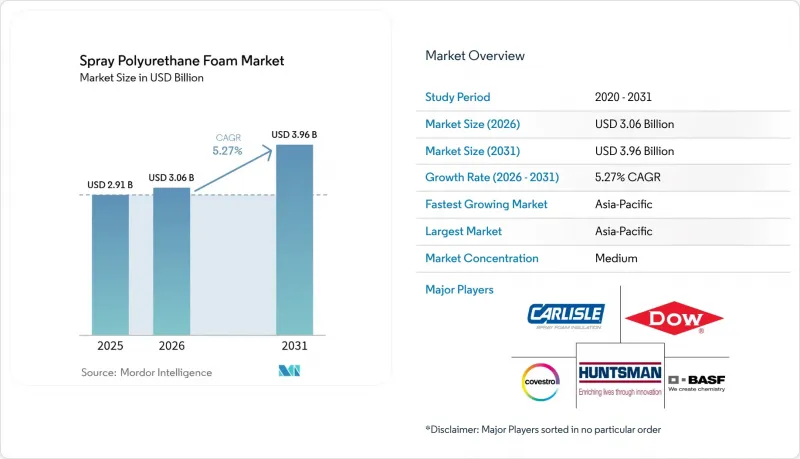
Mordor Intelligence에 의하면, 2026년 스프레이 폴리우레탄 폼 시장 규모는 30억 6,000만 달러로 추정되고 2025년 29억 1,000만 달러에서 확대해, 2031년에는 39억 6,000만 달러에 이를 것으로 예측됩니다.
2026-2031년 동안의 연평균 성장률(CAGR)은 5.27%가 될 것으로 전망됩니다.

본 보고서는 제품 유형별(2액형 고압 스프레이 폼, 2액형 저압 스프레이 폼, 기타), 용도별(단열, 방수, 석면 봉쇄, 실란트, 기타 용도), 최종 이용 산업별(주택, 상업용 건물,산업·인프라, 기타), 지역별(아시아태평양, 북미, 유럽, 남미, 중동 및 아프리카)로 분류되어 있습니다.
세계의 스프레이 폴리우레탄 폼 시장 동향 및 인사이트
엄격한 건축 에너지 기준 및 개보수 의무
2024년판 ‘국제 에너지 절약 기준(IECC)’에서는 독립 기포형 스프레이 폼이 권장되는 기밀층 솔루션으로 자리매김했으며, 건축가들에게 더 높은 R값과 습기 관리 조치의 지정이 요구되었습니다. 캘리포니아주의 2023년 기준과 플로리다주의 2026년 코드 개정은 모두 개보수 공사의 승인 절차를 간소화하고 철거 비용을 절감하는 한편, 특히 경사가 완만한 상업용 지붕에서 수요를 가속화하고 있습니다. 이러한 규제 변경으로 인해 리모델링 대상 범위가 확대되고 하이브리드 단열 구조가 촉진되는 한편, 시공업체들에게는 2액형 시스템에 적합한 교육 및 설비 투자를 더욱 확대하도록 촉구하고 있습니다.
온실가스(GHG) 배출에 대한 우려 고조
기업의 넷제로 목표는 건물 소유주의 비용 목표와 부합하며, EPA의 ‘에너지 스타(Energy Star)’ 프로그램에 따르면 스프레이 폼이 냉난방 에너지를 최대 10%까지 절감할 수 있다는 점이 강조되고 있습니다. 『Installed Building Products』지는 2020년 이후 스프레이 폼 사용으로 CO₂ 배출량을 55% 감축하면서도 생산량을 대폭 늘렸다고 보고하며, 이 기술이 성장과 배출량의 탈동조화를 실현하고 있음을 보여주고 있습니다. 존스 맨빌(Johns Manville) 등의 제조업체는 에너지 절약 제품의 수량이 증가했음에도 불구하고, 절대 배출량에서 두 자릿수 감소를 기록하여 지속가능성과 수익성의 양립이 입증되었습니다.
유리섬유와 셀룰로오스의 경쟁
비용을 중시하는 주택 건설업체들은 오랜 기간 구축된 시공업체 네트워크와 낮은 설비 요건에 힘입어 여전히 유리섬유 단열재를 기본 옵션으로 채택하고 있습니다. Home Innovation Research Labs의 데이터에 따르면, 공동 주택 시장의 성장과 자재 비용 절감이 진행되는 가운데, 스프레이 폼 시장 점유율은 11%에서 8%로 후퇴하여 가격에 대한 민감성이 부각되고 있습니다. 유리섬유 제조업체들은 고밀도 제품을 통해 성능 면에서의 격차를 좁히고 있는 반면, 셀룰로오스는 재활용 소재를 전면에 내세운 브랜딩을 통해 환경 의식이 높은 소비자들에게 어필하고 있습니다. 따라서 스프레이 폼 공급업체들은 높은 초기 비용을 극복하기 위해, 전체 수명 주기 동안의 에너지 절약 효과에 대한 가치 제안을 더욱 명확히 해야 합니다.
부문별 분석
2액형 고압 시스템을 주력으로 하는 이 부문은 2025년 스프레이 폴리우레탄 폼 시장에서 37.02%의 점유율을 차지했습니다. 이는 현장에서의 안정적인 혼합, 뛰어난 단열 성능(R값), 상업 건축 분야의 건축 기준 준수 등을 반영한 결과입니다. BASF가 잔장(Zhanjiang)에서 출시한 새로운 이소시아네이트 및 TPU 제품 라인은 현지 공급망을 강화하고, 아시아태평양의 이 부문에서의 우위를 더욱 공고히 하고 있습니다. 반경질 스프레이 폼은 인프라 프로젝트에서 진동 및 온도 변동에 대한 유연성이 요구됨에 따라 연평균 성장률(CAGR) 6.84%로 확대되고 있습니다. 1액형 스프레이 캔은 소규모 프로젝트에서의 편의성을 충족시키는 한편, 저압 키트는 발열량 저감이 필수적인 민감한 바탕면에 대응합니다.
통합 브랜드 추진은 경쟁 전략을 여실히 보여주고 있습니다. 홀심(Holcim)사의 ‘Enverge(R)’ 브랜드는 ‘Gaco(TM)’와 ‘SES(TM)’의 제품 포트폴리오를 통합하여 시공업체에 지붕, 벽, 특수 폼용 단일 사양 채널을 제공합니다. 제품의 다양화는 교차 판매의 기회를 창출하고 있으며, 반경질 폼의 혁신 기술은 태양광 발전에 대응하는 지붕 및 교량 바닥판을, 팽창성 재료를 배합한 시스템은 내화 규제에 대응하는 것을 각각 목표로 하고 있습니다. 폭넓은 제품 카탈로그와 지역별 기술 센터를 유지하고 있는 공급업체는 사양 선정에서 우위를 확보하는 데 있어 여전히 가장 유리한 입장에 있습니다.
지역별 분석
아시아태평양은 2025년에 스프레이 폴리우레탄 폼 시장의 47.66% 점유율을 차지했으며, 급속한 도시화, 공장 확장, 에너지 규제 도입에 힘입어 연평균 성장률(CAGR) 7.21%로 성장할 것으로 전망됩니다. 중국에서는 부동산 시장의 둔화에 따라 도시 재생에 대한 부양책이 전환되면서, 기존 건물의 단열 개보수에 대한 지출이 증가하고 있습니다. 한편, 인도의 HVAC(난방·환기·공조) 부문은 연평균 성장률(CAGR) 15.8%로 2030년까지 300억 달러에 달할 전망이며, 이는 건축 외피 개보수 수요를 높이고 있습니다. 일본과 한국에서는 지진이 빈번한 지역에 엄격한 건축 외피 요건이 시행되고 있어, 스프레이 폼과 같이 가볍고 밀착성이 높은 단열재가 선호되고 있습니다. 아세안(ASEAN)에서는 수산물 및 백신 보관을 위한 콜드체인 역량이 확대되면서 지역 전체 수요를 끌어올리고 있습니다. BASF가 아시아태평양에 총 195억 달러를 투자할 계획인 것은 이 지역의 흡수 능력에 대한 공급업체들의 신뢰를 여실히 보여줍니다.
북미는 성숙하지만 안정적인 시장을 유지하고 있으며, 연방 정부의 HFC 단계적 폐지 조치로 인해 규제 준수가 통일되고 사양의 복잡성이 낮은 수준으로 억제되고 있습니다. 캐나다의 추운 기후로 인해 다락방에 두꺼운 스프레이 폼을 계속 사용하고 있지만, 멕시코는 니어쇼어링의 기세와 자동차 제조의 성장을 배경으로 세계 4위의 폴리우레탄 소비국으로 부상하고 있습니다. 시공업체 간의 통합으로 인해 전국 규모의 건설업체들은 미국과 캐나다 전역에서 건축 외피 솔루션을 표준화할 수 있게 되었으며, TopBuild의 네트워크 확장이 이러한 움직임을 뒷받침하고 있습니다.
유럽에서는 거시경제의 침체에도 불구하고, 넷 제로 지침과 리모델링 붐이 수요를 자극하고 있습니다. 디이소시아네이트에 관한 교육 규정은 마찰을 야기하고 있지만, 궁극적으로는 견실한 EHS(환경·안전·보건) 프로그램을 갖춘 자본력이 있는 제조업체에 유리하게 작용할 것입니다. 코베스트로(Covestro)의 ‘DreamResource’ 프로젝트는 원료로 20%의 CO2를 함유한 경질 발포재를 도입하여, 순환형 화학 부문에서 유럽의 리더십을 입증하고 있습니다. 리에주 대학교는 바이오 유래 성분을 70-90% 함유한 이소시아네이트 프리 발포재 개발을 추진 중이며, 이는 이 지역에서의 산학 협력의 중요성을 부각시키고 있습니다. 남미, 중동 및 아프리카에서는 에너지 효율에 관한 규제가 점차 강화되고 있습니다. 브라질, 사우디아라비아, 아랍에미리트에서는 선구적인 기업들이 상업용 메가 프로젝트에 스프레이 폼을 채택하고 있어 향후 수요 증가를 시사하고 있습니다.
기타 혜택
- 엑셀 형식 시장 예측(ME) 시트
- 3개월간의 애널리스트 지원
자주 묻는 질문
목차
제1장 서론
제2장 조사 방법
제3장 주요 요약
제4장 시장 구도
제5장 시장 규모 및 성장 예측
제6장 경쟁 구도
제7장 시장 기회 및 향후 전망
KTH 26.09.08According to Mordor Intelligence, spray polyurethane foam market size in 2026 is estimated at USD 3.06 billion, growing from 2025 value of USD 2.91 billion with 2031 projections showing USD 3.96 billion, growing at 5.27% CAGR over 2026-2031.
This report is Segmented by Product Type (Two-Component High-Pressure Spray Foam, Two-Component Low-Pressure Spray Foam, and More), Application (Insulation, Waterproofing, Asbestos Encapsulation, Sealant, Other Application), End-Use Industry (Residential Buildings, Commercial Buildings, Industrial and More), and Geography (Asia-Pacific, North America, Europe, South America, Middle East and Africa).
Global Spray Polyurethane Foam Market Trends and Insights
Strict Building-Energy Codes and Retrofit Mandates
The 2024 International Energy Conservation Code elevates closed-cell spray foam as a preferred air-barrier solution, compelling architects to specify higher R-values and moisture control measures. California's 2023 standards and Florida's 2026 code update both streamline retrofit approvals, lowering removal costs and accelerating demand, particularly for low-slope commercial roofs These rule changes widen the retrofit addressable base, encourage hybrid insulation assemblies, and push contractors toward more training and equipment investment that favors two-component systems.
Rising Concerns Over GHG Emissions
Corporate net-zero goals merge with building-owner cost targets, highlighting spray foam's ability to cut heating-and-cooling energy by up to 10% according to the EPA's Energy Star program. Installed Building Products reported a 55% CO2 reduction from spray foam use since 2020 while materially increasing output, showing the technology's decoupling of growth from emissions. Manufacturers such as Johns Manville logged double-digit drops in absolute emissions even as energy-saving product volumes rose, underscoring alignment between sustainability and profitability.
Competition from Fiberglass and Cellulose
Cost-focused residential builders still default to fiberglass batts, supported by long-standing installer networks and low equipment requirements. Home Innovation Research Labs data showed an 11% to 8% pullback in spray foam share amid multifamily growth and material cost saving, highlighting price sensitivity. Fiberglass makers are narrowing performance gaps with higher-density offerings, while cellulose leverages recycled content branding to appeal to eco-minded consumers. Spray foam suppliers must therefore sharpen value messaging around lifecycle energy savings to overcome higher upfront spend.
Other drivers and restraints analyzed in the detailed report include:
- Growth in Cold-Chain and Refrigerated Logistics
- ESG-Linked Green-Bond Financing for SPF Upgrades
- Regulations and Restrictions on Di-Isocyanates
For complete list of drivers and restraints, kindly check the Table Of Contents.
Segment Analysis
The segment anchored by two-component high-pressure systems held a 37.02% spray polyurethane foam market share in 2025, reflecting consistent on-site mixing, superior R-values, and code acceptance in commercial construction. BASF's new isocyanate and TPU lines in Zhanjiang strengthen local supply chains, reinforcing the segment's dominance in Asia-Pacific. Semi-rigid spray foam is expanding at a 6.84% CAGR as infrastructure projects need flexibility for vibration and temperature swings. One-component cans address small-project convenience, while low-pressure kits cover sensitive substrates where reduced exothermic heat is critical.
A push for integrated brands illustrates competitive strategy: Holcim's Enverge(R) label merges Gaco(TM) and SES(TM) portfolios, giving installers a single specification path for roof, wall, and specialty foams. Product diversification frames cross-selling opportunities, with semi-rigid innovations aimed at solar-ready roofs and bridge decks, and intumescent-infused systems targeting fire-resistance regulations. Suppliers that maintain broad catalogs and regional technical centers remain best positioned to seize specification wins.
Complete Report Scope:
- By Product Type
- Two-Component High-Pressure Spray Foam
- Two-Component Low-Pressure Spray Foam
- One-Component Foam (OCF)
- Semi-Rigid Spray Foam
- By Application
- Insulation
- Waterproofing
- Asbestos Encapsulation
- Sealant
- Other Application (Concrete Lifting / Void Filling, etc.)
- By End-use Industry
- Residential Buildings
- Commercial Buildings
- Industrial and Infrastructure
- Agriculture and Specialty
- By Geography
- Asia-Pacific
- China
- Japan
- India
- South Korea
- ASEAN Countries
- Rest of Asia-Pacific
- North America
- United States
- Canada
- Mexico
- Europe
- Germany
- United Kingdom
- France
- Italy
- Spain
- Russia
- NORDIC Countries
- Rest of Europe
- South America
- Brazil
- Argentina
- Rest of South America
- Middle East and Africa
- Saudi Arabia
- South Africa
- Rest of Middle East and Africa
- Asia-Pacific
Geography Analysis
Asia-Pacific captured 47.66% of spray polyurethane foam market share in 2025 and is forecast to climb at 7.21% CAGR, driven by rapid urbanization, factory expansions, and energy-code adoption. China's real-estate slowdown redirects stimulus toward urban renewal, boosting retrofit insulation spend, while India's HVAC sector is set to hit USD 30 billion by 2030 on a 15.8% CAGR pathway, raising demand for building envelope upgrades. Japan and South Korea enforce stringent envelope requirements in seismic zones, favoring lightweight, high-adhesion insulation such as spray foam. ASEAN nations expand cold-chain capacity for seafood and vaccine storage, pulling regional demand upward. BASF's multi-year USD 19.5 billion Asia-Pacific investment plan exemplifies supplier confidence in the region's absorption capacity.
North America remains a mature but stable arena where federal HFC phase-outs harmonize compliance and keep specification complexity low. Canada's cold climates sustain thick-layer attic spray foam usage, while Mexico emerges as the world's fourth-largest polyurethane consumer on near-shoring momentum and automotive manufacturing growth. Consolidation among contractors enables national builders to standardize envelope solutions across the US and Canada, reinforced by TopBuild's network expansion.
Europe's net-zero directives and renovation wave stimulate demand despite tepid macro-economics. Di-isocyanate training rules introduce friction but ultimately favor well-capitalized manufacturers with robust EHS programs. Covestro's DreamResource project introduces rigid foam containing 20% CO2 as feedstock, demonstrating European leadership in circular chemistry. University of Liege advances isocyanate-free foams with 70-90% biobased content, underscoring regional academic-industry collaboration. In South America and the Middle East and Africa, energy-efficiency codes are tightening gradually; early movers in Brazil, Saudi Arabia, and the UAE adopt spray foam in commercial megaprojects, signaling future volume uplift.
- BASF
- Accella Polyurethane Systems
- Carlisle Spray Foam Insulation
- Covestro AG
- Dow
- FOAM-LOK (Firestone)
- GACO
- Huntsman Corporation LLC
- ISOTHANE LTD
- Johns Manville
- NCFI Polyurethanes
- Rhino Linings
- SOPREMA Canada.
- SWD Urethane
Additional Benefits:
- The market estimate (ME) sheet in Excel format
- 3 months of analyst support
TABLE OF CONTENTS
1 Introduction
- 1.1 Study Assumptions and Market Definition
- 1.2 Scope of the Study
2 Research Methodology
3 Executive Summary
4 Market Landscape
- 4.1 Market Overview
- 4.2 Market Drivers
- 4.2.1 Strict Building-Energy Codes and Retrofit Mandates
- 4.2.2 Rising Concerns over GHG Emissions
- 4.2.3 Growth in Cold-Chain and Refrigerated Logistics
- 4.2.4 ESG-linked green bond financing for SPF upgrades
- 4.2.5 High-lift Foam Demand for Solar-Ready Roofs
- 4.3 Market Restraints
- 4.3.1 Competition from Fiberglass and Cellulose
- 4.3.2 Regulations and Restrictions on Di-isocyanates
- 4.3.3 HFO Blowing-agent Supply Volatility
- 4.4 Value Chain Analysis
- 4.5 Porter's Five Forces
- 4.5.1 Bargaining Power of Suppliers
- 4.5.2 Bargaining Power of Buyers
- 4.5.3 Threat of New Entrants
- 4.5.4 Threat of Substitutes
- 4.5.5 Competitive Rivalry
5 Market Size and Growth Forecasts (Value)
- 5.1 By Product Type
- 5.1.1 Two-Component High-Pressure Spray Foam
- 5.1.2 Two-Component Low-Pressure Spray Foam
- 5.1.3 One-Component Foam (OCF)
- 5.1.4 Semi-Rigid Spray Foam
- 5.2 By Application
- 5.2.1 Insulation
- 5.2.2 Waterproofing
- 5.2.3 Asbestos Encapsulation
- 5.2.4 Sealant
- 5.2.5 Other Application (Concrete Lifting / Void Filling, etc.)
- 5.3 By End-use Industry
- 5.3.1 Residential Buildings
- 5.3.2 Commercial Buildings
- 5.3.3 Industrial and Infrastructure
- 5.3.4 Agriculture and Specialty
- 5.4 By Geography
- 5.4.1 Asia-Pacific
- 5.4.1.1 China
- 5.4.1.2 Japan
- 5.4.1.3 India
- 5.4.1.4 South Korea
- 5.4.1.5 ASEAN Countries
- 5.4.1.6 Rest of Asia-Pacific
- 5.4.2 North America
- 5.4.2.1 United States
- 5.4.2.2 Canada
- 5.4.2.3 Mexico
- 5.4.3 Europe
- 5.4.3.1 Germany
- 5.4.3.2 United Kingdom
- 5.4.3.3 France
- 5.4.3.4 Italy
- 5.4.3.5 Spain
- 5.4.3.6 Russia
- 5.4.3.7 NORDIC Countries
- 5.4.3.8 Rest of Europe
- 5.4.4 South America
- 5.4.4.1 Brazil
- 5.4.4.2 Argentina
- 5.4.4.3 Rest of South America
- 5.4.5 Middle East and Africa
- 5.4.5.1 Saudi Arabia
- 5.4.5.2 South Africa
- 5.4.5.3 Rest of Middle East and Africa
- 5.4.1 Asia-Pacific
6 Competitive Landscape
- 6.1 Market Concentration
- 6.2 Strategic Moves
- 6.3 Market Share(%)/Ranking Analysis
- 6.4 Company Profiles (includes Global level Overview, Market level overview, Core Segments, Financials as available, Strategic Information, Market Rank/Share for key companies, Products and Services, and Recent Developments)
- 6.4.1 BASF
- 6.4.2 Accella Polyurethane Systems
- 6.4.3 Carlisle Spray Foam Insulation
- 6.4.4 Covestro AG
- 6.4.5 Dow
- 6.4.6 FOAM-LOK (Firestone)
- 6.4.7 GACO
- 6.4.8 Huntsman Corporation LLC
- 6.4.9 ISOTHANE LTD
- 6.4.10 Johns Manville
- 6.4.11 NCFI Polyurethanes
- 6.4.12 Rhino Linings
- 6.4.13 SOPREMA Canada.
- 6.4.14 SWD Urethane
7 Market Opportunities and Future Outlook
- 7.1 White-space and Unmet-Need Assessment