

|
시장보고서
상품코드
2122449
중대형 상용차 : 시장 점유율 분석, 업계 동향 및 통계, 성장 예측(2026-2031년)Medium And Heavy Duty Commercial Vehicles - Market Share Analysis, Industry Trends & Statistics, Growth Forecasts (2026 - 2031) |
||||||
 Mordor Intelligence
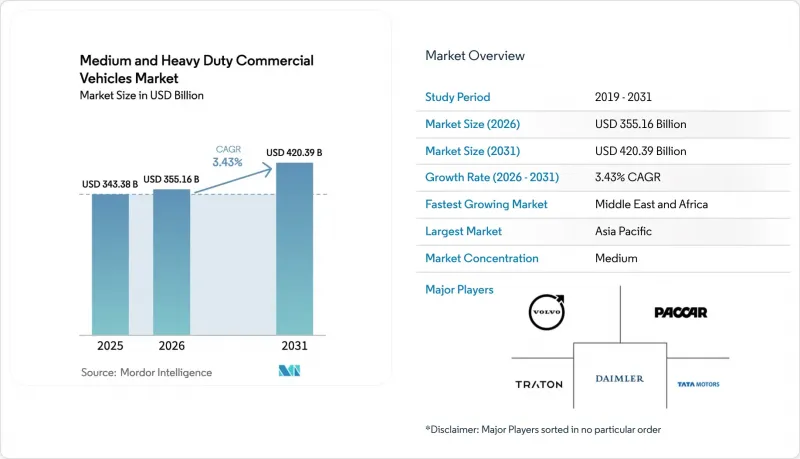
에 의하면, 중대형 상용차 시장 규모는 2025년 3,433억 8,000만 달러로 평가되었습니다. 2026년에는 3,551억 6,000만 달러로 확대되어 2026-2031년에 걸쳐 CAGR 3.43%로 성장을 지속하여, 2031년에는 4,203억 9,000만 달러에 이를 것으로 예측됩니다.

본 보고서는 적재량별(3.5-7.5톤, 7.5-16톤, 16톤 초과), 추진 방식별(내연기관, 배터리 전기차, 기타),차종별(리지드 트럭, 트랙터 트레일러, 팁퍼, 특수 차량), 최종 사용자별(물류, 건설 및 광업, 농업, 유틸리티), 지역별로 분류되어 있습니다. 시장 예측은 금액(달러)과 수량(대)으로 제시되어 있습니다.
세계의 중대형 상용차 시장 동향 및 인사이트
유로 VII 및 EPA 2027 배기가스 규제에 힘입은 차량 교체
가까운 미래에 더욱 엄격해진 유로 VII 규제로 인해 질소산화물 배출 기준치가 대폭 낮아질 것입니다. 또한, 이 규제에서는 실제 주행 환경에서의 도시 지역 스톱 앤 고(Stop-and-Go) 검사가 도입되며, 브레이크와 타이어에서 배출되는 입자상 물질 배출량에 대해 처음으로 상한선이 설정됩니다. 한편, 미국 환경보호청(EPA)의 ‘제3단계 온실가스 규제’는 향후 10년 동안 배출 강도를 대폭 감축하는 것을 목표로 하고 있습니다. 그러나 디젤 차량의 단순한 점진적 개량만으로는 이 목표를 달성하는 것이 불가능합니다. 캘리포니아주를 비롯한 일부 주에서는 향후 10년 이내에 클래스 7-8 차량 판매 대수의 상당 부분을 무공해 차량으로 전환해야 할 의무가 부과되고 있습니다. 이러한 움직임은 신형 디젤 트랙터의 중고차 가격에 위협이 될 것입니다. 이에 대응해 각 제조업체는 배터리 전기차 및 연료전지 플랫폼에 대한 연구 개발에 주력하고 있습니다. 또한 내구성 기준을 충족하기 위해 회생 제동 및 배터리 상태 진단 기능 강화에도 힘쓰고 있습니다. 규제 시행 기한 전에 규제 대응 트럭을 구매한 차량 운용 사업자는 중고차 가격 상승이나 ESG 지표와 연계된 더 유리한 대출 조건 등의 혜택을 누릴 수 있을 것으로 기대됩니다.
신흥국의 인프라 확충을 위한 부양책
인도의 ‘국가 인프라 파이프라인’은 2020년대 중반까지 막대한 투자를 진행할 예정이며, 주로 도로 및 항만 정비에 중점을 두고 있습니다. 이러한 노력으로 인해 다양한 화물 운송 회랑에서 경량 트럭에 대한 수요가 크게 증가했습니다. 한편, 인도네시아와 베트남 양국은 고속도로 프로젝트에 막대한 자원을 할당하고 있습니다. 이러한 투자로 인해 콘크리트 믹서 트럭과 덤프 트럭의 구매가 급증하고 있으며, 양국에서 건설 붐을 뒷받침하고 있습니다. 중동에서는 사우디아라비아가 ‘비전 2030’에 막대한 자금을 투입하고 있으며, 특히 NEOM 물류 회랑 개발을 중점적으로 추진하고 있습니다. 동시에 아랍에미리트는 향후 몇 년 동안 더 많은 컨테이너를 처리할 수 있도록 칼리파 항구의 처리 능력을 야심차게 확대하고 있어, 이에 따라 트랙터 트레일러에 대한 안정적인 수요가 예상됩니다.
제로 배출 트럭의 높은 초기 비용
2025년에도 배터리 전기 구동 클래스 8 트랙터는 디젤 차량에 비해 여전히 상당히 비쌉니다. 게다가 연료전지 차량의 경우 그 비용은 더욱 높아집니다. 미국 ‘인플레이션 감축법(Inflation Reduction Act)’에 따른 세액 공제나 독일의 KsNI 보조금 등의 우대 조치는 가격 차이를 줄이는 데 기여하고 있지만, 그 격차를 완전히 메우지는 못하고 있습니다. 합리적인 자금 조달 수단을 갖추지 못한 소규모 차량 운영업체의 경우, 특히 장거리 운송 부문에서 투자 회수 기간이 장기화되는 것이 과제로 대두되고 있습니다. 리스 모델이나 ‘배터리 애즈 어 서비스(BaaS)’와 같은 선택지가 어느 정도 부담을 덜어주고는 있지만, 그 실현 가능성은 잔존 가치 예측에 달려 있으며, 중고 시장에서의 잔존 가치 동향은 여전히 불투명합니다. 사업자들은 고액의 초기 투자와 디젤 차량의 재판매 가치를 위협하는 배출 규제 구역에서의 규제 강화 사이에서 균형을 맞추며, 어려운 결정을 내려야 하는 상황에 놓여 있습니다.
부문별 분석
2025년, 16톤 이상의 차량은 중대형 상용차 시장 점유율의 61.27%를 차지하며, 도시 간 화물 운송 및 광업 운송 분야에서 그 우위를 반영했습니다. 3.5-7.5톤 차량은 2031년까지 연평균 성장률(CAGR) 3.45%로 성장하고 있습니다. 이는 밀집된 도심에서의 기동성을 중시하고, 한 번의 충전으로 배송 주기를 완료함으로써 이익을 얻을 수 있는 전자상거래 사업자에 의해 주도되고 있습니다.
3.5톤을 초과하는 모든 중량 등급에 일률적으로 엄격한 배기가스 규제가 적용됨에 따라, 중형 카테고리의 규제 준수 측면에서의 우위는 사라지고, 모든 중량 대역에서 차량을 배터리 전기차 또는 연료전지차로 교체하는 것이 촉진되고 있습니다. 현대자동차의 수소 연료전지 트랙터 ‘XCIENT’는 2025년까지 스위스와 캘리포니아에서 운행하며 1,000만 km를 돌파해, 배터리 중량이 여전히 장벽으로 작용하는 장거리 운송에서의 실용성을 입증했습니다. 중대형 상용차 시장에서는 현재 각 OEM 업체들이 적재량 등급에 특화된 충전 허브와 경로 계획 소프트웨어를 공동 설계하고 있으며, 투자 결정을 도시의 구역 지정 정책과 조화시키고 있습니다.
2025년 판매 대수에서 내연기관 차량이 87.71%를 차지했으나, 배터리 전기 트럭은 2031년까지 연평균 성장률(CAGR) 3.55%로 확대되며 이 부문에서 가장 빠른 성장률을 보이고 있습니다. 다임러의 ‘eCascadia’, 볼보의 ‘VNR Electric’, BYD의 ‘8TT’의 총 생산 대수는 2026년까지 연간 5만 대를 넘어설 전망이며, 이는 중대형 상용차 시장에서 최대 규모의 협력적 생산 능력 확장이 될 것입니다.
플러그인 하이브리드 전기차는 과도기의 틈새 시장을 차지하고 있지만, 시스템의 복잡성과 최적화된 디젤 차량에 비해 연료 절감 효과가 제한적이어서 시장 점유율은 3% 이하에 머물고 있습니다. 수소 연료전지 트럭은 수소 회랑이 구축된 지역에서 기반을 다지고 있으나, 대규모 보급을 위해서는 그린 수소 가격이 1kg당 4달러 이하로 떨어지는 것이 관건이 될 것입니다. LNG나 CNG 등의 대체 연료는 충전 인프라가 부족한 농림업 부문에서 임시적인 해결책으로 기능하고 있습니다. 중국의 듀얼 크레딧 제도는 BEV의 보급을 가속화하고 있으며, 국내 OEM 각사는 2024-2025년에 걸쳐 15종의 신형 모델을 출시할 예정입니다.
지역별 분석
2025년, 아시아태평양은 전 세계 매출의 43.16%를 차지했습니다. 이는 신에너지차(NEV) 생산을 장려하는 중국의 정책과 인도의 대규모 인프라 구축 노력이 원동력이 되었습니다. 중국에서는 주요 제조업체들이 규제 요건을 충족하기 위해 여러 전기 트럭 모델을 출시함에 따라 상업용 신에너지차 판매가 크게 증가했습니다. 인도에서는 물류 주도형 경제 성장이 트럭 수요를 뒷받침했으나, 충전 인프라 부족과 소규모 사업자를 위한 자금 조달 문제로 인해 전기차 보급은 여전히 제한적이었습니다. 한편, 일본과 한국에서는 연료전지 트럭에 대한 막대한 보조금이 첨단 모델의 도입을 뒷받침하며, 해당 지역의 전기화 노력을 촉진했습니다.
북미와 유럽은 합쳐서 2025년 매출의 상당 부분을 차지했으며, 그 성장은 조기 전동화를 의무화하는 규제 체계에 의해 형성되었습니다. 미국에서는 트럭 판매의 상당 부분을 대상으로 한 정책이 전환을 주도한 반면, 유럽에서는 더욱 엄격한 배기가스 기준으로 인해 디젤 플랫폼의 생존 가능성이 제한되었습니다. 유럽의 주요 시장에서는 특히 지자체나 소포 배송 노선에서 운용되는 중형 모델에서 배터리 전기 트럭의 도입이 두드러졌습니다.
중동 및 아프리카는 걸프 국가들의 다각화 프로젝트와 광업 부문의 전기화 시범 사업에 힘입어 2031년까지 연평균 성장률(CAGR) 3.51%로 성장을 주도하고 있습니다. 사우디아라비아의 5,000억 달러 규모 NEOM 투자와 아랍에미리트의 항만 확장이 트랙터 트레일러 수요를 뒷받침하고 있는 반면, 남아프리카의 광산에서는 디젤 연료비를 절감하기 위해 운반 트럭을 수소 파워트레인으로 개조하는 작업이 진행되고 있습니다. 튀르키예는 낮은 인건비와 유리한 물류 조건을 활용해 유럽용 중형 트럭의 수출 거점으로 부상하고 있습니다. 라틴아메리카에서는 브라질과 아르헨티나의 농산물 수출에 따라 트럭 보유 대수가 증가하고 있지만, 환율 변동이 전동화 투자를 억제하고 있습니다.
기타 혜택
- 엑셀 형식 시장 예측(ME) 시트
- 3개월간 애널리스트 지원
자주 묻는 질문
목차
제1장 서론
제2장 조사 방법
제3장 주요 요약
제4장 시장 구도
제5장 시장 규모 및 성장 예측
제6장 경쟁 구도
제7장 시장 기회 및 향후 전망
KTH 26.09.08According to Mordor Intelligence, the medium and heavy duty commercial vehicles market size is expected to grow from USD 343.38 billion in 2025 to USD 355.16 billion in 2026 and is forecast to reach USD 420.39 billion by 2031 at a 3.43% CAGR over 2026-2031.
This report is Segmented by Tonnage (3. 5 To 7. 5 T, 7. 5 To 16 T, and Above 16 T), Propulsion Type (ICE, Battery Electric, and More), Vehicle Type (Rigid, Tractor-Trailer, Tipper, and Specialized), End-User (Logistics, Construction & Mining, Agriculture, and Utilities), and Geography. Market Forecasts are in Value (USD) and Volume (Units).
Global Medium And Heavy Duty Commercial Vehicles Market Trends and Insights
Fleet Renewal Driven by Euro-VII & EPA 2027 Emission Rules
In the near future, stricter Euro-VII limits will significantly reduce nitrogen-oxide thresholds. These limits will also introduce real-world urban stop-and-go testing and, for the first time, impose caps on brake and tire particle emissions. Meanwhile, the U.S. EPA's Phase 3 greenhouse-gas rule aims for a substantial reduction in intensity over the next decade. However, achieving this target is impossible through mere incremental improvements in diesel. In California, along with several other states, there is a mandate for a significant portion of Class 7-8 sales to be zero-emission within the next decade. This move jeopardizes the resale value of new diesel tractors . In response, manufacturers are channeling R&D into battery-electric and fuel-cell platforms. They're also bolstering regenerative braking and battery-health diagnostics to adhere to durability standards. Fleets that purchase compliant trucks ahead of the deadline stand to gain from enhanced resale values and better financing terms linked to ESG metrics .
Infrastructure Stimulus in Emerging Economies
India's National Infrastructure Pipeline is set to invest a substantial amount by mid-decade, primarily focusing on upgrading roads and ports. This initiative has significantly boosted the demand for rigid trucks across various freight corridors. Meanwhile, both Indonesia and Vietnam have allocated significant resources for highway projects. These investments are driving a surge in the purchases of concrete mixers and dump trucks, fueling a construction boom in both nations. In the Middle East, Saudi Arabia is channeling considerable funding into its Vision 2030, specifically targeting the development of NEOM logistics corridors. Simultaneously, the United Arab Emirates is ambitiously scaling Khalifa Port's capacity to handle a much larger volume of containers in the coming years, ensuring a steady intake of tractor-trailers.
High Upfront Cost of Zero-Emission Trucks
In 2025, battery-electric Class 8 tractors remain significantly more expensive than their diesel counterparts. Additionally, fuel-cell variants come with an even higher cost. While incentives like the U.S. Inflation Reduction Act's credit and Germany's KsNI subsidy help reduce the price disparity, they do not fully bridge the gap. For smaller fleets without access to affordable capital, the extended payback periods pose a challenge, particularly in long-haul segments. Although leasing models and battery-as-a-service options provide some relief, their feasibility depends on residual-value forecasts, which are still unproven in secondary markets. Operators face a difficult decision, balancing the higher upfront investment against the increasing restrictions in emission zones, which threaten the resale value of diesel assets.
Other drivers and restraints analyzed in the detailed report include:
- E-Commerce Logistics Expansion
- Mining Sector Push for Battery-Electric Haul Trucks
- Supply-Chain Bottlenecks for Power Electronics & Batteries
For complete list of drivers and restraints, kindly check the Table Of Contents.
Segment Analysis
Vehicles above 16 tonnes captured 61.27% of the medium and heavy-duty commercial vehicles market share in 2025, reflecting their dominance in intercity freight and mining haulage. The 3.5-7.5 tonne band is growing at a 3.45% CAGR to 2031, fueled by e-commerce operators that prioritize maneuverability in dense city cores and can profit from single-charge delivery cycles.
Rigid emission standards apply uniformly across weights above 3.5 tonnes, nullifying any compliance advantage of mid-duty categories and nudging fleets toward battery-electric or fuel-cell upgrades in every bracket. Hyundai's XCIENT fuel-cell tractor exceeded 10 million km in Swiss and California service by 2025, proving viability for long-haul payloads where battery weight remains a hurdle. The medium and heavy-duty commercial vehicles market now sees OEMs co-designing charging hubs and route planning software specific to tonnage class, aligning investment decisions with urban zoning policies.
Internal-combustion engines commanded 87.71% of 2025 volume, yet battery-electric trucks expand at a 3.55% CAGR to 2031, the fastest rate in the segment. Combined output of Daimler eCascadia, Volvo VNR Electric, and BYD 8TT exceeds half a lakh vehicles annually by 2026, marking the largest coordinated capacity build-out in the medium and heavy-duty commercial vehicles market context.
Plug-in hybrids occupy a transition niche but remain under 3% share due to complexity and marginal fuel savings over optimized diesel models. Fuel-cell trucks secure footholds in regions with hydrogen corridors, but large-scale uptake hinges on sub-USD 4/kg green hydrogen pricing. Alternative fuels such as LNG and CNG act as interim solutions across agriculture and forestry where charging infrastructure is sparse. China's dual-credit system accelerates BEV penetration, with domestic OEMs launching 15 new models across 2024-2025.
Complete Report Scope:
- By Tonnage
- 3.5 to 7.5 t
- 7.5 to 16 t
- Above 16 t
- By Propulsion Type
- Internal-Combustion Engine (Diesel & Gasoline)
- Battery Electric
- Plug-in Hybrid Electric
- Fuel-cell Electric
- Alternative Fuels (CNG, LNG, Bio-fuel, LPG)
- By Vehicle Type
- Rigid Truck
- Tractor-Trailer
- Tipper / Dump Truck
- Specialized & Vocational Trucks
- By End-user Industry
- Logistics & Transportation
- Construction & Mining
- Agriculture & Forestry
- Utilities & Municipal Services
- By Geography
- North America
- United States
- Canada
- Rest of North America
- South America
- Brazil
- Argentina
- Rest of South America
- Europe
- Germany
- United Kingdom
- France
- Italy
- Spain
- Rest of Europe
- Asia Pacific
- China
- India
- Japan
- South Korea
- Rest of Asia Pacific
- Middle East and Africa
- United Arab Emirates
- Saudi Arabia
- South Africa
- Turkey
- Rest of Middle East and Africa
- North America
Geography Analysis
Asia-Pacific delivered 43.16% of global revenue in 2025, driven by China's policies encouraging new-energy-vehicle production and India's large-scale infrastructure initiatives. Chinese commercial NEV sales saw significant growth as major manufacturers introduced multiple electric truck models to comply with regulatory requirements. While India's logistics-driven economic growth sustained truck demand, the adoption of electric vehicles remained minimal due to inadequate charging infrastructure and financing challenges for smaller operators. Meanwhile, Japan and South Korea's substantial subsidies for fuel-cell trucks supported the rollout of advanced models, boosting the region's electrification efforts.
North America and Europe collectively accounted for a significant share of the 2025 revenue, with their growth shaped by regulatory frameworks mandating early electrification. In the United States, policies targeting a substantial portion of truck sales drove the transition, while in Europe, stricter emissions standards limited the viability of diesel platforms. Key European markets registered notable adoption of battery-electric trucks, particularly in medium-duty models serving municipal and parcel delivery routes.
The Middle East and Africa lead growth at 3.51% CAGR through 2031, buoyed by Gulf diversification projects and mining electrification pilots. Saudi Arabia's USD 500 billion NEOM investment and UAE port expansion underpin tractor-trailer demand, while South African mines retrofit haul trucks with hydrogen powertrains to cut diesel expense. Turkey emerges as an export base for medium-duty trucks into Europe, exploiting lower labor costs and favorable logistics. Latin America's truck fleet expands with agricultural exports from Brazil and Argentina, though currency volatility tempers electrification investment.
- Daimler Truck AG
- Volvo Group
- Traton SE (MAN, Scania, Navistar)
- PACCAR Inc.
- Tata Motors Ltd.
- Hyundai Motor Co.
- CNHTC (Sinotruk)
- Dongfeng Motor Corp.
- FAW Group
- Renault Trucks
- Isuzu Motors Ltd.
- Hino Motors
- Ashok Leyland
- Iveco Group
- Kamaz PJSC
- Shacman (Shaanxi Auto)
- UD Trucks
- BYD Auto
- Nikola Corp.
Additional Benefits:
- The market estimate (ME) sheet in Excel format
- 3 months of analyst support
TABLE OF CONTENTS
1 Introduction
- 1.1 Study Assumptions & Market Definition
- 1.2 Scope of the Study
2 Research Methodology
3 Executive Summary
4 Market Landscape
- 4.1 Market Overview
- 4.2 Market Drivers
- 4.2.1 Fleet Renewal Driven by Euro-VII & EPA 2027 Emission Rules
- 4.2.2 Infrastructure Stimulus in Emerging Economies
- 4.2.3 E-Commerce Logistics Expansion
- 4.2.4 Mining Sector'S Push for Battery-Electric Haul Trucks
- 4.2.5 Telematics-Enabled Usage-Based Insurance Lowers TCO
- 4.2.6 Secondary-Use Battery Leasing Models
- 4.3 Market Restraints
- 4.3.1 High Upfront Cost of Zero-Emission Trucks
- 4.3.2 Supply-Chain Bottlenecks for Power-Electronics & Batteries
- 4.3.3 Depot-Level Grid-Capacity Limitations
- 4.3.4 Skilled-Technician Shortage for HV-EV Drivetrains
- 4.4 Value / Supply-Chain Analysis
- 4.5 Regulatory Landscape
- 4.6 Technological Outlook
- 4.7 Porter's Five Forces
- 4.7.1 Bargaining Power of Suppliers
- 4.7.2 Bargaining Power of Buyers
- 4.7.3 Threat of New Entrants
- 4.7.4 Threat of Substitutes
- 4.7.5 Competitive Rivalry
5 Market Size & Growth Forecasts (Value (USD) and Volume (Units))
- 5.1 By Tonnage
- 5.1.1 3.5 to 7.5 t
- 5.1.2 7.5 to 16 t
- 5.1.3 Above 16 t
- 5.2 By Propulsion Type
- 5.2.1 Internal-Combustion Engine (Diesel & Gasoline)
- 5.2.2 Battery Electric
- 5.2.3 Plug-in Hybrid Electric
- 5.2.4 Fuel-cell Electric
- 5.2.5 Alternative Fuels (CNG, LNG, Bio-fuel, LPG)
- 5.3 By Vehicle Type
- 5.3.1 Rigid Truck
- 5.3.2 Tractor-Trailer
- 5.3.3 Tipper / Dump Truck
- 5.3.4 Specialized & Vocational Trucks
- 5.4 By End-user Industry
- 5.4.1 Logistics & Transportation
- 5.4.2 Construction & Mining
- 5.4.3 Agriculture & Forestry
- 5.4.4 Utilities & Municipal Services
- 5.5 By Geography
- 5.5.1 North America
- 5.5.1.1 United States
- 5.5.1.2 Canada
- 5.5.1.3 Rest of North America
- 5.5.2 South America
- 5.5.2.1 Brazil
- 5.5.2.2 Argentina
- 5.5.2.3 Rest of South America
- 5.5.3 Europe
- 5.5.3.1 Germany
- 5.5.3.2 United Kingdom
- 5.5.3.3 France
- 5.5.3.4 Italy
- 5.5.3.5 Spain
- 5.5.3.6 Rest of Europe
- 5.5.4 Asia Pacific
- 5.5.4.1 China
- 5.5.4.2 India
- 5.5.4.3 Japan
- 5.5.4.4 South Korea
- 5.5.4.5 Rest of Asia Pacific
- 5.5.5 Middle East and Africa
- 5.5.5.1 United Arab Emirates
- 5.5.5.2 Saudi Arabia
- 5.5.5.3 South Africa
- 5.5.5.4 Turkey
- 5.5.5.5 Rest of Middle East and Africa
- 5.5.1 North America
6 Competitive Landscape
- 6.1 Market Concentration
- 6.2 Strategic Moves
- 6.3 Market Share Analysis
- 6.4 Company Profiles (includes Global Level Overview, Market Level Overview, Core Segments, Financials as Available, Strategic Information, Market Rank/Share for Key Companies, Products and Services, SWOT Analysis, and Recent Developments)
- 6.4.1 Daimler Truck AG
- 6.4.2 Volvo Group
- 6.4.3 Traton SE (MAN, Scania, Navistar)
- 6.4.4 PACCAR Inc.
- 6.4.5 Tata Motors Ltd.
- 6.4.6 Hyundai Motor Co.
- 6.4.7 CNHTC (Sinotruk)
- 6.4.8 Dongfeng Motor Corp.
- 6.4.9 FAW Group
- 6.4.10 Renault Trucks
- 6.4.11 Isuzu Motors Ltd.
- 6.4.12 Hino Motors
- 6.4.13 Ashok Leyland
- 6.4.14 Iveco Group
- 6.4.15 Kamaz PJSC
- 6.4.16 Shacman (Shaanxi Auto)
- 6.4.17 UD Trucks
- 6.4.18 BYD Auto
- 6.4.19 Nikola Corp.
7 Market Opportunities & Future Outlook
- 7.1 White-space & Unmet-need Assessment


