
|
시장보고서
상품코드
2122494
일회용 요실금 제품 : 시장 점유율 분석, 업계 동향 및 통계, 성장 예측(2026-2031년)Disposable Incontinence Products - Market Share Analysis, Industry Trends & Statistics, Growth Forecasts (2026 - 2031) |
||||||
 Mordor Intelligence
Mordor Intelligence에 의하면, 일회용 요실금 제품 시장 규모는 2025년 147억 8,000만 달러로 평가되었습니다. 2026년에는 157억 9,000만 달러로 확대되어 2026-2031년에 걸쳐 CAGR 6.87%로 성장을 지속하여, 2031년까지 220억 1,000만 달러에 이를 것으로 예측됩니다.

본 보고서는 제품 유형별(보호복(일회용 성인용 기저귀 등), 소변 주머니, 요도 카테터(간헐적 카테터 등)), 용도별(만성 신부전, 양성 전립선 비대증(BPH), 기타), 최종 사용자별(병원 및 클리닉, 기타),지역별(북미, 유럽, 기타)로 분류되어 있습니다. 시장 예측은 금액(달러) 기준으로 제시되어 있습니다.
세계의 일회용 요실금 제품 시장 동향 및 인사이트
신장·비뇨기 질환 유병률 증가
CKD(만성 신장 질환)는 3,550만 명의 미국인을 괴롭히고 있으며, 사우디아라비아에서는 90세 이상 고령자의 유병률이 50.94%에 달할 전망입니다. CKD와 당뇨병, 고혈압 간의 직접적인 연관성으로 인해 대용량 흡수성 제품 및 감염 예방 코팅이 적용된 카테터 키트에 대한 장기적인 수요가 증가하고 있습니다. 의료 기관의 구매 담당자들은 현재 요실금 관리 용품을 CKD 관리 패키지에 포함시키고 있으며, 이를 통해 안정적인 기본 발주량이 확보되어 일회용 요실금 제품 시장이 안정화되고 있습니다. 만성 질환 관리에 대한 수요량을 예측할 수 있기 때문에 공급업체는 생산 라인을 최적화하고 다년 계약을 체결할 수 있게 되었습니다. 이러한 수요의 견인력은 CKD 진단 커버율이 가장 높은 고소득 지역에서 여전히 가장 강하지만, 전국적인 건강 조사의 확대에 따라 신흥 시장도 그 격차를 좁혀가고 있습니다.
고령화와 평균 수명 연장
아시아태평양의 고령 인구는 2050년까지 12억 명으로 거의 두 배로 증가할 전망이며, 이 지역의 요실금 환자 수는 급증할 것으로 예측됩니다. 많은 고령자가 일관된 건강보험 혜택을 받지 못하고 있기 때문에 각국 정부는 고령자 돌봄 지원에 예산의 더 큰 비중을 할당하고 있습니다. 이러한 인구 통계학적 변화로 인해 도시 지역의 요양 시설에서는 통기성이 뛰어난 고급 기저귀가, 지방의 클리닉에서는 저렴한 풀업형 기저귀에 대한 수요가 각각 증가하고 있습니다. 각 제조업체는 중국, 인도, 인도네시아의 생산 능력에 대한 투자 계획을 수립함에 있어 미래 수요 예측을 중시하고 있습니다. 가족 돌봄 모델이 유료 재택 돌봄 서비스로 전환됨에 따라, 보호복을 일괄 배송하는 정기 구독 프로그램이 확산되고 있어 일회용 요실금 제품 시장을 더욱 확대시키고 있습니다.
제품의 장기 사용으로 인한 피부염 및 감염 위험
미국 식품의약국(FDA)은 외부 카테터로 인한 피부 자극 및 요로 감염과 관련된 유해 사건 보고를 계속해서 접수하고 있습니다. 감염에 대한 우려로 인해 비용을 신경 쓰는 환자들은 일회용 제품을 재사용하려는 경향이 있으며, 그 결과 치료 순응도가 저하되고 있습니다. 이에 대해 시설 측은 입찰 서류에 통기성 있는 안감 필름이나 은 이온 코팅을 지정함으로써 대응하고 있지만, 이로 인해 제품 비용이 상승하고 있습니다. 피부에 자극이 적은 기술 혁신은 이러한 제약 요인을 부분적으로 상쇄하고 있지만, 규제 당국에 대한 신청 절차를 복잡하게 만들고 있습니다. 이 문제는 습도가 높아 세균 증식이 가속화되는 열대 지역에서 더욱 심각하며, 제조업체들은 이에 따라 제품 지침 및 교육 자료를 조정해야 하는 압박을 받고 있습니다.
부문별 분석
2025년, 보호복은 일회용 요실금 제품 시장 점유율의 53.10%를 차지하며, 병원, 요양 시설, 재택 간호 현장에서 널리 채택되고 있음을 반영했습니다. 이 의류는 경증에서 중증의 요실금 증상에 이르기까지, 사용에 익숙하고 별도의 훈련이 거의 필요 없는 해결책을 제공하기 때문에 수요는 단기적인 경제 변동의 영향을 덜 받습니다. 4층 구조의 통기성 패널이나 냄새를 차단하는 젤과 같은 혁신적인 기술 덕분에 착용 시간이 연장되어, 예산이 제한된 시설에서도 하루당 교체 빈도를 줄일 수 있습니다. 요도 카테터는 시장 규모가 작지만, 친수성 코팅이 요도에 가해지는 부담을 줄이고 새로운 HCPCS 상환 코드를 통해 합리적인 가격을 실현함으로써 연평균 성장률(CAGR) 8.98%로 성장하고 있습니다. 여성의 해부학적 구조에 최적화된 외부 카테터 설계도 규제 당국의 승인을 받아, 미개척 외래 환자 부문을 개척하고 있습니다.
카테터 솔루션용 일회용 요실금 제품 시장은 실시간 배뇨 데이터를 의료진의 대시보드로 전송하는 스마트 카테터에 힘입어 꾸준히 확대될 것으로 예측됩니다. 일회용 언더패드는 우발적인 누출로부터 매트리스나 휠체어를 보호하고자 하는 시설 구매자들의 관심을 끌고 있으며, 풀업 팬티는 옷과 같은 외관을 원하는 보행이 가능한 성인들에게 지지를 받고 있습니다. 다리용 소변 주머니는 이동성이 중요한 재택 수액 프로그램에서 시장 점유율을 확대되고 있습니다. 생분해성 폴리머 소재의 개선으로 폐기 비용이 절감되어, 매립세 제도를 도입한 국가들에게 매력적인 옵션이 되고 있습니다. 기저귀와 카테터를 일체화한 키트 등, 카테고리를 넘나드는 하이브리드 제품이 임상시험 단계에 진입하며 추가적인 차별화가 기대되는 가운데, 제품 유형의 동향은 여전히 역동적입니다.
지역별 분석
2025년, 북미는 메디케어 코딩의 안정성과 성숙한 장기 요양 네트워크에 힘입어 매출 점유율 43.05%로 일회용 요실금 제품 시장을 주도했습니다. 2025년 1월부터 시행된 개정판 HCPCS 코드에서는 친수성 카테터가 더 높은 환급률 구분에 분류됨에 따라, 병원들은 고급 제품으로의 업셀링을 촉진하고 있습니다. 또한, 미국의 정책에 따라 림프부종 압박 요법용 제품에 대한 적용 범위가 확대되어, 의료기기 전반에 대해 우호적인 태도를 보이고 있습니다. 캐나다의 공적 의료보험 제도 개편에 따라 재택 지원 수당이 확충되면서, 재택 간호 공급업체 시장 점유율이 확대되고 있습니다. 멕시코에서는 ‘세그로 포플라’를 대체하는 ‘INSABI’가 주립 클리닉에 새로운 자금을 투입하고 있어, 다층적인 입찰 환경이 조성되고 있습니다. 2032년까지 일회용 플라스틱을 25% 감축하도록 의무화하는 캘리포니아주 SB 54법 등 지속가능성 관련 규제로 인해, 각 브랜드는 순환형 경제 시범 사업을 뒷받침하는 재활용 가능한 기저귀 포장재 출시를 서두르고 있습니다.
아시아태평양은 중국, 일본, 한국의 인구 고령화와 만성 신장 질환(CKD) 검진 확대에 힘입어 연평균 성장률(CAGR) 9.95%를 기록하며 세계에서 가장 빠른 성장세를 보였습니다. 중국의 의료기기 제조업체들은 비용 면에서의 우위를 활용하여 라틴아메리카 바이어들에게 판매 경로를 확대하고 있으며, CE 마크의 동등성에 근거하여 풀업형 기저귀와 카테터 키트를 모두 수출하고 있습니다. 인도네시아의 국내 공장은 현지 조달률 관련 규정에 연동된 정부 보조금의 혜택을 받고 있으며, 공립 병원에는 저가 기저귀를 공급하는 한편, 민간 병원 시장에서는 고급 수입품이 시장 점유율을 차지하고 있습니다. 인도의 온라인 약국에서는 눈에 띄지 않는 남성용 가드 및 여성용 생리대 취급을 시작하여 D2C(소비자 직접 판매)의 확산을 가속화하는 동시에 일회용 요실금 제품 시장 규모를 확대되고 있습니다. 호주의 ‘국가 장애 보험 제도(NDIS)’는 일회용 흡수재를 보완하는 재사용형 골반저근 훈련 기구의 보급을 더욱 뒷받침하고 있습니다.
유럽은 성숙해 가면서도 진화를 거듭하는 시장이며, EU의 ‘포장 및 포장 폐기물 규정’에서는 2030년까지 완전히 재활용 가능한 포장의 사용과, 같은 해까지 플라스틱 폐기물을 5% 감축할 것을 의무화하고 있습니다. 제조업체는 지속가능성 향상과, 재처리된 일회용 의료기기까지 대상이 된 엄격한 ‘의료기기 규정(MDR)’에 따른 문서화 요건 사이에서 균형을 맞추어야 합니다. 소비량은 독일이 1위이지만, 프랑스의 친환경 세금 공제 제도에 따라 구매 경향은 퇴비화 가능한 라이너로 이동하고 있습니다. 영국 NHS 공급망은 피부염 감소 지표에 상환액을 연동하는 성과 연계형 계약의 도입을 추진하고 있으며, 이로 인해 공급업체의 평가 기준이 재구성될 가능성이 있습니다. 재활용 가능한 기저귀 도입에서 이미 주도적인 입지를 차지하고 있는 북유럽 국가들은 다른 EU 국가들이 참고할 수 있는 사례를 제공하고 있으며, 일회용 요실금 제품 시장 동향에 더욱 큰 영향을 미치고 있습니다.
기타 혜택
- 엑셀 형식 시장 예측(ME) 시트
- 3개월간의 애널리스트 지원
자주 묻는 질문
목차
제1장 서론
제2장 조사 방법
제3장 주요 요약
제4장 시장 구도
제5장 시장 규모 및 성장 예측
제6장 경쟁 구도
제7장 시장 기회 및 향후 전망
KTH 26.09.08According to Mordor Intelligence, the disposable incontinence products market size is expected to grow from USD 14.78 billion in 2025 to USD 15.79 billion in 2026 and is forecast to reach USD 22.01 billion by 2031 at 6.87% CAGR over 2026-2031.
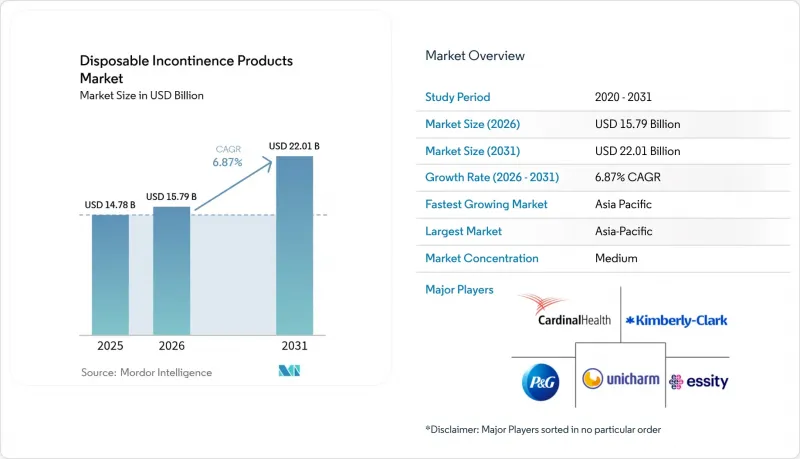
This report is Segmented by Product Type (Protective Garments [Disposable Adult Diapers, and More], Urine Bags, Urinary Catheters [Intermittent Catheters, and More]), Application (Chronic Kidney Failure, Benign Prostatic Hyperplasia, and More), End-User (Hospitals & Clinics, and More), and Geography (North America, Europe, and More). The Market Forecasts are Provided in Terms of Value (USD).
Global Disposable Incontinence Products Market Trends and Insights
Rising Prevalence of Renal & Urological Disorders
CKD afflicts 35.5 million Americans, and prevalence rises to 50.94% among people aged 90 and older in Saudi Arabia. CKD's direct link with diabetes and hypertension magnifies long-term demand for high-capacity absorbent products and catheter kits with infection-prevention coatings. Institutional purchasers now embed incontinence supplies into CKD care bundles, guaranteeing baseline order volumes that stabilize the disposable incontinence products market. Predictable chronic-care volumes allow suppliers to optimize production lines and negotiate multiyear contracts. The driver remains strongest in higher-income regions where CKD diagnostic coverage is highest, yet emerging markets are closing the gap as national health surveys expand.
Aging Population & Higher Life Expectancy
Asia-Pacific's older-adult cohort will nearly double to 1.2 billion by 2050, raising the region's incontinence case load sharply. Many seniors lack consistent health-plan coverage, so governments are directing larger budget shares to elder-care subsidies. The demographic shift pushes demand for both premium breathable diapers in urban nursing homes and affordable pull-ups in rural clinics. Manufacturers rely on forward demand visibility to plan capacity investments across China, India, and Indonesia. As family-based care models evolve into paid in-home services, subscription programs for bulk deliveries of protective garments are gaining traction, further widening the disposable incontinence products market.
Dermatitis & Infection Risks From Prolonged Product Use
The U.S. FDA continues to record adverse-event filings that associate external catheters with skin irritation and urinary-tract infections. Infection fears lower compliance among cost-conscious patients who attempt to reuse single-use items. Facilities counter by specifying breathable backing films and silver-ion coatings in tender documents, which raises product costs. Skin-friendly innovations partially offset the restraint but add complexity to regulatory submissions. The issue is more acute in tropical regions where humidity accelerates bacterial growth, pressing manufacturers to tailor product guidelines and training materials accordingly.
Other drivers and restraints analyzed in the detailed report include:
- Advances in Super-Absorbent & Breathable Nonwovens
- E-Commerce & D2C Brands Expanding Access
- Patchy Reimbursement in Emerging Economies
For complete list of drivers and restraints, kindly check the Table Of Contents.
Segment Analysis
Protective garments generated 53.10% of the disposable incontinence products market share in 2025, reflecting widespread adoption in hospitals, nursing homes, and at-home care routines. Demand is insulated from short-term economic swings because garments offer a familiar, low-training solution across mild-to-severe incontinence profiles. Innovations such as four-layer breathable panels and odor-lock gels extend wear time, thereby lowering daily change frequency for budget-tight facilities. Urinary catheters, while holding a smaller base, are advancing at a 8.98% CAGR as hydrophilic coatings reduce urethral trauma and new HCPCS reimbursement codes increase affordability. External catheter designs optimized for female anatomy are also winning regulatory clearance, opening untapped outpatient segments.
The disposable incontinence products market size for catheter solutions is forecast to rise steadily, supported by smart catheters that transmit real-time flow data to clinician dashboards. Disposable under-pads attract institutional buyers aiming to protect mattresses and wheelchairs against incidental leaks, while pull-up pants resonate with ambulatory adults seeking garment-like aesthetics. Leg urine bags gain share in home infusion programs where mobility is critical. Material upgrades in biodegradable polymers lower disposal costs, appealing to countries with landfill-tax regimes. The product-type landscape remains dynamic as cross-category hybrids-such as integrated diaper-catheter kits-enter clinical trials, promising further differentiation.
Complete Report Scope:
- By Product Type
- Protective Garments
- Disposable Adult Diapers
- Disposable Under-pads
- Disposable Pull-up Pants
- Other Garments
- Urine Bags
- Leg Urine Bags
- Bedside Urine Bags
- Urinary Catheters
- Indwelling (Foley) Catheters
- Intermittent Catheters
- External Catheters
- Protective Garments
- By Application
- Chronic Kidney Failure
- Benign Prostatic Hyperplasia (BPH)
- Bladder Cancer
- Kidney Stone
- Other Applications
- By End-User
- Hospitals & Clinics
- Long-Term Care Facilities
- Homecare Settings
- Geography
- North America
- United States
- Canada
- Mexico
- Europe
- Germany
- United Kingdom
- France
- Italy
- Spain
- Rest of Europe
- Asia-Pacific
- China
- Japan
- India
- South Korea
- Australia
- Rest of Asia-Pacific
- Middle East and Africa
- GCC
- South Africa
- Rest of Middle East and Africa
- South America
- Brazil
- Argentina
- Rest of South America
- North America
Geography Analysis
North America led the disposable incontinence products market with a 43.05% revenue share in 2025, anchored by Medicare coding stability and mature long-term-care networks. Updated HCPCS codes effective January 2025 classify hydrophilic catheters in higher-reimbursement shells, prompting hospitals to upsell advanced variants. U.S. policy also widened coverage to lymphedema compression treatment items, signaling an overall device-friendly stance. Canada's public health-insurance redesign expands home-support allowances, giving home-care suppliers greater wallet share. Mexico's Seguro Popular replacement, INSABI, is channelling new funds to state clinics, creating a multi-tiered tender landscape. Sustainability mandates such as California's SB 54, which enforces a 25% single-use plastic reduction by 2032, push brands to launch recyclable diaper wrappers that feed circular-economy pilots.
Asia-Pacific registered a 9.95% CAGR, the fastest globally, powered by population aging and higher CKD screening in China, Japan, and South Korea. China's device makers are leveraging cost advantages to court Latin American buyers, exporting both pull-ups and catheter kits under CE-mark equivalency. Indonesia's domestic factories benefit from government grants tied to local-content rules, supplying lower-priced diapers to public hospitals while premium imports capture the private-hospital tier. India's e-pharmacies have started stocking discrete male guards and female pads, accelerating D2C penetration and adding volume to the disposable incontinence products market. Australia's National Disability Insurance Scheme further boosts uptake of reusable pelvic-floor trainers that complement single-use absorbents.
Europe remains a mature yet evolving arena where the EU Packaging and Packaging Waste Regulation mandates fully recyclable packaging by 2030 and a 5% plastic-waste reduction by the same year. Manufacturers must balance sustainability upgrades with strict Medical Device Regulation (MDR) documentation that now covers reprocessed single-use devices. Germany leads volume consumption, yet France's eco-tax credits tilt purchasing toward compostable liners. The United Kingdom's NHS Supply Chain is piloting outcome-based contracts that tie reimbursements to dermatitis reduction metrics, potentially reshaping supplier scorecards. Nordic countries, already leaders in recyclable diaper adoption, offer case studies that other EU states may emulate, further influencing the disposable incontinence products market trajectory.
- Becton, Dickinson & Co. (C.R. Bard)
- Cardinal Health
- Coloplast
- Kimberly-Clark Worldwide
- Abena
- Hollister
- Convatec
- First Quality Enterprises
- HARTMANN Group
- Medline Industries
- Essity
- Procter & Gamble
- Unicharm Corp.
- Teleflex
- B. Braun
- Boston Scientific
- Ontex Group
- TZMO SA
- Principle Business Enterprises
Additional Benefits:
- The market estimate (ME) sheet in Excel format
- 3 months of analyst support
TABLE OF CONTENTS
1 Introduction
- 1.1 Study Assumptions & Market Definition
- 1.2 Scope of the Study
2 Research Methodology
3 Executive Summary
4 Market Landscape
- 4.1 Market Overview
- 4.2 Market Drivers
- 4.2.1 Rising Prevalence Of Renal & Urological Disorders
- 4.2.2 Aging Population & Higher Life Expectancy
- 4.2.3 Advances In Super-Absorbent & Breathable Nonwovens
- 4.2.4 E-Commerce & D2C Brands Expanding Access
- 4.2.5 2026 HCPCS Codes For Hydrophilic Catheters (Reimbursement Boost)
- 4.2.6 Adoption Of AI-Enabled Smart Diapers In Long-Term Care
- 4.3 Market Restraints
- 4.3.1 Dermatitis & Infection Risks From Prolonged Product Use
- 4.3.2 Patchy Reimbursement In Emerging Economies
- 4.3.3 Sustainability Regulations On Single-Use Plastics & Landfill Waste
- 4.3.4 Shift Toward Reusable Pelvic-Floor Wearables & Stimulation Devices
- 4.4 Porter's Five Forces
- 4.4.1 Threat of New Entrants
- 4.4.2 Bargaining Power of Buyers
- 4.4.3 Bargaining Power of Suppliers
- 4.4.4 Threat of Substitutes
- 4.4.5 Intensity of Competitive Rivalry
5 Market Size & Growth Forecasts (Value, USD)
- 5.1 By Product Type
- 5.1.1 Protective Garments
- 5.1.1.1 Disposable Adult Diapers
- 5.1.1.2 Disposable Under-pads
- 5.1.1.3 Disposable Pull-up Pants
- 5.1.1.4 Other Garments
- 5.1.2 Urine Bags
- 5.1.2.1 Leg Urine Bags
- 5.1.2.2 Bedside Urine Bags
- 5.1.3 Urinary Catheters
- 5.1.3.1 Indwelling (Foley) Catheters
- 5.1.3.2 Intermittent Catheters
- 5.1.3.3 External Catheters
- 5.1.1 Protective Garments
- 5.2 By Application
- 5.2.1 Chronic Kidney Failure
- 5.2.2 Benign Prostatic Hyperplasia (BPH)
- 5.2.3 Bladder Cancer
- 5.2.4 Kidney Stone
- 5.2.5 Other Applications
- 5.3 By End-User
- 5.3.1 Hospitals & Clinics
- 5.3.2 Long-Term Care Facilities
- 5.3.3 Homecare Settings
- 5.4 Geography
- 5.4.1 North America
- 5.4.1.1 United States
- 5.4.1.2 Canada
- 5.4.1.3 Mexico
- 5.4.2 Europe
- 5.4.2.1 Germany
- 5.4.2.2 United Kingdom
- 5.4.2.3 France
- 5.4.2.4 Italy
- 5.4.2.5 Spain
- 5.4.2.6 Rest of Europe
- 5.4.3 Asia-Pacific
- 5.4.3.1 China
- 5.4.3.2 Japan
- 5.4.3.3 India
- 5.4.3.4 South Korea
- 5.4.3.5 Australia
- 5.4.3.6 Rest of Asia-Pacific
- 5.4.4 Middle East and Africa
- 5.4.4.1 GCC
- 5.4.4.2 South Africa
- 5.4.4.3 Rest of Middle East and Africa
- 5.4.5 South America
- 5.4.5.1 Brazil
- 5.4.5.2 Argentina
- 5.4.5.3 Rest of South America
- 5.4.1 North America
6 Competitive Landscape
- 6.1 Market Concentration
- 6.2 Market Share Analysis
- 6.3 Company Profiles (includes Global level Overview, Market level overview, Core Segments, Financials as available, Strategic Information, Market Rank/Share for key companies, Products & Services, and Recent Developments)
- 6.3.1 Becton, Dickinson & Co. (C.R. Bard)
- 6.3.2 Cardinal Health
- 6.3.3 Coloplast
- 6.3.4 Kimberly-Clark
- 6.3.5 Abena
- 6.3.6 Hollister
- 6.3.7 ConvaTec
- 6.3.8 First Quality Enterprises
- 6.3.9 HARTMANN Group
- 6.3.10 Medline Industries
- 6.3.11 Essity
- 6.3.12 Procter & Gamble
- 6.3.13 Unicharm Corp.
- 6.3.14 Teleflex Inc.
- 6.3.15 B. Braun Melsungen AG
- 6.3.16 Boston Scientific
- 6.3.17 Ontex Group
- 6.3.18 TZMO SA
- 6.3.19 Principle Business Enterprises
7 Market Opportunities & Future Outlook
- 7.1 White-space & Unmet-Need Assessment