|
시장보고서
상품코드
2122495
외골격 : 시장 점유율 분석, 업계 동향 및 통계, 성장 예측(2026-2031년)Exoskeleton - Market Share Analysis, Industry Trends & Statistics, Growth Forecasts (2026 - 2031) |
||||||
 Mordor Intelligence
Mordor Intelligence에 의하면, 외골격 시장 규모는 2025년에 7억 3,000만 달러로 평가되었습니다. 2026년 9억 2,000만 달러에서 2031년까지 23억 5,000만 달러에 이를 것으로 예상되며, 예측 기간(2026-2031년) CAGR은 20.63%를 나타낼 전망입니다.

본 보고서는 이동 형태별(하반신, 상반신, 전신, 특정 관절·요부 시스템), 동력원·구동 방식별(동력식·능동식, 수동식, 하이브리드, 소프트 엑소슈트), 신체 부위별(상지, 하지, 전신),최종 사용자별(병원·재활센터, 기타), 지역별(북미, 유럽, 아시아태평양, 중동 및 아프리카, 남미)로 분류되어 있습니다. 시장 예측은 금액(달러)으로 표시되어 있습니다.
세계의 외골격 시장 동향 및 인사이트
고령화와 신경 질환 유병률 상승에 따른 재활 수요 증가
세계적으로 60세 이상 고령 인구는 2050년까지 21억 명으로 두 배 증가할 것이며, 뇌졸중, 파킨슨병, 척수 손상의 발생률이 더욱 높아질 것으로 예측됩니다. 일본에서는 로봇을 이용한 보행 요법을 통해 뇌졸중 후 평균 입원 기간이 14일 단축되었습니다는 데이터가 제시됨에 따라, 정책 입안자들은 2024년에 사이버다인(Cyberdyne)사의 HAL에 대한 보험 적용 범위를 확대했습니다. 이와 유사한 근거가 유럽 보험사들의 시범 사업에도 반영되어 있으며, 성과 연계형 계약이 재활 기기의 표준 조달 방식이 될 것임을 시사하고 있습니다. FDA의 510(k) 승인 및 ISO 13482 준수는 현재 미국과 유럽연합(EU)의 의료기관 도입을 위한 기본 요건으로 자리 잡고 있습니다. 이러한 동향은 직립 보행 능력 회복, 욕창 위험 감소, 골밀도 유지를 실현하는 하지용 시스템에 대한 지속적인 수요를 부각시키고 있습니다.
산업 부문에서의 도입을 뒷받침하는 산업 안전 규제
2024년에 시행된 OSHA(미국 직업안전보건청)의 개정 지침에 따라, 미국의 고용주는 머리 위 작업과 10kg을 초과하는 하중에 대해 감사를 실시해야 할 의무가 있으며, 이로 인해 어깨 지지 장치 도입에 대한 규제적 인센티브가 발생하고 있습니다. 독일 연방 산업안전보건연구소의 보고서에 따르면, 근로자가 수동형 엑소스켈레톤을 사용했을 때 삼각근의 근전도(EMG)가 30-40% 감소한 것으로 밝혀졌으며, 이에 따라 자동차 제조업체들은 용접, 도장, 조립 공장 전반으로 도입을 확대되고 있습니다. 근골격계 장애로 인한 보험금 청구 감소에 따라 보험료도 낮아지고 있어, 각 공장에서는 상반신용 웨어러블 기기에 대해 두 자릿수의 내부 수익률을 실현하고 있습니다.
높은 자본 비용과 제한된 상환액
임상용 외골격 장치의 정가는 8만-15만 달러이며, 구매는 대학병원이나 대형 재활 체인에 한정되어 있습니다. 미국 메디케어에서는 기존 물리치료가 효과를 보이지 않았음을 증명하는 서류와 의사가 30분간 서 있는 것을 견딜 수 있음을 증명해야 하는데, 이로 인해 잠재적 이용 대상자의 거의 절반이 대상에서 제외되고 있습니다. 민간 보험사는 가정용 모델을 ‘임상시험용’으로 분류하고 있어, FDA 승인을 받았음에도 불구하고 많은 환자가 본인 부담금을 지불해야 하는 상황에 처해 있습니다. 독일에서는 DRG 코드에 따라 병원 내 세션에 대한 보험 급여가 이루어지고 있지만, 개인용 기기에 대한 급여는 인정되지 않고 있으며, 반면 이탈리아와 프랑스에서는 아직 결제 경로가 확립되지 않고 있습니다. 이러한 불일치는 고성장을 이루고 있는 재택 간호 부문에서의 보급을 저해하고 있으며, 실제 환경에서의 결과 데이터와 연계된 종합적 결제 방식의 시범 사업 도입을 요구하는 목소리가 높아지고 있습니다.
부문별 분석
2025년, 하체용 장치는 외골격 시장 점유율의 87.81%를 차지했습니다. 이는 보행 훈련 프로토콜이 프로그래밍 가능한 무릎 및 고관절 보조 기능에 의존하는 뇌졸중 및 척수 손상 재활 부문에서 그 사용이 정착되었음을 반영합니다. 이러한 장치는 재활센터와 재향군인 병원에서 안정적인 교체 수요를 창출하고 있습니다. 대조적으로, 상체용 시스템은 자동차 제조업체와 항공우주 산업의 주요 기업들이 생산성 저하 및 손해배상 청구로 인해 연간 10억 달러를 초과하던 어깨 부상으로 인한 비용을 해결하기 위해 조립 라인에 도입을 가속화함에 따라 연평균 성장률(CAGR) 24.06%를 기록했습니다. 공장 내 실증 실험에서는 앞유리 고정이나 날개에 구멍 뚫기 같은 작업에서 처리량이 15-20% 향상되는 것이 확인되어, 투자 회수 기간이 매우 짧다는 사실이 입증되었습니다. 이러한 두 가지 전략적 전개에 힘입어, 하지용 장치는 임상 부문의 수익을 견인하는 한편, 상반신용 장치는 산업 부문의 수익을 확대하여 공급업체의 수주 포트폴리오 다각화를 촉진하고 있습니다.
상반신용 장치의 발전은 현재 미국과 EU의 인증 감사에서 일반적으로 요구되는 인체공학적 요건과 부합합니다. 무게 3kg 이하의 경량 패시브 브레이스는 교대 근무 시 즉시 착용할 수 있다는 점에서 호평을 받고 있는 반면, 전동식 어깨 유닛은 높은 피크 토크와 예측 유지보수용 원격 측정 기술을 결합함으로써 서비스 계약을 통한 정기적인 수익 흐름을 강화하고 있습니다. 전신형 외골격은 90kg의 하역 수요가 있는 중공업 사용자용 틈새 시장에 국한되어 있지만, 특정 관절을 지지하는 허리 지지대는 사상 최대의 소포 처리량을 겪고 있는 전자상거래 물류 센터에서 보급이 확대되고 있습니다.
2025년에는 외골격 시장 규모의 82.83%를 동력식 아키텍처가 차지했으며, 이는 치료적 보행 제어 및 군인의 부하 경감에 필수적입니다. 클리닉에서는 브러쉬리스 DC 모터와 하모닉 드라이브를 결합하여 50밀리초 이하의 지연으로 40Nm의 무릎 토크를 발생시키고 있으며, 이는 신경 가소성 재활에 필수적입니다. 스프링이나 캠을 기반으로 하는 패시브 프레임은 충전이 필요 없고 유지보수도 최소화되어 있어, 공장에서의 머리 위 작업에 탁월합니다. 하이브리드형은 수동적인 하중 분산과 강력한 모터의 순간 출력을 통합하여 가동 시간을 8-10시간으로 연장하고, OSHA가 정한 교대 근무 블록을 준수합니다. 그 결과, 하이브리드형은 연평균 성장률(CAGR) 27.77%를 기록하며 성장하고 있으며, 이미 자동차 산업의 인체공학 전문가들로부터 새로운 제안 요청을 휩쓸고 있습니다.
배터리를 많이 사용하는 동력식 모델은 여전히 IEC 60601에 따른 규제 부담을 안고 있지만, 패시브 프레임은 많은 의료기기 규제의 적용 대상에서 제외되어 있습니다. 각 벤더들은 현재 사용자의 보행 데이터를 기반으로 보조 곡선을 조정하는 펌웨어를 홍보하며, 하이브리드 외골격을 무선 업데이트를 통해 성능이 향상되는 ‘소프트웨어 정의 자산’으로 포지셔닝하고 있습니다. 이 전략은 지속적인 수익을 창출하는 번들 상품에 초점을 맞추고 있으며, 기존 판매 방식을 뛰어넘는 구독 모델의 도약을 뒷받침하고 있습니다. 에너지 밀도가 향상됨에 따라, 토크 대 와트 비율의 최적화를 극대화한 공급업체는 타사와의 차별화를 꾀하며, 데이터가 점점 더 풍부해지는 밸류체인에서 시장 점유율을 공고히할 것으로 보입니다.
지역별 분석
2025년, 북미는 외골격 시장 점유율의 40.65%를 차지했습니다. 이는 FDA 승인을 받은 제품 포트폴리오와 내구성 의료장비 공급업체의 견고한 유통 네트워크에 힘입은 결과입니다. 미국은 케슬러(Kessler)나 셰퍼드(Shepherd)와 같은 의료 센터에서의 임상 도입을 주도하고 있으며, 이곳에서는 실제 데이터에 기반하여 보험사가 규정을 제정하고 있습니다. OSHA(미국 직업안전보건청)의 2024년 인체공학 평가 지침은 디트로이트에서 시애틀에 이르는 공장 내 시범 도입을 촉진하고 있으며, EHS(환경·보건·안전) 규정 준수 예산이 외골격 임대 비용으로 전환되고 있습니다. 캐나다는 주별 예산 상한선으로 인해 뒤처지고 있는 반면, 멕시코의 미성숙한 시장에서는 보상 확대를 위한 사회보장법 개정이 기대되고 있습니다.
아시아태평양은 2031년까지 연평균 성장률(CAGR) 26.87%로 가장 빠른 성장을 기록하고 있으며, 그 원동력은 중국 내 60세 이상 인구 2억 9,700만 명과 주민의 29%가 65세 이상인 일본의 초고령화 사회입니다. 중국 본토의 병원들은 ‘건강 중국 2030’의 보조금을 활용하여 보행 치료용 로봇을 발주하고 있는 반면, 일본의 국민건강보험에서는 현재 8가지 신경근 질환의 적응증에 대해 HAL의 비용이 환급되고 있습니다. 한국의 500억 원 규모의 로봇 기금은 부품 원가를 절감할 수 있는 국내 액추에이터 제조 공장을 육성하고 있습니다. 호주는 국가 장애인 보험 제도를 활용하여 시범 사업에 보조금을 제공하고 있으며, 인도는 방대한 뇌졸중 환자층을 위해 저가형 기기를 조립하기 위해 외국인 직접 투자(FDI)를 유치하고 있습니다.
유럽에서는 여전히 양극화가 나타나고 있습니다. 독일, 프랑스, 영국에서는 새로운 인체공학 지침에 따라 대규모 산업 시범 사업이 실시되고 있으며, DRG 코드를 통해 CE 마크가 부착된 재활 기기가 조달되고 있습니다. 반면, 남유럽 국가들에서는 환급 제도가 세분화되어 있어 설비 투자 계획 수립이 저해되고 있으며, MDR로의 전환 일정이 수입업체의 자원을 압박하고 있어 도입이 지연되고 있습니다. 스칸디나비아 국가들에서는 지방의 노인 간병을 위해 소프트 슈트에 대한 보조금 제도를 시범 운영 중이며, 동유럽 국가들에서는 EU의 결속 기금을 활용하여 뇌졸중 재활 체제 확충에 주력하고 있습니다. 아랍에미리트(UAE)나 사우디아라비아와 같은 중동의 의료 허브에서는 모델 병원을 위해 최첨단 장비가 도입되고 있습니다. 반면, 아프리카와 남미에서는 상파울루와 리우데자네이루에서 진행 중인 브라질의 시범 프로젝트를 제외하고는 도입이 제한적입니다. 이러한 프로젝트는 관세 제도와 환율 변동의 영향을 받고 있습니다.
기타 혜택
- 엑셀 형식 시장 예측(ME) 시트
- 3개월간의 애널리스트 지원
자주 묻는 질문
목차
제1장 서론
제2장 조사 방법
제3장 주요 요약
제4장 시장 구도
제5장 시장 규모 및 성장 예측
제6장 경쟁 구도
제7장 시장 기회 및 향후 전망
KTH 26.09.08According to Mordor Intelligence, the exoskeleton market size was valued at USD 0.73 billion in 2025 and is estimated to grow from USD 0.92 billion in 2026 to reach USD 2.35 billion by 2031, at a CAGR of 20.63% during the forecast period (2026-2031).
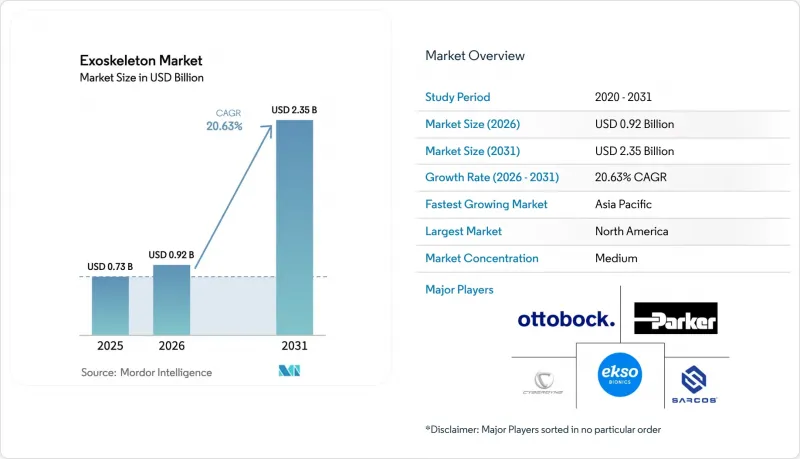
This report is Segmented by Mobility Type (Lower-Body, Upper-Body, Full-Body, Joint-Specific/Waist Systems), Power Source/Mode (Powered/Active, Passive, Hybrid, Soft Exosuits), Body Part (Upper Limb, Lower Limb, Full Body), End User (Hospitals & Rehab Centers, and More), and Geography (North America, Europe, Asia-Pacific, Middle East & Africa, South America). Market Forecasts are Provided in Terms of Value (USD).
Global Exoskeleton Market Trends and Insights
Aging Population & Neurological-Disorder Prevalence Boosting Rehab Demand
Worldwide, the cohort aged 60 and above will double to 2.1 billion by 2050, intensifying the incidence of stroke, Parkinson's disease, and spinal-cord injury. Japanese policymakers widened coverage for Cyberdyne's HAL in 2024 after data showed that robotic gait therapy shortened the average post-stroke hospital stay by 14 days. Similar evidence is informing European payer pilots, signaling that outcome-based contracts will become the default procurement method for rehabilitation devices. FDA 510(k) clearances and ISO 13482 compliance now serve as baseline requirements for clinic adoption in the United States and the European Union. Together, these trends highlight the enduring demand for lower-limb systems that restore upright mobility, mitigate pressure ulcer risk, and maintain bone density.
Work-Safety Regulations Spurring Industrial Adoption
Revised OSHA guidelines, effective in 2024, oblige U.S. employers to audit overhead tasks and loads above 10 kg, creating a regulatory incentive for shoulder-support rigs. Germany's Federal Institute for Occupational Safety and Health reported 30-40% reductions in deltoid EMG when workers used passive exoskeletons, prompting automakers to extend deployments across weld, paint, and assembly shops. As insurance premiums fall alongside musculoskeletal disorder claims, factories capitalize on double-digit internal rate of return metrics for upper-body wearables.
High Capital Cost & Limited Reimbursement
Clinic-grade exoskeletons list at USD 80,000-150,000, restricting purchases to academic medical centers or flagship rehabilitation chains. U.S. Medicare requires documented failure of conventional physiotherapy and physician attestation of 30-minute upright tolerance, disqualifying nearly half of potential candidates. Private insurers label take-home models "investigational," compelling many patients to self-fund despite FDA clearance. Germany reimburses hospital sessions under DRG codes, but refuses to reimburse personal devices, while Italy and France have yet to establish payment pathways. The mismatch depresses adoption in the high-growth home-care segment and reinforces calls for bundled-payment pilots tied to real-world outcome data.
Other drivers and restraints analyzed in the detailed report include:
- Defense Budgets Accelerating Soldier-Augmentation R&D
- Emergence of Mid-Priced Consumer/Outdoor Exosuits Enlarges TAM
- Battery-Energy Density Limits Field Endurance
For complete list of drivers and restraints, kindly check the Table Of Contents.
Segment Analysis
Lower-body rigs held an 87.81% exoskeleton market share in 2025, reflecting their entrenched use in stroke and spinal cord injury rehabilitation, where gait training protocols depend on programmable knee and hip assistance. These units generate steady replacement demand from rehabilitation centers and veterans' hospitals. In contrast, upper-body systems experienced faster adoption in assembly lines, with a 24.06% CAGR, as automakers and aerospace primes addressed shoulder-injury costs that previously exceeded USD 1 billion annually in lost productivity and compensation claims. Factory pilots validate throughput gains of 15-20% in tasks such as windshield fastening and wing drilling, confirming immediate payback periods. The dual-track dynamic positions lower-limb rigs to dominate clinical revenues while upper-body devices expand industrial revenues and diversify supplier order books.
Upper-body progress aligns with ergonomic mandates now commonly found in U.S. and EU certification audits. Light passive braces weighing under 3 kg win favor for their drop-in compatibility with shift changes, whereas powered shoulder units combine high-peak torque with predictive-maintenance telemetry that reinforces service-contract annuity streams. Full-body exoskeletons remain a niche market for heavy-industry users with handling demands of 90 kg, and joint-specific waist supports are gaining traction in e-commerce distribution centers that face record parcel volumes.
Powered architectures commanded 82.83% of the exoskeleton market size in 2025, necessary for therapeutic gait modulation and soldier-load reduction. Clinics rely on brushless DC motors paired with harmonic drives to deliver 40 Nm of knee torque with sub-50 ms latency, which is vital for neuroplastic rehabilitation. Passive frames, built on springs and cams, excel in overhead factory tasks due to their zero recharge requirements and minimal maintenance. Hybrids integrate passive load-sharing with bright motor bursts, lifting runtime to 8-10 hours and aligning with OSHA-defined shift blocks. Consequently, hybrids are growing at 27.77% CAGR and already dominate new proposal requests from automotive ergonomists.
Battery-intensive powered models still bear regulatory burdens under IEC 60601, while passive frames fall outside many medical device regimes. Vendors now tout firmware that tunes assist curves to user gait data, positioning hybrid exoskeletons as software-defined assets whose performance improves via over-the-air updates. The strategy focuses on recurring-revenue bundles and underpins the subscription leap beyond traditional sales. Suppliers that master torque-to-watt optimization will differentiate themselves as energy density increases, consolidating their share in an increasingly data-rich value chain.
Complete Report Scope:
- By Mobility Type
- Lower-Body Exoskeletons
- Upper-Body Exoskeletons
- Full-Body Exoskeletons
- Joint-Specific / Waist Systems
- By Power Source / Mode
- Powered / Active
- Passive
- Hybrid
- Soft Exosuits
- By Body Part
- Upper Limb
- Lower Limb
- Full Body
- By End User
- Hospitals & Rehab Centers
- Personal / Home-care Users
- Other End Users
- By Geography
- North America
- United States
- Canada
- Mexico
- Europe
- Germany
- United Kingdom
- France
- Italy
- Spain
- Rest of Europe
- Asia-Pacific
- China
- Japan
- India
- Australia
- South Korea
- Rest of Asia-Pacific
- Middle East & Africa
- GCC
- South Africa
- Rest of Middle East & Africa
- South America
- Brazil
- Argentina
- Rest of South America
- North America
Geography Analysis
North America accounted for 40.65% of the exoskeleton market share in 2025, driven by FDA-cleared product portfolios and a robust distribution network of durable medical equipment suppliers. The United States leads clinical deployments at centers such as Kessler and Shepherd, where real-world evidence informs payer rule-making. OSHA's 2024 ergonomic assessment directive is catalyzing factory pilots from Detroit to Seattle, converting EHS compliance budgets into exoskeleton leases. Canada lags due to provincial budget ceilings, whereas Mexico's nascent market awaits revisions to its social security code to spur reimbursement.
Asia Pacific registers the fastest growth at a 26.87% CAGR through 2031, propelled by China's 297 million citizens aged 60+ and Japan's super-aged demographic, where 29% of residents exceed 65 years. Mainland hospitals tap Healthy China 2030 subsidies to order gait-therapy robots, while Japan's national insurance now reimburses HAL for eight neuromuscular indications. South Korea's KRW 50 billion robotics fund is nurturing domestic actuator plants that lower bill-of-materials costs. Australia leverages its National Disability Insurance Scheme for pilot grants, and India courts FDI to assemble budget devices for a vast stroke population.
Europe remains bifurcated. Germany, France, and the United Kingdom undertake large-scale industrial pilots under fresh ergonomic directives and secure CE-marked rehab units through DRG codes. Southern Europe lags because fragmented reimbursement hinders capital expenditure planning, and MDR transition timelines strain importer resources. Scandinavia experiments with soft-suit subsidies for rural eldercare, while Eastern Europe focuses EU cohesion funds on stroke rehab capacity. Middle East healthcare hubs in the UAE and Saudi Arabia procure flagship units for showcase hospitals. Still, Africa and South America exhibit limited uptake beyond Brazil's pilot projects in Sao Paulo and Rio, which are constrained by tariff regimes and currency fluctuations.
- B-Temia
- BIONIK Laboratories Corp.
- Bioness Inc. (Bioventus)
- Bioservo Technologies
- CYBERDYNE Inc.
- Ekso Bionics
- Fourier Intelligence
- Gogoa Mobility Robots
- Lockheed Martin Corporation
- Myomo Inc.
- Ottobock
- Panasonic Corporation
- Parker Hannifin
- RB3D SAS
- ReWalk Robotics
- Rehab-Robotics Co. Ltd.
- Sarcos Technology & Robotics Corporation
- Seismic Powered Clothing
- Wearable Robotics SRL
Additional Benefits:
- The market estimate (ME) sheet in Excel format
- 3 months of analyst support
TABLE OF CONTENTS
1 Introduction
- 1.1 Study Assumptions & Market Definition
- 1.2 Scope of the Study
2 Research Methodology
3 Executive Summary
4 Market Landscape
- 4.1 Market Overview
- 4.2 Market Drivers
- 4.2.1 Aging Population & Neurological-Disorder Prevalence Boosting Rehab Demand
- 4.2.2 Work-Safety Regulations Spurring Industrial Adoption
- 4.2.3 Defense Budgets Accelerating Soldier-Augmentation R&D
- 4.2.4 Emergence of Mid-Priced Consumer/Outdoor Exosuits Enlarges TAM
- 4.2.5 Subscription "Exoskeleton-As-A-Service" Lowers SME Entry Barriers
- 4.2.6 Cloud-Based Outcome Analytics Enabling Value-Based Rehab Payments
- 4.3 Market Restraints
- 4.3.1 High Capital Cost & Limited Reimbursement
- 4.3.2 Battery-Energy Density Limits Field Endurance
- 4.3.3 Absence of Ergonomic Test Standards Creates Liability Concerns
- 4.3.4 Tariff-Driven Actuator-Component Cost Volatility Squeezes Margins
- 4.4 Value / Supply-Chain Analysis
- 4.5 Regulatory Landscape
- 4.6 Technological Outlook
- 4.7 Porter's Five Forces Analysis
- 4.7.1 Threat of New Entrants
- 4.7.2 Bargaining Power of Buyers
- 4.7.3 Bargaining Power of Suppliers
- 4.7.4 Threat of Substitutes
- 4.7.5 Competitive Rivalry
5 Market Size & Growth Forecasts
- 5.1 By Mobility Type
- 5.1.1 Lower-Body Exoskeletons
- 5.1.2 Upper-Body Exoskeletons
- 5.1.3 Full-Body Exoskeletons
- 5.1.4 Joint-Specific / Waist Systems
- 5.2 By Power Source / Mode
- 5.2.1 Powered / Active
- 5.2.2 Passive
- 5.2.3 Hybrid
- 5.2.4 Soft Exosuits
- 5.3 By Body Part
- 5.3.1 Upper Limb
- 5.3.2 Lower Limb
- 5.3.3 Full Body
- 5.4 By End User
- 5.4.1 Hospitals & Rehab Centers
- 5.4.2 Personal / Home-care Users
- 5.4.3 Other End Users
- 5.5 By Geography
- 5.5.1 North America
- 5.5.1.1 United States
- 5.5.1.2 Canada
- 5.5.1.3 Mexico
- 5.5.2 Europe
- 5.5.2.1 Germany
- 5.5.2.2 United Kingdom
- 5.5.2.3 France
- 5.5.2.4 Italy
- 5.5.2.5 Spain
- 5.5.2.6 Rest of Europe
- 5.5.3 Asia-Pacific
- 5.5.3.1 China
- 5.5.3.2 Japan
- 5.5.3.3 India
- 5.5.3.4 Australia
- 5.5.3.5 South Korea
- 5.5.3.6 Rest of Asia-Pacific
- 5.5.4 Middle East & Africa
- 5.5.4.1 GCC
- 5.5.4.2 South Africa
- 5.5.4.3 Rest of Middle East & Africa
- 5.5.5 South America
- 5.5.5.1 Brazil
- 5.5.5.2 Argentina
- 5.5.5.3 Rest of South America
- 5.5.1 North America
6 Competitive Landscape
- 6.1 Market Concentration
- 6.2 Market Share Analysis
- 6.3 Company Profiles (includes Global level Overview, Market-level Overview, Core Segments, Financials, Strategic Information, Market Rank/Share, Products & Services, Recent Developments)
- 6.3.1 B-Temia Inc.
- 6.3.2 BIONIK Laboratories Corp.
- 6.3.3 Bioness Inc. (Bioventus)
- 6.3.4 Bioservo Technologies AB
- 6.3.5 CYBERDYNE Inc.
- 6.3.6 Ekso Bionics Holdings Inc.
- 6.3.7 Fourier Intelligence
- 6.3.8 Gogoa Mobility Robots
- 6.3.9 Lockheed Martin Corporation
- 6.3.10 Myomo Inc.
- 6.3.11 Ottobock SE & Co. KGaA
- 6.3.12 Panasonic Corporation
- 6.3.13 Parker Hannifin Corporation
- 6.3.14 RB3D SAS
- 6.3.15 ReWalk Robotics Ltd.
- 6.3.16 Rehab-Robotics Co. Ltd.
- 6.3.17 Sarcos Technology & Robotics Corporation
- 6.3.18 Seismic Powered Clothing
- 6.3.19 Wearable Robotics SRL
7 Market Opportunities & Future Outlook
- 7.1 White-space & Unmet-need Assessment