|
시장보고서
상품코드
2122511
모바일 마케팅 : 시장 점유율 분석, 업계 동향 및 통계, 성장 예측(2026-2031년)Mobile Marketing - Market Share Analysis, Industry Trends & Statistics, Growth Forecasts (2026 - 2031) |
||||||
 Mordor Intelligence
Mordor Intelligence에 의하면, 모바일 마케팅 시장 규모는 2025년 259억 달러로 평가되었습니다. 2026년에는 303억 달러로 확대되어 2026년부터 2031년에 걸쳐 CAGR 16.98%로 성장을 지속하여, 2031년에는 663억 1,000만 달러에 이를 것으로 예측됩니다.

본 보고서는 구성 요소(플랫폼, 서비스), 솔루션 유형(모바일 웹, SMS 및 MMS 등), 유통 채널(소셜 미디어 마케팅, 제휴 마케팅 등), 기업 규모(대기업, 중소기업), 배포 방식(클라우드, On-Premise), 최종 사용자 산업(소매 및 전자상거래, 미디어 및 엔터테인먼트/OTT), 지역별로 분류되어 있습니다. 시장 예측은 금액(달러) 기준으로 제시되어 있습니다.
세계의 모바일 마케팅 시장 동향 및 인사이트
북미에서는 개인정보 보호를 고려한 식별자 프레임워크의 도입으로 앱 내 수익이 증가하고 있습니다.
미국의 주요 퍼블리셔에서는 서버 측 이벤트 수집과 동의 기반 디바이스 토큰이 브라우저 수준의 쿠키를 대체하고 있습니다. 이러한 프레임워크를 도입한 브랜드에서는 매칭률이 두 자릿수 개선되었으며, 주 차원의 개인정보 보호 규제 요건을 충족하면서도 보다 상세한 세분화가 가능해졌다고 보고되고 있습니다. 또한, 동일한 메커니즘을 통해 규정 준수 보고가 자동화되므로 재무 부서는 개인정보 보호 대책 강화를 기술 투자로 활용할 수 있게 됩니다. 그 결과, 마케팅 부서와 리스크 관리 부서는 공통 지표를 기반으로 협력하며, 규제가 강화되더라도 광고주는 개인화된 접근 방식을 유지할 수 있습니다. 이러한 성과는 규정 준수를 충족하는 신원 확인 솔루션이 단순한 비용 센터가 아니라 성장 가속화 요인으로 자리 잡고 있음을 입증합니다.
아시아 도시 지역에서 초저지연 캠페인을 가능하게 하는 5G 확산
현재 상용 5G 네트워크는 아시아의 주요 도시 대부분을 커버하고 있으며, 모바일 동영상의 평균 로딩 시간은 100밀리초를 훨씬 밑돌고 있습니다. 이에 발맞추어 마케터들은 사용자가 자신의 환경에 상품을 가상으로 배치한 후 원터치로 결제할 수 있는 인터랙티브 증강현실(AR)을 활용한 제품 데모를 전개하고 있습니다. 2024년 서울에서 열린 게임 박람회에서 네트워크 에지에서 실행된 실시간 A/B 테스트 결과, 4G 환경에서 동일한 크리에이티브를 사용했을 때와 비교해 이탈률이 25% 가까이 감소했습니다. 이 사례는 대역폭이 단순한 전송 환경 개선에 그치지 않고, 몰입감 있는 스토리텔링을 촉진하는 ‘크리에이티브 캔버스’로서 기능함을 보여줍니다. 5G 보급이 진행됨에 따라 모바일 마케팅 시장에서는 더욱 풍부한 자산 형식과 더 높은 전환 효율이 기대됩니다.
쿠키 없는 환경으로의 전환 방침이 전 세계 앱 간 어트리뷰션에 혼란을 야기하고 있습니다.
주요 브라우저에서 써드파티 쿠키가 사라지고 크로스 디바이스 그래프가 축소되는 가운데, 마케터들은 확률론적 측정 및 증분 효과 실험으로 전환해야 하는 상황에 직면해 있습니다. 사용자 수준 보고서에 의존하던 재무 담당자들은 현재 인과관계의 기여도에 초점을 맞춘 리프트 기반 대시보드를 활용하고 있습니다. 학습 주기는 길어지고 있지만, 확률론적 신호는 개인정보 보호 관련 변동에 대한 내성이 있어 예산 배분은 점차 안정화되고 있습니다. 퍼포먼스 마케팅 담당자들은 단기적인 마찰에 직면하고 있지만, 이러한 전환은 궁극적으로 더 탄력적인 계획 프로세스를 만들어내고, 향후 규제 변동으로부터 모바일 마케팅 시장을 보호하게 될 것입니다.
부문별 분석
플랫폼 소프트웨어는 2025년 매출의 66.20%를 차지하며, 모바일 마케팅 시장 운영의 핵심으로서의 입지를 공고히 했습니다. 각 벤더사는 로우코드(low-code) 여정 빌더와 개인정보 보호 대시보드를 통합하고 있으며, 이를 통해 브랜드 팀은 엔지니어링 팀의 지원 없이도 거의 실시간으로 규칙을 테스트할 수 있게 되었습니다. 서비스 부문은 규모는 작지만, 기업들이 클린룸 도입, 크리에이티브 자동화, 지역별 규제에 대한 지침을 요구함에 따라 더욱 빠르게 확장되고 있습니다. 자문 업무는 미디어 아비트라지에서 기술 지원으로 중심을 옮기며, 새로운 수익원을 개척하는 동시에 밸류체인 전반에 걸친 가치 창출의 균형을 재조정하고 있습니다. 예측 기간 동안 소프트웨어 업그레이드가 고객 유지를 뒷받침하고, 서비스 계약이 고객 락인을 심화시킬 것입니다.
또한 기술 서비스는 광고주와 퍼블리셔 간의 복잡한 데이터 공유 계약을 중개하는 역할도 수행하며, 동의 기반 식별자의 도입을 원활하게 진행하고 있습니다. 기술과 전문 지식이라는 이 두 가지 요구 사항 덕분에 하이브리드형 제공업체는 더 큰 지갑 점유율을 확보할 수 있는 위치에 있습니다. 그 결과, 소프트웨어가 점유율 1위를 유지하는 한편, 구성 서비스와 연계된 모바일 마케팅 시장 규모는 시장 전체의 성장률을 웃도는 속도로 확대될 것으로 예측됩니다.
위치 인텔리전스는 모바일 마케팅 시장 규모의 10% 중반을 차지하고 있으며, 연평균 성장률(CAGR) 21.3%로 성장하여 2031년까지 다른 솔루션군을 능가할 전망입니다. 강화된 기술 스택은 GPS, 블루투스 비콘, 실내 Wi-Fi를 융합하여 1미터 미만의 정확도로 쇼핑객의 체류 구역을 파악합니다. 이러한 ‘현장 한정’ 혜택은 이용률이나 장바구니 금액과 같은 지표에서 일반 쿠폰보다 뛰어난 성과를 내고 있습니다. QR 코드는 진열대와 화면을 연결하는 가교 역할을 하는 기술로 다시 주목받고 있습니다. 2025년 베를린에서 진행된 청량음료 프로모션에서는 뚜껑 아래에 인쇄된 일련번호를 이용해 소비자를 즉시 보상을 받을 수 있는 모바일 게임으로 유도했습니다.
푸시 알림은 뛰어난 열람률 덕분에 여전히 필수적이지만, 오케스트레이션 엔진은 예상되는 사용자 피로도에 따라 발송 빈도를 조정하여 수신 거부율을 방지하도록 설계되어 있습니다. 소매업체들이 이러한 알림에 리치 미디어를 통합함에 따라, 위치 정보 신호를 통해 전송 타이밍이 더욱 정교해지고, 참여도가 높아지며, 사용자 1인당 지출액이 증가합니다. 매핑 API, 분석 기능, 크리에이티브 도구를 하나의 인터페이스로 통합하는 제공업체는 경쟁 우위를 강화하고, 더 광범위한 모바일 마케팅 시장에서 점유율을 확대되고 있습니다.
지역별 분석
북미는 2025년 매출의 37.60%를 차지하며, 애드테크 혁신의 시험장으로서의 역할을 두드러지게 했습니다. 각 주의 개인정보 보호 개정법으로 인해 퍼스트 파티 데이터 프로그램이 가속화되어, 매칭률 향상 및 규정 준수를 충족하는 신원 그래프 구현으로 이어지고 있습니다. 2028년 로스앤젤레스 올림픽을 앞두고, 이벤트 대응형 위치 기반 플랫폼이 등장하여 티켓 판매, 매점, 스폰서 메시지를 통합된 모바일 흐름에 융합시키고 있습니다. 2024년 미식축구 플레이오프 기간 동안 진행된 시범 운영에서는 매점 대기 시간에 맞추어 동적으로 제시되는 혜택이 방문객 수를 늘리지 않으면서도 1인당 지출을 증가시킨다는 사실이 입증되어, 미디어 가치를 뛰어넘는 운영상의 이점이 드러났습니다. 각 퍼블리셔들이 개인정보 보호를 고려한 ID 통합을 서두르는 가운데, 벤처 투자는 견조한 추세를 보이며 모바일 마케팅 시장 전체를 뒷받침하고 있습니다.
아시아태평양은 5G 속도 향상, 슈퍼앱 생태계, 소셜 커머스의 정착과 같은 복합적인 효과를 반영하여 연평균 성장률(CAGR) 19.2%를 나타낼 것으로 예측됩니다. 2024년 동남아시아의 주요 슈퍼앱 내에서 진행된 화장품 캠페인에서는 증강현실(AR)을 활용한 시착 기능과 채팅 내 결제를 결합한 결과, 구매까지의 과정을 60초 미만으로 단축하고 판매량을 3배로 늘렸습니다. 인도에서는 현지 언어를 통한 음성 검색이 도달 범위를 확대하고 있으며, 플랫폼 운영자들은 문해율이 낮은 계층을 대상으로 음성 기반 광고 형식을 도입하고 있습니다. 이러한 혁신은 도입 곡선이 기술적 준비 상황뿐만 아니라 문화적 관습에도 크게 좌우된다는 사실을 뒷받침합니다. 스마트폰의 빠른 교체 주기와 저렴한 데이터 통신 요금이 모바일 마케팅 시장을 더욱 확대시키고 있습니다.
유럽의 엄격한 개인정보 보호 규제로 인해 쿠키를 활용한 도달 범위가 제한되고 있지만, 소매업체들은 폐쇄형 리테일 미디어 네트워크를 통해 로열티 프로그램을 수익화함으로써 이에 대응하고 있습니다. 2025년, 네덜란드의 한 식료품 체인은 공급업체가 스폰서십이 적용된 상품 타일을 구매하고, 이를 해당 체인의 모바일 지갑까지 확장하는 셀프 서비스 포털을 출시하여 며칠 만에 엔드투엔드 어트리뷰션을 실현했습니다. 북유럽 국가들은 규모는 작지만 유럽에서 사용자 1인당 모바일 참여도가 가장 높은 수준을 기록하고 있으며, 소비자의 신뢰만 확보된다면 개인정보 보호를 존중하는 개인화가 성공할 수 있음을 입증하고 있습니다. 규제의 명확화는 단기적인 성장을 둔화시키는 한편, 장기적인 안정성을 촉진하여 해당 지역 전체의 모바일 마케팅 시장의 꾸준한 확장을 뒷받침하고 있습니다.
기타 혜택 :
- 엑셀 형식 시장 예측(ME) 시트
- 3개월간의 애널리스트 지원
자주 묻는 질문
목차
제1장 서론
제2장 조사 방법
제3장 주요 요약
제4장 시장 구도
제5장 시장 규모 및 성장 예측
제6장 경쟁 구도
제7장 시장 기회 및 향후 전망
KTH 26.09.08According to Mordor Intelligence, the mobile marketing market size is expected to grow from USD 25.9 billion in 2025 to USD 30.3 billion in 2026 and is forecast to reach USD 66.31 billion by 2031 at 16.98% CAGR over 2026-2031.
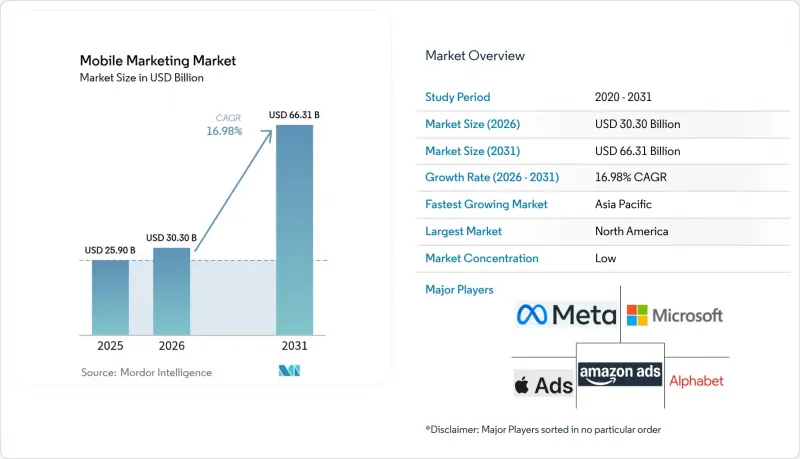
This report is Segmented by Component (Platform, Services), Solution Type (Mobile Web, SMS and MMS, and More), Distribution Channel (Social Media Marketing, Affiliate Marketing, and More), by Enterprise Size (Large Enterprises, Smes), Deployment Mode (Cloud, On-Premises), by End-User Industry (Retail and E-Commerce, Media and Entertainment / OTT), Geography. The Market Forecasts are Provided in Terms of Value (USD).
Global Mobile Marketing Market Trends and Insights
Privacy-safe identifier frameworks lifting in-app returns in North America
Server-side event collection and consented device tokens are replacing browser-level cookies across major United States publishers. Brands embedding these frameworks report doubled-digit improvements in match rates, enabling richer segmentation while meeting state-level privacy mandates. The same mechanisms automate compliance reporting, allowing finance teams to capitalise on privacy upgrades as technology investments. Marketing and risk units, therefore, align on shared metrics, and advertisers can sustain personalised outreach even as regulations tighten. These gains validate that compliant identity resolution is becoming a growth accelerator rather than a cost centre.
5G roll-outs enabling ultra-low-latency campaigns across urban Asia
Commercial 5G networks now serve most tier-one Asian cities, pushing average mobile video load times well below 100 milliseconds. Marketers respond with interactive augmented-reality product demos that let users virtually place items in their environment before one-tap checkout. Live A/B switches executed at the network edge during a 2024 gaming convention in Seoul cut abandonment by nearly 25% versus identical creative on 4G. The experience reveals that bandwidth acts as a creative canvas, spurring immersive storytelling rather than functioning only as a distribution upgrade. As 5G densifies, the mobile marketing market will see richer asset formats and higher conversion efficiency.
Cookieless policies disrupt cross-app attribution worldwide
Third-party cookies are vanishing from mainstream browsers, shrinking cross-device graphs, and forcing marketers toward probabilistic measurement and incrementality experiments. Finance controllers who relied on user-level reports now train on lift-based dashboards focused on causal contribution. Learning cycles lengthen, yet budget allocations gradually stabilise because probabilistic signals tolerate privacy volatility. While performance marketers face near-term friction, the shift ultimately produces more resilient planning processes, cushioning the mobile marketing market against future regulatory swings.
Other drivers and restraints analyzed in the detailed report include:
- Quick-commerce boom drives specialised notification spend in South American capitals
- Retail media networks reshape European campaign supply chains
- Telco SMS firewall upgrades escalate A2P costs in Africa
For complete list of drivers and restraints, kindly check the Table Of Contents.
Segment Analysis
Platform software contributed 66.20% of 2025 revenue, affirming its status as the operating backbone of the mobile marketing market. Vendors embed low-code journey builders and privacy dashboards that let brand teams test rules in near real time without engineering support. Services lines, though smaller, are expanding faster as enterprises seek guidance on clean-room deployment, creative automation and regional regulations. Advisory practices pivot from media arbitrage to technical enablement, carving fresh fee pools and rebalancing value capture along the supply chain. Over the forecast horizon, software upgrades will sustain retention, while service engagements deepen customer lock-in.
Technical services also mediate complex data-sharing agreements between advertisers and publishers, smoothing the adoption of consented identifiers. This dual need for technology and expertise positions hybrid providers to harvest greater wallet share. As a result, the mobile marketing market size tied to component services is projected to outpace overall market growth, even as software retains lead share.
Location intelligence holds a mid-teen fraction of the mobile marketing market size and is poised for a 21.3% CAGR, eclipsing other solution clusters by 2031. Enhanced stacks blend GPS, Bluetooth beacons, and venue Wi-Fi, pinpointing shopper dwell zones with sub-metre accuracy. Moment-specific offers then outperform generic coupons on redemption and basket value metrics. QR codes re-emerge as bridge technology between shelf and screen; a 2025 soft-drink promotion in Berlin used under-cap serialised codes to funnel consumers into a mobile game with instant rewards.
Push alerts remain indispensable for their superior open rates, but orchestration engines throttle frequency against predicted fatigue to prevent opt-outs. As retailers embed rich media into these alerts, location signals further sharpen timing, deepening engagement, and raising spending per user. Providers that integrate mapping APIs, analytics, and creative tooling within one interface widen their moat and expand their share within the wider mobile marketing market.
Complete Report Scope:
- By Component
- Platform
- Services
- By Solution Type
- Mobile Web
- SMS and MMS
- Location-Based Marketing / Geofencing
- In-App and In-Game Advertising
- Push Notification and Rich Media
- QR-Code and Proximity Marketing
- Emerging (AR/VR, Beacons, 5G Edge)
- By Distribution Channel
- Social Media Marketing
- Affiliate Marketing
- Omni-Channel / Retail Apps
- Content and Influencer Marketing
- Online Public Relations
- Email and SMS Campaigns
- In-Game / Esports
- By Enterprise Size
- Large Enterprises
- Small and Medium Enterprises (SMEs)
- By Deployment Mode
- Cloud
- On-Premises
- By End-user Industry
- Retail and E-commerce
- Media and Entertainment / OTT
- BFSI
- Healthcare and Life Sciences
- Travel, Tourism and Hospitality
- Telecommunications
- Automotive
- Education
- Others (Government, Utilities)
- By Geography
- North America
- United States
- Canada
- Mexico
- South America
- Brazil
- Argentina
- Rest of South America
- Europe
- Germany
- United Kingdom
- France
- Italy
- Spain
- Rest of Europe
- Asia-Pacific
- China
- Japan
- South Korea
- India
- Rest of Asia-Pacific
- Middle East and Africa
- United Arab Emirates
- Saudi Arabia
- South Africa
- Rest of Middle East and Africa
- North America
Geography Analysis
North America generated 37.60% of 2025 revenue, underscoring its role as a test bed for ad-tech innovation. State privacy amendments accelerate first-party data programs, leading to higher match rates and compliant identity graphs. Event-grade location platforms emerge ahead of the 2028 Los Angeles Olympics, merging ticketing, concessions, and sponsor messaging into unified mobile flows. Trials during the 2024 football playoffs demonstrated that dynamic offers aligned with concession wait times raised per-capita spend without adding foot traffic, showing operational upside beyond media value. Venture investment remains steady as publishers race to integrate privacy-safe IDs, supporting the broader mobile marketing market.
Asia-Pacific is forecast to post a 19.2% CAGR, reflecting the compounding effect of 5G speed, super-app ecosystems, and social commerce norms. A 2024 cosmetics campaign inside a leading Southeast Asian super-app combined augmented-reality try-ons with in-chat checkout, shrinking purchase journeys to under 60 seconds and tripling unit sales. In India, vernacular voice search expands reach, prompting platform owners to launch speech-driven ad formats for low-literacy segments. These innovations confirm that adoption curves depend on cultural habits as much as technology readiness. Rapid smartphone replacement cycles and low data costs further expand the mobile marketing market.
Europe's stringent privacy statutes restrict cookie-based reach, but retailers counter by monetising loyalty programs through closed-loop retail media networks. A 2025 Dutch grocery chain launched a self-service portal where suppliers buy sponsored product tiles that extend into the chain's mobile wallet, enabling end-to-end attribution within days. Nordic countries, although smaller, record the continent's highest per-user mobile engagement, proving that privacy-respecting personalisation thrives when consumer trust is secured. Regulatory clarity dampens short-term growth yet fosters long-term stability, supporting steady expansion of the mobile marketing market across the region.
- Alphabet Inc. (Google)
- Meta Platforms Inc.
- Apple Inc. (Apple Advertising)
- Microsoft Corporation
- Amazon.com Inc. (Amazon Ads)
- Twitter/X Corp.
- Snap Inc.
- Pinterest Inc.
- Verizon Communications Inc. (Yahoo Advertising)
- ATandT Inc.
- InMobi Pte Ltd
- AppLovin Corporation
- GroundTruth
- Criteo S.A.
- Airship
- Adobe Inc.
- Oracle Corporation
- Salesforce Inc.
- Publicis Groupe (Phonevalley)
- AdColony Inc.
- MoPub (AppLovin Exchange)
Additional Benefits:
- The market estimate (ME) sheet in Excel format
- 3 months of analyst support
TABLE OF CONTENTS
1 INTRODUCTION
- 1.1 Study Assumptions and Market Definition
- 1.2 Scope of the Study
2 RESEARCH METHODOLOGY
3 EXECUTIVE SUMMARY
4 MARKET LANDSCAPE
- 4.1 Market Overview
- 4.2 Market Drivers
- 4.2.1 Privacy-safe Identifier Frameworks Boosting In-App Marketing ROI in North America
- 4.2.2 5G Roll-outs Enabling Ultra-Low-Latency Rich Media Campaigns Across Asia
- 4.2.3 Surge in Quick-Commerce Apps Fuelling Push Notification Spend in Urban South America
- 4.2.4 Retail Media Networks Mandating First-Party Mobile Data Partnerships in Europe
- 4.3 Market Restraints
- 4.3.1 Cookieless Policies Shrinking Device Graphs for Cross-App Attribution
- 4.3.2 Telco SMS Firewall Upgrades Escalating A2P Traffic Costs in Africa
- 4.4 Value / Supply-Chain Analysis
- 4.5 Regulatory or Technological Outlook
- 4.6 Porter's Five Forces Analysis
- 4.6.1 Threat of New Entrants
- 4.6.2 Bargaining Power of Buyers
- 4.6.3 Bargaining Power of Suppliers
- 4.6.4 Threat of Substitutes
- 4.6.5 Intensity of Competitive Rivalry
- 4.7 Industry Value-Chain Analysis
- 4.8 Impact of COVID-19 on the Market
5 MARKET SIZE AND GROWTH FORECASTS (VALUE)
- 5.1 By Component
- 5.1.1 Platform
- 5.1.2 Services
- 5.2 By Solution Type
- 5.2.1 Mobile Web
- 5.2.2 SMS and MMS
- 5.2.3 Location-Based Marketing / Geofencing
- 5.2.4 In-App and In-Game Advertising
- 5.2.5 Push Notification and Rich Media
- 5.2.6 QR-Code and Proximity Marketing
- 5.2.7 Emerging (AR/VR, Beacons, 5G Edge)
- 5.3 By Distribution Channel
- 5.3.1 Social Media Marketing
- 5.3.2 Affiliate Marketing
- 5.3.3 Omni-Channel / Retail Apps
- 5.3.4 Content and Influencer Marketing
- 5.3.5 Online Public Relations
- 5.3.6 Email and SMS Campaigns
- 5.3.7 In-Game / Esports
- 5.4 By Enterprise Size
- 5.4.1 Large Enterprises
- 5.4.2 Small and Medium Enterprises (SMEs)
- 5.5 By Deployment Mode
- 5.5.1 Cloud
- 5.5.2 On-Premises
- 5.6 By End-user Industry
- 5.6.1 Retail and E-commerce
- 5.6.2 Media and Entertainment / OTT
- 5.6.3 BFSI
- 5.6.4 Healthcare and Life Sciences
- 5.6.5 Travel, Tourism and Hospitality
- 5.6.6 Telecommunications
- 5.6.7 Automotive
- 5.6.8 Education
- 5.6.9 Others (Government, Utilities)
- 5.7 By Geography
- 5.7.1 North America
- 5.7.1.1 United States
- 5.7.1.2 Canada
- 5.7.1.3 Mexico
- 5.7.2 South America
- 5.7.2.1 Brazil
- 5.7.2.2 Argentina
- 5.7.2.3 Rest of South America
- 5.7.3 Europe
- 5.7.3.1 Germany
- 5.7.3.2 United Kingdom
- 5.7.3.3 France
- 5.7.3.4 Italy
- 5.7.3.5 Spain
- 5.7.3.6 Rest of Europe
- 5.7.4 Asia-Pacific
- 5.7.4.1 China
- 5.7.4.2 Japan
- 5.7.4.3 South Korea
- 5.7.4.4 India
- 5.7.4.5 Rest of Asia-Pacific
- 5.7.5 Middle East and Africa
- 5.7.5.1 United Arab Emirates
- 5.7.5.2 Saudi Arabia
- 5.7.5.3 South Africa
- 5.7.5.4 Rest of Middle East and Africa
- 5.7.1 North America
6 COMPETITIVE LANDSCAPE
- 6.1 Strategic Developments
- 6.2 Vendor Positioning Analysis
- 6.3 Company Profiles (includes Global level Overview, Market level overview, Core Segments, Financials as available, Strategic Information, Products and Services, and Recent Developments)
- 6.3.1 Alphabet Inc. (Google)
- 6.3.2 Meta Platforms Inc.
- 6.3.3 Apple Inc. (Apple Advertising)
- 6.3.4 Microsoft Corporation
- 6.3.5 Amazon.com Inc. (Amazon Ads)
- 6.3.6 Twitter/X Corp.
- 6.3.7 Snap Inc.
- 6.3.8 Pinterest Inc.
- 6.3.9 Verizon Communications Inc. (Yahoo Advertising)
- 6.3.10 ATandT Inc.
- 6.3.11 InMobi Pte Ltd
- 6.3.12 AppLovin Corporation
- 6.3.13 GroundTruth
- 6.3.14 Criteo S.A.
- 6.3.15 Airship
- 6.3.16 Adobe Inc.
- 6.3.17 Oracle Corporation
- 6.3.18 Salesforce Inc.
- 6.3.19 Publicis Groupe (Phonevalley)
- 6.3.20 AdColony Inc.
- 6.3.21 MoPub (AppLovin Exchange)
7 MARKET OPPORTUNITIES AND FUTURE OUTLOOK
- 7.1 White-space and Unmet-Need Assessment