

|
시장보고서
상품코드
2122514
고객 셀프서비스 소프트웨어 : 시장 점유율 분석, 업계 동향과 통계, 성장 예측(2026-2031년)Customer Self-Service Software - Market Share Analysis, Industry Trends & Statistics, Growth Forecasts (2026 - 2031) |
||||||
 Mordor Intelligence
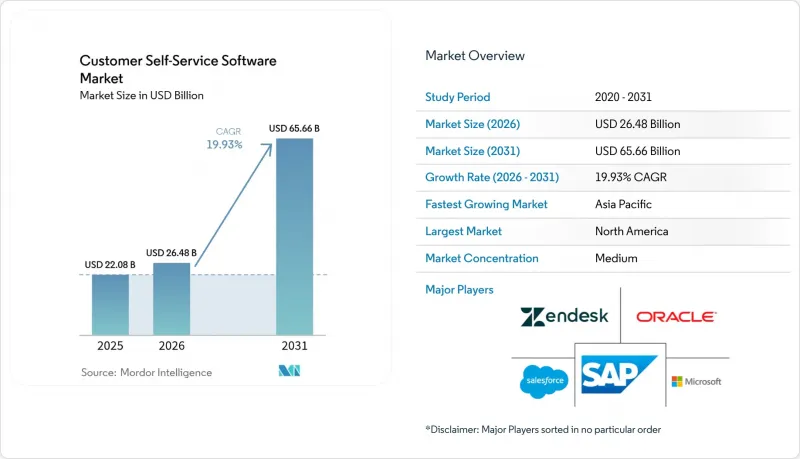
Mordor Intelligence에 의하면, 2026년 고객용 셀프서비스 소프트웨어 시장 규모는 264억 8,000만 달러로 추정되며, 2025년 220억 8,000만 달러에서 2031년에는 656억 6,000만 달러에 달할 것으로 예측됩니다.
또한 2026-2031년 연평균 성장률(CAGR)은 19.93%를 나타낼 전망입니다.
본 보고서는 도입 형태(클라우드, On-Premise, 하이브리드), 제공 형태(솔루션 및 서비스), 채널(웹 포털, 모바일 앱 등), 기업 규모(대기업 및 중소기업), 최종 사용자 산업(은행, 금융서비스 및 보험(BFSI), 헬스케어, 소매 및 전자상거래 등), 그리고 지역별로 분류되어 있습니다. 시장 전망은 금액(달러) 기준으로 제시되어 있습니다.
세계 고객 셀프 서비스 소프트웨어 시장 동향 및 인사이트
‘클라우드 퍼스트’ CX 혁신의 물결
클라우드 네이티브 고객 경험 스택으로 전환한 기업들은 40-60%의 비용 절감과 연중무휴 24시간 가용성을 실현하고 있으며, 이러한 성과가 고객 셀프 서비스 소프트웨어 시장에 대한 추가 투자를 촉진하고 있습니다. 터치포인트 간 거의 즉각적인 데이터 동기화를 통해 상담원이나 봇이 완전한 이력에 접근할 수 있게 되어, 첫 접촉 해결률이 향상됩니다. 구독 모델은 초기 투자가 필요하지 않기 때문에 중소기업이 가장 큰 혜택을 보고 있습니다. 하지만 다중 리전 데이터 거주에 관한 규제가 도입을 복잡하게 만들고 있어, 마이그레이션 지원 체계가 잘 갖춰진 벤더가 유리한 입장에 있습니다.
AI 기반 셀프서비스의 성숙도 곡선
현재 생성형 AI는 의도 해석, 기록 검색, 다단계 워크플로우 실행이 가능해졌으며, 자동화된 포털을 통해 일반적인 문의의 최대 80%를 해결할 수 있게 되었습니다. 티켓 발행 흐름에 대규모 언어 모델을 도입한 기업은 순추천지수(NPS)가 높아지며, 직원은 예외 상황 처리에만 전념할 수 있게 됩니다. 정확도가 향상됨에 따라 고객 셀프 서비스 소프트웨어 시장은 일상적인 FAQ 대응에서 고부가가치이자 규제 대상인 거래 완료로 점차 전환될 것입니다.
분산된 API 보안 기준
토큰 프로토콜의 불일치와 암호화 방식의 비일관성은 통합 비용을 증가시키고, 고객 셀프 서비스 소프트웨어 시장의 도입을 지연시키고 있습니다. 규제가 엄격한 산업에서는 CRM, ERP, 지식베이스의 연결을 단일 보안 모델로 통합해야 하며, 이러한 격차는 새로운 취약점의 원인이 됩니다. 사전 인증된 커넥터를 통해 이 과제를 해결하는 벤더들이 지지를 얻고 있습니다.
부문 분석
클라우드 부문은 2025년에 고객 셀프 서비스 소프트웨어 시장의 58.20% 점유율을 차지할 것으로 예상되며, 2031년까지 연평균 성장률(CAGR) 21.68%를 유지할 것으로 전망됩니다. 클라우드의 부상으로 확장성이 향상되어 데이터센터를 확장하지 않고도 전 세계적으로 서비스를 전개할 수 있게 됩니다. 구독형 가격 책정을 통해 초기 투자가 절감되며, 재무 부서는 해당 비용을 영업 비용으로 계상할 수 있게 됩니다. 각 벤더는 문의 회피율 및 사용자 감정을 시각화하는 내장형 분석 기능을 통해 지속적으로 서비스 제공을 강화하고 있습니다.
기밀성이 높은 관할 구역에서는 주권 관련 규제로 인해 SaaS 이용이 제한되므로, 하이브리드형 프레임워크가 여전히 채택되고 있습니다. 한편, 완전한 On-Premise형 스택은 여전히 정부 기관에 집중되어 있습니다. On-Premise에서 마이그레이션하는 기업들은 기존 티켓 기록을 유지하면서 신규 트래픽을 클라우드로 이전하는 단계적 도입 방식을 일반적으로 채택하고 있습니다. 유지보수 부담 경감 및 즉각적인 패치 적용은 그 매력을 한층 더 높여, 고객 셀프 서비스 소프트웨어 시장의 성장 궤도를 뒷받침하고 있습니다.
2025년에는 엔드투엔드 제품군이 매출의 61.65%를 차지할 것으로 예상되며, 지식베이스, 챗봇, 분석 기능을 통합한 통합 허브에 대한 구매자 수요가 뚜렷해졌습니다. 기업이 설정, 교육, 정기적인 최적화를 필요로 하기 때문에 서비스 부문은 연평균 성장률(CAGR) 21.05%로 성장할 전망입니다. 도입 파트너는 워크플로를 시각화하고, 역할 기반 접근 권한을 관리하는 산업별 플레이북을 작성하여 기업이 변경 관리 과제를 극복할 수 있도록 지원하고 있습니다.
각 벤더는 ITIL 프로세스 및 소매업 주문 현황 흐름에 부합하는 패키지형 액셀러레이터와 사전 구축된 템플릿을 통해 부가가치를 확대되고 있습니다. 지속적인 개선 노력을 통해 모듈이 지속적으로 최적화되어, 진화하는 비즈니스 규칙과 봇의 의도 사이에 발생하는 불일치를 방지하고 있습니다. 이러한 전문 서비스 계층은 플랫폼에 대한 정착도를 높이고, 각 도입에 따른 고객 셀프 서비스 소프트웨어 시장 규모를 확대시키고 있습니다.
지역별 분석
북미는 높은 클라우드 보급률, 성숙한 옴니채널 전략, 그리고 AI 모델 튜닝에 능숙한 기술 인력에 힘입어 2025년 매출의 33.85%를 차지했습니다. 많은 기업이 1단계 도입을 완료했으며, 현재는 보다 정교한 분석을 활용한 고객 여정의 미세 조정에 주력하고 있습니다. 연방 정부 차원의 사이버 보안에 대한 관심으로 인해 정부 기관 및 계약업체는 제로 트러스트(Zero Trust) 요건을 충족하는 플랫폼으로의 전환을 촉진받고 있으며, 이를 통해 갱신 주기가 유지되고 있습니다.
아시아태평양은 2031년까지 연평균 성장률(CAGR)이 21.20%를 나타낼 것으로 예측되어 가장 빠른 성장이 예상됩니다. Z세대가 주축을 이루는 ‘모바일 퍼스트’ 소비자층은 현지 방언이나 노래방 스타일의 발음을 이해하는 챗봇을 원하고 있습니다. 각국 정부는 중소기업을 위한 디지털화 보조금을 지원하고 있으며, 이로 인해 소매, 여행, 은행 업계의 고객 셀프 서비스 소프트웨어 시장 수요가 간접적으로 확대되고 있습니다. 이러한 환경 하에서 다국어 지원 NLP 파이프라인을 보유한 벤더들이 차별화를 꾀하고 있습니다.
유럽에서는 엄격한 개인정보 보호 규제가 있음에도 불구하고 꾸준히 진전이 이루어지고 있습니다. ‘소버린 클라우드’ 프레임워크의 부상으로 규정 준수를 확보하기 위한 지역 데이터센터 건설이 촉진되고 있습니다. 기업의 구매 담당자는 도입을 승인하기 전에 감사 기능과 동의 관리를 면밀히 검토하기 때문에 사실상 경쟁 장벽이 높아지고 있습니다. 규제로 인한 부담이 도입 속도를 늦추는 요인이 되기도 하지만, 솔루션의 규정 준수가 확인되면 인접 부서로 빠르게 확산되어 장기적인 안정성이 확보됩니다.
기타 혜택:
- 엑셀 형식 시장 예측(ME) 시트
- 3개월간의 애널리스트 지원
자주 묻는 질문
목차
제1장 서론
제2장 조사 방법
제3장 주요 요약
제4장 시장 구도
제5장 시장 규모와 성장 예측
제6장 경쟁 구도
제7장 시장 기회와 향후 동향
LSH 26.09.03According to Mordor Intelligence, customer self-Service software market size in 2026 is estimated at USD 26.48 billion, growing from 2025 value of USD 22.08 billion with 2031 projections showing USD 65.66 billion, growing at 19.93% CAGR over 2026-2031.
This report is Segmented by Deployment (Cloud, On-Premise, and Hybrid), Offering (Solution and Service), Channel (Web Portal, Mobile App, and More), Enterprise Size (Large Enterprises and Small and Mid-Sized Enterprises), End-User Industry (BFSI, Healthcare, Retail and E-Commerce, and More), and Geography. The Market Forecasts are Provided in Terms of Value (USD).
Global Customer Self-Service Software Market Trends and Insights
Cloud-first CX Transformation Wave
Enterprises migrating to cloud-native customer experience stacks report 40-60% cost reductions and round-the-clock availability, results that encourage further investment in the customer self-service software market. Near-instant data synchronisation across touchpoints lets agents and bots access complete history, which raises first-contact resolution rates. SMEs gain the most because subscription models avoid up-front capital requirements. Nevertheless, multi-region data residency rules complicate rollouts and reward vendors with strong migration support.
AI-powered Self-service Maturity Curves
Generative AI now interprets intent, retrieves records, and executes multi-step workflows, letting automated portals resolve up to 80% of common queries. Companies that embed large language models inside ticketing flows register higher net-promoter scores and free staff to handle exceptions. As accuracy improves, the customer self-service software market will transition from handling routine FAQs to completing high-value, regulated transactions.
Fragmented API Security Standards
Mismatched token protocols and inconsistent encryption raise integration costs, slowing deployments in the customer self-service software market. Highly regulated verticals must align CRM, ERP, and knowledge-base connections under one security model, and gaps expose new vulnerability surfaces. Vendors answering this pain point with pre-certified connectors gain traction.
Other drivers and restraints analyzed in the detailed report include:
- Hyper-personalisation via Customer Data Platforms
- Rising Self-service Adoption by Gen-Z Consumers
- Data Residency Constraints in Sovereign Clouds
For complete list of drivers and restraints, kindly check the Table Of Contents.
Segment Analysis
The cloud segment commanded 58.20% customer self-service software market share in 2025 and is forecast to maintain a 21.68% CAGR through 2031. Its rise adds scale elasticity, enabling global releases without data-centre expansion. Subscription pricing trims up-front investment and lets finance teams recognise expenses as operating outlays. Vendors continue to enrich offerings with built-in analytics that surface deflection rates and user sentiment.
Hybrid frameworks persist where sovereignty rules block SaaS in sensitive jurisdictions, while fully on-premise stacks remain concentrated in government agencies. Firms migrating from on-premises commonly adopt phased rollouts that preserve legacy ticket records yet shift new traffic to the cloud. Lower maintenance burdens and instant patching further cement the appeal, reinforcing the customer self-service software market trajectory.
End-to-end suites held 61.65% of revenue in 2025, revealing buyer desire for unified hubs that blend knowledge bases, chatbots, and analytics. The services category will grow at 21.05% CAGR as enterprises need configuration, training, and periodic optimisation. Implementation partners craft industry playbooks that map workflows and govern role-based access, guiding firms through change-management hurdles.
Vendors extend value with packaged accelerators, pre-built templates that align to ITIL processes or retail order-status flows. Continuous-improvement engagements keep modules tuned, avoiding drift between evolving business rules and bot intents. These professional-service layers deepen platform stickiness and enlarge the customer self-service software market size attached to each deployment.
Complete Report Scope:
- By Deployment
- Cloud
- On-premise
- Hybrid
- By Offering
- Solution
- Service
- By Channel
- Web Portal
- Mobile App
- Conversational Chatbot/API
- Voice/IVR
- By Enterprise Size
- Large Enterprises
- Small and Mid-Sized Enterprises (SMEs)
- By End-user Industry
- BFSI
- Healthcare
- Retail and E-commerce
- Government
- IT and Telecommunication
- Education
- Other End-user Industries
- By Geography
- North America
- United States
- Canada
- Mexico
- South America
- Brazil
- Argentina
- Chile
- Rest of South America
- Europe
- Germany
- United Kingdom
- France
- Italy
- Spain
- Russia
- Rest of Europe
- Asia-Pacific
- China
- India
- Japan
- South Korea
- Singapore
- Malaysia
- Australia
- Rest of Asia-Pacific
- Middle East and Africa
- Middle East
- United Arab Emirates
- Saudi Arabia
- Turkey
- Rest of Middle East
- Africa
- South Africa
- Nigeria
- Egypt
- Rest of Africa
- Middle East
- North America
Geography Analysis
North America generated 33.85% of 2025 revenue, supported by high cloud penetration, mature omnichannel strategies, and a tech workforce skilled in AI model tuning. Many enterprises completed first-wave deployments and now focus on fine-tuning journeys using deeper analytics. Federal-level attention to cybersecurity nudges agencies and contractors toward platforms meeting zero-trust mandates, sustaining replacement cycles.
Asia-Pacific represents the fastest expansion vector with a projected 21.20% CAGR through 2031. Its mobile-first consumer base, dominated by Gen-Z cohorts, demands chatbots that understand local dialects and karaoke-style transliteration. Governments sponsor SME digitalisation grants, indirectly enlarging demand for the customer self-service software market across retail, travel, and banking. Vendors with multilingual NLP pipelines differentiate in these environments.
Europe advances steadily despite stringent privacy statutes. The emergence of sovereign-cloud frameworks spurs regional data-centre builds, ensuring compliance. Enterprise buyers scrutinise audit capabilities and consent management before green-lighting rollouts, effectively raising the competitive bar. Although regulatory overhead tempers speed, once solutions prove compliant, adoption spreads quickly across adjacent departments, securing long-run stability.
- Oracle Corporation
- Salesforce Inc.
- SAP SE
- Microsoft Corporation
- Zendesk Inc.
- Verint Systems Inc.
- NICE Ltd.
- Genesys Telecommunications Laboratories Inc.
- Freshworks Inc.
- ServiceNow Inc.
- Atlassian Corporation (Jira Service Management)
- HubSpot Inc.
- Intercom Inc.
- Pega Systems Inc.
- Zoho Corporation Pvt. Ltd.
- Zappix Inc.
- Ada Support Inc.
- LivePerson Inc.
- Richpanel Technologies Pvt. Ltd.
- Help Scout PBC
- Drift.com Inc.
- WalkMe Ltd.
- Kustomer LLC
- RingCentral Inc.
- Avaya Inc.
- BMC Software Inc.
Additional Benefits:
- The market estimate (ME) sheet in Excel format
- 3 months of analyst support
TABLE OF CONTENTS
1 INTRODUCTION
- 1.1 Study Assumptions and Market Definition
- 1.2 Scope of the Study
2 RESEARCH METHODOLOGY
3 EXECUTIVE SUMMARY
4 MARKET LANDSCAPE
- 4.1 Market Overview
- 4.2 Market Drivers
- 4.2.1 Cloud-first CX transformation wave
- 4.2.2 AI-powered self-service maturity curves
- 4.2.3 Hyper-personalisation via customer data platforms
- 4.2.4 Rising self-service adoption by Gen-Z consumers
- 4.2.5 Embedded self-service in vertical SaaS "layer-cake"
- 4.2.6 Cyber-insurance premium incentives for self-service
- 4.3 Market Restraints
- 4.3.1 Fragmented API security standards
- 4.3.2 "Quiet quit" of support agents lowering training data
- 4.3.3 Data residency constraints in sovereign clouds
- 4.3.4 Rising CX tool sprawl cost for SMEs
- 4.4 Industry Value Chain Analysis
- 4.5 Regulatory Landscape
- 4.6 Technological Outlook
- 4.7 Industry Attractiveness - Porter's Five Forces Analysis
- 4.7.1 Threat of New Entrants
- 4.7.2 Bargaining Power of Suppliers
- 4.7.3 Bargaining Power of Buyers
- 4.7.4 Threat of Substitutes
- 4.7.5 Intensity of Competitive Rivalry
- 4.8 Impact of Macroeconomic Factors on the Market
5 MARKET SIZE AND GROWTH FORECASTS (VALUES)
- 5.1 By Deployment
- 5.1.1 Cloud
- 5.1.2 On-premise
- 5.1.3 Hybrid
- 5.2 By Offering
- 5.2.1 Solution
- 5.2.2 Service
- 5.3 By Channel
- 5.3.1 Web Portal
- 5.3.2 Mobile App
- 5.3.3 Conversational Chatbot/API
- 5.3.4 Voice/IVR
- 5.4 By Enterprise Size
- 5.4.1 Large Enterprises
- 5.4.2 Small and Mid-Sized Enterprises (SMEs)
- 5.5 By End-user Industry
- 5.5.1 BFSI
- 5.5.2 Healthcare
- 5.5.3 Retail and E-commerce
- 5.5.4 Government
- 5.5.5 IT and Telecommunication
- 5.5.6 Education
- 5.5.7 Other End-user Industries
- 5.6 By Geography
- 5.6.1 North America
- 5.6.1.1 United States
- 5.6.1.2 Canada
- 5.6.1.3 Mexico
- 5.6.2 South America
- 5.6.2.1 Brazil
- 5.6.2.2 Argentina
- 5.6.2.3 Chile
- 5.6.2.4 Rest of South America
- 5.6.3 Europe
- 5.6.3.1 Germany
- 5.6.3.2 United Kingdom
- 5.6.3.3 France
- 5.6.3.4 Italy
- 5.6.3.5 Spain
- 5.6.3.6 Russia
- 5.6.3.7 Rest of Europe
- 5.6.4 Asia-Pacific
- 5.6.4.1 China
- 5.6.4.2 India
- 5.6.4.3 Japan
- 5.6.4.4 South Korea
- 5.6.4.5 Singapore
- 5.6.4.6 Malaysia
- 5.6.4.7 Australia
- 5.6.4.8 Rest of Asia-Pacific
- 5.6.5 Middle East and Africa
- 5.6.5.1 Middle East
- 5.6.5.1.1 United Arab Emirates
- 5.6.5.1.2 Saudi Arabia
- 5.6.5.1.3 Turkey
- 5.6.5.1.4 Rest of Middle East
- 5.6.5.2 Africa
- 5.6.5.2.1 South Africa
- 5.6.5.2.2 Nigeria
- 5.6.5.2.3 Egypt
- 5.6.5.2.4 Rest of Africa
- 5.6.5.1 Middle East
- 5.6.1 North America
6 COMPETITIVE LANDSCAPE
- 6.1 Market Concentration
- 6.2 Strategic Moves
- 6.3 Market Share Analysis
- 6.4 Company Profiles (includes Global level Overview, Market level overview, Core Segments, Financials as available, Strategic Information, Market Rank/Share for key companies, Products and Services, and Recent Developments)
- 6.4.1 Oracle Corporation
- 6.4.2 Salesforce Inc.
- 6.4.3 SAP SE
- 6.4.4 Microsoft Corporation
- 6.4.5 Zendesk Inc.
- 6.4.6 Verint Systems Inc.
- 6.4.7 NICE Ltd.
- 6.4.8 Genesys Telecommunications Laboratories Inc.
- 6.4.9 Freshworks Inc.
- 6.4.10 ServiceNow Inc.
- 6.4.11 Atlassian Corporation (Jira Service Management)
- 6.4.12 HubSpot Inc.
- 6.4.13 Intercom Inc.
- 6.4.14 Pega Systems Inc.
- 6.4.15 Zoho Corporation Pvt. Ltd.
- 6.4.16 Zappix Inc.
- 6.4.17 Ada Support Inc.
- 6.4.18 LivePerson Inc.
- 6.4.19 Richpanel Technologies Pvt. Ltd.
- 6.4.20 Help Scout PBC
- 6.4.21 Drift.com Inc.
- 6.4.22 WalkMe Ltd.
- 6.4.23 Kustomer LLC
- 6.4.24 RingCentral Inc.
- 6.4.25 Avaya Inc.
- 6.4.26 BMC Software Inc.
7 MARKET OPPORTUNITIES AND FUTURE TRENDS
- 7.1 White-Space and Unmet-Need Assessment


