

|
시장보고서
상품코드
2122532
인메모리 데이터베이스 : 시장 점유율 분석, 업계 동향 및 통계, 성장 예측(2026-2031년)In-Memory Database - Market Share Analysis, Industry Trends & Statistics, Growth Forecasts (2026 - 2031) |
||||||
 Mordor Intelligence
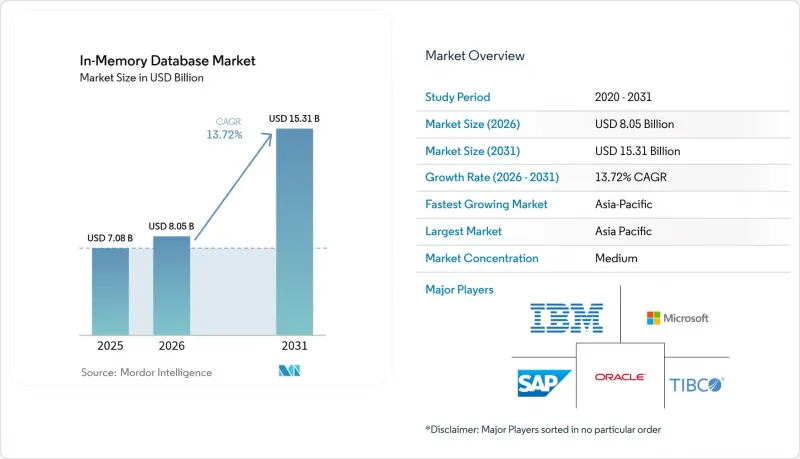
Mordor Intelligence에 의하면, 인메모리 데이터베이스 시장 규모는 2025년 70억 8,000만 달러로 평가되었습니다. 2026년에는 80억 5,000만 달러로 확대되어 2026년부터 2031년에 걸쳐 CAGR 13.72%로 성장을 지속하여, 2031년에는 153억 1,000만 달러에 이를 것으로 예측됩니다.

본 보고서는 처리 방식(OLTP, OLAP, HTAP), 배포 모드(On-Premise 등), 데이터 모델(SQL, NoSQL, 멀티모델), 조직 규모(중소기업 및 대기업), 용도(실시간 트랜잭션 처리 등), 최종 사용자 산업(은행, 금융서비스 및 보험(BFSI), 통신 및 IT 등),지역(북미, 유럽, 아시아태평양, 남미, 중동 및 아프리카)별로 분류되어 있습니다.
세계의 인메모리 데이터베이스 시장 동향 및 인사이트
서브밀리초 수준의 지연 시간을 필요로 하는 클라우드 네이티브 마이크로서비스
클라우드 네이티브 도입으로 인해 컨테이너화된 마이크로서비스가 마이크로초 단위의 데이터 액세스를 필요로 하게 되면서, 성능 기준이 재정의되었습니다. 세션 스토어, 개인화 엔진 및 고빈도 거래 플랫폼은 지연 시간이 1밀리초 증가할 때마다 전환율과 거래 이익이 감소하기 때문에 디스크 기반 데이터베이스에서 메모리 중심 스토어로 전환되었습니다. Dragonfly는 AWS Graviton3E 실리콘에서 초당 643만 건의 작업을 수행하며, 현재 데이터베이스 계층에서 기대되는 최대 성능을 여실히 보여주었습니다. 모놀리식 시스템에서 분산 시스템으로 전환한 금융 기관 및 디지털 커머스 사업자들은 응답 시간 개선이 구체적인 수익 증가로 이어졌음을 실감했으며, 이 촉진요인의 단기적 중요성이 재확인되었습니다.
DRAM 및 퍼시스턴트 메모리의 비용 하락으로 TCO 격차 확대
DDR4 및 DDR5 모듈의 세계 현물 가격은 계속 하락했지만, 삼성의 CXL 메모리 모듈 하이브리드 프로토타입은 DRAM에 필적하는 레이턴시와 영속성을 겸비하여 매력적인 비용 구조를 실현했습니다. 하이퍼스케일 사업자들은 랙 간 메모리를 통합함으로써 유휴 용량과 백업 주기를 줄였습니다. 특히 SLA의 여유가 좁은 분석 워크로드의 경우, SSD 어레이와의 가격 차이가 줄어들면서 기업들은 로드맵을 인메모리 배포로 전환했습니다. 이러한 효과는 아시아태평양의 제조 거점에서 두드러지게 나타나며, 대규모 히스토리안 데이터 세트가 메모리에 로드되어 실시간 디지털 트윈 분석에 활용되고 있습니다.
독자적인 포맷을 둘러싼 벤더 락인 우려
2024년 Redis의 라이선스 변경으로 인해 독점 형식에 대한 구매자의 경계심이 높아졌으며, AWS, Google, Oracle은 Linux Foundation 산하의 Valkey 포크를 지원하게 되었습니다. 수년에 걸친 데이터베이스 프로젝트 예산을 편성하는 기업들은 마이그레이션 비용을 고려함에 따라 구매 주기가 둔화되었습니다. 위험을 완화하기 위해 멀티 데이터베이스 오케스트레이션 계층을 도입한 기업도 있었으나, 이러한 추상화로 인해 지연 시간이 증가하여 메모리 속도가 주는 이점이 부분적으로 상쇄되고 말았습니다.
부문별 분석
2025년, OLTP 부문은 인메모리 데이터베이스 시장 점유율의 44.85%를 차지했으며, 은행, 전자상거래, ERP 시스템 전반에 걸쳐 높은 일관성을 요구하는 트랜잭션 워크로드에 대한 의존도가 여전히 지속되고 있음을 여실히 보여주었습니다. 미션 크리티컬한 레코드에는 여전히 ACID 준수가 요구되고 있으며, 기업들은 서브 밀리초 단위의 커밋을 실현하기 위해 성능 면에서 추가 비용을 지불해야 했기 때문에 수요는 지속되었습니다. OLAP의 도입은 확립된 비즈니스 인텔리전스 프론트엔드를 지원했으나, 분석이 보다 유연한 엔진으로 전환됨에 따라 그 성장세는 둔화되었습니다.
기업들이 단일 플랫폼을 통한 간소화를 추구하는 가운데, HTAP은 2026년부터 2031년까지 연평균 성장률(CAGR) 20.68%를 나타낼 것으로 예측됩니다. GridGain의 플랫폼은 ANSI SQL-99 지원을 유지하면서도 디스크 기반 시스템에 비해 최대 1,000배 빠른 속도를 실현했습니다. 실시간 리스크 계산이나 공급망 트윈에는 동시 읽기/쓰기 액세스가 필요했기 때문에 HTAP이 최적의 아키텍처로 자리 잡았습니다. 이러한 융합을 통해 기존에는 운영 부서와 분석 부서 간에 사일로화되어 있던 각 부서에서 추가 예산을 확보하게 되었고, 인메모리 데이터베이스 시장은 통합형 설계로 나아가게 되었습니다.
규제 대상 산업에서는 데이터 저장 위치에 대한 완벽한 관리와 맞춤형 고가용성(HA) 아키텍처가 요구되었기 때문에 2025년 매출의 55.15%를 On-Premise 도입이 차지했습니다. 레거시 기업 소프트웨어 스택은 On-Premise 데이터베이스와 긴밀하게 통합되어 있어, 퍼블릭 클라우드가 성숙해졌음에도 여전히 지출의 기반을 이루고 있습니다. 하지만 디지털 네이티브 기업들이 인프라 관리를 회피하기 위해 매니지드 서비스를 채택함에 따라 클라우드 도입은 진전되었습니다.
엣지 및 임베디드 환경에서의 도입은 커넥티드카와 IIoT 게이트웨이에 힘입어 연평균 성장률(CAGR) 22.55%를 기록할 전망입니다. 현대 자동차는 연간 약 300TB의 데이터를 생성하며, 자율주행 기능을 실현하기 위해서는 차량 내 처리가 필수적입니다. TDengine은 스마트카 텔레메트리 분야에서 Elasticsearch에 비해 10배의 압축률을 달성하여 업스트림 전송 대역폭을 줄였습니다. 각 제조업체는 생산 라인에서도 유사한 전략을 채택하여 결함을 즉시 감지하고 있습니다. 이러한 변화는 과거 데이터센터에만 국한되었던 성능 향상이 이제는 엣지에서도 필수적임을 보여 주며, 이는 인메모리 데이터베이스 시장 점유율 확대로 이어지고 있습니다.
지역별 분석
아시아태평양은 2025년에 31.95%라는 가장 높은 지역별 매출을 기록했으며, 연평균 성장률(CAGR)은 16.65%를 나타낼 것으로 전망됩니다. 중국, 일본, 인도의 국가 차원 ‘인더스트리 4.0’ 프로그램은 1초 미만의 MES 피드백 루프를 실현하기 위해 인메모리 히스토리안 데이터베이스가 필요한 공장 자동화를 촉진했습니다. 제너럴 모터스(GM)는 MES 4.0 도입 과정에서 10만 건 이상의 운영 기술(OT) 연결을 연동함으로써 엣지 배포의 규모를 여실히 보여주었습니다. 노틸러스 테크놀로지스(Nautilus Technologies)와 같은 현지 벤더가 제공하는 첨단 국산 관계형 엔진을 통해 외국 지적 재산(IP)에 대한 의존도가 낮아지고 있습니다.
북미는 금융 서비스, 하이퍼스케일 클라우드, 자율주행차 연구 개발을 중심으로 성숙해 가면서도 혁신이 풍부한 시장을 형성했습니다. Oracle과 구글은 파트너십을 강화하여 Google Cloud에서 Oracle 데이터베이스 서비스를 네이티브로 실행할 수 있게 했습니다. 이를 통해 엔터프라이즈용 SQL 기능과 AI 가속기가 융합되었습니다. 이 지역의 벤처 자금은 Dragonfly와 같은 신생 기업을 지원하며 경쟁을 심화시켰습니다.
유럽에서는 GDPR(EU 개인정보보호규정)에 기반한 데이터 주권 규정 준수가 우선시되면서 하이브리드 클라우드 도입이 촉진되는 한편, 현지 데이터센터의 매니지드 서비스와 결합된 On-Premise 클러스터가 선호되었습니다. Oracle은 데이터 거주 규정을 충족하기 위해 Database&Azure의 지원 범위를 EU 내 더 많은 지역으로 확대했습니다. 또한, 이 대륙에서는 엄격한 개인정보 보호 체계 하에서 AI 진단을 가능하게 하기 위해 의료 분야에서 HTAP 데이터베이스 도입이 진행되었습니다.
중동 및 아프리카에서는 스마트 시티를 위한 광섬유 및 5G 백본에 대한 투자가 이루어졌으며, 실시간 분석이 필요한 IIoT의 시범 도입이 진행되었습니다. 남미에서는 광업 및 디지털 뱅킹 분야에서 진전이 있었으며, 저지연 부정 감지가 요구됨에 따라 메모리 중심의 고성능 시스템이 채택되었습니다. 이 두 지역의 절대적인 지출 규모는 여전히 소폭에 그쳤으나, 두 자릿수 성장률 덕분에 전 세계 인메모리 데이터베이스 시장의 다양성이 확대되었습니다.
기타 혜택 :
- 엑셀 형식 시장 예측(ME) 시트
- 3개월간 애널리스트 지원
자주 묻는 질문
목차
제1장 서론
제2장 조사 방법
제3장 주요 요약
제4장 시장 구도
제5장 시장 규모 및 성장 예측
제6장 경쟁 구도
제7장 시장 기회 및 향후 전망
KTH 26.09.08According to Mordor Intelligence, the in-Memory database market size is expected to grow from USD 7.08 billion in 2025 to USD 8.05 billion in 2026 and is forecast to reach USD 15.31 billion by 2031 at 13.72% CAGR over 2026-2031.
This report is Segmented by Processing Type (OLTP, OLAP, and HTAP), Deployment Mode (On-Premise, and More), Data Model (SQL, Nosql, and Multi-Model), Organization Size (SMEs, and Large Enterprises), Application (Real-Time Transaction Processing, and More), End-User Industry (BFSI, Telecommunications and IT, and More), and Geography (North America, Europe, Asia-Pacific, South America, and Middle East and Africa).
Global In-Memory Database Market Trends and Insights
Cloud-Native Microservices Demanding Sub-Millisecond Latency
Cloud-native adoption reshaped performance baselines as containerized microservices needed data access in microseconds. Session stores, personalization engines, and high-frequency trading platforms shifted from disk-backed databases to memory-centric stores because every millisecond of delay reduced conversion rates or trading profit. Dragonfly demonstrated 6.43 million operations per second on AWS Graviton3E silicon, highlighting the ceiling now expected from database tiers. Financial institutions and digital commerce operators that migrated monoliths to distributed systems saw response-time improvements translate into tangible revenue gains, reinforcing the driver's near-term importance.
Falling DRAM and Persistent Memory Costs Widening TCO Gap
Global spot pricing of DDR4 and DDR5 modules continued to slide, while Samsung's CXL Memory Module Hybrid prototype showed DRAM-class latency with persistence, creating a compelling cost profile. Hyperscale operators pooled memory across racks, reducing stranded capacity and backup cycles. Enterprises pivoted roadmaps toward in-memory deployment because the premium over SSD arrays narrowed, especially for analytics workloads with tight SLA windows. The effect is visible in Asia-Pacific manufacturing hubs where large historian datasets are moved into memory for real-time digital-twin analytics.
Vendor Lock-in Concerns Around Proprietary Formats
Redis's license change in 2024 heightened buyer wariness of proprietary formats, spurring AWS, Google, and Oracle to back the Valkey fork under the Linux Foundation. Enterprises budgeting multi-year database projects factored in exit costs, slowing purchase cycles. To mitigate risk, some adopted multi-database orchestration layers, but those abstractions introduced latency penalties that partially offset memory-speed gains.
Other drivers and restraints analyzed in the detailed report include:
- Streaming Analytics Adoption in BFSI and Telecom
- HTAP Architectures Accelerating AI/ML Model Serving
- High-Availability Design Complexity for Large Clusters
For complete list of drivers and restraints, kindly check the Table Of Contents.
Segment Analysis
The OLTP segment held 44.85% of the In-Memory Database market share in 2025, underscoring continued reliance on high-integrity transactional workloads across banking, e-commerce, and ERP systems. Demand persisted because mission-critical records still required ACID compliance, with enterprises paying a performance premium for sub-millisecond commits. OLAP deployments addressed established business-intelligence front ends but grew slowly as analytics shifted toward more flexible engines.
HTAP climbed with a 20.68% CAGR forecast from 2026 to 2031 as firms sought single-platform simplicity. GridGain's platform showed up to 1,000X speed-ups over disk-based systems while retaining ANSI SQL-99 support. Real-time risk calculations and supply-chain twins needed simultaneous read-write access, making HTAP the preferred architecture. The convergence unlocked incremental budget from departments earlier siloed between operations and analytics, pushing the In-Memory Database market toward unified designs.
On-premise installations captured 55.15% of 2025 revenue because regulated sectors required full control over data residency and tailored HA architectures. Legacy enterprise software stacks tightly integrated with on-premise databases, anchoring spending even as public clouds mature. Cloud deployments, nonetheless, have advanced as digital-native firms adopted managed services to avoid infrastructure administration.
Edge and embedded deployments displayed a 22.55% CAGR outlook, fueled by connected cars and IIoT gateways. Modern vehicles generate around 300 TB annually, which demands in-vehicle processing for autonomous features. TDengine achieved 10X compression over Elasticsearch in smart-vehicle telemetry, cutting bandwidth for upstream transfers. Manufacturers applied similar strategies on production lines to detect defects instantly. The shift signaled that performance gains once reserved for data centers were now indispensable at the edge, expanding the In-Memory Database market footprint.
Complete Report Scope:
- By Processing Type
- OLTP
- OLAP
- Hybrid Transactional/Analytical Processing (HTAP)
- By Deployment Mode
- On-premise
- Cloud
- Edge/Embedded
- By Data Model
- Relational (SQL)
- NoSQL (Key-Value, Document, Graph)
- Multi-model
- By Organization Size
- Small and Medium Enterprises (SMEs)
- Large Enterprises
- By Application
- Real-time Transaction Processing
- Operational Analytics and BI Dashboards
- AI/ML Model Serving
- Caching and Session Stores
- By End-user Industry
- BFSI
- Telecommunications and IT
- Retail and E-commerce
- Healthcare and Life Sciences
- Manufacturing and Industrial IoT
- Media and Entertainment
- Government and Defense
- Others (Energy, Education, etc.)
- By Geography
- North America
- United States
- Canada
- Mexico
- Europe
- Germany
- France
- United Kingdom
- Nordics
- Rest of Europe
- Asia-Pacific
- China
- Taiwan
- South Korea
- Japan
- India
- Rest of Asia-Pacific
- South America
- Brazil
- Mexico
- Argentina
- Rest of South America
- Middle East and Africa
- Middle East
- Saudi Arabia
- United Arab Emirates
- Turkey
- Rest of Middle East
- Africa
- South Africa
- Rest of Africa
- Middle East
- North America
Geography Analysis
Asia-Pacific recorded the largest regional revenue at 31.95% in 2025 and maintained a 16.65% CAGR outlook. National Industry 4.0 programs in China, Japan, and India spurred factory automation that required in-memory historian databases for sub-second MES feedback loops. General Motors linked more than 100,000 operational technology connections in its MES 4.0 rollout, illustrating the scale of edge deployments. Local vendors such as Nautilus Technologies' advanced indigenous relational engines, reducing reliance on foreign IP.
North America formed a mature but innovation-rich market centered on financial services, hyperscale clouds, and autonomous-vehicle R&D. Oracle and Google deepened their partnership to run Oracle Database services natively on Google Cloud, marrying enterprise SQL capabilities with AI accelerators. The region's venture funding supported emerging players such as Dragonfly, intensifying competitive churn.
Europe prioritized data-sovereignty compliance under GDPR, driving hybrid cloud adoption and favoring on-premise clusters combined with managed services in local data centers. Oracle expanded Database@Azure coverage to additional EU regions to satisfy residency rules. The continent also saw healthcare deployments of HTAP databases to power AI diagnostics under strict privacy frameworks.
The Middle East and Africa invested in smart-city fiber and 5G backbones, leading to pilot IIoT deployments that require real-time analytics. South America gained traction in mining operations and digital banking, where low-latency fraud detection justified premium memory-centric systems. Though absolute spend in these two regions remained modest, double-digit growth expanded the In-Memory Database market's global diversity.
- SAP SE
- Oracle Corp.
- Microsoft Corp.
- IBM Corp.
- Redis Ltd. (Redis Enterprise)
- Aerospike Inc.
- VoltDB Inc.
- Couchbase Inc.
- DataStax Inc.
- Hazelcast Inc.
- MemVerge Inc.
- Altibase Corp.
- GridGain Systems Inc.
- Raima Inc.
- McObject LLC
- Pivotal (VMware Tanzu GemFire)
- Amazon Web Services (Amazon ElastiCache & MemoryDB)
- Google Cloud (AlloyDB, Memorystore)
- Alibaba Cloud (ApsaraDB Tair)
- Huawei Cloud (GaussDB IM)
- Tencent Cloud (Tendis)
Additional Benefits:
- The market estimate (ME) sheet in Excel format
- 3 months of analyst support
TABLE OF CONTENTS
1 INTRODUCTION
- 1.1 Study Assumptions and Market Definition
- 1.2 Scope of the Study
2 RESEARCH METHODOLOGY
3 EXECUTIVE SUMMARY
4 MARKET LANDSCAPE
- 4.1 Market Overview
- 4.2 Market Drivers
- 4.2.1 Cloud-native micro-services demanding sub-millisecond latency
- 4.2.2 Falling DRAM and persistent-memory USD/GB widening TCO gap vs. disk
- 4.2.3 Streaming analytics adoption in BFSI and telecom for fraud and network QoS
- 4.2.4 HTAP architectures accelerating AI/ML model-serving in healthcare
- 4.2.5 Edge-compute use-cases (connected vehicles, IIoT) requiring embedded IMDB
- 4.3 Market Restraints
- 4.3.1 Vendor lock-in concerns around proprietary in-memory formats
- 4.3.2 High-availability design complexity for >40 TB clusters
- 4.3.3 Data-sovereignty laws (e.g., China CSL, EU GDPR) limiting global replication
- 4.4 Value Chain Analysis
- 4.5 Regulatory or Technological Outlook
- 4.6 Porter's Five Forces Analysis
- 4.6.1 Threat of New Entrants
- 4.6.2 Bargaining Power of Buyers/Consumers
- 4.6.3 Bargaining Power of Suppliers
- 4.6.4 Threat of Substitute Products
- 4.6.5 Intensity of Competitive Rivalry
- 4.7 Impact of macroeconomoic factors on the market
5 MARKET SIZE AND GROWTH FORECASTS (VALUE)
- 5.1 By Processing Type
- 5.1.1 OLTP
- 5.1.2 OLAP
- 5.1.3 Hybrid Transactional/Analytical Processing (HTAP)
- 5.2 By Deployment Mode
- 5.2.1 On-premise
- 5.2.2 Cloud
- 5.2.3 Edge/Embedded
- 5.3 By Data Model
- 5.3.1 Relational (SQL)
- 5.3.2 NoSQL (Key-Value, Document, Graph)
- 5.3.3 Multi-model
- 5.4 By Organization Size
- 5.4.1 Small and Medium Enterprises (SMEs)
- 5.4.2 Large Enterprises
- 5.5 By Application
- 5.5.1 Real-time Transaction Processing
- 5.5.2 Operational Analytics and BI Dashboards
- 5.5.3 AI/ML Model Serving
- 5.5.4 Caching and Session Stores
- 5.6 By End-user Industry
- 5.6.1 BFSI
- 5.6.2 Telecommunications and IT
- 5.6.3 Retail and E-commerce
- 5.6.4 Healthcare and Life Sciences
- 5.6.5 Manufacturing and Industrial IoT
- 5.6.6 Media and Entertainment
- 5.6.7 Government and Defense
- 5.6.8 Others (Energy, Education, etc.)
- 5.7 By Geography
- 5.7.1 North America
- 5.7.1.1 United States
- 5.7.1.2 Canada
- 5.7.1.3 Mexico
- 5.7.2 Europe
- 5.7.2.1 Germany
- 5.7.2.2 France
- 5.7.2.3 United Kingdom
- 5.7.2.4 Nordics
- 5.7.2.5 Rest of Europe
- 5.7.3 Asia-Pacific
- 5.7.3.1 China
- 5.7.3.2 Taiwan
- 5.7.3.3 South Korea
- 5.7.3.4 Japan
- 5.7.3.5 India
- 5.7.3.6 Rest of Asia-Pacific
- 5.7.4 South America
- 5.7.4.1 Brazil
- 5.7.4.2 Mexico
- 5.7.4.3 Argentina
- 5.7.4.4 Rest of South America
- 5.7.5 Middle East and Africa
- 5.7.5.1 Middle East
- 5.7.5.1.1 Saudi Arabia
- 5.7.5.1.2 United Arab Emirates
- 5.7.5.1.3 Turkey
- 5.7.5.1.4 Rest of Middle East
- 5.7.5.2 Africa
- 5.7.5.2.1 South Africa
- 5.7.5.2.2 Rest of Africa
- 5.7.5.1 Middle East
- 5.7.1 North America
6 COMPETITIVE LANDSCAPE
- 6.1 Market Concentration
- 6.2 Strategic Moves
- 6.3 Market Share Analysis
- 6.4 Company Profiles (includes Global level Overview, Market level overview, Core Segments, Financials as available, Strategic Information, Market Rank/Share for key companies, Products and Services, and Recent Developments)
- 6.4.1 SAP SE
- 6.4.2 Oracle Corp.
- 6.4.3 Microsoft Corp.
- 6.4.4 IBM Corp.
- 6.4.5 Redis Ltd. (Redis Enterprise)
- 6.4.6 Aerospike Inc.
- 6.4.7 VoltDB Inc.
- 6.4.8 Couchbase Inc.
- 6.4.9 DataStax Inc.
- 6.4.10 Hazelcast Inc.
- 6.4.11 MemVerge Inc.
- 6.4.12 Altibase Corp.
- 6.4.13 GridGain Systems Inc.
- 6.4.14 Raima Inc.
- 6.4.15 McObject LLC
- 6.4.16 Pivotal (VMware Tanzu GemFire)
- 6.4.17 Amazon Web Services (Amazon ElastiCache & MemoryDB)
- 6.4.18 Google Cloud (AlloyDB, Memorystore)
- 6.4.19 Alibaba Cloud (ApsaraDB Tair)
- 6.4.20 Huawei Cloud (GaussDB IM)
- 6.4.21 Tencent Cloud (Tendis)
7 MARKET OPPORTUNITIES AND FUTURE OUTLOOK
- 7.1 White-space and Unmet-Need Assessment


