

|
시장보고서
상품코드
2122619
환경 센서 : 시장 점유율 분석, 업계 동향과 통계, 성장 예측(2026-2031년)Environmental Sensors - Market Share Analysis, Industry Trends & Statistics, Growth Forecasts (2026 - 2031) |
||||||
 Mordor Intelligence
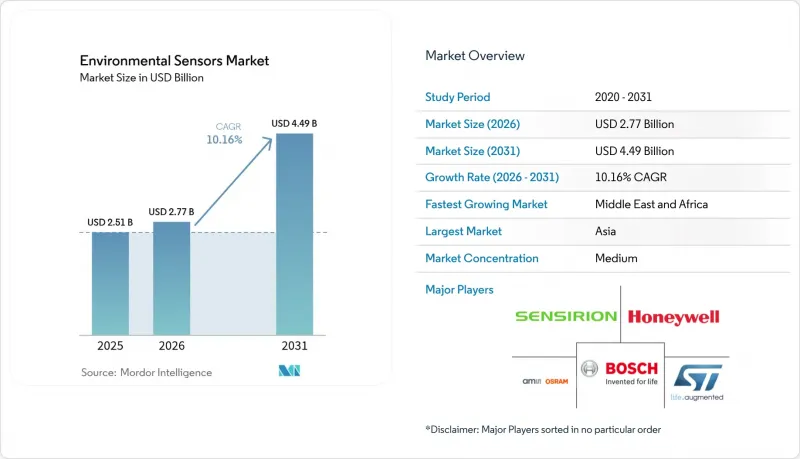
Mordor Intelligence에 의하면, 2026년 환경 센서 시장 규모는 27억 7,000만 달러로 추정되며, 2025년 25억 1,000만 달러에서 2031년에는 44억 9,000만 달러에 달할 것으로 예측됩니다.
또한 2026-2031년 연평균 성장률(CAGR) 10.16%를 기록할 전망입니다.
본 보고서는 제품 유형(고정형, 휴대형, 웨어러블형), 감지 유형(가스, 온도, 습도, 압력, 미세먼지(PM), 다중 파라미터 모듈), 연결 방식(유선, 무선),최종 사용자 산업(산업용, 의료 및 헬스케어, 소비자 가전, 자동차), 지역별로 분류되어 있습니다. 시장 전망은 금액(달러) 기준으로 제시되어 있습니다.
전 세계 환경 센서 시장 동향 및 인사이트
NB-IoT 도입 확대가 고밀도 도시 지역 센서 네트워크 구축을 뒷받침(아시아)
중국의 통신 사업자는 현재 9억 건이 넘는 NB-IoT 연결을 운영하고 있으며, 2030년까지 19억 건을 목표로 하는 확장 계획에 따라 선전 등의 도시에서는 블록 단위의 대기질 매핑을 수행하기 위한 기반이 마련되어 있습니다. 이 저전력 광역 통신 규격은 10년에 달하는 배터리 수명, 실내 깊숙한 곳까지 도달하는 전파, 그리고 라이선싱 대역에 따른 신뢰성을 갖추고 있어, 지자체는 케이블 매설 공사를 하지 않고도 고층 빌딩이 즐비한 지역을 종합적으로 커버할 수 있게 됩니다. 태국에서 UAE에 이르는 인근 국가들도 이 모델을 참고하여 스마트 시티 구축과 ESG 규정 준수를 가속화하고 있습니다.
EU 대기질 지침 2023/2119의 기준 강화
2025년 3월 지침에 따르면, PM2.5의 연간 허용치가 25µg/m³에서 10µg/m³로 하향 조정되었으며, 초미세 입자 추적이 의무화됨에 따라 회원국들은 고가의 기준 관측소를 고밀도 센서 클러스터로 보완할 수밖에 없게 되었습니다. 실시간 공개 데이터 접근에 관한 조항에 따라, 측정값을 중앙 대시보드로 스트리밍하는 IoT 지원 모듈이 우선시되고 있으며, 도시 지역의 스모그 환경에서 ±5µg/m³의 정확도를 실현할 수 있는 교정된 MEMS 유닛에 대한 수요가 증가하고 있습니다.
가혹한 실외 환경에서의 교정 드리프트 및 유지보수 비용
실외 환경에 설치된 전기화학식 센서는 온도 변동, 습도 변화 및 간섭 가스의 영향으로 인해 현저한 교정 드리프트가 발생합니다. 따라서 허용 가능한 정확도를 유지하려면 3개월마다 재교정을 수행해야 합니다. 이러한 유지보수 부담은 특히 환경적 스트레스로 인해 센서의 성능 저하가 가속화되는 가혹한 기후 조건에서는 도입 후 1년 이내에 센서의 초기 조달 비용을 초과할 가능성이 있는 막대한 운영 비용을 초래합니다. 조사에 따르면, 정기 점검 시 90% 이상의 센서가 교정 사양 범위 내를 유지하고 있는 것으로 나타났으며, 이는 현재의 유지보수 일정이 지나치게 보수적인 반면, 규정 미준수로 인한 비용이 막대하기 때문에 필수적인 조치임을 시사합니다.
부문 분석
2025년에는 고정형 센서가 환경 센서 시장 규모의 61.30%를 차지할 것으로 예상되며, 이는 플랜트 운영자가 규제 준수를 중단 없이 입증해야 할 필요성을 반영합니다. 이러한 벽면 설치형 또는 덕트 삽입형 프로브는 감사관이 Scope 1 검증에 의존하는 환경 관리 시스템에 24시간 365일 데이터를 공급합니다. 휴대용 장치는 시장 규모는 작지만, 2031년까지 연평균 성장률(CAGR) 12.31%로 성장하고 있습니다. 이는 긴급 대응 요원, 광업 회사, 건설 컨소시엄이 이동하는 작업 현장에서의 신속한 배치를 중시하기 때문입니다. 미국 국토안보부의 산불 대책 시범 사업에서는 트레일러 탑재형 PM 노드가 위성 이미지보다 30분 더 빠른 정보를 제공할 수 있음이 입증되어, 모바일 그리드의 비즈니스 사례가 실증되었습니다.
휴대용 기기는 고정형 어레이를 대체하기보다는 점점 더 이를 보완하는 존재가 되고 있습니다. 예를 들어, 유틸리티자는 규제 준수를 위해 유선식 SO2 측정 장치를 설치하고, 유지보수로 인한 정전 시에는 배터리 구동식 VOC 감지기를 이동시켜 사용하고 있습니다. 웨어러블 기기는 아직 발전 단계에 있지만, 소비자용 OEM 제조업체에게는 꽃가루 양이나 오염 경보를 피트니스 대시보드에 통합함으로써 건강을 중시하는 차별화를 꾀할 수 있는 수단이 됩니다. 예측 기간 동안, 영구적인 베이스라인과 재배치 가능한 클러스터를 융합한 하이브리드 아키텍처가 환경 센서 시장 전체의 조달 지침을 재정의하게 될 것입니다.
가스 분석 장치는 공장, 터널, 보일러 내에서 CO, NOx 및 휘발성 유기 화합물(VOC)을 감지하는 성숙한 전기화학 셀과 NDIR 광학 시스템 덕분에 2025년에 환경 센서 시장 점유율의 25.60%를 차지했습니다. 한편, 공중보건 기관들이 PM2.5 노출 기준치를 강화하고 있는 가운데, 미세먼지 측정 장치는 연평균 성장률(CAGR) 12.95%로 성장을 지속하고, 있습니다. PM 측정 기기의 환경 센서 시장 규모는 연간 평균 10µg/m3를 의무화하는 EU 및 캘리포니아주의 규제에 힘입어 2031년까지 11억 6,000만 달러에 달할 것으로 예측됩니다.
온도, 습도, 기압 센서는 여전히 보편적인 환경 모니터링 매개변수이며, 대부분의 경우 다중 매개변수 모듈 내에서 주요 가스 및 PM 기능과 결합되어 있습니다. 보쉬 센서테크(Bosch Sensortec)의 BME688은 4개의 물리 센서와 온보드 AI 추론 기능을 통합하여, 기존에는 개별 부품을 구매해야 했던 OEM 제조업체의 부품 원가를 20% 절감하고 있습니다. 이러한 융합으로 인해 기존 카테고리의 경계가 모호해지면서, 단일 매개변수 부품이 아닌 종합적인 ‘환경 팩’의 구매가 촉진되고 있습니다.
지역별 분석
2025년, 아시아태평양은 매출의 37.60%를 차지하며 환경 센서 시장을 주도했습니다. 이는 중국과 인도의 스마트 시티 메가 프로젝트가 가로등, 버스, 학교에 NB-IoT 노드를 탑재하고 있는 것이 원동력이 되었습니다. 심천시만 해도 오픈 데이터 포털에 데이터를 제공하는 3만 7,000대 이상의 대기질 측정기를 운영하고 있습니다. 견고한 전자기기 공급망 덕분에 부품 원가가 절감되어, 지자체는 1제곱킬로미터 규모의 네트워크를 1만 5,000달러 미만으로 구축할 수 있게 되었습니다. 일본과 한국의 반도체 공장은 첨단 MEMS 생산 능력을 투입하고 있는 반면, 호주의 각 주에서는 산불 대책의 일환으로 미세먼지(PM) 및 연기 감지 어레이에 투자하고 있습니다.
북미는 시장 규모 면에서 2위를 차지하고 있습니다. 이 지역의 환경 센서 시장은 SEC(미국 증권거래위원회)의 기후 변화 정보 공개 의무와 캘리포니아주, 오리건주, 브리티시컬럼비아주의 산불 대책 자금 지원에 힘입어 성장세를 보이고 있습니다. 클라우드와 엣지의 연계도 활발해지고 있으며, 하네웰이 2024년에 아날로그 디바이스와 체결한 제휴를 통해 빌딩 자동화용 게이트웨이가 Azure IoT 허브에 직접 연결되어 통합 시간이 절반으로 단축되었습니다. ‘CHIPS and Science Act(CHIPS·과학법)’에 따른 연방 정부의 보조금으로 사이버 복원력을 갖춘 센서 펌웨어의 연구 개발이 촉진되고 있습니다.
유럽은 여전히 중요한 시장이며, PM2.5 및 초미세 입자에 대한 규제 강화로 인해 400개 이상의 도시에서 센서 교체 작업이 진행되고 있습니다. 독일에서는 환경 텔레메트리를 ‘인더스트리 4.0’의 디지털 트윈과 연동하고 있으며, 북유럽의 유틸리티자는 지역 난방 시설의 지하실 내에 이슬점 측정 어레이를 설치하여 결로로 인한 에너지 손실을 관리하고 있습니다. ‘호라이즌 유럽’ 프로그램 하에서 EU 기금이 공기질 모니터링 네트워크 비용의 최대 75%를 지원하게 됨에 따라, 도입까지의 리드타임이 단축되고 있습니다.
중동 및 아프리카는 현재 시장 점유율이 한 자릿수에 머물러 있지만, 연평균 성장률(CAGR)은 13.65%로 성장을 지속하고, 있습니다. 걸프 연안의 산유국에서는 ESG 연계형 채권 발행을 위해 연속 누출 감지 시스템이 도입되고 있으며, 남아프리카의 광업 부문에서는 노동 안전 감사를 강화하기 위해 저비용 PM 측정 네트워크의 시범 운영이 진행되고 있습니다. 교정 실험실 부족은 여전히 과제로 남아 있지만, 2026년부터 2027년에 걸쳐 개설될 예정인 기부금 지원 기준 관측소를 통해 나이로비, 아크라, 라고스 전역에서 대량의 주문이 예상됩니다.
기타 혜택:
- 엑셀 형식 시장 예측(ME) 시트
- 3개월간의 애널리스트 지원
자주 묻는 질문
목차
제1장 서론
제2장 조사 방법
제3장 주요 요약
제4장 시장 구도
제5장 시장 규모와 성장 예측
제6장 경쟁 구도
제7장 시장 기회와 향후 전망
LSH 26.09.03According to Mordor Intelligence, environmental sensors market size in 2026 is estimated at USD 2.77 billion, growing from 2025 value of USD 2.51 billion with 2031 projections showing USD 4.49 billion, growing at 10.16% CAGR over 2026-2031.
This report is Segmented by Product Type (Fixed, Portable, Wearable), Sensing Type (Gas, Temperature, Humidity, Pressure, Particulate Matter (PM), Multi-Parameter Modules), Connectivity (Wired, Wireless), End-User Industry (Industrial, Medical and Healthcare, Consumer Electronics, Automotive), and Geography. The Market Forecasts are Provided in Terms of Value (USD).
Global Environmental Sensors Market Trends and Insights
Increased NB-IoT Deployments Enabling Dense Urban Sensor Networks (Asia)
Chinese operators now run more than 900 million NB-IoT connections, and expansion plans aim for 1.9 billion by 2030, giving cities like Shenzhen the backbone for block-level air-quality mapping. The low-power wide-area standard supports decade-long battery life, deep-indoor penetration, and licensed-spectrum reliability, letting municipalities blanket high-rise districts without trenching cables. Neighboring economies from Thailand to the UAE mirror this model to accelerate smart-city roll-outs and ESG compliance.
Tightening EU Ambient Air-Quality Directive 2023/2119 Standards
The March 2025 directive slices the annual PM2.5 limit from 25 µg/m3 to 10 µg/m3 and mandates ultrafine particle tracking, forcing member states to supplement costly reference stations with dense sensor clusters. Real-time public-data access clauses privilege IoT-ready modules that stream measurements to central dashboards, spurring demand for calibrated MEMS units capable of +-5 µg/m3 accuracy in urban smog.
Calibration Drift & Maintenance Costs in Harsh Outdoor Environments
Electrochemical sensors deployed in outdoor environments experience significant calibration drift due to temperature fluctuations, humidity variations, and exposure to interfering gases, requiring recalibration intervals as frequent as every 3 months to maintain acceptable accuracy. This maintenance burden creates substantial operational costs that can exceed initial sensor procurement costs within the first year of deployment, particularly in harsh climates where environmental stressors accelerate sensor degradation. Research indicates that over 90% of sensors remain within calibration specifications during routine checks, suggesting that current maintenance schedules are overly conservative but necessary due to the high cost of compliance failures.
Other drivers and restraints analyzed in the detailed report include:
- ESG-Linked Industrial Emissions Disclosure Mandates (SEC, CSRD)
- Adoption of Multi-parameter Sensor Modules in Wearables & Hearables
- Limited Reference-Grade Calibration Infrastructure in Emerging Economies
For complete list of drivers and restraints, kindly check the Table Of Contents.
Segment Analysis
Fixed installations dominated the environmental sensors market size with 61.30% revenue in 2025, reflecting plant operators' need for uninterrupted proof of regulatory conformity. These wall-mounted or duct-inserted probes feed 24/7 data to environmental management systems that auditors rely on for Scope 1 verification. Portable devices, although smaller in volume, are pacing a 12.31% CAGR through 2031 as first-responders, mining firms, and construction consortia favor rapid deployment along shifting work sites. The Department of Homeland Security's wildfire pilot showed that trailer-mounted PM nodes delivered 30-minute lead times over satellite imagery, validating the business case for mobile grids.
Portables increasingly complement-not replace-fixed arrays. Utilities, for instance, install hard-wired SO2 stacks for compliance, then wheel battery-powered VOC sniffers during maintenance outages. Wearable units remain nascent but give consumer OEMs a route to health-centric differentiation, bundling pollen counts or pollution alerts into fitness dashboards. Over the forecast cycle, hybrid architectures blending permanent baselines with redeployable clusters will redefine procurement guidelines across the environmental sensors market.
Gas analyzers captured 25.60% of environmental sensors market share in 2025 thanks to mature electrochemical cells and NDIR optics that detect CO, NOx, and volatile organic compounds in factories, tunnels, and boilers. Particulate-matter devices, however, are charting a 12.95% CAGR as public-health agencies tighten PM2.5 exposure thresholds. Environmental sensors market size for PM instruments is forecast to reach USD 1.16 billion by 2031, buoyed by EU and California mandates demanding 10 µg/m3 annual averages.
Temperature, humidity, and pressure chips remain ubiquitous housekeeping parameters, often bundled with primary gas or PM functions inside multi-parameter modules. Bosch Sensortec's BME688 unites four physical sensors plus on-board AI inference, slicing bill-of-materials cost by 20% for OEMs that previously bought discrete components. Convergence blurs historical category lines, steering purchasing toward holistic "environment packs" rather than single-parameter parts.
Complete Report Scope:
- By Product Type
- Fixed
- Portable
- Wearable
- By Sensing Type
- Gas
- Temperature
- Humidity
- Pressure
- Particulate Matter (PM)
- Multi-parameter Modules
- By Connectivity
- Wired
- Wireless
- By End-User Industry
- Industrial
- Medical and Healthcare
- Consumer Electronics
- Automotive
- Smart Homes and Buildings
- Agriculture
- Other End-Users
- By Geography
- North America
- United States
- Canada
- Mexico
- Europe
- United Kingdom
- Germany
- France
- Italy
- Rest of Europe
- Asia-Pacific
- China
- Japan
- India
- South Korea
- Rest of Asia-Pacific
- Middle East
- Israel
- Saudi Arabia
- United Arab Emirates
- Turkey
- Rest of Middle East
- Africa
- South Africa
- Egypt
- Rest of Africa
- South America
- Brazil
- Argentina
- Rest of South America
- North America
Geography Analysis
Asia-Pacific led the environmental sensors market with 37.60% revenue in 2025, powered by smart-city mega-projects in China and India that embed NB-IoT nodes in streetlights, buses, and schools. Shenzhen alone operates more than 37,000 air-quality boxes feeding open data portals. Strong electronics supply chains lower bill-of-materials, letting municipalities deploy square-kilometer grids for less than USD 15,000. Japanese and South Korean fabs inject advanced MEMS capacity, while Australian states invest in PM-and-smoke arrays for bushfire response.
North America ranks second by value. The environmental sensors market here gains momentum from SEC climate disclosure obligations and wildfire-defense funding across California, Oregon, and British Columbia. Cloud-edge alliances flourish: Honeywell's 2024 pact with Analog Devices links building-automation gateways directly to Azure IoT hubs, cutting integration times by half. Federal grants under the CHIPS and Science Act funnel R&D toward cyber-resilient sensor firmware.
Europe remains pivotal; tightened PM2.5 and ultrafine norms drive sensor retrofits across 400+ cities. Germany ties environmental telemetry to Industry 4.0 digital twins, while Nordic utilities install dew-point arrays inside district-heating vaults to manage condensation energy losses. Implementation lead times shorten because EU funds now reimburse up to 75% of air-quality network costs under Horizon Europe.
The Middle East and Africa presently represent a single-digit share but exhibit 13.65% CAGR. Gulf petro-states adopt continuous-leak detection for ESG-linked bond issuance, and South Africa's mining sector pilots low-cost PM nets to bolster labor-safety audits. Scarce calibration labs remain a hurdle, but donor-funded reference stations scheduled for 2026-2027 will unlock volume orders across Nairobi, Accra, and Lagos.
- ams OSRAM AG
- Sensirion Holding AG
- Bosch Sensortec GmbH
- Honeywell International Inc.
- Texas Instruments Inc.
- Analog Devices Inc.
- STMicroelectronics N.V.
- NXP Semiconductors N.V.
- TDK Corporation (InvenSense)
- Omron Corporation
- Sensata Technologies Inc.
- AlphaSense Inc.
- Figaro Engineering Inc.
- Banner Engineering Corp.
- Renesas Electronics Corp.
- Teledyne FLIR LLC
- Hanwei Electronics Group Corp.
- Powelectrics Ltd.
- Eurotech S.p.A.
- Omega Engineering Inc.
- Nesa Srl
- Eko Instruments B.V.
Additional Benefits:
- The market estimate (ME) sheet in Excel format
- 3 months of analyst support
TABLE OF CONTENTS
1 INTRODUCTION
- 1.1 Study Assumptions and Market Definition
- 1.2 Scope of the Study
2 RESEARCH METHODOLOGY
3 EXECUTIVE SUMMARY
4 MARKET LANDSCAPE
- 4.1 Market Overview
- 4.2 Market Drivers
- 4.2.1 Increased NB-IoT Deployments Enabling Dense Urban Sensor Networks (Asia)
- 4.2.2 Tightening EU Ambient Air-Quality Directive 2023/2119 Standards
- 4.2.3 ESG-Linked Industrial Emissions Disclosure Mandates (SEC, CSRD)
- 4.2.4 Adoption of Multi-parameter Sensor Modules in Wearables and Hearables
- 4.2.5 Green-Hydrogen and Battery Gigafactory Build-outs Requiring Humidity/Gas Sensors
- 4.2.6 Wild-fire Early-Warning Networks in North America Using Distributed PM Sensors
- 4.3 Market Restraints
- 4.3.1 Calibration Drift and Maintenance Costs in Harsh Outdoor Environments
- 4.3.2 Limited Reference-Grade Calibration Infrastructure in Emerging Economies
- 4.3.3 Cyber-security and IP Concerns Around Cloud-Connected Industrial Sensors
- 4.3.4 Price Erosion from Commoditization of MEMS Components
- 4.4 Value / Supply-Chain Analysis
- 4.5 Regulatory and Technological Outlook
- 4.6 Porter's Five Forces Analysis
- 4.6.1 Bargaining Power of Suppliers
- 4.6.2 Bargaining Power of Consumers
- 4.6.3 Threat of New Entrants
- 4.6.4 Threat of Substitute Products
- 4.6.5 Intensity of Competitive Rivalry
5 MARKET SIZE AND GROWTH FORECASTS (VALUE)
- 5.1 By Product Type
- 5.1.1 Fixed
- 5.1.2 Portable
- 5.1.3 Wearable
- 5.2 By Sensing Type
- 5.2.1 Gas
- 5.2.2 Temperature
- 5.2.3 Humidity
- 5.2.4 Pressure
- 5.2.5 Particulate Matter (PM)
- 5.2.6 Multi-parameter Modules
- 5.3 By Connectivity
- 5.3.1 Wired
- 5.3.2 Wireless
- 5.4 By End-User Industry
- 5.4.1 Industrial
- 5.4.2 Medical and Healthcare
- 5.4.3 Consumer Electronics
- 5.4.4 Automotive
- 5.4.5 Smart Homes and Buildings
- 5.4.6 Agriculture
- 5.4.7 Other End-Users
- 5.5 By Geography
- 5.5.1 North America
- 5.5.1.1 United States
- 5.5.1.2 Canada
- 5.5.1.3 Mexico
- 5.5.2 Europe
- 5.5.2.1 United Kingdom
- 5.5.2.2 Germany
- 5.5.2.3 France
- 5.5.2.4 Italy
- 5.5.2.5 Rest of Europe
- 5.5.3 Asia-Pacific
- 5.5.3.1 China
- 5.5.3.2 Japan
- 5.5.3.3 India
- 5.5.3.4 South Korea
- 5.5.3.5 Rest of Asia-Pacific
- 5.5.4 Middle East
- 5.5.4.1 Israel
- 5.5.4.2 Saudi Arabia
- 5.5.4.3 United Arab Emirates
- 5.5.4.4 Turkey
- 5.5.4.5 Rest of Middle East
- 5.5.5 Africa
- 5.5.5.1 South Africa
- 5.5.5.2 Egypt
- 5.5.5.3 Rest of Africa
- 5.5.6 South America
- 5.5.6.1 Brazil
- 5.5.6.2 Argentina
- 5.5.6.3 Rest of South America
- 5.5.1 North America
6 COMPETITIVE LANDSCAPE
- 6.1 Market Concentration
- 6.2 Strategic Moves
- 6.3 Market Share Analysis
- 6.4 Company Profiles (includes Global-level Overview, Market-level Overview, Core Segments, Financials as available, Strategic Information, Market Rank/Share, Products and Services, Recent Developments)
- 6.4.1 ams OSRAM AG
- 6.4.2 Sensirion Holding AG
- 6.4.3 Bosch Sensortec GmbH
- 6.4.4 Honeywell International Inc.
- 6.4.5 Texas Instruments Inc.
- 6.4.6 Analog Devices Inc.
- 6.4.7 STMicroelectronics N.V.
- 6.4.8 NXP Semiconductors N.V.
- 6.4.9 TDK Corporation (InvenSense)
- 6.4.10 Omron Corporation
- 6.4.11 Sensata Technologies Inc.
- 6.4.12 AlphaSense Inc.
- 6.4.13 Figaro Engineering Inc.
- 6.4.14 Banner Engineering Corp.
- 6.4.15 Renesas Electronics Corp.
- 6.4.16 Teledyne FLIR LLC
- 6.4.17 Hanwei Electronics Group Corp.
- 6.4.18 Powelectrics Ltd.
- 6.4.19 Eurotech S.p.A.
- 6.4.20 Omega Engineering Inc.
- 6.4.21 Nesa Srl
- 6.4.22 Eko Instruments B.V.
7 MARKET OPPORTUNITIES AND FUTURE OUTLOOK
- 7.1 White-space and Unmet-Need Assessment


