

|
시장보고서
상품코드
2122647
항공기 낙뢰 보호 시장 : 시장 점유율 분석, 업계 동향 및 통계, 성장 예측(2026-2031년)Aircraft Lightning Protection - Market Share Analysis, Industry Trends & Statistics, Growth Forecasts (2026 - 2031) |
||||||
 Mordor Intelligence
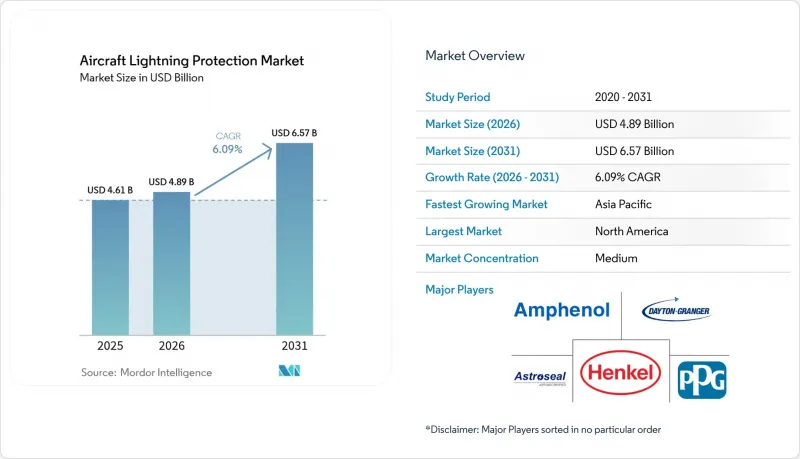
에 의하면, 항공기 낙뢰 보호 시장 규모는 2025년 46억 1,000만 달러로 평가되었고, 2026년에는 48억 9,000만 달러로 추정되고, 2026-2031년 CAGR 6.09%로 성장을 지속할 전망이며, 2031년에는 65억 7,000만 달러에 이를 것으로 예측됩니다.
본 보고서는 제품 유형별(확장 금속 포일, 인터위브 와이어 패브릭 등), 항공기 유형별(고정익기, 회전익기, 무인항공기 등), 도입 형태별(라인 핏, 레트로핏), 최종 사용자별(민간/상용 등), 지역별(북미, 남미, 유럽,아시아태평양 등)로 분류되어 있습니다. 시장 예측은 금액(달러) 기준으로 제시되어 있습니다.
세계의 항공기 낙뢰 보호 시장 동향 및 인사이트
복합재 기체 납품 급증
B787 및 A350 항공기 제품군은 낙뢰 전류를 분산시키기 위해 내장형 구리 또는 알루미늄 메쉬를 채택하고 있으며, 이는 외부 본딩 스트랩에서 근본적인 설계 전환을 의미합니다. 항공사들은 통합형 메쉬를 표준으로 간주하는 경향이 강해지고 있으며, 이러한 기대는 현재 협폭기 개조 프로그램과 최신 지역 제트기에도 파급되고 있습니다. NASA의 시험 패널에 따르면, 경량 비금속 필름을 사용함으로써 낙뢰로 인한 손상 깊이를 79% 줄이면서 낙뢰 후 압축 강도를 21% 향상시킬 수 있는 것으로 나타났습니다. 이에 따라 각 OEM 업체들은 향후 모델에 더 얇고 가벼운 층을 채택하는 것을 촉진하고 있습니다. 각 새로운 복합재 패널에는 공장에서 전도 경로를 설치해야 하기 때문에 소재의 혁신이 단위 수요를 더욱 끌어올리고 있습니다. 이 요인에 의한 수요 견인력은 2027년까지 가장 강력하게 지속될 것이며, 복합재 보급률이 정점에 도달함에 따라 점차 안정화될 전망입니다.
증가하는 민간 항공기 수주 잔고
단동기 제트기의 미결 주문량은 2031년까지 계속해서 포화 상태를 유지하고 있습니다. 보잉과 에어버스는 생산 속도 제고를 확장 금속 박막(expanded metal foil) 등의 특수 소재 안정 공급과 공개적으로 연계하고 있습니다. PPG의 2024년 3분기 항공우주용 코팅 수주 잔고 2억 9,000만 달러는 이미 리드타임이 길어지고 있는 공급망에 가해지는 부담이 얼마나 큰지를 여실히 보여주고 있습니다. 수주 잔고가 소진될 때마다, 낙뢰 보호 키트에 대한 라인 피팅 수요가 물결처럼 발생합니다. 한편, 납품 지연은 항공사들이 구형 기종의 수명을 연장함에 따라 추가적인 개조 기회로 이어집니다. 아시아태평양의 기체는 전 세계 미결 주문량의 3분의 1을 차지하고 있으며, 이 지역은 2026년까지 양적 성장의 원동력이 될 전망입니다.
고액의 인증 시험 비용
200 kA의 임펄스에 대응 가능한 낙뢰 시뮬레이션 실험실에서는 1회 시험당 4만 달러가 넘는 항공우주 업계 요금이 청구되며, 완전한 적합성 프로그램을 수행하려면 여러 크기의 시험편에 걸쳐 수십 회의 낙뢰 시험이 필요할 수 있습니다. 그래핀 및 CNT(탄소나노튜브) 솔루션을 개발하는 신생 기업들은 인증의 이정표를 달성하기 전에 시드 자금을 모두 소진하는 경우가 많으며, 그 결과 해당 지적 재산권(IP)은 대형 기존 기업에 라이선싱되게 됩니다. 이러한 재정적 장벽은 기술의 다양성을 전반적으로 제약하고, 가격 경쟁을 둔화시키며, 향후 예상 성장률을 추정치로 0.8퍼센트 포인트 낮추는 요인이 됩니다.
부문 분석
확장 금속 포일은 오랜 사용 실적과 풍부한 인증 데이터 덕분에 2025년에도 항공기 낙뢰 보호 시장 점유율의 48.62%를 계속 차지했습니다. 그럼에도 불구하고, 도금 탄소섬유는 7.33%라는 연평균 성장률(CAGR)이 기존 포일의 판매량 증가율을 상회하고 있기 때문에 항공기 낙뢰 보호 시장 규모에서 점유율을 확대해 나갈 것으로 예측됩니다. 이 소재는 구조용 프라이 내에 전도성을 접목함으로써 방전 경로를 유지하면서 경량화를 실현하고 있으며, 그 장점은 787의 동체 패널에서 입증되었습니다. 탄소나노튜브가 배합된 시험용 패널에서는 낙뢰로 인한 손상 흔적이 54.8% 감소한 것이 확인되었으며, 나노 강화 플라이가 실험실에서 양산 라인으로 전환됨에 따라 향후 성과가 기대됩니다.
직조된 와이어 패브릭은 입증된 생존성을 요구하는 방위 분야의 주요 제조업체들로부터 지지를 받고 있으며, 특히 폭풍이 잦은 전장에서 저공 비행을 수행하는 회전익기에서 수요가 증가하고 있습니다. 전도성 코팅은 포일 적층이 현실적으로 어려운 개조 분야의 틈새를 메우고 있습니다. 그러나 연구에 따르면 두꺼운 코팅은 아크 열을 가두어 층간 박리 현상을 확대시킬 가능성이 있으므로 채택에 제한이 있습니다. 현재 매출 구성에는 포함되어 있지 않지만, 초기 단계의 그래핀 필름은 고가의 구리를 사용하지 않고도 단위 면적당 무게를 획기적으로 줄일 수 있을 것으로 기대되어, 에어버스와 BAE로부터 연구 개발 자금을 유치하고 있습니다.
2025년 매출의 58.10%를 고정익 제트기가 차지했으며, 항공기 낙뢰 보호 시장의 중추적인 역할을 확고히 하고 있습니다. 또한, 고정익 제트기는 현재 인증 노하우의 대부분을 차지하고 있기 때문에 소재 공급업체들은 신흥 분야에 진출하기 전에 일반적으로 단일 통로형 기체에서 새로운 솔루션을 검증하고 있습니다. 대조적으로, eVTOL 기체 시장은 연평균 성장률(CAGR) 9.85%로 확대되고 있으며, 분산형 추진 포드와 고에너지 배터리가 도입됨에 따라 낙뢰의 침입 경로가 여러 개 발생하고 있습니다. EASA의 최신 특별 조건에서는 구조적 전류 경로에 더해, 배터리의 열 폭주에도 대응하는 시스템 차원의 종합적인 보호가 의무화되어 있습니다.
eVTOL용 부품의 항공기 낙뢰 보호 시장 규모는 2026년 이후 프로토타입이 양산 단계에 접어들면서 수 배로 확대될 것으로 예측됩니다. 회전익 항공기는 회전하는 허브가 자연스럽게 번개를 끌어들이기 때문에 여전히 안정적인 틈새 시장으로 남아 있습니다. 이 때문에 14 CFR 27.610에서 의무화하고 있는 견고한 로터 팁 접합 및 블레이드 보호층이 요구됩니다. 이 부문의 전체적인 상황을 살펴보면, 고정익 제트기의 기존 LINE-FIT 생산량이 금세기 후반 도심항공모빌리티(UAM)(UAM) 기체 군을 장악할 것으로 예상되는 경량 솔루션의 연구 개발(R&D) 자금을 충당하고 있음을 알 수 있습니다.
지역별 분석
북미는 전 세계 복합재 기체 조립 시설, 고에너지 인증 시험소 및 Tier 1 공급업체의 대부분을 보유하고 있어 2025년 매출의 38.12%를 계속 차지했습니다. FAA와의 협력을 통해 인증 시험이 원활하게 진행되어 공급업체는 시장 출시 기간을 단축할 수 있게 되었습니다. 캐나다의 틈새 시장 공급업체는 수지 주입용 포일을 공급하고 있으며, 멕시코의 마키라도라(수출가공구)에서는 객실 구역용 접착 하드웨어가 제조되고 있습니다. 생태계의 긴밀성이 프리미엄 가격 책정을 뒷받침하고 있지만, 인력 부족으로 인해 일정 지연의 위험이 있습니다. 아시아태평양은 7.62%라는 가장 높은 연평균 성장률(CAGR)을 기록하고 있으며, 그 배경에는 2025년까지 270개의 공항을 운영하겠다는 중국의 계획이 있어, 각 공항이 새로운 협폭기 수주를 주도했습니다. 국내 복합재 공장은 급속히 규모를 확대하고 있지만, 지적 재산권 보호와 관련해서는 서유럽 국가들이 여전히 우려를 표명하고 있어 최신 탄소나노튜브(CNT) 강화 메쉬의 기술 이전을 지연시키고 있습니다. 2024년도에 7조 700억 엔으로 급증한 일본의 수주 잔고는 방위성의 엄격한 사양과 맞물려, 고전류용 포일 및 내식성 실란트에 대한 국내 수요를 자극하고 있습니다. 인도 바도다라에 위치한 타타-에어버스 합작 생산 라인은 국산 피뢰 장치 공급을 위한 초기 기반을 마련하고 있지만, 유럽 및 미국 수준의 생산량에 도달하기까지는 20년이 소요될 것으로 예측됩니다. 유럽은 계속해서 기술 최첨단을 달리고 있습니다. 유럽항공안전청(EASA)의 인증 기관은 규제 변경의 조기 도입을 촉진하고 있으며, 호라이즌 계획의 자금을 지원받은 연구소는 메쉬의 무게를 58% 줄이는 초박형 알루미늄 코팅 개발을 주도하고 있습니다. 중동에서는 걸프 지역 항공사들의 기체 갱신이 뒷받침되면서 개조 수요가 확대되고 있습니다. 남미와 아프리카는 여전히 발전 단계에 있지만, 브라질의 지역 제트기 수출은 현지 호일 가공 라인에 대한 미래 수요의 씨앗이 되고 있습니다.
기타 혜택 :
- 엑셀 형식 시장 예측(ME) 시트
- 3개월간의 애널리스트 지원
자주 묻는 질문
목차
제1장 서론
제2장 조사 방법
제3장 주요 요약
제4장 시장 구도
제5장 시장 규모 및 성장 예측
제6장 경쟁 구도
제7장 시장 기회 및 향후 전망
AJY 26.09.07According to Mordor Intelligence, the aircraft lightning protection market size is expected to grow from USD 4.61 billion in 2025 to USD 4.89 billion in 2026 and is forecast to reach USD 6.57 billion by 2031 at 6.09% CAGR over 2026-2031.
This report is Segmented by Product Type (Expanded Metal Foils, Interwoven Wire Fabrics, and More), Aircraft Type (Fixed-Wing Aircraft, Rotorcraft, Unmanned Aerial Vehicle, and More), Fit (Line-Fit, and Retrofit), End User (Civil/Commercial, and More) and Geography (North America, South America, Europe, Asia-Pacific, and More). The Market Forecasts are Provided in Terms of Value (USD).
Global Aircraft Lightning Protection Market Trends and Insights
Surge in Composite-Airframe Deliveries
B787 and A350 aircraft families rely on embedded copper or aluminum meshes to dissipate strike currents, marking a wholesale design departure from external bonding straps. Operators increasingly view integrated mesh as standard, and that expectation now cascades into narrow-body refresh programs and the latest regional jets. NASA test panels showed that lightweight non-metallic films can cut lightning damage depth by 79% while boosting post-strike compressive strength by 21%, encouraging OEMs to adopt thinner, lighter layers in forthcoming models. Material innovation thus compounds unit demand, as each new composite panel requires factory-installed conductive pathways. The driver delivers its strongest pull through 2027, stabilizing as composite penetration plateaus.
Increasing Commercial Aircraft Backlogs
Order books for single-aisle jets remain full well into 2031. Boeing and Airbus have publicly linked production-rate hikes to a reliable supply of specialty materials such as expanded metal foils. PPG's USD 290 million aerospace-coatings backlog in Q3 2024 highlights the strain on supply chains already running at extended lead times. Each backlog drawdown releases a wave of line-fit demand for lightning protection kits, while deferred deliveries translate into incremental retrofit opportunities as airlines stretch the life of older frames. Asia-Pacific fleets constitute a third of the global backlog, positioning the region as the volume growth engine through 2026.
High Qualification-Testing Costs
Lightning simulation labs capable of 200 kA impulses charge aerospace rates exceeding USD 40,000 per shot, and a full compliance program can require dozens of strikes across multiple coupon sizes. Start-ups developing graphene or CNT solutions often exhaust seed funding before clearing certification milestones, leaving their IP to be licensed by larger incumbents. The financial hurdle constrains overall technology diversity and slows price competition, trimming growth by an estimated 0.8 percentage points over the horizon.
Other drivers and restraints analyzed in the detailed report include:
- Stricter FAA and EASA Lightning-Certification Rules
- Growing Retrofit Programs for Aging Fleets
- Weight-Penalty Versus Fuel-Burn Trade-offs
For complete list of drivers and restraints, kindly check the Table Of Contents.
Segment Analysis
Expanded metal foils still held 48.62% of the aircraft lightning protection market share in 2025 due to their long service history and abundant certification data. Even so, plated carbon fiber is projected to capture a rising slice of the aircraft lightning protection market size as its 7.33% CAGR outpaces volume growth in legacy foils. The material embeds conductivity within structural plies, shaving weight while maintaining strike pathways, an advantage validated on 787 fuselage panels. Research panels with carbon nanotubes recorded 54.8% smaller strike scars, pointing to future gains as nano-reinforced plies move from lab to line.
Interwoven wire fabrics appeal to defense primes seeking proven survivability, particularly for rotorcraft operating low-level in storm-dense theaters. Conductive coatings fill retrofit niches where foil lay-up is impractical; however, studies show thick coatings can trap arc heat and enlarge delamination, limiting adoption. Though outside today's revenue pie, early-stage graphene films attract R&D capital from Airbus and BAE because they promise step-changes in areal weight without expensive copper inputs.
Fixed-wing jets generated 58.10% of 2025 revenue, cementing their role as the anchor of the aircraft lightning protection market. They also represent the majority of current certification knowledge, so material suppliers routinely validate new solutions on single-aisle structures before chasing emerging categories. In contrast, eVTOL airframes expand at a 9.85% CAGR and introduce distributed propulsion pods and high-energy batteries that create multiple strike entry points. EASA's latest special conditions now require holistic system-level protection that addresses battery thermal runaway alongside structural current paths.
The aircraft lightning protection market size for eVTOL components is forecast to multiply as prototypes enter serial production from 2026 onward. Rotorcraft remain a steady niche because their rotating hubs naturally attract leaders, demanding robust rotor-tip bonding and blade protection layers mandated by 14 CFR 27.610. The segment tableau shows traditional line-fit volume in fixed-wing jets financing R&D for lightweight solutions poised to dominate the urban air-mobility fleet later in the decade.
Complete Report Scope:
- By Product Type
- Expanded Metal Foils
- Interwoven Wire Fabrics
- Conductive Coatings
- Plated Carbon Fiber (PCF)
- Others
- By Aircraft Type
- Fixed-Wing Aircraft
- Narrow-Body
- Wide-Body
- Regional and Business Jets
- Rotorcraft
- Civil Helicopters
- Military Helicopters
- Unmanned Aerial Vehicles (UAV)
- eVTOL/UAM Vehicles
- Fixed-Wing Aircraft
- By Fit
- Line-Fit
- Retrofit
- By End User
- Civil/Commercial
- Military
- By Region
- North America
- United States
- Canada
- Mexico
- Europe
- United Kingdom
- Germany
- France
- Russia
- Rest of Europe
- Asia-Pacific
- China
- Japan
- India
- South Korea
- Rest of Asia-Pacific
- South America
- Brazil
- Rest of South America
- Middle East and Africa
- Middle East
- United Arab Emirates
- Saudi Arabia
- Israel
- Rest of Middle East
- Africa
- South Africa
- Egypt
- Rest of Africa
- Middle East
- North America
Geography Analysis
North America retained 38.12% of 2025 revenue because the region hosts the bulk of global composite-airframe assembly, high-energy certification labs, and tier-one suppliers. FAA collaboration eases qualification runs, allowing vendors to compress time-to-market. Canada's niche suppliers feed resin-infusion foils, while Mexico's maquiladoras machine bonding hardware for cabin zones. Ecosystem tightness supports premium pricing, though labor shortages risk schedule slip. Asia-Pacific posts the fastest 7.62% CAGR, underpinned by China's intent to operate 270 airports by 2025, each driving fresh narrow-body orders. Domestic composites plants scale rapidly; however, intellectual-property safeguards remain a Western concern, slowing the transfer of the latest CNT-reinforced meshes. Japan's orderbook surge to JPY 7.07 trillion in FY 2024 pairs with stringent MoD specifications, spurring local demand for high-amp foil and corrosion-resistant sealants. India's Tata-Airbus line at Vadodara lays early groundwork for an indigenous lightning-protection supply but needs two decades to match Western volume. Europe continues as the technology vanguard. The EASA certification authority prompts early adoption of regulatory changes, and Horizon-funded labs pioneer ultra-thin aluminum coatings that cut mesh weight by 58%. The Middle East leverages fleet renewals at Gulf carriers, pushing retrofit demand. South America and Africa remain nascent, but Brazil's regional jet exports seed future requirements for local foil conversion lines.
- PPG Industries, Inc.
- Astroseal Products Manufacturing Corp.
- Dayton-Granger, Inc.
- Henkel Corporation
- Amphenol Aerospace (Amphenol Corporation)
- Conductive Composites, Inc.
- Technical Fiber Products Ltd.
- AEF Solutions Ltd.
- APCM, LLC
- Syensqo SA
- Gill Corporation
- 3M COMPANY
- Park Aerospace Corp.
- Priyaa Expanded Mesh Private Limited (PEMPL)
- CThru Metals
- Microchip Technology Incorporated
Additional Benefits:
- The market estimate (ME) sheet in Excel format
- 3 months of analyst support
TABLE OF CONTENTS
1 INTRODUCTION
- 1.1 Study Assumptions and Market Definition
- 1.2 Scope of the Study
2 RESEARCH METHODOLOGY
3 EXECUTIVE SUMMARY
4 MARKET LANDSCAPE
- 4.1 Market Overview
- 4.2 Market Drivers
- 4.2.1 Surge in composite-airframe deliveries
- 4.2.2 Increasing commercial aircraft backlogs
- 4.2.3 Stricter FAA and EASA lightning-certification rules
- 4.2.4 Growing retrofit programs for aging fleets
- 4.2.5 On-board lightning detection and prognostic maintenance
- 4.2.6 Electrification of eVTOL/urban air-taxi fleets
- 4.3 Market Restraints
- 4.3.1 High qualification-testing costs
- 4.3.2 Weight-penalty versus fuel-burn trade-offs
- 4.3.3 Volatile aluminum and copper raw-material prices
- 4.3.4 Slow certification of nanomaterial coatings
- 4.4 Value Chain Analysis
- 4.5 Regulatory Landscape
- 4.6 Technological Outlook
- 4.7 Porter's Five Forces Analysis
- 4.7.1 Threat of New Entrants
- 4.7.2 Bargaining Power of Buyers
- 4.7.3 Bargaining Power of Suppliers
- 4.7.4 Threat of Substitutes
- 4.7.5 Intensity of Competitive Rivalry
5 MARKET SIZE AND GROWTH FORECASTS (VALUE)
- 5.1 By Product Type
- 5.1.1 Expanded Metal Foils
- 5.1.2 Interwoven Wire Fabrics
- 5.1.3 Conductive Coatings
- 5.1.4 Plated Carbon Fiber (PCF)
- 5.1.5 Others
- 5.2 By Aircraft Type
- 5.2.1 Fixed-Wing Aircraft
- 5.2.1.1 Narrow-Body
- 5.2.1.2 Wide-Body
- 5.2.1.3 Regional and Business Jets
- 5.2.2 Rotorcraft
- 5.2.2.1 Civil Helicopters
- 5.2.2.2 Military Helicopters
- 5.2.3 Unmanned Aerial Vehicles (UAV)
- 5.2.4 eVTOL/UAM Vehicles
- 5.2.1 Fixed-Wing Aircraft
- 5.3 By Fit
- 5.3.1 Line-Fit
- 5.3.2 Retrofit
- 5.4 By End User
- 5.4.1 Civil/Commercial
- 5.4.2 Military
- 5.5 By Region
- 5.5.1 North America
- 5.5.1.1 United States
- 5.5.1.2 Canada
- 5.5.1.3 Mexico
- 5.5.2 Europe
- 5.5.2.1 United Kingdom
- 5.5.2.2 Germany
- 5.5.2.3 France
- 5.5.2.4 Russia
- 5.5.2.5 Rest of Europe
- 5.5.3 Asia-Pacific
- 5.5.3.1 China
- 5.5.3.2 Japan
- 5.5.3.3 India
- 5.5.3.4 South Korea
- 5.5.3.5 Rest of Asia-Pacific
- 5.5.4 South America
- 5.5.4.1 Brazil
- 5.5.4.2 Rest of South America
- 5.5.5 Middle East and Africa
- 5.5.5.1 Middle East
- 5.5.5.1.1 United Arab Emirates
- 5.5.5.1.2 Saudi Arabia
- 5.5.5.1.3 Israel
- 5.5.5.1.4 Rest of Middle East
- 5.5.5.2 Africa
- 5.5.5.2.1 South Africa
- 5.5.5.2.2 Egypt
- 5.5.5.2.3 Rest of Africa
- 5.5.5.1 Middle East
- 5.5.1 North America
6 COMPETITIVE LANDSCAPE
- 6.1 Market Concentration
- 6.2 Strategic Moves
- 6.3 Market Share Analysis
- 6.4 Company Profiles (includes Global level Overview, Market level overview, Core Segments, Financials as available, Strategic Information, Market Rank/Share for key companies, Products and Services, and Recent Developments)
- 6.4.1 PPG Industries, Inc.
- 6.4.2 Astroseal Products Manufacturing Corp.
- 6.4.3 Dayton-Granger, Inc.
- 6.4.4 Henkel Corporation
- 6.4.5 Amphenol Aerospace (Amphenol Corporation)
- 6.4.6 Conductive Composites, Inc.
- 6.4.7 Technical Fiber Products Ltd.
- 6.4.8 AEF Solutions Ltd.
- 6.4.9 APCM, LLC
- 6.4.10 Syensqo SA
- 6.4.11 Gill Corporation
- 6.4.12 3M COMPANY
- 6.4.13 Park Aerospace Corp.
- 6.4.14 Priyaa Expanded Mesh Private Limited (PEMPL)
- 6.4.15 CThru Metals
- 6.4.16 Microchip Technology Incorporated
7 MARKET OPPORTUNITIES AND FUTURE OUTLOOK
- 7.1 White-space and Unmet-Need Assessment


