

|
시장보고서
상품코드
2122670
프린트형 센서 시장 : 시장 점유율 분석, 업계 동향 및 통계, 성장 예측(2026-2031년)Printed Sensor - Market Share Analysis, Industry Trends & Statistics, Growth Forecasts (2026 - 2031) |
||||||
 Mordor Intelligence
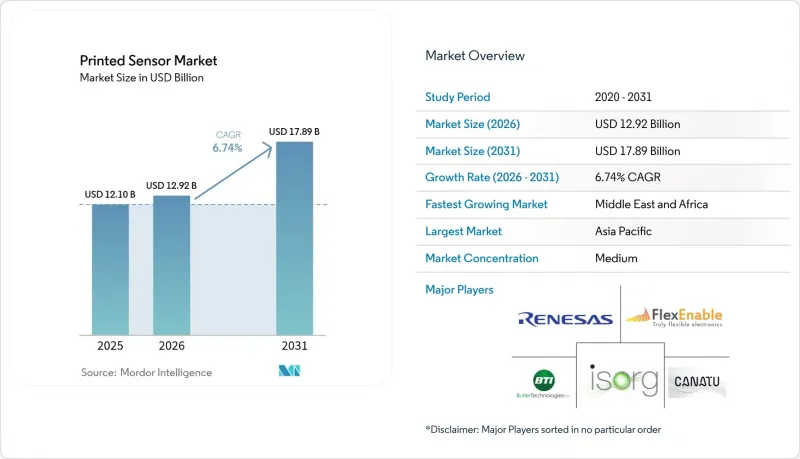
Mordor Intelligence에 의하면, 프린트형 센서 시장 규모는 2025년 121억 달러로 평가되었고, 2026년에는 129억 2,000만 달러로 추정되고, 2026-2031년 CAGR 6.74%로 성장을 지속할 전망이며, 2031년에는 178억 9,000만 달러에 이를 것으로 예측됩니다.
본 보고서는 센서 유형별(터치/정전용량식, 온도 센서 등), 인쇄 기술별(스크린 인쇄, 잉크젯 등), 기판별(플라스틱 필름(PET, PEN), 종이 및 판지 등), 최종 사용자별(소비자용 전자기기, 헬스케어 및 의료기기 등), 지역별로 분류되어 있습니다. 시장 전망은 금액(달러) 기준으로 제시되어 있습니다.
세계의 프린트형 센서 시장 동향 및 인사이트
유연 및 웨어러블 의료기기의 급속한 보급
아시아태평양의 의료 시스템에서는 원격 모니터링 프로그램이 확대되고 있으며, 피부나 섬유에 편안하게 부착할 수 있는 바이오 센서에 대한 수요가 증가하고 있습니다. 현재 땀을 이용한 플랫폼을 통해 신체에 천자를 하지 않고도 염증 마커, 수분량, 혈당를 측정할 수 있게 되었습니다. 플렉서블 하이브리드 일렉트로닉스(FHE)는 인쇄 어레이와 실리콘 로직을 통합하여 블루투스를 통해 실시간 생체 신호를 병원 대시보드로 전송하는 패치를 형성합니다. 이러한 기능 덕분에 FHE 시장은 2030년까지 670억 달러를 넘어설 것으로 예측됩니다. 병원 네트워크에서는 이러한 지속적인 데이터 스트림을 활용하여 입원 기간을 단축하고 합병증을 조기에 감지하고 있습니다. 단가가 3달러 미만으로 떨어짐에 따라 중산층 의료 기관에서도 수술 후 환자가 퇴원 시 착용할 수 있게 되어 지역 내 보급이 가속화되고 있습니다. 일본, 한국, 중국의 규제 당국은 웨어러블 진단 기기에 대한 신속 승인 절차를 공식적으로 도입했으며, 이는 판매 대수의 추가적인 증가를 뒷받침하고 있습니다.
자동차 업계의 곡면 HMI 대시보드로의 전환
세계 자동차 제조업체들은 기계식 노브를 인테리어의 곡선을 따라 매끄럽게 이어지는 터치 패널로 대체하고 있습니다. KURZ사의 ‘PolyTC(R)’ 금속 메쉬 정전용량식 층은 롤-투-롤 방식의 라인을 사용하여 PET 위에 성형되며, 2.5mm 두께의 장식용 플라스틱을 통해서도 터치를 감지할 수 있어 OEM의 스타일링 목표를 충족합니다. 이 센서들은 85°C의 고온 및 40°C의 저온이라는 인증 주기를 견디며, 차량의 수명 기간 내내 반응성을 유지합니다. 또한, 각 Tier 1 공급업체들은 스티어링 휠과 팔걸이에 인쇄된 센서 어레이를 통합하여 운전자의 조작 상황을 감지하고, 이에 따라 에어백 및 경고 시스템을 조정하고 있습니다. 소프트웨어 정의형 콕핏 플랫폼은 균일한 센서 그리드를 활용하여, 하드웨어를 교체하지 않고도 제어 레이아웃을 업데이트할 수 있는 OTA(Over-the-Air) 업그레이드를 가능하게 합니다. 현재 유럽과 북미가 도입을 주도하고 있지만, 중국의 전기차 브랜드들도 그 뒤를 바짝 쫓고 있으며, 2026년 출시를 목표로 일체형 정전용량식 패널을 도입할 예정입니다.
표준화된 시험 프로토콜의 부재
신축성 있는 생체 센서는 신체 움직임에 따라 구부러지고, 뒤틀리고, 압축되지만, 이러한 거동은 기존의 IEC 60601 충격 및 진동 시험에서는 다루지 않습니다. 각 브랜드는 신장, 세탁 내구성, 피부 접촉 시 생체 적합성에 대해 독자적인 시험 체계를 구축해야 하며, 이로 인해 설계 주기가 지연되고 있습니다. UL 솔루션즈는 제품 분류나 지역에 따라 다른 CE, FDA, IEC 요건이라는 복잡한 상황을 종합적으로 정리했습니다. 업계 단체들은 공통의 부하 사례 매트릭스를 마련 중이지만, 보행 모니터, 신생아용 패치, 스마트 저지 등 각 제품이 고유한 변형 패턴을 보이기 때문에 아직 합의에 이르지 못하고 있습니다. 인증 지연은 운전 자금 수요를 증가시켜 중소기업 시장 진입을 저해하는 요인이 되며, 단기적인 시장 침투를 제한하고 있습니다.
부문 분석
터치/정전용량식 유닛은 2025년 31.12%의 점유율로 프린트형 센서 시장을 주도했습니다. 이러한 우위는 스마트폰, 노트북, 인포테인먼트 디스플레이 등 폭넓은 분야에서의 보급에 기인합니다. 바이오센서는 현재 규모는 작지만, 병원이 병원 밖에서의 지속적인 평가로 전환함에 따라 연평균 성장률(CAGR) 11.45%로 성장하고 있습니다. 이러한 추세를 뒷받침하는 것은 젖산, 포도당 및 감염 마커의 비침습적 검출을 가능하게 하는 나노효소 화학입니다. 캐나다와 독일에서 원격 환자 모니터링에 대한 보험 급여 제도에 대한 규제 당국의 승인으로 인해 해당 시장 규모가 확대되고 있습니다. 가스/화학 물질, 온도, 압력/힘, 피에조/변형률 각 카테고리는 안전성, 배터리 팩, 구조적 건전성 측면에서 틈새 역할을 수행하고 있으며, 122 ppb 수준의 암모니아 검출과 같은 획기적인 기술을 통해 새로운 규정 준수 솔루션이 가능해졌습니다. 통합형 멀티모달 스택은 설치 면적을 확대하지 않고도 터치, 압력, 생체 인증을 단일 적층체에 결합하여, 스마트 링이나 이어폰과 같이 공간이 제한된 설계에 채택되고 있습니다.
10달러 미만의 바이오센서 패치는 동남아시아의 진료소에서 대규모 선별 검사 프로그램을 촉진하고, 만성 질환의 추적 관리를 개선하고 있습니다. TPU 필름에 인쇄된 압력 어레이는 노인 요양 시설에서 낙상 위험을 감지하는 AI 보행 분석 엔진에 힘 데이터를 제공합니다. 리튬 이온 모듈에 내장된 가스 센서는 조기 가스 방출 경보를 제공하여 배터리 팩 제조업체가 UN 38.3 안전 규정을 준수할 수 있도록 지원합니다. 공장 컨베이어 벨트에 직조된 피에조 실은 변형을 감지하여, 예측 유지보수 소프트웨어가 치명적인 파단이 발생하기 전에 가동 중단 시간을 계획할 수 있도록 합니다. 이러한 기능의 다양성 덕분에 공급업체는 유연성을 유지하고 있습니다. 맞춤형 잉크의 화학 조성, 기판 선정, 전극 형상은 프로젝트마다 다르기 때문에 모듈식 생산 툴킷의 도입이 요구되고 있습니다.
스크린 인쇄는 세라믹 및 PCB 분야에서 입증된 처리량, 두꺼운 필름 형성 능력, 그리고 수십 년에 걸쳐 상각된 설비 덕분에 2025년에는 매출의 41.55%를 차지했습니다. 약 100µm의 표준 선폭은 대부분의 정전용량식 및 저항식 형식에 대응하며, 최근 메쉬의 개선으로 해상도는 50µm 가까이까지 향상되었습니다. 잉크젯은 디자인이 매주 변경되는 소량 생산에서 여전히 중요한 역할을 하고 있으며, 브랜드는 새로운 스크린을 제작하지 않고도 신속하게 방향을 전환할 수 있습니다. 에어로졸 제트, 전기유체역학 제트,및 MEMS 마이크로 노즐 어레이는 3D 윤곽 위에 10µm 미만의 트랙을 증착함으로써 가장 높은 연평균 성장률(CAGR) 13.25%로 성장을 지속하고, 있으며, 케이스 주변을 구불구불하게 감도는 안테나나 배터리 내부의 미세 피치 온도 그리드에 최적입니다.
플렉소 인쇄기는 길이가 수백 미터에 달하고 색상 일치 허용 범위가 넓은 경우에 탁월합니다. 그라비아 인쇄는 HUD(헤드업 디스플레이)의 전면 유리 상단 투명 히터 등 광학적 투명도가 중요한 상황에서 균일한 나노 수준의 두께 코팅에 탁월합니다. 하이브리드 라인에서는 여러 기법을 결합합니다. 잉크젯으로 하층을 인쇄하고, 레이저 소결로 구리를 용착하며, 스크린 코팅으로 보호용 유전체 탑코트를 도포합니다. 이러한 선택에 따라 비용, 기능 밀도, 신뢰성이 결정되기 때문에 Tier 1 제조업체에서는 동일한 거점에 여러 대의 장비를 설치하는 사례가 늘고 있습니다. 새롭게 등장한 AI 비전 시스템은 공차를 유지하기 위해 스퀴지의 각도나 제트의 체류 시간을 실시간으로 조정하여 수율을 98% 이상으로 끌어올리고 있습니다.
지역별 분석
2025년, 아시아태평양은 중국의 대규모 생산 능력, 일본의 심도 있는 재료 과학, 그리고 한국의 대형 디스플레이 기업들에 힘입어 프린트형 센서 시장의 39.05%를 차지했습니다. 현지 연구개발 컨소시엄은 실험실에서의 획기적인 성과를 신속하게 파일럿 라인으로 전환하여, 구상부터 수출까지의 주기를 단축하고 있습니다. 정부의 보조금은 OLED 터치 매트릭스를 인쇄하는 새로운 그라비아 인쇄기의 감가상각비를 상쇄하는 한편, 대학에서는 병원용 웨어러블 기기를 목표로 하는 스타트업이 분사되고 있습니다. 이 지역의 개발 파이프라인에는 섬유에 내장된 호흡 센서와 전자 종이 리더기용 접이식 터치 포일이 포함되어 있어, 스마트폰 이외의 분야에서도 수익 다각화가 진행되고 있습니다.
북미에서는 ‘CHIPS &Science Act(칩스 앤 사이언스 법)’을 활용하고 있습니다. 이 법은 인쇄 전자의 테스트베드에 자금을 배정하여, 팹(제조 공장)이 고액의 설비 투자를 극복할 수 있도록 지원하고 있습니다. 소재 공급업체와 항공우주 대기업간의 제휴를 통해, 공기역학적 성능을 저해하지 않으면서 날개의 처짐을 측정하기 위한 두께가 불과 25µm에 불과한 압력 센서 어레이가 제조되고 있습니다. 헬스케어 생태계가 도입을 뒷받침하고 있으며, 진료소에서는 메디케어(Medicare)의 보상 대상이 되는 재택 모니터링 시범 사업을 실시하여 바이오센서 패치의 사업 타당성을 입증하고 있습니다. 보스턴과 실리콘밸리의 연구센터에서는 열에 민감한 열가소성 플라스틱과 호환되며 70°C에서 소결되는 잉크의 배합을 지속적으로 개선하고 있습니다.
중동은 걸프 국가들이 석유 수입을 스마트 시티 구상에 투자하고 있기 때문에 2031년까지 연평균 성장률(CAGR)이 9.18%로 가장 높은 성장세를 보이고 있습니다. 두바이의 ‘루트 2020 메트로’에서는 예측 유지보수를 위해 선로에 인쇄식 변형 게이지를 도입하고 있는 반면, 리야드의 대규모 프로젝트에서는 새로운 환경 기준을 충족하기 위해 건설 현장 전체에 대기질 측정 어레이가 통합되어 있습니다. 외국 기업들의 합작 투자가 제벨 알리 인근에 롤-투-롤 생산 라인을 설립하여, 면세 구역을 활용해 유럽 및 아프리카 시장에 공급하고 있습니다. 유럽도 여전히 견고한 기반을 유지하고 있으며, 특히 독일에서는 Tier 1 기업들이 곡면 HMI 패널의 제조 기술을 정교화하고 있습니다. EU의 ‘Chips for Europe 이니셔티브’는 플렉서블 하이브리드를 포함한 반도체 생산 능력에 79억 유로를 추가 투자하여 장기적인 경쟁력의 기반을 다지고 있습니다.
기타 혜택 :
- 엑셀 형식 시장 예측(ME) 시트
- 3개월간의 애널리스트 지원
자주 묻는 질문
목차
제1장 서론
제2장 조사 방법
제3장 주요 요약
제4장 시장 구도
제5장 시장 규모 및 성장 예측
제6장 경쟁 구도
제7장 시장 기회 및 향후 전망
AJY 26.09.07According to Mordor Intelligence, the printed sensor market size is expected to grow from USD 12.1 billion in 2025 to USD 12.92 billion in 2026 and is forecast to reach USD 17.89 billion by 2031 at 6.74% CAGR over 2026-2031.
This report is Segmented by Sensor Type (Touch / Capacitive, Temperature, and More), Printing Technology (Screen, Inkjet, and More), Substrate (Plastic Films (PET, PEN), Paper and Paperboard, and More), End-User (Consumer Electronics, Healthcare and Medical Devices, and More), and Geography. The Market Forecasts are Provided in Terms of Value (USD).
Global Printed Sensor Market Trends and Insights
Rapid Adoption of Flexible & Wearable Medical Devices
Asia-Pacific healthcare systems are scaling remote monitoring programs, elevating demand for biosensors that wrap comfortably around skin and textiles. Sweat-based platforms now profile inflammation markers, hydration, and glucose without puncturing the body. Flexible hybrid electronics integrate printed arrays with silicon logic, forming patches that relay real-time vitals over Bluetooth to hospital dashboards, a capability forecast to lift the FHE market past USD 67 billion by 2030. Hospital networks use these continuous data streams to shorten inpatient stays and flag complications early. With unit prices falling under USD 3, even mid-income providers can equip postoperative patients at discharge, accelerating regional adoption. Regulatory bodies in Japan, Korea, and China are formalizing fast-track approvals for wearable diagnostics, further supporting volume growth.
Automotive Shift to Curved HMI Dashboards
Global automakers are replacing mechanical knobs with sweeping touch surfaces that follow interior contours. PolyTC(R) metal-mesh capacitive layers from KURZ are deposited on PET using roll-to-roll lines and still register touch through 2.5 mm of decorative plastic, satisfying OEM styling goals. These sensors survive the 85 °C heat and 40 °C cold of qualification cycles, preserving responsiveness over vehicle life. Tier-1s are also embedding printed arrays into steering wheels and armrests to detect driver engagement and adjust airbags or alerts accordingly. Software-defined cockpit platforms capitalize on the uniform sensor grid, allowing over-the-air upgrades that refresh control layouts without hardware swaps. Europe and North America lead deployments today, but Chinese EV brands are close behind with fully moulded capacitive panels slated for 2026 launches.
Lack of Standardized Test Protocols
Stretchable biosensors bend, twist, and compress with the body, behaviours not covered by legacy IEC 60601 shock or vibration tests. Brands must invent in-house regimes for elongation, wash durability, and skin-contact biocompatibility, slowing design cycles. UL Solutions summarises the maze of CE, FDA, and IEC requirements that differ by product class and geography. Industry groups are drafting common load-case matrices, yet consensus remains elusive because gait monitors, neonatal patches, and smart jerseys all experience unique strain patterns. Qualification delays raise working capital needs and dissuade smaller entrants, capping near-term market penetration.
Other drivers and restraints analyzed in the detailed report include:
- Transition to Solid-State Gas Detection
- Roll-to-Roll Cost Advantage in IoT Applications
- Limited Stability Under Thermal Cycling
For complete list of drivers and restraints, kindly check the Table Of Contents.
Segment Analysis
Touch/Capacitive units led the printed sensor market with 31.12% share in 2025, a dominance tied to their ubiquity across phones, laptops, and infotainment displays. Biosensors, though smaller today, are growing at an 11.45% CAGR as hospitals shift to continuous assessment outside clinical walls. This wave is anchored by nanozyme chemistry that enables non-invasive detection of lactate, glucose, and infection markers. Regulatory green lights for remote patient monitoring refund schemes in Canada and Germany widen the addressable base. Gas/Chemical, Temperature, Pressure/Force, and Piezo/Strain categories fill niche roles in safety, battery packs, and structural health, with breakthroughs such as 122 ppb ammonia detection enabling new compliance solutions. Integrated multi-modal stacks combine touch, pressure, and biometrics in a single laminate without enlarging the footprint, winning space-constrained designs in smart rings and earbuds.
Biosensor patches priced under USD 10 encourage mass screening programs across Southeast-Asian clinics, improving chronic disease tracking. Pressure arrays printed on TPU film feed force data to AI gait engines that flag fall risk in elder-care homes. Gas sensors embedded inside lithium-ion modules offer early venting alerts, helping pack makers comply with UN 38.3 safety rules. Piezo threads woven into factory belts decode strain, letting predictive maintenance software schedule downtimes before catastrophic tears. This functional diversity keeps suppliers agile; custom ink chemistries, substrate picks, and electrode geometries shift from project to project, forcing a modular production toolkit.
Screen printing captured 41.55% of revenue in 2025, thanks to proven throughput, thick-film build-up, and equipment amortized over decades in ceramics and PCBs. Typical line widths around 100 µm satisfy most capacitive and resistive formats, while recent mesh upgrades push resolution nearer 50 µm. Inkjet retains relevance for short runs where designs evolve weekly; brands can pivot without fabricating new screens. Aerosol-Jet, electrohydrodynamic jets, and MEMS micro-nozzle arrays post the fastest 13.25% CAGR by depositing sub-10 µm tracks on 3D contours, perfect for antennas snaking around housings or fine-pitch temperature grids inside batteries.
Flexographic presses win when length hits hundreds of meters and colour registration is forgiving. Gravure excels at uniform nano-thick coatings where optical clarity matters, such as transparent heaters on HUD windshields. Hybrid lines mix methods: inkjet prints seed layers, laser sintering fuses copper, and screen coating applies protective dielectric topcoats. The choice shapes cost, feature density, and reliability, so tier-1s increasingly co-locate multiple machines. Emerging AI vision systems adjust squeegee angle and jet dwell time in real time to hold tolerance, lifting yield beyond 98%.
Complete Report Scope:
- By Sensor Type
- Touch/Capacitive
- Pressure / Force
- Biosensors
- Gas/Chemical
- Piezo/Strain
- Temperature
- By Printing Technology
- Screen
- Inkjet
- Flexographic
- Gravure
- Aerosol-Jet and Others
- By Substrate
- Plastic Films (PET, PEN)
- Paper and Paperboard
- Glass
- Textiles and Elastomers
- By End-User
- Consumer Electronics
- Healthcare and Medical Devices
- Industrial and Manufacturing
- Automotive and Transportation
- Aerospace and Defense
- Others (Smart Packaging, Agriculture)
- By Geography
- North America
- United States
- Canada
- Europe
- Germany
- France
- United Kingdom
- Italy
- Rest of Europe
- Asia-Pacific
- China
- Japan
- South Korea
- India
- Rest of Asia-Pacific
- South America
- Brazil
- Rest of South America
- Middle East
- GCC
- Turkey
- Rest of Middle East
- Africa
- South Africa
- Rest of Africa
- North America
Geography Analysis
Asia-Pacific commanded 39.05% of the printed sensor market in 2025, backed by China's large-scale production capacity, Japan's material science depth, and South Korea's display majors. Local R&D consortia turn lab breakthroughs into pilot lines fast, shortening the cycle from concept to export. Government grants offset depreciation on new gravure presses that print OLED touch matrices, while universities spin off start-ups targeting hospital wearables. The regional pipeline includes textile-integrated respiration sensors and foldable touch foils for e-paper readers, diversifying revenue beyond phones.
North America leverages the CHIPS & Science Act, which earmarked funds for printed electronics testbeds, helping fabs overcome high capex. Partnerships between material suppliers and aerospace primes produce pressure arrays as thin as 25 µm to measure wing flex without aerodynamic penalty. The healthcare ecosystem anchors adoption: clinics run at-home monitoring pilots reimbursed by Medicare, validating business cases for biosensor patches. Research centers in Boston and Silicon Valley iterate ink formulations that sinter at 70 °C, compatible with heat-sensitive thermoplastics.
The Middle East posts the swiftest 9.18% CAGR through 2031 as Gulf states channel oil revenue into smart city blueprints. Dubai's Route 2020 Metro deploys printed strain gauges on tracks for predictive maintenance, while Riyadh's giga projects embed air-quality arrays across construction sites to meet new environmental codes. Foreign joint ventures set up roll-to-roll lines near Jebel Ali, exploiting duty-free zones to serve Europe and Africa. Europe retains a strong foothold, notably Germany where Tier-1s refine curved HMI panels. The EU's Chips for Europe Initiative adds EUR 7.9 billion to semiconductor capacity including flexible hybrids, anchoring long-term competitiveness.
- FlexEnable Ltd.
- ISORG SA
- Plastic Logic HK Ltd.
- Renesas Electronics Corp.
- Butler Technologies Inc.
- Canatu Oy
- SPEC Sensors LLC
- Peratech Holdco Ltd.
- Pressure Profile Systems Inc.
- Tekscan Inc.
- Thin Film Electronics ASA
- Molex LLC
- Interlink Electronics Inc.
- Fujifilm Dimatix Inc.
- Heraeus Noblelight GmbH
- Nissha Co. Ltd.
- T+Ink Inc.
- GSI Technologies LLC
- Brewer Science Inc.
- Henkel AG and Co. KGaA
Additional Benefits:
- The market estimate (ME) sheet in Excel format
- 3 months of analyst support
TABLE OF CONTENTS
1 INTRODUCTION
- 1.1 Study Assumptions and Market Definition
- 1.2 Scope of the Study
2 RESEARCH METHODOLOGY
3 EXECUTIVE SUMMARY
4 MARKET LANDSCAPE
- 4.1 Market Drivers
- 4.1.1 Rapid adoption of flexible and wearable medical devices across Asia-Pacific
- 4.1.2 Automotive shift to curved HMI dashboards requiring large-area capacitive printed sensors
- 4.1.3 Transition from mechanical to solid-state gas detection in smart factories (Europe-led)
- 4.1.4 Roll-to-roll cost advantage versus MEMS in high-volume consumer IoT nodes
- 4.2 Market Restraints
- 4.2.1 Limited long-term stability of conductive inks under automotive thermal cycling
- 4.2.2 Lack of standardized test protocols for stretchable biosensors slows OEM qualification
- 4.2.3 Capital intensity of converting existing PCB lines to roll-to-roll hybrid lines
- 4.2.4 Intellectual-property fragmentation around PEDOT:PSS formulations driving royalty costs
- 4.3 Value / Supply-Chain Analysis
- 4.4 Regulatory Outlook
- 4.5 Technological Outlook
- 4.6 Porter's Five Forces Analysis
- 4.6.1 Threat of New Entrants
- 4.6.2 Bargaining Power of Buyers
- 4.6.3 Bargaining Power of Suppliers
- 4.6.4 Threat of Substitutes
- 4.6.5 Intensity of Rivalry
- 4.7 Technology Snapshot
- 4.7.1 Inkjet Printing
- 4.7.2 Screen Printing
- 4.7.3 Flexographic Printing
- 4.7.4 Gravure Printing
- 4.7.5 Aerosol-Jet and Other Emerging Methods
- 4.8 Investment Analysis
- 4.8.1 VC Funding Trends
- 4.8.2 MandA Landscape
5 MARKET SIZE AND GROWTH FORECASTS (VALUE)
- 5.1 By Sensor Type
- 5.1.1 Touch/Capacitive
- 5.1.2 Pressure / Force
- 5.1.3 Biosensors
- 5.1.4 Gas/Chemical
- 5.1.5 Piezo/Strain
- 5.1.6 Temperature
- 5.2 By Printing Technology
- 5.2.1 Screen
- 5.2.2 Inkjet
- 5.2.3 Flexographic
- 5.2.4 Gravure
- 5.2.5 Aerosol-Jet and Others
- 5.3 By Substrate
- 5.3.1 Plastic Films (PET, PEN)
- 5.3.2 Paper and Paperboard
- 5.3.3 Glass
- 5.3.4 Textiles and Elastomers
- 5.4 By End-User
- 5.4.1 Consumer Electronics
- 5.4.2 Healthcare and Medical Devices
- 5.4.3 Industrial and Manufacturing
- 5.4.4 Automotive and Transportation
- 5.4.5 Aerospace and Defense
- 5.4.6 Others (Smart Packaging, Agriculture)
- 5.5 By Geography
- 5.5.1 North America
- 5.5.1.1 United States
- 5.5.1.2 Canada
- 5.5.2 Europe
- 5.5.2.1 Germany
- 5.5.2.2 France
- 5.5.2.3 United Kingdom
- 5.5.2.4 Italy
- 5.5.2.5 Rest of Europe
- 5.5.3 Asia-Pacific
- 5.5.3.1 China
- 5.5.3.2 Japan
- 5.5.3.3 South Korea
- 5.5.3.4 India
- 5.5.3.5 Rest of Asia-Pacific
- 5.5.4 South America
- 5.5.4.1 Brazil
- 5.5.4.2 Rest of South America
- 5.5.5 Middle East
- 5.5.5.1 GCC
- 5.5.5.2 Turkey
- 5.5.5.3 Rest of Middle East
- 5.5.6 Africa
- 5.5.6.1 South Africa
- 5.5.6.2 Rest of Africa
- 5.5.1 North America
6 COMPETITIVE LANDSCAPE
- 6.1 Strategic Moves
- 6.1.1 Partnerships and Licensing
- 6.1.2 Capacity Expansions
- 6.2 Market Share Analysis
- 6.3 Company Profiles (includes Global level Overview, Market level overview, Core Segments, Financials as available, Strategic Information, Market Rank/Share for key companies, Products and Services, and Recent Developments)
- 6.3.1 FlexEnable Ltd.
- 6.3.2 ISORG SA
- 6.3.3 Plastic Logic HK Ltd.
- 6.3.4 Renesas Electronics Corp.
- 6.3.5 Butler Technologies Inc.
- 6.3.6 Canatu Oy
- 6.3.7 SPEC Sensors LLC
- 6.3.8 Peratech Holdco Ltd.
- 6.3.9 Pressure Profile Systems Inc.
- 6.3.10 Tekscan Inc.
- 6.3.11 Thin Film Electronics ASA
- 6.3.12 Molex LLC
- 6.3.13 Interlink Electronics Inc.
- 6.3.14 Fujifilm Dimatix Inc.
- 6.3.15 Heraeus Noblelight GmbH
- 6.3.16 Nissha Co. Ltd.
- 6.3.17 T+Ink Inc.
- 6.3.18 GSI Technologies LLC
- 6.3.19 Brewer Science Inc.
- 6.3.20 Henkel AG and Co. KGaA
7 MARKET OPPORTUNITIES AND FUTURE OUTLOOK
- 7.1 White-space and Unmet Need Analysis


