

|
시장보고서
상품코드
2122686
베트남의 수산양식용 사료 : 시장 점유율 분석, 업계 동향 및 통계, 성장 예측(2026-2031년)Vietnam Aquaculture Feed - Market Share Analysis, Industry Trends & Statistics, Growth Forecasts (2026 - 2031) |
||||||
 Mordor Intelligence
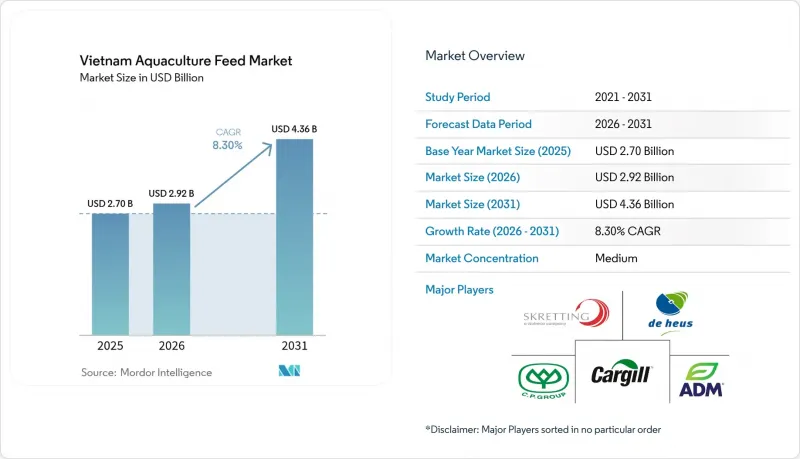
Mordor Intelligence에 의하면, 베트남의 수산양식용 사료 시장 규모는 2025년에 27억 달러로 평가되었습니다. 2026년 29억 2,000만 달러에서 2031년까지 43억 6,000만 달러에 이를 것으로 예상되며, 예측 기간(2026-2031년) CAGR은 8.30%를 나타낼 전망입니다.

본 보고서는 사료 유형(압출 사료, 펠렛 사료, 습식 사료, 마이크로 사료), 원료 조달처(어분·어유, 식물성 단백질, 동물성 부산물, 조류·대체 단백질),대상 어종(흰다리새우, 자이언트 타이거 새우, 팡가시우스, 잉어, 메기, 틸라피아, 기타 어종)별로 분류되어 있습니다. 시장 예측은 금액(달러) 기준으로 제시되어 있습니다.
베트남의 수산양식용 사료 시장 동향 및 인사이트
국내 재순환식 양식 시스템(RAS) 시설의 강력한 확대
베트남에서 재순환식 양식 시스템(RAS)의 급속한 확대는 고부가가치 어종의 양식에서 생산 효율과 생물 안전성을 크게 향상시키고 있습니다. RAS는 수질 관리를 용이하게 하고, 질병 발생을 억제하며, 특히 새우와 팡가시우스 양식에서 사육 밀도를 높일 수 있습니다. 예를 들어, 메콩 델타 지역의 집약형 새우 양식장에서는 물 교환을 최소화하고 조기 사망 증후군(EMS) 등의 질병 위험을 줄이기 위해 RAS 기술 도입이 점점 더 확대되고 있습니다. 이러한 기술 주도형 접근 방식은 헥타르당 생산량 향상과 연중 안정적인 생산을 뒷받침하며, 수산 양식 산업 전반의 성장에 직접적으로 기여하고 있습니다.
기능성 사료의 보급
프로바이오틱스, 효소, 면역 자극제를 배합한 기능성 사료의 채택 확대에 따라, 새우와 어류 양식에서의 사료 전환율과 생존율이 향상되고 있습니다. 질병 관리가 점점 더 중요해지는 가운데, 양식업자들은 기존 사료에서 장내 환경과 면역력을 높이는 특수 배합 사료로 전환하고 있습니다. 예를 들어, 속창성과 바크리우성의 새우 양식장에서는 수출 기준의 품질을 유지하면서 항생제 의존도를 낮추기 위해 프로바이오틱스를 배합한 사료를 사용하고 있습니다. 이러한 전환으로 톤당 사료 가치가 높아지고, 양식장의 생산성이 향상되어 결과적으로 산업 전체의 성장을 견인하고 있습니다. GreenFeed는 2025년 10월, 자사의 프로바이오틱스가 배합된 새우용 사료에 대해 수산양식관리협의회(ASC) 인증을 획득하여, 양식업자들에게 사료 전환율 개선과 비용 절감을 실현했습니다.
어분·어유 가격 변동
베트남은 수산 사료 생산에 있어 수입 어분과 어유에 크게 의존하고 있어, 이 산업은 세계 가격 변동의 영향을 받기 쉬운 상황에 놓여 있습니다. 페루공급 제약으로 인해 자주 발생하는 세계 어분 가격 상승은 사료 생산 비용을 직접적으로 끌어올립니다. 이는 새우 양식업자에게 영향을 미쳐 이익률 하락으로 이어집니다. 그 결과, 일부 소규모 사업자는 사육 밀도를 낮추거나 생산 주기를 늦출 수밖에 없는 상황에 처해 있습니다. 베트남산 어유의 수출 가격은 지난 2년 동안 크게 변동했습니다. 2024년에는 가격이 1kg당 0.83달러에서 2.96달러 범위에서 등락했습니다. 2025년이 되어서도 가격은 변동을 이어가며, 1kg당 0.97달러에서 2.48달러 범위에서 등락했습니다.
부문별 분석
압출 사료는 가장 큰 부문으로, 2025년에는 베트남 양식용 사료 시장 점유율의 42.0%를 차지했습니다. 이는 폐기물을 줄이고 사료 전환율을 향상시킨다는 부력 측면의 이점을 반영한 것입니다. 펠렛 사료도 큰 점유율을 차지하고 있었으나, 집약적인 새우 양식업자들이 더 높은 효율성을 추구함에 따라 압출 사료에 점유율을 빼앗기고 있습니다. 펠렛 사료 제조업체들은 펠렛의 내구성을 높이기 위해 스팀 컨디셔너를 도입하고 있지만, 새우의 섭식 습관과 밀도 간의 불일치라는 근본적인 문제로 인해 보급에는 한계가 있습니다.
마이크로 사료는 가장 빠르게 성장하는 부문으로, 2031년까지 연평균 성장률(CAGR) 11.5%로 확대되고 있습니다. 이는 부화장이 유생의 생존율을 높이기 위해 서방형 기술에 대한 투자를 추진하고 있기 때문입니다. 습식 사료는 유통 기한이 짧아 인건비가 증가하고, 베트남의 수산 양식 사료 시장에서의 상업적 가능성이 제한되기 때문에 장어나 관상어용 틈새 시장에 머물러 있습니다. 탄롱 그룹은 2024년 5월 하이즈온성에 새로운 사료 공장을 개설하여 연간 생산 능력을 70만 톤으로 확대했습니다. 이 시설은 프리미엄 부문을 대상으로 하며, 이익률을 높이기 위해 압출 공법을 이용한 새우 사료 생산에 주력하고 있습니다.
기타 혜택
- 엑셀 형식 시장 예측(ME) 시트
- 3개월간의 애널리스트 지원
자주 묻는 질문
목차
제1장 서론
제2장 조사 방법
제3장 주요 요약
제4장 시장 구도
제5장 시장 규모 및 성장 예측
제6장 경쟁 구도
제7장 시장 기회 및 향후 전망
KTH 26.09.08According to Mordor Intelligence, the Vietnam aquaculture feed market size was valued at USD 2.70 billion in 2025 and estimated to grow from USD 2.92 billion in 2026 to reach USD 4.36 billion by 2031, at a CAGR of 8.30% during the forecast period (2026-2031).
This report is Segmented by Feed Type (Extruded Feed, Pelleted Feed, Moist Feed, and Micro Feed), by Ingredient Source (Fish Meal and Fish Oil, Plant Protein, Animal By-Products, and Algal and Alternative Proteins), and by Species (White-Leg Shrimp, Giant Tiger Prawn, Pangasius, Carp, Catfish, Tilapia, and Other Species). The Market Forecasts are Provided in Terms of Value (USD).
Vietnam Aquaculture Feed Market Trends and Insights
Robust Expansion of Domestic Recirculating Aquaculture Systems Facilities
The rapid expansion of Recirculating Aquaculture Systems (RAS) in Vietnam is significantly improving production efficiency and biosecurity in high-value species farming. RAS facilitates controlled water quality, reduces disease outbreaks, and enhances stocking density, particularly in shrimp and pangasius farming. For instance, intensive shrimp farms in the Mekong Delta are increasingly adopting RAS technology to minimize water exchange and mitigate disease risks such as Early Mortality Syndrome (EMS). This technology-driven approach supports higher output per hectare and stabilizes year-round production, directly contributing to overall aquaculture growth.
Mainstream Growth of Functional Feeds
The growing adoption of functional feeds fortified with probiotics, enzymes, and immunostimulants is improving feed conversion ratios and survival rates in shrimp and fish farming. As disease management becomes increasingly critical, farmers are transitioning from traditional feed to specialized formulations that enhance gut health and immunity. For instance, shrimp farms in Soc Trang and Bac Lieu provinces are using probiotic-enhanced feeds to reduce reliance on antibiotics while maintaining export-grade quality. This shift increases feed value per metric ton and enhances farm productivity, thereby driving sectoral growth. GreenFeed secured Aquaculture Stewardship Council certification in October 2025 for its probiotic shrimp diet, delivering improved feed conversion and cost savings for farmers.
Volatile Fish-Meal and Fish-Oil Prices
Vietnam relies heavily on imported fishmeal and fish oil for aquafeed production, making the industry susceptible to global price fluctuations. Increases in global fishmeal prices, often driven by supply constraints in Peru, directly raise feed production costs. This impacts shrimp farmers, leading to margin compression. As a result, some small-scale operators are compelled to reduce stocking densities or delay production cycles. The export price of fish oil from Vietnam has fluctuated significantly over the past two years. In 2024, prices ranged from 0.83 USD per kg to 2.96 USD per kg. In 2025, prices continued to vary, ranging from 0.97 USD per kg to 2.48 USD per kg.
Other drivers and restraints analyzed in the detailed report include:
- Rising Consumer Demand for Antibiotic-Free Seafood
- Integration of AI-Driven Precision-Feeding Platforms
- Stringent Effluent-Discharge Rules
For complete list of drivers and restraints, kindly check the Table Of Contents.
Segment Analysis
Extruded diets were the largest segment, accounting for 42.0% of the Vietnam aquaculture feed market share in 2025, reflecting their buoyancy advantage, which reduces waste and improves feed conversion. Pelleted diets held a significant share yet are losing ground to extruded formats as intensive shrimp farmers shift toward higher efficiency. Pelleted manufacturers are retrofitting steam conditioners to raise pellet durability, but their inherent density mismatch with shrimp feeding habits restricts uptake.
Micro feeds are the fastest-growing segment, advancing at a 11.5% CAGR through 2031, as hatcheries invest in controlled-release technology to drive gains in larval survival. Moist feeds remain a niche for eel and ornamental species because their short shelf life increases labor costs and limits their commercial potential in the Vietnamese aquaculture feed market. Thang Long Group inaugurated a new feed mill in Hai Duong province in May 2024, increasing its annual capacity to 700,000 metric tons. The facility focuses on producing extruded shrimp diets to target the premium segment and enhance profit margins.
Complete Report Scope:
- By Feed Type
- Extruded Feed
- Pelleted Feed
- Moist Feed
- Micro Feed
- By Ingredient Source
- Fish Meal and Fish Oil
- Plant Protein
- Animal By-products
- Algal and Alternative Proteins
- By Species
- White-leg Shrimp (Litopenaeus vannamei)
- Giant Tiger Prawn (Penaeus monodon)
- Pangasius
- Carp
- Catfish
- Tilapia
- Other Species
List of Companies Covered in this Report:
- Cargill Inc.
- De Heus Animal Nutrition B.V.
- Skretting (Nutreco NV)
- Archer-Daniels-Midland Company
- Charoen Pokphand Group
- Skretting Vietnam (Nutreco N.V.)
- Grobest Industrial Co. Ltd. (Grobest Group)
- Tongwei Co. Ltd.
- Alltech Inc.
- Lallemand Inc.
- INVE Aquaculture Inc. (Benchmark Holdings Plc)
- Aller Aqua Vietnam (Aller Aqua A/S)
- GreenFeed Vietnam Corp.
- Uni-President Vietnam Co. Ltd.
Additional Benefits:
- The market estimate (ME) sheet in Excel format
- 3 months of analyst support
TABLE OF CONTENTS
1 Introduction
- 1.1 Study Assumptions and Market Definition
- 1.2 Scope of the Study
2 Research Methodology
3 Executive Summary
4 Market Landscape
- 4.1 Market Overview
- 4.2 Market Drivers
- 4.2.1 Robust expansion of domestic Recirculating Aquaculture Systems facilities
- 4.2.2 Mainstream growth of functional feeds
- 4.2.3 Rising consumer demand for antibiotic-free seafood
- 4.2.4 Integration of AI-driven precision-feeding platforms
- 4.2.5 Scale-up of single-cell protein production from biogas effluent
- 4.2.6 Shrimp-specific feed subsidies in Mekong Delta
- 4.3 Market Restraints
- 4.3.1 Volatile fish-meal and fish-oil prices
- 4.3.2 Stringent effluent-discharge rules from Ministry of Natural Resources and Environment
- 4.3.3 Supply-chain bottlenecks for specialty additives
- 4.3.4 Farmer hesitancy toward genetically engineered protein inputs
- 4.4 Regulatory Landscape
- 4.5 Technological Outlook
- 4.6 Porter's Five Forces Analysis
- 4.6.1 Bargaining Power of Suppliers
- 4.6.2 Bargaining Power of Buyers
- 4.6.3 Threat of New Entrants
- 4.6.4 Threat of Substitutes
- 4.6.5 Intensity of Competitive Rivalry
5 Market Size and Growth Forecasts (Value)
- 5.1 By Feed Type
- 5.1.1 Extruded Feed
- 5.1.2 Pelleted Feed
- 5.1.3 Moist Feed
- 5.1.4 Micro Feed
- 5.2 By Ingredient Source
- 5.2.1 Fish Meal and Fish Oil
- 5.2.2 Plant Protein
- 5.2.3 Animal By-products
- 5.2.4 Algal and Alternative Proteins
- 5.3 By Species
- 5.3.1 White-leg Shrimp (Litopenaeus vannamei)
- 5.3.2 Giant Tiger Prawn (Penaeus monodon)
- 5.3.3 Pangasius
- 5.3.4 Carp
- 5.3.5 Catfish
- 5.3.6 Tilapia
- 5.3.7 Other Species
6 Competitive Landscape
- 6.1 Market Concentration
- 6.2 Strategic Moves
- 6.3 Market Share Analysis
- 6.4 Company Profiles (Includes Global Level Overview, Market Level Overview, Core Segments, Financials as Available, Strategic Information, Market Rank/Share for Key Companies, Products and Services, Recent Developments)
- 6.4.1 Cargill Inc.
- 6.4.2 De Heus Animal Nutrition B.V.
- 6.4.3 Skretting (Nutreco NV)
- 6.4.4 Archer-Daniels-Midland Company
- 6.4.5 Charoen Pokphand Group
- 6.4.6 Skretting Vietnam (Nutreco N.V.)
- 6.4.7 Grobest Industrial Co. Ltd. (Grobest Group)
- 6.4.8 Tongwei Co. Ltd.
- 6.4.9 Alltech Inc.
- 6.4.10 Lallemand Inc.
- 6.4.11 INVE Aquaculture Inc. (Benchmark Holdings Plc)
- 6.4.12 Aller Aqua Vietnam (Aller Aqua A/S)
- 6.4.13 GreenFeed Vietnam Corp.
- 6.4.14 Uni-President Vietnam Co. Ltd.


