|
시장보고서
상품코드
2122695
건설기계 렌탈 시장 : 시장 점유율 분석, 업계 동향 및 통계, 성장 예측(2026-2031년)Construction Equipment Rental - Market Share Analysis, Industry Trends & Statistics, Growth Forecasts (2026 - 2031) |
||||||
 Mordor Intelligence
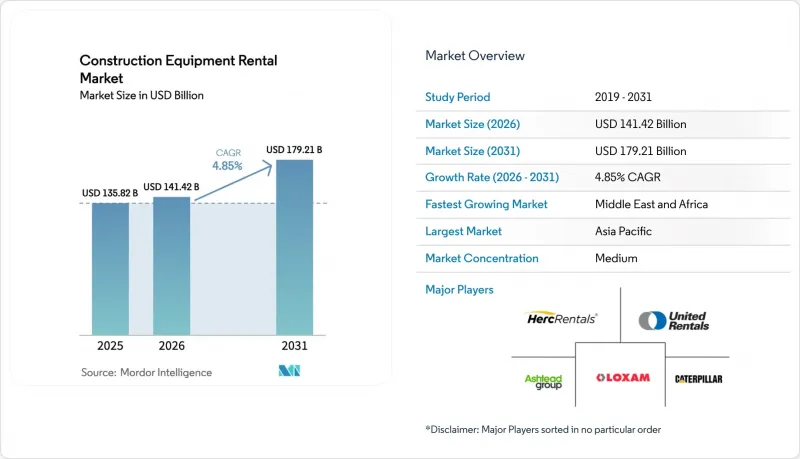
Mordor Intelligence에 의하면, 건설기계 렌탈 시장 규모는 2025년에 1,358억 2,000만 달러로 평가되었고, 2026년에 1,414억 2,000만 달러로 추정되고, 2031년까지 1,792억 1,000만 달러에 이를 것으로 예측되며, 2026-2031년 CAGR 4.85%로 성장할 전망입니다.
본 보고서는 장비 유형별(토공 기계, 자재관리 기계 등), 구동 방식별(내연 기관, 하이브리드 등), 용도별(주택 건설, 상업용 건설 등), 렌탈 채널별(오프라인 및 온라인), 서비스 형태별(단기 렌탈, 중기 렌탈 등), 그리고 지역별로 분류되어 있습니다. 시장 전망은 금액(달러) 기준으로 제시되어 있습니다.
세계의 건설기계 렌탈 시장 동향 및 인사이트
인프라 부양책에 따른 메가 프로젝트 파이프라인
대규모 공공 지출 프로그램으로 인해 투기적 수요가 확실한 다년간의 임대 계약으로 전환되고 있습니다. 미국은 이미 ‘인프라 투자 및 고용법’에 따라 6만 건이 넘는 인프라 프로젝트에 막대한 투자를 약속했습니다. 2024년, 중국은 주로 교통 회랑 및 도시 재생 프로젝트에 초점을 맞추어 지방채 발행을 대폭 확대했습니다. 인도는 2024-25 회계연도에 인프라 정비에 11.11 라크 크롤(1,330억 달러)을 예산으로 편성했습니다. 사우디아라비아의 ‘비전 2030’에는 건설 수요와 건설 기계의 가동률을 뒷받침하는 여러 기가 프로젝트(예 : NEOM, 키디야)가 포함되어 있습니다. 튀르키예의 예비 피해 평가에 따르면 1,000억 미달러가 넘는 자금이 필요한 것으로 나타나, 지속적인 복구 활동을 뒷받침하고 있습니다. 이러한 프로젝트들은 중기 임대 수요로 직접 연결되어 이미 상당한 수익을 창출하고 있습니다.
건설업체의 CAPEX에서 OPEX로의 전환
유동성을 확보하기 위해 건설사는 자사 소유 장비에 의존하는 대신 렌탈에 대한 의존도를 높이고 있습니다. 유나이티드 렌탈즈는 2024년, 렌탈을 목적으로 한 전문 장비 및 전동 자산에 대한 소수 주주의 자금 조달에 중점을 두며 대규모 연간 설비 투자 프로그램을 유지했습니다. 선벨트 렌탈스는 2025 회계연도에 차량 대수 확충을 위해 막대한 자원을 투입하는 동시에, 미국 전역에 수많은 신규 지점을 개설했습니다. 하크 렌탈스는 2024년 특수한 틈새 시장에 집중하여 보유 장비의 가치를 대폭 높였습니다. 북미와 유럽에서 신용 시장이 긴축되는 가운데, 자본 구매보다 운영 리스로의 전환이 두드러지게 나타나고 있습니다. 이 재무 전략은 현재 아시아태평양의 건설업체들에게도 확산되고 있습니다.
숙련된 조작자 부족이 가동 중단 위험을 높입니다.
수요가 급증할 때 숙련된 운전자를 확보하지 못해 임대 장비가 유휴 상태가 되는 경우가 종종 있습니다. 미국 노동통계국은 2026년 이후 주로 장비 교체 수요에 힘입어 향후 10년 동안 건설 기계 운전자 채용이 매년 지속될 것으로 예측했습니다. 퇴직자가 신규 자격 취득자를 상회하기 때문에 건설 성수기에는 이러한 인력 부족이 더욱 두드러집니다. 독일과 일본에서도 유사한 인력 부족 현상이 두드러지며, 노동력의 고령화로 인해 임금 프리미엄이 상승하고 채용 주기가 장기화되면서 프로젝트 비용 증가와 공사 기간 연장으로 이어지고 있습니다. 렌탈 회사는 계약에 운전사 교육을 포함시키거나 직업 훈련 학교와 제휴하는 등 위험 완화를 도모하고 있지만, 교육 대기자 명단이 밀려 있어 건설 업체는 인증된 인력을 몇 주 동안 기다려야만 합니다. 가동되지 않는 기계는 가동률을 떨어뜨리고, 렌탈 회사는 서비스 수준 보장을 충족하기 위해 더 대규모의 장비를 보유할 수밖에 없으며, 그 결과 전동화나 디지털화에 투자되어야 할 자본이 묶이게 됩니다. 교육 체계가 대폭 확충되지 않는 한, 운영자 부족은 적어도 중기적으로는 적절한 장비의 가용성을 지속적으로 저하시켜 렌탈 마진에 하방 압력을 계속 가할 것입니다.
부문별 분석
2025년, 토목 건설 기계는 건설 기계 렌탈 시장 점유율의 41.05%를 차지했으며, 2031년까지 연평균 성장률(CAGR) 7.61%는 시장 전체의 성장 속도를 상회하고 있습니다. 굴삭기, 로더, 불도저는 도로, 철도, 광산 프로젝트에서 여전히 필수적인 존재입니다. 백호 로더는 다용도성이 중시되는 유틸리티 및 주택 건설 현장에서 활약하고 있습니다. 굴삭기, 특히 크롤러식은 대규모 토사 제거 수요를 주도하고 있지만, 기동성이 중요한 도시 지역 현장에서는 휠식이 점유율을 확대되고 있습니다.
자재관리 장비는 고층 빌딩이나 물류 시설 개발에 사용되는 크레인 및 텔레핸들러에 힘입어 두 번째로 큰 시장 점유율을 차지하고 있습니다. 콘크리트 및 도로 건설 기계는 고속도로 투자 확대에 따라 수요가 증가하고 있으며, 발전기나 압축기 등의 동력 장비는 현장에서의 간헐적인 수요에 대응하고 있습니다. 텔레매틱스 기능을 탑재한 토공 기계는 가격이 아닌 가동률이라는 관점에서 렌탈 차량군의 차별화를 꾀하고 있으며, 건설 기계 렌탈 시장에서 그 중심적인 역할을 더욱 공고히 하고 있습니다.
2025년 시점에서는 디젤 연료 보급망이 여전히 널리 보급되어 있어, 내연기관(IC) 탑재 기종이 시장 구성의 86.13%를 차지했습니다. 하이브리드 모델은 디젤과 전기를 결합하여 저공해 구역에서의 운용을 가능하게 하고 있습니다. 캘리포니아주에서 다수의 제로 배출 모델이 등록된 것도 뒷받침되어, 배터리식 전기 건설 기계의 성장세가 가속화되고 있습니다.
2025년 바우마(Bauma)에서 공개된 현대의 HW155H 굴삭기와 같은 수소 연료전지 장비는 2031년까지 연평균 성장률(CAGR) 15.88%로 성장하고 있으며, 배터리 주행 거리 제한 없이 제로 배출이 필요한 프로젝트를 유치하고 있습니다. JCB의 수소 연소 엔진은 디젤 엔진을 그대로 대체할 수 있는 대안을 제공합니다. 향후 10년 동안은 내연기관(IC)이 주류를 유지할 전망이지만, 규제 압력과 총소유비용(TCO)의 감소로 인해 장기적으로는 전기 및 수소 기술로 시장이 전환될 것입니다.
지역별 분석
아시아태평양은 2025년에 40.11%의 점유율을 차지한 것으로 평가되었으며, 2031년까지 상당한 연평균 성장률(CAGR)을 유지할 전망입니다. 중국의 지방 인프라 채권, 인도의 방대한 프로젝트 계획, 그리고 일본의 건설 예산이 수요의 기반이 되고 있습니다. 한국의 대규모 사업 계획과 호주의 광업 및 재생에너지를 결합한 사업도 마찬가지로 임대 수요를 뒷받침하고 있습니다. 이 지역의 도시화와 메가 프로젝트의 시너지 효과가 건설 기계 임대 시장을 지탱하고 있습니다.
중동 및 아프리카는 NEOM, 레드시, 키디야에 걸친 ‘사우디 비전 2030’의 1조 3,000억 달러 규모 프로젝트 군에 힘입어 6.72%라는 가장 높은 연평균 성장률(CAGR)을 기록하고 있습니다. 아랍에미리트(UAE)의 에티하드 레일 2단계 등의 프로젝트에서는 지속적인 장비 교체가 필요합니다. 튀르키예의 1,000억 달러 규모 재건 사업과 남아프리카공화국의 재생에너지 계획도 시장에 두께를 더하고 있습니다.
북미와 유럽에서는 완만하지만 꾸준한 성장이 나타나고 있습니다. 미국은 막대한 투자를 통해 강력한 인프라 구축을 지속적으로 추진하고 있습니다. 캐나다는 대중교통 및 송전선을 우선시하는 반면, 독일은 도시 지역의 저배출 가스 규제에 따라 전기차 도입에 건설의 중점을 두고 있습니다. 영국의 건설 업계도 규제 준수를 확보하기 위해 특수 장비 대여에 주력하고 있습니다.
기타 혜택 :
- 엑셀 형식 시장 예측(ME) 시트
- 3개월간의 애널리스트 지원
자주 묻는 질문
목차
제1장 서론
제2장 조사 방법
제3장 주요 요약
제4장 시장 구도
제5장 시장 규모 및 성장 예측
제6장 경쟁 구도
제7장 시장 기회 및 향후 전망
AJY 26.09.07According to Mordor Intelligence, the construction equipment rental market size is projected to be USD 135.82 billion in 2025, USD 141.42 billion in 2026, and reach USD 179.21 billion by 2031, growing at a CAGR of 4.85% from 2026 to 2031.
This report is Segmented by Equipment Type (Earthmoving Equipment, Material Handling Equipment, and More), Drive Type (IC Engine, Hybrid, and More), Application (Residential Construction, Commercial Construction, and More), Rental Channel (Offline and Online), Service Type (Short-Term Rental, Medium-Term Rental, and More), and Geography. The Market Forecasts are Provided in Terms of Value (USD).
Global Construction Equipment Rental Market Trends and Insights
Infrastructure-Stimulus Megaproject Pipeline
Large public spending programs turn speculative demand into firm, multi-year rental contracts. The United States has already committed significant investment to over 60,000 infrastructure projects under the Infrastructure Investment and Jobs Act. In 2024, China significantly increased its deployment of provincial bonds, focusing primarily on transport corridors and urban renewal projects. India budgeted INR 11.11 lakh crore (USD 133 billion) for infrastructure in fiscal 2024-25 . Saudi Arabia's Vision 2030 includes multiple giga-projects (e.g., NEOM, Qiddiya) that are sustaining construction demand and equipment utilization. Preliminary damage assessments for Turkiye indicate needs above USD 100 billion, supporting sustained reconstruction activity. These pipelines feed directly into medium-term rentals, already generating notable revenue.
Shift from CAPEX-to-OPEX Among Contractors
In a bid to preserve liquidity, construction firms are increasingly turning to rentals instead of relying on owned fleets. United Rentals maintained a significant annual capex program in 2024, with a focus on minority-financing specialty and electric assets for rental purposes. Sunbelt Rentals committed substantial resources in fiscal 2025 for fleet expansion, simultaneously inaugurating numerous new outlets across the United States. Herc Rentals, in 2024, enhanced its fleet value significantly, honing in on specialty niches. As tighter credit markets emerge in North America and Europe, there's a noticeable shift towards operating leases over capital purchases. This financial strategy is now being rolled out to contractors in the Asia-Pacific region.
Skilled-Operator Scarcity Elevates Downtime Risk
Rental equipment often sits idle because trained operators are unavailable when demand surges. In 2026, the U.S. Bureau of Labor Statistics projects continued annual openings for construction equipment operators over the next decade, driven mainly by replacement needs. This gap becomes more pronounced during peak construction months, as retirements outpace new certifications. Similar shortages are also evident in Germany and Japan, where aging workforces drive up wage premiums and lengthen recruitment cycles, thereby inflating project costs and extending schedules. Rental firms attempt to mitigate the risk by bundling operator training into contracts and partnering with vocational schools; however, class backlogs still mean contractors wait weeks for certified personnel. Idle machinery erodes utilization metrics, forcing rental companies to maintain larger fleets to meet service-level guarantees, thereby tying up capital that could be used to fund electrification or digital upgrades. Unless training pipelines expand materially, operator scarcity will continue to depress adequate fleet availability and place downward pressure on rental margins through at least the medium term.
Other drivers and restraints analyzed in the detailed report include:
- Stringent ESG Targets Accelerating Electric Rentals
- Digital Rental-Platform Explosion in Emerging Markets
- High Multi-Brand Maintenance Complexity
For complete list of drivers and restraints, kindly check the Table Of Contents.
Segment Analysis
Earthmoving equipment secured 41.05% of the construction equipment rental market share in 2025, and its 7.61% CAGR through 2031 exceeds the overall market pace. Excavators, loaders, and bulldozers remain indispensable for road, rail, and mining projects. Backhoe loaders serve utilities and residential work where versatility matters. Excavators, especially tracked units, lead demand for heavy soil removal, while wheeled variants gain ground in urban sites where mobility is prized.
Material-handling gear forms the next-largest slice, driven by cranes and telehandlers used in high-rise and logistics developments. Concrete and road machinery rise with highway spending, and power equipment-such as generators and compressors-meets intermittent site needs. Telematics-enabled earthmovers differentiate rental fleets on uptime rather than price, reinforcing their central role in the construction equipment rental market.
Internal Combustion (IC) engine machines accounted for 86.13% of the mix in 2025, as diesel refueling networks remain ubiquitous. Hybrid models blend diesel and electric to navigate low-emission zones. Battery electric equipment gains momentum, helped by a significant number of zero-emission models listed in California.
Hydrogen fuel-cell units, such as Hyundai's HW155H excavator unveiled at Bauma 2025, are growing at a 15.88% CAGR by 2031 and attract projects that need zero emissions without battery-range limits. JCB's hydrogen-combustion engines offer a drop-in diesel alternative. IC dominance will persist this decade; however, regulatory pressure and falling total cost of ownership will tilt the longer-term curve toward electric and hydrogen technologies.
Complete Report Scope:
- By Equipment Type
- Earthmoving Equipment
- Backhoe Loaders
- Loaders
- Excavators
- Bulldozers
- Skid-Steer Loaders
- Other Earthmoving
- Material Handling Equipment
- Cranes
- Forklifts
- Dump Trucks
- Telehandlers
- Other Material Handling
- Concrete and Road Construction Equipment
- Power and Energy Equipment
- Other Equipment
- Earthmoving Equipment
- By Drive Type
- IC Engine
- Hybrid
- Electric
- Hydrogen Fuel Cell
- By Application
- Residential Construction
- Commercial Construction
- Industrial / Manufacturing
- Infrastructure (Roads, Bridges, Ports)
- Mining and Quarrying
- Oil and Gas
- By Rental Channel
- Offline (Branch-based)
- Online Platforms
- By Service Type
- Short-Term Rental (less than 1 Month)
- Medium-Term Rental (1 - 12 Months)
- Long-Term Rental (Over 1 Year)
- By Geography
- North America
- United States
- Canada
- Rest of North America
- Europe
- Germany
- United Kingdom
- France
- Italy
- Spain
- Russia
- Rest of Europe
- Asia-Pacific
- China
- Japan
- India
- South Korea
- Australia
- Rest of Asia-Pacific
- South America
- Brazil
- Argentina
- Chile
- Rest of South America
- Middle East and Africa
- Saudi Arabia
- United Arab Emirates
- Turkey
- South Africa
- Nigeria
- Rest of Middle East and Africa
- North America
Geography Analysis
Asia-Pacific captured a 40.11% share in 2025 and is tracking a notable CAGR to 2031. China's local infrastructure bonds, India's significant pipeline, and Japan's construction budget anchor demand. South Korea's considerable program and Australia's mining-plus-renewables mix likewise favor rentals. The region's mix of urbanization and mega-projects sustains the construction equipment rental market.
The Middle East and Africa log the fastest CAGR of 6.72%, led by Saudi Vision 2030's USD 1.3 trillion slate spanning NEOM, the Red Sea, and Qiddiya. Projects in the United Arab Emirates, such as Etihad Rail Phase 2, require continuous rotations . Turkey's USD 100 billion reconstruction and South Africa's renewable-energy program add depth.
North America and Europe experience a steady, albeit slow, growth. The United States continues its strong infrastructure push with significant investments. While Canada prioritizes transit and power lines, Germany channels its construction efforts towards electric fleets, aligning with urban low-emission mandates. The United Kingdom construction sector also leans into specialty rentals to ensure compliance.
- United Rentals Inc.
- Ashtead Group plc (Sunbelt Rentals)
- Herc Rentals Inc.
- Loxam Group
- Caterpillar Inc.
- Sumitomo Corporation
- Hitachi Construction Machinery Co., Ltd.
- Liebherr-International AG
- Kanamoto Co., Ltd.
- CNH Industrial N.V.
- Boels Rental
- Cramo Oyj
- Ahern Rentals
- Maxim Crane Works
- Coates Hire Operations Pty Ltd.
- Sarens n.v./s.a.
Additional Benefits:
- The market estimate (ME) sheet in Excel format
- 3 months of analyst support
TABLE OF CONTENTS
1 Introduction
- 1.1 Study Assumptions & Market Definition
- 1.2 Scope of the Study
2 Research Methodology
3 Executive Summary
4 Market Landscape
- 4.1 Market Overview
- 4.2 Market Drivers
- 4.2.1 Infrastructure-Stimulus Megaproject Pipeline
- 4.2.2 Shift from CAPEX-to-OPEX Among Contractors
- 4.2.3 Stringent ESG Targets Accelerating Electric Rentals
- 4.2.4 Digital Rental-Platform Explosion in Emerging Markets
- 4.2.5 Pay-Per-Use and Outcome-Based Contracting Models
- 4.2.6 Data-Driven Fleet Optimization Boosts Customer ROI
- 4.3 Market Restraints
- 4.3.1 Skilled-Operator Scarcity Elevates Downtime Risk
- 4.3.2 High Multi-Brand Maintenance Complexity
- 4.3.3 OEMs' Direct-to-Customer Rental Cannibalization
- 4.3.4 Residual-Value Volatility for Lithium-Battery Assets
- 4.4 Value / Supply-Chain Analysis
- 4.5 Regulatory Landscape
- 4.6 Technological Outlook
- 4.7 Porter's Five Forces
- 4.7.1 Threat of New Entrants
- 4.7.2 Bargaining Power of Buyers
- 4.7.3 Bargaining Power of Suppliers
- 4.7.4 Threat of Substitutes
- 4.7.5 Intensity of Competitive Rivalry
5 Market Size & Growth Forecasts (Value, USD)
- 5.1 By Equipment Type
- 5.1.1 Earthmoving Equipment
- 5.1.1.1 Backhoe Loaders
- 5.1.1.2 Loaders
- 5.1.1.3 Excavators
- 5.1.1.4 Bulldozers
- 5.1.1.5 Skid-Steer Loaders
- 5.1.1.6 Other Earthmoving
- 5.1.2 Material Handling Equipment
- 5.1.2.1 Cranes
- 5.1.2.2 Forklifts
- 5.1.2.3 Dump Trucks
- 5.1.2.4 Telehandlers
- 5.1.2.5 Other Material Handling
- 5.1.3 Concrete and Road Construction Equipment
- 5.1.4 Power and Energy Equipment
- 5.1.5 Other Equipment
- 5.1.1 Earthmoving Equipment
- 5.2 By Drive Type
- 5.2.1 IC Engine
- 5.2.2 Hybrid
- 5.2.3 Electric
- 5.2.4 Hydrogen Fuel Cell
- 5.3 By Application
- 5.3.1 Residential Construction
- 5.3.2 Commercial Construction
- 5.3.3 Industrial / Manufacturing
- 5.3.4 Infrastructure (Roads, Bridges, Ports)
- 5.3.5 Mining and Quarrying
- 5.3.6 Oil and Gas
- 5.4 By Rental Channel
- 5.4.1 Offline (Branch-based)
- 5.4.2 Online Platforms
- 5.5 By Service Type
- 5.5.1 Short-Term Rental (less than 1 Month)
- 5.5.2 Medium-Term Rental (1 - 12 Months)
- 5.5.3 Long-Term Rental (Over 1 Year)
- 5.6 By Geography
- 5.6.1 North America
- 5.6.1.1 United States
- 5.6.1.2 Canada
- 5.6.1.3 Rest of North America
- 5.6.2 Europe
- 5.6.2.1 Germany
- 5.6.2.2 United Kingdom
- 5.6.2.3 France
- 5.6.2.4 Italy
- 5.6.2.5 Spain
- 5.6.2.6 Russia
- 5.6.2.7 Rest of Europe
- 5.6.3 Asia-Pacific
- 5.6.3.1 China
- 5.6.3.2 Japan
- 5.6.3.3 India
- 5.6.3.4 South Korea
- 5.6.3.5 Australia
- 5.6.3.6 Rest of Asia-Pacific
- 5.6.4 South America
- 5.6.4.1 Brazil
- 5.6.4.2 Argentina
- 5.6.4.3 Chile
- 5.6.4.4 Rest of South America
- 5.6.5 Middle East and Africa
- 5.6.5.1 Saudi Arabia
- 5.6.5.2 United Arab Emirates
- 5.6.5.3 Turkey
- 5.6.5.4 South Africa
- 5.6.5.5 Nigeria
- 5.6.5.6 Rest of Middle East and Africa
- 5.6.1 North America
6 Competitive Landscape
- 6.1 Market Concentration
- 6.2 Strategic Moves
- 6.3 Market Share Analysis
- 6.4 Company Profiles (Includes Global Level Overview, Market Level Overview, Core Segments, Financials as Available, Strategic Information, Market Rank/Share for Key Companies, Products and Services, SWOT Analysis, and Recent Developments)
- 6.4.1 United Rentals Inc.
- 6.4.2 Ashtead Group plc (Sunbelt Rentals)
- 6.4.3 Herc Rentals Inc.
- 6.4.4 Loxam Group
- 6.4.5 Caterpillar Inc.
- 6.4.6 Sumitomo Corporation
- 6.4.7 Hitachi Construction Machinery Co., Ltd.
- 6.4.8 Liebherr-International AG
- 6.4.9 Kanamoto Co., Ltd.
- 6.4.10 CNH Industrial N.V.
- 6.4.11 Boels Rental
- 6.4.12 Cramo Oyj
- 6.4.13 Ahern Rentals
- 6.4.14 Maxim Crane Works
- 6.4.15 Coates Hire Operations Pty Ltd.
- 6.4.16 Sarens n.v./s.a.