|
시장보고서
상품코드
2122704
낙서 방지 코팅 : 시장 점유율 분석, 업계 동향 및 통계, 성장 예측(2026-2031년)Anti-Graffiti Coatings - Market Share Analysis, Industry Trends & Statistics, Growth Forecasts (2026 - 2031) |
||||||
 Mordor Intelligence
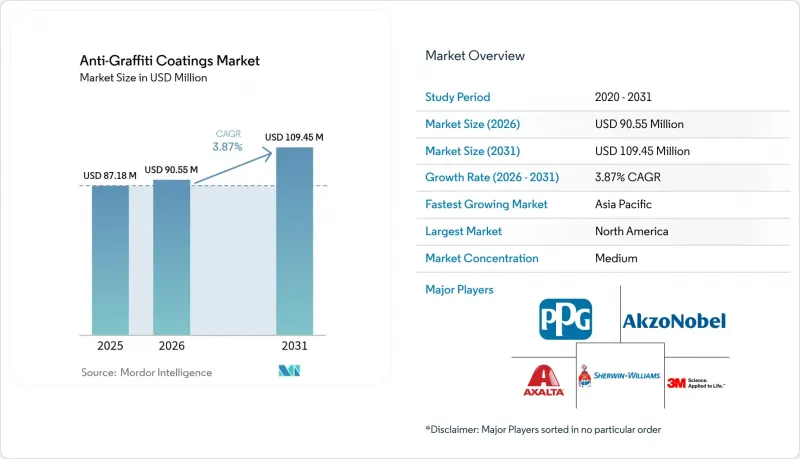
Mordor Intelligence에 의하면, 낙서 방지 코팅 시장 규모는 2025년 8,718만 달러로 평가되었습니다. 2026년에는 9,055만 달러로 확대되고 2026-2031년에 걸쳐 CAGR 3.87%로 성장을 지속하여, 2031년에는 1억 945만 달러에 이를 것으로 예측됩니다.

본 보고서는 유형별(희생형, 반희생형, 비희생형), 기술별(수성, 용제형, 분체 도장), 최종 사용자 산업별(자동차 및 운송 산업, 건설, 기타 최종 사용자 산업), 지역별(아시아태평양, 북미, 유럽, 남미, 중동 및 아프리카)로 분류되어 있습니다. 시장 예측은 금액(달러) 기준으로 제시되어 있습니다.
세계의 낙서 방지 코팅 시장 동향 및 인사이트
낙서 제거를 위한 지자체 지출 증가
각 도시는 정기적인 유지 관리비 예산을 초과하는 급증하는 파괴 행위로 인한 비용을 억제하기 위해 예산을 앞당겨 편성하고 있습니다. 포틀랜드시의 긴급 조례 1099-2024는 2020-2022년에 걸쳐 낙서 관련 민원이 586% 급증한 것을 계기로 제정된 것이며, 한편 웰링턴 시의회는 2025년까지의 보호 프로그램을 위해 757만 달러를 확보했습니다. 독일 철도(Deutsche Bahn)가 청소에 연간 800만 유로를 지출하고 있는 상황에서 이 철도 사업자는 용제를 사용하지 않는 세척 주기를 반복해도 견딜 수 있는 폴리실라잔계 배리어 코팅 도입을 추진하고 있습니다. 예방 조치가 반복적인 제거 작업보다 비용 효율성이 뛰어난 것으로 입증됨에 따라, 지자체 조달에서는 도시 경관을 유지하고 수명 주기 비용을 최소화하는 영구적인 저VOC(휘발성 유기 화합물) 도료가 점점 더 중요하게 여겨지고 있습니다. 이러한 변화로 인해 공공 인프라 및 교통 자산 분야의 낙서 방지 도료 시장에 대한 안정적인 수요가 뒷받침되고 있으며, 공급업체의 중기적인 수익 전망이 확고해지고 있습니다.
공공 인프라 건설의 급속한 확대
아시아태평양의 건설 붐은 표면 보호 솔루션에 대한 기초적인 수요를 끌어올리고 있습니다. 중국 국가발전개혁위원회가 2024년에 발표한 로드맵에서는 ‘고품질 인프라’가 내수 견인 역할을 한다고 강조하고 있으며, 철도, 교량, 스마트 시티 프로젝트에서 낙서 방지 사양의 채택이 가속화되고 있습니다. 인도 및 인도네시아에서는 병행하여 진행되고 있는 스마트 모빌리티 회랑 건설에서 향후 유지 관리 비용을 절감하기 위해 영구적인 코팅이 조달 기준에 포함되었습니다. 마찬가지로, 미국의 ‘Federal Buy Clean’ 이니셔티브를 통한 자금 지원에서는 20억 달러 이상이 저탄소 건축자재에 투입되고 있으며, 수성이고 휘발성 유기 화합물(VOC) 규제를 준수하는 제품에 대한 선호도가 높아지고 있습니다. 신흥 지역의 건설업체들은 대부분 확립된 청소 체계를 갖추지 않은 채 사업을 전개하고 있기 때문에 내구성이 뛰어난 코팅을 수명 주기 비용을 절감하는 초기 단계의 보호 조치로 간주하고 있으며, 이로 인해 낙서 방지 코팅 시장 전체의 장기적인 보급이 촉진되고 있습니다.
변동이 심한 실록산·불소계 폴리머의 원료 비용
실록산과 불소 폴리머의 가격 변동이, 최종 사용자가 여전히 가격에 민감한 상황에서 생산자의 이익률을 압박하고 있습니다. 유럽화학물질청(ECHA)이 이산화규소(SiO2)를 포함한 특정 규소 화합물에 대한 규제를 강화하는 제안을 함에 따라, 공급망 내 경계심이 고조되고 있으며, 규정 준수 관련 지출이 증가하고 있습니다. 각 생산 업체들은 내구성을 유지하면서 실록산 사용량을 줄이는 하이브리드 화학 조성 실험을 진행하고 있지만, 재설계에 따른 과제와 인증 획득까지의 기간이 길어짐에 따라 제품 출시 속도는 둔화되고 있습니다. 현물 구매에 의존하고 있는 중소 배합 제조업체들은 비용 전가 위험이 현저히 높아지고 있으며, 이로 인해 낙서 방지 코팅 시장의 단기 생산량이 억제되고 있습니다.
부문별 분석
2025년 시점에서 비희생형 시스템은 낙서 방지 코팅 시장의 51.63% 점유율을 차지했으며, 2031년까지 연평균 성장률(CAGR) 4.42%로 확대되고 있습니다. 고객들은 한 번의 도포로 충분하고 물로 반복 세척을 견딜 수 있어 수명 주기 비용을 절감할 수 있다는 점을 높이 평가했습니다. 세미 희생형 방식은 적당한 재도장 주기로 중간 수준의 예산에 대응하는 반면, 희생형 필름은 내구성이 뛰어난 폴리머를 사용할 수 없는 역사적 건축물이나 민감한 기판에 적합합니다.
비희생형 코팅에 대한 초기 투자 비용은 높지만, 재도장을 위해 교통역이나 공공 건축물을 폐쇄해야 하는 횟수가 줄어들어 그 비용이 상쇄됩니다. 폴리우레탄 분말 배리어에 관한 사례 연구에서는 광택을 손상시키지 않으면서 1,000회 이상의 세척 주기를 견디는 내세척성이 입증되었습니다. 이러한 경제성은 프리미엄 틈새 시장을 강화하고, 낙서 방지 코팅 시장 내 가치 집중을 뒷받침하고 있습니다.
지역별 분석
2025년, 북미는 낙서 방지 코팅 시장의 38.90% 점유율을 유지했습니다. 포틀랜드시의 긴급 조례 1099-2024 및 유사한 도시 조례에 따라 보호 코팅이 연간 유지 관리 예산에 포함되어 있으며, 이는 예측 가능한 정기적인 발주로 이어지고 있습니다. 이 지역의 ‘바이 클린(Buy Clean)’ 조항에 따라 연방 자금이 저탄소 수성 코팅에 배정되면서, 규정을 준수하는 공급업체들이 우선 공급업체로서의 위상을 높이고 있습니다. 캘리포니아주 대기질 관리구(AQMD)가 비희생형 코팅에 대해 정한 휘발성 유기 화합물(VOC) 100g/L 상한치는 계속해서 연구 개발(R&D) 성과를 촉진하고 있으며, 전 세계로 출하되는 제품 라인에 영향을 미치고 있습니다.
아시아태평양은 중국의 인프라 구축 가속화와 인도의 ‘100개 스마트 시티’ 계획 추진에 힘입어 2031년까지 연평균 성장률(CAGR) 4.14%로 가장 빠르게 성장하고 있는 지역입니다. 지하철 기둥이나 육교에 예방용 코팅재 사용을 지정하는 도시 지자체들은 향후 청소 작업의 급증 현상을 방지하고자 하고 있습니다. 일본이나 한국 등의 성숙한 시장에서는 환경 규제가 강화됨에 따라 기존 철도 및 고속도로 자산을 저VOC 코팅으로 개보수함으로써 수요가 유지되고 있습니다.
유럽에서는 진보적인 환경 규제의 압력 하에서 꾸준한 성장이 나타나고 있습니다. 프랑스의 퍼플루오로알킬 물질·폴리플루오로알킬 물질(PFAS) 사용 금지 조치와 유럽연합(EU)에서 검토 중인 광범위한 규제로 인해 수지 선택지가 재검토되고 있으며, 실리콘 및 바이오 폴리머에 대한 연구가 가속화되고 있습니다. 독일에서는 그래피티로 인한 피해액이 매년 2억 유로를 초과함에 따라, 영구적인 오염 방지 대책의 경제적 타당성이 높아지고 있으며, 지방 자치 단체 컨소시엄이 그래피티 방지 조항을 포함한 장기 유지보수 계약을 체결하는 움직임이 활발해지고 있습니다. 남미, 중동 및 아프리카는 현재 시장 규모는 작지만, 상파울루와 리야드에서 진행 중인 지하철의 급속한 현대화에 힘입어 시장 점유율을 확대하고 있으며, 그래피티 방지 코팅 시장은 여러 지역으로 확대되는 추세를 보이고 있습니다.
기타 혜택
- 엑셀 형식 시장 예측(ME) 시트
- 3개월간 애널리스트의 지원
자주 묻는 질문
목차
제1장 서론
제2장 조사 방법
제3장 주요 요약
제4장 시장 구도
제5장 시장 규모 및 성장 예측
제6장 경쟁 구도
제7장 시장 기회 및 향후 전망
KTH 26.09.08According to Mordor Intelligence, the anti-Graffiti coatings market size is expected to grow from USD 87.18 Million in 2025 to USD 90.55 Million in 2026 and is forecast to reach USD 109.45 Million by 2031 at 3.87% CAGR over 2026-2031.
This report is Segmented by Type (Sacrificial, Semi-Sacrificial, and Non-Sacrificial), Technology (Water-Based, Solvent-Based, and Powder Coating), End-User Industry (Automotive and Transportation, Construction, and Other End-User Industries), and Geography (Asia-Pacific, North America, Europe, South America, and Middle East and Africa). The Market Forecasts are Provided in Terms of Value (USD).
Global Anti-Graffiti Coatings Market Trends and Insights
Escalating Municipality Spending on Graffiti Removal
Cities are front-loading budgets to curb soaring vandalism costs that outpace routine maintenance allocations. Portland's Emergency Ordinance 1099-2024 follows a 586% jump in graffiti complaints between 2020 and 2022, while Wellington City Council ring-fenced USD 7.57 Million for protective programmes through 2025 . Deutsche Bahn's EUR 8 Million annual outlay on cleanup has pushed the rail operator toward polysilazane barriers that tolerate repeated solvent-free wash cycles. As prevention proves cheaper than serial removal, municipal procurement increasingly favours permanent, low-VOC (Volatile Organic Compound) coatings that preserve urban aesthetics and minimise life-cycle costs. This shift anchors steady volume off-take for the anti-graffiti coatings market in public infrastructure and transit assets, underpinning suppliers' medium-term revenue visibility.
Rapid Expansion of Public Infrastructure Construction
Asia-Pacific construction booms are boosting baseline demand for surface-protection solutions. China's 2024 National Development and Reform Commission roadmap highlights "high-quality infrastructure" as a domestic-demand catalyst, accelerating anti-graffiti specification in rail, bridge, and smart-city projects. Parallel smart-mobility corridors in India and Indonesia are embedding permanent coatings into procurement standards to curb future maintenance outlays. Similar funding flows from the United States' Federal Buy Clean initiative channel more than USD 2 Billion toward low-carbon building materials, tilting preferences to water-based, Volatile Organic Compound (VOC)-compliant offerings. Contractors in emerging hubs, often operating without established cleaning fleets, view durable coatings as an upfront safeguard that lowers whole-life costs, reinforcing long-run uptake across the anti-graffiti coatings market.
Volatile Siloxane and Fluoropolymer Raw-Material Costs
Siloxane and fluoropolymer pricing swings are squeezing producer margins at a time when end-users remain price sensitive. European Chemicals Agency proposals to tighten rules on certain silicon compounds, including Silicon Dioxide (SiO2), have heightened supply-chain caution and inflated compliance expenditures. Producers are experimenting with hybrid chemistries that trim siloxane loads while safeguarding durability, yet re-engineering hurdles and certification timelines slow roll-outs. Smaller formulators reliant on spot purchases face pronounced cost pass-through risks, restraining near-term output in the anti-graffiti coatings market.
Other drivers and restraints analyzed in the detailed report include:
- Stricter Volatile Organic Compound (VOC) Norms Accelerating Water-borne Formulations
- Adoption of Anti-graffiti Powder Coatings for Smart-city Street Furniture
- Emerging Per- and polyfluoroalkyl substances (PFAS) Restrictions Affecting Fluorinated Coatings
For complete list of drivers and restraints, kindly check the Table Of Contents.
Segment Analysis
Non-sacrificial systems held 51.63% of anti-graffiti coatings market share in 2025 and are expanding at a 4.42% CAGR to 2031. Customers favour their one-time application and rinse-repeat cleaning tolerance that shrink life-cycle spend. Semi-sacrificial formats satisfy mid-tier budgets with moderate recoat intervals, while sacrificial films cater to historic preservation or sensitive substrates that cannot host durable polymers.
Higher upfront expenditure on non-sacrificial layers is offset by fewer closures of transit stations or public buildings for re-painting. Case studies on polyurethane-powder barriers show wash-off resilience beyond 1,000 cleaning cycles without gloss loss. These economics reinforce the premium niche, anchoring value concentration within the anti-graffiti coatings market.
Complete Report Scope:
- By Type
- Sacrificial
- Semi-Sacrificial
- Non-Sacrificial
- By Technology
- Water-Based
- Solvent-Based
- Powder Coating
- By End-User Industry
- Automotive and Transportation
- Construction
- Other End-User Industries (Industrial Equipment, Utilities)
- By Geography
- Asia-Pacific
- China
- Japan
- India
- South Korea
- ASEAN Countries
- Rest of Asia-Pacific
- North America
- United States
- Canada
- Mexico
- Europe
- Germany
- United Kingdom
- France
- Italy
- Spain
- Russia
- NORDIC Countries
- Rest of Europe
- South America
- Brazil
- Argentina
- Rest of South America
- Middle East and Africa
- Saudi Arabia
- South Africa
- Rest of Middle East and Africa
- Asia-Pacific
Geography Analysis
North America retained 38.90% of the Anti-Graffiti Coatings market share in 2025. Portland's Emergency Ordinance 1099-2024 and similar city mandates integrate protective coatings into annual maintenance budgets, translating to predictable recurrent orders. The region's Buy Clean clauses funnel federal funds toward low-carbon, water-based layers, pushing compliant suppliers up the preferred-vendor ladder. California's Air Quality Management District (AQMD) caps of 100 g/L Volatile Organic Compound (VOC) on non-sacrificial coatings continue to spur research and development (R&D) output, influencing product lines shipped worldwide.
Asia-Pacific is the fastest-expanding territory at 4.14% CAGR through 2031, propelled by China's infrastructure acceleration and India's 100-smart-city rollout. Urban councils specifying preventive coatings for metro pillars and pedestrian bridges aim to avoid future cleaning labour spikes. Mature markets such as Japan and South Korea sustain flow by retrofitting existing rail and highway assets with low-VOC layers in line with tightened environmental policies.
Europe grows steadily under the weight of progressive environmental regulation. France's Per- and polyfluoroalkyl substances (PFAS) embargo and the European Union (EU)'s pending wide-spectrum restriction are reshuffling resin choices and fast-tracking silicone and bio-polymer research. Germany's graffiti damage exceeding EUR 200 Million each year sharpens the financial case for permanent barriers, encouraging municipal consortiums to award long-term maintenance contracts featuring anti-graffiti clauses. South America and the Middle East & Africa, while smaller today, are carving space through rapid metro upgrades in Sao Paulo and Riyadh, positioning the anti-graffiti coatings market for multi-regional breadth.
- 3M
- AkzoNobel N.V.
- Axalta Coating Systems LLC
- BASF
- CSL Silicones Inc.
- Dulux
- Hempel A/S
- Hydron Protective Coatings Ltd
- IFS Coatings
- IGP Pulvertechnik AG
- Nano-Care Deutschland AG
- Nukote Coating Systems International
- PPG Industries Inc.
- Saint-Gobain
- Teknos Group
- The Sherwin-Williams Company
- Urban Hygiene Ltd
- W.R.Meadows, Inc.
- Wacker Chemie AG
Additional Benefits:
- The market estimate (ME) sheet in Excel format
- 3 months of analyst support
TABLE OF CONTENTS
1 Introduction
- 1.1 Study Assumptions & Market Definition
- 1.2 Scope of the Study
2 Research Methodology
3 Executive Summary
4 Market Landscape
- 4.1 Market Overview
- 4.2 Market Drivers
- 4.2.1 Escalating Municipality Spending on Graffiti Removal
- 4.2.2 Rapid Expansion of Public-infrastructure Construction
- 4.2.3 Stricter Volatile Organic Compound (VOC) Norms Accelerating Water-borne Formulations
- 4.2.4 Adoption of Anti-graffiti Powder Coatings for Smart-city Street Furniture
- 4.2.5 Convergence of Anti-graffiti & Antimicrobial Surfaces in Transit Assets
- 4.3 Market Restraints
- 4.3.1 Volatile Siloxane & Fluoropolymer Raw-material Costs
- 4.3.2 Emerging Per- and polyfluoroalkyl substances (PFAS) Restrictions Affecting Fluorinated Coatings
- 4.3.3 Adhesion Challenges on Highly Porous 3D-Printed Concrete Facades
- 4.4 Value Chain Analysis
- 4.5 Porter's Five Forces
- 4.5.1 Bargaining Power of Suppliers
- 4.5.2 Bargaining Power of Buyers
- 4.5.3 Threat of New Entrants
- 4.5.4 Threat of Substitutes
- 4.5.5 Degree of Competition
5 Market Size & Growth Forecasts (Value)
- 5.1 By Type
- 5.1.1 Sacrificial
- 5.1.2 Semi-Sacrificial
- 5.1.3 Non-Sacrificial
- 5.2 By Technology
- 5.2.1 Water-Based
- 5.2.2 Solvent-Based
- 5.2.3 Powder Coating
- 5.3 By End-User Industry
- 5.3.1 Automotive and Transportation
- 5.3.2 Construction
- 5.3.3 Other End-User Industries (Industrial Equipment, Utilities)
- 5.4 By Geography
- 5.4.1 Asia-Pacific
- 5.4.1.1 China
- 5.4.1.2 Japan
- 5.4.1.3 India
- 5.4.1.4 South Korea
- 5.4.1.5 ASEAN Countries
- 5.4.1.6 Rest of Asia-Pacific
- 5.4.2 North America
- 5.4.2.1 United States
- 5.4.2.2 Canada
- 5.4.2.3 Mexico
- 5.4.3 Europe
- 5.4.3.1 Germany
- 5.4.3.2 United Kingdom
- 5.4.3.3 France
- 5.4.3.4 Italy
- 5.4.3.5 Spain
- 5.4.3.6 Russia
- 5.4.3.7 NORDIC Countries
- 5.4.3.8 Rest of Europe
- 5.4.4 South America
- 5.4.4.1 Brazil
- 5.4.4.2 Argentina
- 5.4.4.3 Rest of South America
- 5.4.5 Middle East and Africa
- 5.4.5.1 Saudi Arabia
- 5.4.5.2 South Africa
- 5.4.5.3 Rest of Middle East and Africa
- 5.4.1 Asia-Pacific
6 Competitive Landscape
- 6.1 Market Concentration
- 6.2 Strategic Moves
- 6.3 Market Share(%)/Ranking Analysis
- 6.4 Company Profiles (includes Global level Overview, Market level overview, Core Segments, Financials as available, Strategic Information, Market Rank/Share for key companies, Products & Services, and Recent Developments)
- 6.4.1 3M
- 6.4.2 AkzoNobel N.V.
- 6.4.3 Axalta Coating Systems LLC
- 6.4.4 BASF
- 6.4.5 CSL Silicones Inc.
- 6.4.6 Dulux
- 6.4.7 Hempel A/S
- 6.4.8 Hydron Protective Coatings Ltd
- 6.4.9 IFS Coatings
- 6.4.10 IGP Pulvertechnik AG
- 6.4.11 Nano-Care Deutschland AG
- 6.4.12 Nukote Coating Systems International
- 6.4.13 PPG Industries Inc.
- 6.4.14 Saint-Gobain
- 6.4.15 Teknos Group
- 6.4.16 The Sherwin-Williams Company
- 6.4.17 Urban Hygiene Ltd
- 6.4.18 W.R.Meadows, Inc.
- 6.4.19 Wacker Chemie AG
7 Market Opportunities & Future Outlook
- 7.1 White-space & Unmet-Need Assessment
- 7.2 Introduction of Bio-based Technology Coatings