|
시장보고서
상품코드
2122732
이력관리 솔루션 : 시장 점유율 분석, 업계 동향 및 통계, 성장 예측(2026-2031년)Track And Trace Solutions - Market Share Analysis, Industry Trends & Statistics, Growth Forecasts (2026 - 2031) |
||||||
 Mordor Intelligence
Mordor Intelligence에 의하면, 이력관리 솔루션 시장 규모는 2025년에 35억 1,000만 달러로 평가되었습니다. 2026년에 38억 3,000만 달러에 달하고, 2031년까지 59억 3,000만 달러에 이를 것으로 예측되며, 2026-2031년에 걸쳐 CAGR 9.14%로 성장할 전망입니다.

본 보고서는 구성 요소(하드웨어 시스템(인쇄·마킹 장비 등), 소프트웨어 솔루션, 기타), 기술(바코드·2차원 데이터 매트릭스, 기타), 용도(일련번호 부여 솔루션, 집계 솔루션), 최종 사용자(제약 제조업체, 기타),지역(북미, 유럽, 기타)별로 분류되어 있습니다. 시장 전망은 금액(달러) 기준으로 제시되어 있습니다.
세계의 이력관리 솔루션 시장 동향과 인사이트
전 세계 의약품 추적성 규제의 통합
규제의 조화로 인해 도입 일정이 단축되고 있습니다. 2026년 1월에 시행되는 중국의 새로운 GMP 부록에서는 API(원료의약품) 출하 시 전자 배치 기록이 의무화되는 한편, 2025년 2월에 시행된 인도의 수출 규정에서는 QR 코드 도입이 가속화되고 있습니다. ISO 12931은 거래 파트너 간의 통합 지연을 줄이는 공통 인증 프레임워크를 규정하고 있습니다. 다국적 기업들은 지역별로 고립된 시스템을 유지하는 대신, 전사적 아키텍처의 표준화를 추진하고 있습니다. 인증 격차(2025년 시점에서 남아시아 제네릭 의약품 기업 10곳 중 3곳만이 ISO 12931을 준수했습니다)로 인해, 규정을 준수하는 공급업체는 유리한 계약을 따낼 수 있습니다.
심화되는 위조 의약품 위협으로 인한 환자 안전 확보의 필요성 증가
인터폴의 2023년 ‘오퍼레이션 판게아(Operation Pangea)’ 작전에서는 5,300만 달러 상당의 불법 의약품이 압수되었으나, WHO 기록에 따르면 2024년에는 1,500건의 위조 의약품 사건이 발생했습니다(1). 미국의 병원 그룹 구매 조직은 현재 일련번호가 부여된 추적 가능성 데이터가 없는 배송 물품을 거부하고 있습니다. 원격의료의 확산으로 환자들이 오프라인 약국을 우회하게 되면서 새로운 취약점이 발생하고 있으며, FDA는 2024년에 온라인 판매업자들에게 15건의 경고장을 발송했습니다. 이러한 환경 속에서 일련번호 부여는 최전선의 방어 수단으로 추진되고 있습니다.
국가별 도입 일정의 차이로 인한 투자 불확실성
브라질은 소규모 제조업체에 대한 완전한 일련번호 관리를 2027년까지 연기함에 따라, 자본은 더 명확한 기한이 설정된 시장으로 흘러가고 있습니다. 사우디아라비아는 2024년에 단계적 도입을 완료했으나, 인근 국가들에서는 여전히 독자적인 파일 형식이 유지되고 있습니다. 튀르키예에서는 현지 기업보다 외국 기업에 대해 벌금이 부과되는 빈도가 높아, 규정 준수 압박이 고르지 않은 상황입니다. 제조업체들은 이러한 제각각인 상황 속에서 자원 배분을 강요받고 있어 의사결정 주기가 장기화되고 있습니다.
부문별 분석
소프트웨어 솔루션은 2025년 매출의 52.64%를 차지하며, 라인 레벨 컨트롤러와 전사적 자원 관리(ERP)를 연결하는 통합 계층으로서의 역할을 강조했습니다. 이력관리 솔루션 시장은 DSCSA의 로트 수준 이벤트 관리 및 EU로의 집계 데이터 업로드를 관리하기 위해 단일 세계 플랫폼을 의무화하는 다국적 기업 수요에 힘입어 성장하고 있습니다. 관리형 서비스 전문 업체들이 검증, 감사, 업그레이드를 수행하고 있으며, 일련 번호 관리 인력이 부족한 중견 기업들이 규정 준수 업무를 아웃소싱함에 따라 연평균 성장률(CAGR) 10.49%로 성장하고 있습니다.
하드웨어 시스템은 여전히 필수적이지만, 구매자들은 벤더 종속성을 피하고 있습니다. Videojet의 모듈형 데이터 매트릭스 프린터는 신속하게 설치할 수 있으며, 타사 카메라와 연동하여 전환 시간을 단축합니다. AI가 탑재된 비전 시스템은 바코드 결함이나 라벨 부착 오류를 실시간으로 감지하여 수작업 수정 작업을 30% 줄여줍니다. 위조 방지 라벨은 일부 중동 및 아프리카 시장에서 의무화되어 틈새 시장을 지속적으로 개척하고 있지만, 계약 성패를 좌우하는 것은 소프트웨어 주도형 상호 운용성입니다. 규제 감사가 엄격해지는 가운데, 이력관리 솔루션 시장에서는 예산의 중점이 장비에서 라이프사이클 서비스로 계속 이동하고 있습니다.
바코드와 2차원 데이터 매트릭스 심볼은 모든 스캐너와의 호환성과 단위당 비용이 매우 저렴하다는 점 덕분에 2025년 지출의 55.76%를 차지했습니다. 이 점유율은 이력관리 솔루션 시장에서 표준 기반 바코드가 지배적임을 나타내며, 이는 미국, 유럽, 중국, 인도의 규제 당국 요건을 충족하는 기준이 되고 있습니다. GS1 데이터 매트릭스는 GTIN, 일련 번호, 로트 번호, 유효 기간을 작은 공간에 인코딩하기 때문에 블리스터 카드나 병에 고속 인쇄가 가능합니다.
RFID와 NFC는 지속적인 온도 관리가 필요한 생물학적 제제 및 백신을 주동력으로 삼아 연평균 성장률(CAGR) 8.85%로 확대되고 있습니다.
지역별 분석
북미는 2025년 매출의 42.24%를 차지했습니다. 미국은 2024년 11월 DSCSA의 안정화 기간을 종료한 후, 2025년까지 제한적인 적용 예외를 연장했습니다. 이에 따라 EPCIS와 기존 플랫 파일의 흐름을 동시에 지원할 수 있는 플랫폼이 유리해지는 단계적 업그레이드가 진행되었습니다. 캐나다에서는 2025년에 걸쳐 일련번호 부여 규정이 단계적으로 도입되었으나, 시행은 비교적 완만했습니다. 한편, 멕시코의 제안에는 명확한 일정이 제시되지 않아 공급업체들은 미국에 대한 대응을 우선시하고 있습니다. 이러한 동향으로 인해 기업들이 DSCSA의 최종 이정표를 달성해 감에 따라 지출은 높은 수준을 유지하고 있습니다.
아시아태평양은 연평균 성장률(CAGR) 10.29%로 성장을 주도하고 있습니다. 중국의 2027년까지 공급망 전반에 걸친 추적성 목표와 인도의 수출용 QR 코드 의무화로 인해 생산 라인의 급속한 개조가 시급해지고 있습니다. 2026년에 시행될 중국의 GMP 부칙에서는 첨가제와 원료의약품(API)에 대한 일련번호가 부여된 배치 기록이 의무화되어, 국내 수요가 증가하고 있습니다. 인도의 ‘상위 300대 브랜드’에 대한 QR 코드 규제는 업그레이드 자금을 확보한 브랜드 기업을 우대하는 ‘양극화된 시장’을 만들어내고 있습니다. 일본에서는 자발적인 도입이 권장되고 있지만, 경쟁 압력으로 인해 선구적인 기업들은 고부가가치 치료제의 일련번호 부여를 추진하고 있습니다. 이러한 요인들이 맞물려 아시아태평양의 이력관리 솔루션 시장 점유율을 확대시키고 있습니다.
유럽에서는 ‘위조 의약품 지침’에 따라 성숙한 도입 상황이 유지되고 있지만, 각국의 검증 시스템 발전 속도는 제각각입니다. 남유럽 일부 지역에서는 여전히 수동 스캔이 이루어지고 있어, 약국의 규정 준수 속도가 더딘 실정입니다. 영국의 브렉시트 이후 독립형 리포지토리는 이중 시장에서 사업을 전개하는 제조업체들에게 복잡성과 추가 비용을 초래하고 있습니다. 성숙기에 접어들었음에도 불구하고 지속적인 기능 강화로 인해 유럽 전역의 이력관리 솔루션 시장은 한 자릿수 중반대의 성장률을 유지하고 있습니다.
중동 및 아프리카에서는 진행 상황에 편차가 나타납니다. 걸프협력회의(GCC) 회원국들은 항만에서의 바코드 및 집계 사용을 의무화하고 있지만, 사하라 이남 아프리카 국가들은 기부금으로 지원되는 시범 사업에 의존하고 있어 대규모 전개 단계에서 정체되는 경우가 많습니다. 사우디아라비아는 2024년에 단계적 도입을 완료했으나, 인근 시장에서는 여전히 데이터 형식에 편차가 나타나고 있습니다. 남아프리카공화국의 규정안은 아직 결정되지 않은 상태입니다. 이러한 격차는 성장을 둔화시키고 있지만, 조화가 이루어진다면 장기적인 확대 여지가 남아 있습니다.
남미에서는 여전히 시장이 분열된 상태가 지속되고 있습니다. 브라질에서는 도입이 거듭 연기됨에 따라 현지 시스템 업데이트가 2027년까지 미뤄지면서 투자가 정체되고 있습니다. 아르헨티나에서는 향정신성 약물 및 규제 약물에 대한 일련번호 부여가 의무화되어 있지만, 일원화된 검증 체계가 갖춰지지 않아 그 혜택이 제한적입니다. 칠레와 콜롬비아는 의무화 조치가 없는 지침만을 공표한 상태이며, 그 결과 국내법이 아닌 다국적 기업의 정책에 따라 임의적으로 도입이 진행되고 있습니다. 이러한 불확실성으로 인해 보다 명확한 시행 방침이 제시될 때까지는 해당 지역의 이력관리 솔루션 시장 규모가 제한될 것입니다.
기타 혜택
- 엑셀 형식 시장 예측(ME) 시트
- 3개월간의 애널리스트 지원
자주 묻는 질문
목차
제1장 서론
제2장 조사 방법
제3장 주요 요약
제4장 시장 구도
제5장 시장 규모 및 성장 예측
제6장 경쟁 구도
제7장 시장 기회 및 향후 전망
KTH 26.09.08According to Mordor Intelligence, the track and trace solutions market size is projected to be USD 3.51 billion in 2025, USD 3.83 billion in 2026, and reach USD 5.93 billion by 2031, growing at a CAGR of 9.14% from 2026 to 2031.
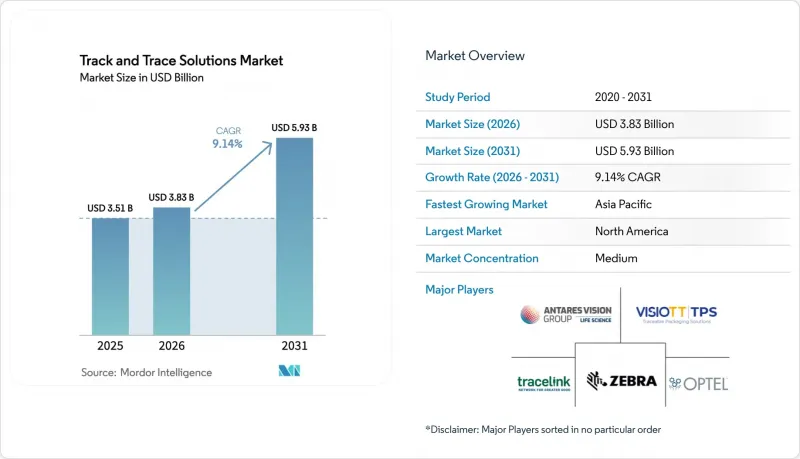
This report is Segmented by Component (Hardware Systems [Printing & Marking Equipment, and More], Software Solutions, and More), Technology (Barcode / 2-D DataMatrix, and More), Application (Serialization Solutions and Aggregation Solutions), End User (Pharmaceutical Manufacturers, and More), and Geography (North America, Europe, and More). The Market Forecasts are Provided in Terms of Value (USD).
Global Track And Trace Solutions Market Trends and Insights
Convergence of Global Pharmaceutical Traceability Mandates
Regulatory alignment is compressing deployment schedules. China's new GMP appendices effective January 2026 enforce electronic batch records for API shipments, while India's February 2025 export rule accelerates QR-code rollouts. ISO 12931 offers a shared authentication blueprint that trims integration delays across trading partners. Multinationals are standardizing enterprise-wide architectures instead of maintaining isolated regional stacks. The certification gap-only three in ten South Asian generic firms met ISO 12931 by 2025-lets compliant suppliers command premium contracts.
Escalating Counterfeit Drug Threat Elevating Patient-Safety Imperatives
Interpol's 2023 Operation Pangea seized illicit drugs valued at USD 53 million, yet WHO recorded 1,500 falsified-medicine incidents in 2024[1]. Hospital group-purchasing organizations in the United States now reject shipments lacking serialized pedigree data. Telemedicine growth opens fresh vulnerabilities as patients bypass brick-and-mortar pharmacies; the FDA sent 15 warning letters to online outlets in 2024. This environment propels serialization as a frontline defense.
Fragmented Country-Level Timelines Generating Investment Uncertainty
Brazil deferred full serialization for smaller producers to 2027, diverting capital to markets with firmer deadlines. Saudi Arabia completed phased rollouts in 2024, yet neighboring states retain unique file formats. Turkey fines foreign firms more often than local peers, creating uneven compliance pressure. Manufacturers juggle resources across this patchwork, extending decision cycles.
Other drivers and restraints analyzed in the detailed report include:
- Surge in Direct-to-Patient and E-commerce Channels Requiring End-to-End Visibility
- Digitalization of Pharma Supply Chains and Cloud-Native SaaS Adoption
- High Capital and Integration Costs with Legacy Systems
For complete list of drivers and restraints, kindly check the Table Of Contents.
Segment Analysis
Software Solutions anchored 52.64% of 2025 revenue, underscoring their role as the unifying layer that links line-level controllers with enterprise resource planning. The Track and Trace Solutions market benefits from multinationals that mandate single global platforms to manage DSCSA lot-level events alongside EU aggregation uploads. Managed-service specialists execute validation, audits, and upgrades, growing at 10.49% CAGR as mid-sized firms lacking serialization talent outsource compliance.
Hardware Systems remain essential, yet buyers avoid vendor lock-in. Modular DataMatrix printers from Videojet install quickly and pair with third-party cameras, cutting changeover time. AI-equipped vision systems identify barcode defects and misapplied labels in real time, trimming rework by 30%. Tamper-evident labeling is compulsory in select MEA markets and continues to carve a niche, but software-driven interoperability decides contract awards. The Track and Trace Solutions market continues to shift budget weight from equipment to lifecycle services as regulatory audits intensify.
Barcodes and 2-D DataMatrix symbols delivered 55.76% of 2025 spending because of universal scanner compatibility and negligible per-unit cost. This share underscores the Track and Trace Solutions market dominance of standards-based barcoding, a baseline that satisfies regulators across the United States, Europe, China, and India. GS1 DataMatrix encodes GTIN, serial, lot, and expiration within a small footprint, enabling high-speed printing on blister cards and bottles.
RFID & NFC are advancing at 8.85% CAGR, driven by biologics and vaccines that need continuous temperature assurance.
Complete Report Scope:
- By Component
- Hardware Systems
- Printing & Marking Equipment
- Monitoring & Verification Systems
- Labeling & Tamper-evident Solutions
- Other Hardware
- Software Solutions
- Plant-level Management Suites
- Line Controller Software
- Bundle / Pallet Tracking Software
- Enterprise & Cloud Platforms
- Professional & Managed Services
- Hardware Systems
- By Technology
- Barcode / 2-D DataMatrix
- RFID & NFC
- Advanced IoT Sensors & BLE Beacons
- By Application
- Serialization Solutions
- Bottle Serialization
- Blister & Strip Serialization
- Carton & Case Serialization
- Data-Matrix / QR Serialization
- Aggregation Solutions
- Bundle Aggregation
- Case Aggregation
- Pallet Aggregation
- Serialization Solutions
- By End User
- Pharmaceutical Manufacturers
- Contract Manufacturing & Packaging Organizations (CMOs/CPOs)
- Medical Device Manufacturers
- Healthcare Distributors & Wholesalers
- Other Life-science Stakeholders (OTC, Nutraceuticals, Cosmetics, Legal Cannabis)
- By Geography
- North America
- United States
- Canada
- Mexico
- Europe
- Germany
- United Kingdom
- France
- Italy
- Spain
- Rest of Europe
- Asia-Pacific
- China
- Japan
- India
- South Korea
- Australia
- Rest of Asia-Pacific
- Middle East and Africa
- GCC
- South Africa
- Rest of Middle East and Africa
- South America
- Brazil
- Argentina
- Rest of South America
- North America
Geography Analysis
North America delivered 42.24% of 2025 revenue. The United States closed its DSCSA stabilization period in November 2024, then extended limited exemptions through 2025, prompting staggered upgrades that favored platforms able to support EPCIS and legacy flat-file flows simultaneously. Canada phased in serialization rules through 2025, though enforcement remained lighter, while Mexico's proposal lacks firm dates, leading suppliers to prioritize U.S. readiness. These dynamics keep spending elevated as firms complete final DSCSA milestones.
Asia-Pacific leads growth at 10.29% CAGR. China's 2027 full-chain traceability goal and India's export QR-code mandate force rapid line retrofits. Chinese GMP appendices effective 2026 impose serialized batch records for excipients and APIs, increasing domestic demand. India's top-300-brand QR rule creates a two-speed market favoring branded players with capital for upgrades. Japan recommends voluntary adoption, yet competitive pressure nudges early movers to serialize high-value therapies. Collectively, these forces enlarge the Track and Trace Solutions market share for Asia-Pacific.
Europe maintains mature adoption under the Falsified Medicines Directive, but national verification systems evolve at varied speeds. Pharmacy compliance lags in parts of Southern Europe where manual scans persist. The United Kingdom's separate repository post-Brexit adds complexity and incremental cost for dual-market manufacturers. Despite maturity, continuing enhancements sustain mid-single-digit growth in the Track and Trace Solutions market across Europe.
Middle East and Africa show uneven progress. Gulf Cooperation Council states enforce barcodes and aggregation at ports, yet sub-Saharan nations rely on donor-funded pilots that often stall at scale. Saudi Arabia finished phased implementation in 2024 but adjacent markets still diverge on data formats. South Africa's draft rules remain pending. Such disparity tempers growth but leaves headroom for long-run expansion once harmonization improves.
South America remains fragmented. Brazil's repeated postponements push local upgrades to 2027, stalling investments. Argentina requires serialization for psychotropics and controlled drugs yet lacks centralized verification, limiting benefits. Chile and Colombia publish guidance without mandates, resulting in optional adoption guided by multinational policy rather than national law. This uncertainty curbs the Track and Trace Solutions market size in the region until clearer enforcement emerges.
- OPTEL Group
- TraceLink
- Antares Vision SpA
- SEA Vision SRL
- Syntegon Technology
- Zebra Technologies
- Mettler Toledo
- Korber
- ACG Worldwide
- VISIOTT
- Uhlmann
- Sato Holdings Corporation
- Siemens Digital Industries
- Brother Industries, Ltd. (Domino Printing Sciences plc)
- Dover Corporation (Markem-Imaje)
- Wipotec-OCS GmbH
- Veralto Corporation (Videojet Technologies Inc.)
- Coesia S.p.A.
Additional Benefits:
- The market estimate (ME) sheet in Excel format
- 3 months of analyst support
TABLE OF CONTENTS
1 Introduction
- 1.1 Study Assumptions & Market Definition
- 1.2 Scope of the Study
2 Research Methodology
3 Executive Summary
4 Market Landscape
- 4.1 Market Overview
- 4.2 Market Drivers
- 4.2.1 Convergence of Global Pharmaceutical Traceability Mandates (WHO, ISO)
- 4.2.2 Escalating Counterfeit Drug Threat Elevating Patient?Safety Imperatives
- 4.2.3 Surge in Direct-to-Patient & E-commerce Channels Requiring End-to-End Visibility
- 4.2.4 Digitalization of Pharma Supply Chains and Cloud-native SaaS Adoption
- 4.2.5 Transition to Personalized & Small-Batch Therapies Necessitating Flexible Serialization
- 4.2.6 Brand Reputation & Recall Cost Avoidance Driving Investment in Track & Trace Analytics
- 4.3 Market Restraints
- 4.3.1 Divergent Country-level Timelines Generating Investment Uncertainty
- 4.3.2 High Capital & Integration Costs with Legacy MES/ERP and Packaging Lines
- 4.3.3 Data Privacy & Cyber-security Risks in Networked Traceability Platforms
- 4.3.4 Limited Per-unit ROI for Low-margin Generic Manufacturers
- 4.4 Technological Outlook
- 4.5 Porter's Five Forces
- 4.5.1 Threat of New Entrants
- 4.5.2 Bargaining Power of Buyers
- 4.5.3 Bargaining Power of Suppliers
- 4.5.4 Threat of Substitutes
- 4.5.5 Intensity of Competitive Rivalry
5 Market Size & Growth Forecasts (Value, USD)
- 5.1 By Component
- 5.1.1 Hardware Systems
- 5.1.1.1 Printing & Marking Equipment
- 5.1.1.2 Monitoring & Verification Systems
- 5.1.1.3 Labeling & Tamper-evident Solutions
- 5.1.1.4 Other Hardware
- 5.1.2 Software Solutions
- 5.1.2.1 Plant-level Management Suites
- 5.1.2.2 Line Controller Software
- 5.1.2.3 Bundle / Pallet Tracking Software
- 5.1.2.4 Enterprise & Cloud Platforms
- 5.1.3 Professional & Managed Services
- 5.1.1 Hardware Systems
- 5.2 By Technology
- 5.2.1 Barcode / 2-D DataMatrix
- 5.2.2 RFID & NFC
- 5.2.3 Advanced IoT Sensors & BLE Beacons
- 5.3 By Application
- 5.3.1 Serialization Solutions
- 5.3.1.1 Bottle Serialization
- 5.3.1.2 Blister & Strip Serialization
- 5.3.1.3 Carton & Case Serialization
- 5.3.1.4 Data-Matrix / QR Serialization
- 5.3.2 Aggregation Solutions
- 5.3.2.1 Bundle Aggregation
- 5.3.2.2 Case Aggregation
- 5.3.2.3 Pallet Aggregation
- 5.3.1 Serialization Solutions
- 5.4 By End User
- 5.4.1 Pharmaceutical Manufacturers
- 5.4.2 Contract Manufacturing & Packaging Organizations (CMOs/CPOs)
- 5.4.3 Medical Device Manufacturers
- 5.4.4 Healthcare Distributors & Wholesalers
- 5.4.5 Other Life-science Stakeholders (OTC, Nutraceuticals, Cosmetics, Legal Cannabis)
- 5.5 By Geography
- 5.5.1 North America
- 5.5.1.1 United States
- 5.5.1.2 Canada
- 5.5.1.3 Mexico
- 5.5.2 Europe
- 5.5.2.1 Germany
- 5.5.2.2 United Kingdom
- 5.5.2.3 France
- 5.5.2.4 Italy
- 5.5.2.5 Spain
- 5.5.2.6 Rest of Europe
- 5.5.3 Asia-Pacific
- 5.5.3.1 China
- 5.5.3.2 Japan
- 5.5.3.3 India
- 5.5.3.4 South Korea
- 5.5.3.5 Australia
- 5.5.3.6 Rest of Asia-Pacific
- 5.5.4 Middle East and Africa
- 5.5.4.1 GCC
- 5.5.4.2 South Africa
- 5.5.4.3 Rest of Middle East and Africa
- 5.5.5 South America
- 5.5.5.1 Brazil
- 5.5.5.2 Argentina
- 5.5.5.3 Rest of South America
- 5.5.1 North America
6 Competitive Landscape
- 6.1 Market Concentration
- 6.2 Market Share Analysis
- 6.3 Company Profiles (includes Global level Overview, Market level overview, Core Business Segments, Financials, Headcount, Key Information, Market Rank, Market Share, Products and Services, and analysis of Recent Developments)
- 6.3.1 OPTEL Group
- 6.3.2 TraceLink Inc.
- 6.3.3 Antares Vision SpA
- 6.3.4 SEA Vision SRL
- 6.3.5 Syntegon Technology GmbH
- 6.3.6 Zebra Technologies Corp.
- 6.3.7 Mettler-Toledo International Inc.
- 6.3.8 Korber Medipak Systems GmbH
- 6.3.9 ACG Worldwide
- 6.3.10 VISIOTT
- 6.3.11 Uhlmann
- 6.3.12 Sato Holdings Corporation
- 6.3.13 Siemens Digital Industries
- 6.3.14 Brother Industries, Ltd. (Domino Printing Sciences plc)
- 6.3.15 Dover Corporation (Markem-Imaje)
- 6.3.16 Wipotec-OCS GmbH
- 6.3.17 Veralto Corporation (Videojet Technologies Inc.)
- 6.3.18 Coesia S.p.A.
7 Market Opportunities & Future Outlook
- 7.1 White-space & Unmet-need Assessment