

|
시장보고서
상품코드
2122758
약국 관리 시스템 시장 : 시장 점유율 분석, 업계 동향 및 통계, 성장 예측(2026-2031년)Pharmacy Management System - Market Share Analysis, Industry Trends & Statistics, Growth Forecasts (2026 - 2031) |
||||||
 Mordor Intelligence
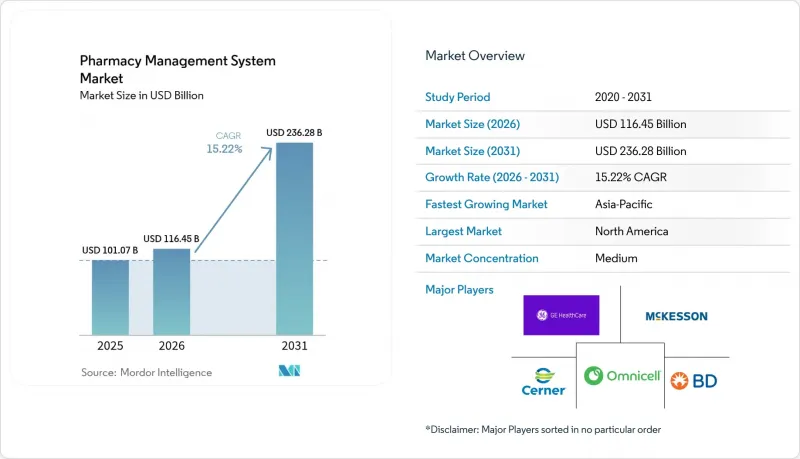
Mordor Intelligence에 의하면, 2026년 약국 관리 시스템 시장 규모는 1,164억 5,000만 달러로 추정되고, 2025년 1,010억 7,000만 달러에서 확대해, 2031년에는 2,362억 8,000만 달러에 이를 것으로 예측됩니다.
2026-2031년 연평균 성장률(CAGR)은 15.22%가 될 것으로 전망됩니다.
본 보고서는 구성 요소별(솔루션, 서비스), 도입 형태별(클라우드 기반, 온프레미스형), 조직 규모별(독립 약국, 체인 약국), 최종 사용자 산업별(병원 약국, 소매/지역 약국 등), 지역별(북미, 남미, 유럽, 아시아태평양, 중동 및 아프리카)로 분류되어 있습니다. 시장 예측은 금액(달러) 기준으로 제시되어 있습니다.
세계의 약국 관리 시스템 시장 동향 및 인사이트
처방전 수 증가가 약사들에게 부담을 가중시키고 있습니다.
2024년, 미국의 처방약 지출은 10-12% 증가했으며, 그 증가분의 80% 이상을 GLP-1 수용체 작용제(비만 치료제)가 차지함에 따라 일상적인 조제 업무에 대한 부담이 더욱 가중되고 있습니다. 조사에 따르면, 현재 미국인의 61%가 약국을 1차 진료의 적절한 제공 장소로 간주하고 있으며, 약사의 업무 범위는 상담 및 예방 접종까지 확대되고 있습니다. 특히 독립 약국은 이러한 부담을 크게 느끼고 있으며, 2023년에는 하루에 한 곳씩 폐점하는 속도로 잇따랐습니다. 이는 보수 삭감과 수작업에 의존하는 업무 흐름이 이익을 압박했기 때문입니다. 약국 관리 시스템 시장의 자동 조제 기능과 임상 문서 작성 모듈은 반복적인 업무를 제거하여 약사가 더 높은 부가가치를 창출하는 서비스에 집중할 수 있도록 합니다. 첨단 워크플로 엔진을 도입한 업체들에서는 실수 감소와 대기 시간 단축이 보고되고 있으며, 이는 환자 충성도 향상으로 이어지고 있습니다.
클라우드 기반 약국 플랫폼으로의 급속한 전환
제약 관련 조직의 83%는 이미 주요 업무 부하를 클라우드에서 운영하고 있으며, 해당 부문의 클라우드 지출은 2030년까지 593억 7,000만 달러에 달할 것으로 예측됩니다. 클라우드 아키텍처는 수천 개의 지점을 보유한 체인 전체에서 실시간 데이터 동기화를 지원하지만, 이는 온프레미스 서버로는 실현하기 어려운 것입니다. 코로나19 팬데믹 기간 동안 원격 로그인 및 탄력적인 용량 확보가 단순한 옵션이 아닌 업무상의 필수 요건이 됨에 따라 수요는 더욱 증가했습니다. 또한, 현대의 클라우드 공급업체들은 각 지역의 개인정보 보호 프레임워크에 기반한 인증을 획득하여, 과거 도입을 지연시켰던 데이터 주권에 대한 우려를 완화하고 있습니다. 구독형 가격 책정 방식 덕분에 IT 비용이 처방전 처리량에 비례하게 되었기 때문에 단일 매장을 운영하는 독립 약국조차도 자본 투자가 필요 없이 엔터프라이즈 수준의 분석 기능을 활용할 수 있게 되어 약국 관리 시스템 시장에 진입하고 있습니다.
레거시 공급업체에 의한 벤더 락인
대규모 의료 시스템의 경우, 조제, 청구, 처방약 목록 데이터를 독자적인 형식으로 통합한 맞춤형 시스템에 의존하는 경우가 많으며, 벤더를 교체하려면 수백만 달러의 비용이 들고 수개월에 걸친 재교육이 필요합니다. 반면, 독립 약국은 IT 인력 부족이나 취약한 현금 흐름을 위협하는 가동 중단에 대한 우려 등 다른 장벽에 직면해 있습니다. 2024년 BD가 Parata Systems를 15억 4,800만 달러에 인수했을 때, 업계 관측통들이 지적했듯이, 인수자가 오픈 API를 단계적으로 폐지할 경우 업계 재편은 락인을 더욱 심화시킬 가능성이 있습니다. 클라우드 분야의 신규 진출기업들은 마이그레이션 지원 도구와 ‘성장에 따른 과금’ 조건을 제공함으로써 이러한 장벽을 서서히 해소하고 있지만, 기존 계약이 만료될 때까지는 완전한 마이그레이션에 여전히 오랜 시간이 걸릴 것입니다.
부문 분석
2025년, 솔루션 제품은 약국 관리 시스템 시장 규모의 66.90%를 차지했습니다. 이는 전자 처방전 처리, 재고 관리, 규정 준수 추적이 필수 요건임을 반영합니다. 이 부문에 통합된 임상 점검 기능과 자동화된 재무 대조 기능은 규제 당국으로부터의 벌금으로 이어질 수 있는 오류를 방지합니다. 병원이나 체인점에서는 약사가 자격을 최대한 발휘할 수 있도록 여러 모듈로 구성된 제품군을 도입하여, 시스템이 반복적인 입력 작업을 처리하고 있습니다. 2031년까지 연평균 성장률(CAGR)이 16.05%로 예측되는 서비스 분야의 성장은 핵심 소프트웨어가 가동된 후에도 사용자가 설정, 직원 교육, 관리형 호스팅을 점점 더 많이 요구하고 있음을 보여줍니다.
이러한 서비스의 확산은 시장이 성숙해가고 있으며, 최적화가 가동 후에도 장기간에 걸쳐 지속될 것임을 시사합니다. 약국에서는 새로운 보험 급여 규정 도입에 따라 분석 기능 조정, 보안 패치 적용, 워크플로우 재설계가 요구되고 있습니다. 컨설턴트는 각 지점 간의 조제율, 대기 시간, 보험사 구성을 비교하는 벤치마크 대시보드를 통합하여 사업자가 이익률을 유지할 수 있도록 지원하고 있습니다. 소프트웨어와 자문 지원을 융합하는 벤더는 더 안정적인 수익원을 확보하며 약국 관리 시스템 시장에서의 점유율을 확대되고 있습니다.
클라우드 도입은 2025년에 62.85%의 점유율을 차지한 것으로 평가되었으며, 2031년까지 연평균 성장률(CAGR) 17.18%라는 가장 높은 성장률을 기록할 전망입니다. 이는 확장성,낮은 초기 비용, 원활한 업데이트와 같은 장점이 온프레미스형 하드웨어가 주는 안정감을 능가하고 있음을 여실히 보여줍니다. 체인점은 수백 개 점포에 걸친 데이터 표준화를 위해 클라우드를 선호하는 반면, 독립 약국은 설비 투자를 운영비로 전환할 수 있는 구독 모델을 환영하고 있습니다.
사이버 위험 완화, 중복성 확보 및 유지보수에는 소규모 IT 팀으로는 감당하기 어려운 고도의 기술이 요구되므로, 온프레미스형 도입 규모는 축소되고 있습니다. 규정 준수 감사 기관은 현재 벤더가 여러 프레임워크에 기반해 인증받은 견고한 환경을 유지하고 있다는 점에서 클라우드 시스템을 더 높게 평가했습니다. 이러한 전환으로 인해 처방 의사, 보험사, 약사 간의 실시간 연계가 강화되어, 지역에 관계없이 약국 관리 시스템 시장의 도입이 더욱 확대되고 있습니다.
지역별 분석
북미가 주도적인 위치를 차지하고 있는 배경에는 성숙한 보험 시장, 대규모 체인점의 전개, 그리고 조제 시마다 전자 확인을 의무화하는 규제 당국의 존재가 있습니다. 오피오이드 남용 대책을 위한 미국의 노력은 실시간 처방전 모니터링의 보급을 뒷받침하고 있는 반면, 캐나다의 국민건강보험 제도는 비용 대비 효과가 높은 처방전 재발급 조정의 필요성을 부각시키고 있습니다. 전자건강기록(EHR)과 관련된 부정행위에 대해 미국 마약단속국(DEA)이 최근 발령한 경고를 계기로, 감사 추적 및 다단계 인증에 대한 투자가 가속화되고 있습니다. 또한, 업무 부담 경감을 약속하는 AI 스타트업 기업에 대한 벤처 자금도 유입되고 있으며, 이로 인해 최첨단 매장과 기존 매장 간의 기술 격차가 확대되고 있습니다.
아시아태평양은 중국, 인도, 인도네시아가 1차 의료 제공 체계를 강화하고 공급망의 디지털화를 추진하는 가운데 가장 빠른 성장 궤도를 그리고 있습니다. 각국의 전자의료(e-health) 기본 계획에 따라 클라우드 지원 소프트웨어에 대한 보조금이 투입되어, 지방의 진료소가 도시 지역의 병원과 의료 기록을 공유할 수 있게 되었습니다. 일본에서는 급속한 고령화에 따라 조제 플랫폼과 연동되는 복약 순응도 앱에 대한 관심이 높아지고 있습니다. 동남아시아에 진출하는 다국적 체인점들은 유럽과 미국의 운영 체제를 반영한 엔터프라이즈 시스템을 강력히 요구하고 있으며, 이것이 약국 관리 시스템 시장 수요를 뒷받침하고 있습니다.
유럽은 이 두 극단 사이의 중간 위치에 있습니다. 유럽의약품청(EMA)의 통합 지침에 따라 약국은 일련번호 추적 및 국경을 초월한 통합적인 부작용 보고가 요구되고 있습니다. 브렉시트로 인해 추가 통관 서류가 필요해짐에 따라, 영국의 매장에서는 재고 보충 및 규제 당국에 대한 신고의 자동화가 진행되고 있습니다. 일찍부터 전자 처방전을 도입해 온 스칸디나비아 시장에서는 현재 인건비 급등을 상쇄하기 위해 AI를 활용한 수요 예측으로의 전환이 진행되고 있습니다. 유럽 전역에서 GDPR(EU 개인정보보호규정) 등의 개인정보 보호 규제로 인해 세밀한 동의 관리를 제공하는 공급업체가 우대받고 있습니다.
기타 혜택 :
- 엑셀 형식 시장 예측(ME) 시트
- 3개월간의 애널리스트 지원
자주 묻는 질문
목차
제1장 서론
제2장 조사 방법
제3장 주요 요약
제4장 시장 구도
제5장 시장 규모 및 성장 예측
제6장 경쟁 구도
제7장 시장 기회 및 향후 전망
AJY 26.09.07According to Mordor Intelligence, pharmacy management system market size in 2026 is estimated at USD 116.45 billion, growing from 2025 value of USD 101.07 billion with 2031 projections showing USD 236.28 billion, growing at 15.22% CAGR over 2026-2031.
This report is Segmented by Component (Solutions, Services), Deployment (Cloud-Based, On-Premise), Organisation Size (Independent Pharmacies, Chained Pharmacies), End-User Industries (Hospital Pharmacies, Retail/Community Pharmacies, and More), and Geography (North America, South America, Europe, APAC, Middle East, Africa). The Market Forecasts are Provided in Terms of Value (USD).
Global Pharmacy Management System Market Trends and Insights
Rising Prescription Volumes Burdening Pharmacists
Prescription drug spend in the United States rose at 10-12% during 2024, with GLP-1 anti-obesity agents responsible for more than 80% of incremental revenue, intensifying daily dispensing pressure. Surveys show 61% of Americans now consider pharmacies appropriate sites for primary care, stretching pharmacist duties into counseling and vaccination. Independent outlets feel the strain most, with one closing each day in 2023 because reimbursement cuts and manual workflows eroded profits. Automated dispensing and clinical documentation modules inside the pharmacy management system market remove repetitive tasks, letting pharmacists focus on higher-value services. Providers that adopt advanced workflow engines report fewer errors and shorter wait times, improving patient loyalty.
Rapid Shift Toward Cloud-Hosted Pharmacy Platforms
Eighty-three percent of pharmaceutical organizations already keep core workloads in the cloud, and the sector's cloud spending is forecast to climb to USD 59.37 billion by 2030. Cloud architectures support real-time data synchronization across chains with thousands of branches, a feat that on-premise servers struggle to match. Demand intensified during the COVID-19 pandemic when remote log-ons and elastic capacity became operational necessities, not optional perks. Modern cloud vendors also certify against regional privacy frameworks, lowering concerns over data sovereignty that once delayed adoption. As subscription pricing aligns IT cost with prescription volume, even single-site independents enter the pharmacy management system market to access enterprise-grade analytics without capital outlays.
Vendor Lock-in with Legacy Vendors
Large health systems often rely on bespoke builds that weave dispensing, billing, and formulary data into proprietary formats; switching vendors can cost millions and demand months of retraining . Independent outlets face different barriers, such as limited IT staff and fear of downtime that threaten fragile cash flows. Consolidation can deepen lock-in when an acquirer phases out open APIs, as observers noted after BD paid USD 1.548 billion for Parata Systems in 2024. Cloud newcomers gradually erode these obstacles by offering migration utilities and pay-as-you-grow terms, yet full transition remains protracted while legacy contracts run their course.
Other drivers and restraints analyzed in the detailed report include:
- Stringent Global Medication-Safety Regulations
- Cost-Savings from AI-Led Inventory Optimisation
- Escalating Cyber-Security and Privacy Concerns
For complete list of drivers and restraints, kindly check the Table Of Contents.
Segment Analysis
Solutions products generated 66.90% of the pharmacy management system market size in 2025, reflecting the non-negotiable need for e-prescription processing, inventory control, and compliance tracking. The segment's built-in clinical checks and automated financial reconciliation guard against errors that can spark regulatory fines. Hospitals and chains deploy multi-module suites so pharmacists practice at the top of license while systems handle repetitive inputs. Growth in services, expected at 16.05% CAGR to 2031, shows users increasingly seek configuration, staff training, and managed hosting once the base software is live.
The services wave signals a maturing marketplace in which optimization extends long after go-live. Pharmacies demand analytics tuning, security patching, and workflow redesign as new reimbursement rules arrive. Consultants embed benchmark dashboards that compare fill rates, wait times, and payer mix across branches, helping operators defend margin. Vendors that blend software and advisory support position themselves for stickier revenue streams, deepening share within the pharmacy management system market.
Cloud installations owned 62.85% share in 2025 and will post the fastest 17.18% CAGR through 2031, underscoring how elasticity, lower upfront cost, and seamless updates outweigh the comfort of on-premise hardware. Chains favor cloud to standardize data across hundreds of outlets, while independents welcome subscription models that convert capital expenditure into operating cost.
On-premise footprints shrink as cyber-risk mitigation, redundancy, and maintenance demand skills that small IT teams cannot supply. Compliance auditors now rate cloud systems higher because vendors maintain hardened environments certified under multiple frameworks. The pivot enhances real-time collaboration among prescribers, payers, and pharmacists, deepening adoption of the pharmacy management system market across geographies.
Complete Report Scope:
- By Component
- Solutions
- Inventory Management
- Purchase Order Management
- Supply-Chain Management
- Regulatory and Compliance Information
- Clinical and Administrative Performance
- Other Solutions
- Services
- Solutions
- By Deployment
- Cloud-based
- On-premise
- By Organisation Size
- Independent Pharmacies
- Chained Pharmacies
- By End-User Industries
- Hospital Pharmacies
- Retail/Community Pharmacies
- Long-term-care and Specialty Pharmacies
- By Geography
- North America
- United States
- Canada
- Mexico
- Europe
- United Kingdom
- Germany
- France
- Italy
- Rest of Europe
- Asia-Pacific
- China
- Japan
- India
- South Korea
- Rest of Asia-Pacific
- Middle East
- Israel
- Saudi Arabia
- United Arab Emirates
- Turkey
- Rest of Middle East
- Africa
- South Africa
- Egypt
- Rest of Africa
- South America
- Brazil
- Argentina
- Rest of South America
- North America
Geography Analysis
North America's dominance rests on mature insurance markets, sizable chain footprints, and regulators that mandate electronic checks at every dispense. U.S. initiatives to combat opioid misuse spur uptake of real-time prescription monitoring, while Canada's universal coverage highlights the need for cost-efficient refill coordination. Recent DEA alerts about EHR fraud accelerate investments in audit trails and multifactor authentication. Venture funding also flows into AI start-ups that promise workflow relief, widening the technology gap between modern and legacy stores.
Asia-Pacific records the fastest trajectory as China, India, and Indonesia upgrade primary-care delivery and digitize supply chains. National e-health blueprints channel subsidies into cloud-ready software so rural clinics share records with urban hospitals. Japan's rapidly aging population sharpens focus on medication adherence apps that integrate with dispensing platforms. Multinational chains entering Southeast Asia insist on enterprise systems that mirror their Western operations, fueling demand within the pharmacy management system market.
Europe sits between these extremes. Harmonized EMA guidelines push pharmacies to track serial numbers and report adverse events uniformly across borders. Brexit introduces extra customs documentation, encouraging British outlets to automate replenishment and regulatory filings. Scandinavian markets, long early adopters of e-prescription, now upgrade to AI-enabled forecasting that offsets higher labor costs. Throughout the continent, privacy regulations such as GDPR favor vendors that offer fine-grained consent management.
- McKesson Corporation
- Omnicell, Inc.
- Cerner Corporation
- Becton, Dickinson and Company
- GE HealthCare Technologies Inc.
- Talyst Systems, LLC
- Epicor Software Corporation
- Allscripts Healthcare Solutions, Inc.
- ACG Infotech Ltd.
- Clanwilliam Health Ltd.
- DATASCAN (DCS Pharmacy, Inc.)
- GlobeMed Ltd.
- Health Business Systems, Inc.
- Idhasoft Ltd.
- MedHOK, Inc.
- PioneerRx, LLC
- QS/1 Data Systems, LLC (RedSail Technologies)
- ScriptPro LLC
- Liberty Software, Inc.
- Computer-Rx, Inc.
Additional Benefits:
- The market estimate (ME) sheet in Excel format
- 3 months of analyst support
TABLE OF CONTENTS
1 INTRODUCTION
- 1.1 Study Assumptions and Market Definition
- 1.2 Scope of the Study
2 RESEARCH METHODOLOGY
3 EXECUTIVE SUMMARY
4 MARKET LANDSCAPE
- 4.1 Market Overview
- 4.2 Market Drivers
- 4.2.1 Rising prescription volumes burdening pharmacists
- 4.2.2 Rapid shift toward cloud-hosted pharmacy platforms
- 4.2.3 Stringent global medication-safety regulations
- 4.2.4 Cost-savings from AI-led inventory optimisation
- 4.2.5 Integration of pharmacogenomics modules
- 4.2.6 Expansion of tele-pharmacy services
- 4.3 Market Restraints
- 4.3.1 Vendor lock-in with legacy vendors
- 4.3.2 Escalating cyber-security and privacy concerns
- 4.3.3 High upfront automation capital cost
- 4.3.4 FHIR interoperability gaps with next-gen EHRs
- 4.4 Value Chain Analysis
- 4.5 Regulatory Landscape
- 4.6 Technological Outlook
- 4.7 Porter's Five Forces Analysis
- 4.7.1 Bargaining Power of Suppliers
- 4.7.2 Bargaining Power of Buyers
- 4.7.3 Threat of New Entrants
- 4.7.4 Threat of Substitutes
- 4.7.5 Competitive Rivalry
- 4.8 Impact of Macroeconomic Factors
- 4.9 Investment Analysis
5 MARKET SIZE AND GROWTH FORECASTS (VALUE, USD)
- 5.1 By Component
- 5.1.1 Solutions
- 5.1.1.1 Inventory Management
- 5.1.1.2 Purchase Order Management
- 5.1.1.3 Supply-Chain Management
- 5.1.1.4 Regulatory and Compliance Information
- 5.1.1.5 Clinical and Administrative Performance
- 5.1.1.6 Other Solutions
- 5.1.2 Services
- 5.1.1 Solutions
- 5.2 By Deployment
- 5.2.1 Cloud-based
- 5.2.2 On-premise
- 5.3 By Organisation Size
- 5.3.1 Independent Pharmacies
- 5.3.2 Chained Pharmacies
- 5.4 By End-User Industries
- 5.4.1 Hospital Pharmacies
- 5.4.2 Retail/Community Pharmacies
- 5.4.3 Long-term-care and Specialty Pharmacies
- 5.5 By Geography
- 5.5.1 North America
- 5.5.1.1 United States
- 5.5.1.2 Canada
- 5.5.1.3 Mexico
- 5.5.2 Europe
- 5.5.2.1 United Kingdom
- 5.5.2.2 Germany
- 5.5.2.3 France
- 5.5.2.4 Italy
- 5.5.2.5 Rest of Europe
- 5.5.3 Asia-Pacific
- 5.5.3.1 China
- 5.5.3.2 Japan
- 5.5.3.3 India
- 5.5.3.4 South Korea
- 5.5.3.5 Rest of Asia-Pacific
- 5.5.4 Middle East
- 5.5.4.1 Israel
- 5.5.4.2 Saudi Arabia
- 5.5.4.3 United Arab Emirates
- 5.5.4.4 Turkey
- 5.5.4.5 Rest of Middle East
- 5.5.5 Africa
- 5.5.5.1 South Africa
- 5.5.5.2 Egypt
- 5.5.5.3 Rest of Africa
- 5.5.6 South America
- 5.5.6.1 Brazil
- 5.5.6.2 Argentina
- 5.5.6.3 Rest of South America
- 5.5.1 North America
6 COMPETITIVE LANDSCAPE
- 6.1 Market Concentration
- 6.2 Strategic Moves
- 6.3 Market Share Analysis
- 6.4 Company Profiles (includes Global-level Overview, Market-level Overview, Core Segments, Financials as available, Strategic Information, Market Rank/Share for key companies, Products and Services, and Recent Developments)
- 6.4.1 McKesson Corporation
- 6.4.2 Omnicell, Inc.
- 6.4.3 Cerner Corporation
- 6.4.4 Becton, Dickinson and Company
- 6.4.5 GE HealthCare Technologies Inc.
- 6.4.6 Talyst Systems, LLC
- 6.4.7 Epicor Software Corporation
- 6.4.8 Allscripts Healthcare Solutions, Inc.
- 6.4.9 ACG Infotech Ltd.
- 6.4.10 Clanwilliam Health Ltd.
- 6.4.11 DATASCAN (DCS Pharmacy, Inc.)
- 6.4.12 GlobeMed Ltd.
- 6.4.13 Health Business Systems, Inc.
- 6.4.14 Idhasoft Ltd.
- 6.4.15 MedHOK, Inc.
- 6.4.16 PioneerRx, LLC
- 6.4.17 QS/1 Data Systems, LLC (RedSail Technologies)
- 6.4.18 ScriptPro LLC
- 6.4.19 Liberty Software, Inc.
- 6.4.20 Computer-Rx, Inc.
7 MARKET OPPORTUNITIES AND FUTURE OUTLOOK
- 7.1 White-space and Unmet-need Assessment


