|
시장보고서
상품코드
2122767
방사선 선량 관리 시장 : 시장 점유율 분석, 업계 동향 및 통계, 성장 예측(2026-2031년)Radiation Dose Management - Market Share Analysis, Industry Trends & Statistics, Growth Forecasts (2026 - 2031) |
||||||
 Mordor Intelligence
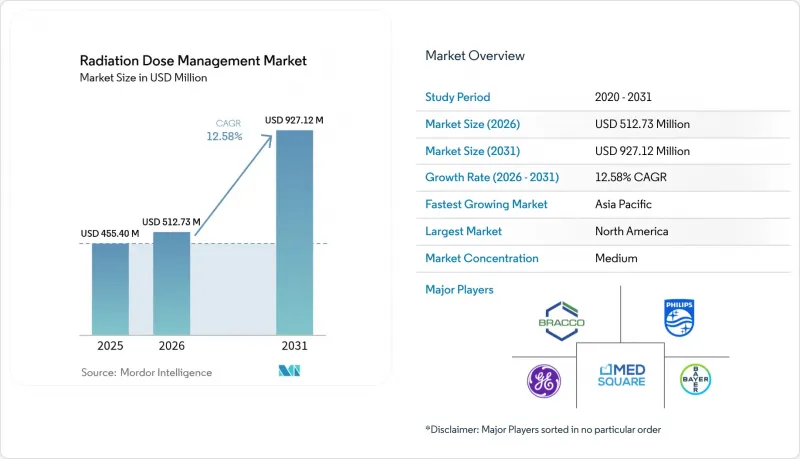
Mordor Intelligence에 의하면, 방사선 선량 관리 시장 규모는 2025년 4억 5,540만 달러로 평가되었고, 2026년에는 5억 1,273만 달러로 추정되고, 2026-2031년 CAGR 12.58%로 성장을 지속할 전망이며, 2031년에는 9억 2,712만 달러에 이를 것으로 예측됩니다.
본 보고서는 제품 및 서비스별(독립형 선량 추적 소프트웨어, 통합형 선량 관리 플랫폼 등), 도입 형태별(온프레미스 및 클라우드), 모달리티별(CT, 핵의학 등), 용도별(종양학, 순환기학 등), 최종 사용자별(병원, 외래·영상진단센터 등), 지역별로 분류되어 있습니다. 시장 예측은 금액(달러) 기준으로 제시되어 있습니다.
세계의 방사선 선량 관리 시장 동향 및 인사이트
방사선과에 대한 엄격한 DRL 규제
규제 당국은 자발적인 지침에서 의무적인 선량 상한선으로 전환하고 있으며, 모든 영상 진단 제공업체에게 스캐너 수준의 추적 기능 통합을 의무화하고 있습니다. FDA는 현재 CT 시스템에 대해 누적 선량 표시 및 자동 로그 유지 관리를 의무화하고 있으며, 이러한 변화로 인해 모니터링 기능이 내장된 스캐너로의 조달 경향이 강해지고 있습니다. 이에 이어, 조인트 커미션(Joint Commission)은 2024년 인증 조항에서 병원에 방사선 안전 프로그램에 대한 연례 감사를 의무화하여, 보고서 작성 소프트웨어에 대한 수요를 촉진하고 있습니다. 유럽도 ‘의료기기 규정(MDR)’을 통해 유사한 입장을 보이고 있으며, 시장 진입을 선량 최적화의 증거와 연계하고 있습니다. 미국에서는 CMS의 품질 평가 지표가 보험 급여와 규정 준수를 연계하고 있기 때문에 경영진은 선량 관리를 단순한 선택적 업그레이드가 아닌 수익을 지키기 위한 필수 조치로 인식하고 있습니다. 이러한 규제들이 맞물리면서, 방사선 선량 관리 시장은 모든 영상 진단 기법에서 필수적인 요소가 되었습니다.
종양학 워크플로우에서 CT 및 하이브리드 영상 진단의 검사 건수 증가
현재 암 치료에서는 치료 효과를 모니터링하기 위해 연속적인 CT, PET-CT, SPECT-CT에 의존하고 있으며, 이로 인해 환자의 누적 피폭량이 증가하고 모니터링이 강화되고 있습니다. 한 번의 PET-CT 검사에서 20 mSv를 초과하는 경우도 있는데, 이는 의료진의 연간 직업 피폭 한도치에 근접한 수준이며, 환자는 일반적으로 하나의 치료 주기당 여러 번의 스캔을 받습니다. 전신 PET 시스템은 피폭을 줄여주지만, 여전히 전문 시설로 제한되어 있어 선량에 대한 우려는 여전히 높습니다. 소아 및 젊은 성인의 암 치료에서는 평생 위험 모델이 과도한 방사선 피폭을 불리하게 평가하기 때문에 그 시급성이 더욱 커지고 있습니다. 이에 AI를 활용한 프로토콜의 개별화가 도입되어, 환자의 병력에 따라 설정을 최적화함으로써 화질을 저하시키지 않으면서 총 피폭 선량을 줄입니다. 이러한 첨단 모니터링 워크플로우에 대한 의존으로 인해, 종양학은 방사선 피폭량 관리 시장의 핵심 부문으로서의 입지를 공고히 하고 있습니다.
지역 병원 및 저·중소득 국가(LMICs)의 예산 제약
이익률이 낮은 의료 기관에서는 선량 추적 시스템 도입과 시급한 환자 치료 요구 사이에서 균형을 맞추어야 하는 상황에 처해 있습니다. 전체 플랫폼 가격은 5만-20만 달러에 달하며, 직접적인 환급 인센티브가 없다면 그 비용을 정당화하기 어렵습니다. 많은 중저소득 국가에서는 여전히 기본적인 영상 진단 역량 확충에 중점을 두고 있어, 첨단 모니터링은 부차적인 위치에 머물러 있습니다. 공급업체들은 리스나 SaaS(SaaS) 계약을 제공하고 있지만, 자금 부족으로 인해 도입 현황에 편차가 발생하고 있으며, 방사선 선량 관리 시장 내 양극화 구조가 유지되고 있습니다.
부문 분석
2025년 현재, 통합형 플랫폼은 방사선 선량 관리 시장의 44.72%를 차지했으며, 연평균 성장률(CAGR) 16.47%로 성장하고 있습니다. 이러한 우위는 피폭량 추적, 프로토콜 최적화, 규제 보고서 자동 생성을 단일 워크플로우로 실현하는 통합 대시보드 덕분입니다. 의료 기관은 벤더 수 감소, 교육에 드는 부담 경감, 싱글 사인온(SSO)을 통한 편의성을 중요시하고 있습니다. 독립형 추적기는 예를 들어 핵의학 선량 측정과 같은 틈새 분야에서 여전히 입지를 유지하고 있지만, 플랫폼 제공업체들이 동등한 모듈을 매력적인 가격에 묶음으로 제공하고 있어 이익률 압박에 직면해 있습니다. 병원들이 의료 물리 업무를 외부에 위탁함에 따라 매니지드 서비스가 가장 빠르게 성장하고 있습니다. 그 결과, 탄탄한 임상 지원을 제공하는 벤더들은 장기 계약을 확보하며 방사선 선량 관리 시장에서 플랫폼 시장 점유율을 높이고 있습니다.
또한, 의료 기관이 벤치마크 해석이나 규정 준수 격차 해소를 위한 지원을 요청함에 따라 전문 서비스에 대한 수요도 증가하고 있습니다. 자문 수익은 소프트웨어 구독을 보완하여 고객 생애 가치(CLV)를 확대시킵니다. 전반적으로 통합형 접근 방식의 흐름은 사일로화된 용도에서 모달리티를 초월하여 확장 가능한 생태계로의 전환을 촉진하고 있으며, 통합형 제품군이 방사선 선량 관리 시장의 전략적 중심에 계속 자리 잡고 있습니다.
온프레미스 도입은 여전히 58.88%의 점유율을 차지하고 있으며, 이는 개인정보 보호 규정과 뿌리 깊은 위험 회피 경향을 반영한 것이지만, 클라우드 솔루션은 연평균 성장률(CAGR) 16.12%로 점유율을 확대되고 있습니다. 대기업의 경우, 영상 데이터를 로컬에 보관하면서 클라우드상에서 데이터를 분석하는 하이브리드 모델을 채택하는 경우가 많습니다. 이 전략은 데이터 저장과 관련된 법규를 준수하면서도 AI 및 고급 벤치마크 기능을 활용할 수 있게 해줍니다. 지역 병원의 경우, 종량제 요금제 덕분에 막대한 초기 투자가 필요 없어져 방사선 선량 관리 업계의 최신 도구에 대한 접근성이 확대되고 있습니다.
GPU를 많이 사용하는 AI 추론이나 지속적인 소프트웨어 업데이트를 고려하면 총소유비용(TCO)은 더욱 클라우드 쪽으로 기울게 됩니다. 각 벤더들은 규제 당국의 우려를 해소하기 위해 암호화된 오버레이나 지역별 스토리지 존을 제안하고 있습니다. 주권 문제를 둘러싼 논의는 계속되고 있지만, 성능과 경제적 이점으로 인해 클라우드로의 전환은 꾸준히 진행되고 있습니다. 그 결과, 2030년까지 특히 여러 거점을 동시에 현대화하는 시스템에서 클라우드 아키텍처가 방사선 피폭 관리 시장의 훨씬 더 큰 점유율을 차지할 것으로 예측됩니다.
지역별 분석
북미는 조인트 커미션(Joint Commission)의 철저한 규제와 CMS(미국 의료보험서비스센터)가 최적화와 환급을 연계한 것을 배경으로, 2025년에는 방사선 피폭량 관리 시장의 32.85%를 차지했습니다. AI 도구에 대한 FDA의 조기 승인으로 미국의 의료 시스템은 선구자로서의 우위를 확보하고 있으며, 캐나다도 독자적인 선량 보고 기준을 마련하여 이를 따르고 있습니다. 멕시코에서는 민간 병원 체인에서의 도입이 확대되는 추세이지만, 도입률은 여전히 미국에 뒤처져 있습니다. 기존 PACS의 높은 보급률이 도입을 저해하는 요인이 되기도 하지만, EHR(전자건강기록)과의 광범위한 연동을 통해 기업 전체 차원의 벤치마킹이 가능해지면서, 이 지역은 절대적인 지출 규모 측면에서 확고한 선두를 유지하고 있습니다.
아시아태평양은 가장 빠르게 성장하는 시장으로, 2031년까지의 연평균 성장률(CAGR)은 14.62%로 성장을 지속하고 있습니다. 인도의 대규모 병원 건설 계획과 중국의 디지털 헬스 투자로 수요가 견인되고 있는 반면, 일본은 고령화에 직면해 있어 영상 진단 빈도가 증가하고 있습니다. 호주와 한국은 하이브리드 방식 도입을 선호하는 경향과 AI 모듈의 급속한 보급이라는 점에서 선진국 시장의 양상과 유사합니다. 동남아시아 국가들은 우선 스캐너 조달을 우선시하고 있지만, 새로운 국가 지침을 충족하기 위해 선량 관리를 함께 도입하는 경향이 강해지고 있습니다. 이처럼 성숙도가 다양하기 때문에 APAC 지역은 패치워크와 같은 상황을 보이고 있으며, 공급업체는 가격 책정이나 도입 모델을 현지 상황에 맞추어 조정해야 하지만, 전체적인 시장 기회는 방사선 선량 관리 시장에서 여전히 가장 역동적인 부문으로 남아 있습니다.
유럽에서는 MDR(의료기기 규정)의 조화를 통해 회원국 간 벤더 인증이 간소화되어 꾸준한 성장이 관찰됩니다. 독일, 프랑스, 영국이 도입을 주도하고 있으며, 북유럽 국가들에서는 통합형 의료 시스템 덕분에 거의 모든 시설에서 도입이 완료되었습니다. 남유럽에서는 재정적 제약이 완화되고 디지털 헬스 분야에 대한 자금 지원이 증가함에 따라 뒤처졌던 부분을 만회하고 있습니다. 데이터 주권을 고려하여 로컬 스토리지와 클라우드 분석을 결합한 하이브리드 솔루션이 권장되고 있으며, 각 벤더사는 현재 이 구성을 제안서의 기본값으로 포함시키고 있습니다. 브렉시트로 인한 규제 차이는 행정 절차의 부담을 가중시키고 있지만, 영국 수요를 억제하고 있지는 않습니다. 영국에서는 NHS(국민보건서비스) 현대화 계획에 선량 안전 지표가 포함되어 있습니다. 전반적으로 유럽의 조달 활동은 규율을 갖춘 ‘안전 제일’의 자세를 유지하고 있으며, 이것이 방사선 선량 관리 시장 예측 가능한 성장을 뒷받침하고 있습니다.
기타 혜택 :
- 엑셀 형식 시장 예측(ME) 시트
- 3개월간의 애널리스트 지원
자주 묻는 질문
목차
제1장 서론
제2장 조사 방법
제3장 주요 요약
제4장 시장 구도
제5장 시장 규모 및 성장 예측
제6장 경쟁 구도
제7장 시장 기회 및 향후 전망
AJY 26.09.07According to Mordor Intelligence, the radiation dose management market size is expected to grow from USD 455.40 million in 2025 to USD 512.73 million in 2026 and is forecast to reach USD 927.12 million by 2031 at 12.58% CAGR over 2026-2031.
This report is Segmented by Products & Services (Stand-Alone Dose-Tracking Software, Integrated Dose-Management Platforms, and More), Deployment Mode (OnPremise and Cloud), Modality (CT, Nuclear Medicine, and More), Application (Oncology, Cardiology and More), End User (Hospital, Ambulatory & Imaging Centers and More), and Geography. The Market Forecasts are Provided in Terms of Value (USD).
Global Radiation Dose Management Market Trends and Insights
Stringent DRL mandates for radiology
Regulators have moved from voluntary guidance to mandatory dose ceilings, forcing every imaging provider to embed tracking at the scanner level. The FDA now requires CT systems to display cumulative dose and maintain automated logs, a shift that steers procurement toward scanners with built-in monitoring. The Joint Commission followed with 2024 accreditation clauses that oblige hospitals to audit radiation safety programs annually, spurring demand for reporting software. Europe mirrors this stance through the Medical Device Regulation, which ties market access to evidence of dose optimization. In the United States, CMS quality measures link reimbursement to compliance, so executives view dose management as revenue protection rather than an optional upgrade. Collectively, these rules turn the radiation dose management market into a must-have layer across all imaging modalities.
Rising CT and hybrid-imaging volumes in oncology workflows
Cancer care now relies on serial CT, PET-CT and SPECT-CT to monitor therapy response, raising cumulative patient exposure and intensifying oversight. A single PET-CT can exceed 20 mSv, edging close to annual occupational limits for staff, and patients typically undergo several scans per treatment cycle. Total-body PET systems mitigate exposure yet remain limited to specialized centers, keeping dose concerns high. Pediatric and young-adult oncology heightens the urgency because lifetime risk models penalize excess radiation. AI-driven protocol personalization enters here, refining settings per patient history and thus lowering total dose without compromising image quality. This workflow dependence on advanced monitoring cements oncology as the anchor segment for the radiation dose management market.
Budget constraints in community hospitals and LMICs
Facilities operating on slim margins weigh dose-tracking purchases against immediate patient-care needs. A full platform can cost USD 50,000-200,000, a figure difficult to justify without direct reimbursement incentives. Many low-to-middle-income nations still focus on expanding basic imaging capacity, so sophisticated monitoring remains secondary. While vendors offer leasing and SaaS terms, capital scarcity keeps uptake uneven and sustains a two-tier structure within the radiation dose management market.
Other drivers and restraints analyzed in the detailed report include:
- Cloud-based analytics lowering total cost of ownership
- AI-powered real-time dose-alerting gaining regulatory clearances
- Integration hurdles with legacy PACS/RIS ecosystems
For complete list of drivers and restraints, kindly check the Table Of Contents.
Segment Analysis
Integrated platforms accounted for 44.72% of the radiation dose management market in 2025 and are growing at 16.47% CAGR. This dominance stems from unified dashboards that track exposure, optimize protocols and auto-generate regulatory reports in one workflow. Health systems prefer fewer vendors, lower training overhead and single-sign-on usability. Standalone trackers retain niches-for example, nuclear-medicine dosimetry-yet face margin pressure because platform providers bundle equivalent modules at attractive prices. Managed services post the fastest gains as hospitals outsource medical-physics tasks. Vendors with deep clinical support therefore secure long-term contracts, reinforcing platform stickiness within the radiation dose management market.
Professional services also rise as institutions seek help interpreting benchmarks and closing compliance gaps. Advisory revenue complements software subscriptions, enlarging total customer lifetime value. Overall, the integrated-approach narrative reinforces a migration away from siloed applications toward ecosystems that scale across modalities, keeping integrated suites at the center of the radiation dose management market strategy.
On-premise installations still hold 58.88% share, a testament to privacy rules and ingrained risk aversion, yet cloud solutions are climbing at 16.12% CAGR. Larger enterprises often adopt hybrid models that analyze data in the cloud while retaining images locally. This strategy respects residency laws while unlocking AI and advanced benchmarking. For community hospitals, pay-as-you-go pricing eliminates large capital outlays, widening access to the radiation dose management industry's newest tools.
Total cost of ownership tilts further toward the cloud when GPU-intensive AI inference and continuous software updates enter the equation. Vendors showcase encrypted overlays and region-specific storage zones to soothe regulators. Although the debate on sovereignty persists, the performance and economic benefits keep migration steady. As a result, cloud architectures are projected to command a far larger slice of the radiation dose management market by 2030, especially in systems modernizing multiple sites simultaneously.
Complete Report Scope:
- By Products & Services
- Stand-alone Dose-Tracking Software
- Integrated Dose-Management Platforms
- Professional & Managed Services
- By Deployment Mode
- On-premise
- Cloud / Web-hosted
- By Modality
- Computed Tomography (CT)
- Fluoroscopy & Interventional X-ray
- Nuclear Medicine / PET-CT
- Radiography & Mammography
- By Application
- Oncology
- Cardiology
- Orthopaedics & Trauma
- By End User
- Hospitals (>300 beds)
- Ambulatory & Imaging Centres
- Others (Academic, CRO, Government)
- By Geography
- North America
- United States
- Canada
- Mexico
- Europe
- Germany
- United Kingdom
- France
- Italy
- Spain
- Rest of Europe
- Asia-Pacific
- China
- Japan
- India
- Australia
- South Korea
- Rest of Asia-Pacific
- Middle East and Africa
- GCC
- South Africa
- Rest of Middle East and Africa
- South America
- Brazil
- Argentina
- Rest of South America
- North America
Geography Analysis
North America owned 32.85% of the radiation dose management market in 2025 on the strength of the Joint Commission's enforcement and CMS linking optimization to reimbursements. Early FDA clearances for AI tools give U.S. health systems first mover advantage, and Canada follows with its own dose-reporting standards. Mexico shows rising traction in private hospital chains, though adoption still lags the United States. Legacy PACS saturation occasionally slows rollouts, yet widespread EHR connectivity supports enterprise-wide benchmarking, keeping the region firmly ahead in absolute spending.
Asia-Pacific is the fastest-growing arena, posting a 14.62% CAGR through 2031. India's expansive hospital-building program and China's digital-health investments lead volumes, while Japan confronts aging demographics that drive imaging intensity. Australia and South Korea mirror developed-market patterns with hybrid deployment preferences and quick uptake of AI modules. Southeast Asian countries prioritize scanner procurement first but increasingly bundle dose management to satisfy new national guidelines. This broad spectrum of maturity turns APAC into a patchwork where vendors must adapt pricing and deployment models locally, yet the aggregated opportunity remains the most dynamic segment of the radiation dose management market.
Europe grows steadily as MDR harmonization simplifies vendor certification across member states. Germany, France and the United Kingdom spearhead installations, with Nordic nations achieving near-universal compliance due to integrated care systems. Southern Europe catches up as fiscal constraints ease and digital health funding rises. Data-sovereignty considerations encourage hybrid solutions that couple local storage with cloud analytics, a configuration vendors now bake into proposals by default. Brexit's regulatory divergence adds paperwork but has not curtailed demand in the UK, where NHS modernization plans include dose safety metrics. Collectively, European procurement maintains a disciplined, safety-first posture that sustains predictable expansion of the radiation dose management market.
- Agfa-Gevaert
- Bayer
- Bracco Imaging S.p.A
- Canon Medical Informatics
- FUJIFILM
- GE HealthCare Technologies Inc.
- Guerbet SA
- Koninklijke Philips
- INFINITT Healthcare
- Landauer, Inc.
- Medsquare
- Mirion Technologies
- Novarad
- PACSHealth, LLC
- Qaelum
- Sectra
- Siemens Healthineers
- Sun Nuclear (Mirion)
- Thermo Fisher Scientific
- Volpara Health
Additional Benefits:
- The market estimate (ME) sheet in Excel format
- 3 months of analyst support
TABLE OF CONTENTS
1 Introduction
- 1.1 Study Assumptions and Market Definition
- 1.2 Scope of the Study
2 Research Methodology
3 Executive Summary
4 Market Landscape
- 4.1 Market Overview
- 4.2 Market Drivers
- 4.2.1 Stringent DRL Mandates for Radiology
- 4.2.2 Rising CT & Hybrid-Imaging Procedure Volumes In Oncology Workflows
- 4.2.3 Cloud-Based Analytics Lowering Total Cost Of Ownership
- 4.2.4 AI-Powered Real-Time Dose-Alerting Gaining Regulatory Clearances
- 4.2.5 Shift To Photon-Counting CT Enabling Ultra-Low-Dose Protocols (UID)
- 4.2.6 Upcoming G7 Carbon-Reduction Targets Driving Energy-Efficient Imaging Suites
- 4.3 Market Restraints
- 4.3.1 Budget Constraints In Community Hospitals & LMICs
- 4.3.2 Integration Hurdles With Legacy PACS/RIS Ecosystems
- 4.3.3 Radiologist Shortages Slowing Protocol Optimisation Adoption
- 4.3.4 Data-Sovereignty Concerns Limiting Cloud Deployment
- 4.4 Value / Supply-Chain Analysis
- 4.5 Regulatory Landscape
- 4.6 Technology Outlook
- 4.7 Porter's Five Forces Analysis
- 4.7.1 Bargaining Power of Suppliers
- 4.7.2 Bargaining Power of Buyers
- 4.7.3 Threat of New Entrants
- 4.7.4 Threat of Substitutes
- 4.7.5 Intensity of Competitive Rivalry
5 Market Size and Growth Forecasts (Value-USD)
- 5.1 By Products & Services
- 5.1.1 Stand-alone Dose-Tracking Software
- 5.1.2 Integrated Dose-Management Platforms
- 5.1.3 Professional & Managed Services
- 5.2 By Deployment Mode
- 5.2.1 On-premise
- 5.2.2 Cloud / Web-hosted
- 5.3 By Modality
- 5.3.1 Computed Tomography (CT)
- 5.3.2 Fluoroscopy & Interventional X-ray
- 5.3.3 Nuclear Medicine / PET-CT
- 5.3.4 Radiography & Mammography
- 5.4 By Application
- 5.4.1 Oncology
- 5.4.2 Cardiology
- 5.4.3 Orthopaedics & Trauma
- 5.5 By End User
- 5.5.1 Hospitals (>300 beds)
- 5.5.2 Ambulatory & Imaging Centres
- 5.5.3 Others (Academic, CRO, Government)
- 5.6 By Geography
- 5.6.1 North America
- 5.6.1.1 United States
- 5.6.1.2 Canada
- 5.6.1.3 Mexico
- 5.6.2 Europe
- 5.6.2.1 Germany
- 5.6.2.2 United Kingdom
- 5.6.2.3 France
- 5.6.2.4 Italy
- 5.6.2.5 Spain
- 5.6.2.6 Rest of Europe
- 5.6.3 Asia-Pacific
- 5.6.3.1 China
- 5.6.3.2 Japan
- 5.6.3.3 India
- 5.6.3.4 Australia
- 5.6.3.5 South Korea
- 5.6.3.6 Rest of Asia-Pacific
- 5.6.4 Middle East and Africa
- 5.6.4.1 GCC
- 5.6.4.2 South Africa
- 5.6.4.3 Rest of Middle East and Africa
- 5.6.5 South America
- 5.6.5.1 Brazil
- 5.6.5.2 Argentina
- 5.6.5.3 Rest of South America
- 5.6.1 North America
6 Competitive Landscape
- 6.1 Market Concentration
- 6.2 Market Share Analysis
- 6.3 Company profiles (includes Global level Overview, Market level overview, Core Segments, Financials as available, Strategic Information, Market Rank/Share for key companies, Products and Services, and Recent Developments)
- 6.3.1 Agfa-Gevaert NV
- 6.3.2 Bayer AG
- 6.3.3 Bracco Imaging S.p.A
- 6.3.4 Canon Medical Informatics
- 6.3.5 FUJIFILM Holdings
- 6.3.6 GE HealthCare Technologies Inc.
- 6.3.7 Guerbet SA
- 6.3.8 Koninklijke Philips N.V
- 6.3.9 INFINITT Healthcare
- 6.3.10 Landauer, Inc.
- 6.3.11 Medsquare
- 6.3.12 Mirion Technologies
- 6.3.13 Novarad Corporation
- 6.3.14 PACSHealth, LLC
- 6.3.15 Qaelum NV
- 6.3.16 Sectra AB
- 6.3.17 Siemens Healthineers
- 6.3.18 Sun Nuclear (Mirion)
- 6.3.19 Thermo Fisher Scientific
- 6.3.20 Volpara Health
7 Market Opportunities and Future Outlook
- 7.1 White-Space and Unmet-Need Assessment