

|
시장보고서
상품코드
2122768
공항 보안 : 시장 점유율 분석, 업계 동향 및 통계, 성장 예측(2026-2031년)Airport Security - Market Share Analysis, Industry Trends & Statistics, Growth Forecasts (2026 - 2031) |
||||||
 Mordor Intelligence
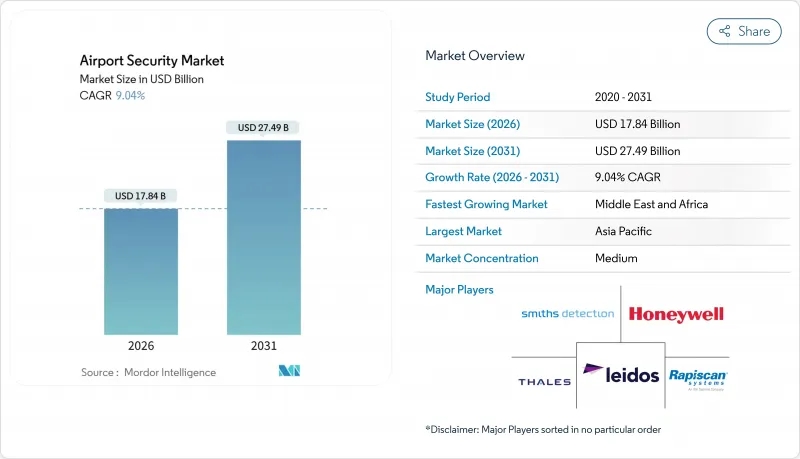
Mordor Intelligence에 의하면, 공항 보안 시장 규모는 2026년에 178억 4,000만 달러에 달하고, 2031년까지 274억 9,000만 달러에 이를 것으로 예상되며, 예측 기간 중 연평균 복합 성장률(CAGR)은 9.04%를 나타낼 전망입니다.

본 보고서는 보안 시스템(스크리닝·스캐닝 시스템, 모니터링 시스템, 출입 관리·생체 인증, 기타),공항 규모(500만 명 미만, 500만-1,500만 명, 기타), 기술(하드웨어, 소프트웨어, 서비스), 용도(터미널, 에어사이드, 랜드사이드, 기타), 지역(북미, 유럽, 기타)별로 분류되어 있습니다. 시장 예측은 금액(달러) 기준으로 제시되어 있습니다.
세계의 공항 보안 시장 동향 및 인사이트
여객 수 증가와 비접촉식 검사
현재 여객 수는 팬데믹 이전의 최고 수준에 필적하는 기록적인 수준에 도달했으며, 보안 검색대에서는 몇 시간이 아닌 몇 분 이내에 여객 검사를 완료해야 하는 상황에 직면해 있습니다. TSA(미국 교통안전청)는 2025년 10월까지 250개 공항에 2,054대의 신분증 인증 장치를 도입했고, 2049년까지 3,585대로 확대할 계획입니다. 각 장치는 2초 만에 승객의 얼굴을 암호화된 신분증과 대조합니다. 645개 레인에 도입된 CT 스캐너 덕분에 승객은 수하물에 액체를 그대로 넣어둘 수 있게 되어, 과거 면세품 매출을 저해하던 병목 현상이 해소되었습니다. 아시아태평양의 허브 공항에서는 도착부터 탑승구까지 소요 시간을 10분 이하로 단축하는 시범 운영이 진행되고 있으며, 이 서비스 수준이 기준이 됨에 따라 기존 공항들도 생체 인증 기술 도입을 가속화할 수밖에 없게 되었습니다. 각 항공사들도 이러한 변화를 지지하고 있으며, e-게이트를 도입한 공항에서는 환승 실패로 인한 민원이 40% 감소했다고 지적하고 있습니다. 코로나19 유행 기간 동안 정착된 건강 및 위생에 대한 배려는 여전히 지속되고 있으며, 이에 따라 공항 측의 비접촉식 서비스 도입 추진이 뒷받침되어 일부 지역에서 수익률이 하락하고 있음에도 불구하고 시설 갱신 추세는 유지되고 있습니다.
국제 보안 규정의 조화
ICAO 부속서 17이 표준 기준을 제공하고 있지만, 국가별 추가 요건으로 인해 공급업체들은 기존에 여러 제품 라인을 유지할 수밖에 없었습니다. 현재 ECAC 공통 평가 절차를 통해 유럽 44개국에서 단일 승인을 받을 수 있게 되어, 인증 기간이 수년에서 수개월로 단축되었습니다. 이와 병행하여, 곧 발간될 부속서 17 제14판에는 디지털 여행 인증 정보가 공식적으로 포함될 예정이며, 이는 공항들이 상호 운용 가능한 생체 인식 기준으로 수렴하도록 뒷받침하고 있습니다. TSA(미국 교통안전청)가 위탁 수하물에 대해 요구하는 ‘폭발물 미량 흔적 검사 100% 실시’라는 요건은 유럽 일부 지역에서 여전히 허용되고 있는 통계적 표본 조사와 대조적입니다. 위험 기반 검색이 정착됨에 따라, 세계 기준의 통일을 위한 움직임이 가속화되고 있습니다. 기준의 통일로 인해 대상 입찰 건수가 확대되고, 더 많은 입찰자가 모여들며, 결국 단가 인하로 이어집니다. 한편, 현대 사양서에 포함된 복잡한 사이버 보안 보증 조항을 충족해야 하는 신규 진출기업에게는 초기 비용 증가로 이어집니다.
장기적인 인증·인정 주기
미국에서는 새로운 검사 방식을 프로토타입 단계에서 검사 현장으로 도입하는 데 30개월 이상 걸리는 경우도 있습니다. 장비는 ‘인증 제품 목록(QPL)’에 추가되기 전에 실험실 검사, 현장 검사, 전체 기단을 대상으로 한 시범 운영을 거쳐야 합니다. 위탁 수하물의 폭발물 감지의 경우, 기밀로 분류된 위협 라이브러리가 복잡하기 때문에 훨씬 더 긴 기간이 소요됩니다. 유럽의 ECAC 절차에서는 평가 기간이 단축되었지만, 그래도 2년이 걸립니다. 기존 기업들은 포트폴리오의 사전 인증을 활용하여 기존 인증 하에서 단계적인 업그레이드를 진행하는 반면, 스타트업 기업들은 승인을 기다리는 동안 자금을 소진해 버립니다. 공항 측은 인증이 확정될 때까지 발주를 미루기 때문에 수요 침체가 발생하고, 이는 혁신을 둔화시키며 연구개발 투자 회수를 정체시키고 있습니다.
부문별 분석
TSA(미국 교통안전청)가 승객이 수하물에 액체나 전자기기를 넣은 채로 반입할 수 있는 645개의 CT 레인을 도입함에 따라, 2025년에는 스크리닝 및 스캐닝 시스템이 공항 보안 시장을 주도하며 매출의 38.90%를 차지했습니다. 한편, 공항이 수동 신원 확인을 얼굴 인식, 홍채 인식, 지문 인식으로 대체함에 따라, 접근 제어 및 생체 인식 시장은 2031년까지 연평균 성장률(CAGR) 10.75%로 확대될 것으로 예측됩니다. 원활한 여행 실현을 위한 이러한 노력은 탑승 대기 시간 단축과 부가 수익 증대를 목표로 하는 항공사의 관심사와 부합합니다. 지문 인식 장치는 비용 면에서의 이점으로 인해 직원 출입 관리에 여전히 널리 보급되어 있지만, 얼굴 인식 스캐너는 여행자가 기기에 손을 대기 위해 멈출 필요가 없기 때문에 승객 흐름에서 주류를 이루고 있습니다. 홍채 인증 기술은 오인율이 거의 제로여야 하는 제한 구역에서 틈새 용도로 사용되지만, 센서 비용이 높아 대규모 도입을 가로막고 있습니다. AI를 활용한 모니터링 시스템은 기존 카메라 기능을 강화하여, 수상한 배회, 인파 밀도, 방치된 물품의 유무 등을 사업자에게 경고함으로써 인력 부족 해소에도 기여하고 있습니다. 경계 침입 감지 시스템은 드론, 울타리 절단, 지반 진동 등을 감지하는 다층 센서 어레이를 활용하고 있습니다. 화재 및 생명 안전 시스템은 예측 가능한 업데이트 주기를 따르며, 환경 규제에 따라 할론에서 청정 소화제로의 전환이 진행되고 있습니다. 동시에, 과거에는 고립되어 운영되던 네트워크를 보호하기 위해 사이버 보안 예산도 증가하고 있습니다.
2세대 지휘통제 제품군은 이러한 하위 시스템을 클라우드 대시보드 상에서 통합하고 있어, 공항은 몇 년에 한 번씩 하드웨어를 교체하는 대신 지속적인 소프트웨어 업데이트를 활용할 수 있게 됩니다. 각 벤더는 개별 장비 대수가 아닌, 대기 시간을 10분 이하로 단축한다는 성과를 내세우며 이를 약속하고 있습니다. 이러한 변화로 인해 광범위한 AI 연구소와 대규모 데이터 세트를 보유하고, 오탐을 최소화하면서 이상 징후를 감지하는 모델을 훈련시킬 수 있는 공급업체가 유리한 입장에 서게 됩니다. 레거시 사일로 구조를 가진 공항에서는 미들웨어 변환 도구를 운영하고 있지만, 장기적인 경제성이라는 관점에서는 통합 부채를 해소하고 확대되는 위협 영역을 일원적으로 시각화할 수 있는 풀 플랫폼으로의 전환이 유리합니다. 공항 보안 시장에서는 오픈 표준과 턴키 방식의 도입을 병행하여, 공항이 벤더 종속을 피하면서도 엄격한 도입 일정을 확실하게 달성할 수 있는 솔루션 제공업체가 계속해서 높은 평가를 받고 있습니다.
2025년 시점에서 연간 여객 수 5,000만 명 이상을 처리하는 허브 공항은 공항 보안 시장 규모의 40.70%를 차지했으며, 이는 두바이 국제공항이나 베이징 다싱 국제공항 등 주요 공항에 대한 자본 집중을 반영하고 있습니다. 연간 여객 수 1,500만 명에서 3,000만 명 규모의 공항은 레거시 시스템 통합에 따른 함정을 피할 수 있는 모듈식 클라우드 플랫폼에 힘입어 연평균 성장률(CAGR) 10.98%라는 가장 높은 성장률을 보일 것으로 전망됩니다. 지난 10년 동안 많은 중규모 터미널이 개장했습니다. 이러한 터미널에는 배선 공사를 다시 수행할 필요 없이 플러그 앤 플레이 방식의 분석 기능을 지원하는 개방형 아키텍처의 케이블 배선 및 IP 카메라가 도입되었습니다. 구독 방식을 통해 초기 자본 지출이 예측 가능한 운영비로 전환되므로, 운영 사업자는 막대한 일회성 투자를 하지 않고도 승객 수에 따라 보안 체계를 확대할 수 있습니다.
연간 승객 수가 500만-1,500만 명인 시설에서는 장비, 소프트웨어, 유지보수를 1인당 요금으로 묶은 벤더 관리형 서비스 계약을 채택하는 경우가 많습니다. 이 모델에서는 성능 위험이 공급업체로 이전되므로, 기술 노후화를 우려하는 이사회에게 매력적인 제안이 되고 있습니다. 연간 승객 수가 500만 명 이하인 공항은 여전히 가격에 민감하며, 규제 당국으로부터 CT 스캐너로의 업그레이드를 의무화받기 전까지는 금속 감지기나 2D X선 장비를 계속 구매하고 있습니다. 반면, 연간 승객 수가 3,000만-5,000만 명인 허브 공항은 기로에 서 있습니다. 승객 수만 놓고 보면 현대화가 정당화되지만, 1990년대의 인프라가 AI를 광범위하게 활용한 서비스 도입을 복잡하게 만들고 있습니다. 단계적인 개보수는 업무의 연속성을 확보하는 한편, 환경의 불일치를 장기화시키는 결과를 초래합니다. 이에 반해, 동남아시아의 제로베이스 방식으로 건설된 터미널에서는 통합된 생체 인식 통로나 드론 대응 경계 경비 시스템을 첫날부터 도입하여 단숨에 도약을 이루고 있습니다.
지역별 분석
베이징 다싱, 델리 인디라 간디, 싱가포르 창이 같은 아시아의 메가 허브는 2025년에 전 세계 공항 보안 시장 매출의 3분의 1 이상을 차지했습니다. 이는 지속적인 두 자릿수 승객 수 성장과 정부가 뒷받침하는 생체 인증 의무화를 반영한 것입니다. 인도만 해도 수백만 명의 국내선 이용객을 ‘Digi Yatra’에 등록하여, 레거시 시스템의 제약을 피하는 확장 가능한 클라우드 네이티브 ID 인프라를 입증하고 있습니다. 중국의 5개년 항공 계획에는 연간 2,000만 명 이상의 승객을 처리하는 모든 관문 공항에 클라우드 기반 지휘 센터를 설치하는 내용이 포함되어 있으며, AI를 활용한 이상 감지 및 드론 감지 기능을 갖춘 경계 경비 시스템을 기본 사양으로 도입하고 있습니다. 지역 저비용 항공사들은 탑승 수속의 신속화로 항공기 회전율이 높아지고 수익성이 향상되기 때문에 보안 자동화를 지지하고 있습니다.
중동 및 아프리카는 동서 간 환승 승객을 유치하기 위해 전략적으로 배치된 국가 자금 지원 메가 프로젝트에 힘입어 가장 높은 복합 성장률을 나타낼 것으로 예측됩니다. 사우디아라비아의 킹 살만 국제공항은 310억 달러의 예산이 투입되어 개항 초기부터 주변 레이더 펜스, 생체 인증을 통한 탑승 수속, 클라우드에서 호스팅되는 보안 오케스트레이션을 통합하고 있습니다. 카타르의 하마드 국제공항에서는 미세한 인파의 급증을 감지하는 AI 영상 모듈을 도입하여, 성지 순례 시즌의 피크 시간대에 줄이 역류하는 것을 방지하고 있습니다. 아프리카에서의 투자는 남아프리카공화국, 케냐, 모로코에 집중되어 있으며, 대부분의 경우 결제를 여객 요금과 연동하는 벤더 금융 계약 하에 이루어지고 있습니다. 다자간 은행은 아프리카 대륙 자유무역지대(AfCFTA)의 무역 회랑을 따라 위치한 지역 게이트웨이의 업그레이드를 지원하고 있으며, 보안 현대화 및 화물 디지털화 프로그램을 함께 추진하고 있습니다.
북미의 성숙한 인프라는 성장을 완만하게 하고 있지만, TSA가 보안 검색대의 CT 스캐너 및 신분증 인증 시스템 업데이트를 추진함에 따라 여전히 연간 예산의 상당 부분을 차지하고 있습니다. 연방 정부의 보조금을 통해 마이애미와 로스앤젤레스에서 주변 드론 감지 시범 사업이 공동 자금 지원을 받고 있으며, 다층 방어 체계 도입을 목표로 하는 지역 공항을 위한 모범 사례가 창출되고 있습니다. 유럽의 회복은 동유럽 국가들에 비해 뒤처져 있어, 이것이 설비 투자에 압박을 가하고 있습니다. 그러나 ECAC(유럽민간항공회의)에 의한 인증 조화를 통해 자금 조달이 순조롭게 이루어지면 조달상의 마찰은 완화될 것입니다. 남미의 허브 공항에서는 단계적인 현대화가 진행되고 있으며, 상파울루 과룰류스 공항은 보안 검색대의 자동화에 주력하는 한편,산티아고 데 칠레 공항은 2024년 화물 강도 사건으로 사각지대가 부각된 것을 계기로, 주변 지역의 광섬유망에 투자하고 있습니다.
기타 혜택
- 엑셀 형식 시장 예측(ME) 시트
- 3개월간의 애널리스트 지원
자주 묻는 질문
목차
제1장 서론
제2장 조사 방법
제3장 주요 요약
제4장 시장 구도
제5장 시장 규모 및 성장 예측
제6장 경쟁 구도
제7장 시장 기회 및 향후 전망
KTH 26.09.08According to Mordor Intelligence, the airport security market size stood at USD 17.84 billion in 2026 and is projected to reach USD 27.49 billion by 2031, registering a 9.04% CAGR over the forecast period.
This report is Segmented by Security System (Screening and Scanning Systems, Surveillance Systems, Access Control and Biometrics, and More), Airport Size (Less Than 5 Million, 5 To 15 Million, and More), Technology (Hardware, Software, and Services), Application (Terminal, Airside, Landside, and More), and Geography (North America, Europe, and More). The Market Forecasts are Provided in Terms of Value (USD).
Global Airport Security Market Trends and Insights
Rising Passenger Traffic and Touchless Screening
Record volumes now rival pre-pandemic highs, pressuring checkpoints to clear travelers in minutes rather than hours. The TSA installed 2,054 credential-authentication units across 250 airports by October 2025 and plans 3,585 units by 2049, with each device matching a passenger's face to an encrypted ID in two seconds. CT scanners deployed at 645 lanes allow passengers to keep liquids in their bags, eliminating bottlenecks that once dampened duty-free sales. Asia-Pacific hubs pilot curb-to-gate flows of under ten minutes, creating a service benchmark that forces legacy airports to accelerate their biometric adoption. Airlines support the transformation, noting a 40% reduction in missed-connection claims at sites running eGates. Health and hygiene preferences that emerged during COVID-19 remain persistent, reinforcing airports' push for no-touch modalities and maintaining momentum for equipment upgrades despite softer yields in some regions.
Harmonized International Security Regulations
ICAO Annex 17 provides the standard baseline, but national overlays have historically forced vendors to maintain multiple product lines. The ECAC Common Evaluation Process now grants a single clearance across 44 European states, compressing certification time from years to months. In parallel, the forthcoming 14th edition of Annex 17 will enshrine digital travel credentials, nudging airports to converge on interoperable biometric standards. The TSA's 100% explosive-trace requirement for checked baggage contrasts with the statistical sampling still allowed in parts of Europe; momentum favors global parity as risk-based screening formalizes. Harmonization expands the addressable tenders, attracts more bidders, and ultimately lowers unit prices. It increases the upfront cost for entrants that must satisfy intricate cyber-assurance clauses embedded in modern specifications.
Lengthy Certification and Qualification Cycles
Bringing a new screening modality from prototype to checkpoint can take more than 30 months in the US, where devices must navigate lab tests, live trials, and fleet-wide pilots before being added to the Qualified Products List. Explosive detection for checked baggage faces even longer timelines due to the complexity of classified threat libraries. Europe's ECAC process shortens the evaluation period but still spans two years. Incumbents exploit portfolio pre-qualification, launching incremental upgrades under existing certificates, while startups burn capital waiting for approvals. Airports delay orders until certificates are finalized, producing a demand valley that slows innovation and stalls return on R&D investment.
Other drivers and restraints analyzed in the detailed report include:
- Integrated Command-and-Control with AI Analytics
- Cyber-Physical Convergence and Cloud Migration
- Scarcity of Skilled Aviation Security Technologists
For complete list of drivers and restraints, kindly check the Table Of Contents.
Segment Analysis
Screening and scanning systems led the airport security market, accounting for 38.90% of the revenue in 2025, following the TSA's rollout of 645 CT lanes that allow passengers to leave liquids and electronics in their carry-ons. Access control and biometrics, however, are forecast to expand at a 10.75% CAGR through 2031 as airports replace manual ID checks with facial recognition, iris matching, and fingerprint verification. The push for seamless travel aligns with airlines' interest in shorter dwell times and higher ancillary revenue. Fingerprint readers remain prevalent for employee access due to cost advantages, but facial scanners dominate passenger flows because travelers do not need to pause to touch equipment. Iris technology has niche applications in restricted areas where false acceptance must approach zero; however, higher sensor costs restrain mass deployment. AI-powered surveillance enhances legacy cameras, alerting operators to instances of loitering, crowd density, or abandoned objects, thereby helping to offset labor shortages. Perimeter intrusion detection capitalizes on multilayer sensor arrays that detect drones, fence cuts, and ground vibrations. Fire and life-safety systems follow predictable replacement cycles, transitioning from Halon to clean-agent suppression in line with environmental regulations. At the same time, cybersecurity budgets rise to secure networks that once operated in isolation.
Second-generation command-and-control suites integrate these subsystems on cloud dashboards, allowing airports to subscribe to continuous software updates instead of multi-year hardware refreshes. Vendors market outcomes, promising queue times below ten minutes, rather than discrete equipment counts. This shift favors suppliers with extensive AI laboratories and large datasets to train models that flag anomalies with fewer false positives. Airports with legacy silos run middleware translators, but long-run economics favor full platform migrations that shed integration debt and deliver single-pane visibility into an expanding threat surface. The airport security market continues to reward solution providers that can balance open standards with turnkey delivery, ensuring airports avoid vendor lock-in while still meeting aggressive deployment timelines.
Hubs handling more than 50 million passengers held 40.70% of the airport security market size in 2025, reflecting capital concentration at gateways such as Dubai International and Beijing Daxing. Airports processing 15 to 30 million travelers are set to grow at the fastest rate, with a 10.98% CAGR, driven by modular cloud platforms that sidestep legacy integration pitfalls. Many mid-tier terminals have opened within the last decade, incorporating open-architecture cabling and IP cameras that support plug-and-play analytics without requiring re-wiring. Subscriptions convert upfront capital expenditures into operating predictable expenses, allowing these operators to scale security in line with traffic rather than making significant lump-sum investments.
Facilities with 5 to 15 million passengers often pursue vendor-managed service contracts, bundling equipment, software, and maintenance into a single per-passenger fee. This model transfers performance risk to suppliers, a compelling proposition for boards wary of technology obsolescence. Airports with fewer than 5 million passengers remain price-sensitive, purchasing metal detectors and 2D X-ray units until regulators compel them to upgrade to CT scanners. Conversely, hubs with 30 to 50 million passengers sit at a crossroads: their traffic justifies modernization, but 1990s-era infrastructure complicates adoption of AI-rich services. Incremental retrofits preserve continuity but prolong heterogeneous environments, whereas clean-sheet terminals in South-East Asia leapfrog with integrated biometric corridors and drone-aware perimeters from day one.
Complete Report Scope:
- By Security System
- Screening and Scanning Systems
- Surveillance Systems
- Access Control and Biometrics
- Fingerprint Recognition
- Facial Recognition
- Iris and Retina Recognition
- Perimeter Intrusion Detection Systems
- Fire and Life-Safety Systems
- Cybersecurity and Network Protection
- Command, Control, and Integration Platforms
- By Airport Size
- Less than 5 Million
- 5 to 15 Million
- 15 to 30 Million
- 30 to 50 Million
- More than 50 Million
- By Technology
- Hardware
- Software
- Services
- By Application
- Terminal
- Airside
- Landside
- Perimeter and Restricted Areas
- Cargo and Logistics Facilities
- By Geography
- North America
- United States
- Canada
- Mexico
- Europe
- United Kingdom
- France
- Germany
- Italy
- Spain
- Rest of Europe
- Asia-Pacific
- China
- India
- Japan
- South Korea
- Singapore
- Rest of Asia-Pacific
- South America
- Brazil
- Argentina
- Rest of South America
- Middle East and Africa
- Middle East
- United Arab Emirates
- Saudi Arabia
- Qatar
- Rest of Middle East
- Africa
- South Africa
- Rest of Africa
- Middle East
- North America
Geography Analysis
Asian megahubs such as Beijing Daxing, Delhi Indira Gandhi, and Singapore Changi collectively accounted for more than one-third of the global airport security market revenue in 2025, reflecting sustained double-digit traffic growth and government-backed biometric mandates. India alone enrolled millions of domestic passengers into Digi Yatra, demonstrating a scalable cloud-native identity infrastructure that sidesteps legacy constraints. China's five-year aviation plan earmarks cloud command centers for every gateway handling over 20 million fliers, embedding AI anomaly detection and drone-aware perimeters as baseline specifications. Regional low-cost carriers support security automation because faster boarding unlocks additional aircraft rotations, enhancing profitability.
The Middle East and Africa are projected to experience the fastest compounded growth, driven by state-funded mega-projects strategically positioned to capture east-west transfer traffic. Saudi Arabia's King Salman International, budgeted at USD 31 billion, combines perimeter radar fences, biometric boarding, and cloud-hosted security orchestration from day zero. Qatar's Hamad International adds AI-video modules that detect micro-crowd surges, preventing queue spill-back during pilgrimage peaks. African investment concentrates in South Africa, Kenya, and Morocco, often under vendor-financed contracts that align payments with passenger fees. Multilateral banks sponsor upgrades to regional gateways along the African Continental Free Trade Area trade corridors, bundling security modernization with cargo digitization programs.
North America's mature infrastructure moderates growth, but it still contributes sizable annual budgets as the TSA upgrades its checkpoint CT and credential-authentication fleets. Federal grants co-finance perimeter drone-detection pilots in Miami and Los Angeles, creating reference sites for regional airports seeking to replicate layered defenses. Europe's recovery lags behind its eastern peers, which pressures capital expenditures. However, harmonized certification under ECAC reduces procurement friction once financing aligns. Southern American hubs pursue phased modernization; Sao Paulo Guarulhos focuses on checkpoint automation, while Santiago de Chile invests in perimeter fiber optics after a 2024 cargo heist highlighted blind spots.
- Smiths Detection Group Ltd. (Smiths Group plc)
- Rapiscan Systems, Inc. (OSI Systems Inc.)
- Leidos, Inc.
- Thales Group
- Honeywell International, Inc.
- Siemens AG
- KEENINFINITY (Robert Bosch GmbH)
- Teledyne FLIR LLC (Teledyne Technologies Incorporated)
- Collins Aerospace (RTX Corporation)
- SITA N.V.
- NEC Corporation
- IDEMIA
- Nuctech Technology Co., Ltd.
- Garrett Electronics Inc.
- ICTS Europe S.A.
- Rohde & Schwarz GmbH & Co. KG
- Hart Security Limited
- Senstar Corp
Additional Benefits:
- The market estimate (ME) sheet in Excel format
- 3 months of analyst support
TABLE OF CONTENTS
1 INTRODUCTION
- 1.1 Study Assumptions and Market Definition
- 1.2 Scope of the Study
2 RESEARCH METHODOLOGY
3 EXECUTIVE SUMMARY
4 MARKET LANDSCAPE
- 4.1 Market Overview
- 4.2 Market Drivers
- 4.2.1 Rising passenger traffic and touchless screening
- 4.2.2 Harmonized international security regulations
- 4.2.3 Integrated command-and-control (C2) with AI analytics
- 4.2.4 Cyber-physical convergence and cloud migration
- 4.2.5 Biometric One-ID and seamless travel initiatives
- 4.2.6 Drone and UAS threats lifting perimeter demand
- 4.3 Market Restraints
- 4.3.1 Lengthy certification and qualification cycles
- 4.3.2 Scarcity of skilled aviation security technologists
- 4.3.3 Integration debt from legacy infrastructure
- 4.3.4 Capex compression amid uneven traffic recovery
- 4.4 Value Chain Analysis
- 4.5 Regulatory Landscape
- 4.6 Technological Outlook
- 4.7 Porter's Five Forces Analysis
- 4.7.1 Bargaining Power of Suppliers
- 4.7.2 Bargaining Power of Buyers/Consumers
- 4.7.3 Threat of New Entrants
- 4.7.4 Threat of Substitute Products
- 4.7.5 Intensity of Competitive Rivalry
5 MARKET SIZE AND GROWTH FORECASTS (VALUE)
- 5.1 By Security System
- 5.1.1 Screening and Scanning Systems
- 5.1.2 Surveillance Systems
- 5.1.3 Access Control and Biometrics
- 5.1.3.1 Fingerprint Recognition
- 5.1.3.2 Facial Recognition
- 5.1.3.3 Iris and Retina Recognition
- 5.1.4 Perimeter Intrusion Detection Systems
- 5.1.5 Fire and Life-Safety Systems
- 5.1.6 Cybersecurity and Network Protection
- 5.1.7 Command, Control, and Integration Platforms
- 5.2 By Airport Size
- 5.2.1 Less than 5 Million
- 5.2.2 5 to 15 Million
- 5.2.3 15 to 30 Million
- 5.2.4 30 to 50 Million
- 5.2.5 More than 50 Million
- 5.3 By Technology
- 5.3.1 Hardware
- 5.3.2 Software
- 5.3.3 Services
- 5.4 By Application
- 5.4.1 Terminal
- 5.4.2 Airside
- 5.4.3 Landside
- 5.4.4 Perimeter and Restricted Areas
- 5.4.5 Cargo and Logistics Facilities
- 5.5 By Geography
- 5.5.1 North America
- 5.5.1.1 United States
- 5.5.1.2 Canada
- 5.5.1.3 Mexico
- 5.5.2 Europe
- 5.5.2.1 United Kingdom
- 5.5.2.2 France
- 5.5.2.3 Germany
- 5.5.2.4 Italy
- 5.5.2.5 Spain
- 5.5.2.6 Rest of Europe
- 5.5.3 Asia-Pacific
- 5.5.3.1 China
- 5.5.3.2 India
- 5.5.3.3 Japan
- 5.5.3.4 South Korea
- 5.5.3.5 Singapore
- 5.5.3.6 Rest of Asia-Pacific
- 5.5.4 South America
- 5.5.4.1 Brazil
- 5.5.4.2 Argentina
- 5.5.4.3 Rest of South America
- 5.5.5 Middle East and Africa
- 5.5.5.1 Middle East
- 5.5.5.1.1 United Arab Emirates
- 5.5.5.1.2 Saudi Arabia
- 5.5.5.1.3 Qatar
- 5.5.5.1.4 Rest of Middle East
- 5.5.5.2 Africa
- 5.5.5.2.1 South Africa
- 5.5.5.2.2 Rest of Africa
- 5.5.5.1 Middle East
- 5.5.1 North America
6 COMPETITIVE LANDSCAPE
- 6.1 Market Concentration
- 6.2 Strategic Moves
- 6.3 Market Share Analysis
- 6.4 Company Profiles (includes Global-level Overview, Market-level Overview, Core Segments, Financials, Strategic Info, Market Rank/Share, Products and Services, and Recent Developments)
- 6.4.1 Smiths Detection Group Ltd. (Smiths Group plc)
- 6.4.2 Rapiscan Systems, Inc. (OSI Systems Inc.)
- 6.4.3 Leidos, Inc.
- 6.4.4 Thales Group
- 6.4.5 Honeywell International, Inc.
- 6.4.6 Siemens AG
- 6.4.7 KEENINFINITY (Robert Bosch GmbH)
- 6.4.8 Teledyne FLIR LLC (Teledyne Technologies Incorporated)
- 6.4.9 Collins Aerospace (RTX Corporation)
- 6.4.10 SITA N.V.
- 6.4.11 NEC Corporation
- 6.4.12 IDEMIA
- 6.4.13 Nuctech Technology Co., Ltd.
- 6.4.14 Garrett Electronics Inc.
- 6.4.15 ICTS Europe S.A.
- 6.4.16 Rohde & Schwarz GmbH & Co. KG
- 6.4.17 Hart Security Limited
- 6.4.18 Senstar Corp
7 MARKET OPPORTUNITIES AND FUTURE OUTLOOK
- 7.1 White-space and Unmet-Need Assessment


