
|
시장보고서
상품코드
2122783
항공기 프로펠러 시스템 시장 : 시장 점유율 분석, 업계 동향 및 통계, 성장 예측(2026-2031년)Aircraft Propeller Systems - Market Share Analysis, Industry Trends & Statistics, Growth Forecasts (2026 - 2031) |
||||||
 Mordor Intelligence
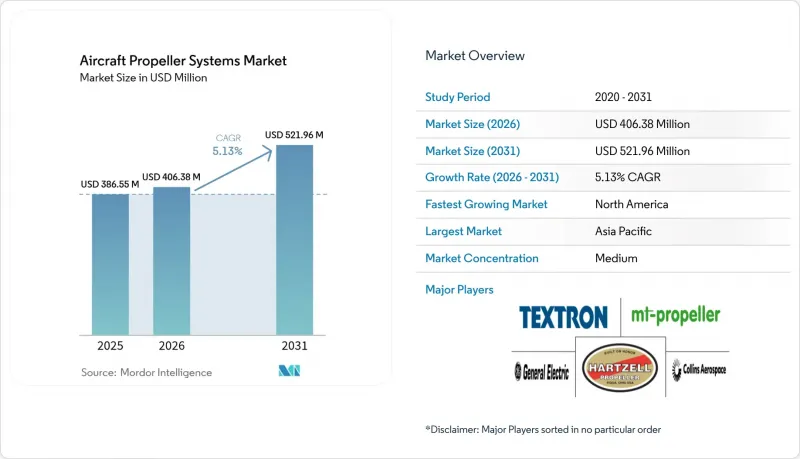
Mordor Intelligence에 의하면, 항공기 프로펠러 시스템 시장 규모는 2025년에 3억 8,655만 달러로 평가되었고, 2026년 4억 638만 달러에서 2031년까지 5억 2,196만 달러에 이를 것으로 추정되며, 예측 기간(2026-2031년) CAGR은 5.13%를 나타낼 전망입니다.
본 보고서는 프로펠러 유형별(고정 피치 및 가변 피치), 구성 부품별(블레이드, 허브 어셈블리 등), 블레이드 재질별(알루미늄 등), 엔진 유형별(피스톤 엔진 등), 항공기 유형별(민간기 등), 최종 사용자별(OEM 및 애프터마켓), 지역별(북미, 유럽 등)로 분류되어 있습니다. 시장 예측은 금액(달러) 기준으로 제시되어 있습니다.
세계의 항공기 프로펠러 시스템 시장 동향 및 인사이트
노후화된 피스톤 엔진 및 터보프롭 항공기군의 교체가 OEM 수요를 가속화하고 있습니다.
1970-1990년 제조된 노후화된 항공기는 항공기 프로펠러 시스템 시장에 있어 상당한 규모의 교체 대상이 되고 있습니다. 북미만 해도 11만 대 이상의 단발 피스톤 항공기가 현재 평균 40년 이상의 운용 이력을 가지고 있으며, 운항사는 구형 알루미늄 블레이드의 부식과 관련된 정비 비용 증가에 직면해 있습니다. 공항 소음 규제가 강화되는 가운데, 소유주들은 더 조용한 이륙을 실현하기 위해 시미터 프로파일 블레이드와 정교한 선단 형상을 결합한 최신 프로펠러로의 도입을 추진하고 있습니다. 연료 소비량 감소와 점검 주기 연장으로 인해 업그레이드 투자 비용은 3-5년 내에 회수할 수 있게 되었으며, 이에 따라 비행 학교와 전세 운항사는 연간 800시간 이상 운항하고 있습니다. 저소음 항공기에 대한 착륙료 감면과 같은 규제상의 우대 조치도 사업 타당성을 더욱 강화하고 있습니다. 이러한 기체 갱신 추세는 OEM의 생산 라인을 뒷받침하고, 개조 수요를 끌어올리며, 항공기 프로펠러 시스템 시장에 구조적인 지지력을 제공합니다.
알루미늄에서 첨단 복합재 블레이드로의 보편적인 전환이 성능 기준을 일변시키고 있습니다.
복합재 블레이드는 최대 20%의 경량화를 실현하고, 스팬을 늘리며, 종횡비를 높임으로써 유도 항력을 저감합니다. 허니콤 코어 위에 적층된 탄소-에폭시 수지는 단조 알루미늄으로는 실현할 수 없는 복잡한 후퇴익 끝단이나 가변 현수장 설계를 가능하게 하여, 순항 단계에서의 연료 소비를 현저히 줄여줍니다. 자동 섬유 배열 등의 제조 기술 발전으로 인해 스크랩을 줄이고, 재현성을 높이며, 사이클 타임을 단축할 수 있게 되어, 프로펠러 생산은 항공우주 분야의 복합재 워크플로우 전체와 일관성을 유지하고 있습니다. 또한, 각 항공사는 이 소재의 내식성을 높이 평가했습니다. 이를 통해 염분이 포함된 환경이나 열대 기후에서도 도장 시스템을 양호한 상태로 유지할 수 있으며, 정비 주기를 40-60% 연장할 수 있습니다. 각 항공사가 환경·사회·지배구조(ESG) 목표를 통합하고, 더 가볍고 정숙성이 높은 추진 부품을 우선시함에 따라 항공기 프로펠러 시스템 시장은 혜택을 보고 있으며, 복합재료의 채택은 고급 비즈니스 항공이라는 틈새 시장을 넘어 가속화되고 있습니다.
항공우주 등급 탄소섬유공급망 부족 및 가격 변동
항공기용 하드웨어 인증을 받은 PAN계 고탄성률 섬유를 공급하는 제조업체는 극소수이며, 그 중 다수는 와이드바디기 동체 계약에 공급량의 대부분을 할당하고 있습니다. 에너지 가격의 급등이나 무역 혼란이 발생하면, 그 영향은 즉시 프리프레그 비용에 파급되어 블레이드 가격을 두 자릿수 비율로 끌어올립니다. 중소 프로펠러 제조업체들은 장기 계약을 헤지할 구매력이 없기 때문에 현물 시장의 가격 변동 위험에 노출되어 이익률이 압박받고 있습니다. 또한, 리드타임의 불확실성은 OEM의 생산 계획 담당자들을 곤란하게 하여, 운전자금을 묶어두는 과잉 재고를 안고 있을 수밖에 없게 만듭니다. 그 결과, 공급 부족으로 인해 납기가 지연되면 항공기 프로펠러 시스템 시장에서 수주 흐름에 편차가 발생합니다.
부문 분석
2025년에는 조종사가 상승, 순항, 하강 전 단계에서 효율성을 추구한 결과, 가변 피치형 유닛이 매출 점유율의 57.25%를 차지했습니다. 가변 피치 설계의 항공기 프로펠러 시스템 시장 규모는 제어 가능한 추력 솔루션에 대한 OEM 수요에 연동하여 확대될 것으로 예측됩니다. 한편, 고정 피치 프로펠러는 무인 항공기(UAV) 기체 증가와 전기 항공기 개발자들이 추구하는 단순화의 이점에 힘입어 연평균 성장률(CAGR) 6.62%로 성장을 주도하고 있습니다. 하이브리드 실증 기체에서 역회전 구성의 채택 확대가 제품 개발을 가속화하고 있습니다. 반면, 비용 효율을 중시하는 운항 사업자들 사이에서는 유지보수 빈도를 최소화하는 표준화된 고정 피치 프로펠러로의 교체가 환영받고 있습니다.
2025년, 항공기 프로펠러 시스템 시장 규모의 50.83%를 블레이드가 차지했으며, 이는 전문적인 설비가 필요한 복잡한 복합재 적층, 기계 가공 및 균형 조정을 반영한 것입니다. 복합재의 보급으로 비용과 무게의 지속적인 감축이 진행되고 있습니다. 제어 및 거버너 시스템은 연평균 성장률(CAGR) 6.19%로 성장하고 있으며, 디지털 전자 기기, 센서, 소프트웨어가 예측 유지보수 및 원격 상태 모니터링 기능을 구현함으로써 항공기 소유주에게 직접적인 운영 비용 절감을 가져다주고 있습니다.
전자식 거버너는 현재 엔진의 FADEC 유닛과 원활하게 통합되어 있으며, 다양한 출력 설정 하에서 프로펠러 회전수를 최적 수준으로 유지하고, 데이터 기반의 정비 일정 수립을 지원하고 있습니다. 공급업체들은 소프트웨어 업데이트 및 성능 분석을 통해 수익화를 도모하며, 지속적인 수익원을 확대되고 있습니다.
지역별 분석
북미는 2025년 매출 점유율의 32.55%를 차지했습니다. 이는 20만 대 이상의 등록된 일반 항공기와 지역 공급망을 뒷받침하는 프로펠러 OEM 본사의 존재에 힘입은 결과입니다. 활발한 개조 문화와 엄격한 군사 조달 파이프라인 덕분에 블레이드, 허브, 디지털 제어 장치에 대한 수요가 유지되고 있습니다. 규제 당국은 소음 및 배기가스 규제 준수를 중시하고 있으며, 이로 인해 업그레이드 활동이 착실히 진행되고 있습니다.
아시아태평양은 중국, 인도, 일본 및 동남아시아 국가들이 조종사 훈련, 지역 노선 및 무인 항공기(UAV) 적용을 확대함에 따라 2031년까지 연평균 성장률(CAGR) 7.49%로 가장 높은 성장률을 기록하고 있습니다. ANA 홀딩스의 145억 달러 규모 수주 포트폴리오에 포함된 77대의 신형 항공기 도입은 지역 운항을 위해 고효율 프로펠러를 우선시하는 수송 능력 확충을 뒷받침하고 있습니다. 현지 복합재료 제조 역량이 성숙해지면서 수입품과의 리드타임 차이가 좁혀지고 있습니다.
유럽은 유서 깊은 OEM 제조업체, 엄격한 환경 목표, 그리고 차세대 회전익기 개발을 가속화하는 ‘클린 항공(Clean Aviation)’ 등의 프로그램을 통한 강력한 연구개발 자금 덕분에 여전히 큰 시장 점유율을 유지하고 있습니다. 운항사는 인구 밀집 지역에서 저소음 접근이 가능한 복합재 블레이드를 원하고 있는 반면, 군용 사용자는 혹독한 기후에 적응한 해상 순찰 솔루션을 요구하고 있습니다. 동유럽의 항공기 함대 역시 구형 플랫폼을 위한 비용 효율적인 고정 피치 업그레이드 솔루션에 투자하고 있습니다.
기타 혜택 :
- 엑셀 형식 시장 예측(ME) 시트
- 3개월간의 애널리스트 지원
자주 묻는 질문
목차
제1장 서론
제2장 조사 방법
제3장 주요 요약
제4장 시장 구도
제5장 시장 규모 및 성장 예측
제6장 경쟁 구도
제7장 시장 기회 및 향후 전망
AJY 26.09.07According to Mordor Intelligence, the aircraft propeller systems market size was valued at USD 386.55 million in 2025 and estimated to grow from USD 406.38 million in 2026 to reach USD 521.96 million by 2031, at a CAGR of 5.13% during the forecast period (2026-2031).
This report is Segmented by Propeller Type (Fixed-Pitch and Variable-Pitch), Component (Blades, Hub Assembly, and More), Blade Material (Aluminum, and More), Engine Type (Piston Engine, and More), Aircraft Type (Commercial, and More), End-User (OEM and Aftermarket), and Geography (North America, Europe, and More). The Market Forecasts are Provided in Terms of Value (USD).
Global Aircraft Propeller Systems Market Trends and Insights
Replacement of Aging Piston and Turboprop Fleets Accelerates OEM Demand
Ageing aircraft built between 1970 and 1990 create a sizeable replacement pool for the aircraft propeller system market. Over 110,000 single-engine pistons in North America alone now average more than 40 years in service, and operators face rising corrosion-related overhaul costs on legacy aluminium blades. Stricter airport noise rules push owners toward modern propellers that combine scimitar-profile blades with refined tip geometry for quieter departures. Upgrade payback is achieved in three to five years through lower fuel use and extended inspection intervals, encouraging flight schools and charter operators to utilize more than 800 hours annually. Regulatory incentives such as reduced landing fees for low-noise aircraft further strengthen the business case. This fleet-renewal momentum sustains OEM production lines and lifts retrofit demand, adding structural support to the aircraft propeller systems market.
Universal Shift from Aluminum to Advanced Composite Blades Transforms Performance Standards
Composite blades achieve weight reductions of up to 20%, permitting longer spans and higher aspect ratios that cut induced drag. Carbon-epoxy lay-up over honeycomb cores supports complex swept tips and variable chord designs that are not feasible in forged aluminium, delivering measurable cruise-phase fuel savings. Manufacturing advances such as automated fibre placement lower scrap, improve repeatability, and shorten cycle time, aligning propeller production with broader aerospace composite workflows. Operators also value the material's corrosion immunity, which keeps paint systems intact in saline or tropical climates and extends time between overhauls by 40-60%. The aircraft propeller systems market benefits as airlines integrate environmental, social, and governance targets, favoring lighter, quieter propulsion components, accelerating composite adoption beyond premium business-aviation niches.
Supply-Chain Tightness and Price Volatility for Aerospace-Grade Carbon Fibre
Only a handful of producers supply PAN-based high-modulus fibres certified for flight hardware, and many allocate a large share to wide-body fuselage contracts. Any surge in energy prices or trade disruptions immediately flows through to prepreg cost, lifting blade pricing by double-digit percentages. Small propeller manufacturers lack the purchasing clout to hedge long contracts, so they face spot-market exposure that compresses margins. Lead-time uncertainty also frustrates OEM production planners, prompting them to hold thicker inventories that tie up working capital. Therefore, the aircraft propeller systems market sees uneven order flow when supply shortages delay deliveries.
Other drivers and restraints analyzed in the detailed report include:
- Hybrid-Electric Demonstrators Requiring High-Efficiency Contra-Rotating Propellers
- Lifecycle-Cost Reduction Programs Accelerating Aftermarket Composite Blade Sales
- Lengthy and Expensive Regulatory Certification Cycles Discourage Innovation
For complete list of drivers and restraints, kindly check the Table Of Contents.
Segment Analysis
Variable-pitch units held a 57.25% revenue share in 2025 as pilots sought efficiency across climb, cruise, and descent. The aircraft propeller systems market size for variable-pitch designs is projected to rise in line with OEM demand for controllable thrust solutions. Fixed-pitch propellers lead growth at a 6.62% CAGR, powered by the expanding UAV fleet and the simplicity benefits electric aircraft developers seek. The growing adoption of contra-rotating configurations in hybrid demonstrators amplifies product development. At the same time, cost-sensitive operators welcome standardized fixed-pitch replacements that minimize maintenance touchpoints.
Blades contributed 50.83% of the aircraft propeller systems market size in 2025, reflecting complex composite layup, machining, and balancing that demand specialized equipment. Composite penetration drives continual cost and weight reductions. Control and governor systems advance at a 6.19% CAGR as digital electronics, sensors, and software unlock predictive maintenance and remote health monitoring capabilities that deliver direct operating-cost savings to fleet owners.
Electronic governors now integrate seamlessly with engine FADEC units, ensuring optimal propeller RPM under varying power settings and supporting data-driven maintenance scheduling. Suppliers monetise software updates and performance analytics, expanding recurring revenue streams.
Complete Report Scope:
- By Propeller Type
- Fixed-Pitch
- Variable-Pitch
- Controllable Pitch Propeller
- Constant Speed Propeller
- Full Feathering Propeller
- Others
- By Component
- Blades
- Hub Assembly
- Spinner and Accessories
- Control and Governor System
- By Blade Material
- Aluminum
- Composite
- Wood
- By Engine Type
- Piston Engine Aircraft
- Turboprop Aircraft
- Electric/Hybrid Propulsion Aircraft
- By Aircraft Type
- Commercial
- Military
- Transport and Maritime Patrol
- Trainer Aircraft
- Unmanned Aerial Vehicles (UAVs)
- General Aviation
- Single-Engine Piston
- Multi-Engine Piston
- Light-Sport Aircraft
- By End-User
- Original Equipment Manufacturer (OEM)
- Aftermarket
- By Geography
- North America
- United States
- Canada
- Mexico
- Europe
- United Kingdom
- France
- Germany
- Italy
- Russia
- Rest of Europe
- Asia-Pacific
- China
- Japan
- India
- South Korea
- Rest of Asia-Pacific
- South America
- Brazil
- Rest of South America
- Middle East and Africa
- Middle East
- Saudi Arabia
- United Arab Emirates
- Rest of Middle East
- Africa
- South Africa
- Rest of Africa
- Middle East
- North America
Geography Analysis
North America held a 32.55% revenue share in 2025, buoyed by more than 200,000 registered general aviation aircraft and propeller OEM headquarters that anchor the regional supply chain. A vibrant retrofit culture and rigorous military procurement pipelines maintain demand for blades, hubs, and digital controls. Regulators emphasise noise and emissions compliance, ensuring a steady flow of upgrade activity.
Asia-Pacific registers the fastest 7.49% CAGR through 2031 as China, India, Japan, and Southeast Asian nations expand pilot training, regional routes, and UAV applications. The arrival of 77 new aircraft in ANA Holdings' USD 14.5 billion order portfolio underscores capacity additions favouring high-efficiency propellers for regional operations. Local composite fabrication capability matures, narrowing lead-time gaps versus imports.
Europe maintains a substantial share thanks to legacy OEMs, stringent environmental targets, and strong R&D funding under programs such as Clean Aviation, which accelerate next-generation rotorcraft development. Operators demand composite blades capable of quieter approach profiles in densely populated regions, while military users seek maritime patrol solutions adapted to harsh climates. Eastern European fleets likewise invest in cost-effective fixed-pitch upgrades for legacy platforms.
- Collins Aerospace (RTX Corporation)
- Dowty Propellers (General Electric Company)
- McCauley Propeller Systems (Textron Inc.)
- Hartzell Propeller Inc.
- MT-Propeller Entwicklung GmbH
- Safran S.A.
- Sensenich Propeller Manufacturing Co., Inc.
- Aerosila R&P Enterprise OJSC
- Airmaster Propellers
- GSC Systems Ltd.
- Jabiru Aircraft Pty Ltd.
- Hercules Propellers Ltd.
- FP-Propeller Srl
- DUC HELICES
- Catto Propellers
- Warp Drive Incorporated
- Ivoprop Corporation
- Helix Carbon GmbH
Additional Benefits:
- The market estimate (ME) sheet in Excel format
- 3 months of analyst support
TABLE OF CONTENTS
1 INTRODUCTION
- 1.1 Study Assumptions and Market Definition
- 1.2 Scope of the Study
2 RESEARCH METHODOLOGY
3 EXECUTIVE SUMMARY
4 MARKET LANDSCAPE
- 4.1 Market Overview
- 4.2 Market Drivers
- 4.2.1 Replacement of aging piston and turboprop fleets
- 4.2.2 Universal shift from aluminum to advanced composite blades
- 4.2.3 Hybrid-electric demonstrators requiring high-efficiency contra-rotating propellers
- 4.2.4 Lifecycle-cost reduction programs accelerating aftermarket composite blade sales
- 4.2.5 Digital governors and blade-health sensors integration
- 4.2.6 Explosive growth of civil and governmental UAV missions
- 4.3 Market Restraints
- 4.3.1 Supply-chain tightness and price volatility for aerospace-grade carbon fiber
- 4.3.2 Lengthy and expensive regulatory certification cycles
- 4.3.3 High up-front cost of composite propellers
- 4.3.4 Highly consolidated engine-airframer alliances giving incumbents advantage
- 4.4 Value Chain Analysis
- 4.5 Regulatory Outlook
- 4.6 Technological Outlook
- 4.7 Porter's Five Forces Analysis
- 4.7.1 Bargaining Power of Suppliers
- 4.7.2 Bargaining Power of Buyers
- 4.7.3 Threat of New Entrants
- 4.7.4 Threat of Substitute Products
- 4.7.5 Intensity of Competitive Rivalry
5 MARKET SIZE AND GROWTH FORECASTS (VALUE)
- 5.1 By Propeller Type
- 5.1.1 Fixed-Pitch
- 5.1.2 Variable-Pitch
- 5.1.2.1 Controllable Pitch Propeller
- 5.1.2.2 Constant Speed Propeller
- 5.1.2.3 Full Feathering Propeller
- 5.1.2.4 Others
- 5.2 By Component
- 5.2.1 Blades
- 5.2.2 Hub Assembly
- 5.2.3 Spinner and Accessories
- 5.2.4 Control and Governor System
- 5.3 By Blade Material
- 5.3.1 Aluminum
- 5.3.2 Composite
- 5.3.3 Wood
- 5.4 By Engine Type
- 5.4.1 Piston Engine Aircraft
- 5.4.2 Turboprop Aircraft
- 5.4.3 Electric/Hybrid Propulsion Aircraft
- 5.5 By Aircraft Type
- 5.5.1 Commercial
- 5.5.2 Military
- 5.5.2.1 Transport and Maritime Patrol
- 5.5.2.2 Trainer Aircraft
- 5.5.2.3 Unmanned Aerial Vehicles (UAVs)
- 5.5.3 General Aviation
- 5.5.3.1 Single-Engine Piston
- 5.5.3.2 Multi-Engine Piston
- 5.5.3.3 Light-Sport Aircraft
- 5.6 By End-User
- 5.6.1 Original Equipment Manufacturer (OEM)
- 5.6.2 Aftermarket
- 5.7 By Geography
- 5.7.1 North America
- 5.7.1.1 United States
- 5.7.1.2 Canada
- 5.7.1.3 Mexico
- 5.7.2 Europe
- 5.7.2.1 United Kingdom
- 5.7.2.2 France
- 5.7.2.3 Germany
- 5.7.2.4 Italy
- 5.7.2.5 Russia
- 5.7.2.6 Rest of Europe
- 5.7.3 Asia-Pacific
- 5.7.3.1 China
- 5.7.3.2 Japan
- 5.7.3.3 India
- 5.7.3.4 South Korea
- 5.7.3.5 Rest of Asia-Pacific
- 5.7.4 South America
- 5.7.4.1 Brazil
- 5.7.4.2 Rest of South America
- 5.7.5 Middle East and Africa
- 5.7.5.1 Middle East
- 5.7.5.1.1 Saudi Arabia
- 5.7.5.1.2 United Arab Emirates
- 5.7.5.1.3 Rest of Middle East
- 5.7.5.2 Africa
- 5.7.5.2.1 South Africa
- 5.7.5.2.2 Rest of Africa
- 5.7.5.1 Middle East
- 5.7.1 North America
6 COMPETITIVE LANDSCAPE
- 6.1 Market Concentration
- 6.2 Strategic Moves
- 6.3 Market Share Analysis
- 6.4 Company Profiles (includes Global-level Overview, Market-level Overview, Core Segments, Financials as available, Strategic Information, Market Rank/Share, Products and Services, Recent Developments)
- 6.4.1 Collins Aerospace (RTX Corporation)
- 6.4.2 Dowty Propellers (General Electric Company)
- 6.4.3 McCauley Propeller Systems (Textron Inc.)
- 6.4.4 Hartzell Propeller Inc.
- 6.4.5 MT-Propeller Entwicklung GmbH
- 6.4.6 Safran S.A.
- 6.4.7 Sensenich Propeller Manufacturing Co., Inc.
- 6.4.8 Aerosila R&P Enterprise OJSC
- 6.4.9 Airmaster Propellers
- 6.4.10 GSC Systems Ltd.
- 6.4.11 Jabiru Aircraft Pty Ltd.
- 6.4.12 Hercules Propellers Ltd.
- 6.4.13 FP-Propeller Srl
- 6.4.14 DUC HELICES
- 6.4.15 Catto Propellers
- 6.4.16 Warp Drive Incorporated
- 6.4.17 Ivoprop Corporation
- 6.4.18 Helix Carbon GmbH
7 MARKET OPPORTUNITIES AND FUTURE OUTLOOK
- 7.1 White-space and Unmet-Need Assessment