

|
시장보고서
상품코드
2122808
메틸메타크릴레이트(MMA) 접착제 : 시장 점유율 분석, 업계 동향 및 통계, 성장 예측(2026-2031년)Methyl Methacrylate (MMA) Adhesives - Market Share Analysis, Industry Trends & Statistics, Growth Forecasts (2026 - 2031) |
||||||
 Mordor Intelligence
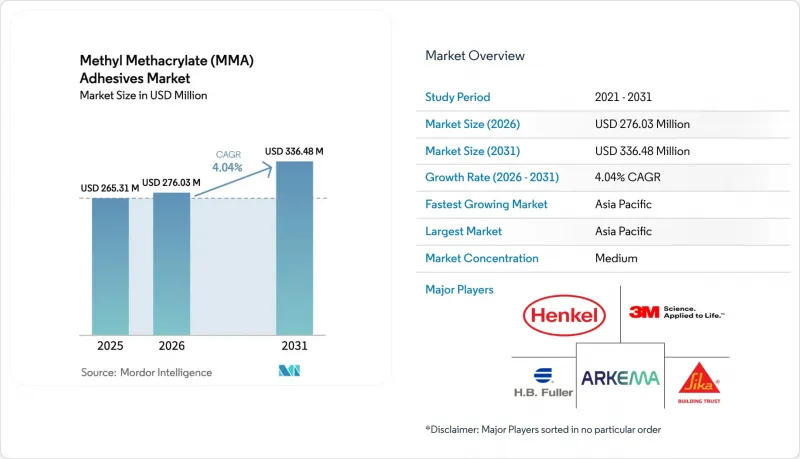
메틸메타크릴레이트(MMA) 접착제 시장 규모는 2025년 2억 6,531만 달러로 평가되었습니다. 2026년에는 2억 7,603만 달러로 확대되어 2031년까지 3억 3,648만 달러에 이를 것으로 예상되고 2026년부터 2031년에 걸쳐 CAGR 4.04%로 성장할 전망입니다.

본 보고서는 기판(금속, 플라스틱, 복합재료, 기타 기판), 최종 이용 산업(운송, 항공우주, 건축 및 건설, 발전, 기타 최종 이용 산업), 지역(아시아태평양, 북미, 유럽, 남미, 중동 및 아프리카)별로 세분화되어 있습니다. 시장 전망은 금액(달러) 기준으로 제시되어 있습니다.
세계의 메틸메타크릴레이트(MMA) 접착제 시장 동향 및 인사이트
모빌리티 분야 전반에 걸쳐 진행되고 있는 경량화 추진
자동차 제조업체와 항공기 OEM 기업들은 무게를 줄이고, 항속 거리를 향상시키며, CO2 배출 목표를 달성하기 위해 기계식 체결 부재를 제거하고 있습니다. 포드는 MMA 접착제를 사용하여 알루미늄과 고장력 강철을 접합함으로써 2025년형 F-150 라이트닝에서 47kg의 경량화를 실현하고, 항속 거리를 3.2% 연장했습니다. 에어버스는 2차 구조부의 리벳을 MMA 접착제 접합으로 대체한 결과, A321neo 1대당 680 kg의 경량화를 실현하고, 항공기 전체 수명 기간 동안 1.8%의 연료 절감을 달성했다고 보고했습니다. 1 kg이 경량화될 때마다 전기차의 주행 거리가 약 20 m 연장되므로, 특히 OEM이 새로운 스폿 용접 셀에 대한 설비 투자를 피할 수 있는 경우, MMA 접착이 용접보다 비용 면에서 우월하다는 점은 경제적으로 정당화됩니다. 따라서 배합 개발자들은 EU에서 새로 정한 50ppm이라는 작업장 노출 한도를 충족하면서, 빠른 속도의 조립 라인에 대응할 수 있는 15-30분의 고정 시간에 주력하고 있습니다.
복합재료와 금속 접합에서 용접 및 리벳의 대체
보잉 787과 에어버스 A350에서는 복합재료의 함유율이 50%를 초과합니다. 그러나 패스너용 구멍을 뚫는 것은 피로 수명을 저하시킵니다. NASA의 2024년 시험 프로그램에 따르면, 접착 접합은 리벳 접합에 비해 복합재료의 피로 수명을 15%-25% 연장하는 것으로 밝혀졌습니다. 스피릿 에어로시스템즈(Spirit AeroSystems)는 2025년에 MMA계 접착제로 전환한 결과, 737 MAX의 날개 1세트당 1,200개의 체결 부품을 줄이고, 제조 비용을 1만 8,000달러 절감하는 동시에 조립 시간을 34% 단축했습니다. BMW는 iX M60에서 탄소섬유 재질의 루프를 알루미늄 재질의 필러에 접착할 때 28 MPa의 랩 전단 강도를 달성했습니다. 이를 통해 갈바닉 부식을 방지하는 동시에 열팽창률의 차이도 상쇄하고 있습니다. ISO 11003-2에 기반한 항공우주 인증은 진입 장벽을 높게 유지하고 있으며, 일단 배합이 승인되면 그 가치는 확고해집니다.
MMA 모노머 원료 가격 변동
2025년 2분기, 중국 및 한국의 프로파일렌 공급 중단으로 인해 MMA 현물 가격은 18% 급등하여 FOB 아시아 가격 기준 2,340달러/t에 달했습니다. 이로 인해 장기 계약을 체결하지 못한 배합 제조업체들은 어려운 상황에 처하게 되었습니다. 원료 가격이 15% 상승하면 완제품 접착제의 원가는 9%-11% 상승하지만, 경쟁 압박으로 인해 가격 전가율은 4%-6%로 억제되어, 매출 총이익률은 300-500 베이시스 포인트 압박을 받게 됩니다. 2024년에 가동을 시작한 미쓰비시 화학의 사우디아라비아 공장(연산 100 kt)은 생산 능력을 확충했으나, 그럼에도 불구하고 전 세계 공급량의 불과 3.2%만을 충당할 뿐입니다. 상위 15개 공급업체 중 자체적으로 모노머를 생산하는 곳은 4곳에 불과하기 때문에 대다수의 기업은 지난 24개월 동안 변동계수 32%를 기록한 가격 변동의 영향을 지속적으로 받고 있습니다.
부문별 분석
금속 분야가 수요에서 가장 큰 비중을 차지하며, 2025년에는 42.19%를 나타냈습니다. 이는 자동차 및 항공우주 제조업체들이 여전히 18-24 MPa의 중첩 전단 강도를 필요로 하고, 서로 다른 열팽창 계수를 견딜 수 있는 알루미늄과 강철의 접합에 크게 의존하고 있기 때문입니다. 금액 기준으로 볼 때, 2026년 메틸 메타크릴레이트(MMA) 접착제 시장에서 금속 부문의 규모는 1억 1,650만 달러였습니다. 복합재료는 뚜렷한 성장 동력이 되고 있으며, 탄소섬유로 제작된 풍력 터빈 스퍼 캡 및 항공기의 2차 구조가 보급됨에 따라 2031년까지 연평균 성장률(CAGR) 6.15%로 확대되고 있습니다. 접착 접합은 갈바닉 부식에 대한 우려를 해소하는 동시에 하중을 더 넓은 표면적에 분산시켜 차세대 기체의 피로 수명을 연장합니다.
이러한 복합재료의 급증은 단순한 경기 순환적 회복이 아니라, 구조 재료의 전환을 반영한 것입니다. 보잉사는 777X의 복합재료 사용률을 54%로 높였으며, 리벳 사용 시 발생하는 구멍 뚫기로 인한 손상을 방지하기 위해 동체 패널 접합에 MMA 접착을 지정했습니다. 높이 100m를 초과하는 풍력 터빈에는 공조 설비가 없는 연안 지역의 공장에서 상온에서 경화되는 틈새 충전용 접착제가 필요하지만, 이 틈새 시장에서는 MMA계 접착제가 에폭시 수지를 앞지르고 있습니다. 플라스틱의 비중은 적지만 증가 추세에 있습니다. 특히 EV 배터리 케이스에 사용되는 ABS, 폴리카보네이트, 아크릴 등은 MMA계 접착제를 사용하면 최소한의 표면 처리만으로 접합할 수 있기 때문입니다. 세라믹이나 목재의 용도는 여전히 틈새 분야에 머물러 있지만, 전자기기의 방열판에서 세라믹과 금속의 접합에 대해서는 연구 개발의 주목을 받고 있습니다.
지역별 분석
아시아태평양은 2025년에 세계 수요의 46.29%를 차지했으며, 2031년까지 연평균 성장률(CAGR) 5.76%로 성장할 전망입니다. 중국은 2025년에 18.2 GW 규모의 신규 해상 풍력 발전 사업을 승인했는데, 1 MW당 최대 12 kg의 MMA가 사용되므로 이에 따라 연간 145-218 t 수요 증가가 예상됩니다. 인도는 2024-25 회계연도에 590만 대의 승용차를 생산할 예정이며, 2027년까지 118 g CO2/km로 강화될 연비 규제를 충족하기 위해 접착제 채택이 가속화되고 있습니다. 일본의 수소 연료전지 로드맵은 700 bar의 압력을 견디고 미세한 균열이 발생하지 않는 탄소섬유 저장 탱크에 MMA 사용을 촉진하고 있습니다. 3조 1,000억 달러 규모의 아세안(ASEAN) 인프라 계획에서는 MMA로 접착된 조립식 모듈에 대한 의존도가 높으며, 2025년에는 신규 상업 프로젝트 착공 건수의 34%에서 채택률이 상승했습니다.
북미에서는 보잉사가 월 38대의 737 MAX 제트기를 생산할 계획인 가운데, 2차 구조부만으로도 매달 최대 11톤의 접착제가 소비됩니다. ‘인플레이션 억제법(Inflation Reduction Act)’은 현지 조달을 장려하고 있으며, 헨켈(Henkel)사가 코네티컷주에서 추진하는 6,500만 달러 규모의 확장 계획에 따라 자동차 및 풍력 발전 고객을 대상으로 연간 12kt의 생산 능력이 추가될 예정입니다. 캐나다의 5GW 규모 해상 풍력 발전 프로젝트는 2027년부터 29년에 걸쳐 건설이 시작되면 새로운 수요원이 될 것입니다. 멕시코의 자동차 산업 거점에서는 GM과 포드가 알루미늄 배터리 트레이를 강철 언더바디에 접착하는 전기차(EV) 플랫폼을 도입함에 따라, 2025년에는 약 3,200톤의 접착제가 사용되었습니다.
유럽 시장은 성숙기에 접어들었으나, 2025년에 7.3GW 규모의 해상 풍력 발전소가 가동을 시작한 점과 OEM 각사가 용접 비용을 절감하기 위해 접착 접합으로 전환하고 있는 점이 호재로 작용하고 있습니다. 폭스바겐은 ID.7의 루프 패널 1장당 340곳의 용접을 줄여, 차량 1대당 18유로의 비용 절감을 실현했습니다. 영국의 최근 차액결제계약(CfD) 입찰에서는 2026년부터 건설 단계에 들어가는 6.4GW 규모의 해상 풍력 발전 프로젝트가 선정되었습니다. 규모는 작지만 미래가 기대되는 남미에서는 브라질의 풍력 발전 확대가 호재로 작용하고 있으며, 중동에서는 사우디아라비아의 NEOM 도시가 주거 건축물의 80%에 대해 접착제를 이용한 파사드 시공을 의무화하고 있는 점이 호재로 작용하고 있습니다.
기타 혜택 :
- 엑셀 형식 시장 예측(ME) 시트
- 3개월간의 애널리스트 지원
자주 묻는 질문
목차
제1장 서론
제2장 조사 방법
제3장 주요 요약
제4장 시장 구도
제5장 시장 규모 및 성장 예측
제6장 경쟁 구도
제7장 시장 기회 및 향후 전망
KTH 26.09.08According to Mordor Intelligence, the methyl methacrylate adhesives market size is expected to increase from USD 265.31 million in 2025 to USD 276.03 million in 2026 and reach USD 336.48 million by 2031, growing at a CAGR of 4.04% over 2026-2031.
This report is Segmented by Substrate (Metals, Plastics, Composites, and Other Substrates), End-Use Industry (Transportation, Aerospace, Building and Construction, Power Generation, and Other End-User Industries), and Geography (Asia-Pacific, North America, Europe, South America, and Middle East and Africa). The Market Forecasts are Provided in Terms of Value (USD).
Global Methyl Methacrylate (MMA) Adhesives Market Trends and Insights
Light-Weighting Push Across Mobility Segments
Automakers and aircraft OEMs are eliminating mechanical fasteners to remove mass, improve range, and meet CO2 targets. Ford cut 47 kg from its 2025 F-150 Lightning by bonding aluminum to high-strength steel with MMA adhesives, realizing a 3.2% range gain. Airbus reported a 680 kg reduction on each A321neo after replacing rivets in secondary structures, saving 1.8% fuel over the aircraft life. Because every kilogram trimmed extends electric-vehicle range by roughly 20 m, MMA bonding's premium over welding is economically justified, particularly when OEMs avoid the capital outlay for new spot-welding cells. Formulators are therefore focused on 15- to 30-minute fixture times that match paced assembly lines while meeting new 50 ppm workplace-exposure limits in the EU.
Substitution of Welding/Riveting in Composite-Metal Joints
Composite content exceeds 50% on the Boeing 787 and Airbus A350, yet drilling fastener holes degrades fatigue life. NASA's 2024 test program found bonded joints extend composite fatigue life by 15%-25% compared with riveted equivalents. Spirit AeroSystems eliminated 1,200 fasteners per 737 MAX wing set, trimming USD 18,000 in build cost and 34% in assembly time after shifting to MMA adhesives in 2025. BMW achieved 28 MPa lap-shear strength when bonding carbon-fiber roofs to aluminum pillars on the iX M60, avoiding galvanic corrosion while tolerating differential thermal expansion. Aerospace certification under ISO 11003-2 keeps barriers high, locking in value once a formulation is approved.
Volatility in MMA Monomer Feedstock Prices
Spot MMA prices jumped 18% to USD 2,340 /t FOB Asia in Q2 2025 after propylene outages in China and South Korea, squeezing formulators unable to lock long-term contracts. A 15% feedstock hike lifts finished-adhesive cost by 9%-11%, but competitive pressure caps pass-through at 4%-6%, clipping gross margins 300-500 bp. Mitsubishi Chemical's 100 kt/yr Saudi plant, started in 2024, adds capacity yet still covers just 3.2% of global supply. Because only 4 of the top 15 suppliers run captive monomer production, the majority remain exposed to swings that showed a 32% coefficient of variation over 24 months.
Other drivers and restraints analyzed in the detailed report include:
- Growth of Offshore Wind-Turbine Blade Bonding
- Rapid Infrastructure Build-Out in ASEAN Prefab Construction
- Stringent VOC and Odor Exposure Limits
For complete list of drivers and restraints, kindly check the Table Of Contents.
Segment Analysis
Metals produced the largest slice of demand, accounting for 42.19% in 2025, because automotive and aerospace builders still rely heavily on aluminum-to-steel joints that require 18-24 MPa lap-shear strength and tolerate differing thermal expansion rates. In value terms, the metals slice of the methyl methacrylate (MMA) adhesives market size stood at USD 116.5 million in 2026. Composites are the clear growth engine, expanding at a 6.15% CAGR to 2031 as carbon-fiber wind-turbine spar caps and aircraft secondary structures proliferate. Adhesive joints eliminate galvanic-corrosion concerns while spreading loads over greater surface area, extending fatigue life in next-generation airframes.
The composites surge encapsulates a structural material shift rather than a cyclical rebound. Boeing raised composite content on the 777X to 54%, specifying MMA bonding for fuselage-panel integration that avoids the drilling damage seen with rivets. Wind turbines longer than 100 m require gap-filling adhesives that cure at ambient temperature in coastal factories lacking climate control, a niche where MMA chemistry surpasses epoxies. Plastics form a small yet rising cohort-especially ABS, polycarbonate, and acrylic in EV battery casings-because MMA joins them with minimal surface prep. Ceramics and wood remain niche uses, though ceramic-metal bonds in electronics heat sinks are attracting R&D attention.
Complete Report Scope:
- By Substrate
- Metals
- Plastics
- Composites
- Other Substrates
- By End-Use Industry
- Transportation
- Aerospace
- Building and Construction
- Power Generation (Wind and Solar)
- Other End-user Industries (Marine, Electronics and Appliances)
- By Geography
- Asia-Pacifc
- China
- India
- Japan
- South Korea
- ASEAN Countries
- Rest of Asia-Pacific
- North America
- United States
- Canada
- Mexico
- Europe
- Germany
- United Kingdom
- France
- Italy
- Rest of Europe
- South America
- Brazil
- Argentina
- Rest of South America
- Middle East and Africa
- Saudi Arabia
- South Africa
- Rest of Middle East and Africa
- Asia-Pacifc
Geography Analysis
Asia-Pacific captured 46.29% of global demand in 2025 and is set to advance at 5.76% CAGR to 2031. China approved 18.2 GW of new offshore wind in 2025, each MW adding up to 12 kg of MMA usage, translating to an incremental 145-218 t per year. India built 5.9 million passenger cars in FY 2024-25, accelerating adhesive uptake to meet fuel-economy rules tightening to 118 g CO2/km by 2027. Japan's hydrogen-fuel-cell road map is spurring MMA use in carbon-fiber storage tanks that must hold 700 bar without micro-cracking. ASEAN's USD 3.1 trillion infrastructure pipeline leans heavily on prefab modules bonded with MMA, with adoption climbing to 34% of new commercial starts in 2025.
In North America, Boeing's plan to build 38 737 MAX jets per month consumes up to 11 t of adhesive monthly for secondary structures alone. The Inflation Reduction Act encourages local sourcing; Henkel's USD 65 million expansion in Connecticut adds 12 kt of annual capacity for automotive and wind clients. Canada's 5 GW offshore wind prospects will open a fresh channel when construction begins in 2027-29. Mexican auto hubs used about 3,200 t in 2025 as GM and Ford rolled out EV platforms that bond aluminum battery trays to steel underbodies.
Europe, though mature, is buoyed by 7.3 GW of offshore wind commissioned in 2025 and by OEM shifts toward adhesive bonding to trim welding costs. Volkswagen cut 340 welds on each ID.7 roof panel, saving EUR 18 per unit. The UK's latest Contracts for Difference round awarded 6.4 GW of offshore projects entering build phase from 2026. Smaller yet promising, South America rides Brazilian wind expansions, while the Middle East benefits from Saudi Arabia's NEOM city, which mandates adhesive-bonded facades in 80% of residential buildings.
- 3M
- Arkema
- BASF
- Dow
- Evonik Industries AG
- H.B. Fuller Company
- Henkel AG & Co. KGaA
- Huntsman International LLC
- IPS Corporation
- ITW Performance Polymers
- Master Bond
- Matrix Adhesives Group
- Parker Hannifin Corp
- Permabond LLC
- Scott Bader Company Ltd
- Sika AG
- Ulbrich Group
Additional Benefits:
- The market estimate (ME) sheet in Excel format
- 3 months of analyst support
TABLE OF CONTENTS
1 Introduction
- 1.1 Study Assumptions and Market Definition
- 1.2 Scope of the Study
2 Research Methodology
3 Executive Summary
4 Market Landscape
- 4.1 Market Overview
- 4.2 Market Drivers
- 4.2.1 Light-Weighting Push Across Mobility Segments
- 4.2.2 Substitution of Welding/Riveting in Composite-Metal Joints
- 4.2.3 Growth of Offshore Wind-Turbine Blade Bonding
- 4.2.4 Rapid Infrastructure Build-Out in ASEAN Prefab Construction
- 4.2.5 Increasing Demand from Marine Sector
- 4.3 Market Restraints
- 4.3.1 Volatility in MMA Monomer Feedstock Prices
- 4.3.2 Stringent VOC and Odor Exposure Limits
- 4.3.3 Cartridge Waste-Disposal Regulations in Urban Plants
- 4.4 Value Chain Analysis
- 4.5 Porter's Five Forces
- 4.5.1 Bargaining Power of Suppliers
- 4.5.2 Bargaining Power of Buyers
- 4.5.3 Threat of New Entrants
- 4.5.4 Threat of Substitutes
- 4.5.5 Industry Rivalry
5 Market Size and Growth Forecasts (Value)
- 5.1 By Substrate
- 5.1.1 Metals
- 5.1.2 Plastics
- 5.1.3 Composites
- 5.1.4 Other Substrates
- 5.2 By End-Use Industry
- 5.2.1 Transportation
- 5.2.2 Aerospace
- 5.2.3 Building and Construction
- 5.2.4 Power Generation (Wind and Solar)
- 5.2.5 Other End-user Industries (Marine, Electronics and Appliances)
- 5.3 By Geography
- 5.3.1 Asia-Pacifc
- 5.3.1.1 China
- 5.3.1.2 India
- 5.3.1.3 Japan
- 5.3.1.4 South Korea
- 5.3.1.5 ASEAN Countries
- 5.3.1.6 Rest of Asia-Pacific
- 5.3.2 North America
- 5.3.2.1 United States
- 5.3.2.2 Canada
- 5.3.2.3 Mexico
- 5.3.3 Europe
- 5.3.3.1 Germany
- 5.3.3.2 United Kingdom
- 5.3.3.3 France
- 5.3.3.4 Italy
- 5.3.3.5 Rest of Europe
- 5.3.4 South America
- 5.3.4.1 Brazil
- 5.3.4.2 Argentina
- 5.3.4.3 Rest of South America
- 5.3.5 Middle East and Africa
- 5.3.5.1 Saudi Arabia
- 5.3.5.2 South Africa
- 5.3.5.3 Rest of Middle East and Africa
- 5.3.1 Asia-Pacifc
6 Competitive Landscape
- 6.1 Market Concentration
- 6.2 Strategic Moves
- 6.3 Market Share(%)/Ranking Analysis
- 6.4 Company Profiles {(includes Global level Overview, Market level overview, Core Segments, Financials as available, Strategic Information, Market Rank/Share, Products and Services, Recent Developments)}
- 6.4.1 3M
- 6.4.2 Arkema
- 6.4.3 BASF
- 6.4.4 Dow
- 6.4.5 Evonik Industries AG
- 6.4.6 H.B. Fuller Company
- 6.4.7 Henkel AG & Co. KGaA
- 6.4.8 Huntsman International LLC
- 6.4.9 IPS Corporation
- 6.4.10 ITW Performance Polymers
- 6.4.11 Master Bond
- 6.4.12 Matrix Adhesives Group
- 6.4.13 Parker Hannifin Corp
- 6.4.14 Permabond LLC
- 6.4.15 Scott Bader Company Ltd
- 6.4.16 Sika AG
- 6.4.17 Ulbrich Group
7 Market Opportunities and Future Outlook
- 7.1 White-space and Unmet-Need Assessment
- 7.2 Growing Applications across Construction Segments


