
|
시장보고서
상품코드
2122819
비상 조명 시장 : 시장 점유율 분석, 업계 동향 및 통계, 성장 예측(2026-2031년)Emergency Lighting - Market Share Analysis, Industry Trends & Statistics, Growth Forecasts (2026 - 2031) |
||||||
 Mordor Intelligence
Mordor Intelligence에 의하면, 비상 조명 시장 규모는 2025년에 73억 1,000만 달러로 평가되었고, 2026년 80억 5,000만 달러에서 2031년까지 129억 8,000만 달러에 이를 것으로 예측되며, 예측 기간(2026-2031년) CAGR은 10.05%를 나타낼 전망입니다.
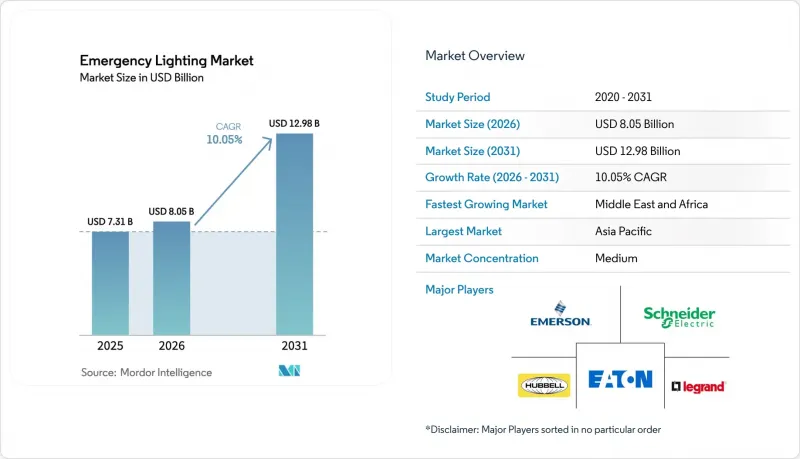
본 보고서는 광원별(LED, 형광등 등), 전원 시스템별(자립형/배터리 백업, 중앙 배터리(UPS) 등), 설치 유형별(표면 장착형, 이식형 등), 제품별(비상구 표지판 등), 통신 방식별(유선 등), 최종 사용자별(주거용, 산업용 등), 지역별로 분류되어 있습니다. 시장 예측은 금액(달러) 기준으로 제시되어 있습니다.
세계의 비상 조명 시장 동향 및 인사이트
유럽 공공 인프라의 스마트 LED 전환
유럽의 지자체에서는 에너지 소비를 최대 50%까지 줄이면서 규정 준수 보고를 간소화하는 네트워크 연결형 LED 조명 기구로 형광등 기구를 교체하고 있습니다. EU 그린딜은 공공 건축물에 대해 2030년까지 탄소 중립을 달성할 것을 요구하고 있으며, 네트워크에 연결된 조명 기구는 테스트 로그를 시설 대시보드로 자동 전송함으로써 유지보수 작업의 부담을 줄여줍니다. Acuity Brands사의 ‘STAR Gateway’는 자동화된 감사가 EN 50172 요건을 어떻게 충족하는지 보여주고 있으며, 이를 통해 스마트 LED가 기차역, 학교, 관공서에서 표준적인 선택지가 되고 있습니다.
고층 빌딩에 대한 미국 IBC/NFPA 101의 더욱 엄격해진 요건
2024년 건축 기준 개정에 따라 대피 경로의 최소 조도는 90분 동안 1.07 룩스로 상향 조정되었으며, 점등까지의 시간은 10초로 단축되었습니다. 많은 구형 니켈 카드뮴식 조명 기구는 현재 ‘정상 전력 공급 중’ 신호를 요구하는 개정된 UL 924 시험을 통과하지 못하여, 소유주는 재인증 기한에 앞서 기기를 교체할 수밖에 없는 상황에 처해 있습니다. 연방 정부 시설에서는 GSA의 에너지 목표를 달성하기 위해 제어 기능을 통합한 LED 시스템의 도입이 의무화되어 있어, 이는 추가적인 압박 요인으로 작용하고 있습니다.
의료시설에서의 리튬 이온 배터리 화재 안전 우려
병원에서는 열 폭주 사고로 인해 병동 대피를 강요받은 사례를 계기로 리튬 이온 배터리 도입을 연기하고 있습니다. NFPA는 시설 내 보관을 규제하는 NFPA 800 초안을 작성 중이지만, 최종 결정이 내려질 때까지 많은 의료 네트워크가 수명이 짧은 밀폐형 납축전지나 니켈수소 배터리 팩을 계속 사용하고 있습니다. 전미적인 배터리 안전 기준을 법제화하려는 미국의 법안 초안 또한 추가적인 불확실성을 야기하고 있습니다.
부문 분석
2025년에는 LED 기기가 비상 조명 시장 점유율의 57.25%를 차지했으며, 이 부문은 2031년까지 연평균 성장률(CAGR) 9.54%로 성장할 전망입니다. 오래된 건물에서는 여전히 형광등이 사용되고 있지만, 에너지 요금 상승과 램프 사용 금지 조치로 인해 교체 일정이 앞당겨지고 있습니다. 틈새 시장인 고휘도 방전(HID) 조명은 광효율보다 10kV 서지 내성이 우선시되는 석유화학 플랜트 등에서 계속 사용되고 있습니다.
스마트 다이오드에는 현재 센서, 메모리 및 색온도 선택 기능이 내장되어 있으며, 그 대표적인 예가 ‘Green Creative Universal CCT Select’ 튜브입니다. 이를 통해 설계자는 하드웨어를 교체하지 않고도 눈부심 수준을 조정할 수 있게 됩니다. 조명과 지능의 이러한 융합으로 인해, 무선 프로토콜이 제품 라인의 로드맵을 재구성하고 있는 상황에서도 LED 시스템은 비상 조명 시장의 핵심으로 자리 잡고 있습니다.
2025년에는 설치가 간편하고 유지보수도 단위별로만 이루어지기 때문에 자립형 팩이 비상 조명 시장 규모의 65.05%를 차지했습니다. 그러나 대규모 시설에서는 방별 배터리 점검을 줄이기 위해 중앙 집중형 배터리가 선호되고 있습니다. 데이터센터는 이러한 변화를 상징하며, 중앙 집중식 랙을 통해 모든 조명 기구가 단일 허브로부터 안정적인 전력과 펌웨어 업데이트를 받을 수 있게 되었습니다.
이튼(Eaton)사의 인버터 플랫폼은 조만간 엑서써름(Exertherm)사의 열 분석 기술을 통합할 예정이며, 이를 통해 예측 유지보수를 통한 예기치 않은 가동 중단 시간 감소 효과를 부각시키고 있습니다. 리튬 이온 배터리 스트링은 긴 사이클 수명을 실현하고 있지만, 규제가 명확해질 때까지는 병원이나 공항에서 여전히 중요 구역에 VRLA 배터리가 지정되고 있습니다. 자율형과 중앙 관리형의 양극화가 예측 기간 동안의 조달 방침을 결정짓게 될 것입니다.
지역별 분석
비상 조명 시장에서 33.85%의 점유율을 차지하는 아시아태평양은 뭄바이 메트로 3호선이나 베이징 서브센터 터널과 같은 메가 프로젝트의 혜택을 받고 있습니다. 이 지역의 정부는 아시아개발은행(ADB) 등의 기관으로부터 받은 양허성 융자를 활용하여 주변 지역의 전기화를 추진하고 있으며, 신설되는 모든 변전소와 철도 지선에서 규격에 부합하는 조명 기구가 지정되도록 보장하고 있습니다. 반도체 부족으로 인해 일정 관리가 어렵지만, 선전과 페낭에 위치한 현지 인쇄회로기판(PCB) 제조업체들이 국내 공급업체를 위한 리드타임을 단축하고 있습니다.
중동 및 아프리카은 카타르가 LNG 수출 허브를 확장하고, ‘사우디 비전 2030’이 관광 회랑 정비를 가속화함에 따라 2031년까지 연평균 성장률(CAGR) 10.74%를 기록할 전망입니다. 페르시아만 해상 시추 장비에서는 염수 분무와 60℃의 고온을 견딜 수 있는 무구리 알루미늄 재질의 케이스가 요구되고 있습니다. 북해 유전에서 사용되고 있는 ‘Chalmit’ 브랜드의 ‘Protecta X’ 조명 기구는 12만 시간의 수명이 입증되어, 이에 따라 국영 석유 회사(NOC)는 고품질 솔루션에 대한 예산 편성을 적극적으로 추진하고 있습니다.
북미 및 유럽에서는 꾸준한 교체 주기가 예상됩니다. 미국 건축 기준의 개정에 따라 고층 빌딩 소유주는 재인증 기간 내에 설비를 업그레이드해야 할 의무가 있으며, 이에 따라 개보수 공사가 증가하고 있습니다. 유럽의 ‘리노베이션 붐’에서는 공공 부문의 LED 전환을 위해 보조금이 투입되고 있으며, 독일에서는 2030년 목표에 앞서 탄소 발자국을 줄이는 스마트 제어 시스템 도입이 지원되고 있습니다. 경험이 풍부한 구매자들은 하드웨어에 분석 대시보드를 묶어 제공하는 공급업체를 선호하는 경향이 있으며, 이로 인해 소프트웨어 유지보수 계약이 비상 조명 시장에서 필수적인 요소로 자리 잡고 있습니다.
기타 혜택 :
- 엑셀 형식 시장 예측(ME) 시트
- 3개월간의 애널리스트 지원
자주 묻는 질문
목차
제1장 서론
제2장 조사 방법
제3장 주요 요약
제4장 시장 구도
제5장 시장 규모 및 성장 예측
제6장 경쟁 구도
제7장 시장 기회 및 향후 전망
AJY 26.09.07According to Mordor Intelligence, the emergency lighting market size was valued at USD 7.31 billion in 2025 and estimated to grow from USD 8.05 billion in 2026 to reach USD 12.98 billion by 2031, at a CAGR of 10.05% during the forecast period (2026-2031).
This report is Segmented by Light Source (LED, Fluorescent, and More), Power System (Self-Contained/Battery-Backup, Central Battery (UPS), and More), Installation Type (Surface-Mounted, Recessed, and More), Product (Emergency Exit Signs, and More), Communication (Wired, and More), End-User (Residential, Industrial, and More), and Geography. The Market Forecasts are Provided in Terms of Value (USD).
Global Emergency Lighting Market Trends and Insights
Smart LED retrofits across European public infrastructure
European municipalities are replacing fluorescent fixtures with networked LED luminaires that cut energy consumption by up to 50% while simplifying compliance reporting. The EU Green Deal pushes public buildings to reach carbon neutrality by 2030, and connected fixtures automatically send test logs to facility dashboards, trimming maintenance labor. Acuity Brands' STAR Gateway illustrates how automated audits meet EN 50172 requirements, making smart LEDs the default choice for rail stations, schools, and government offices.
Stricter U.S. IBC/NFPA 101 mandates for high-rises
The 2024 code cycle raises minimum egress illuminance to 1.07 lux for 90 minutes and cuts activation time to 10 seconds. Many legacy nickel-cadmium units cannot pass updated UL 924 tests that now require a "normal-power present" signal, compelling owners to replace equipment ahead of recertification deadlines. Federal facilities add another layer of pressure by specifying LED systems with integrated controls to meet GSA energy targets.
Lithium-ion fire-safety concerns in healthcare facilities
Hospitals are delaying lithium-ion rollouts after thermal-runaway incidents that led to ward evacuations. NFPA is drafting NFPA 800 to govern on-site storage, but until finalized, many health networks stay with sealed lead-acid or nickel-metal hydride packs despite shorter life. Proposed U.S. legislation to codify national battery safety standards adds further uncertainty.
Other drivers and restraints analyzed in the detailed report include:
- Urban rail-tunnel build-outs in China and India
- Data-center boom adopting centralized battery systems
- Supply-chain crunch for IC drivers and optics
For complete list of drivers and restraints, kindly check the Table Of Contents.
Segment Analysis
LED devices controlled 57.25% of emergency lighting market share in 2025, and the segment is set to advance at a 9.54% CAGR through 2031. Fluorescent tubes linger in older buildings, yet rising energy tariffs and lamp bans speed replacement schedules. Niche high-intensity discharge units remain in petrochemical zones where 10 kV surge immunity takes precedence over efficacy.
Smart diodes now embed sensors, memory, and selectable color temperatures, exemplified by the Green Creative Universal CCT Select tube, which helps specifiers tailor glare levels without swapping hardware. This convergence of intelligence with illumination keeps LED systems as the anchor of the emergency lighting market, even as wireless protocols reshape product line roadmaps.
Self-contained packs represented 65.05% of emergency lighting market size in 2025, thanks to straightforward installation and unitized maintenance. Large venues, however, prefer central banks to cut room-by-room battery checks. Data centers exemplify the shift, with centralized racks ensuring all fixtures receive conditioned power and firmware updates from a single hub.
Eaton's inverter platforms, soon incorporating Exertherm thermal analytics, highlight how predictive monitoring reduces unscheduled downtime. Lithium-ion strings deliver long cycle life, yet hospitals and airports still specify VRLA in critical zones until regulatory clarity improves. The split between autonomy and central command will define procurement choices over the forecast horizon.
Complete Report Scope:
- By Light Source
- LED
- Fluorescent Lamps
- High-Intensity Discharge (HID)
- Induction and Others
- By Power System
- Self-Contained/Battery-Backup
- Central Battery (UPS)
- Hybrid/Distributed
- By Installation Type
- Surface-Mounted
- Recessed
- Suspended
- Portable
- By Product
- Emergency Exit Signs
- Stand-alone Emergency Luminaires
- Combo Units
- Emergency Ballasts and Drivers
- By Communication
- Wired
- Wireless/IoT-Enabled
- By End-user
- Commercial - Offices
- Commercial - Hospitality and Retail
- Industrial -Manufacturing and Warehouses
- Oil and Gas/Mining
- Residential
- Public Infrastructure (Airports, Tunnels, Rail)
- Healthcare Facilities
- By Geography
- North America
- United States
- Canada
- Mexico
- Europe
- Germany
- United Kingdom
- France
- Nordics
- Rest of Europe
- South America
- Brazil
- Rest of South America
- Asia-Pacific
- China
- Japan
- India
- South-East Asia
- Rest of Asia-Pacific
- Middle East and Africa
- Middle East
- Gulf Cooperation Council Countries
- Turkey
- Rest of Middle East
- Africa
- South Africa
- Rest of Africa
- Middle East
- North America
Geography Analysis
Asia-Pacific, with a 33.85% stake in the emergency lighting market, benefits from megaprojects such as Mumbai Metro Line 3 and Beijing Sub-Center Tunnel. Regional governments use concessional loans from institutions like ADB to electrify outlying provinces, ensuring every new substation or rail spur specifies compliant luminaires. Semiconductor shortages make scheduling tricky, but local PCB houses in Shenzhen and Penang shorten lead times for domestic vendors.
The Middle East and Africa will register a 10.74% CAGR through 2031 as Qatar extends LNG export hubs and Saudi Vision 2030 accelerates tourism corridors. Offshore rigs in the Gulf demand copper-free aluminum bodies that survive salt-spray and 60 °C highs. Chalmit-branded Protecta X fixtures in North Sea fields validate 120,000-hour lifespans, encouraging NOCs to budget for premium solutions.
North America and Europe offer steady replacement cycles. U.S. code revisions now force high-rise landlords to upgrade within recertification windows, bolstering retrofit volumes. Europe's Renovation Wave funnels grants toward public-sector LED swaps, with Germany underwriting smart controls that shave carbon footprints ahead of 2030 targets. Mature buyers favor vendors that bundle analytics dashboards with hardware, elevating software maintenance contracts as a vital slice of the emergency lighting market.
- Acuity Brands Inc.
- Arrow Emergency Lighting Ltd.
- Beghelli SpA
- Cooper Lighting Solutions (Signify)
- Daisalux SAU
- Digital Lumens
- Diehl Stiftung and Co. KG
- Eaton Corp. plc
- Emerson Electric Co.
- Fulham Co. Inc.
- Hubbell Lighting Inc.
- Legrand SA
- Lutron Electronics Co.
- Myers Emergency Power Systems
- OSRAM GmbH
- Schneider Electric SE
- Signify NV (Philips Lighting)
- Taurac BV
- Thorlux Lighting
- Toshiba Corporation
- Tridonic GmbH
- Zumtobel Group AG
Additional Benefits:
- The market estimate (ME) sheet in Excel format
- 3 months of analyst support
TABLE OF CONTENTS
1 INTRODUCTION
- 1.1 Study Assumptions and Market Definition
- 1.2 Scope of the Study
2 RESEARCH METHODOLOGY
3 EXECUTIVE SUMMARY
4 MARKET LANDSCAPE
- 4.1 Market Overview
- 4.2 Market Drivers
- 4.2.1 Increasing retrofit demand for smart-connected LED emergency luminaires across Europe-s public infrastructure
- 4.2.2 Stricter occupant-safety mandates in United States high-rise codes (IBC/NFPA 101)
- 4.2.3 Rapid urban rail-tunnel build-outs in China and India
- 4.2.4 Data-center boom driving centralized battery-backup lighting in North America
- 4.2.5 ESG-led green-building certifications fueling LED exit-sign upgrades
- 4.2.6 Surge in offshore platform investments in Middle East
- 4.3 Market Restraints
- 4.3.1 Lithium-ion battery fire-safety concerns limiting adoption in healthcare facilities
- 4.3.2 Supply-chain crunch for IC drivers and optics since 2023
- 4.3.3 Fragmented local standards complicating product localization in ASEAN
- 4.3.4 High installation and testing cost for addressable wireless systems
- 4.4 Industry Ecosystem Analysis
- 4.5 Regulatory Outlook
- 4.6 Technological Outlook
- 4.7 Porter's Five Forces Analysis
- 4.7.1 Threat of New Entrants
- 4.7.2 Bargaining Power of Buyers
- 4.7.3 Bargaining Power of Suppliers
- 4.7.4 Threat of Substitutes
- 4.7.5 Competitive Rivalry
5 MARKET SIZE AND GROWTH FORECASTS (VALUES)
- 5.1 By Light Source
- 5.1.1 LED
- 5.1.2 Fluorescent Lamps
- 5.1.3 High-Intensity Discharge (HID)
- 5.1.4 Induction and Others
- 5.2 By Power System
- 5.2.1 Self-Contained/Battery-Backup
- 5.2.2 Central Battery (UPS)
- 5.2.3 Hybrid/Distributed
- 5.3 By Installation Type
- 5.3.1 Surface-Mounted
- 5.3.2 Recessed
- 5.3.3 Suspended
- 5.3.4 Portable
- 5.4 By Product
- 5.4.1 Emergency Exit Signs
- 5.4.2 Stand-alone Emergency Luminaires
- 5.4.3 Combo Units
- 5.4.4 Emergency Ballasts and Drivers
- 5.5 By Communication
- 5.5.1 Wired
- 5.5.2 Wireless/IoT-Enabled
- 5.6 By End-user
- 5.6.1 Commercial - Offices
- 5.6.2 Commercial - Hospitality and Retail
- 5.6.3 Industrial -Manufacturing and Warehouses
- 5.6.4 Oil and Gas/Mining
- 5.6.5 Residential
- 5.6.6 Public Infrastructure (Airports, Tunnels, Rail)
- 5.6.7 Healthcare Facilities
- 5.7 By Geography
- 5.7.1 North America
- 5.7.1.1 United States
- 5.7.1.2 Canada
- 5.7.1.3 Mexico
- 5.7.2 Europe
- 5.7.2.1 Germany
- 5.7.2.2 United Kingdom
- 5.7.2.3 France
- 5.7.2.4 Nordics
- 5.7.2.5 Rest of Europe
- 5.7.3 South America
- 5.7.3.1 Brazil
- 5.7.3.2 Rest of South America
- 5.7.4 Asia-Pacific
- 5.7.4.1 China
- 5.7.4.2 Japan
- 5.7.4.3 India
- 5.7.4.4 South-East Asia
- 5.7.4.5 Rest of Asia-Pacific
- 5.7.5 Middle East and Africa
- 5.7.5.1 Middle East
- 5.7.5.1.1 Gulf Cooperation Council Countries
- 5.7.5.1.2 Turkey
- 5.7.5.1.3 Rest of Middle East
- 5.7.5.2 Africa
- 5.7.5.2.1 South Africa
- 5.7.5.2.2 Rest of Africa
- 5.7.5.1 Middle East
- 5.7.1 North America
6 COMPETITIVE LANDSCAPE
- 6.1 Market Concentration
- 6.2 Strategic Moves
- 6.3 Market Share Analysis
- 6.4 Company Profiles (includes Global-level Overview, Market-level Overview, Core Segments, Financials as available, Strategic Information, Market Rank/Share, Products and Services, Recent Developments)
- 6.4.1 Acuity Brands Inc.
- 6.4.2 Arrow Emergency Lighting Ltd.
- 6.4.3 Beghelli SpA
- 6.4.4 Cooper Lighting Solutions (Signify)
- 6.4.5 Daisalux SAU
- 6.4.6 Digital Lumens
- 6.4.7 Diehl Stiftung and Co. KG
- 6.4.8 Eaton Corp. plc
- 6.4.9 Emerson Electric Co.
- 6.4.10 Fulham Co. Inc.
- 6.4.11 Hubbell Lighting Inc.
- 6.4.12 Legrand SA
- 6.4.13 Lutron Electronics Co.
- 6.4.14 Myers Emergency Power Systems
- 6.4.15 OSRAM GmbH
- 6.4.16 Schneider Electric SE
- 6.4.17 Signify NV (Philips Lighting)
- 6.4.18 Taurac BV
- 6.4.19 Thorlux Lighting
- 6.4.20 Toshiba Corporation
- 6.4.21 Tridonic GmbH
- 6.4.22 Zumtobel Group AG
7 MARKET OPPORTUNITIES AND FUTURE OUTLOOK
- 7.1 White-space and Unmet-Need Assessment