
|
시장보고서
상품코드
2124634
미국의 비상 조명 : 시장 점유율 분석, 업계 동향 및 통계, 성장 예측(2026-2031년)United States Emergency Lighting - Market Share Analysis, Industry Trends & Statistics, Growth Forecasts (2026 - 2031) |
||||||
 Mordor Intelligence
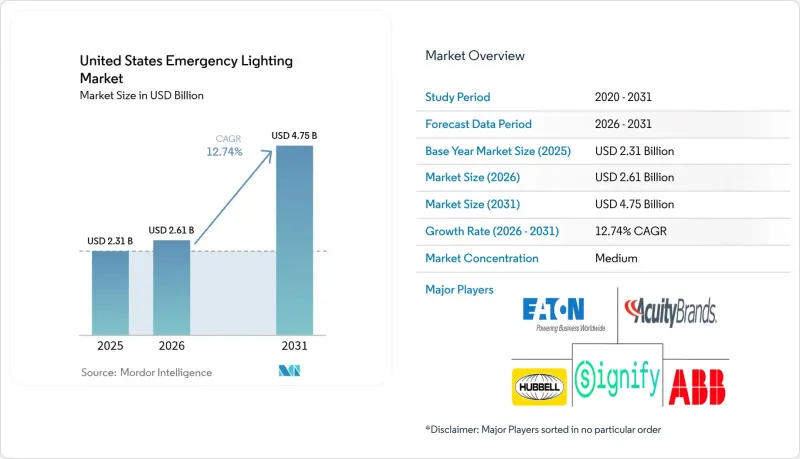
Mordor Intelligence에 의하면, 미국의 비상 조명 시장 규모는 2025년에 23억 1,000만 달러로 평가되었습니다. 2026년 26억 1,000만 달러에서 2031년까지 47억 5,000만 달러에 이를 것으로 예상되며, 예측 기간(2026-2031년) CAGR은 12.74%를 나타낼 전망입니다.
본 보고서는 시스템 유형(자립형 및 중앙 집중식), 광원(LED, 형광등, 기타),작동 모드(상시 점등형, 비상 점등형, 스위치식/멀티 모드), 최종 사용자(상업시설, 산업 시설, 교육 시설, 의료시설, 공공 인프라 및 교통 기관, 기타)별로 분류되어 있습니다. 시장 예측은 금액(달러) 기준으로 제시되어 있습니다.
미국의 비상 조명 시장 동향 및 인사이트
LED 효율 향상과 가격 하락이 시장 변화를 주도
신세대 LED 비상 조명 기구는 현재 180 lm/W를 초과하여, 시설 소유주는 개보수 후 에너지 사용량을 최대 82%까지 절감할 수 있게 되었습니다. 맥라렌 헬스케어는 11개 병원에서 2만 5,000대를 교체하여 연간 에너지 비용을 160만 달러 절감했습니다. 이를 통해 규제에 따른 배터리 업그레이드가 필요했음에도 불구하고 투자 회수 기간이 짧았음이 확인되었습니다. 다이오드 비용의 하락으로 기구 가격이 낮아지면서, 미국의 비상 조명 시장은 기존 형광등 제품과의 가격 경쟁이 더욱 치열해지고 있습니다. 고효율화로 인해 필요한 배터리 용량이 줄어들어 초기 투자 비용이 더욱 절감됩니다. 그 결과, 2027년까지 신규 설치의 90% 이상에서 LED가 채택될 것으로 예측됩니다. 이러한 기술적 우위는 공급 기업의 협상력을 강화하는 동시에, 예산에 민감한 교육 기관 및 지자체 프로젝트에서의 채택 확대를 뒷받침하고 있습니다.
엄격한 NFPA 70/101 및 OSHA 규정 준수 요건이 설치 기준 재구성을 촉진
최신 NFPA 101에서는 대피 경로의 조도를 최소 1 fc, 백업 시간을 90분 이상으로 의무화하고 있어, 시설 관리자는 개보수 공사 시 규격에 부합하지 않는 조명 기구를 교체할 수밖에 없게 되었습니다. UL 924(2022년 5월)에서는 조명 기구가 정상적인 전원 공급을 감지할 수 있어야 한다고 규정하고 있으며, nLight AIR와 같은 무선 메시 제품은 추가 제어 배선 없이도 이 요건을 충족합니다. 웨스트 미플린 학군과 같이 성과 계약 모델을 활용하는 학군에서는 법규 기준을 상회함으로써 15년 동안 990만 달러를 절감할 것으로 예측됩니다. 스마트 드라이버가 생성하는 월간 정기 자가 진단 및 연간 방전 보고서를 통해 수작업에 의한 기록 관리가 불필요해지며, OSHA 감사가 원활해집니다. 규제 집행 강화로 인해 교체 주기가 단축됨에 따라, 미국의 비상 조명 시장에서 규정 준수 기능이 입찰 사양의 필수 요건으로 자리 잡고 있습니다.
규격 준수 시스템의 높은 초기 비용이 도입을 저해하고 있습니다.
고도의 자가 진단 기능, LiFePO4 배터리 팩, 무선 통신 기능으로 인해 기존 형광등 유닛에 비해 부품 원가가 최대 40% 상승하여, 자금 사정이 여의치 않은 소유주에게는 투자 회수 기간이 길어지고 있습니다. 소규모 소매업체나 커뮤니티 칼리지의 경우, 에너지 리베이트가 있음에도 불구하고 업그레이드를 미루는 경우가 많아, 건축물 재고의 3분의 1 이상을 차지하는 이러한 부문에서의 잠재적 시장 규모 확대가 둔화되고 있습니다. 그러나 LED 부품 비용이 하락하고 전력 회사가 규정 기반의 인센티브를 확대함에 따라 비용 측면의 장벽은 완화될 것으로 예상되며, 이에 따라 잠재적 수요가 활기를 띠고 있는 미국의 비상 조명 시장으로 전환될 것으로 전망됩니다.
부문별 분석
2025년에는 자립형 유닛이 미국의 비상 조명 시장 점유율의 64.38%를 차지하며 주류가 되었으며, 2031년까지 연평균 성장률(CAGR) 13.92%로 확대될 것으로 전망됩니다. 이는 설치의 용이성과 단일 고장 지점에 대한 내성을 뒷받침하는 것입니다. 각 조명 기구에 내장된 분산형 배터리 덕분에 사무실, 병원, 기차역 등에서 분산형 개조가 간소화되어 전용 배터리실이 필요 없게 됩니다. 한편, 집중 급전 시스템은 통일된 모니터링 체계를 통해 분기별 점검이 용이한 대규모 의료시설 프로젝트에서 일정한 입지를 유지하고 있지만, 비용이 많이 드는 배선 공사로 인해 신규 도입에는 제약이 따르고 있습니다.
이러한 분산형 지능화의 동향은 상업용 부동산의 광범위한 디지털화와 궤를 같이 하고 있으며, 자립형 조명 기구는 건물 전체의 센서 네트워크의 중추로서 입지를 확립하고 있습니다. 각 조명 기구 내의 엣지 분석을 통해 국소적인 진단이 가능해져 평균 수리 시간(MTTR)이 단축될 뿐만 아니라, 미국의 비상 조명 시장에서 NFPA 및 OSHA 인증을 유지하는 데 필수적인 규정 준수 보고가 강화됩니다.
LED는 2025년 출하 대수의 78.02%를 차지했으며, 연평균 성장률(CAGR) 14.06%로 가장 빠르게 성장하는 광원으로 남을 전망입니다. 이는 뛰어난 광효율, 순간 점등 기능, 그리고 5만시간의 수명을 반영한 결과입니다. 조달 담당자들이 두 자릿수의 에너지 절감 효과와 유지보수 예산 절감을 추구하는 가운데, LED 조명 기구와 관련된 미국의 비상 조명 시장 규모는 예측 기간 동안 형광등 대체 시장을 4배의 속도로 앞지를 것으로 전망됩니다. 산업 분야 고객들로부터는 T8 기반 배터리 팩에서 전용 설계된 LED 비상구 조명으로 전환한 후 유지보수 요청 건수가 60% 감소했다는 반응이 전해지고 있습니다.
부품 가격 하락으로 인해 LED의 가격 격차는 줄어들고 있어, 가격에 민감한 지자체 프로젝트에서도 신속한 투자 회수가 가능해졌습니다. 형광등이나 할로겐 램프의 선택지는 주로 틈새 용도로 남아 있지만, 그 합계 점유율은 2028년까지 5% 미만으로 떨어질 전망이며, 이는 LED가 미국의 비상 조명 시장에서 사실상 표준이 될 것임을 뒷받침하고 있습니다.
기타 혜택 :
- 엑셀 형식 시장 예측(ME) 시트
- 3개월간의 애널리스트 지원
자주 묻는 질문
목차
제1장 서론
제2장 조사 방법
제3장 주요 요약
제4장 시장 구도
제5장 시장 규모 및 성장 예측
제6장 경쟁 구도
제7장 시장 기회 및 향후 전망
KTH 26.09.14According to Mordor Intelligence, the United States emergency lighting market size was valued at USD 2.31 billion in 2025 and estimated to grow from USD 2.61 billion in 2026 to reach USD 4.75 billion by 2031, at a CAGR of 12.74% during the forecast period (2026-2031).
This report is Segmented by System Type (Self-Sustained and Centrally Supplied), Light Source (LED, Fluorescent, and Others), Operating Mode (Maintained, Non-Maintained, and Switched/Multi-mode), and End User (Commercial, Industrial, Educational Facilities, Healthcare Facilities, Public Infrastructure and Transit, and Others). The Market Forecasts are Provided in Terms of Value (USD).
United States Emergency Lighting Market Trends and Insights
Growing LED Efficacy and Price Declines Drive Market Transformation
New-generation LED emergency luminaires now surpass 180 lm/W, allowing facility owners to cut energy use by up to 82% after retrofits. McLaren Health Care replaced 25,000 units across 11 hospitals and lowered annual utility costs by USD 1.6 million, confirming favorable payback periods despite code-driven battery upgrades. Falling diode costs compress fixture pricing, pushing the United States emergency lighting market deeper into price-parity territory with fluorescent incumbents. High efficacy shortens battery sizing requirements, further trimming upfront spend. As a result, LED penetration is expected to exceed 90% of new installations before 2027. The technology leadership strengthens supplier bargaining power while widening adoption in budget-sensitive education and municipal projects.
Stringent NFPA 70/101 and OSHA Compliance Push Reshapes Installation Standards
The latest NFPA 101 edition mandates 1 fc minimum egress illuminance and 90-minute backup duration, driving facility managers to replace non-conforming fixtures during remodels. UL 924 (May 2022) now requires luminaires to sense normal power presence; wireless mesh offerings like nLight AIR satisfy this rule without extra control wiring. School districts leveraging performance-contract models, such as West Mifflin, anticipate USD 9.9 million in savings across 15 years by exceeding code baselines. Consistent monthly self-tests and annual discharge reports generated by smart drivers remove manual log-keeping, easing OSHA audits. Enhanced enforcement boosts replacement cycles and cements compliance features as table-stakes in bid specifications throughout the United States emergency lighting market.
High Upfront Cost of Code-Compliant Systems Constrains Adoption
Advanced self-test drivers, LiFePO4 packs, and wireless radios elevate the bill-of-materials up to 40% versus legacy fluorescent units, stretching payback horizons for cash-constrained owners. Smaller retailers and community colleges often postpone upgrades despite energy rebates, slowing total addressable volume in segments that collectively account for more than one-third of building stock. Nonetheless, as LED component costs retreat and utilities expand prescriptive incentives, cost barriers are forecast to soften, permitting latent demand to migrate into the active United States emergency lighting market.
Other drivers and restraints analyzed in the detailed report include:
- Rise in Smart-Building Retrofits Accelerates IoT Integration
- Federal Infrastructure-Upgrade Funding Creates Unprecedented Market Opportunities
- Lithium-Battery Supply Volatility Threatens Cost Predictability
For complete list of drivers and restraints, kindly check the Table Of Contents.
Segment Analysis
Self-sustained units dominated with a 64.38% United States emergency lighting market share in 2025 and are projected to expand at a 13.92% CAGR to 2031, underscoring their ease of installation and resilience against single-point failures. Dispersed batteries embedded inside every luminaire simplify decentralized retrofits in offices, hospitals, and rail stations, eliminating the need for dedicated battery rooms. Centrally supplied systems retain a foothold in mega-campus healthcare projects where unified monitoring eases quarterly testing, but their cost-intensive wiring constrains new adoption.
The distributed-intelligence trend aligns with the broader digitization of commercial real estate, positioning self-contained fixtures as a backbone for building-wide sensor networks. Edge analytics within each light enable localized diagnostics, compressing mean-time-to-repair and enhancing compliance reporting that is critical for maintaining NFPA and OSHA certifications across the United States emergency lighting market.
LEDs accounted for 78.02% of 2025 shipments and will remain the fastest-growing light source at 14.06% CAGR, reflecting superior efficacy, instant-on capability, and 50,000-hour lifetimes. The United States emergency lighting market size associated with LED luminaires is set to outpace fluorescent replacements by a factor of four during the forecast horizon as procurement managers chase double-digit energy savings and lower maintenance budgets. Industrial clients cite maintenance callouts falling by 60% after switching from T8-based battery packs to purpose-built LED exits.
Declines in component pricing are shrinking the LED premium, enabling quick paybacks even in price-sensitive municipal projects. Fluorescent and halogen options persist mainly in niche applications, but their combined unit share will likely dip below 5% before 2028, confirming LEDs as the de-facto standard throughout the United States emergency lighting market.
Complete Report Scope:
- By System Type
- Self-sustained
- Centrally Supplied
- By Light Source
- LED
- Fluorescent
- Others (Halogen, Incandescent, etc.)
- By Operating Mode
- Maintained
- Non-maintained
- Switched/Multi-mode
- By End User
- Commercial
- Industrial
- Educational Facilities
- Healthcare Facilities
- Public Infrastructure and Transit
- Others (Residential, Hospitality, etc.)
List of Companies Covered in this Report:
- Acuity Brands Inc.
- Eaton Corporation plc
- ABB Ltd
- Hubbell Incorporated
- Signify N.V.
- Legrand S.A.
- Emerson Electric Co.
- Myers Emergency Power Systems LLC
- Cree LED Lighting Solutions Inc.
- Digital Lumens Inc.
- Encore Wire Corporation
- Larson Electronics LLC
- Beghelli S.p.A.
- Cooper Lighting Solutions LLC
- Stanley Electric Co., Ltd.
- Lite-On Technology Corporation
- Schneider Electric SE
- Zumtobel Group AG
- Fagerhult AB
- Philips Emergency Lighting
Additional Benefits:
- The market estimate (ME) sheet in Excel format
- 3 months of analyst support
TABLE OF CONTENTS
1 INTRODUCTION
- 1.1 Study Assumptions and Market Definition
- 1.2 Scope of the Study
2 RESEARCH METHODOLOGY
3 EXECUTIVE SUMMARY
4 MARKET LANDSCAPE
- 4.1 Market Overview
- 4.2 Market Drivers
- 4.2.1 Growing LED efficacy and price declines
- 4.2.2 Stringent NFPA 70/101 and OSHA compliance push
- 4.2.3 Rise in smart-building retrofits (IoT integration)
- 4.2.4 Federal infrastructure-upgrade funding (IIJA)
- 4.2.5 Climate-resilience mandates for severe-weather events
- 4.2.6 Corporate ESG-lighting decarbonisation targets
- 4.3 Market Restraints
- 4.3.1 High upfront cost of code-compliant systems
- 4.3.2 Competition from distributed micro-UPS and PoE lighting
- 4.3.3 Lithium-battery supply volatility
- 4.3.4 Skills gap in low-voltage ?installation
- 4.4 Impact of Macroeconomic Factors
- 4.5 Industry Supply-Chain Analysis
- 4.6 Technology Snapshot
- 4.7 Regulatory Landscape
- 4.8 Porter's Five Forces
- 4.8.1 Threat of New Entrants
- 4.8.2 Bargaining Power of Buyers
- 4.8.3 Bargaining Power of Suppliers
- 4.8.4 Threat of Substitutes
- 4.8.5 Intensity of Competitive Rivalry
5 MARKET SIZE AND GROWTH FORECASTS (VALUE)
- 5.1 By System Type
- 5.1.1 Self-sustained
- 5.1.2 Centrally Supplied
- 5.2 By Light Source
- 5.2.1 LED
- 5.2.2 Fluorescent
- 5.2.3 Others (Halogen, Incandescent, etc.)
- 5.3 By Operating Mode
- 5.3.1 Maintained
- 5.3.2 Non-maintained
- 5.3.3 Switched/Multi-mode
- 5.4 By End User
- 5.4.1 Commercial
- 5.4.2 Industrial
- 5.4.3 Educational Facilities
- 5.4.4 Healthcare Facilities
- 5.4.5 Public Infrastructure and Transit
- 5.4.6 Others (Residential, Hospitality, etc.)
6 COMPETITIVE LANDSCAPE
- 6.1 Market Concentration
- 6.2 Strategic Moves
- 6.3 Market Share Analysis
- 6.4 Company Profiles (includes Global-level Overview, Market-level Overview, Core Segments, Financials as available, Strategic Information, Market Rank/Share, Products and Services, Recent Developments)
- 6.4.1 Acuity Brands Inc.
- 6.4.2 Eaton Corporation plc
- 6.4.3 ABB Ltd
- 6.4.4 Hubbell Incorporated
- 6.4.5 Signify N.V.
- 6.4.6 Legrand S.A.
- 6.4.7 Emerson Electric Co.
- 6.4.8 Myers Emergency Power Systems LLC
- 6.4.9 Cree LED Lighting Solutions Inc.
- 6.4.10 Digital Lumens Inc.
- 6.4.11 Encore Wire Corporation
- 6.4.12 Larson Electronics LLC
- 6.4.13 Beghelli S.p.A.
- 6.4.14 Cooper Lighting Solutions LLC
- 6.4.15 Stanley Electric Co., Ltd.
- 6.4.16 Lite-On Technology Corporation
- 6.4.17 Schneider Electric SE
- 6.4.18 Zumtobel Group AG
- 6.4.19 Fagerhult AB
- 6.4.20 Philips Emergency Lighting
7 MARKET OPPORTUNITIES AND FUTURE OUTLOOK
- 7.1 White-space and Unmet-need Assessment