
|
시장보고서
상품코드
2122837
수의 분자진단 시장 : 시장 점유율 분석, 업계 동향 및 통계, 성장 예측(2026-2031년)Veterinary Molecular Diagnostics - Market Share Analysis, Industry Trends & Statistics, Growth Forecasts (2026 - 2031) |
||||||
 Mordor Intelligence
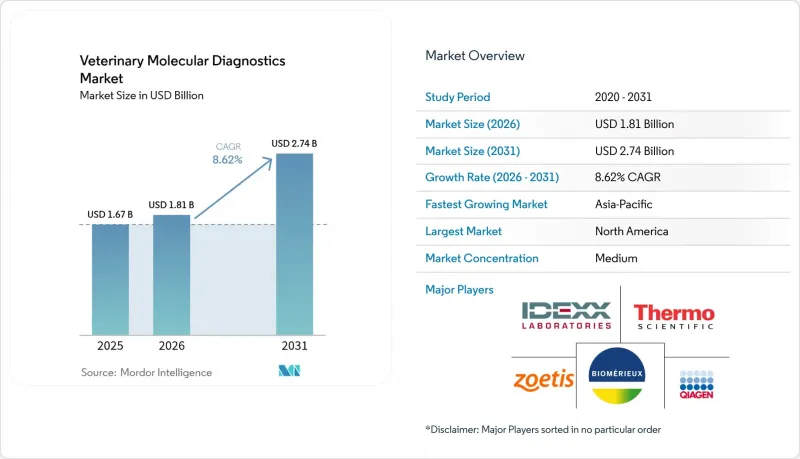
Mordor Intelligence에 의하면, 수의용 분자진단 시장 규모는 2025년 16억 7,000만 달러로 평가되었고, 2026년에는 18억 1,000만 달러로 추정되고, 2026-2031년 CAGR 8.62%로 성장을 지속할 전망이며, 2031년에는 27억 4,000만 달러에 이를 것으로 예측됩니다.

본 보고서는 제품별(장비, 키트 등), 용도별(감염병, 유전학 등), 기술별(PCR, 마이크로어레이 등), 동물 종별(반려동물 및 가축), 최종 사용자별(동물병원 및 진료소 등), 지역별(북미, 유럽, 아시아태평양 등)로 분류되어 있습니다. 시장 규모 및 전망은 금액(달러) 기준으로 제시되어 있습니다.
세계의 수의 분자진단 시장 동향 및 인사이트
동물 감염병 발생률 증가
2024년, 고병원성 조류 인플루엔자 H5N1이 미국의 젖소에 감염되면서 미네소타 대학 등 검사 기관은 2025년 5월까지 11만 5,000건 이상의 검체를 처리하게 되었습니다. 이러한 급증은 하루에 수백 건의 결과를 도출하는 고처리량 PCR 플랫폼에 대한 수요를 자극하고, 바이러스의 진화를 추적하기 위한 전체 유전체 시퀀싱의 도입을 촉진하고 있습니다. 소와 관련된 인간의 H5N1 감염 사례가 확인됨에 따라 ‘원 헬스(One Health)’의 중요성이 재인식되었으며, 분자진단은 동물과 인간의 합동 발병 대응에 필수적인 인프라가 되었습니다. 그 결과, 시퀀싱 역량에 대한 투자로 인해 수의 분자진단 시장은 통합되고 신속하며 확장 가능한 솔루션으로 전환되고 있습니다.
동물 유래 단백질에 대한 수요 증가
아시아태평양의 육류 및 유제품 소비 증가에 따라, 생산자들은 생물 보안 강화와 질병 저항성이 있는 유전자 계통의 선정을 요구받고 있습니다. 축산 사업자들은 현재 병원체 균주를 식별하기 위해 고분해능 용해법을 채택하고, 우수한 사료 전환율을 실현하기 위한 유전자 마커를 활용함으로써 동물 복지를 지키면서 항생제 사용을 줄이고 있습니다. 이러한 생산 지향적 검사는 단일 워크플로우 내에서 병원체 검출과 유전자 프로파일링을 결합할 수 있는 멀티플렉스 플랫폼의 장기적인 매출을 뒷받침하고 있습니다.
숙련된 수의 분자진단 전문가의 부족
인간 의료 분야에서는 검사 기사의 공석률이 35%-40%에 달하고 있으며, 수의학 현장에서도 유사한 인력 부족 현상이 발생하고 있습니다. 지방의 수의사들은 종종 검사 기사의 역할까지 겸해야 하지만, 대부분의 수의학 교육 과정에서는 분자생물학 교육이 제한적입니다. 인력 부족으로 인해 첨단 플랫폼 도입이 지연되면서, 소규모 동물병원에서의 수의 분자진단 시장 확대가 저해되고 있습니다.
부문 분석
2025년 매출 중 키트 및 시약이 58.50%를 차지했으며, 공급업체의 현금 흐름을 안정시키는 정기적인 수익 모델을 뒷받침하고 있습니다. 한편, 클라우드 분석, AI 기반 해석 모듈, 구독형 데이터 포털이 검사실 업무에 필수적인 요소로 자리 잡으면서 소프트웨어 및 서비스 부문은 연평균 성장률(CAGR) 11.7%로 확대되고 있습니다. 주요 공급업체들은 소모품, 장비, 분석 기능을 번들로 제공함으로써 타사로의 전환 장벽을 높이고 있습니다. 소모품에 기인한 수의 분자진단 시장 규모는 2031년까지 지배적인 위치를 유지할 것으로 예상되지만, 차별화를 꾀하는 데 있어 소프트웨어의 전략적 중요성은 점점 더 커질 것입니다. 소형화 및 개방형 플랫폼 설계로 인해 진입 장벽이 낮아지고, 기존 데스크톱 시스템 비용의 몇 분의 일 수준에 구입할 수 있는 휴대용 나노포어 시퀀서가 그 좋은 예인 것처럼, 장비의 이익률은 축소되고 있습니다. 그 결과, 제조업체들은 하드웨어와 디지털 분석, 그리고 키트의 수명 주기 수익을 결합한 통합 생태계로 무게중심을 옮기고 있습니다.
감염병 감시는 2025년 매출의 68.90%를 차지했으며, 검사 기관이 조류 인플루엔자, 아프리카 돼지 열병, 개 파보바이러스에 대응함에 따라 계속해서 수의 분자진단 시장의 중심을 이루고 있습니다. 증후군별 패널 검사를 통해 감별 진단 시간이 단축되고, 경험적 항생제 투여가 감소하고 있습니다. 연평균 성장률(CAGR) 10.24%로 확대되고 있는 유전학 분야의 용도는 반려동물 주인들의 유전성 질환 선별 검사 수요와 번식가들의 유전체 선별에 대한 집중을 반영하고 있습니다. 종양학 분야의 액체 생검은 임상 현장에서의 채택이 더욱 확대되고 있습니다. 시퀀싱 비용의 하락에 따라 질병의 소인 및 성능 특성 모두에 대한 정기 검진이 가능해짐에 따라, 수의 분자진단 시장 내 유전학 분야 시장 규모는 가속화될 것으로 예측됩니다.
지역별 분석
북미는 2025년 매출의 41.20%를 차지했습니다. 이는 잘 갖춰진 수의학 인프라, 반려동물 관리에 대한 막대한 지출, 그리고 2025년 미국 농무부(USDA)가 동물 건강 검진을 위해 6,442만 9,000달러를 지원한 것이 배경이 되었습니다. 신규 검사법에 대한 연방 정부의 신속 승인 절차가 혁신을 가속화하고 있지만, 지방 지역의 기술자 부족은 여전히 병목 현상으로 작용하고 있습니다.
유럽은 엄격한 항생제 적정 사용 규제 덕분에 여전히 큰 시장 점유율을 유지하고 있습니다. 규정(EU) 2019/6에 따라 수의약품 감독 체계가 현대화되면서 신속한 내성 검사에 대한 수요가 증가하고 있습니다. 2018-2022년, 이 지역에서는 육용 가축에 대한 항생제 사용량이 28.3% 감소했으며, 이에 따라 농장에서는 규정 준수를 확보하기 위한 수단으로 분자 감시 체계가 도입되기 시작했습니다.
아시아태평양은 연평균 성장률(CAGR) 10.96%로 가장 빠르게 성장하고 있는 지역입니다. 중산층의 반려동물 사육 확산, 대규모 낙농의 확대, 그리고 아세안(ASEAN) 의료기기 지침과 같은 지원 정책이 도입을 뒷받침하고 있습니다. 라틴아메리카 및 중동 및 아프리카에서는 꾸준한 도입이 진행되고 있으나, 환율 변동과 검사 기관 네트워크의 제한이 성장의 걸림돌이 되고 있습니다. 다양한 동물 종과 기후에 대응하는 휴대용 진단 키트는 이들 지역에서의 보급을 가속화할 유망한 수단입니다.
기타 혜택 :
- 엑셀 형식 시장 예측(ME) 시트
- 3개월간의 애널리스트 지원
자주 묻는 질문
목차
제1장 서론
제2장 조사 방법
제3장 주요 요약
제4장 시장 구도
제5장 시장 규모 및 성장 예측
제6장 경쟁 구도
제7장 시장 기회 및 향후 전망
AJY 26.09.07According to Mordor Intelligence, the veterinary molecular diagnostics market size is expected to grow from USD 1.67 billion in 2025 to USD 1.81 billion in 2026 and is forecast to reach USD 2.74 billion by 2031 at 8.62% CAGR over 2026-2031.
This report is Segmented by Products (Instruments, Kits, and More), Applications (Infectious Diseases, Genetics, and More), Technology (PCR, Microarray, and More), Animal Type (Companion Animals and Livestock), End User (Veterinary Hospitals & Clinics, and More), and Geography (North America, Europe, Asia-Pacific, and More). The Market Sizes and Forecasts are Provided in Terms of Value (USD).
Global Veterinary Molecular Diagnostics Market Trends and Insights
Rise in Prevalence of Animal Infectious Diseases
High-pathogenicity avian influenza H5N1 infected U.S. dairy cattle in 2024, pushing laboratories such as the University of Minnesota to process more than 115,000 samples by May 2025. Such surges spur demand for high-throughput PCR platforms that deliver hundreds of results per day and drive adoption of whole-genome sequencing to track viral evolution. Confirmed human H5N1 cases linked to cattle reinforce the One-Health imperative, making molecular diagnostics essential infrastructure for joint animal-human outbreak response. Investments in sequencing capacity therefore shift the veterinary molecular diagnostics market toward integrated, rapid and scalable solutions.
Growing Demand for Animal-Derived Proteins
Rising meat and dairy consumption in Asia Pacific is pushing producers to intensify biosecurity and select disease-resistant genetics. Livestock operators now deploy high-resolution melting assays to distinguish pathogen strains and apply genetic markers for superior feed conversion, cutting antibiotic usage while protecting welfare. This production-oriented testing sustains long-term sales of multiplex platforms capable of combining pathogen detection with genetic profiling inside a single workflow.
Lack of Skilled Veterinary Molecular Diagnosticians
Vacancy rates for laboratory technologists have reached 35%-40% in human health, with parallel gaps in veterinary practice. Rural veterinarians must often double as lab technicians, yet most veterinary curricula provide limited molecular-biology training. Staffing shortages slow installation of advanced platforms and limit the veterinary molecular diagnostics market in smaller clinics.
Other drivers and restraints analyzed in the detailed report include:
- Increasing Companion-Animal Ownership & Spend
- Adoption of Syndromic Multiplex Panels
- One-Health AMR Surveillance Funding Surge
- Portable Nanopore Sequencing Enters Field Use
- High Cost of Instruments & Consumables
For complete list of drivers and restraints, kindly check the Table Of Contents.
Segment Analysis
Kits and reagents produced 58.50% of 2025 revenues, anchoring a recurring business model that stabilizes cash flow for suppliers. Software and services, however, are expanding at an 11.7% CAGR as cloud analytics, AI interpretive modules, and subscription data portals become integral to laboratory operations. Leading vendors bundle consumables, instruments, and analytics, reinforcing switching barriers. The veterinary molecular diagnostics market size attributable to consumables is forecast to remain dominant through 2031, yet software will command increasing strategic importance for differentiation. Instrument margins tighten as miniaturization and open-platform designs lower entry barriers, illustrated by portable nanopore sequencers costing a fraction of legacy bench-top systems. As a result, manufacturers pivot toward integrated ecosystems that pair hardware with digital interpretation and lifetime kit revenue.
Infectious disease surveillance generated 68.90% of 2025 sales and remains the core of the veterinary molecular diagnostics market as laboratories manage avian influenza, African swine fever, and canine parvovirus. Syndromic panels shorten differential diagnosis and reduce empirical antibiotic use. Genetics applications, advancing at a 10.24% CAGR, reflect pet owners' desire for hereditary screening and breeders' focus on genomic selection. Liquid biopsies for oncology further widen clinical adoption. The veterinary molecular diagnostics market size for genetics is projected to accelerate as sequencing costs fall, enabling routine screening for both disease predisposition and performance traits.
Complete Report Scope:
- By Product
- Instruments
- Kits & Reagents
- Software & Services
- By Application
- Infectious Diseases
- Genetics
- Other Applications
- By Technology
- PCR
- Microarray
- DNA Sequencing
- By Animal Type
- Companion Animals
- Livestock
- By End User
- Veterinary Hospitals & Clinics
- Reference Laboratories
- Research Institutes
- Geography
- North America
- United States
- Canada
- Mexico
- Europe
- Germany
- United Kingdom
- France
- Italy
- Spain
- Rest of Europe
- Asia Pacific
- China
- Japan
- India
- South Korea
- Australia
- Rest of Asia Pacific
- Middle East and Africa
- GCC
- South Africa
- Rest of Middle East and Africa
- South America
- Brazil
- Argentina
- Rest of South America
- North America
Geography Analysis
North America captured 41.20% revenue in 2025, underpinned by extensive veterinary infrastructure, generous pet-care spending, and USDA funding of USD 64.429 million for animal-health diagnostics in 2025. Federal fast-track pathways for new assays accelerate innovation, though rural skills shortages remain a bottleneck.
Europe maintains a substantial share thanks to strict antimicrobial stewardship rules. Regulation (EU) 2019/6 modernizes veterinary medicinal oversight and boosts demand for rapid resistance testing. Between 2018 and 2022, the region cut antimicrobial use in food animals by 28.3%, prompting farms to adopt molecular surveillance as a compliance tool.
Asia Pacific is the fastest-growing territory at an 10.96% CAGR. Middle-class pet ownership, mega-dairy expansion, and supportive policies such as the ASEAN Medical Device Directive spur uptake. Latin America and the Middle East & Africa record steady adoption, although currency volatility and limited laboratory networks temper growth. Portable diagnostic kits tailored for diverse species and climates show promise for accelerating penetration in these regions.
- Biochek
- bioMerieux
- Bioneer Corp.
- IDEXX
- Ingenetix
- Neogen Corp.
- Thermo Fisher Scientific
- Veterinary Molecular Diagnostics
- Biomedica Group
- Novacyt Group
- QIAGEN
- Virbac
- Zoetis
- Randox Laboratories
- Seegene
- BioNote Inc.
- LGC Group
- Abaxis (Zoetis)
- PathoSense NV
- Boehringer Ingelheim
Additional Benefits:
- The market estimate (ME) sheet in Excel format
- 3 months of analyst support
TABLE OF CONTENTS
1 Introduction
- 1.1 Study Assumptions & Market Definition
- 1.2 Scope of the Study
2 Research Methodology
3 Executive Summary
4 Market Landscape
- 4.1 Market Overview
- 4.2 Market Drivers
- 4.2.1 Rise In Prevalence of Animal Infectious Diseases
- 4.2.2 Growing Demand for Animal-Derived Proteins
- 4.2.3 Increasing Companion-Animal Ownership & Spend
- 4.2.4 Adoption Of Syndromic Multiplex Panels
- 4.2.5 One-Health Amr Surveillance Funding Surge
- 4.2.6 Portable Nanopore Sequencing Enters Field Use
- 4.3 Market Restraints
- 4.3.1 Lack Of Skilled Veterinary Molecular Diagnosticians
- 4.3.2 High Cost of Instruments & Consumables
- 4.3.3 Limited Multi-Species Assay Validation Standards
- 4.3.4 Sample-Logistics Hurdles in Decentralised Networks
- 4.4 Supply Chain Analysis
- 4.5 Regulatory Landscape
- 4.6 Technological Outlook
- 4.7 Porter's Five Forces
- 4.7.1 Threat of New Entrants
- 4.7.2 Bargaining Power of Buyers
- 4.7.3 Bargaining Power of Suppliers
- 4.7.4 Threat of Substitutes
- 4.7.5 Intensity of Competitive Rivalry
5 Market Size & Growth Forecasts (Value)
- 5.1 By Product
- 5.1.1 Instruments
- 5.1.2 Kits & Reagents
- 5.1.3 Software & Services
- 5.2 By Application
- 5.2.1 Infectious Diseases
- 5.2.2 Genetics
- 5.2.3 Other Applications
- 5.3 By Technology
- 5.3.1 PCR
- 5.3.2 Microarray
- 5.3.3 DNA Sequencing
- 5.4 By Animal Type
- 5.4.1 Companion Animals
- 5.4.2 Livestock
- 5.5 By End User
- 5.5.1 Veterinary Hospitals & Clinics
- 5.5.2 Reference Laboratories
- 5.5.3 Research Institutes
- 5.6 Geography
- 5.6.1 North America
- 5.6.1.1 United States
- 5.6.1.2 Canada
- 5.6.1.3 Mexico
- 5.6.2 Europe
- 5.6.2.1 Germany
- 5.6.2.2 United Kingdom
- 5.6.2.3 France
- 5.6.2.4 Italy
- 5.6.2.5 Spain
- 5.6.2.6 Rest of Europe
- 5.6.3 Asia Pacific
- 5.6.3.1 China
- 5.6.3.2 Japan
- 5.6.3.3 India
- 5.6.3.4 South Korea
- 5.6.3.5 Australia
- 5.6.3.6 Rest of Asia Pacific
- 5.6.4 Middle East and Africa
- 5.6.4.1 GCC
- 5.6.4.2 South Africa
- 5.6.4.3 Rest of Middle East and Africa
- 5.6.5 South America
- 5.6.5.1 Brazil
- 5.6.5.2 Argentina
- 5.6.5.3 Rest of South America
- 5.6.1 North America
6 Competitive Landscape
- 6.1 Market Concentration
- 6.2 Market Share Analysis
- 6.3 Company Profiles (includes Global level Overview, Market level overview, Core Segments, Financials as available, Strategic Information, Market Rank/Share for key companies, Products & Services, and Recent Developments)
- 6.3.1 Biochek BV
- 6.3.2 bioMerieux SA
- 6.3.3 Bioneer Corp.
- 6.3.4 IDEXX Laboratories Inc.
- 6.3.5 Ingenetix GmbH
- 6.3.6 Neogen Corp.
- 6.3.7 Thermo Fisher Scientific Inc.
- 6.3.8 Veterinary Molecular Diagnostics Inc.
- 6.3.9 Biomedica Group
- 6.3.10 Novacyt Group
- 6.3.11 QIAGEN N.V.
- 6.3.12 Virbac
- 6.3.13 Zoetis Inc.
- 6.3.14 Randox Laboratories
- 6.3.15 Seegene Inc.
- 6.3.16 BioNote Inc.
- 6.3.17 LGC Group
- 6.3.18 Abaxis (Zoetis)
- 6.3.19 PathoSense NV
- 6.3.20 Boehringer Ingelheim Animal Health
7 Market Opportunities & Future Outlook
- 7.1 White-space & Unmet-need Assessment