|
시장보고서
상품코드
2122870
모바일 인공지능(AI) 시장 : 시장 점유율 분석, 업계 동향 및 통계, 성장 예측(2026-2031년)Mobile Artificial Intelligence - Market Share Analysis, Industry Trends & Statistics, Growth Forecasts (2026 - 2031) |
||||||
 Mordor Intelligence
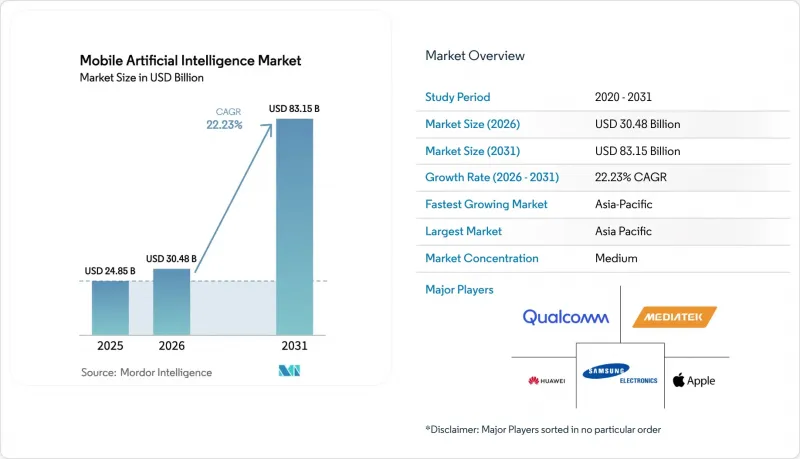
Mordor Intelligence에 의하면, 모바일 인공지능(AI) 시장 규모는 2025년 248억 5,000만 달러로 평가되었고, 2026년 304억 8,000만 달러에서 2031년에는 831억 5,000만 달러로 확대될 것으로 예측되며, 2026-2031년 CAGR 22.23%를 기록할 전망입니다.
본 보고서는 용도별(스마트폰, 카메라 등), 구성 요소별(하드웨어, 소프트웨어, 서비스), 기술별(CPU, GPU, NPU/AI 가속기, DSP), 처리 유형별(온디바이스/엣지, 클라우드 기반, 하이브리드), 최종 사용자 산업별(소비자 가전, 자동차·모빌리티 등), 지역별로 분류되어 있습니다. 시장 예측은 금액(달러) 기준으로 제시되어 있습니다.
세계의 모바일 인공지능 시장 동향 및 인사이트
AI 지원 프로세서 수요 급증
2025년에는 각 벤더사가 3억 2,000만 대 이상의 AI 지원 스마트폰을 출하할 것으로 예상되며, 구매자들은 현재 프리미엄 단말기를 CPU 클럭 속도가 아닌 NPU의 TOPS로 평가했습니다. Snapdragon 8 Elite는 3nm 공정에서 8와트의 전력 소비로 45 TOPS를 실현하여, 이전 세대에 비해 60%의 효율 향상을 달성했습니다. Apple의 A18 Pro는 16코어 뉴럴 엔진을 통해 35 TOPS를 달성하여, 30억 파라미터의 모델을 단말기 내에서 처리할 수 있게 했습니다. MediaTek의 Dimensity 9400은 레이 트레이싱 및 확산 모델 하드웨어를 단일 SoC에 통합하여 혼합 현실(MR) 작업을 지원합니다. 제품 주기의 단축으로 인해 파운드리 및 패키징 공급이 부족해지면서, 2023년부터 2024년까지의 호황기에 장기 생산 능력 계약을 체결한 기업들의 입지가 더욱 공고해지고 있습니다.
생성형 AI 탑재 스마트폰 출시
삼성의 ‘Galaxy S25’는 ‘Gemini Nano’를 통합하여 클라우드를 거치지 않고 통화 텍스트 변환을 실현함으로써 50-150밀리초의 왕복 지연 시간을 해소했습니다. 구글의 ‘픽셀 9’는 ‘매직 에디터’를 도입하여 확산 모델을 활용한 임페인팅을 3초 미만 만에 로컬에서 실행합니다. 샤오미의 ‘15 Pro’는 ‘HyperOS 2.0’을 활용하여 오프라인 멀티 앱 워크플로를 통합했습니다. 현재 단말기 간의 경쟁은 메가픽셀 수가 아닌 추론 지연 시간이나 전력 소비를 중심으로 벌어지고 있으며, 소프트웨어 생태계가 지속 가능한 경쟁 우위로 재정의되고 있습니다.
AI 칩셋의 프리미엄 가격 책정
Snapdragon 8 Elite는 OEM을 대상으로 약 160달러에 판매되고 있으며, 이는 Snapdragon 7 Gen 3보다 약 50% 높은 가격으로, 중급 단말기의 소매 가격에 80-120달러가 추가되는 수준입니다. 애플 역시 A18 Pro와 A16 사이에서 비슷한 가격 차이를 겪고 있으며, 인플레이션의 영향을 쉽게 받는 지역에서는 이익률이 압박받고 있습니다. CoWoS 및 I-Cube 패키징의 경우, 수요가 공급 능력을 초과하고 있어 다이 1개당 20-30달러의 추가 비용이 발생하고 있습니다. 높은 초기 가격으로 인해 2027년까지는 최첨단 AI가 플래그십 모델로만 한정될 것이며, 보급 속도는 둔화될 전망입니다.
부문 분석
2025년, 스마트폰은 모바일 AI 시장 규모의 41.23%를 차지했으며, 반도체 벤더에게 판매량의 원동력으로서의 역할을 입증하고 있습니다. 그러나 성숙한 시장이 포화 상태에 이르렀고, 차별화의 초점이 사용자를 더 긴 업그레이드 주기에 묶어두는 소프트웨어 생태계로 이동함에 따라 성장은 둔화되고 있습니다. 대조적으로, 산업용 로봇 분야는 물류 분야의 인력 부족이 모바일 AI 비전 및 경로 계획 모듈에 대한 투자를 촉진하고 있어 연평균 성장률(CAGR) 23.81%를 나타낼 것으로 예측됩니다.
스마트폰 판매 대수와 로봇 보급 속도의 격차가 벌어짐에 따라 포트폴리오 다각화가 진행되고 있습니다. 칩 제조업체들은 스마트폰의 규모를 활용해 연구개발비를 상각하는 동시에, 더 높은 전력 소모를 허용하는 고수익률 로봇을 타겟으로 삼을 수 있습니다. 퀄컴의 로봇용 칩 ‘RB5’와 엔비디아의 15와트 ‘Jetson Orin Nano’는 공급업체들이 모바일용 코어 IP를 자율형 기계용으로 전용하고 있는 대표적인 사례입니다.
2025년에는 하드웨어가 62.13%의 점유율을 차지했지만, 소프트웨어 라이선싱은 연평균 성장률(CAGR) 22.41%로 성장하고 있으며, 그 원동력은 반도체 이외의 분야에서 지속적인 수익을 창출하는 SDK 이용료와 모델 마켓플레이스입니다. 퀄컴의 ‘AI Hub’는 기기별 이용료를 통해 100개 이상의 최적화된 모델로 수익화를 도모하고 있으며, 애플의 ‘Core ML’은 크리에이터를 App Store의 유통 생태계에 임베디드시키고 있습니다.
노드 및 패키징 비용 증가로 인해 하드웨어 이익률이 압박받는 가운데, 각 벤더들은 개발자 생태계로부터의 지속적인 수익원을 모색하고 있습니다. 이러한 동향은 경쟁 구도를 완전히 바꾸고 있습니다. 실리콘과 OS를 모두 장악한 기업은 이중으로 가치를 창출할 수 있는 반면, 순수한 칩 설계 기업은 플랫폼 소유자와 제휴하지 않으면 상품화(commoditization)의 위험에 직면하게 됩니다.
지역별 분석
아시아태평양은 2025년에 모바일 AI 시장의 37.16% 점유율을 차지한 것으로 평가되었으며, 중국의 OEM 업체들이 수출 규제를 회피하기 위해 자체 칩셋을 설계함에 따라 연평균 성장률(CAGR) 24.12%로 성장할 전망입니다. 500억 달러가 넘는 정부계 펀드가 SMIC 및 화홍(Hua Hong)의 7nm 및 5nm 생산 라인을 지원하고 있어 TSMC에 대한 의존도를 낮추고 있습니다.
일본의 통신 사업자들은 자율주행 시범 사업을 위해 5G 엣지 AI 노드에 대한 투자를 추진하고 있는 반면, 수직 통합형 기업인 한국의 삼성은 패키징 기술의 혁신을 갤럭시 단말기에 직접 반영하고 있습니다. 인도의 PLI 보조금 제도는 폭스콘과 페가트론을 유치하여 AI 탑재 스마트폰 조립을 현지화함으로써, 인도를 중저가 단말기의 세계 저비용 생산 거점으로 자리매김하고 있습니다.
북미는 견고한 기업용 핸드헬드 단말기에 있어 여전히 수익성이 높은 시장이지만, 판매 대수는 아시아태평양에 미치지 못하는 상황입니다. 유럽에서는 엄격한 개인정보 보호법으로 인해 단말기 내 처리가 추진되고 있으나, 감사를 기다리는 바람에 신기능 도입이 지연되고 있습니다. 중동 및 아프리카에서는 스마트 시티 예산을 원동력으로 선택적인 성장이 나타나는 반면, 남미에서는 거시경제의 변동으로 인해 단말기 업그레이드가 억제되고 있습니다.
기타 혜택 :
- 엑셀 형식 시장 예측(ME) 시트
- 3개월간의 애널리스트 지원
자주 묻는 질문
목차
제1장 서론
제2장 조사 방법
제3장 주요 요약
제4장 시장 구도
제5장 시장 규모 및 성장 예측
제6장 경쟁 구도
제7장 시장 기회 및 향후 전망
AJY 26.09.07According to Mordor Intelligence, the mobile artificial intelligence market size is projected to expand from USD 24.85 billion in 2025 and USD 30.48 billion in 2026 to USD 83.15 billion by 2031, registering a CAGR of 22.23% between 2026 to 2031.

This report is Segmented by Application (Smartphone, Camera, and More), Component (Hardware, Software, and Services), Technology (CPU, GPU, NPU/AI Accelerator, and DSP), Processing Type (On-Device/Edge, Cloud-Based, and Hybrid), End-User Industry (Consumer Electronics, Automotive and Mobility, and More), and Geography. The Market Forecasts are Provided in Terms of Value (USD).
Global Mobile Artificial Intelligence Market Trends and Insights
AI-Capable Processor Demand Surge
Vendors shipped more than 320 million AI-ready phones in 2025, and buyers now judge premium devices by NPU TOPS rather than CPU clock speeds. Snapdragon 8 Elite delivers 45 TOPS at 8 watts on a 3 nm node, a 60% efficiency jump over its predecessor. Apple's A18 Pro hits 35 TOPS with a 16-core neural engine, letting a 3-billion-parameter model stay local. MediaTek's Dimensity 9400 folds ray-tracing and diffusion-model hardware into a single SoC for mixed-reality tasks. Faster product cycles are tightening foundry and packaging supply, solidifying the position of firms that signed long-term capacity contracts during the 2023-2024 boom.
Generative-AI Smartphone Launches
Samsung's Galaxy S25 integrates Gemini Nano for call transcription without the cloud, eliminating 50-150 ms round-trip latency. Google's Pixel 9 introduced Magic Editor, performing diffusion-model inpainting locally in under three seconds. Xiaomi's 15 Pro leverages HyperOS 2.0 to orchestrate multi-app workflows offline. Devices now compete on inference latency and energy draw instead of megapixel count, repositioning software ecosystems as enduring competitive moats.
Premium Pricing of AI Chipsets
Snapdragon 8 Elite sells to OEMs for about USD 160, roughly 50% above a Snapdragon 7 Gen 3, adding USD 80-120 to retail prices in mid-tier handsets. Apple faces a similar gap between A18 Pro and A16, compressing margins in inflation-sensitive regions. CoWoS and I-Cube packaging tack on another USD 20-30 per die as demand outruns capacity. High entry prices confine cutting-edge AI to flagships until 2027, slowing mass adoption.
Other drivers and restraints analyzed in the detailed report include:
- Edge-AI Chip Energy-Efficiency Gains
- Consumer Privacy and Low-Latency Need
- Thermal and Power-Budget Constraints
For complete list of drivers and restraints, kindly check the Table Of Contents.
Segment Analysis
Smartphones contributed 41.23% of the mobile artificial intelligence market size in 2025, confirming their role as the volume engine for silicon vendors. Growth is tapering, however, because mature markets are saturated and differentiation is shifting to software ecosystems that lock users in for longer upgrade cycles. Industrial robotics, by contrast, is forecast to climb at a 23.81% CAGR as labor shortages in logistics spur investment in mobile AI vision and path-planning modules.
The widening gap between smartphone volume and robotics velocity drives portfolio diversification. Chipmakers can leverage smartphone scale to amortize R&D while targeting high-margin robots that accept higher power envelopes. Qualcomm's robotics-ready RB5 and NVIDIA's 15-watt Jetson Orin Nano illustrate how suppliers repurpose mobile core IP for autonomous machines.
Hardware dominated with a 62.13% share in 2025, but software licensing is growing at a 22.41% CAGR, driven by SDK fees and model marketplaces that generate recurring revenue beyond silicon. Qualcomm's AI Hub monetizes over one hundred tuned models through per-device fees, and Apple's Core ML locks creators into the App Store's distribution economics.
As hardware margins compress under node and packaging costs, vendors seek annuity streams from developer ecosystems. This dynamic reshapes competition: firms that control both silicon and the OS can capture value twice, while pure-play chip designers must ally with platform owners or risk commoditization.
Complete Report Scope:
- By Application
- Smartphone
- Camera
- Drone
- Robotics
- Automotive
- Other Applications
- By Component
- Hardware
- Software
- Services
- By Technology
- CPU
- GPU
- NPU / AI Accelerator
- DSP
- By Processing Type
- On-Device / Edge
- Cloud-Based
- Hybrid
- By End-User Industry
- Consumer Electronics
- Automotive and Mobility
- Industrial and Manufacturing
- Healthcare and Life-Sciences
- Defense and Aerospace
- Other End-User Industries
- By Geography
- North America
- United States
- Canada
- Mexico
- South America
- Brazil
- Argentina
- Rest of South America
- Europe
- Germany
- United Kingdom
- France
- Italy
- Spain
- Rest of Europe
- Asia-Pacific
- China
- India
- Japan
- South Korea
- Australia and New Zealand
- Rest of Asia-Pacific
- Middle East
- Saudi Arabia
- United Arab Emirates
- Turkey
- Rest of Middle East
- Africa
- South Africa
- Nigeria
- Egypt
- Rest of Africa
- North America
Geography Analysis
Asia-Pacific captured 37.16% of the mobile artificial intelligence market share in 2025 and will rise at a 24.12% CAGR as Chinese OEMs design in-house chipsets to sidestep export controls. State-backed funds exceeding USD 50 billion support 7 nm and 5 nm production lines at SMIC and Hua Hong, dialing down reliance on TSMC.
Japan's carriers are investing in 5G edge AI nodes for autonomous mobility pilots, while South Korea's vertically integrated Samsung funnels packaging breakthroughs directly into Galaxy devices. India's PLI subsidies attract Foxconn and Pegatron to localize AI-phone assembly, positioning the country as the world's low-cost production hub for mid-tier devices.
North America remains lucrative for ruggedized enterprise handhelds, but unit volumes trail Asia-Pacific. Europe's strict privacy laws drive on-device processing, yet slow new feature rollouts pending audits. The Middle East and Africa grow selectively via smart city budgets, while macroeconomic volatility suppresses South American upgrades.
- Qualcomm Technologies Inc.
- Apple Inc.
- Samsung Electronics Co. Ltd.
- MediaTek Inc.
- Huawei Technologies Co. Ltd. (HiSilicon)
- Alphabet Inc. (Google)
- Nvidia Corporation
- Intel Corporation
- Microsoft Corporation
- International Business Machines Corporation
- Arm Ltd.
- OPPO
- Xiaomi Corporation
- Vivo Mobile Communication Co. Ltd.
- Honor Device Co. Ltd.
- Baidu Inc.
- Taiwan Semiconductor Manufacturing Company Limited (TSMC)
- Synopsys Inc.
- Cadence Design Systems Inc.
- Graphcore Ltd.
- Cerebras Systems Inc.
Additional Benefits:
- The market estimate (ME) sheet in Excel format
- 3 months of analyst support
TABLE OF CONTENTS
1 INTRODUCTION
- 1.1 Study Assumptions and Market Definition
- 1.2 Scope of the Study
2 RESEARCH METHODOLOGY
3 EXECUTIVE SUMMARY
4 MARKET LANDSCAPE
- 4.1 Market Overview
- 4.2 Market Drivers
- 4.2.1 AI-Capable Processor Demand Surge
- 4.2.2 Generative-AI Smartphone Launches
- 4.2.3 Edge-AI Chip Energy-Efficiency Gains
- 4.2.4 Consumer Privacy and Low-Latency Need
- 4.2.5 Memory Subsystem Breakthroughs for On-Device LLMs
- 4.2.6 Proliferation of Open-Source TinyML Model Zoos
- 4.3 Market Restraints
- 4.3.1 Premium Pricing of AI Chipsets
- 4.3.2 Thermal and Power-Budget Constraints
- 4.3.3 Regulatory Scrutiny on On-Device Data
- 4.3.4 Advanced Substrate Supply Crunch
- 4.4 Industry Value Chain Analysis
- 4.5 Regulatory Landscape
- 4.6 Technological Outlook
- 4.7 Porter's Five Forces Analysis
- 4.7.1 Bargaining Power of Buyers
- 4.7.2 Bargaining Power of Suppliers
- 4.7.3 Threat of New Entrants
- 4.7.4 Threat of Substitutes
- 4.7.5 Competitive Rivalry
5 MARKET SIZE AND GROWTH FORECASTS (VALUE)
- 5.1 By Application
- 5.1.1 Smartphone
- 5.1.2 Camera
- 5.1.3 Drone
- 5.1.4 Robotics
- 5.1.5 Automotive
- 5.1.6 Other Applications
- 5.2 By Component
- 5.2.1 Hardware
- 5.2.2 Software
- 5.2.3 Services
- 5.3 By Technology
- 5.3.1 CPU
- 5.3.2 GPU
- 5.3.3 NPU / AI Accelerator
- 5.3.4 DSP
- 5.4 By Processing Type
- 5.4.1 On-Device / Edge
- 5.4.2 Cloud-Based
- 5.4.3 Hybrid
- 5.5 By End-User Industry
- 5.5.1 Consumer Electronics
- 5.5.2 Automotive and Mobility
- 5.5.3 Industrial and Manufacturing
- 5.5.4 Healthcare and Life-Sciences
- 5.5.5 Defense and Aerospace
- 5.5.6 Other End-User Industries
- 5.6 By Geography
- 5.6.1 North America
- 5.6.1.1 United States
- 5.6.1.2 Canada
- 5.6.1.3 Mexico
- 5.6.2 South America
- 5.6.2.1 Brazil
- 5.6.2.2 Argentina
- 5.6.2.3 Rest of South America
- 5.6.3 Europe
- 5.6.3.1 Germany
- 5.6.3.2 United Kingdom
- 5.6.3.3 France
- 5.6.3.4 Italy
- 5.6.3.5 Spain
- 5.6.3.6 Rest of Europe
- 5.6.4 Asia-Pacific
- 5.6.4.1 China
- 5.6.4.2 India
- 5.6.4.3 Japan
- 5.6.4.4 South Korea
- 5.6.4.5 Australia and New Zealand
- 5.6.4.6 Rest of Asia-Pacific
- 5.6.5 Middle East
- 5.6.5.1 Saudi Arabia
- 5.6.5.2 United Arab Emirates
- 5.6.5.3 Turkey
- 5.6.5.4 Rest of Middle East
- 5.6.6 Africa
- 5.6.6.1 South Africa
- 5.6.6.2 Nigeria
- 5.6.6.3 Egypt
- 5.6.6.4 Rest of Africa
- 5.6.1 North America
6 COMPETITIVE LANDSCAPE
- 6.1 Market Concentration
- 6.2 Strategic Moves
- 6.3 Market Share Analysis
- 6.4 Company Profiles (includes Global Level Overview, Market Level Overview, Core Segments, Financials as available, Strategic Information, Market Rank/Share, Products and Services, Recent Developments)
- 6.4.1 Qualcomm Technologies Inc.
- 6.4.2 Apple Inc.
- 6.4.3 Samsung Electronics Co. Ltd.
- 6.4.4 MediaTek Inc.
- 6.4.5 Huawei Technologies Co. Ltd. (HiSilicon)
- 6.4.6 Alphabet Inc. (Google)
- 6.4.7 Nvidia Corporation
- 6.4.8 Intel Corporation
- 6.4.9 Microsoft Corporation
- 6.4.10 International Business Machines Corporation
- 6.4.11 Arm Ltd.
- 6.4.12 OPPO
- 6.4.13 Xiaomi Corporation
- 6.4.14 Vivo Mobile Communication Co. Ltd.
- 6.4.15 Honor Device Co. Ltd.
- 6.4.16 Baidu Inc.
- 6.4.17 Taiwan Semiconductor Manufacturing Company Limited (TSMC)
- 6.4.18 Synopsys Inc.
- 6.4.19 Cadence Design Systems Inc.
- 6.4.20 Graphcore Ltd.
- 6.4.21 Cerebras Systems Inc.
7 MARKET OPPORTUNITIES AND FUTURE OUTLOOK
- 7.1 White-Space and Unmet-Need Assessment