|
시장보고서
상품코드
2122909
플렉서블 일렉트로닉스 시장 : 시장 점유율 분석, 업계 동향 및 통계, 성장 예측(2026-2031년)Flexible Electronics - Market Share Analysis, Industry Trends & Statistics, Growth Forecasts (2026 - 2031) |
||||||
 Mordor Intelligence
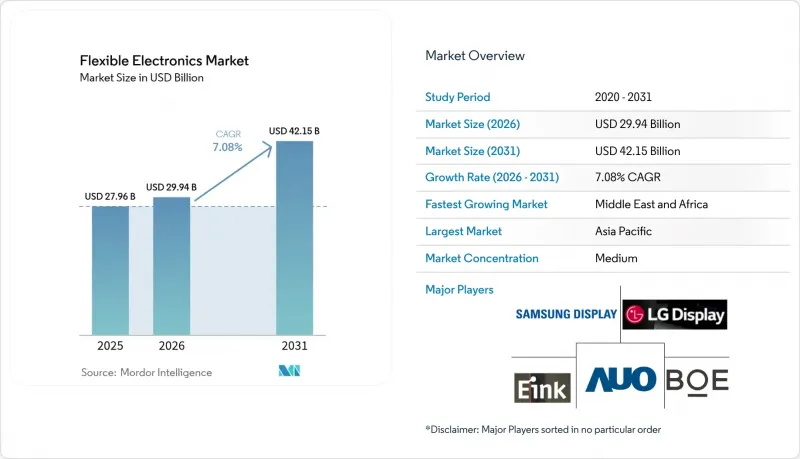
Mordor Intelligence에 의하면, 2026년 플렉서블 일렉트로닉스 시장 규모는 299억 4,000만 달러로 추정되고, 2025년 279억 6,000만 달러에서 확대해, 2031년에는 421억 5,000만 달러에 이를 것으로 예측됩니다.
2026-2031년 연평균 성장률(CAGR)은 7.08%를 나타낼 전망입니다.
본 보고서는 구성 요소별(플렉서블 디스플레이, 플렉서블 센서 등), 소재별(플라스틱 기판, 유리 등), 기술별(인쇄 전자, 유기 일렉트로닉스 등), 용도별(센싱, 조명, 디스플레이 등), 최종 사용자 산업별(소비자 가전, 자동차 및 운송 장비 등) 및 지역별로 분류되어 있습니다. 시장 예측은 금액(달러) 기준으로 제시되어 있습니다.
세계의 플렉서블 전자 시장 동향 및 인사이트
초박형 OLED 스택의 내구성 향상으로 폴더블 스마트폰 구현 가능해짐
삼성디스플레이의 ‘Flex Magic Pixel’ 데모 기기는 군용 등급의 내구성 테스트를 통과했으며, 눈에 띄는 주름도 없어져 견고한 접이식 스크린에 대한 사용자의 기대에 부응하고 있습니다. 애플이 2026년에 7.8인치 패널 900만-1,500만 장을 발주한 것은 상용화 준비가 완료되었음을 뒷받침하며, 대량 채택의 조짐을 보여주고 있습니다. 2026년 노트북용 패널의 30% 경량화와 30% 전력 절감으로 인해, 대상 기기의 범위는 스마트폰을 넘어 확대되고 있습니다. 각 OEM 업체들이 태블릿과 노트북을 구부릴 수 있는 형태로 전환함에 따라, 이러한 진전은 플렉서블 전자 제품 시장 전체로 파급되고 있으며, 고차단성 캡슐화 및 초박형 유리에 대한 공급망 수요를 뒷받침하고 있습니다.
북미 전역의 웨어러블 의료용 패치용 컨포멀 센서에 대한 수요
X-trodes사의 ‘Smart Skin’과 캘리포니아 대학교 샌디에이고 캠퍼스의 1,024채널 뇌 센서 어레이가 FDA 승인을 획득함에 따라, 지속적인 모니터링을 목적으로 하는 플렉서블 바이오 센서의 타당성이 인정받았습니다. 의료 제도의 보상 모델은 치료 성과에 기반한 치료로 전환되고 있으며, 환자의 경과 데이터를 수집할 수 있는 기기가 중요시되고 있습니다. 플렉서블 기판은 동작으로 인한 아티팩트를 줄이고, 일상 활동 중 신호의 무결성을 유지합니다. 기기 제조업체들은 센서 내 컴퓨팅에 유기 전기화학 트랜지스터를 채택함으로써 지연을 최소화하고 환자의 프라이버시를 보호하고 있습니다. 원격 모니터링이 보험 환급 코드에 명시됨에 따라, 플렉서블 전자 시장도 센서 및 패치의 정기적인 교체를 통해 혜택을 보고 있습니다.
신축성 상호 연결의 신뢰성 시험에 대한 표준화 부족
경질 전자 기기 규격은 웨어러블 기기 사용 시 발생하는 굽힘, 비틀림 및 온도 사이클의 동시 발생을 적절하게 평가하지 못하고 있습니다. IEEE 초안인 ‘방광 팽창법’은 다축 신장을 측정하지만, 여전히 임의의 규격에 그치고 있어 인증된 수명 데이터가 필요한 자동차 및 의료 분야의 OEM 제조업체들의 진입을 저해하고 있습니다. 연구자들은 변형 하에서 기판의 균열을 억제하기 위한 폴리머 중간층 설계를 제안하고 있지만, 합의된 평가 지표가 없어 투자자들은 대량 생산용 금형에 대한 자금 지원을 주저하고 있습니다. 따라서 통일된 프로토콜이 확립될 때까지 플렉서블 전자 제품 시장에서는 설계가 실제 적용되기까지의 주기가 길어질 것으로 예측됩니다.
부문 분석
2025년, 플렉서블 디스플레이는 플렉서블 전자 제품 시장 점유율의 54.12%를 차지했습니다. 이는 폴더블 스마트폰의 지속적인 출시와 곡면이 적용된 자동차 대시보드의 보급에 힘입은 결과입니다. 삼성의 18.1인치 접이식 프로토타입은 노트북에 적용할 수 있음을 입증한 반면, LG의 신축성 있는 마이크로 LED 패널은 패션 및 차량용 조명 분야에서 3D 표면을 구현할 수 있게 해줍니다. 디스플레이를 보완하는 센서 분야는 병원들이 만성 질환 관리를 위해 표피형 심전도(ECG) 및 뇌파(EEG) 패치를 도입함에 따라, 2026-2031년 연평균 성장률(CAGR) 8.78%를 나타낼 것으로 전망됩니다. 1.5배의 신장력을 견디는 양자점 디스플레이·센서 하이브리드는 데이터를 표시하는 동시에 감지 기능도 수행하는 다기능 표면의 도래를 알리고 있으며, 센서는 차기 성장 동력으로 자리매김하고 있습니다. 일부 진전이 보이지만, 플렉서블 배터리 및 메모리는 안전성 및 수율 문제로 인해 뒤처지고 있어, 현재로서는 완전히 통합된 플렉서블 시스템의 보급을 제한하고 있습니다.
플렉서블 전자기기 시장에서는 패널 제조업체들이 투명 OLED 스택을 활용하여 지문 인식 및 SpO2 측정 기능을 화면 바로 아래에 내장함으로써 부품 수를 줄이고 기기의 두께를 얇게 만드는 추세가 진행되고 있습니다. 바이오 센싱 기능을 통합한 디스플레이는 차별화를 꾀하는 스마트폰 제조업체들에게 새로운 수익 창출의 길을 열어줍니다. 진동을 마이크로와트 단위의 전력으로 변환하는 에너지 수확 필름은 웨어러블 기기나 산업용 태그의 배터리 부하를 경감시키지만, 그 상용화를 위해서는 고성능 압전 폴리머의 안정적인 공급이 필요합니다. 부품 간의 시너지 효과가 성숙해짐에 따라, 기기 설계자는 시각, 촉각, 센싱 기능을 융합한 매끄러운 폼 팩터를 설계할 수 있게 될 것입니다.
2025년에는 디스플레이 제조 공장과 연계된 성숙한 폴리이미드 공급망에 힘입어, 플렉서블 전자 제품 시장 규모의 61.10%를 플라스틱 기판이 차지했습니다. 400°C까지의 내열성은 구리 배선과 호환성이 뛰어나, 온도 변동이 심한 자동차 대시보드에서도 박리 현상을 최소화할 수 있습니다. 주로 구리와 스테인리스 스틸으로 구성된 금속 호일은 방위용 무선기나 고속 데이터 케이블에서 높이 평가받는 고유한 전도성과 EMI 차폐 효과 덕분에 연평균 성장률(CAGR) 8.11%로 성장을 지속하고 있습니다. 그래핀 코팅 구리 나노와이어는 인듐 주석 산화물(ITO)보다 낮은 시트 저항을 실현하면서도 유연성을 유지하고 있어, 롤 투 롤 방식의 터치 센서로 주목받고 있습니다.
초박형 유리는 완벽한 광학 성능과 내 스크래치성이 요구되는 고급 폴더블 기기에서 주목받고 있습니다. 코닝사의 최신 유리는 두께가 불과 30µm에 불과하며, 폴리머보다 비싸긴 하지만 5mm의 곡률 반경까지 구부려도 파손되지 않습니다. 듀폰이 2024년에 C3Nano를 인수하면서 가속화된 은 나노와이어 잉크의 기술 발전으로 인해 스마트 윈도우의 투명성과 기계적 내구성이 향상되고 있습니다. 탄소계 전도성 잉크는 희귀한 인듐이나 유독한 용제를 사용하지 않아 ESG 요건을 충족하므로, 파사드에 통합된 플렉서블 태양전지 제조업체에게 매력적입니다. 규제 당국이 전자 폐기물을 엄격히 감독하는 가운데, 소재 선정에 있어서는 비용, 성능, 재활용성의 균형이 중요시되고 있습니다.
지역별 분석
2025년, 아시아태평양은 플렉서블 전자 제품 시장 점유율의 45.30%를 차지했으며, 중국의 제조 규모와 한국의 OLED 기술 혁신 파이프라인이 이를 뒷받침했습니다. 청두에 건설된 BOE의 90억 달러 규모 Gen-8.6 AMOLED 공장(이 도시 최대의 단일 산업 투자)은 태블릿 및 자동차 콕핏용 패널의 생산 능력을 확대되고 있습니다. 한국의 연구 기관은 압전식 에너지 하베스터의 출력을 280배 높임으로써 디스플레이, 센서, 에너지 디바이스 분야에서 이 지역의 리더십을 돋보이게 하고 있습니다. 일본은 폴더블 스마트폰의 신뢰성을 뒷받침하는 정밀 증착 장비와 초박형 유리를 제공합니다.
북미는 고부가가치 의료·방위 분야에 주력하고 있으며, 플렉서블 바이오센서에 대한 FDA 승인 및 전장용 안테나 어레이에 대한 미국 국방부의 자금 지원을 활용하고 있습니다. 삼성이 2억 4,000만 달러를 투자한 요코하마의 패키징 연구개발 거점은 아시아공급업체가 미국 시스템 통합사업자 근처에 거점을 마련하는 등 국경을 초월한 협력을 두드러지게 하고 있습니다. 실리콘밸리의 스타트업 기업들은 플렉서블 IC 설계 자동화를 선도하며, 일회용 진단 기기에 사용되는 프린트 로직의 테이프아웃 주기를 단축하고 있습니다.
유럽에서는 자동차의 디지털화와 지속가능성이 우선시되고 있습니다. 독일의 자동차 제조업체들은 2028년까지 홀로그래픽 HUD 탑재를 의무화하고 있어, 강한 눈부심 및 내충격 기준을 충족하는 굽힘 가능한 디스플레이에 대한 수요를 견인하고 있습니다. 건축 일체형 태양광 발전에 관한 EU 지침에 따라, 파사드에 내장된 플렉서블 PV 스킨의 실증 실험이 촉진되고 있습니다. 동시에, 엄격한 전자 폐기물 규제로 인해 재활용성이 요구되면서 생분해성 기판에 대한 연구가 가속화되고 있습니다.
중동 및 아프리카은 국방력 현대화 및 스마트 시티 계획의 일환으로, 무게에 민감한 드론이나 혹독한 기후 조건에서 작동하는 센서에 컨포멀 일렉트로닉스가 채택됨에 따라 11.05%라는 가장 높은 연평균 성장률(CAGR)을 기록하고 있습니다. 각국 정부는 5G 및 엣지 네트워크 도입을 가속화하고 있어, 모래와 열에 내성이 있는 플렉서블 안테나에 대한 수요를 창출하고 있습니다. 이 지역의 대학들은 Off-grid IoT 노드에 전력을 공급하기 위한 유기 PV에 대해 유럽의 연구 기관과 협력하고 있어, 응용 범위의 다양화가 진행되고 있습니다.
기타 혜택 :
- 엑셀 형식 시장 전망(ME) 시트
- 3개월간의 애널리스트 지원
자주 묻는 질문
목차
제1장 서론
제2장 조사 방법
제3장 주요 요약
제4장 시장 구도
제5장 시장 규모 및 성장 예측
제6장 경쟁 구도
제7장 시장 기회 및 향후 전망
AJY 26.09.07According to Mordor Intelligence, the flexible electronics market size in 2026 is estimated at USD 29.94 billion, growing from 2025 value of USD 27.96 billion with 2031 projections showing USD 42.15 billion, growing at 7.08% CAGR over 2026-2031.
This report is Segmented by Component (Flexible Displays, Flexible Sensors, and More), Material (Plastic Substrate, Glass, and More), Technology (Printed Electronics, Organic Electronics, and More), Application (Sensing, Lighting, Display, and More), End-User Industry (Consumer Electronics, Automotive and Transportation, and More), and Geography. The Market Forecasts are Provided in Terms of Value (USD).
Global Flexible Electronics Market Trends and Insights
Improved durability of ultra-thin OLED stacks enabling foldable smartphones
Samsung Display's Flex Magic Pixel demonstrator passed military-grade durability tests, eliminating visible creases and meeting user expectations for robust folding screens. Apple's 2026 foldable iPhone order for 9-15 million 7.8-inch panels validates commercial readiness and signals mass adoption. Weight reductions of 30% and power savings of 30% in 2026 laptop panels widen the addressable device pool beyond phones. These advances resonate across the flexible electronics market as OEMs migrate tablets and laptops toward bendable formats, reinforcing supply-chain demand for high-barrier encapsulation and ultra-thin glass.
Demand for conformal sensors in wearable medical patches across North America
FDA clearance for X-trodes' Smart Skin and UC San Diego's 1,024-channel brain sensor array legitimizes flexible biosensors for continuous monitoring. Health-system reimbursement models pivot toward outcome-based care, favoring devices that capture longitudinal patient data. Flexible substrates reduce motion artifacts, maintaining signal integrity during everyday activities. Device makers tap organic electrochemical transistors for in-sensor computing, minimizing latency and protecting patient privacy. As reimbursement codes codify remote monitoring, the flexible electronics market benefits from recurrent sensor and patch replacements.
Limited standardization of stretchable interconnect reliability tests
Rigid-electronics standards fail to capture simultaneous bending, twisting, and temperature cycling seen in wearable use. IEEE's draft bladder-inflation method measures multi-axis stretch but remains voluntary, deterring automotive and medical OEMs that require certified lifetime data. Researchers propose polymer interlayer designs to curb substrate cracking under strain, yet without consensus metrics investors hesitate to fund high-volume tooling. The flexible electronics market thus faces slower design-win cycles until unified protocols emerge.
Other drivers and restraints analyzed in the detailed report include:
- Automotive cockpit digitization driving curved HUD adoption in Europe
- Roll-to-roll manufacturing cost reduction in Asia for printed ICs
- Yield Losses in Large-area Printing of Metallic Inks
For complete list of drivers and restraints, kindly check the Table Of Contents.
Segment Analysis
Flexible displays accounted for 54.12% of flexible electronics market share in 2025, powered by relentless foldable smartphone launches and curved automotive dashboards. Samsung's 18.1-inch foldable prototype proves scalability into laptops, while LG's stretchable micro-LED panel unlocks 3D surfaces in fashion and in-vehicle lighting. Complementing displays, the sensor category yields a 8.78% CAGR over 2026-2031 as hospitals adopt epidermal ECG and EEG patches for chronic care. Quantum-dot display-sensor hybrids that tolerate 1.5X stretching herald multifunctional surfaces that both show and sense data, positioning sensors as the next growth catalyst. Despite progress, flexible batteries and memory lag due to safety and yield hurdles, limiting fully integrated flexible systems today.
The flexible electronics market benefits from panel makers leveraging transparent OLED stacks to embed fingerprint and SpO2 reading directly under the screen, condensing component count and thinning device profiles. Integrated biosensing displays open new monetization avenues for smartphone vendors seeking differentiation. Energy-harvesting films that convert vibration into micro-watts reduce battery load in wearables and industrial tags, though commercialization awaits stable supply of high-performance piezoelectric polymers. As cross-component synergies mature, device architects can design seamless form factors that merge visual, haptic, and sensing capabilities.
Plastic substrates represented 61.10% of flexible electronics market size in 2025, driven by mature polyimide supply chains aligned with display fabs. Their thermal stability up to 400 °C pairs well with copper traces, minimizing delamination in automotive dashboards exposed to wide temperature swings. Metal foils, chiefly copper and stainless steel, post an 8.11% CAGR thanks to innate conductivity and EMI shielding valued in defense radios and high-speed data cables. Graphene-coated copper nanowires offer lower sheet resistance than indium-tin-oxide while retaining flexibility, attracting interest for roll-to-roll touch sensors.
Ultra-thin glass gains traction in premium foldable devices requiring pristine optics and scratch resistance. At just 30 µm, Corning's latest glass can bend to 5 mm radius without fracture, albeit at a higher price point than polymer. Silver-nanowire ink advances, accelerated by DuPont's 2024 C3Nano asset purchase, improve transparency and mechanical resilience for smart windows. Carbon-based conductive inks address ESG mandates by eliminating scarce indium and toxic solvents, appealing to builders of flexible photovoltaics integrated into facades. Material selection now balances cost, performance, and recyclability as regulators scrutinize electronic waste.
Complete Report Scope:
- By Component
- Flexible Displays
- OLED
- E-Paper
- Others
- Flexible Sensors
- Biosensors
- Pressure Sensors
- Temperature Sensors
- Others
- Flexible Batteries
- Flexible Memory
- Flexible Photovoltaics
- Others
- Flexible Displays
- By Material
- Plastic Substrate
- Glass (Ultra-thin)
- Metal Foils
- Conductive Inks
- Dielectrics/Encapsulation
- By Technology
- Printed Electronics
- Organic Electronics
- Thin-Film Inorganic Electronics
- Hybrid Systems
- By Application
- Sensing
- Lighting
- Display
- Energy Harvesting
- RFID and Smart Labels
- Others
- By End-User Industry
- Consumer Electronics
- Automotive and Transportation
- Healthcare and Medical Devices
- Military and Defense
- Industrial and IoT
- Others
- By Geography
- North America
- United States
- Canada
- Mexico
- Europe
- Germany
- United Kingdom
- France
- Nordics
- Rest of Europe
- South America
- Brazil
- Rest of South America
- Asia-Pacific
- China
- Japan
- India
- South-East Asia
- Rest of Asia-Pacific
- Middle East and Africa
- Middle East
- Gulf Cooperation Council Countries
- Turkey
- Rest of Middle East
- Africa
- South Africa
- Rest of Africa
- Middle East
- North America
Geography Analysis
Asia-Pacific commanded 45.30% of flexible electronics market share in 2025, anchored by China's manufacturing scale and Korea's OLED innovation pipeline. BOE's USD 9 billion Gen-8.6 AMOLED fab in Chengdu-the city's largest single industrial investment-expands panel capacity for tablets and automotive cockpits. Korean institutes pushed piezoelectric harvester output 280X, underscoring regional leadership across displays, sensors, and energy devices. Japan contributes precision deposition tools and ultra-thin glass that support foldable handset reliability.
North America focuses on high-value healthcare and defense niches, leveraging FDA clearances for flexible biosensors and Pentagon funding for battlefield antenna arrays. Samsung's USD 240 million Yokohama packaging R&D hub highlights cross-border collaboration, as Asian suppliers co-locate near U.S. system integrators. Silicon Valley startups pioneer flexible IC design automation, shortening tape-out cycles for printed logic that feeds disposable diagnostics.
Europe prioritizes automotive digitization and sustainability. German OEMs mandate holographic HUD integration by 2028, driving demand for bendable displays meeting stringent glare and impact standards. EU directives on building-integrated photovoltaics spur trials of facade-embedded flexible PV skins. Simultaneously, strict e-waste rules push recyclability, accelerating research into biodegradable substrates.
Middle East and Africa posts the highest 11.05% CAGR as defense modernization and smart-city programs embrace conformal electronics for weight-sensitive drones and harsh-climate sensors. Governments fast-track 5G and edge networks, creating pull for flexible antennas resistant to sand and heat. Regional universities partner with European labs on organic PV to power off-grid IoT nodes, broadening application diversity.
- Samsung Display Co. Ltd
- LG Display Co. Ltd
- BOE Technology Group Co. Ltd
- AU Optronics Corp.
- Royole Corporation
- E Ink Holdings Inc.
- OLEDWorks LLC
- FlexEnable Ltd
- PragmatIC Semiconductor Ltd
- Imprint Energy Inc.
- Blue Spark Technologies Inc.
- Flexpoint Sensor Systems Inc.
- Universal Display Corporation
- Kyocera Corporation
- Panasonic Holdings Corp.
- Sony Group Corp.
- Polyera Corporation
- Cambrios Advanced Materials Corp.
- Heliatek GmbH
- First Solar Inc. (Flex PV Division)
Additional Benefits:
- The market estimate (ME) sheet in Excel format
- 3 months of analyst support
TABLE OF CONTENTS
1 INTRODUCTION
- 1.1 Study Assumptions and Market Definition
- 1.2 Scope of the Study
2 RESEARCH METHODOLOGY
3 EXECUTIVE SUMMARY
4 MARKET LANDSCAPE
- 4.1 Market Overview
- 4.2 Market Drivers
- 4.2.1 Improved Durability of Ultra-thin OLED Stacks Enabling Foldable Smartphones
- 4.2.2 Demand for Conformal Sensors in Wearable Medical Patches across North America
- 4.2.3 Automotive Cockpit Digitization Driving Curved HUD Adoption in Europe
- 4.2.4 Roll-to-Roll Manufacturing Cost Reduction in Asia for Printed ICs
- 4.2.5 Defense Push for Lightweight, Conformal Antennas in Middle East UAVs
- 4.2.6 ESG-Led Push toward Flexible PV Skins on Commercial Buildings
- 4.3 Market Restraints
- 4.3.1 Yield Losses in Large-area Printing of Metallic Inks
- 4.3.2 Limited Standardization of Stretchable Interconnect Reliability Tests
- 4.3.3 Supply-chain Concentration of High-barrier Encapsulation Films
- 4.3.4 Disposal and Recycling Complexities of Poly-imide Substrates
- 4.4 Industry Value Chain Analysis
- 4.5 Technological Outlook
- 4.6 Porter's Five Forces Analysis
- 4.6.1 Bargaining Power of Suppliers
- 4.6.2 Bargaining Power of Buyers
- 4.6.3 Threat of New Entrants
- 4.6.4 Threat of Substitutes
- 4.6.5 Intensity of Competitive Rivalry
- 4.7 Investment Analysis
5 MARKET SIZE AND GROWTH FORECASTS (VALUES)
- 5.1 By Component
- 5.1.1 Flexible Displays
- 5.1.1.1 OLED
- 5.1.1.2 E-Paper
- 5.1.1.3 Others
- 5.1.2 Flexible Sensors
- 5.1.2.1 Biosensors
- 5.1.2.2 Pressure Sensors
- 5.1.2.3 Temperature Sensors
- 5.1.2.4 Others
- 5.1.3 Flexible Batteries
- 5.1.4 Flexible Memory
- 5.1.5 Flexible Photovoltaics
- 5.1.6 Others
- 5.1.1 Flexible Displays
- 5.2 By Material
- 5.2.1 Plastic Substrate
- 5.2.2 Glass (Ultra-thin)
- 5.2.3 Metal Foils
- 5.2.4 Conductive Inks
- 5.2.5 Dielectrics/Encapsulation
- 5.3 By Technology
- 5.3.1 Printed Electronics
- 5.3.2 Organic Electronics
- 5.3.3 Thin-Film Inorganic Electronics
- 5.3.4 Hybrid Systems
- 5.4 By Application
- 5.4.1 Sensing
- 5.4.2 Lighting
- 5.4.3 Display
- 5.4.4 Energy Harvesting
- 5.4.5 RFID and Smart Labels
- 5.4.6 Others
- 5.5 By End-User Industry
- 5.5.1 Consumer Electronics
- 5.5.2 Automotive and Transportation
- 5.5.3 Healthcare and Medical Devices
- 5.5.4 Military and Defense
- 5.5.5 Industrial and IoT
- 5.5.6 Others
- 5.6 By Geography
- 5.6.1 North America
- 5.6.1.1 United States
- 5.6.1.2 Canada
- 5.6.1.3 Mexico
- 5.6.2 Europe
- 5.6.2.1 Germany
- 5.6.2.2 United Kingdom
- 5.6.2.3 France
- 5.6.2.4 Nordics
- 5.6.2.5 Rest of Europe
- 5.6.3 South America
- 5.6.3.1 Brazil
- 5.6.3.2 Rest of South America
- 5.6.4 Asia-Pacific
- 5.6.4.1 China
- 5.6.4.2 Japan
- 5.6.4.3 India
- 5.6.4.4 South-East Asia
- 5.6.4.5 Rest of Asia-Pacific
- 5.6.5 Middle East and Africa
- 5.6.5.1 Middle East
- 5.6.5.1.1 Gulf Cooperation Council Countries
- 5.6.5.1.2 Turkey
- 5.6.5.1.3 Rest of Middle East
- 5.6.5.2 Africa
- 5.6.5.2.1 South Africa
- 5.6.5.2.2 Rest of Africa
- 5.6.5.1 Middle East
- 5.6.1 North America
6 COMPETITIVE LANDSCAPE
- 6.1 Market Concentration
- 6.2 Strategic Moves
- 6.3 Market Share Analysis
- 6.4 Company Profiles (includes Global Level Overview, Market Level Overview, Core Segments, Financials as available, Strategic Information, Market Rank/Share for key companies, Products and Services, and Recent Developments)
- 6.4.1 Samsung Display Co. Ltd
- 6.4.2 LG Display Co. Ltd
- 6.4.3 BOE Technology Group Co. Ltd
- 6.4.4 AU Optronics Corp.
- 6.4.5 Royole Corporation
- 6.4.6 E Ink Holdings Inc.
- 6.4.7 OLEDWorks LLC
- 6.4.8 FlexEnable Ltd
- 6.4.9 PragmatIC Semiconductor Ltd
- 6.4.10 Imprint Energy Inc.
- 6.4.11 Blue Spark Technologies Inc.
- 6.4.12 Flexpoint Sensor Systems Inc.
- 6.4.13 Universal Display Corporation
- 6.4.14 Kyocera Corporation
- 6.4.15 Panasonic Holdings Corp.
- 6.4.16 Sony Group Corp.
- 6.4.17 Polyera Corporation
- 6.4.18 Cambrios Advanced Materials Corp.
- 6.4.19 Heliatek GmbH
- 6.4.20 First Solar Inc. (Flex PV Division)
7 MARKET OPPORTUNITIES AND FUTURE OUTLOOK
- 7.1 White-space and Unmet-Need Assessment