

|
시장보고서
상품코드
2122930
야금 코크스 : 시장 점유율 분석, 업계 동향 및 통계, 성장 예측(2026-2031년)Metallurgical Coke - Market Share Analysis, Industry Trends & Statistics, Growth Forecasts (2026 - 2031) |
||||||
 Mordor Intelligence
에 의하면, 야금 코크스 시장 규모는 2025년 5억 4,578만 톤으로 평가되었습니다. 2026년에는 5억 6,385만 톤으로 확대되어 2026-2031년에 걸쳐 CAGR 3.67%로 성장을 지속하여, 2031년에는 6억 7,519만 톤에 이를 것으로 예측됩니다.

본 보고서는 코크스 유형(고로 코크스, 기타), 등급(저회분(회분 8-12%), 고회분(회분 15% 이상)), 용도(철강 제조, 기타), 최종 사용자 산업(종합 제철 제조업체, 주조소, 기타),지역(아시아태평양, 북미, 유럽, 남미, 중동 및 아프리카)별로 분류되어 있습니다. 시장 예측은 수량(톤) 기준으로 제시되어 있습니다.
세계의 야금 코크스 시장 동향 및 인사이트
공공 인프라 분야의 철강 수요 증가
아시아태평양 및 중동 각국 정부는 철근과 강판이 필요한 고속도로, 지하철, 재생에너지 송전망에 전례 없는 규모의 예산을 배정하고 있으며, 이들 모두는 야금 코크스를 사용하는 고로 공정에 의존하고 있습니다. 인도의 1조 4,000억 달러 규모의 ‘국가 인프라 계획’에서는 그 4분의 1 가까이가 교통 프로젝트에 배정되어 있으며, 이는 조강 1톤당 약 0.8톤의 코크스 수요에 해당합니다. 사우디아라비아의 NEOM 및 관련 메가 프로젝트로 인해, 해당 국가의 철강 수요는 2028년까지 1,200만 톤에 달할 것으로 예측되며, 이에 따라 지역 제철소들은 수년에 걸친 코크스 조달 계약을 유지하게 될 것입니다. 베트남의 남북 고속도로도 추가 수요를 견인하고 있으며, 호아팟 그룹은 2027년까지 150만 톤의 코크스 수요 증가를 예상하여 새로운 고로 설치를 추진하고 있습니다. 이를 종합해 보면, 이러한 계획들이 야금 코크스 시장 수요 증가 추세를 뒷받침하고 있습니다.
자동차 생산 능력 확대
2025년, 중국, 인도, 태국에서는 경차 생산 대수가 회복되었지만, 자동차 제조업체들이 얇은 두께의 고장력강과 알루미늄을 채택함에 따라 차량 1대당 철강 사용량은 감소했습니다. 중국에서는 2025년에 3,020만 대의 자동차가 조립되어 2024년 대비 4% 증가했으나, 대당 평균 철강 사용량은 820kg으로 감소했습니다. 인도의 경우, 고로 점유율을 고려할 때 자동차 생산이 100만 대 증가할 때마다 여전히 18만 톤의 코크스 수요가 예상되며, 전기로(EAF)가 점차 확산되고 있음에도 불구하고 야금 코크스 산업 수요를 뒷받침하고 있습니다. 태국에서 전기차(EV)가 확대됨에 따라 지역 공급업체로부터의 전기로강 조달이 증가하고 있으며, 이는 자동차의 전동화가 궁극적으로 동남아시아의 코크스 성장률에 상한선을 가져올 것임을 시사합니다.
야금 코크스 가격 변동
2024년부터 2025년에 걸쳐 사이클론 ‘재스퍼’가 퀸즐랜드주의 철도 운송을 마비시킨 여파로, 하드 코크스용 석탄의 현물 가격은 톤당 210-340달러 사이에서 변동하며, EBITDA 평균 6-8%의 이익률을 자랑하는 상업용 코크스 생산 업체들의 마진을 압박했습니다. 2025년에 5,400만 톤의 코크스용 석탄을 수입한 인도는 그 중 85%가 호주산 수입품이기 때문에 특히 영향을 받기 쉬운 상황에 놓여 있었습니다. 다롄 상품 거래소의 선물 헤지를 통해 일부는 완화되겠지만, 실물 등급 간의 격차로 인해 기초 위험이 남아 있습니다.
부문별 분석
2025년, 고로용 코크스는 전 세계 총량의 64.27%를 차지하며, 현대식 1,500°C 고로 내에서 환원제 및 구조적 지지대로서 필수적인 역할을 했습니다. 주조용 코크스는 큐폴라의 통기성을 높이는 10-25mm 크기의 입자를 파운드리에서 요구하고 있기 때문에 연평균 성장률(CAGR) 4.25%로 가장 빠르게 성장하고 있습니다. 주조용 코크스는 CSR 60% 이상 및 황분 0.6% 이하를 요구하는 회주철 및 연성주철 공장에 공급됨으로써 틈새 시장으로서의 입지를 유지하고 있습니다. 제철소가 소결광에서 플럭스가 첨가된 펠릿으로 전환함에 따라 코크스 브리즈의 사용은 정체되어 있으며, 야금 코크스 시장의 저부가가치 말단 부문이 축소되고 있습니다.
중국의 대형 일체형 제철소는 5,000m3 용광로에서 15bar를 초과하는 샤프트 압력을 견디기 위해 계속해서 높은 CSR(65% 이상)을 가진 용광로용 코크스를 지정하고 있습니다. CDQ의 도입으로 강도가 3-5% 포인트 향상되어, 석탄 가격 변동 속에서도 생산자는 프리미엄 가격을 확보할 수 있게 됩니다. 예측 기간 동안, 너트 코크스 수요는 고로용 코크스 수요 증가율을 상회하겠지만, 절대적인 취급량은 후자가 더 많아 고로용 코크스가 야금 코크스 시장의 주력으로서의 입지를 공고히할 것으로 보입니다.
저회분(8-12%) 코크스는 2025년에 70.80%의 점유율을 차지했으며, 연간 4.59%의 성장이 전망되어 고회분 대체품을 크게 앞지를 것으로 보입니다. 회분 함량이 1% 포인트 낮아질 때마다 용선 1톤당 슬래그가 15kg 감소하여, 석회석 및 내화물 비용을 절감할 수 있습니다. 그 결과, 인도와 중국에서 4,500m³를 초과하는 고로를 가동하는 제철소들은 저회분 코크스 생산을 확보하기 위해 고품질 석탄 혼합에 대한 다년 공급 계약을 체결하고 있으며, 야금 코크스 시장에서 품질 중심의 부문이 확립되고 있습니다. 한편, 일반적으로 15%를 초과하는 고회분 코크스는 구형 고로 및 비철금속 제련소로 그 용도가 제한되어 있습니다.
2025년에는 중국 내 고배출량 비하이브 용광로에 대한 단속으로 인해 한계 공급이 압박받으면서, 가격 차이는 톤당 35-40달러로 확대되었습니다. ISO 18894 : 2024에서는 현재 알칼리 함량이 측정 대상으로 지정되어, 나트륨과 칼륨을 0.3% 이하로 보장할 수 있는 저회분 생산자에게 유리한 새로운 요소가 추가되었습니다. 이러한 품질 기준은 야금 코크스 시장의 구조적 프리미엄을 더욱 공고히 하고 있습니다.
지역별 분석
아시아태평양은 2025년에 생산량의 69.70%를 차지했으며, 중국의 4억 8,000만 톤 코크스 생산과 인도의 급속한 철강 생산 능력 확대로 인해 2031년까지 연평균 성장률(CAGR) 4.16%를 유지할 것으로 예측됩니다. 중국 생태환경부는 2025년에 규제 기준을 충족하지 못하는 1,500만 톤의 생산 능력을 폐쇄하고, 배출량이 적은 CDQ(코크스 품질 관리) 설비를 갖춘 대규모 국영 기업으로 공급을 전환했습니다. 인도는 자국 내 코크스로 생산 능력을 4,500만 톤으로 확대했으나, 여전히 5,400만 톤의 코크스용 석탄을 수입에 의존하고 있어 야금 코크스 시장에서의 국경 간 거래가 정착되어 있습니다.
2025년 북미의 생산량은 SunCoke의 일반용 코크스 공장과 통합 제철소 사이에 분산되어 있었으나, 미국 Steel이 전기로(EAF) 생산 방식을 우선시하며 구식 고로를 가동 중단함에 따라 코크스 수요는 점차 둔화되고 있습니다. 캐나다 유일의 Dofasco 코크스로는 탄소세 인상에 직면해 있으며, 이로 인해 전기화가 가속화될 가능성이 있어 2031년까지 지역 야금 코크스 시장에서 수요 점유율이 축소될 우려가 있습니다.
유럽에서는 벤젠 규제 강화에 따라 2025년에 생산량이 감소했습니다. 아르셀로미탈이 크라쿠프 설비를 전기로(EAF)로 전환하고, 티센크루프가 수소 주입 시험을 진행 중이므로, 2035년까지 유럽 수요는 더욱 감소할 가능성이 있습니다. 남미는 안정적인 상태를 유지하고 있지만, 중동 및 아프리카는 사우디아라비아와 이집트의 제철소가 생산 능력을 확대함에 따라 수요가 증가할 가능성이 있습니다. 다만, 야금 코크스 시장을 통한 수입 의존도는 여전히 높은 상태입니다.
기타 혜택
- 엑셀 형식 시장 예측(ME) 시트
- 3개월간의 애널리스트 지원
자주 묻는 질문
목차
제1장 서론
제2장 조사 방법
제3장 주요 요약
제4장 시장 구도
제5장 시장 규모 및 성장 예측(수량)
제6장 경쟁 구도
제7장 시장 기회 및 향후 전망
KTH 26.09.08According to Mordor Intelligence, the metallurgical coke market size is expected to grow from 545.78 Million tons in 2025 to 563.85 Million tons in 2026 and is forecast to reach 675.19 Million tons by 2031 at a 3.67% CAGR over 2026-2031.
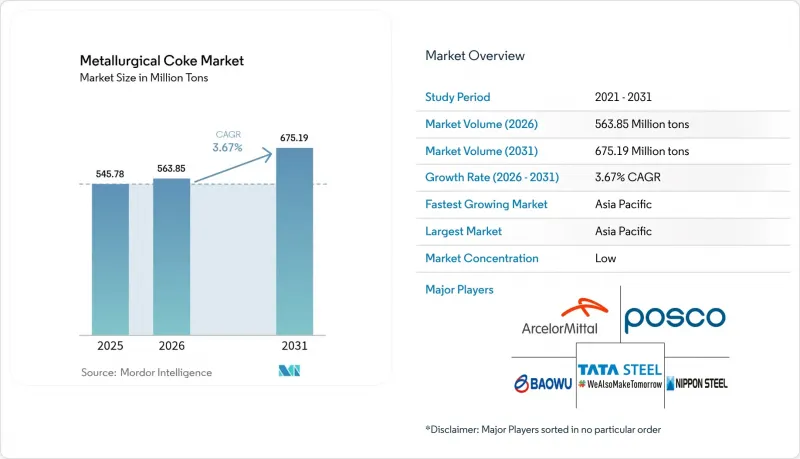
This report is Segmented by Coke Type (Blast-Furnace Coke and More), Grade (Low Ash (8 To 12% Ash) and High Ash (More Than 15% Ash)), Application (Iron and Steel Making, and More), End-User Industry (Integrated Steel Producers, Foundries, and More), and Geography (Asia-Pacific, North America, Europe, South America, and Middle-East and Africa). The Market Forecasts are Provided in Terms of Volume (tons).
Global Metallurgical Coke Market Trends and Insights
Rising Demand for Steel in Public Infrastructure
Governments in Asia-Pacific and the Middle East are allocating unprecedented budgets to highways, metro rail, and renewable-energy grids that require rebar and plate, both of which depend on blast-furnace routes using metallurgical coke. India's USD 1.4 trillion National Infrastructure Pipeline earmarks nearly one-quarter for transport projects, translating into steady coke offtake of roughly 0.8 tons per ton of crude steel. Saudi Arabia's NEOM and related megaprojects are projected to lift the kingdom's steel demand to 12 million tons by 2028, keeping regional mills on multi-year coke procurement contracts. Vietnam's North-South Expressway adds further pull, prompting Hoa Phat Group to install new blast furnaces with an extra 1.5 million tons of coke demand by 2027. Taken together, these programs underpin the positive demand trajectory of the metallurgical coke market.
Expanding Automotive Production Capacity
Light-vehicle output rebounded in China, India, and Thailand in 2025, yet steel intensity per vehicle eased as automakers adopted thinner high-strength steels and aluminum. China assembled 30.2 million vehicles in 2025, 4% above 2024, while average steel content slipped to 820 kg per car. Each incremental million vehicles in India still implies 180,000 tons of coke when blast-furnace share is considered, anchoring demand for the metallurgical coke industry despite gradual EAF inroads. Thailand's EV expansion sources more EAF steel from regional suppliers, hinting that vehicle electrification will eventually cap coke growth rates in Southeast Asia.
Metallurgical Coke Price Volatility
Spot hard-coking-coal prices swung between USD 210 and USD 340 per ton during 2024-2025 after Cyclone Jasper disrupted Queensland rail, compressing merchant-coke producer margins that average 6-8% EBITDA. India, which imported 54 million tons of coking coal in 2025, remains especially exposed, as 85% arrives from Australia. Futures hedging on the Dalian Commodity Exchange offers partial relief, yet physical-grade differentials leave basis risk.
Other drivers and restraints analyzed in the detailed report include:
- Capacity Additions in Integrated Steel Mills
- Urban Construction Boom in Emerging Economies
- Stringent Environmental Regulations on Coking Plants
For complete list of drivers and restraints, kindly check the Table Of Contents.
Segment Analysis
Blast-furnace coke accounted for 64.27% of global volume in 2025, underscoring its indispensable function as both reductant and structural support inside modern 1,500 °C furnaces. Nut coke is rising fastest at 4.25% CAGR because foundries crave 10-25 mm particles that enhance cupola permeability. Foundry coke retains its niche by supplying gray- and ductile-iron plants that demand CSR above 60% and sulfur below 0.6%. Coke breeze use is stagnating as mills shift from sinter to fluxed pellets, trimming the low-value tail of the metallurgical coke market.
Big Chinese integrated mills continue to specify high-CSR (greater than 65%) blast-furnace coke to withstand shaft pressures exceeding 15 bar in 5,000 m3 furnaces. Adoption of CDQ improves strength by 3-5 percentage points, allowing producers to fetch premiums even amid coal-price volatility. Over the forecast period, nut-coke demand will outpace blast-furnace growth, yet absolute tonnages favor the latter, cementing its status as the mainstay of the metallurgical coke market.
Low-ash (8-12%) coke captured 70.80% share in 2025 and is set to grow 4.59% annually, well ahead of high-ash alternatives. Each 1 percentage-point drop in ash trims slag by 15 kg per ton of hot metal, saving limestone and refractory costs. Consequently, mills commissioning furnaces above 4,500 m3 in India and China contract multi-year supplies of premium coal blends to secure low-ash output, locking in a quality-driven tier within the metallurgical coke market. High-ash coke, typically above 15%, retreats to legacy furnaces and non-ferrous smelters.
The price spread widened to USD 35-40 per ton in 2025 as China's crackdown on high-emission beehive ovens squeezed marginal supply. ISO 18894:2024 now measures alkali content, adding another lever that favors low-ash producers able to guarantee sodium and potassium below 0.3%. These quality screens reinforce the structural premium in the metallurgical coke market.
Complete Report Scope:
- By Coke Type
- Blast-Furnace Coke
- Foundry Coke
- Nut Coke
- Coke Breeze
- By Grade
- Low Ash (8 to 12% Ash)
- High Ash (more than 15% Ash)
- By Application
- Iron and Steel Making
- Foundry Castings
- Sugar Processing
- Glass Manufacturing
- Other Applications
- By End-User Industry
- Integrated Steel Producers
- Mini-mills / EAF Operators
- Foundries
- Non-ferrous Metallurgy
- Other End-user Industries
- By Geography
- Asia-Pacific
- China
- India
- Japan
- South Korea
- ASEAN Countries
- Rest of Asia-Pacific
- North America
- United States
- Canada
- Mexico
- Europe
- Germany
- United Kingdom
- Italy
- France
- Russia
- Rest of Europe
- South America
- Brazil
- Argentina
- Rest of South America
- Middle East and Africa
- Saudi Arabia
- United Arab Emirates
- South Africa
- Egypt
- Rest of Middle East and Africa
- Asia-Pacific
Geography Analysis
Asia-Pacific commanded 69.70% of volume in 2025 and will maintain a 4.16% CAGR to 2031, thanks to China's 480 million tons of coke production and India's rapid steel-capacity build-out. China's Ministry of Ecology and Environment shuttered 15 million tons of non-compliant capacity in 2025, shifting supply toward large, CDQ-equipped state enterprises with lower emission footprints. India expanded captive coke-oven capacity to 45 million tons, yet still relies on 54 million tons of coking-coal imports, cementing cross-border trade in the metallurgical coke market.
North America's production in 2025 was split between SunCoke merchant plants and integrated mills, but coke demand is gradually easing as US Steel idles older blast furnaces in favor of EAF routes. Canada's lone Dofasco oven faces rising carbon taxes that may accelerate electrification, potentially trimming regional metallurgical coke market demand share by 2031.
Europe's output fell in 2025 amid stricter benzene limits. With ArcelorMittal converting Krakow to an EAF and thyssenkrupp trialing hydrogen injection, European demand could drop further by 2035. South America remains stable, whereas the Middle East and Africa together may rise as Saudi and Egyptian mills add capacity, albeit with heavy dependence on imports via the metallurgical coke market.
- ArcelorMittal
- BlueScope Steel Ltd.
- China Baowu Steel Group
- China Shenhua Energy Co. Ltd.
- Drummond Company Inc.
- Gujarat NRE Coke Ltd. (GNCL)
- Hickman-Williams & Company
- Jiangsu Surung High-Carbon Co. Ltd.
- JSW Steel Ltd.
- Mahalaxmi Ennore Coke Pvt Ltd
- Mechel PAO
- Nippon Steel Corporation
- OKK Koksovny a.s.
- POSCO
- Shanxi Coking Coal Group
- SunCoke Energy Inc.
- Tata Steel Ltd.
- United States Steel Corporation
Additional Benefits:
- The market estimate (ME) sheet in Excel format
- 3 months of analyst support
TABLE OF CONTENTS
1 Introduction
- 1.1 Study Assumptions & Market Definition
- 1.2 Scope of the Study
2 Research Methodology
3 Executive Summary
4 Market Landscape
- 4.1 Market Drivers
- 4.1.1 Rising demand for steel in public infrastructure
- 4.1.2 Expanding automotive production capacity
- 4.1.3 Capacity additions in integrated steel mills
- 4.1.4 Urban construction boom in emerging economies
- 4.1.5 Adoption of dry-quenching technology enabling premium pricing
- 4.2 Market Restraints
- 4.2.1 Metallurgical coke price volatility
- 4.2.2 Stringent environmental regulations on coking plants
- 4.2.3 Supply risk from Australian met-coal logistics disruptions
- 4.3 Value Chain Analysis
- 4.4 Porter's Five Forces
- 4.4.1 Bargaining Power of Suppliers
- 4.4.2 Bargaining Power of Buyers
- 4.4.3 Threat of New Entrants
- 4.4.4 Threat of Substitutes
- 4.4.5 Degree of Competition
5 Market Size and Growth Forecasts ( Volume)
- 5.1 By Coke Type
- 5.1.1 Blast-Furnace Coke
- 5.1.2 Foundry Coke
- 5.1.3 Nut Coke
- 5.1.4 Coke Breeze
- 5.2 By Grade
- 5.2.1 Low Ash (8 to 12% Ash)
- 5.2.2 High Ash (more than 15% Ash)
- 5.3 By Application
- 5.3.1 Iron and Steel Making
- 5.3.2 Foundry Castings
- 5.3.3 Sugar Processing
- 5.3.4 Glass Manufacturing
- 5.3.5 Other Applications
- 5.4 By End-User Industry
- 5.4.1 Integrated Steel Producers
- 5.4.2 Mini-mills / EAF Operators
- 5.4.3 Foundries
- 5.4.4 Non-ferrous Metallurgy
- 5.4.5 Other End-user Industries
- 5.5 By Geography
- 5.5.1 Asia-Pacific
- 5.5.1.1 China
- 5.5.1.2 India
- 5.5.1.3 Japan
- 5.5.1.4 South Korea
- 5.5.1.5 ASEAN Countries
- 5.5.1.6 Rest of Asia-Pacific
- 5.5.2 North America
- 5.5.2.1 United States
- 5.5.2.2 Canada
- 5.5.2.3 Mexico
- 5.5.3 Europe
- 5.5.3.1 Germany
- 5.5.3.2 United Kingdom
- 5.5.3.3 Italy
- 5.5.3.4 France
- 5.5.3.5 Russia
- 5.5.3.6 Rest of Europe
- 5.5.4 South America
- 5.5.4.1 Brazil
- 5.5.4.2 Argentina
- 5.5.4.3 Rest of South America
- 5.5.5 Middle East and Africa
- 5.5.5.1 Saudi Arabia
- 5.5.5.2 United Arab Emirates
- 5.5.5.3 South Africa
- 5.5.5.4 Egypt
- 5.5.5.5 Rest of Middle East and Africa
- 5.5.1 Asia-Pacific
6 Competitive Landscape
- 6.1 Market Concentration
- 6.2 Strategic Moves
- 6.3 Market Share(%)/Ranking Analysis
- 6.4 Company Profiles (includes Global level Overview, Market level overview, Core Segments, Financials as available, Strategic Information, Products and Services, and Recent Developments)
- 6.4.1 ArcelorMittal
- 6.4.2 BlueScope Steel Ltd.
- 6.4.3 China Baowu Steel Group
- 6.4.4 China Shenhua Energy Co. Ltd.
- 6.4.5 Drummond Company Inc.
- 6.4.6 Gujarat NRE Coke Ltd. (GNCL)
- 6.4.7 Hickman-Williams & Company
- 6.4.8 Jiangsu Surung High-Carbon Co. Ltd.
- 6.4.9 JSW Steel Ltd.
- 6.4.10 Mahalaxmi Ennore Coke Pvt Ltd
- 6.4.11 Mechel PAO
- 6.4.12 Nippon Steel Corporation
- 6.4.13 OKK Koksovny a.s.
- 6.4.14 POSCO
- 6.4.15 Shanxi Coking Coal Group
- 6.4.16 SunCoke Energy Inc.
- 6.4.17 Tata Steel Ltd.
- 6.4.18 United States Steel Corporation
7 Market Opportunities and Future Outlook
- 7.1 White-space and Unmet-need Assessment


