

|
시장보고서
상품코드
2122944
금속 가공 장비 시장 : 시장 점유율 분석, 업계 동향 및 통계, 성장 예측(2026-2031년)Metal Fabrication Equipment - Market Share Analysis, Industry Trends & Statistics, Growth Forecasts (2026 - 2031) |
||||||
 Mordor Intelligence
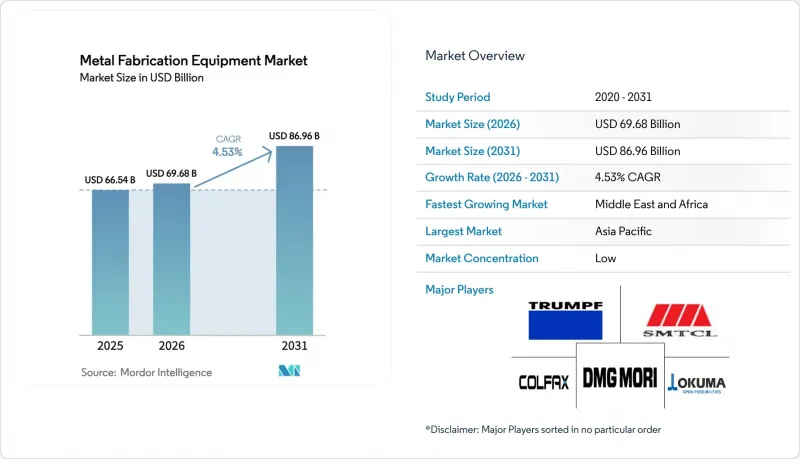
Mordor Intelligence에 의하면, 금속 가공 장비 시장 규모는 2025년에 665억 4,000만 달러로 평가되었고, 2026년 696억 8,000만 달러에서 2031년까지 869억 6,000만 달러에 이를 것으로 예측되며, 예측 기간(2026-2031년) CAGR은 4.53%를 나타낼 전망입니다.
본 보고서에서는 업계를 설비 유형별(기계 가공, 절단, 용접·접합 설비, 성형 등), 최종 사용자 산업별(자동차, 건설, 항공우주 등), 그리고 지역별(북미, 남미, 유럽, 아시아태평양, 중동 및 아프리카)로 분류하고 있습니다. 본 보고서에서는 상기 모든 부문에 대해 시장 규모 및 예측치(달러)를 제시하고 있습니다.
세계의 금속 가공 장비 시장 동향 및 인사이트
자동차 생산 확대 및 모델 변경 주기 단축
자동차 제조업체들은 모델 변경 주기를 7년에서 4년 미만으로 단축하고 있으며, 이에 따라 프레스 라인, 레이저 커터, 로봇 용접 셀의 빈번한 설비 갱신이 진행되고 있습니다. 북미의 배터리식 전기차(BEV) 공장에서는 현재 새로운 플랫폼마다 최대 12대의 서보 프레스와 여러 대의 파이버 레이저 블랭킹 시스템이 지정되어 있습니다. 1차 공급업체에 따르면, BEV가 100만 대 증가할 때마다 약 240대의 CNC 머시닝 센터와 320대의 로봇 용접 스테이션이 필요하다고 보고되고 있습니다. 인도와 아세안(ASEAN) 국가들의 인센티브 프로그램으로 인해 고정밀 톱니 절삭기의 수주가 더욱 가속화되고 있습니다. 설계가 구조형 배터리 팩으로 전환됨에 따라, ±0.05mm 미만의 재현성으로 얇은 알루미늄 판을 성형할 수 있는 설비에 대한 수요가 높아지고 있습니다.
건설 및 인프라 투자 확대
사우디아라비아, 인도, 인도네시아 각지에서 진행 중인 메가 프로젝트에서는 엄격한 시운전 일정을 충족하기 위해 대형 프레스 브레이크, 워터젯 커터, 자동 서브머지 아크 용접기가 필요합니다. NEOM 프로젝트만 해도 2030년까지 2,600만 미터톤 이상의 가공 강재가 소비될 전망이며, 현장에서의 강판 성형 및 레이저 절단 능력이 요구되고 있습니다. 미국과 유럽의 기후 변화에 대비한 유틸리티 프로그램으로 인해, 홍수 방지벽 및 고가 철도 회랑용 스테인리스 스틸 수요가 증가하고 있습니다. 또한, 프리팹 및 모듈식 건축의 부상으로, 2차 모따기 가공 없이 150mm 강판을 가공할 수 있는 CNC 플라즈마 커터의 수주도 증가하고 있습니다. 성형, 접합, 검사를 통합한 턴키 방식의 셀을 제공하는 공급업체가 가장 많은 수주 잔고를 보유하고 있습니다.
철강·비철금속 가격 변동
2024년, 열간 압연 코일 강재 가격은 1미터톤당 650달러에서 950달러 사이에서 변동했으며, 이로 인해 가공업체들은 분기마다 계약 재협상을 해야만 했고, 기계 구매를 4개월 이상 연기할 수밖에 없었습니다. 알루미늄 가격은 31%의 변동폭을 보이며, 항공우주 분야 및 전기차(EV) 배터리 케이스 제조 분야의 이익률을 압박했습니다. 구리 가격은 2025년 3월 톤당 1만 달러를 넘어서는 최고치를 기록한 후 하락세로 돌아서, 전기기기 제조업체의 자재 수요 예측을 어렵게 만들었습니다. 많은 유럽 서비스 센터가 재고를 18% 감축함에 따라, 하류 단절 업체 및 브레이크 가공 업체의 리드타임이 길어졌습니다. 이러한 가격 변동으로 인해 구매자들은 현금을 절약할 수 있는 리스나 종량제 모델을 제공하는 설비 공급업체를 선호하는 추세입니다.
부문별 분석
2025년, 기계 가공은 금속 가공 장비 시장에서 30.56%라는 최대 점유율을 유지했으며, 복잡한 엔진 블록, 터빈 디스크, 산업용 기어박스 성형에 있어 핵심적인 역할을 하고 있음이 부각되었습니다. 수요는 장시간 연속 가동 시에도 ±4마이크론 이하의 위치 정밀도를 유지할 수 있는 5축 가공기 및 고토크 수평 가공기에 집중되고 있습니다. 한편, 절단 시스템은 2031년까지 연평균 성장률(CAGR) 6.78%로 확대될 것으로 예측되며, 금속 가공 장비 시장 내에서 가장 높은 성장 속도를 보이고 있습니다. 8kW 이상의 파이버 레이저 플랫폼은 두께 3mm의 연강에서 분당 100미터를 넘는 절단 속도를 실현하여, 플라즈마 가공에 비해 40% 더 높은 처리량을 발휘하는 동시에 열영향부를 20미크론 미만으로 억제합니다. 네스팅 소프트웨어와 자동 노즐 체인저를 결합한 솔루션을 제공하는 공급업체는 150만 달러의 투자에 상응하는 정량화 가능한 자재 비용 절감 효과를 가져옵니다.
용접 및 접합 라인은 배터리 하우징 및 LNG 극저온 탱크의 기공률 제한을 충족하기 위해 파이버 레이저 및 마찰 교반 접합 공정으로 전환되고 있습니다. 모든 범주에서 로봇을 이용한 적재/하역, 공정 내 계측, 비전 가이드를 통한 이음매 추적 등의 자동화 모듈이 제품을 차별화하고, 공급업체를 다음 생산 능력 확대 주기를 향해 자리매김하고 있습니다.
지역별 분석
아시아태평양은 2025년 전 세계 매출의 46.76%를 차지했으며, 금속 가공 장비 시장에서 생산량 1위라는 입지를 확고히 다졌습니다. 중국의 ‘쌍순환’ 정책은 2027년까지 CNC 시스템의 국내 자급률 70%를 목표로 할 전망이며, 이에 따라 정부의 지원을 받는 국내 제조업체에 대한 대규모 수주가 촉진되고 있습니다. 인도의 장려책에 따라 2,590억 루피(31억 달러)가 파이버 레이저 커터 및 서보 프레스에 대한 보조금으로 투입되었으며, 일본 및 독일로부터의 설비 수입이 34% 급증했습니다. 아세안(ASEAN) 국가들은 전자 및 자동차 분야의 외국인 직접 투자(FDI)의 혜택을 받고 있으며, 베트남만 해도 2024년에 금속을 많이 사용하는 조립 라인을 위해 82억 달러의 투자를 유치했습니다.
중동 및 아프리카은 2031년까지 연평균 성장률(CAGR) 6.23%로 가장 높은 성장세를 기록할 전망입니다. 사우디아라비아의 공공투자기금(PIF)은 NEOM 프로젝트에 5,000억 달러를 투입하고 있으며, 철강을 많이 사용하는 인프라 건설을 위해 현지에서 레이저 가공 설비 및 판재 압연 설비를 조달하고 있습니다. 아랍에미리트(UAE)는 2030년 엑스포 이후 프로젝트를 위해 모듈식 건설 기술을 확대하고 있으며, 숙련된 노동자의 필요성을 최소화하는 턴키 방식의 로봇 용접 셀을 우선적으로 도입하고 있습니다. 남아프리카공화국은 태양광 트래커 프레임과 풍력 발전용 타워의 현지 생산을 추진하기 위해 재생에너지 관련 제품 제조를 가속화하고 있습니다.
북미에서 일고 있는 제2의 ‘리쇼어링’ 물결로 인해 2024년 이전 발표 건수는 78% 급증했으며, 수요는 미국 중서부 및 멕시코의 자동차 산업 회랑에 집중되고 있습니다. 구매자들은 랜섬웨어 위험을 완화하기 위해 IEC 62443을 준수하고 원격 모니터링 기능을 갖춘 기계를 우선적으로 선정하고 있습니다. 캐나다의 항공우주 클러스터에서는 주축 회전수가 30,000 rpm을 초과하는 5축 머시닝 센터에 대한 수요가 지속되고 있습니다. 유럽에서는 저탄소강으로의 전환이 진행되고 있어, 가공 업체들은 재활용 합금의 편차를 보정할 수 있는 적응형 머시닝 센터의 도입을 서두르고 있습니다. 독일은 2024년 생산량이 3.1% 감소했음에도 여전히 지역의 핵심 지위를 유지하고 있는 반면, 이탈리아,스페인, 폴란드는 수출 지향형 설비 생산을 통해 성장을 이어가고 있습니다. 남미는 규모는 다소 작지만, 브라질의 자동차 부문에서는 프레스 브레이크와 용접 로봇에 대한 정기적인 구매 주기가 유지되고 있습니다.
기타 혜택 :
- 엑셀 형식 시장 예측(ME) 시트
- 3개월간의 애널리스트 지원
자주 묻는 질문
목차
제1장 서론
제2장 조사 방법
제3장 주요 요약
제4장 시장 구도
제5장 시장 규모 및 성장 예측
제6장 경쟁 구도
제7장 시장 기회 및 향후 전망
AJY 26.09.07According to Mordor Intelligence, the metal fabrication equipment market size was valued at USD 66.54 billion in 2025 and is estimated to grow from USD 69.68 billion in 2026 to reach USD 86.96 billion by 2031, at a CAGR of 4.53% during the forecast period (2026-2031).
This report Segments the Industry Into by Equipment Type (Machining, Cutting, Welding & Joining Equipment, Forming, and More), by End-User Industry (Automotive, Construction, Aerospace, and More), and by Geography (North America, South America, Europe, Asia Pacific, and the Middle East and Africa). The Report Offers Market Size and Forecasts in Value (USD) for all the Above Segments.
Global Metal Fabrication Equipment Market Trends and Insights
Growing Automotive Production & Model Refresh Cycles
Automakers are compressing model-refresh intervals from seven to under four years, driving frequent retooling of press lines, laser cutters, and robotic welding cells. North American battery-electric vehicle plants now specify up to twelve servo presses and multiple fiber-laser blanking systems for each new platform. Tier-1 suppliers report that every one million incremental battery-electric cars requires about 240 CNC machining centers and 320 robotic welding stations. Incentive programs in India and ASEAN further accelerate orders for high-precision gear-cutting machines. As designs shift toward structural battery packs, demand rises for equipment capable of forming thin-gauge aluminum with repeatability below +-0.05 millimeters.
Expanding Construction & Infrastructure Investments
Megaprojects across Saudi Arabia, India, and Indonesia necessitate heavy-duty press brakes, waterjet cutters, and automated submerged-arc welders to meet compressed commissioning schedules. NEOM alone will consume more than 26 million metric tons of fabricated steel by 2030, requiring on-site plate-forming and laser-cutting capacity. Climate-resilient public works programs in the United States and Europe add stainless-steel demand for flood barriers and elevated rail corridors. The rise of prefabricated, modular buildings also boosts orders for CNC plasma cutters that can process 150-millimeter plate without secondary beveling. Suppliers offering turnkey cells that blend forming, joining, and inspection enjoy the largest order backlogs.
Volatile Raw-Steel & Non-Ferrous Prices
Hot-rolled coil steel fluctuated between USD 650 and USD 950 per metric ton in 2024, causing fabricators to renegotiate contracts quarterly and delay machine purchases by more than four months . Aluminum tracked a 31% price swing, squeezing margins in aerospace and EV battery-enclosure work. Copper peaked above USD 10,000 per metric ton in March 2025 before easing, complicating material forecasts for electrical-equipment shops. Many European service centers cut inventories by 18%, stretching lead times for downstream cutters and brake operators. Such volatility forces buyers to favor equipment suppliers offering leasing or pay-per-use models that preserve cash.
Other drivers and restraints analyzed in the detailed report include:
- Rising Demand from Aerospace Manufacturing
- Near-Shoring of Heavy-Fabrication Supply Chains
- High Cap-Ex Requirement for Next-Gen CNC Systems
For complete list of drivers and restraints, kindly check the Table Of Contents.
Segment Analysis
Machining retained the largest 30.56% metal fabrication equipment market share in 2025, underscoring its central role in shaping complex engine blocks, turbine disks, and industrial gearboxes. Demand concentrates in five-axis and high-torque horizontal centers capable of maintaining positional accuracy below +-4 microns across extended shifts. Meanwhile, cutting systems are forecast to expand at a 6.78% CAGR to 2031, marking the highest pace within the metal fabrication equipment market. Fiber-laser platforms above 8 kW deliver cut speeds surpassing 100 meters per minute on 3-millimeter mild steel, offering a 40% throughput edge over plasma while producing heat-affected zones under 20 microns. Suppliers bundling nesting software with automatic nozzle changers provide quantifiable material savings that justify the USD 1.5 million investment.
Welding and joining lines transition toward fiber-laser and friction-stir processes to meet porosity limits in battery housings and LNG cryogenic tanks. Across all categories, automation modules such as robotic load/unload, in-process metrology, and vision-guided seam tracking differentiate offerings and position vendors for the next cycle of capacity additions.
Complete Report Scope:
- By Equipment Type / Process
- Machining
- Machining Centres
- Lathe Machines
- Drilling, Grinding, Honing & Lapping
- Gear-Cutting Machines
- Other Handling & Cutting Equipment
- Cutting
- Laser Cutting
- Plasma Cutting
- Waterjet
- Others (Sawing & Cut-off Machines, etc)
- Welding & Joining Equipment
- Arc Welding
- Oxy-fuel Welding
- Laser-Beam Welding
- Other Welding Types
- Forming
- Sheet metal forming (press brakes/bending, punching/notching, shearing, stamping, roll forming)
- Bulk forming (forging)
- Other Presses & Metal-Forming Machines
- Other Equipment Types (Material Handling, Workholding & Automation, etc.)
- Machining
- By End-user Industry
- Automotive
- Construction
- Aerospace
- Electrical & Electronics
- Industrial Machinery / Heavy Eequipment
- Shipbuilding & Marine
- Rail
- Energy / Oil & Gas
- Other Industries (HVAC & appliances, metal furniture, etc)
- By Geography
- North America
- United States
- Canada
- Rest of North America
- South America
- Brazil
- Argentina
- Rest of South America
- Europe
- United Kingdom
- Germany
- France
- Italy
- Spain
- Rest of Europe
- Asia-Pacific
- China
- India
- Japan
- Australia
- ASEAN (Indonesia, Thailand, Philippines, Malaysia, Vietnam)
- Rest of Asia-Pacific
- Middle East and Africa
- Saudi Arabia
- United Arab Emirates
- Turkey
- South Africa
- Rest of Middle East and Africa
- North America
Geography Analysis
Asia-Pacific captured 46.76% of global 2025 revenue, affirming its status as the volume leader in the metal fabrication equipment market. China's dual-circulation policy targets 70% domestic self-sufficiency in CNC systems by 2027, spurring large government-backed orders for local builders. India's incentive schemes converted INR 259 billion (USD 3.1 billion) into subsidies for fiber-laser cutters and servo presses, producing a 34% jump in equipment imports from Japan and Germany. ASEAN countries benefit from electronics and automotive FDI, with Vietnam alone attracting USD 8.2 billion in 2024 for metal-intensive assembly lines.
The Middle East and Africa region will log the fastest 6.23% CAGR through 2031. Saudi Arabia's Public Investment Fund channels USD 500 billion into NEOM, procuring on-site laser and plate-rolling assets for its steel-heavy infrastructure. The UAE expands modular construction techniques for post-Expo 2030 projects, favoring turnkey robotic welding cells that minimize skilled-labor requirements. South Africa accelerates renewable-energy fabrication to localize solar-tracker frames and wind towers.
North America's second reshoring wave produces a 78% surge in announced relocations during 2024, concentrating demand in the U.S. Midwest and Mexican automotive corridor. Buyers prioritize machines with remote monitoring compliant with IEC 62443 to mitigate ransomware risk. Canada's aerospace clusters maintain demand for five-axis machining centers with spindle speeds above 30,000 rpm. Europe transitions to low-carbon steel, pushing fabricators to adopt adaptive machining centers capable of compensating for recycled alloy variability. Germany remains the regional anchor despite a 3.1% contraction in 2024 output, while Italy, Spain, and Poland grow through export-oriented equipment production. South America remains modest in scale, yet Brazil's automotive sector sustains regular purchase cycles for press brakes and welding robots.
- Trumpf
- Amada
- DMG MORI
- Yamazaki Mazak
- Bystronic
- Shenyang Machine Tool
- Okuma
- FANUC
- Lincoln Electric
- ESAB Corp.
- Hypertherm
- Doosan Machine Tools
- Haas Automation
- Atlas Copco
- Colfax (Howden)
- Koike Aronson
- Mitsubishi Electric (MC Machinery)
- Prima Industrie
- Salvagnini
- Sandvik
Additional Benefits:
- The market estimate (ME) sheet in Excel format
- 3 months of analyst support
TABLE OF CONTENTS
1 Introduction
- 1.1 Study Assumptions & Market Definition
- 1.2 Scope of the Study
2 Research Methodology
3 Executive Summary
4 Market Landscape
- 4.1 Market Overview
- 4.2 Market Drivers
- 4.2.1 Growing automotive production & model refresh cycles
- 4.2.2 Expanding construction & infrastructure investments
- 4.2.3 Rising demand from aerospace manufacturing
- 4.2.4 Near-shoring of heavy-fabrication supply chains
- 4.2.5 Offshore wind-turbine tower build-outs
- 4.2.6 Hybrid additive-subtractive fabrication cells
- 4.3 Market Restraints
- 4.3.1 Volatile raw-steel & non-ferrous prices
- 4.3.2 High cap-ex requirement for next-gen CNC systems
- 4.3.3 Shortage of skilled welders & machinists
- 4.3.4 Cyber-security risk in connected machine tools
- 4.4 Value / Supply-Chain Analysis
- 4.5 Regulatory Landscape
- 4.6 Technological Outlook
- 4.7 Industry Attractiveness - Porter's Five Forces
- 4.7.1 Threat of New Entrants
- 4.7.2 Bargaining Power of Buyers
- 4.7.3 Bargaining Power of Suppliers
- 4.7.4 Threat of Substitutes
- 4.7.5 Intensity of Competitive Rivalry
5 Market Size & Growth Forecasts (Value, In USD Billion)
- 5.1 By Equipment Type / Process
- 5.1.1 Machining
- 5.1.1.1 Machining Centres
- 5.1.1.2 Lathe Machines
- 5.1.1.3 Drilling, Grinding, Honing & Lapping
- 5.1.1.4 Gear-Cutting Machines
- 5.1.1.5 Other Handling & Cutting Equipment
- 5.1.2 Cutting
- 5.1.2.1 Laser Cutting
- 5.1.2.2 Plasma Cutting
- 5.1.2.3 Waterjet
- 5.1.2.4 Others (Sawing & Cut-off Machines, etc)
- 5.1.3 Welding & Joining Equipment
- 5.1.3.1 Arc Welding
- 5.1.3.2 Oxy-fuel Welding
- 5.1.3.3 Laser-Beam Welding
- 5.1.3.4 Other Welding Types
- 5.1.4 Forming
- 5.1.4.1 Sheet metal forming (press brakes/bending, punching/notching, shearing, stamping, roll forming)
- 5.1.4.2 Bulk forming (forging)
- 5.1.4.3 Other Presses & Metal-Forming Machines
- 5.1.5 Other Equipment Types (Material Handling, Workholding & Automation, etc.)
- 5.1.1 Machining
- 5.2 By End-user Industry
- 5.2.1 Automotive
- 5.2.2 Construction
- 5.2.3 Aerospace
- 5.2.4 Electrical & Electronics
- 5.2.5 Industrial Machinery / Heavy Eequipment
- 5.2.6 Shipbuilding & Marine
- 5.2.7 Rail
- 5.2.8 Energy / Oil & Gas
- 5.2.9 Other Industries (HVAC & appliances, metal furniture, etc)
- 5.3 By Geography
- 5.3.1 North America
- 5.3.1.1 United States
- 5.3.1.2 Canada
- 5.3.1.3 Rest of North America
- 5.3.2 South America
- 5.3.2.1 Brazil
- 5.3.2.2 Argentina
- 5.3.2.3 Rest of South America
- 5.3.3 Europe
- 5.3.3.1 United Kingdom
- 5.3.3.2 Germany
- 5.3.3.3 France
- 5.3.3.4 Italy
- 5.3.3.5 Spain
- 5.3.3.6 Rest of Europe
- 5.3.4 Asia-Pacific
- 5.3.4.1 China
- 5.3.4.2 India
- 5.3.4.3 Japan
- 5.3.4.4 Australia
- 5.3.4.5 ASEAN (Indonesia, Thailand, Philippines, Malaysia, Vietnam)
- 5.3.4.6 Rest of Asia-Pacific
- 5.3.5 Middle East and Africa
- 5.3.5.1 Saudi Arabia
- 5.3.5.2 United Arab Emirates
- 5.3.5.3 Turkey
- 5.3.5.4 South Africa
- 5.3.5.5 Rest of Middle East and Africa
- 5.3.1 North America
6 Competitive Landscape
- 6.1 Market Concentration
- 6.2 Strategic Moves
- 6.3 Market Share Analysis
- 6.4 Company Profiles (includes Global level Overview, Market level overview, Core Segments, Financials as available, Strategic Information, Market Rank/Share, Products & Services, Recent Developments)
- 6.4.1 Trumpf
- 6.4.2 Amada
- 6.4.3 DMG MORI
- 6.4.4 Yamazaki Mazak
- 6.4.5 Bystronic
- 6.4.6 Shenyang Machine Tool
- 6.4.7 Okuma
- 6.4.8 FANUC
- 6.4.9 Lincoln Electric
- 6.4.10 ESAB Corp.
- 6.4.11 Hypertherm
- 6.4.12 Doosan Machine Tools
- 6.4.13 Haas Automation
- 6.4.14 Atlas Copco
- 6.4.15 Colfax (Howden)
- 6.4.16 Koike Aronson
- 6.4.17 Mitsubishi Electric (MC Machinery)
- 6.4.18 Prima Industrie
- 6.4.19 Salvagnini
- 6.4.20 Sandvik
7 Market Opportunities & Future Outlook
- 7.1 White-space & Unmet-need Assessment


