

|
시장보고서
상품코드
2123000
전자 피부 패치 시장 : 시장 점유율 분석, 업계 동향 및 통계, 성장 예측(2026-2031년)Electronic Skin Patches - Market Share Analysis, Industry Trends & Statistics, Growth Forecasts (2026 - 2031) |
||||||
 Mordor Intelligence
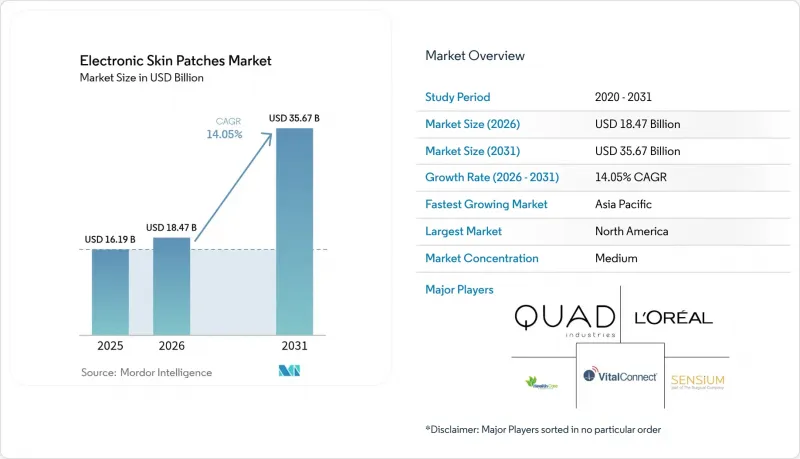
Mordor Intelligence에 의하면, 2026년 전자 피부 패치 시장 규모는 184억 7,000만 달러로 추정되고, 2025년 161억 9,000만 달러에서 확대해, 2031년에는 356억 7,000만 달러에 이를 것으로 예측됩니다.
2026-2031년 연평균 성장률(CAGR)은 14.05%가 될 것으로 전망됩니다.
본 보고서는 제품 유형별(센싱·진단용 패치, 약물 전달용 패치 등), 용도별(심혈관 모니터링, 약물 전달 등), 기술별(전기화학식 바이오센서, MEMS 및 마이크로플루이딕스 기술 등), 접착제별(실리콘계, 아크릴계 등), 최종 사용자별(병원 및 진료소, 재택치료 등), 지역별로 분류되어 있습니다.
세계의 전자 피부 패치 시장 동향 및 인사이트
연속 혈당 모니터링(CGM) 패치의 채택이 급증
2024년 Dexcom사의 ‘Stelo’와 Abbott사의 ‘Lingo’가 FDA 승인을 획득함에 따라 처방전 관련 장벽이 해소되었고, 인슐린을 사용하지 않는 미국의 2형 당뇨병 환자 2,500만 명을 대상으로 CGM 카테고리가 개방되었습니다. 동시에, 예방적 대사 건강 관리를 위한 소비자용 바이오센싱의 필요성이 입증되었습니다. Dexcom사의 ‘Simplera’와 같은 일회용 올인원 설계는 보험사 및 의료 제공업체의 교육 비용을 절감하고, 약국 채널을 통한 빠른 보급을 촉진하고 있습니다. Dexcom사는 ‘Stelo’를 통해 첫해 4,000만 달러의 매출을 예상하고 있으며, 이는 새롭게 개척 가능한 부문에서 수요 탄력성이 높음을 보여줍니다. 제약사들은 현재 CGM 데이터 스트림을 체중 감량 프로그램 및 대사증후군 관리 프로그램에 통합하고 있으며, 이를 통해 당뇨병 환자라는 핵심 고객층을 넘어 기기 수요를 확대되고 있습니다. 성장은 전 세계적으로 이루어지고 있지만, 북미에서는 유리한 보험 환급 제도 덕분에 초기 매출의 대부분을 차지하고 있습니다. 각 벤더들은 혈당 원격 모니터링을 폐쇄 루프 치료 생태계에 통합하기 위한 경쟁을 펼치고 있으며, 가정 환경에서 손가락 채혈식 혈당 측정기의 대체를 가속화하고 있습니다.
재택 심장 원격 모니터링의 보험 급여 범위 확대
메디케어, 미국의 주요 민간 보험사, 그리고 EU의 여러 보험 지급 기관은 현재 14일 및 30일 패치형 심전도(ECG) 서비스에 대한 보험 환급을 실시하고 있으며, 기존 원격 모니터링에 비해 재입원율이 최대 30% 감소한다는 점을 근거로 제시하고 있습니다. VitalConnect사는 2025년에 1억 달러의 자금을 조달하고, 이 자금을 ‘Hospital-at-Home’ 계약을 위한 VitalPatch의 생산량을 3배로 늘리는 데 사용할 것을 결정했습니다. 낙상 예방 DRG의 대상이 되는 ‘LEAF 환자 모니터링 시스템’과 같은 보완적 플랫폼은 다중 매개변수 패치가 심혈관 분야와 안전 측면의 이용 사례를 어떻게 통합할 수 있는지를 보여주고 있습니다. 보상 요건의 명확화로 인해 의료 시스템의 조달 예산이 유도되고 있으며, 고령 환자들에게는 부피가 큰 홀터 모니터보다 패치가 선호되고 있습니다. 현재 가장 두드러진 성장이 나타나고 있는 곳은 미국이지만, 독일, 프랑스, 일본에서도 파일럿 코드가 도입되어 있어, 이를 통해 중기적으로는 유럽 및 아시아에서 수요 증가가 예상됩니다.
데이터 보안 및 개인정보 보호 규정 준수에 드는 비용
의료기기와 소비자용 웰니스 제품의 경계를 모호하게 만드는 패치는 규제 분절화에 직면해 있습니다. HIPAA(의료보험 이동성 및 책임에 관한 법률)는 많은 소비자용 웨어러블 기기를 적용 대상에서 제외하고 있는 반면, GDPR(EU 개인정보보호규정)(일반 데이터 보호 규정)은 엄격한 동의 획득, 암호화 및 데이터 최소화 의무를 부과하고 있습니다. 두 규제 체계를 모두 충족하는 듀얼 스택 아키텍처를 구축하려면 소규모 제조업체의 경우 연구 개발(R&D) 예산에 15-20%의 추가 비용이 발생할 수 있습니다. 미국에서는 웨어러블 데이터에 관한 명확한 법률을 제정한 주가 불과 20개 주에 그치고 있으며, 이러한 법적 불확실성으로 인해 보안 투자에 있어 보수적인 태도가 나타나고 있습니다. 기존 대형 기업들은 기존의 SOC-2 및 ISO-27001 프로그램을 활용하여 규정 준수 관련 고정 비용을 분산시키고 있으며, 이로 인해 경쟁력 격차가 더욱 확대되고 있습니다.
부문 분석
에너지 수확형 스마트 패치는 연평균 성장률(CAGR) 21.23%로 성장하고 있으며, 수요 증가율 면에서 기존의 배터리 구동형 센싱 플랫폼을 추월하고 있습니다. 이 하위 카테고리의 전자 피부 패치 시장 규모는 2026-2031년 3배 이상으로 증가할 것으로 예측됩니다. 이는 전력 자급형 설계로 인해 환경에 미치는 부담과 매주 센서를 교체해야 하는 사용자의 불편함이 해소되기 때문입니다. 센싱 및 진단용 패치는 시장이 성숙 단계에 접어들었음에도 불구하고 2025년 매출의 45.35%를 차지했으며, 임상의들이 정확성과 확립된 보험 적용을 우선시하는 규제된 치료 경로에서 여전히 필수적인 존재입니다. 약물 전달용 패치는 통증 치료 및 호르몬 요법 분야에서 꾸준히 채택되고 있지만, 에너지 수확형이 누리고 있는 것과 같은 성장의 전환점에는 아직 도달하지 못했습니다. 미용·웰니스용 패치는 안티에이징 및 수분 공급 분석에 대한 소비자의 관심이 높아짐에 힘입어, 소폭이지만 지속적인 성장을 보이는 수익원이 되고 있으며, 풍부한 데이터를 바탕으로 한 개인화를 추구하는 대형 미용 기업들의 관심을 끌고 있습니다. 최근 산학 협력을 통해 6분간 충전으로 20 mA cm-2를 출력하는 땀 발전형 마이크로 슈퍼커패시터가 개발되었으며, 실험실 프로토타입 단계를 넘어 실용화 준비가 완료되었음이 입증되었습니다. 워털루 대학의 연구진은 열전사를 생체 적합성 기판에 직접 짜 넣어 두께를 늘리지 않고도 전원 및 센서 어레이를 통합했습니다. 이러한 진전은 더 얇고 유연한 적층 구조에 맞추어 케이스를 재설계하려는 OEM의 로드맵과 부합하며, 팔꿈치나 무릎과 같이 움직임이 심한 부위에도 장치를 밀착시킬 수 있게 해줍니다. 지적 재산권(IP)이 성숙해짐에 따라 칩 제조업체, 접착제 제조업체 및 소비자 헬스케어 브랜드 간의 라이선싱 계약이 가속화되어, 외래 진료 프로토콜 및 라이프스타일 분야에서 전자 피부 패치 시장 침투가 더욱 촉진될 전망입니다.
2025년에는 심혈관 모니터링이 전자 피부 패치 시장에서 37.55%라는 압도적인 점유율을 차지한 것으로 평가되었으며, 이는 보험사들이 부정맥 감시를 통해 재입원을 줄이는 데 주력하고 있는 점이 뒷받침되고 있습니다. 그러나 오랫동안 간과되어 온 임상적 요구가 벤처 캐피털의 지원을 받으면서, 연평균 성장률(CAGR) 19.04%로 예측되는 ‘여성 건강 및 불임 치료’ 분야의 응용이 현재 가장 역동적으로 성장하는 분야가 되고 있습니다. MIT가 개발한 휴대용 유방 초음파 패치는 자율형 영상 진단 기술이 병원에서 일반 가정으로 옮겨갈 가능성을 보여주는 좋은 사례입니다. 불임 치료 추적 기업은 호르몬을 감지하는 하이드로겔을 활용해 황체형성호르몬을 지속적으로 측정함으로써, 기초 체온표보다 더 정확한 월경 주기 예측을 사용자에게 제공합니다. 통증 및 근골격계 관리 분야에서는 신경 신호를 차단하는 전기 자극 패치가 활용되어, 오피오이드를 사용하지 않는 진통법이 제공되고 있습니다. 당뇨병 관리 분야는 CGM(연속 혈당 모니터링)의 보급으로 여전히 큰 시장 규모를 유지하고 있지만, 인슐린 의존 환자층에서의 보급률이 포화 상태에 가까워짐에 따라 그 성장세는 완만해지고 있습니다. 신경·정신 건강 분야는 아직 발전 단계에 있지만, 미래성이 기대되고 있습니다. 피부 전기 활동(EDA) 패치와 머신러닝 분류기를 결합함으로써 불안 발작을 선별할 수 있게 되어, 적시에 행동 지침을 제공할 수 있습니다. 용도의 다양화로 인해 수익의 주기성이 완화되었으며, 전자 피부 패치 업계가 충분한 의료 서비스를 받지 못하는 계층으로 사업을 전환할 수 있는 능력이 부각되고 있습니다.
지역별 분석
북미는 2025년 전자 피부 패치 시장 점유율의 37.55%를 차지했습니다. 이는 FDA 승인 절차에 따라 OTC(일반의약품) CGM이 약국 진열대에 진열되면서, 내분비과 클리닉 이외의 분야에서도 판매량이 확대된 덕분입니다. ‘재택 병원(Hospital-at-Home)’의 보험 청구 코드 덕분에 원격 모니터링이 의료 제공업체에게 예측 가능한 수익원이 되었으며, 팬데믹의 정점이 지난 후에도 주문이 지속되고 있습니다. 캐나다에서는 주 차원에서 원격 심장 모니터링 프로그램이 시범적으로 도입되고 있는 반면, 멕시코의 마키라도라(수출가공구)는 USMCA(미국·멕시코·캐나다 협정)에 따른 관세 면제 물류 체제를 바탕으로 OEM 조립을 유치하여 입고 비용을 8-10% 절감하고 있습니다. 아시아태평양은 디지털 헬스 분야의 시범 사업에 자금을 지원하는 중국의 ‘건강 중국 2030’ 계획과 일본의 실버 이코노미 수요 급증에 힘입어 16.32%라는 가장 높은 연평균 성장률(CAGR)을 기록하고 있습니다. 한국의 ODM 팹은 플렉서블 PCB 에칭부터 무균 포장에 이르는 수직 통합을 강점으로 삼아, 해당 지역에 진출하는 유럽 및 미국 브랜드의 리드 타임을 대폭 단축하고 있습니다. 인도의 ‘국가 디지털 헬스 미션’에서는 당뇨병 시범 프로그램에서 블루투스 LE 지원 패치의 비용을 상환하고 있으나, 가격 상한선이 설정되어 있어 배터리를 많이 사용하는 수입품보다 에너지 수확 방식의 모델이 우대받고 있습니다. 유럽에서는 GDPR(EU 개인정보보호규정)을 둘러싼 마찰이 있음에도 불구하고 꾸준한 성장이 나타나고 있습니다. 엄격한 데이터 관리가 패치 상의 암호화용 ASIC 투자를 촉진하고 있어, 프리미엄 가격을 실현할 수 있는 차별화된 제품이 탄생하고 있습니다. 2027년에 시행될 EU의 ‘배터리 규정’은 에코디자인에 대한 인센티브와 연계되어, 제조업체들이 바이오연료전지를 이용한 전원 방식으로 전환하도록 촉진하고 있습니다. 독일은 바덴뷔르템베르크주의 민관 클러스터를 활용해 폴리머 연구를 추진하고 있는 반면, 영국의 NHS는 2026년까지 5,000개의 급성기 병상을 감축하는 것을 목표로 하는 ‘가상 병동’ 구상에 패치를 도입하고 있습니다. 북유럽의 전자 처방전 네트워크는 CGM 데이터를 자동으로 연동하여, 1차 진료에서 알고리즘에 기반한 인슐린 투여를 가능하게 하고 있습니다.
기타 혜택 :
- 엑셀 형식 시장 예측(ME) 시트
- 3개월간의 애널리스트 지원
자주 묻는 질문
목차
제1장 서론
제2장 조사 방법
제3장 주요 요약
제4장 시장 구도
제5장 시장 규모 및 성장 예측
제6장 경쟁 구도
제7장 시장 기회 및 향후 전망
AJY 26.09.07According to Mordor Intelligence, electronic skin patches market size in 2026 is estimated at USD 18.47 billion, growing from 2025 value of USD 16.19 billion with 2031 projections showing USD 35.67 billion, growing at 14.05% CAGR over 2026-2031.
This report is Segmented by Product Type (Sensing and Diagnostic Patches, Drug-Delivery Patches, and More), Application (Cardiovascular Monitoring, Drug-Delivery, and More), Technology (Electrochemical Biosensors, MEMS and Microfluidics, and More), Adhesive Material (Silicone-Based, Acrylic-Based, and More), End-User (Hospitals and Clinics, Home Healthcare, and More), and Geography.
Global Electronic Skin Patches Market Trends and Insights
Continuous Glucose-Monitoring (CGM) Patch Adoption Surge
FDA clearance of Dexcom Stelo and Abbott Lingo in 2024 removed prescription barriers and opened the CGM category to 25 million U.S. type 2 diabetics not on insulin, while also legitimizing consumer-grade biosensing for preventive metabolic health. Disposable, all-in-one designs such as Dexcom's Simplera lower training costs for payers and providers, fostering rapid uptake in pharmacy channels. Dexcom projects USD 40 million first-year revenue from Stelo, signaling strong elasticity in the newly addressable segment. Pharmaceutical firms are now embedding CGM data streams into weight-loss and metabolic-syndrome programs, expanding device demand beyond the core diabetes cohort. Growth is global, yet North America captures early volumes due to favorable reimbursement. Vendors are racing to integrate glucose telemetry into closed-loop therapy ecosystems, accelerating replacement of finger-stick meters in home settings.
Home-Based Cardiac Telemetry Reimbursement Expansion
Medicare, major U.S. commercial insurers, and several EU payers now reimburse 14-day and 30-day patch ECG services, citing up to 30% lower readmission rates compared with traditional telemetry. VitalConnect earmarked its 2025 USD 100 million raise to triple VitalPatch output for Hospital-at-Home contracts. Complementary platforms such as the LEAF Patient Monitoring System, covered under fall-prevention DRGs, illustrate how multiparameter patches can bundle cardiology and safety use-cases. Reimbursement clarity attracts health-system procurement budgets, which favor patches over bulky holter monitors for elderly patients. Expansion is strongest in the United States today, yet Germany, France, and Japan have introduced pilot codes that should unlock medium-term European and Asian volume.
Data-Security and Privacy Compliance Costs
Patches that blur medical-device and consumer-wellness categories face fragmented regulation. HIPAA exempts many direct-to-consumer wearables, while GDPR imposes strict consent, encryption, and data-minimization obligations. Building dual-stack architectures capable of satisfying both frameworks can add 15-20% to R&D budgets for small manufacturers. Only 20 U.S. states have explicit wearable data laws, creating legal uncertainty that drives conservative security investments. Larger incumbents use existing SOC-2 and ISO-27001 programs to spread compliance fixed costs, widening the competitiveness gap.
Other drivers and restraints analyzed in the detailed report include:
- Ageing Population and Chronic-Care Decentralisation
- Flexible Biofuel-Cell Power Sources Hit Mass Production
- Adhesion / Skin-Irritation Failure Rates
For complete list of drivers and restraints, kindly check the Table Of Contents.
Segment Analysis
Energy-Harvesting Smart Patches are growing at a 21.23% CAGR, overtaking traditional, battery-powered sensing platforms in demand velocity. The electronic skin patch market size for this sub-category is projected to more than triple between 2026 and 2031 as power-autonomous designs remove both environmental waste and user inconvenience linked to weekly sensor swaps. Sensing and Diagnostic Patches, while mature, still control 45.35% 2025 revenue and remain essential in regulated care pathways where clinicians prioritize accuracy and established reimbursement. Drug-Delivery Patches keep steady adoption in pain and hormone therapy, but lack the growth inflection energy-harvesting variants enjoy. Cosmetic and Wellness Patches, driven by consumer focus on anti-aging and hydration analytics, form a modest but rising revenue line that attracts beauty majors eager for data-rich personalization.Recent academic-industry collaboration produced sweat-powered micro-supercapacitors that output 20 mA cm-2 after a six-minute charge, validating real-world readiness beyond lab prototypes. University of Waterloo researchers knit thermoelectric yarns directly into biocompatible substrates, integrating power and sensor arrays without added thickness. Such advances align with OEM roadmaps to re-engineer housings around thinner, more flexible stacks, allowing devices to conform to high-motion anatomical sites like elbows and knees. As IP matures, licensing deals between chipmakers, adhesive formulators, and consumer-health brands should accelerate, further boosting electronic skin patch market penetration in outpatient protocols and lifestyle segments alike.
Cardiovascular Monitoring held a commanding 37.55% electronic skin patch market share in 2025, upheld by payer focus on reducing readmissions through rhythm surveillance. Yet Women's Health and Fertility applications, projected at 19.04% CAGR, now represent the most dynamic vector as long-neglected clinical needs receive venture backing. MIT's portable breast ultrasound patch exemplifies how self-contained imaging can transition from hospitals to living rooms. Fertility-tracking companies leverage hormone-sensing hydrogels for continuous luteinizing hormone readouts, empowering users with cycle predictions more precise than basal-temperature charts.Pain and Musculoskeletal management harnesses electrical-stimulation patches that gate nerve signals, offering opioid-free analgesia. Diabetes Management remains sizeable due to CGM volume, yet its growth moderates as penetration approaches saturation in insulin-dependent cohorts. Neuro-mental health remains nascent but promising: electrodermal-activity patches, coupled with machine-learning classifiers, screen for anxiety episodes, enabling timely behavioral cues. The diversification across applications reduces revenue cyclicality and underscores the electronic skin patch industry's ability to pivot toward underserved populations.
Complete Report Scope:
- By Product Type
- Sensing and Diagnostic Patches
- Drug-Delivery Patches
- Electrical-Stimulation Patches
- Cosmetic and Wellness Patches
- Energy-Harvesting Smart Patches
- By Application
- Cardiovascular Monitoring
- Diabetes Management
- Pain / Musculoskeletal
- Infectious-Disease and Fever
- Women's Health and Fertility
- Neuro and Mental Health
- Sports and Fitness
- Drug-Delivery
- By Technology
- Electrochemical Biosensors
- Optical / PPG Sensors
- MEMS and Microfluidics
- RFID / NFC Smart Patches
- Energy-Harvesting and Battery-less
- By Adhesive Material
- Silicone-based
- Acrylic-based
- Hydrogel-based
- Others (PU, Hybrid)
- By End-User
- Hospitals and Clinics
- Home Healthcare
- Sports and Fitness Centres
- Military and Emergency Services
- Cosmetic and Dermatology Clinics
- Research Institutions
- By Geography
- North America
- United States
- Canada
- Mexico
- South America
- Brazil
- Argentina
- Rest of South America
- Europe
- Germany
- United Kingdom
- France
- Italy
- Spain
- Russia
- Rest of Europe
- Asia Pacific
- China
- India
- Japan
- South Korea
- Rest of Asia Pacific
- Middle East and Africa
- Middle East
- Saudi Arabia
- UAE
- Turkey
- Rest of Middle East
- Africa
- South Africa
- Nigeria
- Rest of Africa
- Middle East
- North America
Geography Analysis
North America commands 37.55% electronic skin patch market share in 2025, benefited by FDA pathways that brought OTC CGMs to pharmacy shelves, thus expanding unit volumes beyond endocrinology clinics. Hospital-at-Home reimbursement codes convert remote monitoring into predictable revenue streams for providers, sustaining purchase orders even after pandemic peaks. Canada experiments with provincial remote-cardiac programs, while Mexican maquiladoras attract OEM assembly due to tariff-free USMCA logistics, shaving 8-10% off landed costs.Asia Pacific delivers the fastest 16.32% CAGR, powered by China's Healthy China 2030 blueprint that funds digital-health pilots and by Japan's Silver Economy demand spike. South Korea's ODM fabs tout vertical integration-from flex-PCB etching to sterile packaging-slashing lead times for Western brands entering the region. India's National Digital Health Mission reimburses Bluetooth LE-enabled patches in pilot diabetes programs, albeit with price caps that favor energy-harvesting models over battery-heavy imports.Europe grows steadily despite GDPR friction: stringent data controls catalyze investments in on-patch encryption ASICs, yielding differentiated products able to command premium ASPs. The bloc's Battery Regulation, effective 2027, pushes manufacturers toward biofuel-cell power, aligning with eco-design incentives. Germany leverages public-private clusters in Baden-Wurttemberg for polymer research, while the U.K. NHS integrates patches into virtual-ward targets aimed at freeing 5,000 acute beds by 2026. Nordic e-prescription networks automatically link CGM data, enabling algorithmic insulin dosing in primary care.
- Abbott Laboratories
- DexCom Inc.
- iRhythm Technologies Inc.
- VitalConnect Inc.
- Medtronic plc
- Insulet Corporation
- Leaf Healthcare Inc.
- Sensium Healthcare Ltd.
- MC10 Inc.
- Quad Industries SA
- Philips Healthcare
- GE Healthcare
- Nemaura Medical
- VivaLNK
- Masimo Corporation
- Blue Spark Technologies
- G-Tech Medical
- Omron Healthcare
- Nutromics
Additional Benefits:
- The market estimate (ME) sheet in Excel format
- 3 months of analyst support
TABLE OF CONTENTS
1 INTRODUCTION
- 1.1 Study Assumptions and Market Definition
- 1.2 Scope of the Study
2 RESEARCH METHODOLOGY
3 EXECUTIVE SUMMARY
4 MARKET LANDSCAPE
- 4.1 Market Overview
- 4.2 Market Drivers
- 4.2.1 Continuous glucose-monitoring (CGM) patch adoption surge
- 4.2.2 Home-based cardiac telemetry reimbursement expansion
- 4.2.3 Ageing population and chronic-care decentralisation
- 4.2.4 Flexible biofuel-cell power sources hit mass production
- 4.2.5 Hospital-at-home CPT codes for connected patches
- 4.2.6 API-level integration with digital-therapeutics platforms
- 4.3 Market Restraints
- 4.3.1 Data-security and privacy compliance costs
- 4.3.2 Adhesion / skin-irritation failure rates
- 4.3.3 Battery-disposal and e-waste regulation pressure
- 4.3.4 Patch reimbursement gaps in emerging economies
- 4.4 Value Chain Analysis
- 4.5 Regulatory Landscape
- 4.6 Technological Outlook
- 4.7 Porter's Five Forces Analysis
- 4.7.1 Threat of New Entrants
- 4.7.2 Bargaining Power of Buyers
- 4.7.3 Bargaining Power of Suppliers
- 4.7.4 Threat of Substitute Products
- 4.7.5 Intensity of Competitive Rivalry
- 4.8 Investment and Funding Trends
5 MARKET SIZE AND GROWTH FORECASTS (VALUE)
- 5.1 By Product Type
- 5.1.1 Sensing and Diagnostic Patches
- 5.1.2 Drug-Delivery Patches
- 5.1.3 Electrical-Stimulation Patches
- 5.1.4 Cosmetic and Wellness Patches
- 5.1.5 Energy-Harvesting Smart Patches
- 5.2 By Application
- 5.2.1 Cardiovascular Monitoring
- 5.2.2 Diabetes Management
- 5.2.3 Pain / Musculoskeletal
- 5.2.4 Infectious-Disease and Fever
- 5.2.5 Women's Health and Fertility
- 5.2.6 Neuro and Mental Health
- 5.2.7 Sports and Fitness
- 5.2.8 Drug-Delivery
- 5.3 By Technology
- 5.3.1 Electrochemical Biosensors
- 5.3.2 Optical / PPG Sensors
- 5.3.3 MEMS and Microfluidics
- 5.3.4 RFID / NFC Smart Patches
- 5.3.5 Energy-Harvesting and Battery-less
- 5.4 By Adhesive Material
- 5.4.1 Silicone-based
- 5.4.2 Acrylic-based
- 5.4.3 Hydrogel-based
- 5.4.4 Others (PU, Hybrid)
- 5.5 By End-User
- 5.5.1 Hospitals and Clinics
- 5.5.2 Home Healthcare
- 5.5.3 Sports and Fitness Centres
- 5.5.4 Military and Emergency Services
- 5.5.5 Cosmetic and Dermatology Clinics
- 5.5.6 Research Institutions
- 5.6 By Geography
- 5.6.1 North America
- 5.6.1.1 United States
- 5.6.1.2 Canada
- 5.6.1.3 Mexico
- 5.6.2 South America
- 5.6.2.1 Brazil
- 5.6.2.2 Argentina
- 5.6.2.3 Rest of South America
- 5.6.3 Europe
- 5.6.3.1 Germany
- 5.6.3.2 United Kingdom
- 5.6.3.3 France
- 5.6.3.4 Italy
- 5.6.3.5 Spain
- 5.6.3.6 Russia
- 5.6.3.7 Rest of Europe
- 5.6.4 Asia Pacific
- 5.6.4.1 China
- 5.6.4.2 India
- 5.6.4.3 Japan
- 5.6.4.4 South Korea
- 5.6.4.5 Rest of Asia Pacific
- 5.6.5 Middle East and Africa
- 5.6.5.1 Middle East
- 5.6.5.1.1 Saudi Arabia
- 5.6.5.1.2 UAE
- 5.6.5.1.3 Turkey
- 5.6.5.1.4 Rest of Middle East
- 5.6.5.2 Africa
- 5.6.5.2.1 South Africa
- 5.6.5.2.2 Nigeria
- 5.6.5.2.3 Rest of Africa
- 5.6.5.1 Middle East
- 5.6.1 North America
6 COMPETITIVE LANDSCAPE
- 6.1 Market Concentration
- 6.2 Strategic Moves
- 6.3 Market Share Analysis
- 6.4 Company Profiles (includes Global level Overview, Market level overview, Core Segments, Financials as available, Strategic Information, Market Rank/Share for key companies, Products and Services, and Recent Developments)
- 6.4.1 Abbott Laboratories
- 6.4.2 DexCom Inc.
- 6.4.3 iRhythm Technologies Inc.
- 6.4.4 VitalConnect Inc.
- 6.4.5 Medtronic plc
- 6.4.6 Insulet Corporation
- 6.4.7 Leaf Healthcare Inc.
- 6.4.8 Sensium Healthcare Ltd.
- 6.4.9 MC10 Inc.
- 6.4.10 Quad Industries SA
- 6.4.11 Philips Healthcare
- 6.4.12 GE Healthcare
- 6.4.13 Nemaura Medical
- 6.4.14 VivaLNK
- 6.4.15 Masimo Corporation
- 6.4.16 Blue Spark Technologies
- 6.4.17 G-Tech Medical
- 6.4.18 Omron Healthcare
- 6.4.19 Nutromics
7 MARKET OPPORTUNITIES AND FUTURE OUTLOOK
- 7.1 White-space and Unmet-need Assessment


