
|
시장보고서
상품코드
2123081
데이터 분류 시장 : 시장 점유율 분석, 업계 동향 및 통계, 성장 예측(2026-2031년)Data Classification - Market Share Analysis, Industry Trends & Statistics, Growth Forecasts (2026 - 2031) |
||||||
 Mordor Intelligence
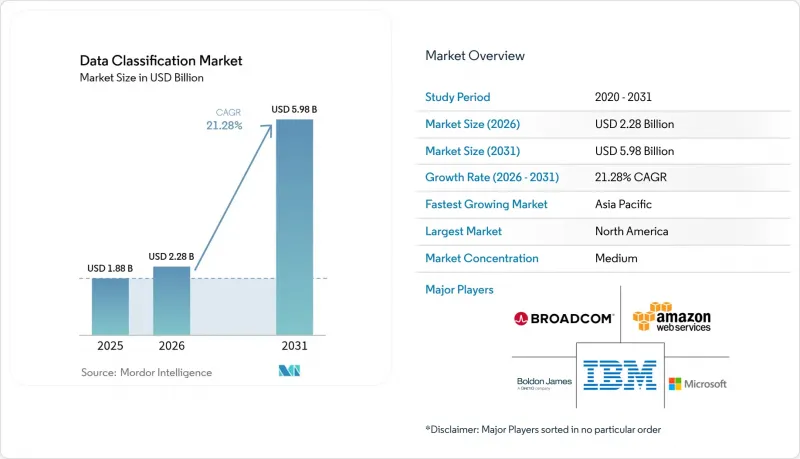
Mordor Intelligence에 의하면, 2026년 데이터 분류 시장 규모는 22억 8,000만 달러로 추정되고, 2025년 18억 8,000만 달러에서 확대해, 2031년에는 59억 8,000만 달러에 이를 것으로 예측됩니다.
2026-2031년 연평균 성장률(CAGR)은 21.28%를 나타낼 전망입니다.
본 보고서는 구성 요소별(소프트웨어 및 서비스), 분류 방법별(컨텐츠 기반, 컨텍스트 기반 등), 조직 규모별(대기업 및 중소기업(SME)), 용도별(접근 제어 및 IAM, 거버넌스 및 규정 준수 등), 산업 분야별(BFSI 등), 그리고 지역별로 분류되어 있습니다. 시장 전망은 금액(달러) 단위로 표시됩니다.
세계의 데이터 분류 시장 동향 및 인사이트
확대되는 전 세계 개인정보 보호 규제
유럽의 DORA 규정 및 개정된 HIPAA 기준에 따라 규정 준수의 방식이 정기 감사에서 지속적인 검증으로 전환되고 있으며, 기업은 데이터 처리 워크플로우에 분류 로직을 직접 통합해야 할 의무가 있습니다. 여러 관할 구역에서 사업을 영위하는 다국적 기업들은 대개 가장 엄격한 세계 요건을 기준으로 적용하고 있으며, 이는 통합된 분류 아키텍처의 도입을 가속화하고 있습니다. 금융 기관은 자금 세탁 방지(AML) 관련 보고를 몇 분 이내에 완료해야 하므로, 정책 주도형 데이터 감지에 대한 수요가 증가하고 있습니다. 이와 유사한 압박은 GDPR(EU 개인정보보호규정)을 준수하는 라틴아메리카의 데이터 주권 관련 법규에서도 발생하고 있습니다. 이러한 규제들이 맞물려 조달 주기가 단축되면서, 중견 기업조차도 정책을 자동으로 업데이트하는 SaaS 기반 도구를 도입하도록 유도되고 있습니다.
비정형 데이터의 폭발적인 증가와 정보 유출 위험
비정형 데이터의 저장량은 매년 62%씩 증가하고 있으며, 보안 팀은 누가 기밀 기록을 보유하고 있는지 파악하지 못하고 있습니다. 기업 보고서에 따르면, 파일 공유의 82%에서 권한이 과도하게 부여되어 있어 귀중한 설계도나 고객 데이터가 노출되고 있습니다. 에너지 사업자는 현재 주당 1,100건의 사이버 공격을 받고 있으며, 정보 유출 조사 결과 잘못 분류된 문서가 근본 원인인 것으로 밝혀졌습니다. 법률 사무소 역시 고객 파일이 라벨 없이 공유 드라이브에 저장되어 있어 유사한 위험에 노출되어 있습니다. 정적인 규칙 세트로는 동적인 협업 플랫폼의 속도를 따라갈 수 없기 때문에 AI를 활용한 패턴 인식이 점점 더 많이 채택되고 있습니다.
업계를 아우르는 분류 기준의 부재
금융 규제 당국과 의료 당국은 위험 데이터를 분류하는 방식이 달라, 벤더는 업계별 고유한 규칙 라이브러리를 유지해야만 합니다. 다국적 기업은 파일을 전송할 때 GDPR(EU 개인정보보호규정) 용어와 중국의 ‘중요 데이터’ 정의를 일치시켜야 합니다. 이러한 분절화는 맞춤형 코딩 부담을 가중시키고, 벤더 종속성에 대한 우려를 높이며, 구매 결정을 지연시키고 있습니다. 업계 단체들은 개방형 스키마 초안을 마련하고 있지만, 그 채택 현황은 여전히 고르지 않습니다. 그 결과, 통합 업체들은 순수한 소프트웨어 라이선스보다 매핑 워크숍을 통해 더 많은 수익을 올리고 있습니다.
부문 분석
소프트웨어는 여전히 최대 수익원이며, 2025년에는 데이터 분류 시장의 67.92%를 차지한 것으로 평가되었습니다. 라이선스 판매는 정책 엔진, 디스커버리 크롤러, SaaS 대시보드를 중심으로 이루어지고 있습니다. 그럼에도 불구하고, 전문 서비스 및 관리형 서비스는 연평균 성장률(CAGR) 23.62%로 확대되고 있습니다. 이는 기업들이 수년에 걸친 분류 지연을 해소하기 위해 지침이 필요하기 때문입니다. 프로젝트는 대개 수 페타바이트 규모의 스캔으로 시작됩니다. 이로 인해 시정 조치가 미처 처리되지 못한 업무가 쌓이고, 사내 자원이 부족해집니다. 매니지드 서비스 제공업체는 구독 방식에 따라 모델 재교육, 규정 업데이트, 티켓 우선순위 지정을 지원함으로써 기술 부족을 보완합니다. 이러한 계약은 수년에 걸쳐 지속될 수 있으며, 이로 인해 지출이 일회성 자본 지출에서 지속적인 운영 비용(OPEX)으로 전환됩니다. 이 접근 방식은 예측 가능한 예산과 감사 대응이 가능한 증거를 요구하는 이사회로부터 지지를 받고 있습니다. 금액 측면에서 보면, 2031년까지 데이터 분류 시장 규모 중 21억 6,000만 달러를 서비스가 차지할 것으로 예상되며, 이는 그 전략적 중요성을 반영합니다. 따라서 소프트웨어 벤더들은 이익률을 유지하기 위해 프리미엄 플랜에 자문 기능을 포함시키고 있습니다.
2세대 구현에서는 연 1회의 상태 점검 대신 지속적인 조정이 이루어집니다. 서비스 파트너는 오브젝트 스토리지에 새로운 데이터가 저장될 때마다 분류가 트리거되는 DevSecOps 파이프라인을 구축합니다. 또한, 사업 부서 간 공통 분류 체계를 표준화함으로써 인수 시 도입 기간을 단축합니다. 이러한 추세로 인해 데이터 분류 시장은 확대되고 있습니다. 중견 기업은 인력 부족으로 인한 전문가 채용 대신, 외부에서 전문 지식을 조달할 수 있게 되었기 때문입니다. 현재 벤더의 마켓플레이스에는 ISO 27001, HIPAA 또는 PCI 템플릿을 준수하는 엄선된 서비스 번들이 게재되어 있어 도입이 더욱 확산되고 있습니다. 서비스 수익이 확대되는 가운데, 시스템 통합사업자들은 전문 지식을 강화하고 시장 점유율을 확보하기 위해 전문성이 높은 컨설팅 회사를 인수하고 있습니다.
2025년에는 정규 표현식(regex)이나 지문을 활용하여 지적 재산을 식별하는 컨텐츠 기반 검사가 지출의 42.76%를 차지했습니다. 그러나 ML 기반 및 시맨틱 모델은 수백만 건의 라벨이 지정된 문서에서 문맥을 학습함으로써 연평균 성장률(CAGR) 22.44%로 급성장하고 있습니다. 문장 구조를 분석하는 트랜스포머 네트워크와 같은 패턴에 의존하지 않는 기능 덕분에 리콜률이 향상되고 오탐이 감소하고 있습니다. Microsoft Purview는 전 세계 텔레메트리 데이터를 활용해 학습을 수행하므로, 고객 측의 조작 없이도 정기적인 모델 업데이트가 가능합니다. Digital Guardian은 컨텐츠 단서에 더해 위치나 기기 상태와 같은 맥락적 신호를 결합함으로써 위험 가중형 태깅을 구현하고 있습니다. 이러한 복합적인 접근 방식은 현재 사전 설정된 번들로 제공되고 있어, 관리자는 업무에 지장을 주지 않고 새로운 엔진을 단계적으로 도입할 수 있습니다.
조기 도입 기업에 따르면, ML 도입으로 인해 사람의 판단이 필요한 항목이 줄어들어 검토 담당자의 생산성이 35% 향상되었다고 합니다. 다국어 아카이브를 보유한 조직에서는 수동 키워드 목록보다 의미론 모델이 언어의 다양성에 더 잘 대응할 수 있어 측정 가능한 이점을 얻고 있습니다. 각 벤더사는 고객 고유의 온톨로지를 통합하기 위한 API를 개방하고 있어, 처음부터 개발할 필요 없이 맞춤형 정확도를 실현하고 있습니다. 이러한 변화는 과거에는 제한된 조직만이 보유했던 기능을 SaaS의 표준 기능으로 전환함으로써 데이터 분류 시장을 활성화시키고 있습니다. 그럼에도 불구하고 틈새 분야에서는 여전히 훈련 데이터가 병목 현상으로 작용하고 있으며, 일부 기업에서는 상호 이익 협정에 따라 익명화된 코퍼스를 공유하는 움직임도 나타나고 있습니다. 예측 기간 동안 머신러닝 도입으로 인해 가치 실현까지의 기간이 분기에서 수 주일로 단축되어, 머신러닝이 기본 조사 기법으로서의 입지를 확고히할 것으로 예측됩니다.
지역별 분석
북미는 엄격한 규제와 AI의 조기 도입으로 인해 기업들이 디스커버리 프로그램의 현대화를 서둘러야 했기 때문에 2025년 매출의 40.62%를 차지했으며, 계속해서 주도적인 위치를 유지했습니다. 2025년 BigID가 진행한 6,000만 달러 규모의 자금 조달 라운드는 SEC의 새로운 공시 규정에 앞서 데이터 위생 관리를 자동화하는 솔루션에 대한 벤처 기업의 강한 관심을 보여줍니다. 금융 기관들은 일일 보고 요건을 충족하기 위해 라벨링을 도입하고 있는 반면, 의료 서비스 제공업체들은 계속 확대되는 HIPAA 요건을 준수하기 위해 전자 건강 기록에 태그를 통합하고 있습니다. 캐나다 각 주의 개인정보 보호법은 연방 요건을 반영하고 있어 일관된 수요를 뒷받침하고 있습니다. 멕시코의 기술 클러스터에서는 USMCA의 데이터 전송 조항을 충족하기 위해 클라우드 호스팅 플랫폼이 채택되고 있지만, 그 도입은 다국적 기업의 자회사에 집중되어 있습니다.
아시아태평양은 연평균 성장률(CAGR) 22.07%로 가장 빠르게 성장하고 있으며, 이는 소버린 클라우드 의무화 및 하이퍼스케일러의 대규모 인프라 투자를 반영한 것입니다. AWS는 말레이시아에 60억 달러를, NTT는 방콕 데이터센터에 9,000만 달러를 투자하겠다고 약속했으며, 이를 통해 정책 엔진의 지연을 줄여주는 로컬 컴퓨팅 환경이 구축되고 있습니다. 중국은 해외로의 데이터 전송 승인을 완화할 것을 제안하고 있지만, 여전히 많은 데이터 세트를 ‘중요’로 분류하고 있어 이중 관리를 할 수밖에 없는 상황입니다. 일본과 한국에서는 영업 비밀을 보호하기 위해 5G 제조 분야에서 데이터 분류를 도입하고 있습니다. 인도의 IT 서비스 수출 기업들은 고객 데이터를 분리하기 위한 멀티테넌트 태깅을 요구하고 있으며, 이로 인해 클라우드 가입자의 잠재 고객층이 확대되고 있습니다.
유럽은 2025년까지 지속적인 제어 테스트를 의무화하는 ‘디지털 운영 복원력 법’에 힘입어 금액 기준 견고한 2위를 차지하고 있습니다. 독일의 ‘인더스트리 4.0’ 공장에서는 지적 재산을 보호하고 공급망 보안 감사를 준수하기 위해 운영 데이터에 태그를 부여하고 있습니다. 영국은 브렉시트 이후의 적정성 인정과 국내 혁신 규제 간의 균형을 모색하고 있으며, 기업들은 이중 정책 하에서 국경을 넘는 데이터 흐름을 모니터링하고 있습니다. 프랑스는 공공 부문의 워크로드를 호스팅하기 위한 ‘주권 클라우드 구역’을 추진하는 한편, 이탈리아는 중요 인프라 보호를 강화하고 있습니다. GDPR(EU 개인정보보호규정)을 조기에 도입한 북유럽 국가들은 현재, 평문을 노출시키지 않고 인라인 태그 지정을 가능하게 하는 기밀 컴퓨팅 칩의 시범 운영을 진행 중이며, 이를 통해 해당 지역을 차세대 혁신의 중심지로 자리매김하고 있습니다.
기타 혜택 :
- 엑셀 형식 시장 예측(ME) 시트
- 3개월간의 애널리스트 지원
자주 묻는 질문
목차
제1장 서론
제2장 조사 방법
제3장 주요 요약
제4장 시장 구도
제5장 시장 규모 및 성장 예측
제6장 경쟁 구도
제7장 시장 기회 및 향후 전망
AJY 26.09.07According to Mordor Intelligence, the data classification market size in 2026 is estimated at USD 2.28 billion, growing from 2025 value of USD 1.88 billion with 2031 projections showing USD 5.98 billion, growing at 21.28% CAGR over 2026-2031.

This report is Segmented by Component (Software and Services), Classification Method (Content-Based, Context-Based, and More), Organization Size (Large Enterprises and Small and Medium Enterprises (SMEs)), Application (Access Control and IAM, Governance and Compliance, and More), Industry Vertical (BFSI, and More), and Geography. The Market Forecasts are Provided in Terms of Value (USD).
Global Data Classification Market Trends and Insights
Expanding Global Privacy Mandates
European DORA rules and updated HIPAA standards shift compliance from scheduled audits to continuous verification, obliging firms to embed classification logic directly into data processing workflows. Multinational enterprises operating in multiple jurisdictions often apply the strictest global requirement as the baseline, which accelerates deployment of unified classification architectures. Financial institutions must meet anti-money-laundering reporting within minutes, increasing demand for policy-driven discovery. Similar pressure comes from Latin American data sovereignty statutes that align with GDPR. Together these mandates shorten procurement cycles, nudging even mid-sized firms toward SaaS-based tools that update policies automatically.
Explosive Growth of Unstructured Data and Breach Risk
Unstructured repositories grow 62% each year, leaving security teams blind to who holds sensitive records. Enterprises report excessive permissions on 82% of file shares, which exposes valuable designs and customer data. Energy utilities now see 1,100 weekly cyberattacks, and breach investigations show mis-classified documents as a root cause. Law practices suffer similar exposure because client files sit in shared drives without labels. AI-driven pattern recognition is increasingly chosen because static rule sets cannot keep pace with dynamic collaboration platforms.
Lack of Cross-Industry Taxonomy Standards
Financial regulators classify risk data differently from medical authorities, forcing vendors to maintain sector-specific rule libraries. Multinationals must reconcile GDPR terminology with China's definition of "important data" when transferring files. This fragmentation drives custom coding effort, increases vendor lock-in fears, and slows purchasing decisions. Industry alliances are drafting open schema proposals but adoption remains uneven. As a result, integrators earn sizeable revenue from mapping workshops rather than from pure software licenses.
Other drivers and restraints analyzed in the detailed report include:
- Cloud-Native Data Classification Demand
- AI/ML-Powered Auto-Classification Hitting Production at Scale
- High Integration Cost in Legacy Estates
For complete list of drivers and restraints, kindly check the Table Of Contents.
Segment Analysis
Software continued to generate the highest revenue, translating into 67.92% of the data classification market in 2025. License sales centered on policy engines, discovery crawlers, and SaaS dashboards. Even so, professional and managed services are scaling at a 23.62% CAGR because enterprises need guidance to clear long-standing classification debt. Engagements often begin with multi-petabyte scans that feed remediation backlogs and stretch internal resources. Managed service providers supplement skill shortages by handling model retraining, regulatory updates, and ticket triage on a subscription basis. These contracts can span several years, which shifts spending from one-time capital expense to recurring OPEX. The approach resonates with boards seeking predictable budgets and audit-ready evidence. In monetary terms, services could represent USD 2.16 billion of the data classification market size by 2031, reflecting their strategic importance. Software vendors are therefore bundling advisory capacity into premium tiers to protect margins.
Second-generation implementations rely on continuous tuning rather than annual health checks. Service partners build DevSecOps pipelines that trigger classification whenever new data lands in object storage. They also codify shared taxonomies across business units, which compresses onboarding timelines for acquisitions. The trend broadens the data classification market because mid-tier firms can rent expertise instead of hiring scarce specialists. Vendor marketplaces now list curated service bundles that align to ISO 27001, HIPAA, or PCI templates, further democratizing adoption. As services revenue accelerates, system integrators are acquiring boutique consultancies to strengthen domain knowledge and secure wallet share.
Content-based inspection held 42.76% of spending in 2025 by leveraging regex and fingerprinting to flag intellectual property. Yet ML-driven and semantic models are compounding at a 22.44% CAGR by learning context from millions of labeled documents. Pattern-blind capabilities, such as transformer networks that analyze sentence structure, lift recall rates and cut false alerts. Microsoft Purview trains on global telemetry, which fuels regular model refreshes without customer action. Digital Guardian layers contextual signals like location and device posture on top of content clues, enabling risk-weighted tagging. Combined approaches now ship as pre-configured bundles so administrators can phase in new engines without business disruption.
Early adopters report that ML lifts reviewer productivity by 35%, as fewer items require human adjudication. Organizations with multilingual archives gain measurable benefit because semantic models handle language variance better than manual keyword lists. Vendors are opening APIs to integrate customer-specific ontologies, bringing bespoke accuracy without ground-up development. The shift boosts the data classification market because it turns what was once an elite capability into a SaaS checkbox. Training data nevertheless remains a bottleneck for niche domains, prompting some firms to share anonymized corpora under mutual-benefit agreements. Over the forecast horizon, ML adoption is expected to reduce time-to-value from quarters to weeks, cementing its role as the default methodology.
Complete Report Scope:
- By Component
- Software
- Services
- By Classification Method
- Content-based
- Context-based
- User-/Role-based
- ML-driven and Semantic
- By Organization Size
- Large Enterprises
- Small and Medium Enterprises (SMEs)
- By Application
- Access Control and IAM
- Governance and Compliance
- Email and Mobile Protection
- By Industry Vertical
- BFSI
- Healthcare and Life Sciences
- Government and Defence
- IT and Telecom
- Energy and Utilities
- Other Industry Verticals
- By Geography
- North America
- United States
- Canada
- Mexico
- Europe
- Germany
- United Kingdom
- France
- Italy
- Spain
- Rest of Europe
- Asia-Pacific
- China
- Japan
- India
- South Korea
- Australia
- Rest of Asia-Pacific
- South America
- Brazil
- Argentina
- Rest of South America
- Middle East and Africa
- Middle East
- Saudi Arabia
- United Arab Emirates
- Turkey
- Rest of Middle East
- Africa
- South Africa
- Egypt
- Nigeria
- Rest of Africa
- Middle East
- North America
Geography Analysis
North America retained leadership with 40.62% of 2025 revenue because stringent regulations and early AI adoption pushed enterprises to modernize discovery programs. BigID's USD 60 million funding round in 2025 exemplifies venture appetite for solutions that automate data hygiene ahead of new SEC disclosure rules. Financial institutions deploy labeling to meet intraday reporting, while healthcare providers integrate tags into electronic medical records to comply with evolving HIPAA expansions. Canada's provincial privacy acts mirror federal requirements, reinforcing consistent demand. Mexico's tech clusters adopt cloud-hosted platforms to meet USMCA data-transfer clauses, though uptake concentrates in multinational subsidiaries.
Asia-Pacific is the fastest-growing region with a 22.07% CAGR, reflecting sovereign-cloud mandates and heavy infrastructure spending by hyperscalers. AWS pledged USD 6 billion to Malaysia and NTT committed USD 90 million to Bangkok data centers, creating local compute that reduces latency for policy engines. China proposes easing outbound data approval but still labels many datasets as "important," forcing dual controls. Japan and South Korea deploy classification in 5G manufacturing to protect trade secrets. India's IT-services exporters demand multi-tenant tagging to segregate client data, expanding the addressable pool of cloud subscribers.
Europe ranks a solid second by value, propelled by the Digital Operational Resilience Act that requires continuous control testing by 2025. Germany's Industry 4.0 plants tag operational data to safeguard intellectual property and comply with supply-chain security audits. The United Kingdom balances post-Brexit adequacy with domestic innovation rules, so firms monitor cross-border flows under dual policies. France promotes sovereign cloud zones to host public-sector workloads, while Italy tightens critical-infrastructure protections. Nordic countries, early GDPR adopters, now pilot confidential-computing chips that enable inline tagging without exposing clear text, positioning the region for next-wave innovation.
- Amazon Web Services
- Microsoft Corporation
- IBM Corporation
- Broadcom (Symantec)
- Google LLC
- OpenText (TITUS)
- Thales Group
- Fortra (Boldon James)
- SECLORE
- Digital Guardian
- Forcepoint
- Varonis Systems
- BigID Inc.
- Concentric AI
- Netwrix Corporation
- Spirion LLC
- Immuta Inc.
- OneTrust LLC
- PKWARE Inc.
- Palo Alto Networks
Additional Benefits:
- The market estimate (ME) sheet in Excel format
- 3 months of analyst support
TABLE OF CONTENTS
1 INTRODUCTION
- 1.1 Study Assumptions and Market Definition
- 1.2 Scope of the Study
2 RESEARCH METHODOLOGY
3 EXECUTIVE SUMMARY
4 MARKET LANDSCAPE
- 4.1 Market Overview
- 4.2 Market Drivers
- 4.2.1 Expanding global privacy mandates
- 4.2.2 Explosive growth of unstructured data and breach risk
- 4.2.3 Cloud-native data classification demand
- 4.2.4 AI/ML-powered auto-classification hitting production at scale
- 4.2.5 Confidential-computing chipsets enabling inline tagging
- 4.2.6 GenAI safety requiring fine-grained data labeling
- 4.3 Market Restraints
- 4.3.1 Lack of cross-industry taxonomy standards
- 4.3.2 High integration cost in legacy estates
- 4.3.3 "Classification debt" from synthetic data proliferation
- 4.3.4 Homomorphic encryption delaying clear-text inspection
- 4.4 Value Chain Analysis
- 4.5 Regulatory Landscape
- 4.6 Technological Outlook
- 4.7 Porter's Five Forces Analysis
- 4.7.1 Bargaining Power of Suppliers
- 4.7.2 Bargaining Power of Consumers
- 4.7.3 Threat of New Entrants
- 4.7.4 Threat of Substitute Products
- 4.7.5 Intensity of Competitive Rivalry
- 4.8 Assessment of the Impact of Macroeconomic Trends on the Market
5 MARKET SIZE AND GROWTH FORECASTS (VALUE)
- 5.1 By Component
- 5.1.1 Software
- 5.1.2 Services
- 5.2 By Classification Method
- 5.2.1 Content-based
- 5.2.2 Context-based
- 5.2.3 User-/Role-based
- 5.2.4 ML-driven and Semantic
- 5.3 By Organization Size
- 5.3.1 Large Enterprises
- 5.3.2 Small and Medium Enterprises (SMEs)
- 5.4 By Application
- 5.4.1 Access Control and IAM
- 5.4.2 Governance and Compliance
- 5.4.3 Email and Mobile Protection
- 5.5 By Industry Vertical
- 5.5.1 BFSI
- 5.5.2 Healthcare and Life Sciences
- 5.5.3 Government and Defence
- 5.5.4 IT and Telecom
- 5.5.5 Energy and Utilities
- 5.5.6 Other Industry Verticals
- 5.6 By Geography
- 5.6.1 North America
- 5.6.1.1 United States
- 5.6.1.2 Canada
- 5.6.1.3 Mexico
- 5.6.2 Europe
- 5.6.2.1 Germany
- 5.6.2.2 United Kingdom
- 5.6.2.3 France
- 5.6.2.4 Italy
- 5.6.2.5 Spain
- 5.6.2.6 Rest of Europe
- 5.6.3 Asia-Pacific
- 5.6.3.1 China
- 5.6.3.2 Japan
- 5.6.3.3 India
- 5.6.3.4 South Korea
- 5.6.3.5 Australia
- 5.6.3.6 Rest of Asia-Pacific
- 5.6.4 South America
- 5.6.4.1 Brazil
- 5.6.4.2 Argentina
- 5.6.4.3 Rest of South America
- 5.6.5 Middle East and Africa
- 5.6.5.1 Middle East
- 5.6.5.1.1 Saudi Arabia
- 5.6.5.1.2 United Arab Emirates
- 5.6.5.1.3 Turkey
- 5.6.5.1.4 Rest of Middle East
- 5.6.5.2 Africa
- 5.6.5.2.1 South Africa
- 5.6.5.2.2 Egypt
- 5.6.5.2.3 Nigeria
- 5.6.5.2.4 Rest of Africa
- 5.6.5.1 Middle East
- 5.6.1 North America
6 COMPETITIVE LANDSCAPE
- 6.1 Market Concentration
- 6.2 Strategic Moves
- 6.3 Market Share Analysis
- 6.4 Company Profiles (includes Global level Overview, Market level overview, Core Segments, Financials as available, Strategic Information, Market Rank/Share for key companies, Products and Services, and Recent Developments)
- 6.4.1 Amazon Web Services
- 6.4.2 Microsoft Corporation
- 6.4.3 IBM Corporation
- 6.4.4 Broadcom (Symantec)
- 6.4.5 Google LLC
- 6.4.6 OpenText (TITUS)
- 6.4.7 Thales Group
- 6.4.8 Fortra (Boldon James)
- 6.4.9 SECLORE
- 6.4.10 Digital Guardian
- 6.4.11 Forcepoint
- 6.4.12 Varonis Systems
- 6.4.13 BigID Inc.
- 6.4.14 Concentric AI
- 6.4.15 Netwrix Corporation
- 6.4.16 Spirion LLC
- 6.4.17 Immuta Inc.
- 6.4.18 OneTrust LLC
- 6.4.19 PKWARE Inc.
- 6.4.20 Palo Alto Networks
7 MARKET OPPORTUNITIES AND FUTURE OUTLOOK
- 7.1 White-Space and Unmet-Need Assessment