

|
시장보고서
상품코드
2123086
인원 계수 시스템 시장 : 점유율 분석, 업계 동향과 통계, 성장 예측(2026-2031년)People Counting System - Market Share Analysis, Industry Trends & Statistics, Growth Forecasts (2026 - 2031) |
||||||
 Mordor Intelligence
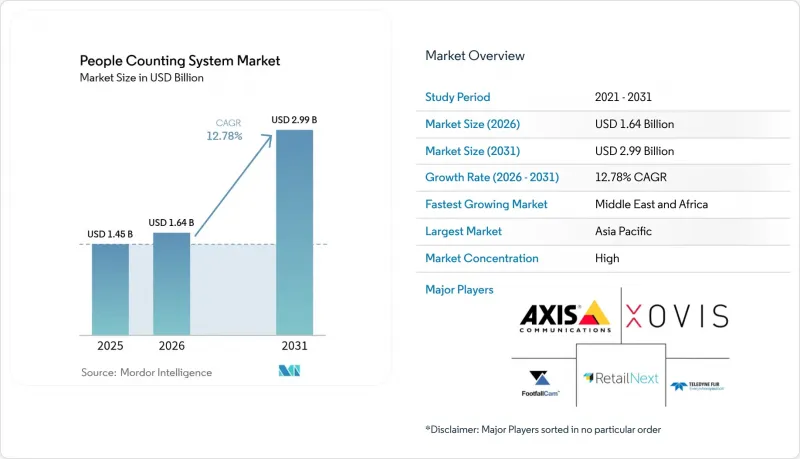
Mordor Intelligence에 의하면, 인원 계수 시스템 시장 규모는 2025년 14억 5,000만 달러, 2026년 16억 4,000만 달러에서 2031년까지 29억 9,000만 달러로 확대된다고 예측되고 있어 2026년부터 2031년까지 CAGR 12.78%를 기록할 전망입니다.
본 보고서는 제품군(하드웨어, 소프트웨어, 서비스), 센서 기술(적외선 빔, 열화상, 영상 기반 등), 배포 방식(On-Premise, 클라우드), 연결 방식(유선, 무선, LP-WAN), 최종 사용자 산업(소매, 쇼핑몰,교통, 호텔·레저 등) 및 지역별로 분류되어 있습니다. 시장 전망은 금액(달러) 기준으로 제시되어 있습니다.
전 세계 인원 계수 시스템 시장 동향 및 인사이트
북미 및 유럽의 스마트 리테일 분야에서 실시간 방문객 수 분석에 대한 수요
소매업체들은 전환율 향상 및 인력 배치 최적화를 위해 익명화된 방문객 수 데이터를 활용하고 있습니다. 미국 쇼핑몰의 사례에서는 분석 시스템 도입 후 매출이 5-15% 증가한 것으로 나타났습니다. Link Retail의 ‘LinkVision’ 카메라 소프트웨어는 기존 CCTV를 활용하여 95% 이상의 정확도를 실현함으로써, 유럽 체인점의 개조 비용을 절감하고 있습니다. Telstra가 2024년 호주 매장에서 전개할 계획은 이 회사의 세계 확장 역량을 입증하는 것으로, 95% 이상의 정확도와 개인정보 보호 위험을 해결하는 기기 내 처리를 결합하고 있습니다. 인파 데이터에 인구통계학적 메타데이터를 추가함으로써 소매업체는 데이터 공유로 인한 위험에 노출되지 않고 매장 레이아웃을 조정하며 타겟을 좁힌 프로모션을 실시할 수 있습니다. 이러한 주목할 만한 점은 인원 계수 시스템 시장이 옴니채널 전략의 핵심을 이루고 있음을 뒷받침합니다.
코로나19 사태 이후의 수용 인원 규제가 도입을 촉진(EU, 미국)
개정된 건축기준법에서는 비상시 대피 경로 확보 및 실내 공기질 모니터링을 지원하기 위해 실시간 인원 측정이 의무화되어 있으며, 이로 인해 의료시설 및 공공기관에서의 도입이 촉진되고 있습니다. GSA 오클라호마시티 연방 청사에서는 재실 센서를 빌딩 관리 시스템(BMS)과 연동하여 에너지 사용량을 41% 절감하고, 정부 조달 담당자에게 투자 대비 효과(ROI)를 입증했습니다. FootfallCam의 GDPR(EU 개인정보보호규정) 준수 설계는 칩 수준에서 데이터를 익명화하여 개인을 식별할 수 있는 이미지의 저장을 방지하면서도 측정 정확도를 유지하고 있습니다. 국토안보부가 2024년에 실시한 조사에서는 15가지 군중 분석 도구가 권장되었으며, 이는 이 기술이 공공 안전 대책에 있어 중요함을 뒷받침하고 있습니다. 따라서 엄격해진 규정 준수 요건은 도입을 촉진하는 요인이자 동시에 선별 기준으로도 작용하여, 정당한 개인정보 보호 대책을 입증한 공급업체에 유리하게 작용하고 있습니다.
GDPR(EU 개인정보보호규정)/CCPA의 개인정보 보호 규정 준수가 EU 및 캘리포니아주에서 카메라 기반 시스템 도입을 저해하고 있습니다.
엄격한 동의 규칙에 따라 공급업체는 익명화 기능과 로컬 처리를 통합해야 할 의무가 있으며, 이로 인해 부품 원가와 법무 컨설팅 비용이 증가하고 있습니다. Aura Vision의 기기 내 분석 기술은 이미지 저장을 피하고, 규제 당국의 요건을 충족하면서 방향별 집계 데이터를 확보하고 있습니다. ToF 센서가 대안으로 부상하고 있으며, 개인을 식별할 수 있는 프레임을 생성하지 않으면서 95% 이상의 정확도를 실현하여 인증 장벽을 완화하고 있습니다. 종단 간(end-to-end) 규정 준수를 검증할 수 있는 공급업체가 공공 조달에서 점점 더 선호되고 있으며, 이것이 인원 계수 시스템 시장 내의 경쟁 구도를 형성하고 있습니다.
부문 분석
하드웨어는 여전히 인원 계수 시스템 시장의 매출을 주도하고 있으며, 2025년에는 63.30%의 점유율을 차지할 전망입니다. 설비 투자는 소매점 입구, 공항 터미널, 공공시설에 설치되는 ToF 및 LiDAR 센서에 집중되고 있습니다. 한편, 사업자들이 분석 업무의 외부 위탁, 규정 준수 감사, 지속적인 보정을 요구함에 따라 매니지드 서비스 시장은 연평균 성장률(CAGR) 13.45%로 확대되고 있습니다. 일회성 도입에서 구독 모델로의 전환은 수익 전망을 바꾸고 지속 가능한 성장의 기반이 되고 있습니다. 인원 계수 시스템 업계 관계자들은 센서 업그레이드와 대시보드 교육을 결합한 교차 판매를 활용하여 다년 계약을 확보하고자 합니다. 소프트웨어 플랫폼은 타사 데이터를 통합하는 마이크로서비스로 전환되고 있으며, 예측 기반 인력 배치 및 에너지 최적화와 같은 이용 사례를 지원하고 있습니다.
통합이 심화되면서 복잡성이 증가하는 가운데, 서비스 기업들은 IT 보안, 시설 관리, 마케팅을 통합하는 오케스트레이터로서의 역할을 수행하고 있습니다. 점유율 데이터와 HVAC(공조) 일정을 연동하는 프로젝트는 구체적인 운영 비용(OPEX) 절감 효과를 입증하고 있으며, 이를 통해 건물 소유주는 고정자산 지출에서 성과 기반 계약으로의 전환을 추진하고 있습니다. 그 결과, 서비스 분야는 인류 측정 시스템 시장을 하드웨어 업데이트 주기에 그치지 않는 다양한 형태로 발전시키는 데 기여하고 있습니다.
적외선 빔 센서는 좁은 출입구에 설치 시 높은 신뢰성을 바탕으로 2025년에는 인원 계수 시스템 시장 점유율의 36.10%를 차지했습니다. 한편, ToF 3D 센서는 비이미지형 깊이 측정을 권장하는 개인정보 보호 관련 법규의 뒷받침을 받아 연평균 성장률(CAGR) 14.05%로 성장할 전망입니다. ToF는 빛의 비행 시간을 깊이 맵으로 변환하여 사람, 카트, 반려동물을 구별하며, 조명 조건이 변해도 정확도를 유지합니다. 이러한 변화는 GDPR(EU 개인정보보호규정)을 준수하는 로직을 탑재할 수 있는 독자적인 ToF ASIC을 보유한 벤더에게는 호재가 될 것입니다. 영상 기반 접근 방식은 개인의 영상 정보를 제거하는 엣지 측 추론으로의 전환을 통해 살아남고 있지만, 일부 구매자들은 여전히 신중한 태도를 고수하고 있습니다. 열화상 기술은 체온 검사와 인원 계수가 융합된 병원이라는 틈새 시장에서 자리 잡고 있습니다. ToF 센서와 관련된 인원 계수 시스템 시장 규모는 부품 비용의 하락에 따라 2030년까지 적외선 기술의 매출액을 넘어설 것으로 예측됩니다.
입구에서의 ToF와 개방 구역에서의 Wi-Fi 프로브를 결합한 하이브리드 방식의 도입은 멀티모달을 통한 고정밀도에 대한 관심이 높아지고 있음을 보여줍니다. 확장 가능한 깊이 추정에 관한 퀄컴의 특허 활동은 ToF의 성능을 급격한 향상 궤도에 계속 올려놓는 보다 광범위한 기술 스택에 대한 투자를 뒷받침하고 있습니다. 채택이 확대됨에 따라 규모의 경제 효과로 인해 가격이 더욱 하락하고, 전환의 기세가 더욱 강해질 것입니다.
지역별 분석
아시아태평양은 정부 주도의 스마트 시티 구상과 단가를 낮추는 현지 생산 센서 하드웨어에 힘입어 2025년에는 매출의 31.10%를 차지할 것으로 전망됩니다. 싱가포르의 MRT는 카메라 업그레이드와 승차권 데이터를 활용하여 혼잡 경보를 발령하고 있으며, 홍콩에서는 철도 안전을 확보하기 위해 LiDAR를 활용한 엣지 AI를 통합하고 있습니다. 일본의 JR 동일본은 약 600개 역에 걸친 Suica 거래 로그를 처리하여 통근자 흐름을 모델화하고, 그 데이터를 교통 계획과 소매점 배치 모두에 활용하고 있습니다. 중국의 2선 도시에서 도시화가 진행됨에 따라 군중 관리 키트에 대한 대량 주문이 촉진되고 있으며, 동남아시아의 공항에서는 보안 검색 대기 시간을 단축하기 위해 ToF 카운터가 도입되고 있습니다. 이러한 연계된 인프라 구축 노력이 인원 계수 시스템 시장에서 해당 지역의 장기적인 우위를 공고히 하고 있습니다.
중동은 연평균 성장률(CAGR) 13.85%를 기록하며 가장 빠르게 성장하는 지역으로 부상하고 있습니다. ‘비전 2030’ 프로그램은 사우디아라비아, 아랍에미리트(UAE), 카타르에서의 대규모 센서 도입을 뒷받침하고 있습니다. Bold Technologies는 모빌리티, 헬스케어, 에너지 데이터를 단일 AI 레이어에서 융합하는 ‘Aion Sentia’ 인지 시티 플랫폼에 25억 달러를 투자하고 있습니다. 두바이는 도로 수준의 센서를 활용한 도시 전체의 디지털 트윈 구현을 목표로 하고 있으며, 이로 인해 인파 분석 제공업체에 대한 비즈니스 기회가 확대되고 있습니다. MENA 지역의 분석 스타트업에 대한 벤처 캐피털 유입은 현지 공급 역량이 강화되고 있음을 보여줍니다.
북미에서는 소매 업계의 설비 교체 주기와 연방 정부 시설의 의무화 조치로 인해 도입이 지속되고 있습니다. 2025년에 미국 쇼핑몰의 방문객이 회복됨에 따라, 직원과 방문객을 구분하는 기능에 대한 수요가 다시 불붙고 있습니다. 유럽의 GDPR(EU 개인정보보호규정) 규제는 프라이버시를 중시하는 ToF(비행 시간) 기술과 엣지 측 영상 솔루션을 촉진하고 있으며, 신규 도입보다는 기존 시스템의 업그레이드를 뒷받침하고 있습니다. 남미에서는 중소기업(SMB)의 비용 대비 효과 문제에 직면해 있는 반면, 아프리카의 초기 단계에 있는 스마트 시티 계획은 장기적인 성장 잠재력을 지니고 있습니다.
기타 혜택:
- 엑셀 형식 시장 예측(ME) 시트
- 3개월간의 애널리스트 지원
자주 묻는 질문
목차
제1장 서론
제2장 조사 방법
제3장 주요 요약
제4장 시장 구도
제5장 시장 규모와 성장 예측
제6장 경쟁 구도
제7장 시장 기회와 향후 전망
JHS 26.09.09According to Mordor Intelligence, the people counting system market size is projected to expand from USD 1.45 billion in 2025 and USD 1.64 billion in 2026 to USD 2.99 billion by 2031, registering a CAGR of 12.78% between 2026 to 2031.
This report is Segmented by Offering (Hardware, Software, Services), Sensor Technology (Infrared Beam, Thermal Imaging, Video-Based and More), Deployment Mode (On-Premise, Cloud), Connectivity (Wired, Wireless, LP-WAN), End-User Vertical (Retail, Malls, Transportation, Hospitality and More), and by Geography. The Market Forecasts are Provided in Terms of Value (USD).
Global People Counting System Market Trends and Insights
Smart-retail demand for real-time footfall analytics in North America and Europe
Retailers rely on anonymized footfall data to raise conversion and calibrate staffing; evidence from U.S. malls shows 5-15% revenue uplift after analytics rollouts. Link Retail's LinkVision camera software leverages existing CCTV to surpass 95% accuracy, lowering retrofit costs for European chains. Telstra's 2024 deployment across Australian stores underscores global reach, pairing >95% accuracy with on-device processing that addresses privacy risk. By enriching traffic counts with demographic metadata, retailers adjust layouts and execute targeted promotions without data-sharing exposure. These traction points reinforce the People Counting System market as a core pillar of omnichannel strategy.
Post-COVID occupancy compliance mandates fueling installations (EU, US)
Revised building codes now require live head-counting to support emergency egress and indoor-air-quality monitoring, spurring adoption in health facilities and public offices. The GSA Oklahoma City Federal Building linked occupancy sensors to its BMS and cut energy use 41%, proving ROI to government buyers. GDPR-aligned designs from FootfallCam anonymize data at chip level, preventing storage of personal imagery while sustaining counting fidelity. Homeland Security's 2024 survey that endorsed 15 crowd-analysis tools confirms the technology's relevance to public-safety readiness. Heightened compliance requirements therefore work as both catalyst and filter, rewarding vendors with defensible privacy credentials.
GDPR/CCPA privacy compliance hindering camera-based adoption in EU and CA
Stringent consent rules compel vendors to embed anonymization and local processing, raising bill-of-materials and legal consultancy costs. Aura Vision's on-device analytics avoid image storage, satisfying regulators yet still capturing directional counts. ToF sensors emerge as a substitute, providing >95% accuracy without identifiable frames, easing certification hurdles. Vendors that can verify end-to-end compliance are increasingly favored in public tenders, which shapes competitive dynamics within the People Counting System market.
Other drivers and restraints analyzed in the detailed report include:
- Smart-city transportation hubs deploying crowd-flow sensors across Asia
- AI-enabled video analytics cutting TCO and boosting accuracy
- Accuracy gaps in open-area counting reducing buyer confidence (stadiums)
For complete list of drivers and restraints, kindly check the Table Of Contents.
Segment Analysis
Hardware continues to dominate People Counting System market revenue, holding 63.30% share in 2025. Capital outlays concentrate on ToF and LiDAR sensors installed across retail thresholds, airport terminals, and public facilities. Managed services, however, are climbing at a 13.45% CAGR as operators seek outsourced analytics, compliance auditing, and continuous calibration. The migration from one-off installs to subscription models transforms revenue visibility and underpins sustainable growth. People Counting System industry participants leverage cross-selling-pairing sensor upgrades with dashboard training-to lock in multi-year contracts. Software platforms move toward micro-services that ingest third-party data, supporting predictive staffing and energy-optimization use cases.
Integration depth raises complexity, positioning services firms as orchestrators that align IT security, facilities management, and marketing. Projects that join occupancy data with HVAC schedules demonstrate tangible opex gains, encouraging building owners to shift spending from fixed assets to outcome-based agreements. As a result, the services category helps diversify the People Counting System market beyond hardware refresh cycles.
Infrared beam sensors captured 36.10% of People Counting System market share in 2025 on the back of reliability in narrow-door installations. Yet ToF 3D sensors are set to expand at a 14.05% CAGR, catalyzed by privacy laws that favor non-imaging depth measurement. By converting light-flight time into depth maps, ToF differentiates people from carts and pets, sustaining accuracy under changing lighting. The shift bodes well for vendors with proprietary ToF ASICs that can embed GDPR-inclusive logic. Video-based approaches survive by pivoting to on-edge inference that strips personal imagery, but some buyers remain cautious. Thermal imaging occupies a niche in hospitals where temperature screening merges with head counts. The People Counting System market size tied to ToF sensors is projected to eclipse infrared revenues before 2030 as component cost curves decline.
Hybrid deployments that blend ToF at entry points with Wi-Fi probes in open zones demonstrate rising interest in multimodal precision. Qualcomm's patent work on scalable depth estimation underscores wider tech-stack investment that will keep ToF on a steep performance trajectory. As adoption broadens, economies of scale further compress price points, reinforcing switch-over momentum.
Complete Report Scope:
- By Offering
- Hardware
- Software
- Services
- By Sensor Technology
- Infrared Beam
- Thermal Imaging (IR)
- Video-Based (Mono / Stereo / AI)
- Time-of-Flight (3-D)
- Pressure and Magnetic
- Wi-Fi / BLE Probe
- By Deployment Mode
- On-Premise
- Cloud
- By Connectivity
- Wired (Ethernet / PoE)
- Wireless (Wi-Fi)
- LP-WAN (LoRa, Zigbee, BLE)
- By End-User Vertical
- Retail Stores
- Shopping Malls and Hypermarkets
- Transportation Hubs (Airports / Metro / Bus)
- Hospitality and Leisure (Hotels, Casinos, Theme Parks)
- Sports and Entertainment Venues
- Banks and Financial Institutions
- Corporate and Government Buildings
- Healthcare Facilities
- Smart Cities and Public Spaces
- Others
- By Geography
- North America
- United States
- Canada
- Mexico
- South America
- Brazil
- Argentina
- Chile
- Rest of South America
- Europe
- United Kingdom
- Germany
- France
- Italy
- Spain
- Nordics (Sweden, Norway, Denmark, Finland)
- Rest of Europe
- Asia Pacific
- China
- Japan
- India
- South Korea
- Southeast Asia
- Australia
- New Zealand
- Rest of Asia Pacific
- Middle East and Africa
- Middle East
- Saudi Arabia
- United Arab Emirates
- Turkey
- Rest of Middle East
- Africa
- South Africa
- Nigeria
- Rest of Africa
- Middle East
- North America
Geography Analysis
Asia Pacific holds a 31.10% revenue stake in 2025, propelled by government-funded smart-city frameworks and locally manufactured sensor hardware that compresses unit costs. Singapore's MRT applies camera upgrades and ticket data to push crowdedness alerts, while Hong Kong integrates LiDAR-backed edge AI for railway safety. Japan's JR East processes Suica transaction logs across ~600 stations to model commuter flow, feeding both transport planning and retail placement. China's tier-two city urbanization fuels bulk orders for crowd-management kits, and Southeast Asian airports deploy ToF counters to speed security lines. These coordinated infrastructure goals cement the region's long-term dominance within the People Counting System market.
The Middle East emerges as the fastest-growing geography at a 13.85% CAGR. Vision 2030 programs back large-scale sensor rollouts in Saudi Arabia, the UAE, and Qatar. Bold Technologies allocates USD 2.5 billion to the Aion Sentia cognitive-city platform that fuses mobility, healthcare, and energy data on one AI layer. Dubai targets a city-wide digital twin via street-level sensors, expanding opportunities for crowd analytics providers. Venture-capital flows into MENA analytics startups indicate rising local supply capacity.
North America sustains adoption through retail refresh cycles and federal facility mandates. The return of U.S. mall shoppers in 2025 renews appetite for staff-versus-shopper differentiation features. Europe's GDPR regime fosters privacy-centric ToF and on-edge video solutions, stimulating upgrades rather than greenfield sales. South America grapples with SMB affordability, while Africa's nascent smart-city schemes provide longer-dated upside.
- RetailNext Inc.
- Sensormatic Solutions (ShopperTrak)
- Axis Communications AB
- Teledyne FLIR Systems Inc.
- HELLA Aglaia Mobile Vision GmbH
- IEE S.A.
- InfraRed Integrated Systems Ltd. (IRISYS)
- Traf-Sys Inc.
- FootfallCam Ltd.
- V-Count Inc.
- Xovis AG
- iris-GmbH infrared and intelligent sensors
- DILAX Intelcom GmbH
- Eurotech S.p.A.
- SensMax Ltd.
- Countlogic LLC
- Dor Technologies Inc.
- Density Inc.
- Cognimatics AB
- Megvii Technology Ltd.
Additional Benefits:
- The market estimate (ME) sheet in Excel format
- 3 months of analyst support
TABLE OF CONTENTS
1 INTRODUCTION
- 1.1 Study Assumptions and Market Definition
- 1.2 Scope of the Study
2 RESEARCH METHODOLOGY
3 EXECUTIVE SUMMARY
4 MARKET LANDSCAPE
- 4.1 Market Overview
- 4.2 Market Drivers
- 4.2.1 Smart-Retail Demand for Real-Time Footfall Analytics in North America and Europe
- 4.2.2 Post-COVID Occupancy Compliance Mandates Fueling Installations (EU, US)
- 4.2.3 Smart-City Transportation Hubs Deploying Crowd-Flow Sensors Across Asia
- 4.2.4 AI-Enabled Video Analytics Cutting TCO and Boosting Accuracy
- 4.2.5 HVAC Energy-Optimization via Occupancy Integration in Commercial Buildings
- 4.2.6 Venture-Capital Surge into MENA Footfall-as-a-Service Platforms
- 4.3 Market Restraints
- 4.3.1 GDPR/CCPA Privacy Compliance Hindering Camera-Based Adoption in EU and CA
- 4.3.2 Accuracy Gaps in Open-Area Counting Reducing Buyer Confidence (Stadiums)
- 4.3.3 Legacy BMS Integration Complexity in Emerging Markets
- 4.3.4 Price Sensitivity of SMB Retailers in South America
- 4.4 Regulatory and Technological Outlook
- 4.5 Porter's Five Forces Analysis
- 4.5.1 Bargaining Power of Suppliers
- 4.5.2 Bargaining Power of Buyers
- 4.5.3 Threat of New Entrants
- 4.5.4 Threat of Substitutes
- 4.5.5 Competitive Rivalry
- 4.6 Technology Snapshot
- 4.6.1 Wired Sensors
- 4.6.2 Wireless (Wi-Fi / BLE / LoRa)
- 4.6.3 Thermal Imaging Sensors
- 4.6.4 Time-of-Flight 3-D Sensors
- 4.6.5 Other Technologies (Pressure Mats, Magnetic, LiDAR)
5 MARKET SIZE AND GROWTH FORECASTS (VALUE)
- 5.1 By Offering
- 5.1.1 Hardware
- 5.1.2 Software
- 5.1.3 Services
- 5.2 By Sensor Technology
- 5.2.1 Infrared Beam
- 5.2.2 Thermal Imaging (IR)
- 5.2.3 Video-Based (Mono / Stereo / AI)
- 5.2.4 Time-of-Flight (3-D)
- 5.2.5 Pressure and Magnetic
- 5.2.6 Wi-Fi / BLE Probe
- 5.3 By Deployment Mode
- 5.3.1 On-Premise
- 5.3.2 Cloud
- 5.4 By Connectivity
- 5.4.1 Wired (Ethernet / PoE)
- 5.4.2 Wireless (Wi-Fi)
- 5.4.3 LP-WAN (LoRa, Zigbee, BLE)
- 5.5 By End-User Vertical
- 5.5.1 Retail Stores
- 5.5.2 Shopping Malls and Hypermarkets
- 5.5.3 Transportation Hubs (Airports / Metro / Bus)
- 5.5.4 Hospitality and Leisure (Hotels, Casinos, Theme Parks)
- 5.5.5 Sports and Entertainment Venues
- 5.5.6 Banks and Financial Institutions
- 5.5.7 Corporate and Government Buildings
- 5.5.8 Healthcare Facilities
- 5.5.9 Smart Cities and Public Spaces
- 5.5.10 Others
- 5.6 By Geography
- 5.6.1 North America
- 5.6.1.1 United States
- 5.6.1.2 Canada
- 5.6.1.3 Mexico
- 5.6.2 South America
- 5.6.2.1 Brazil
- 5.6.2.2 Argentina
- 5.6.2.3 Chile
- 5.6.2.4 Rest of South America
- 5.6.3 Europe
- 5.6.3.1 United Kingdom
- 5.6.3.2 Germany
- 5.6.3.3 France
- 5.6.3.4 Italy
- 5.6.3.5 Spain
- 5.6.3.6 Nordics (Sweden, Norway, Denmark, Finland)
- 5.6.3.7 Rest of Europe
- 5.6.4 Asia Pacific
- 5.6.4.1 China
- 5.6.4.2 Japan
- 5.6.4.3 India
- 5.6.4.4 South Korea
- 5.6.4.5 Southeast Asia
- 5.6.4.6 Australia
- 5.6.4.7 New Zealand
- 5.6.4.8 Rest of Asia Pacific
- 5.6.5 Middle East and Africa
- 5.6.5.1 Middle East
- 5.6.5.1.1 Saudi Arabia
- 5.6.5.1.2 United Arab Emirates
- 5.6.5.1.3 Turkey
- 5.6.5.1.4 Rest of Middle East
- 5.6.5.2 Africa
- 5.6.5.2.1 South Africa
- 5.6.5.2.2 Nigeria
- 5.6.5.2.3 Rest of Africa
- 5.6.5.1 Middle East
- 5.6.1 North America
6 COMPETITIVE LANDSCAPE
- 6.1 Market Concentration
- 6.2 Strategic Moves
- 6.3 Market Share Analysis
- 6.4 Company Profiles (includes Global level Overview, Market level overview, Core Segments, Financials as available, Strategic Information, Market Rank/Share for key companies, Products and Services, and Recent Developments)
- 6.4.1 RetailNext Inc.
- 6.4.2 Sensormatic Solutions (ShopperTrak)
- 6.4.3 Axis Communications AB
- 6.4.4 Teledyne FLIR Systems Inc.
- 6.4.5 HELLA Aglaia Mobile Vision GmbH
- 6.4.6 IEE S.A.
- 6.4.7 InfraRed Integrated Systems Ltd. (IRISYS)
- 6.4.8 Traf-Sys Inc.
- 6.4.9 FootfallCam Ltd.
- 6.4.10 V-Count Inc.
- 6.4.11 Xovis AG
- 6.4.12 iris-GmbH infrared and intelligent sensors
- 6.4.13 DILAX Intelcom GmbH
- 6.4.14 Eurotech S.p.A.
- 6.4.15 SensMax Ltd.
- 6.4.16 Countlogic LLC
- 6.4.17 Dor Technologies Inc.
- 6.4.18 Density Inc.
- 6.4.19 Cognimatics AB
- 6.4.20 Megvii Technology Ltd.
7 MARKET OPPORTUNITIES AND FUTURE OUTLOOK
- 7.1 White-Space and Unmet-Need Assessment


