

|
시장보고서
상품코드
2123102
스마트 침대 시장 : 시장 점유율 분석, 업계 동향 및 통계, 성장 예측(2026-2031년)Smart Bed - Market Share Analysis, Industry Trends & Statistics, Growth Forecasts (2026 - 2031) |
||||||
 Mordor Intelligence
Mordor Intelligence에 의하면, 2026년 스마트 침대 시장 규모는 33억 7,000만 달러로 추정되고, 2025년 32억 1,000만 달러에서 확대해, 2031년에는 42억 8,000만 달러에 이를 것으로 예측됩니다.
2026-2031년 연평균 성장률(CAGR) 4.92%로 성장할 것으로 전망됩니다.
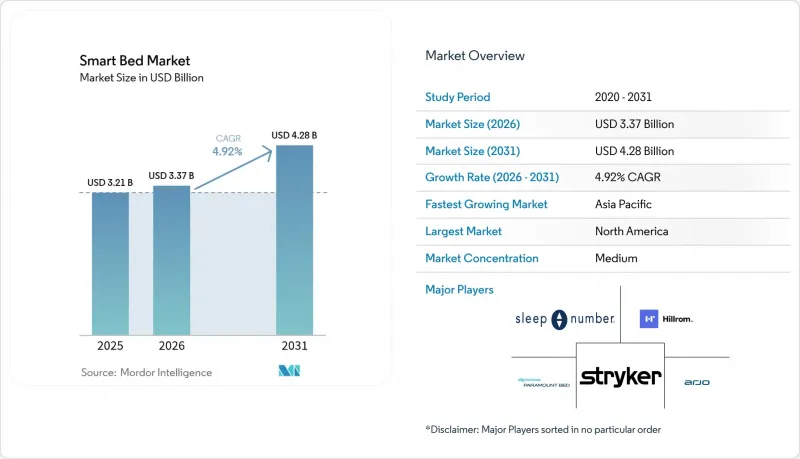
본 보고서는 제품별(수동식 침대, 반전동식 침대, 전전동식 침대), 최종 사용자별(주거용 및 상업용), 유통 채널별(B2C/소매, B2B/프로젝트), 지역별(북미, 남미, 유럽, 아시아태평양, 중동 및 아프리카)로 분류되어 있습니다. 시장 전망은 금액(달러) 기준으로 제시되어 있습니다.
세계의 스마트 침대 시장 동향 및 인사이트
IoT 기반 급성기 후 관리로의 도입
스마트 침대는 환자가 급성기 병동에서 퇴원한 후, 간병인이 환자의 상태를 파악하는 방식을 재정의하고 있습니다. 내장 센서가 심박수, 호흡, 움직임, 수면의 질을 추적하고, 그 정보를 ISO/IEEE 11073-10206 상호 운용성 표준에 따라 병원 기록으로 직접 전송합니다. 24년에 실시된 다기관 파일럿 연구(24시간 침대 기반 모니터링이 30일 이내 재입원을 줄일 수 있는지 검증하기 위해 설계된 연구)에 따르면, 커넥티드 침대 그룹에서 전년도에 치료를 받은 대조군에 비해 재입원률이 23% 감소한 것으로 나타났습니다. 연구진은 실시간 경보를 통해 임상의가 예정된 활력 징후 순회를 기다리지 않고, 이상 징후가 나타나는 초기 단계에서 개입할 수 있는지 여부를 밝히는 것을 목표로 했습니다. 같은 해 발표된 병행 연구에서는 무선 생체 모니터링 기기가 유선 리드선을 대체할 수 있으며, 환자의 이동 자유도를 높이는 동시에 의료진에게 지속적으로 데이터를 전송할 수 있음이 입증되었습니다. 이러한 결과를 종합해 보면, 재입원과 관련된 행정 업무가 아닌 예방적 경보가 워크플로우를 주도하는 치료 모델이 제시되고 있으며, 이 모든 측면에서 안전성 및 데이터 무결성에 관한 FDA의 의료기기 지침을 충족하고 있습니다.
고급 호텔에서의 스마트 조절식 침대 도입
부티크 호텔과 도시의 유명 호텔에서는 수면을 수익원으로 재정의하고, 각 투숙객의 일주기 리듬에 맞추어 경도, 표면 온도, 허리 지지력을 자동으로 미세 조정하는 커넥티드 침대를 도입하고 있습니다. 각 시설에서는 이 기술을 도입한 후 1박당 요금이 최대 15% 상승했다고 보고되고 있습니다. 이는 체인 전체에서 선호하는 수면 설정을 저장할 수 있는 앱 내 체크인 기능에 의해 뒷받침되고 있습니다. 도입 증가세가 가장 두드러지는 곳은 부티크 리조트로, 이곳에서는 독자적인 웰니스 기능이 즉시 예약률 향상과 만족도 점수 상승으로 이어지고 있으며, 프리미엄 시장의 최상위층을 이끄는 것은 가격이 아니라 경험이라는 사실이 입증되고 있습니다. 또한, 클라우드 기반 시설 관리 대시보드는 운영자가 예측 유지보수 일정을 수립하는 데 도움을 주어 자산의 수명을 연장하고 브랜드 일관성을 유지하고 있습니다. 투자 회수 기간이 짧기 때문에 아시아태평양의 리조트와 유럽의 웰니스 리트리트에서 도입이 가속화되고 있으며, 스마트 침대 시장에는 비용 경쟁이 아닌 경험의 차별화를 통해 번영하는 활기찬 프리미엄 상업용 하위 부문이 형성되고 있습니다.
공립 병원의 예산 동결로 인해 병상 교체 주기가 지연되고 있습니다.
팬데믹의 여파로 인한 재정적 압박으로 인해, 유럽 및 북미의 공립 의료 기관은 병상의 수명을 최대 15년까지 연장할 수밖에 없는 상황입니다. 노후된 설비에는 최신 센서가 탑재되어 있지 않고, 전자 차트와의 연동도 불가능하기 때문에 공립 병동과 민간 자금으로 운영되는 시설 간의 격차가 확대되고 있습니다. 각 제조업체는 현재 후장착용 센서 매트나 클립식 게이트웨이를 판매하고 있지만, 이러한 부분적인 대책으로는 기본적인 생체 신호만 측정할 수 있을 뿐, 소프트웨어 기반의 편의 기능은 제외되어 있습니다. 그 결과 발생한 양극화된 환경은 최대 기관 구매자 부문에서의 판매량 증가를 둔화시키고 있지만, 한편으로는 향후 완전한 스마트 프레임으로 전환 가능한 모듈식 애드온의 혁신을 촉진하고 있습니다.
부문 분석
완전 전동 모델은 2025년 매출의 59.40%를 차지했으며, 스마트 침대 시장의 주축을 이루고 있습니다. 다축 모터가 욕창 예방을 위한 자동 루틴과 환자의 부담 없는 이동을 가능하게 하기 때문입니다. 이 부문은 연평균 성장률(CAGR) 4.55%로 확대될 것으로 예상되며, 음성 어시스턴트 및 건강 기록 API와 같은 연결 기능이 추가되어 침대가 케어 플랫폼으로 변모하고 있습니다. 통합된 마이크로컨트롤러를 통해 밀리초 단위의 체압 재분배가 가능해졌으며, 내장된 RFID 코일은 수면 무호흡증 선별 검사에 유효성이 확인된 수면 자세 데이터를 수집합니다. 그 결과, 임상적 유용성이 향상되어 병원에서 프리미엄 가격 책정을 정당화할 뿐만 아니라 가정에서도 구체적인 건강상의 이점을 제공합니다.
세미 전동식 설계 제품은 등받이와 무릎 부분의 전동 가동 기능을 갖추고 있으면서도 높이 조절에는 수동 크랭크를 채택하고 있어, 신흥 시장의 가격에 민감한 구매자나 자금 사정이 어려운 장기 요양 시설을 대상으로 포지셔닝되어 있습니다. 전력 공급이 불안정한 지역이나 규제로 인해 전동 가구 사용이 제한된 지역에서는 여전히 수동식 프레임이 사용되고 있습니다. 이러한 저사양 카테고리는 시장 진입의 발판을 제공하지만, 펌웨어 업그레이드를 통해 지속적인 수익을 창출하는 완전 전동 제품군에서 혁신은 계속해서 집중되고 있습니다. 그 결과, 각 제조업체는 향후 출하될 제품에 대응할 수 있도록 소프트웨어 확장성과 모듈식 센서 베이를 우선시하고 있으며, 스마트 침대 시장이 완전한 디지털 아키텍처로 꾸준히 전환되는 추세가 강화되고 있습니다.
지역별 분석
북미는 2025년 매출의 41.60%를 차지했습니다. 이는 첨단 의료 제공 인프라, 낙상 방지 기술을 장려하는 보험사의 인센티브, 그리고 재택 웰니스 기기에 대한 높은 재량 지출에 힘입은 결과입니다. 통합된 전자 의료 기록(EMR) 환경은 조달 위원회가 간호 시간 절감 및 입원 일수 단축을 정량적으로 평가할 수 있게 함으로써 의료 기관에서의 도입을 가속화하고 있습니다. 고소득 가구에서는 웨어러블 기기와 연동되는 프리미엄 조절식 침대 베이스가 받아들여지고 있어, 이 지역 내 부문 전반에 걸친 활용 범위가 확대되고 있습니다. 캐나다는 미국과 유사한 추세를 보이고 있으나 규모는 더 작으며, 멕시코에서는 민간 3차 의료기관 및 해안 리조트 지역에서 성장세가 두드러집니다.
아시아태평양은 가장 빠르게 성장하는 시장으로, 도시 지역의 소득 증가와 모바일 상거래의 보급을 반영하여 연평균 성장률(CAGR) 6.15%가 예상됩니다. 중국에서는 주민의 64%가 수면의 질에 대해 우려를 표명하고 있으며, 기존 스마트 홈 생태계에 통합할 수 있는 알고리즘 제어 침구에 대한 수요가 증가하고 있습니다. 각 브랜드는 D2C(소비자 직접 판매) 앱을 활용하여 펌웨어 업데이트를 배포하고, 새로 식별된 코골이 패턴에 대응하는 동시에 사용자 유지율을 높이고 있습니다. 한국에서는 기술을 적극적으로 수용하는 문화가 AI 기반 수면 코칭의 급속한 보급을 뒷받침하고 있는 반면, 일본에서는 고령화 사회가 진행됨에 따라 야간에 화장실에 가기 위해 일어나는 것을 감지하여 간병인에게 알림을 보내는 침대에 대한 수요가 증가하고 있습니다. 인도에서는 도시 지역의 부유층이 수입된 무선 모니터링 프레임을 구매함에 따라 시장이 서서히 확대되고 있으며, 호주에서는 보험사가 자금을 지원하는 재택 원격의료 시범 사업을 통해 1인당 도입률이 선두를 달리고 있습니다.
유럽에서는 독일, 프랑스, 영국을 중심으로 견조한 판매량을 유지하고 있으며, 각국의 의료 혁신과 엄격한 데이터 거버넌스 요건 간의 균형이 잘 잡혀 있습니다. GDPR(EU 개인정보보호규정)은 사용자 간의 신뢰를 구축하는 한편, 클라우드 분석에 의존하는 업그레이드 시장 출시 시기를 늦추고 있습니다. 북유럽 국가에서는 스마트 홈 기기의 광범위한 보급과 수면 건강 개입 비용을 보조하는 국가 지원 프로그램의 영향으로 가구 보급률이 가장 높습니다. 남유럽에서는 고급 리조트가 객실 등급을 차별화하기 위해 커넥티드 침구를 도입하는 등, 호스피탈리티 업계 주도의 성장이 나타나고 있습니다. 그러나 공공 부문의 예산 상한선으로 인해 병원의 설비 갱신 주기가 지연되고 있어, 제조업체들은 의료 서비스의 질을 유지하면서 기존 자산을 연장할 수 있는 사후 장착형 센서 키트의 판매를 추진하고 있습니다.
기타 혜택 :
- 엑셀 형식 시장 예측(ME) 시트
- 3개월간의 애널리스트 지원
자주 묻는 질문
목차
제1장 서론
제2장 조사 방법
제3장 주요 요약
제4장 시장 구도
제5장 시장 규모 및 성장 예측
제6장 경쟁 구도
제7장 시장 기회 및 향후 전망
AJY 26.09.07According to Mordor Intelligence, the smart bed market size in 2026 is estimated at USD 3.37 billion, growing from 2025 value of USD 3.21 billion with 2031 projections showing USD 4.28 billion, growing at 4.92% CAGR over 2026-2031.
This report is Segmented by Product (Manual Beds, Semi-Electric Beds, and Fully Electric Beds), End User (Residential and Commercial), Distribution Channel (B2C/Retail, B2B/Projects), and Geography (North America, South America, Europe, Asia-Pacific, Middle East and Africa). The Market Forecasts are Provided in Terms of Value (USD).
Global Smart Bed Market Trends and Insights
IoT-enabled Post-Acute-Care Adoption
Smart beds are redefining how caregivers keep tabs on patients once they leave the acute ward. Built-in sensors track heart rate, breathing, movement, and sleep quality, then stream that information straight into hospital records under the ISO/IEEE 11073-10206 interoperability standard . A 2024 multi-facility pilot-designed to test whether round-the-clock, bed-based monitoring could cut 30-day returns-found that the connected-bed cohort recorded a 23% drop in readmissions compared with matched patients treated the previous year. Researchers aimed to determine whether real-time alerts would let clinicians intervene at the first sign of trouble rather than waiting for scheduled vital-sign rounds. Parallel work published the same year showed that wireless biomonitoring hardware can replace tethered leads, giving patients more freedom of movement while still feeding continuous data back to the care team . Taken together, these results point to a care model where proactive alerts-not readmission paperwork-drive the workflow, all while meeting FDA device guidelines for safety and data integrity.
Premium-Hotel Deployment of Smart Adjustable Beds
Boutique hotels and marquee city properties are re-imagining sleep as a revenue lever, integrating connected beds that automatically fine-tune firmness, surface temperature, and lumbar support to each guest's circadian rhythm. Properties report nightly rate uplifts of up to 15% after introducing the technology, supported by in-app check-in that stores preferred sleep settings across chains. The adoption curve is steepest in boutique resorts, where unique wellness features translate quickly into higher booking rates and stronger satisfaction scores, confirming that experience, not price, is steering the premium end of the market . Cloud-based fleet dashboards also help operators schedule predictive maintenance, extending asset life and protecting brand consistency. Short payback periods are fueling rollouts across Asia-Pacific resort destinations and European wellness retreats, giving the smart bed market a vibrant premium-commercial subsegment that thrives on experiential differentiation rather than cost competition.
Public-Hospital Budget Freezes Delaying Replacement Cycles
Fiscal pressures stemming from pandemic aftershocks compel European and North American public systems to stretch bed lifespans up to 15 years. Aging fleets lack modern sensors and cannot connect to electronic records, widening the gap between public wards and privately funded facilities. Manufacturers now market retrofit sensor mats and clip-on gateways, but these partial fixes capture only basic vitals and omit software-driven comfort features. The resulting two-tier environment slows volume growth in the largest institutional buyer segment, although it also spurs innovation in modular add-ons that can later be migrated to full smart frames.
Other drivers and restraints analyzed in the detailed report include:
- Aging Population and Government Health Directives
- E-commerce-led AI Sleep-Tracking Bed Sales
- General Data Protection Regulation (GDPR)-Driven Cloud-Connectivity Compliance Costs
For complete list of drivers and restraints, kindly check the Table Of Contents.
Segment Analysis
Fully electric models controlled 59.40% of 2025 revenue and anchor the smart bed market because their multi-axis motors support automated anti-pressure-injury routines and effortless patient mobilization. This segment is forecast to expand to a 4.55% CAGR, adding connectivity layers such as voice assistants and health-record APIs that transform beds into care platforms. Integrated micro-controllers now enable millisecond-level pressure redistribution, and embedded RFID coils capture sleep posture data validated for sleep-apnea screening. The result is enhanced clinical utility that justifies premium pricing in hospitals and delivers tangible wellness benefits in homes.
Semi-electric designs offer electric back and knee articulation but retain manual height cranks, positioning them for price-sensitive buyers in emerging markets or cash-strapped long-term care facilities. Manual frames persist where grid power is unreliable or regulatory rules restrict electrified furniture. While these lower-spec categories provide entry points, innovation continues to cluster inside fully electric portfolios where firmware upgrades unlock recurring revenue. Consequently, manufacturers prioritize software scalability and modular sensor bays that future-proof new shipments, reinforcing the smart bed market's steady migration toward fully digital architectures.
Complete Report Scope:
- By Product
- Manual Beds
- Semi-Electric Beds
- Fully Electric Beds
- By End User
- Residential
- Commercial
- Hospitals
- Long-Term-Care Facilities
- Home-Healthcare Settings
- Hotels & Resorts
- Others
- By Distribution Channel
- B2C/Retail
- Home Centers
- Specialty Furniture Stores
- Online
- Other Distribution Channels
- B2B/Projects (directly to businesses)
- B2C/Retail
- By Geography
- North America
- Canada
- United States
- Mexico
- South America
- Brazil
- Peru
- Chile
- Argentina
- Rest of South America
- Europe
- United Kingdom
- Germany
- France
- Spain
- Italy
- BENELUX (Belgium, Netherlands, and Luxembourg)
- NORDICS (Denmark, Finland, Iceland, Norway, and Sweden)
- Rest of Europe
- Asia-Pacific
- India
- China
- Japan
- Australia
- South Korea
- South East Asia (Singapore, Malaysia, Thailand, Indonesia, Vietnam, and Philippines)
- Rest of Asia-Pacific
- Middle East And Africa
- United Arab of Emirates
- Saudi Arabia
- South Africa
- Nigeria
- Rest of Middle East And Africa
- North America
Geography Analysis
North America commanded 41.60% of 2025 revenue, propelled by advanced care-delivery infrastructure, payer incentives that reward fall-prevention technology, and high discretionary spending on at-home wellness devices. Integrated EMR environments accelerate institutional adoption because procurement committees can quantify nursing-hour savings and shorter lengths of stay. High-income households embrace premium adjustable bases that sync with wearables, expanding the region's cross-segment usage footprint. Canada mirrors the United States but on a smaller scale, and Mexico shows momentum in private tertiary hospitals and coastal resort corridors.
Asia-Pacific is the fastest-growing territory, posting a 6.15% CAGR forecast that reflects rising urban incomes and the ubiquity of mobile commerce. In China, 64% of residents expressed sleep-quality concerns, steering them toward algorithm-guided bedding that slots into existing smart-home ecosystems. Brands leverage direct-to-consumer apps to roll out firmware updates, addressing newly identified snoring patterns and boosting user retention. South Korea's tech-forward culture fuels rapid uptake of AI-driven sleep coaching, while Japan's aging society spurs demand for beds that flag nocturnal bathroom trips and trigger caregiver alerts. India edges forward as premium urban consumers purchase imported wireless monitoring frames, and Australia leads per-capita adoption through insurer-funded home tele-health pilots.
Europe maintains solid volume anchored in Germany, France, and the United Kingdom, each balancing healthcare innovation with strict data-governance mandates. GDPR builds trust among users but slows time-to-market for upgrades that rely on cloud analytics. Nordic countries register the highest household penetration, reflecting broad acceptance of smart-home devices and state-backed programs that reimburse sleep-health interventions. Southern Europe shows hospitality-led growth as upscale resorts use connected bedding to differentiate room categories. Public-sector budget caps, however, delay hospital refresh cycles, prompting manufacturers to push retrofit sensor kits that extend legacy assets while preserving care-quality gains.
- Sleep Number Corporation
- Hill-Rom Holdings Inc. (Baxter)
- Stryker Corporation
- Arjo AB
- Invacare Corporation
- LINET Group SE
- Paramount Bed Holdings Co. Ltd.
- Tempur Sealy International Inc.
- Eight Sleep
- ReST Performance
- Ergomotion Inc.
- Drive DeVilbiss Healthcare
- Medline Industries LP
- Joerns Healthcare
- Stiegelmeyer GmbH & Co. KG
- Auping
- Guldmann A/S
- Leggett & Platt Inc.
- Xiaomi Inc.
- Reverie
- Hi-Interiors Srl
- Bryte
- American National Manufacturing
Additional Benefits:
- The market estimate (ME) sheet in Excel format
- 3 months of analyst support
TABLE OF CONTENTS
1 Introduction
- 1.1 Study Assumptions & Market Definition
- 1.2 Scope of the Study
2 Research Methodology
3 Executive Summary
4 Market Landscape
- 4.1 Market Overview
- 4.2 Market Drivers
- 4.2.1 IoT-enabled Post-Acute-Care Adoption
- 4.2.2 Premium-Hotel Deployment of Smart Adjustable Beds in Luxury Hospitality
- 4.2.3 Aging Population & Governments' Health Directives Driving Bed Upgrades in Long-Term Care
- 4.2.4 E-commerce-led AI Sleep-Tracking Bed Sales Surge in China & South Korea
- 4.2.5 Hospital EMR Integration of Smart-Bed APIs Automating Vital-Signs Capture
- 4.2.6 Growing Expenditures in Sleep Technology
- 4.3 Market Restraints
- 4.3.1 Public-Hospital Budget Freezes Delaying Replacement Cycles
- 4.3.2 GDPR-Driven Cloud-Connectivity Compliance Costs
- 4.3.3 Humidity-Induced Sensor Failure Rates
- 4.4 Industry Value Chain Analysis
- 4.5 Porter's Five Forces Analysis
- 4.5.1 Threat of New Entrants
- 4.5.2 Bargaining Power of Suppliers
- 4.5.3 Bargaining Power of Buyers
- 4.5.4 Threat of Substitutes
- 4.5.5 Competitive Rivalry
- 4.6 Insights into the Latest Trends and Innovations in the Market
- 4.7 Insights on Recent Developments (New Product Launches, Strategic Initiatives, Investments, Partnerships, JVs, Expansion, M&As, etc.) in the Market
5 Market Size & Growth Forecasts (Value)
- 5.1 By Product
- 5.1.1 Manual Beds
- 5.1.2 Semi-Electric Beds
- 5.1.3 Fully Electric Beds
- 5.2 By End User
- 5.2.1 Residential
- 5.2.2 Commercial
- 5.2.2.1 Hospitals
- 5.2.2.2 Long-Term-Care Facilities
- 5.2.2.3 Home-Healthcare Settings
- 5.2.2.4 Hotels & Resorts
- 5.2.2.5 Others
- 5.3 By Distribution Channel
- 5.3.1 B2C/Retail
- 5.3.1.1 Home Centers
- 5.3.1.2 Specialty Furniture Stores
- 5.3.1.3 Online
- 5.3.1.4 Other Distribution Channels
- 5.3.2 B2B/Projects (directly to businesses)
- 5.3.1 B2C/Retail
- 5.4 By Geography
- 5.4.1 North America
- 5.4.1.1 Canada
- 5.4.1.2 United States
- 5.4.1.3 Mexico
- 5.4.2 South America
- 5.4.2.1 Brazil
- 5.4.2.2 Peru
- 5.4.2.3 Chile
- 5.4.2.4 Argentina
- 5.4.2.5 Rest of South America
- 5.4.3 Europe
- 5.4.3.1 United Kingdom
- 5.4.3.2 Germany
- 5.4.3.3 France
- 5.4.3.4 Spain
- 5.4.3.5 Italy
- 5.4.3.6 BENELUX (Belgium, Netherlands, and Luxembourg)
- 5.4.3.7 NORDICS (Denmark, Finland, Iceland, Norway, and Sweden)
- 5.4.3.8 Rest of Europe
- 5.4.4 Asia-Pacific
- 5.4.4.1 India
- 5.4.4.2 China
- 5.4.4.3 Japan
- 5.4.4.4 Australia
- 5.4.4.5 South Korea
- 5.4.4.6 South East Asia (Singapore, Malaysia, Thailand, Indonesia, Vietnam, and Philippines)
- 5.4.4.7 Rest of Asia-Pacific
- 5.4.5 Middle East And Africa
- 5.4.5.1 United Arab of Emirates
- 5.4.5.2 Saudi Arabia
- 5.4.5.3 South Africa
- 5.4.5.4 Nigeria
- 5.4.5.5 Rest of Middle East And Africa
- 5.4.1 North America
6 Competitive Landscape
- 6.1 Market Concentration
- 6.2 Strategic Moves
- 6.3 Market Share Analysis
- 6.4 Company Profiles {(includes Global level Overview, Market level overview, Core Segments, Financials as available, Strategic Information, Market Rank/Share for key companies, Products & Services, and Recent Developments)}
- 6.4.1 Sleep Number Corporation
- 6.4.2 Hill-Rom Holdings Inc. (Baxter)
- 6.4.3 Stryker Corporation
- 6.4.4 Arjo AB
- 6.4.5 Invacare Corporation
- 6.4.6 LINET Group SE
- 6.4.7 Paramount Bed Holdings Co. Ltd.
- 6.4.8 Tempur Sealy International Inc.
- 6.4.9 Eight Sleep
- 6.4.10 ReST Performance
- 6.4.11 Ergomotion Inc.
- 6.4.12 Drive DeVilbiss Healthcare
- 6.4.13 Medline Industries LP
- 6.4.14 Joerns Healthcare
- 6.4.15 Stiegelmeyer GmbH & Co. KG
- 6.4.16 Auping
- 6.4.17 Guldmann A/S
- 6.4.18 Leggett & Platt Inc.
- 6.4.19 Xiaomi Inc.
- 6.4.20 Reverie
- 6.4.21 Hi-Interiors Srl
- 6.4.22 Bryte
- 6.4.23 American National Manufacturing
7 Market Opportunities & Future Outlook
- 7.1 Rising Adoption of Smart Home Technology
- 7.2 Rising Focus on Health and Wellness


