

|
시장보고서
상품코드
2123115
증강 분석 시장 : 시장 점유율 분석, 업계 동향 및 통계, 성장 예측(2026-2031년)Augmented Analytics - Market Share Analysis, Industry Trends & Statistics, Growth Forecasts (2026 - 2031) |
||||||
 Mordor Intelligence
Mordor Intelligence에 의하면, 증강 분석 시장 규모는 2025년에 298억 1,000만 달러로 평가되었고, 2026년 379억 6,000만 달러에서 2031년까지 1,271억 8,000만 달러에 이를 것으로 추정되며, 예측 기간(2026-2031년) CAGR은 27.35%를 나타낼 전망입니다.
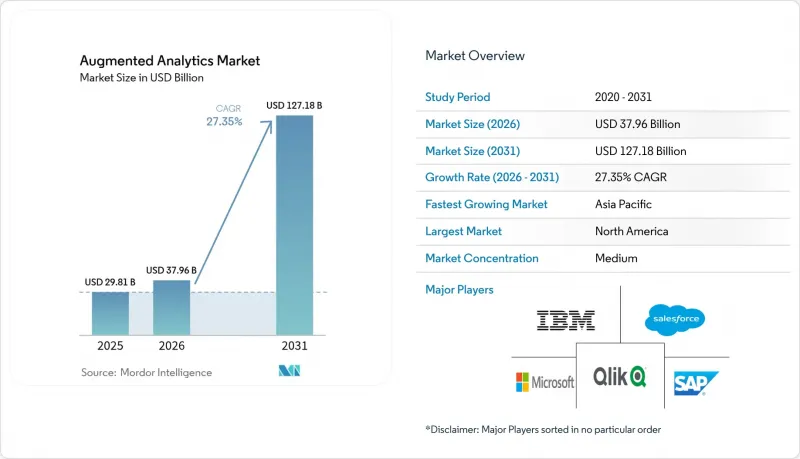
본 보고서는 구성 요소별(소프트웨어 및 서비스), 도입 형태별(온프레미스, 클라우드, 하이브리드), 조직 규모별(대기업 및 중소기업), 최종 사용자 산업별(은행, 금융서비스 및 보험(BFSI), 통신 및 IT, 소매 및 소비재, 헬스케어 및 생명과학, 제조, 미디어 및 엔터테인먼트, 정부·공공 부문), 지역별로 분류되어 있습니다.
세계의 증강 분석 시장 동향 및 인사이트
다구조 데이터 분석에 대한 수요 증가
기업 정보의 약 80%는 비정형 데이터이며, 문서, 이미지, 기계 로그 등에 이릅니다. 현재, 고급 언어 및 시각 모델이 기존의 표 형식 데이터 세트에 더해 이러한 형식도 분석할 수 있게 되어, 분석가에게 단일 분석 플랫폼을 제공합니다. 자동차 제조업체들은 이 기능을 활용하여 센서 텔레메트리 데이터를 정비 매뉴얼과 통합함으로써 가동 중단 시간 예측 정확도를 85% 향상시켰습니다. 병원에서는 방사선 영상, 임상 기록, 유전체 프로파일을 결합하여 진단 프로세스를 최적화하고 있습니다. 이러한 미활용 데이터 풀을 활용할 수 있는 능력 덕분에 조직들은 AI 네이티브 분석 기능이 통합된 플랫폼으로의 전환을 추진하고 있으며, 이는 확장형 애널리틱스 시장의 성장을 뒷받침하고 있습니다.
셀프 서비스 BI 및 데이터 민주화 추진
자연어 프롬프트를 통해 마케팅 관리자, 재무 관리자, 콜센터 슈퍼바이저는 SQL을 사용하지 않고도 복잡한 쿼리를 실행할 수 있게 되었습니다. 이러한 변화로 인해 요청에서 인사이트 도출까지의 주기가 몇 주에서 몇 분으로 단축되었으며, 데이터 엔지니어링 팀은 더 높은 부가가치를 창출하는 업무에 집중할 수 있게 되었습니다. ThoughtSpot과 Google의 Gemini 모델 간의 통합은 대화형 검색이 복잡성을 숨기면서도 거버넌스가 확보된 공유 가능한 답변을 반환하는 메커니즘을 보여줍니다. 이용률 향상은 데이터 리터러시의 피드백 루프를 강화하고, 분석 문화를 정착시키며, 확장형 분석 시장을 더욱 부양할 것입니다.
데이터 개인정보 보호 및 보안에 대한 우려
GDPR(EU 개인정보보호규정) 및 산업별 규제는 명시적 동의, 데이터 최소화, 감사 추적을 요구하고 있어, 제약 없는 AI 실험은 위험을 수반합니다. 각 벤더는 현재 지역 데이터센터 내에 ‘소버린 클라우드’ 구역을 구축하고 있습니다. MicroStrategy는 STACKIT과 제휴하여 독일과 오스트리아에서 호스팅되는 EU 규정 준수 스택을 제공합니다. 규정 준수 대응에 드는 부담은 프로젝트 배포를 지연시키고, 장기적인 신뢰는 구축되지만 단기적인 지출은 억제하게 됩니다.
부문 분석
2025년에는 구매자들이 데이터 수집, 모델링, 시각화를 통합한 엔드투엔드 제품군에 관심을 보였기 때문에 소프트웨어가 매출의 77.40%를 차지했습니다. 금액 기준으로 볼 때, 이 부문은 증강 분석 시장 규모에 230억 7,000만 달러를 기여했습니다. 제품 내 LLM 챗봇과 같은 지속적인 기능 출시는 계약 갱신 및 업셀링 기회를 공고히 하고 있습니다. 서비스 부문은 규모는 작지만, 도입, 모델 거버넌스, 사용자 도입 프로젝트를 배경으로 연평균 성장률(CAGR) 28.40%로 성장하고 있습니다. 멀티 클라우드 환경이 확대됨에 따라, 고객들은 정책 설계, 테스트, ROI 기준선 수립을 파트너사에 위탁하고 있습니다. 벤더의 전문 서비스 부서는 이러한 기회를 활용하고 있는 반면, 세계 시스템 통합사업자들은 수요를 확보하기 위해 1,000명 규모의 AI 스튜디오를 구축하고 있습니다.
2차적 효과로 인해 소프트웨어의 우위가 더욱 강화되고 있습니다. Snowflake가 Anthropic의 모델을 자사의 Cortex 서비스에 통합했을 때, 고객은 데이터를 내보내지 않고도 생성형 요약 기능을 이용할 수 있게 되어 플랫폼에 대한 의존도가 높아졌습니다. 예측 기간 동안 오픈소스 AI 구성 요소는 계속 진화할 것이며, 구매자들은 여전히 보안 패치와 법적 보상을 보장하는 상용 래퍼를 선호할 것으로 예상되므로, 증강 분석 시장 내 소프트웨어 부문의 우위는 유지될 전망입니다.
2025년에는 클라우드 도입이 총 지출의 59.10%를 차지했습니다. 금융 서비스 기업, 온라인 마켓플레이스, 스트리밍 네트워크는 공휴일로 인한 수요 급증과 모델 훈련의 집중 처리에 대응하기 위해 탄력성을 활용하고 있습니다. 그러나 엄격한 데이터 상주 요건으로 인해 중요한 워크로드는 프라이빗 존으로 이전되고 있으며, 이로 인해 하이브리드 환경 도입이 연평균 성장률(CAGR) 29.75%로 확대되고 있습니다. 증강 분석 시장에서 하이브리드의 점유율은 2026년 131억 2,000만 달러에서 2031년까지 482억 6,000만 달러로 증가할 것으로 예측됩니다. 엣지 디바이스는 개인 식별 정보를 로컬에서 처리하고, 집계된 패턴을 클라우드 AI로 전송하여 보다 상세한 추론을 수행함으로써 규정 준수 및 분석 깊이의 균형을 맞추고 있습니다.
엣지에서 클라우드로의 오케스트레이션 도구는 향후 경쟁의 장을 시사합니다. 플랫폼은 방화벽 양쪽에 위치한 쿠버네티스 클러스터 전체에서 SQL, 벡터 검색, 강화 학습 작업을 스케줄링해야 합니다. 컨테이너 자동 배포, 암호화 키 관리, 지연 시간 최적화가 가능한 공급업체가 시장 점유율의 대부분을 차지할 것으로 전망됩니다. 원자력, 국방, 제약 분야에서는 온프레미스 전용 도입이 여전히 중요하지만, 설비 투자에 제약이 있는 업계에서는 하드웨어 교체 주기가 길어지기 때문에 그 성장세는 하이브리드 환경에 뒤처지고 있습니다.
지역별 분석
북미는 2025년에 전 세계 매출의 47.20%를 창출한 것으로 평가되었으며, 클라우드 리전의 고밀도 구축, 벤처 캐피털 자금 공급원, AI 기술을 보유한 인재 풀과 같은 구조적 우위를 유지하고 있습니다. 포춘 500대 기업은 AI 센터 오브 엑설런스(Center of Excellence) 헌장을 제도화하고, 재무, 공급망, 인사 각 용도에 분석 기능을 통합하고 있습니다. AI 연구에 대한 연방 정부의 자금 지원과 IPO 절차의 간소화는 경쟁 환경을 일신하는 스타트업 기업들을 끌어모으고 있습니다. 그러나 캐나다의 데이터 현지화 조항, 캘리포니아주 소비자 개인정보 보호법(CCPA) 개정, 그리고 독점 금지법상의 심사로 인해 규정 준수 관련 비용이 발생하고 있으며, 기업들은 여러 관할 구역에 걸쳐 있는 하이브리드 아키텍처로 전환할 수밖에 없는 상황입니다.
아시아태평양은 현재 규모는 작지만, 2031년까지 연평균 성장률(CAGR) 28.10%의 궤도에 올라 있습니다. 정부가 AI 인프라, 반도체, 인재 육성에 배정한 예산은 5,000억 달러를 초과합니다. 중국의 AI 허브인 선전에서는 보조금을 받은 GPU 클러스터가 제공되고 있습니다. 인도의 ‘디지털 개인 데이터 보호법’은 국내 혁신을 장려하는 동시에 규제 체계를 정립하고 있습니다. 제조 대기업들은 도쿄, 서울, 싱가포르 주변에 집적되어 있어 현장 예측 분석에 대한 수요의 선순환을 창출하고 있습니다. 현지 벤더들은 중국어, 힌디어, 인도네시아어 음성 모델을 통합하여 언어 요건을 충족시킴으로써 지역 기업에 경쟁 우위를 제공합니다. 따라서 증강 분석 시장은 아시아태평양에서 가장 빠른 성장세를 보이고 있습니다.
유럽에서는 GDPR(EU 개인정보보호규정) 및 향후 시행될 AI 법에 따라 벤더의 의무가 강화되고 있음에도 불구하고, 여전히 15%대 중반의 성장률을 유지하고 있습니다. 독일의 중견 기업(미텔슈탄트)은 국내에 ‘소버린 클라우드’를 도입하고 있습니다. 프랑스의 공공기관은 시민 데이터 관련 법규를 준수하기 위해 격리된 지역에서 분석을 수행하고 있습니다. 벤더의 로드맵에는 현재 ‘EU 트러스트드 존(EU Trusted Zone)’이라는 명칭이 포함되어 있으며, 이는 유럽 대륙의 규제적 영향력을 반영하고 있습니다. 북부와 남부 간의 디지털 기술 격차는 여전히 존재하지만, EU가 자금을 지원하는 재교육 프로그램이 이러한 격차를 해소하며 꾸준한 도입을 뒷받침하고 있습니다.
라틴아메리카, 중동 및 아프리카는 보다 후기의 기회를 상징하며, 2031년까지 증강 분석 시장의 9.85% 미만을 차지할 것으로 예측됩니다. 모바일 우선 비즈니스 모델, 핀테크 보급률 상승, 그리고 은행 서비스를 이용하기 어려운 계층의 존재가 신용 평가 및 사기 감지와 관련된 분석 수요를 창출하고 있습니다. 상파울루, 리야드, 요하네스버그에 클라우드 리전이 출범함에 따라 지연 시간이 감소하고 데이터 상주 요건도 충족할 수 있게 되어, ROI가 실현될 경우 프로덕션 환경의 워크로드로 전환할 수 있는 파일럿 예산이 확보됩니다.
기타 혜택 :
- 엑셀 형식 시장 예측(ME) 시트
- 3개월간의 애널리스트 지원
자주 묻는 질문
목차
제1장 서론
제2장 조사 방법
제3장 주요 요약
제4장 시장 구도
제5장 시장 규모 및 성장 예측
제6장 경쟁 구도
제7장 시장 기회 및 향후 전망
AJY 26.09.07According to Mordor Intelligence, the augmented analytics market size was valued at USD 29.81 billion in 2025 and estimated to grow from USD 37.96 billion in 2026 to reach USD 127.18 billion by 2031, at a CAGR of 27.35% during the forecast period (2026-2031).
This report is Segmented by Component (Software and Services), Deployment (On-Premise, Cloud, and Hybrid), Organization Size (Large Enterprises and Small and Mid-Size Enterprises), End-User Industry (BFSI, Telecom and IT, Retail and Consumer Goods, Healthcare and Life Sciences, Manufacturing, Media and Entertainment, and Government and Public Sector), and Geography.
Global Augmented Analytics Market Trends and Insights
Rising demand to analyse multi-structured data
Nearly 80% of enterprise information is unstructured, spanning documents, images, and machine logs. Advanced language and vision models now parse these formats alongside classic tabular datasets, giving analysts a single discovery surface. Automotive manufacturers use the capability to fuse sensor telemetry with maintenance manuals and raise downtime-forecasting accuracy by 85%. Hospitals are combining radiology scans, clinical notes, and genomic profiles to refine diagnostic pathways. The ability to tap these untapped data pools pushes organisations toward platforms that embed AI-native parsers, reinforcing growth for the augmented analytics market.
Self-service BI and data-democratisation push
Natural-language prompts let marketing managers, finance controllers, and call-centre supervisors run complex queries without SQL. This shift cuts request-to-insight cycles from weeks to minutes and frees data-engineering teams for higher-value tasks. ThoughtSpot's integration with Google's Gemini models shows how conversational search hides complexity while returning governed, shareable answers. Higher usage rates improve data-literacy feedback loops, anchoring analytics culture, and lifting the augmented analytics market further.
Data-privacy and security concerns
GDPR and sectoral rules require explicit consent, data minimisation, and audit trails, making unfettered AI experimentation risky. Vendors now launch "sovereign cloud" zones inside regional data centres; MicroStrategy partnered with STACKIT to deliver an EU-compliant stack hosted in Germany and Austria. Compliance overhead slows project rollout, trimming near-term spending even as long-term trust builds.
Other drivers and restraints analyzed in the detailed report include:
- SME uptake via cloud subscriptions
- Generative-AI infused analytics suites
- Workforce anxiety over human-replacement
For complete list of drivers and restraints, kindly check the Table Of Contents.
Segment Analysis
Software accounted for 77.40% revenue in 2025 as buyers gravitated toward end-to-end suites bundling ingestion, modelling, and visualisation. In monetary terms, the segment contributed USD 23.07 billion to the augmented analytics market size. Continuous feature releases, such as in-product LLM chatbots, lock in renewals and upsell paths. The services segment, although smaller, is scaling at 28.40% CAGR on the back of implementation, model-governance, and user-adoption projects. As multi-cloud estates grow, clients commission partners to handle policy design, testing, and ROI baselining. Vendor professional-services groups tap this opportunity, while global system integrators build 1,000-person AI studios to capture demand.
Second-order effects reinforce software primacy. When Snowflake embedded Anthropic's models inside its Cortex service, customers accessed generative summarisation without exporting data, tightening platform dependence. Over the forecast horizon, open-source AI components will evolve, yet buyers still prefer commercial wrappers that guarantee security patches and legal indemnities, sustaining the software segment's lead within the augmented analytics market.
Cloud installations generated 59.10% of total spending in 2025. Financial-services firms, online marketplaces, and streaming networks exploit elasticity for holiday spikes and model-training bursts. However, strict residency mandates push critical workloads to private zones, propelling hybrid setups at a 29.75% CAGR. The hybrid share of the augmented analytics market is projected to rise from USD 13.12 billion in 2026 to USD 48.26 billion by 2031. Edge devices process personally identifiable information locally, then forward aggregated patterns to cloud AI for deeper inference, balancing compliance with analytic depth.
Edge-to-cloud orchestration tools signal the next battleground: platforms must schedule SQL, vector-search, and reinforcement-learning jobs across Kubernetes clusters on both sides of the firewall. Providers able to auto-deploy containers, govern encryption keys, and optimise latency stand to capture an outsized wallet share. On-premises-only deployments remain relevant for nuclear energy, defence, and pharmaceuticals, but growth lags behind hybrid because hardware refresh cycles elongate in capex-constrained sectors.
Complete Report Scope:
- By Component
- Software
- Services
- By Deployment
- On-premise
- Cloud
- Hybrid
- By Organisation Size
- Large Enterprises
- Small and Mid-size Enterprises
- By End-user Industry
- BFSI
- Telecom and IT
- Retail and Consumer Goods
- Healthcare and Life Sciences
- Manufacturing
- Media and Entertainment
- Government and Public Sector
- By Geography
- North America
- US
- Canada
- Mexico
- South America
- Brazil
- Argentina
- Rest of South America
- Europe
- Germany
- United Kingdom
- France
- Italy
- Russia
- Asia Pacific
- China
- Japan
- India
- South Korea
- Rest of Asia Pacific
- Middle East
- Saudi Arabia
- United Arab Emirates
- Qatar
- Rest of Middle East
- Africa
- South Africa
- Nigeria
- Rest of Africa
- North America
Geography Analysis
North America generated 47.20% of global revenue in 2025 and retains structural advantages: dense cloud-region footprint, venture-capital pipelines, and AI-skilled labour pools. Fortune 500 firms institutionalise AI centre-of-excellence charters, embedding analytics inside finance, supply-chain, and HR apps. Federal funding for AI research and streamlined IPO pathways attract startups that refresh the competitive arena. However, data-localisation clauses in Canada, California Consumer Privacy Act amendments, and antitrust scrutiny introduce compliance spend, nudging firms toward multi-jurisdictional hybrid architectures.
Asia-Pacific, while smaller today, is on a 28.10% CAGR trajectory through 2031. Government allocations exceed USD 500 billion for AI infrastructure, semiconductors, and talent development. China's AI hub in Shenzhen offers subsidised GPU clusters; India's Digital Personal Data Protection Act sets guardrails while encouraging domestic innovation. Manufacturing conglomerates cluster around Tokyo, Seoul, and Singapore, creating demand flywheels for shop-floor predictive analytics. Local vendors integrate Mandarin, Hindi, and Bahasa speech models, meeting linguistic requirements and giving regional players an edge. The augmented analytics market thus finds its fastest volume expansion in APAC geographies.
Europe continues to post mid-teen growth even as GDPR and the forthcoming AI Act heighten vendor obligations. Enterprises in Germany's Mittelstand adopt sovereign-cloud deployments inside national borders. French public-sector agencies run analytics in isolated regions to comply with citizen-data statutes. Vendor road maps now include "EU trusted zone" labels, reflecting the continent's regulatory pull. North-to-south digital-skills disparities persist, but EU-funded reskilling programmes close gaps, supporting steady adoption.
Latin America, the Middle East, and Africa represent later-stage opportunities, together projected to account for just under 9.85% of the augmented analytics market by 2031. Mobile-first business models, rising fintech penetration, and under-banked populations create analytics needs around credit scoring and fraud detection. Cloud-region launches in Sao Paulo, Riyadh, and Johannesburg lower latency and address data-residency rules, unlocking pilot budgets that convert to production workloads when ROI materialises.
- Microsoft Corporation
- Salesforce Inc. (incl. Tableau)
- SAP SE
- International Business Machines Corp.
- QlikTech International AB
- Google LLC (Looker)
- Oracle Corporation
- SAS Institute Inc.
- TIBCO Software Inc.
- ThoughtSpot Inc.
- MicroStrategy Inc.
- Sisense Inc.
- GoodData Corp.
- Alteryx Inc.
- Domo Inc.
- Zoho Corporation (Zoho Analytics)
- Amazon Web Services - QuickSight
- Yellowfin BI
- Board International
Additional Benefits:
- The market estimate (ME) sheet in Excel format
- 3 months of analyst support
TABLE OF CONTENTS
1 INTRODUCTION
- 1.1 Study Assumptions and Market Definition
- 1.2 Scope of the Study
2 RESEARCH METHODOLOGY
3 EXECUTIVE SUMMARY
4 MARKET LANDSCAPE
- 4.1 Market Overview
- 4.2 Market Drivers
- 4.2.1 Rising demand to analyse multi-structured data
- 4.2.2 Self-service BI and data-democratisation push
- 4.2.3 SME uptake via cloud subscriptions
- 4.2.4 Generative-AI infused analytics suites
- 4.2.5 Edge-tier deployments for data sovereignty
- 4.2.6 SaaS copilot-led embedded-analytics monetisation
- 4.3 Market Restraints
- 4.3.1 Data-privacy and security concerns
- 4.3.2 Workforce anxiety over human-replacement
- 4.3.3 Prompt-engineering skill gap
- 4.3.4 GPU scarcity and inference cost inflation
- 4.4 Value/Supply-Chain Analysis
- 4.5 Regulatory Landscape
- 4.6 Technological Outlook
- 4.7 Porter's Five Forces Analysis
- 4.7.1 Threat of New Entrants
- 4.7.2 Bargaining Power of Buyers
- 4.7.3 Bargaining Power of Suppliers
- 4.7.4 Threat of Substitutes
- 4.7.5 Competitive Rivalry
5 MARKET SIZE AND GROWTH FORECASTS (VALUE)
- 5.1 By Component
- 5.1.1 Software
- 5.1.2 Services
- 5.2 By Deployment
- 5.2.1 On-premise
- 5.2.2 Cloud
- 5.2.3 Hybrid
- 5.3 By Organisation Size
- 5.3.1 Large Enterprises
- 5.3.2 Small and Mid-size Enterprises
- 5.4 By End-user Industry
- 5.4.1 BFSI
- 5.4.2 Telecom and IT
- 5.4.3 Retail and Consumer Goods
- 5.4.4 Healthcare and Life Sciences
- 5.4.5 Manufacturing
- 5.4.6 Media and Entertainment
- 5.4.7 Government and Public Sector
- 5.5 By Geography
- 5.5.1 North America
- 5.5.1.1 US
- 5.5.1.2 Canada
- 5.5.1.3 Mexico
- 5.5.2 South America
- 5.5.2.1 Brazil
- 5.5.2.2 Argentina
- 5.5.2.3 Rest of South America
- 5.5.3 Europe
- 5.5.3.1 Germany
- 5.5.3.2 United Kingdom
- 5.5.3.3 France
- 5.5.3.4 Italy
- 5.5.3.5 Russia
- 5.5.4 Asia Pacific
- 5.5.4.1 China
- 5.5.4.2 Japan
- 5.5.4.3 India
- 5.5.4.4 South Korea
- 5.5.4.5 Rest of Asia Pacific
- 5.5.5 Middle East
- 5.5.5.1 Saudi Arabia
- 5.5.5.2 United Arab Emirates
- 5.5.5.3 Qatar
- 5.5.5.4 Rest of Middle East
- 5.5.6 Africa
- 5.5.6.1 South Africa
- 5.5.6.2 Nigeria
- 5.5.6.3 Rest of Africa
- 5.5.1 North America
6 COMPETITIVE LANDSCAPE
- 6.1 Market Concentration
- 6.2 Strategic Moves
- 6.3 Market Share Analysis
- 6.4 Company Profiles (includes Global level Overview, Market level overview, Core Segments, Financials as available, Strategic Information, Market Rank/Share for key companies, Products and Services, and Recent Developments)
- 6.4.1 Microsoft Corporation
- 6.4.2 Salesforce Inc. (incl. Tableau)
- 6.4.3 SAP SE
- 6.4.4 International Business Machines Corp.
- 6.4.5 QlikTech International AB
- 6.4.6 Google LLC (Looker)
- 6.4.7 Oracle Corporation
- 6.4.8 SAS Institute Inc.
- 6.4.9 TIBCO Software Inc.
- 6.4.10 ThoughtSpot Inc.
- 6.4.11 MicroStrategy Inc.
- 6.4.12 Sisense Inc.
- 6.4.13 GoodData Corp.
- 6.4.14 Alteryx Inc.
- 6.4.15 Domo Inc.
- 6.4.16 Zoho Corporation (Zoho Analytics)
- 6.4.17 Amazon Web Services - QuickSight
- 6.4.18 Yellowfin BI
- 6.4.19 Board International
7 MARKET OPPORTUNITIES AND FUTURE OUTLOOK
- 7.1 White-space and Unmet-need Assessment


