
|
시장보고서
상품코드
2123135
지적재산 관리 소프트웨어 시장 : 점유율 분석, 산업 동향 및 통계 데이터, 성장 예측(2026-2031년)Intellectual Property Management Software - Market Share Analysis, Industry Trends & Statistics, Growth Forecasts (2026 - 2031) |
||||||
 Mordor Intelligence
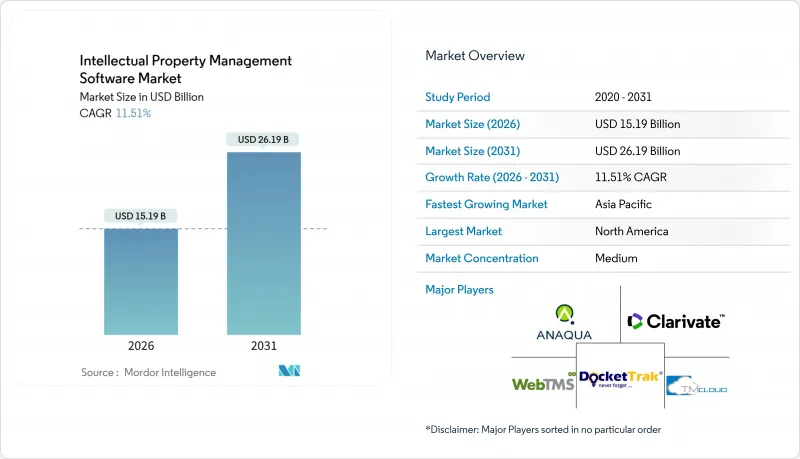
Mordor Intelligence에 의하면, 지적재산 관리 소프트웨어 시장 규모는 2026년에 151억 9,000만 달러가 되어, 2031년까지 261억 9,000만 달러에 이를 것으로 예측되며, 예측 기간을 통해서 CAGR 11.51%로 확대해 갈 전망입니다.
본 보고서는 배포 방식(On-Premise, 클라우드), 구성 요소(소프트웨어, 서비스), 지적 재산 유형(특허, 상표 등), 조직 규모(대기업, 중소기업), 최종 사용자 산업(은행, 금융서비스 및 보험(BFSI), 의료 및 생명과학 등), 지역(북미, 유럽 등)별로 세분화되어 있습니다. 시장 예측은 금액(달러) 기준으로 제시되어 있습니다.
세계 지적재산 관리 소프트웨어 시장 동향 및 인사이트
AI를 활용한 특허 분석 도입이 북미 전역에서 제품군 업데이트를 촉진
미국 및 캐나다 기업들은 키워드 검색 도구에서 특허를 의미론적으로 클러스터링하는 트랜스포머 기반 분석 도구로 전환하고 있으며, 실시 자유도(FTO) 조사에 소요되는 기간을 수주에서 수일로 단축하고 있습니다. 미국 특허상표청(USPTO)은 2025년 6월 ‘자동 주제 분석 플랫폼(Automated Subject-Matter Analysis Platform)’의 시범 운영을 시작하며, AI를 활용한 심사에 대한 규제 당국의 승인을 시사했습니다. 유효한 특허 패밀리가 1만 건을 넘는 포트폴리오를 보유한 자동차 및 제약 업계의 출원인들이 초기 도입자로 나서고 있습니다. 클라리베이트(Clarivate)는 2025년 9월, 디자인비전(DesignVision)과 제휴하여 전자상거래 사이트에서의 디자인권 침해를 컴퓨터 비전 기술로 감지하는 기능을 추가했습니다. 이 기능은 출원부터 공개까지 18개월이 소요되는 공개 지연을 해결하기 위한 것입니다. 이에 이어 렉시스넥시스(LexisNexis)는 2025년 3월, 심사관의 과거 심사 실적을 기반으로 한 ‘허가 예측 스코어링’을 도입하여, 변호사가 심사 자원을 허가 확률이 높은 출원에 집중할 수 있도록 했습니다. 이러한 혁신들이 결합되면서 심사 주기가 단축되었고, 지적재산 관리 소프트웨어 시장은 효율성 측면에서 선도하는 기업과 뒤처지는 기업으로 양극화되기 시작했습니다.
생성형 AI를 활용한 선행기술 검색을 통한 초안 작성 주기 단축
현재 대규모 언어 모델은 요약 보고서, 규격, 학술 논문을 통합하여 관련성 순으로 순위를 매긴 목록을 생성합니다. 이를 통해 변호사는 며칠이 아닌 몇 시간 만에 검토를 수행할 수 있게 되었습니다. 유럽특허청은 2025년 4월, 심사관이 자연어로 쿼리를 입력하면 문맥 발췌문이 포함된 인용 문헌 제안을 받을 수 있는 생성형 어시스턴트를 도입했습니다. 민간 로펌의 경우, LexisNexis가 2025년에 15개 로펌을 대상으로 실시한 파일럿 프로그램에서 평균 검색 시간이 42% 단축되었다고 보고했습니다. Patsnap은 2025년 1월, 문제 정의를 입력하면 여러 정보원에서 나온 결과를 생성해 주는 생성형 검색 도구를 출시했습니다. 이를 통해 실현된 비용 절감은 정액 보수 계약의 길을 열어주었으며, 외부 법률 고문 간의 가격 경쟁을 심화시키고 있습니다. 모델이 성숙해짐에 따라 특정 분야의 코퍼스를 활용해 모델을 미세 조정하고, 심사관의 피드백을 재학습 파이프라인에 반영하는 벤더가 그 우위를 더욱 확대해 나갈 것으로 보입니다.
EU 데이터 기준의 파편화가 포트폴리오 통합을 방해하고 있다.
일반 데이터 보호 규정(GDPR(EU 개인정보보호규정))에 따른 각국의 미묘한 차이로 인해, 27개국으로 구성된 EU 역내에서는 거주지나 현지화에 관한 규정이 다르기 때문에 다국적 기업은 여러 건의 관리 시스템을 병행하여 운영할 수밖에 없습니다. 게다가 유럽 특허청과 유럽연합 지적재산청의 메타데이터 스키마가 서로 다르기 때문에 통합 과정이 더욱 복잡해지고 있습니다. 보완 보호 증명서를 관리하는 제약 기업은 국가별로 다른 서류가 필요한 연장 신청을 제출해야 합니다. 각국의 특허청은 대개 맞춤형 API 커넥터를 요구하고 있으며, 이로 인해 벤더의 개발 비용이 증가하고 유럽 전역에서 기능의 균일화가 지연되고 있습니다. EU가 지적 재산 데이터에 관한 디지털 서비스 프레임워크를 통일할 때까지는 기업들이 클라우드 도입을 통한 비용 절감 효과를 충분히 누릴 수 없을 것입니다.
부문 분석
2025년, 지적재산 관리 소프트웨어 시장 점유율의 55.31%를 On-Premise 도입이 차지했습니다. 이는 주로 로펌과 다국적 제약 기업이 데이터 주권 및 감사 목적으로 레거시 시스템을 유지하고 있기 때문입니다. 그러나 클라우드 매출은 연평균 성장률(CAGR) 12.36%로 확대될 것으로 예측됩니다. 이는 서버 조달보다 구독 방식을 선호하는 인도, 브라질, 동남아시아의 중소기업에서의 이용 확대를 반영한 것입니다. 기밀성이 높은 통신 기록을 On-Premise에 저장하면서 분석 쿼리를 클라우드 AI 엔진으로 라우팅하는 하이브리드 모델이 그 격차를 메우고 있습니다. 유럽의 생명과학 기업들은 데이터 현지화 요건을 충족하기 위해 EU 지역 내에 설치된 지역 클라우드 인스턴스를 채택하고 있습니다. 벤더 측은 활성화된 제품군 단위로 요금을 부과하는 종량제 요금제를 도입하고 있으며, 이를 통해 기업의 법무 부서는 비용 예측을 보다 용이하게 관리할 수 있게 되었습니다.
특허청의 디지털화와 사이버 보험의 보급으로 인해 클라우드 도입에 따른 위험에 대한 우려가 줄어들면서, 지적재산 관리 소프트웨어 시장의 On-Premise 도입률은 2031년까지 45% 미만으로 떨어질 전망입니다. 자동차 제조업체들 사이에서는 기밀성이 높은 설계 도면을 분리해 두면서, 경쟁사 정보를 위해 특허 등록 정보를 클라우드 대시보드에 동기화하는 하이브리드형 도입이 탄력을 받고 있습니다. 일본에서는 특허 심사에 기계 번역이 도입됨에 따라, 다국어 분석을 다루는 클라우드 서비스에 대한 수용도가 높아지고 있습니다. 이러한 변화를 종합해 볼 때, 예측 기간 동안에는 도입 형태의 순수성보다는 유연성이 조달을 주도할 것으로 보입니다.
2025년 매출액 중 소프트웨어 모듈이 63.36%를 차지하며, 그 범위는 도켓 관리, 검색 데이터베이스, 분석 대시보드, 평가 도구에 이릅니다. 서비스 도입, 컨설팅, 분석 및 관리형 지원은 기업이 인력 부족에 직면한 가운데 2031년까지 연평균 성장률(CAGR) 13.52%를 나타낼 것으로 예측되며, 이는 소프트웨어 성장률을 상회할 것으로 전망됩니다. 일본에서는 2024년에 등록 변리사의 은퇴자 수가 신규 등록자 수를 15% 상회함에 따라, 정기적인 상황 분석을 제공하는 제3자 분석 계약에 대한 수요가 증가하고 있습니다. 또한, 투자자들의 ESG 관련 평가 요청으로 인해 재무 부서가 감사에 대응 가능한 무형자산 평가를 요구하는 가운데, 대상 서비스의 범위도 확대되고 있습니다.
기존의 On-Premise형 시스템에서 클라우드 네이티브형 제품군으로 전환하는 기업에서는 데이터 정제, 워크플로우 재구축, 사용자 교육이 필요하며, 대규모 도입의 경우 구현 주기가 평균 9개월에 달할 전망입니다. 그 결과, 서비스와 연동된 지적재산 관리 소프트웨어 시장 규모는 소프트웨어 단독 시장 규모보다 빠르게 확대되고 있으며, 고객이 영구 라이선스가 아닌 제공된 전문 지식에 대해 대가를 지불하는 성과 연동형 가격 책정이 이러한 추세를 더욱 강화하고 있습니다. 견고한 플랫폼과 컨설팅 부문을 겸비한 벤더는 번들 계약을 확보할 수 있을 것으로 전망됩니다.
지역별 분석
북미는 미국 특허상표청(USPTO)의 AI 로드맵과 캐나다의 8,500만 캐나다 달러(6,300만 달러) 규모의 디지털화 이니셔티브에 힘입어 2025년 매출의 38.36%를 차지했습니다. 니어쇼어링 추세로 인해 2024년 멕시코의 특허 출원 건수는 12% 증가했으며, 이중 언어 대시보드에 대한 수요가 높아졌습니다. 사모펀드(PE) 스폰서들이 무형 자산에 대해 감사 대응이 가능한 지표를 요구함에 따라, 이 지역의 기업들은 현재 분석 및 평가 도구를 우선적으로 도입하고 있습니다.
아시아태평양은 가장 두드러진 성장을 보이는 지역으로, 2031년까지 연평균 성장률(CAGR)이 14.32%를 나타낼 것으로 예측됩니다. 2024년 중국에서 450만 건의 상표 출원이 이루어졌고, 인도에서 12개월간의 신속 심사 제도가 도입됨에 따라 이 지역 전체의 지적 재산 관리 소프트웨어 시장 성장이 가속화되고 있습니다. 일본에서는 특허 분석 분야의 인력 부족이 관리형 서비스 도입을 뒷받침하고 있는 반면, 한국에서는 반도체에 대한 집중, 호주에서는 농업 혁신 추진으로 인해 수요가 다양화되고 있습니다. 아세안(ASEAN)에서는 베트남의 상표 출원 건수가 23% 급증하며 지역 전체의 성장을 뒷받침하고 있습니다.
유럽은 중간 정도 시장 점유율을 차지하고 있지만, 데이터 표준의 불일치에 직면해 있어 플랫폼 통합이 지연되고 있습니다. 2025년 4월에 도입된 유럽특허청의 생성형 검색 어시스턴트는 해당 기관이 현대화에 적극적임을 보여줍니다. 브라질은 2025년 3월에 그린 기술에 대한 신속 심사 절차를 도입하여 남미를 선도하고 있습니다. 또한 아르헨티나에서는 출원 처리 워크플로의 90%가 디지털화된 것으로 보고되었습니다. 중동 국가들에서는 상호 운용성이 제한적이긴 하지만, 블록체인을 활용한 등록 제도의 실증 실험이 진행되고 있습니다. 한편, 아프리카의 성장은 남아프리카공화국, 나이지리아, 케냐의 대학 기술 이전 기관을 중심으로 이루어지고 있습니다.
기타 혜택:
- Excel 형식 시장 예측(ME) 시트
- 3개월간의 애널리스트 지원
자주 묻는 질문
목차
제1장 서론
제2장 분석 방법
제3장 주요 요약
제4장 시장 구도
제5장 시장 규모 및 성장률 예측
제6장 경쟁 구도
제7장 시장 기회와 향후 전망
JHS 26.09.09According to Mordor Intelligence, the intellectual property management software market size stands at USD 15.19 billion in 2026 and is projected to reach USD 26.19 billion by 2031, advancing at an 11.51% CAGR through the forecast period.
This report is Segmented by Deployment (On-Premise, and Cloud), Component (Software, and Services), IP Type (Patent, Trademark, and More), Organization Size (Large Enterprises, and Small and Medium Enterprises), End-User Industry (BFSI, Healthcare and Lifesciences, and More), and Geography (North America, Europe, and More). The Market Forecasts are Provided in Terms of Value (USD).
Global Intellectual Property Management Software Market Trends and Insights
Adoption of AI-Powered Patent-Analytics Driving Suite Upgrades Across North America
Corporations across the United States and Canada are moving from keyword-search tools to transformer-based analytics that cluster patents semantically, trimming freedom-to-operate studies from weeks to days. The USPTO piloted its Automated Subject-Matter Analysis Platform in June 2025, signaling regulatory approval for AI-assisted examination. Automotive and pharmaceutical filers handling portfolios that exceed 10,000 active families are early adopters. Clarivate partnered with DesignVision in September 2025 to add computer-vision detection of design infringement on e-commerce sites, a feature that counters the 18-month publication lag between filing and public visibility. LexisNexis followed in March 2025 with predictive-allowance scoring based on examiner histories, letting counsel shift prosecution resources to high-probability applications. Collectively, these innovations shorten prosecution cycles and have begun to divide the intellectual property management software market into efficiency leaders and laggards.
Generative AI-Based Prior-Art Search Reducing Draft Cycles
Large language models now synthesize abstracts, standards, and academic papers into ranked relevance lists that attorneys review in hours rather than days. The European Patent Office embedded a generative assistant in April 2025 that lets examiners pose natural-language queries and receive citation suggestions with context snippets. In private practice, LexisNexis reported a 42% drop in average search time during a 2025 pilot with 15 law firms. Patsnap launched a generative-search tool in January 2025 for problem-statement inputs and multi-source outputs. The resulting cost savings have paved the way for fixed-fee engagements, intensifying price competition among outside counsel. As models mature, vendors that fine-tune them on domain-specific corpora and loop examiner feedback into retraining pipelines are likely to widen their lead.
Fragmented EU Data Standards Hindering Portfolio Consolidation
National nuances in the General Data Protection Regulation require multinationals to manage parallel docket systems, as residency and localization rules vary across the 27-member bloc. Separate metadata schemas at the European Patent Office and the European Union Intellectual Property Office further complicate the integration process. Pharmaceutical companies managing supplementary protection certificates must file country-specific extensions, which require varying documentation. Each national patent office often requires bespoke application programming interface connectors, which inflates development costs for vendors and delays feature parity across Europe. Until the bloc harmonizes a digital services framework for IP data, enterprises will see reduced savings from cloud adoption.
Other drivers and restraints analyzed in the detailed report include:
- D2C Brand Trademark Surge in Asia Accelerating SaaS Adoption
- U.S-China Semiconductor Patent Wars Spurring Cross-Border Monitoring Demand
- Rising Cyber-Insurance Premiums Inflating Cloud Total Cost of Ownership
For complete list of drivers and restraints, kindly check the Table Of Contents.
Segment Analysis
On-premise installations accounted for 55.31% of the intellectual property management software market share in 2025, largely because law firms and pharmaceutical multinationals retain legacy systems for sovereignty and audit purposes. Cloud revenue, however, is projected to advance at a 12.36% CAGR, reflecting uptake among small and medium enterprises in India, Brazil, and Southeast Asia that favor subscription economics over server procurement. Hybrid models, which store sensitive correspondence on-premise but route analytics queries to cloud AI engines, are bridging the gap. European life sciences companies are adopting regional cloud instances housed within the bloc to meet data-localization requirements. Vendors are responding with consumption-based pricing that charges per active family, making cost forecasts easier for corporate legal departments to manage.
The intellectual property management software market is likely to see on-premise deployments drop below 45% by 2031, as patent office digitization and cyber insurance normalization reduce the perceived risk of cloud deployment. Hybrid adoption is gaining momentum among automotive manufacturers that segregate confidential design drawings while syncing granted patents to cloud dashboards for competitive intelligence. Japan's inclusion of machine translation in patent examination has improved comfort with cloud services that handle cross-lingual analytics. Collectively, these shifts suggest that flexibility rather than deployment purity will drive procurement over the forecast horizon.
Software modules made up 63.36% of 2025 revenue, spanning docketing, search databases, analytics dashboards, and valuation tools. Services implementation, consulting, analytics, and managed support are forecast to grow at a 13.52% CAGR to 2031, outstripping software growth as enterprises confront talent shortages. In Japan, retirements among registered patent attorneys outpaced new certifications by 15% in 2024, spurring demand for third-party analytics contracts that deliver periodic landscape reviews. ESG-linked valuation mandates from investors have also expanded the addressable services pool, as finance teams seek audit-ready intangible-asset appraisals.
Enterprises migrating from legacy on-premise stacks to cloud-native suites require data cleansing, workflow reconfiguration, and user training, lengthening implementation cycles to an average of nine months for large deployments. The intellectual property management software market size attached to services is therefore rising faster than that of software alone, and outcome-based pricing, where clients pay for delivered insights rather than perpetual licenses, is strengthening this trend. Vendors that combine robust platforms with consulting arms stand to win bundled contracts.
Complete Report Scope:
- By Deployment
- On-premise
- Cloud
- By Component
- Software
- IP Portfolio Management Suites
- Patent and Trademark Search Databases
- IP Analytics Dashboards
- Docketing and Workflow Automation
- Services
- Implementation and Integration
- Consulting and Analytics
- Support and Maintenance
- Software
- By IP Type
- Patent
- Trademark
- Copyright
- Design
- Trade Secret
- By Organization Size
- Large Enterprises (?1,000 Employees)
- Small and Medium Enterprises (<1,000 Employees)
- By End-User Industry
- BFSI
- Healthcare and Lifesciences
- Automotive and Mobility
- IT and Telecom
- Consumer Electronics and Semiconductor
- Government and Public Sector
- Academia and Research Institutes
- Other End-User Industries
- By Geography
- North America
- United States
- Canada
- Mexico
- South America
- Brazil
- Argentina
- Rest of South America
- Europe
- Germany
- United Kingdom
- France
- Italy
- Spain
- Russia
- Rest of Europe
- Asia Pacific
- China
- Japan
- South Korea
- India
- Australia
- New Zealand
- Rest of Asia Pacific
- Middle East
- United Arab Emirates
- Saudi Arabia
- Turkey
- Rest of Middle East
- Africa
- South Africa
- Nigeria
- Kenya
- Rest of Africa
- North America
Geography Analysis
North America contributed 38.36% to 2025 revenue, supported by the USPTO's AI roadmap and Canada's CAD 85 million (USD 63 million) digitization initiative. Nearshoring trends increased Mexican patent applications by 12% in 2024, driving demand for bilingual dashboards. Enterprises across the region are now prioritizing analytics and valuation tools as private-equity sponsors demand audit-ready metrics for intangible assets.
Asia Pacific is the fastest-growing region, forecast at a 14.32% CAGR to 2031. China's 4.5 million trademark filings in 2024 and India's twelve-month expedited examination pathway have accelerated the growth of the intellectual property management software market across the bloc. Japan's talent shortage in patent analytics fuels the uptake of managed services, while South Korea's semiconductor focus and Australia's agri-innovation agenda diversify demand. ASEAN's 23% jump in Vietnamese trademark filings underscores the broader regional expansion.
Europe holds a mid-tier share but faces data-standard fragmentation that slows platform consolidation. The European Patent Office's generative search assistant, introduced in April 2025, demonstrates the regulatory agency's willingness to modernize. Brazil leads South America after launching a fast-track green-tech route in March 2025, and Argentina reports 90% digitization of prosecution workflows. Middle Eastern nations experiment with blockchain registries, albeit with limited interoperability, while Africa's growth centers on university tech-transfer offices in South Africa, Nigeria, and Kenya.
- Anaqua Inc.
- Clarivate PLC
- DocketTrak
- WebTMS Ltd.
- TM Cloud Inc.
- CPA Global Ltd.
- Alt Legal Inc.
- Questel SAS
- Gridlogics Technologies Pvt. Ltd
- AppColl Inc.
- Patrix AB
- Patsnap Pte Ltd
- MaxVal Group Inc.
- LexisNexis IP (RELX)
- Inteum Company LLC
- IPfolio (Zenith IP)
- Minesoft Ltd.
- TechInsights Inc.
- Ambercite Pty Ltd.
- Dennemeyer Group
- Dolcera Corp.
- Computer Packages Inc.
Additional Benefits:
- The market estimate (ME) sheet in Excel format
- 3 months of analyst support
TABLE OF CONTENTS
1 INTRODUCTION
- 1.1 Study Assumptions and Market Definition
- 1.2 Scope of the Study
2 RESEARCH METHODOLOGY
3 EXECUTIVE SUMMARY
4 MARKET LANDSCAPE
- 4.1 Market Overview
- 4.2 Market Drivers
- 4.2.1 Adoption of AI-Powered Patent-Analytics Driving Suite Upgrades Across North America
- 4.2.2 D2C Brand Trademark Surge in Asia Accelerating SaaS IP Adoption
- 4.2.3 U.S.-China Semiconductor Patent Wars Spurring Cross-Border Monitoring Demand
- 4.2.4 ESG-Linked IP Valuation Mandates Attracting Investors to Integrated Suites
- 4.2.5 India and Brazil Fast-Track Prosecution Schemes Unlocking SME Uptake
- 4.2.6 Generative AI-Based Prior-Art Search Reducing Draft Cycles
- 4.3 Market Restraints
- 4.3.1 Fragmented EU Data Standards Hindering Portfolio Consolidation
- 4.3.2 Rising Cyber-Insurance Premiums Inflating Cloud Total Cost of Ownership
- 4.3.3 IP-Analytics Talent Shortage Capping Services Capacity in Japan
- 4.3.4 Slow Blockchain Registry Adoption Delaying Inter-operability Investments
- 4.4 Industry Value Chain Analysis
- 4.5 Regulatory Outlook
- 4.6 Technological Outlook
- 4.7 Porter's Five Forces Analysis
- 4.7.1 Bargaining Power of Suppliers
- 4.7.2 Bargaining Power of Buyers
- 4.7.3 Threat of New Entrants
- 4.7.4 Threat of Substitutes
- 4.7.5 Intensity of Competitive Rivalry
- 4.8 Impact of Macroeconomic Factors on the Market
5 MARKET SIZE AND GROWTH FORECASTS (VALUE)
- 5.1 By Deployment
- 5.1.1 On-premise
- 5.1.2 Cloud
- 5.2 By Component
- 5.2.1 Software
- 5.2.1.1 IP Portfolio Management Suites
- 5.2.1.2 Patent and Trademark Search Databases
- 5.2.1.3 IP Analytics Dashboards
- 5.2.1.4 Docketing and Workflow Automation
- 5.2.2 Services
- 5.2.2.1 Implementation and Integration
- 5.2.2.2 Consulting and Analytics
- 5.2.2.3 Support and Maintenance
- 5.2.1 Software
- 5.3 By IP Type
- 5.3.1 Patent
- 5.3.2 Trademark
- 5.3.3 Copyright
- 5.3.4 Design
- 5.3.5 Trade Secret
- 5.4 By Organization Size
- 5.4.1 Large Enterprises (?1,000 Employees)
- 5.4.2 Small and Medium Enterprises (<1,000 Employees)
- 5.5 By End-User Industry
- 5.5.1 BFSI
- 5.5.2 Healthcare and Lifesciences
- 5.5.3 Automotive and Mobility
- 5.5.4 IT and Telecom
- 5.5.5 Consumer Electronics and Semiconductor
- 5.5.6 Government and Public Sector
- 5.5.7 Academia and Research Institutes
- 5.5.8 Other End-User Industries
- 5.6 By Geography
- 5.6.1 North America
- 5.6.1.1 United States
- 5.6.1.2 Canada
- 5.6.1.3 Mexico
- 5.6.2 South America
- 5.6.2.1 Brazil
- 5.6.2.2 Argentina
- 5.6.2.3 Rest of South America
- 5.6.3 Europe
- 5.6.3.1 Germany
- 5.6.3.2 United Kingdom
- 5.6.3.3 France
- 5.6.3.4 Italy
- 5.6.3.5 Spain
- 5.6.3.6 Russia
- 5.6.3.7 Rest of Europe
- 5.6.4 Asia Pacific
- 5.6.4.1 China
- 5.6.4.2 Japan
- 5.6.4.3 South Korea
- 5.6.4.4 India
- 5.6.4.5 Australia
- 5.6.4.6 New Zealand
- 5.6.4.7 Rest of Asia Pacific
- 5.6.5 Middle East
- 5.6.5.1 United Arab Emirates
- 5.6.5.2 Saudi Arabia
- 5.6.5.3 Turkey
- 5.6.5.4 Rest of Middle East
- 5.6.6 Africa
- 5.6.6.1 South Africa
- 5.6.6.2 Nigeria
- 5.6.6.3 Kenya
- 5.6.6.4 Rest of Africa
- 5.6.1 North America
6 COMPETITIVE LANDSCAPE
- 6.1 Market Concentration
- 6.2 Strategic Moves
- 6.3 Market Share Analysis
- 6.4 Company Profiles
- 6.4.1 Anaqua Inc.
- 6.4.2 Clarivate PLC
- 6.4.3 DocketTrak
- 6.4.4 WebTMS Ltd.
- 6.4.5 TM Cloud Inc.
- 6.4.6 CPA Global Ltd.
- 6.4.7 Alt Legal Inc.
- 6.4.8 Questel SAS
- 6.4.9 Gridlogics Technologies Pvt. Ltd
- 6.4.10 AppColl Inc.
- 6.4.11 Patrix AB
- 6.4.12 Patsnap Pte Ltd
- 6.4.13 MaxVal Group Inc.
- 6.4.14 LexisNexis IP (RELX)
- 6.4.15 Inteum Company LLC
- 6.4.16 IPfolio (Zenith IP)
- 6.4.17 Minesoft Ltd.
- 6.4.18 TechInsights Inc.
- 6.4.19 Ambercite Pty Ltd.
- 6.4.20 Dennemeyer Group
- 6.4.21 Dolcera Corp.
- 6.4.22 Computer Packages Inc.
7 MARKET OPPORTUNITIES AND FUTURE OUTLOOK
- 7.1 White-space and Unmet-Need Assessment